Proprioception
Aditya Johan Romadhon
Introduction
▪ The term proprioception was passed down to us by Sherrington
▪ “In muscular receptivity we see the body itself acting as a stimulus
to its own receptors”
▪ the term proprioceptor has been restricted to receptors concerned
with conscious sensations, and these include the senses of limb
position and movement, the sense of tension or force, the sense
of effort, and the sense of balance
▪ Kinesthesia, a term introduced by Bastian, is used here to refer to
sensa tions of limb position and movement
Proprioception (Kinesthesia)
▪ During limb movement and changes in position, the tissues
around the relevant joints will be deformed, including skin,
muscles, tendons, fascia, joint capsules, and ligaments
▪ All these tissues are innervated by mechanically sensitive
receptors, and their density varies across muscles and
regions of the body
▪ Muscle spindles play the major role in kinesthesia, with some
skin receptors providing additional information
▪ Golgi tendon organs contribute to proprioception, including
the senses of force and heaviness
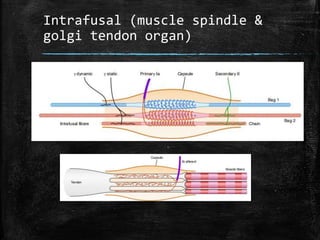
Intrafusal (muscle spindle &
golgi tendon organ)
Joint receptors
Joint receptors probably
play only a minor role at
most joints, acting as
limit detectors
In patients who have had
a total hip replacement
involving removal of all
capsular and
ligamentous
components, both
position and movement
sense remained intact.
The ability to detect
passive movements and
to duplicate positions of
the hip was retained
shortly after recovery
from the operation
This view was supported
by observations on local
anesthesia within the
knee joint
Dorsal column lesion
▪ If sensory receptors contribute to conscious sensation, their
afferents must project to the cerebral cortex
▪ The pathway taken by skin and joint afferents is via the
dorsal (posterior) columns, gracile and cuneate nuclei, medial
lemniscus, and thalamus, muscle afferents from the forelimb
also project centrally via the dorsal columns
▪ However, for the hindlimbs, muscle afferents, unlike skin and
joint afferents, leave the dorsal column in the upper lumbar
region, synapse in Clarke’s column, and project centrally in
the dorsolateral funiculus as the dorsal spinocerebellar tract
▪ Posterior column section at a thoracic level in humans leads
to extensive loss of skin and joint sensation in the legs, but
the central projection pathway for muscle afferents remains
intact, indicated by preservation of the senses of position
and movement
▪ destruction of dorsal columns in the thoracic region does not
impair kinesthesia in the lower limbs, by implication, skin and
joint input is not essential for qualitatively normal kinesthesia
in the legs
Skin receptor
▪ Joint rotation causes skin on one side of the joint to be stretched
and to be slackened or even folded on the other side, such
deformations will stimulate skin mechanoreceptors
▪ There are four kinds of specialized mechanoreceptors in
glabrous skin:
▪ rapidly adapting type I (Meissner corpuscles)
▪ rapidly adapting type II (Pacinian corpuscles)
▪ slowly adapting type I (Merkel endings)
▪ slowly adapting type II (Ruffifini endings)
▪ While all four receptor types are likely to contribute to
movement sensations, slowly adapting type II, the skin stretch
receptors, are potentially able to signal limb position
Exercise Disturbs
Proprioception
▪ It is common to feel awkward and clumsy after intense
exercise.
▪ It is not just muscle weakness from fatigue; we are less sure
about placement of our fatigued limbs if we are not looking
at them
▪ Muscle fatigue is not just a matter of peripheral mechanisms
accompanying depletion of muscle energy supplies, but
includes activation processes at spinal and cortical levels
▪ There are three types of muscle contractions: concentric,
isometric, and eccentric
▪ All three kinds of exercise, if carried out suffificiently intensively,
cause muscle fatigue and disturb proprioception.
▪ The loss of force from concentric exercise is largely due to
depletion of metabolic factors and is therefore short lasting,
with recovery complete within 2 hours
▪ Eccentric exercise is distinguishable from other forms of exercise
because it is accompanied, not only by metabolic fatigue, but a
component of the loss in force is due to muscle damage
▪ Force recovery after eccentric exercise is only partial, and a
signifificant defificit persists for up to a week, the time taken to
repair the damage
▪ The damage from eccentric exercise raises the possibility
that it may damage muscle proprioceptors and that this was
responsible for the disturbance to proprioception
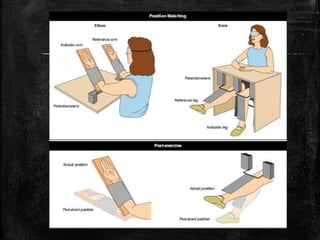
▪ For position sense an important consideration is the method
of measurement
▪ Commonly a two-limb matching task is used, other methods
include displacing a limb and asking the subject to indicate
its position with a pointer or asking the subject to reproduce
a previously remembered position
▪ It has been claimed that concentric exercise disturbed
position sense to a greater degree than isometric or eccentric
exercise
▪ A possible explanation for the above observations was that
fatigue of a muscle had increased the discharge rate of its
muscle spindles and that led to a shift in perceived limb
position representing a more stretched muscle
Exercise and Force Sense
▪ The effect of eccentric exercise on force sense has been
studied by a number of groups
▪ The main finding is that in a bilateral force matching task in
elbow flexors, if subjects are instructed “to make both arms
feel the same,” after the exercise they will overestimate the
force in the exercised arm

Proprioception

  • 1.
  • 2.
    Introduction ▪ The termproprioception was passed down to us by Sherrington ▪ “In muscular receptivity we see the body itself acting as a stimulus to its own receptors” ▪ the term proprioceptor has been restricted to receptors concerned with conscious sensations, and these include the senses of limb position and movement, the sense of tension or force, the sense of effort, and the sense of balance ▪ Kinesthesia, a term introduced by Bastian, is used here to refer to sensa tions of limb position and movement
  • 3.
    Proprioception (Kinesthesia) ▪ Duringlimb movement and changes in position, the tissues around the relevant joints will be deformed, including skin, muscles, tendons, fascia, joint capsules, and ligaments ▪ All these tissues are innervated by mechanically sensitive receptors, and their density varies across muscles and regions of the body ▪ Muscle spindles play the major role in kinesthesia, with some skin receptors providing additional information ▪ Golgi tendon organs contribute to proprioception, including the senses of force and heaviness
  • 4.
    Intrafusal (muscle spindle& golgi tendon organ)
  • 5.
    Joint receptors Joint receptorsprobably play only a minor role at most joints, acting as limit detectors In patients who have had a total hip replacement involving removal of all capsular and ligamentous components, both position and movement sense remained intact. The ability to detect passive movements and to duplicate positions of the hip was retained shortly after recovery from the operation This view was supported by observations on local anesthesia within the knee joint
  • 6.
    Dorsal column lesion ▪If sensory receptors contribute to conscious sensation, their afferents must project to the cerebral cortex ▪ The pathway taken by skin and joint afferents is via the dorsal (posterior) columns, gracile and cuneate nuclei, medial lemniscus, and thalamus, muscle afferents from the forelimb also project centrally via the dorsal columns ▪ However, for the hindlimbs, muscle afferents, unlike skin and joint afferents, leave the dorsal column in the upper lumbar region, synapse in Clarke’s column, and project centrally in the dorsolateral funiculus as the dorsal spinocerebellar tract
  • 7.
    ▪ Posterior columnsection at a thoracic level in humans leads to extensive loss of skin and joint sensation in the legs, but the central projection pathway for muscle afferents remains intact, indicated by preservation of the senses of position and movement ▪ destruction of dorsal columns in the thoracic region does not impair kinesthesia in the lower limbs, by implication, skin and joint input is not essential for qualitatively normal kinesthesia in the legs
  • 8.
    Skin receptor ▪ Jointrotation causes skin on one side of the joint to be stretched and to be slackened or even folded on the other side, such deformations will stimulate skin mechanoreceptors ▪ There are four kinds of specialized mechanoreceptors in glabrous skin: ▪ rapidly adapting type I (Meissner corpuscles) ▪ rapidly adapting type II (Pacinian corpuscles) ▪ slowly adapting type I (Merkel endings) ▪ slowly adapting type II (Ruffifini endings) ▪ While all four receptor types are likely to contribute to movement sensations, slowly adapting type II, the skin stretch receptors, are potentially able to signal limb position
  • 9.
    Exercise Disturbs Proprioception ▪ Itis common to feel awkward and clumsy after intense exercise. ▪ It is not just muscle weakness from fatigue; we are less sure about placement of our fatigued limbs if we are not looking at them ▪ Muscle fatigue is not just a matter of peripheral mechanisms accompanying depletion of muscle energy supplies, but includes activation processes at spinal and cortical levels
  • 10.
    ▪ There arethree types of muscle contractions: concentric, isometric, and eccentric ▪ All three kinds of exercise, if carried out suffificiently intensively, cause muscle fatigue and disturb proprioception. ▪ The loss of force from concentric exercise is largely due to depletion of metabolic factors and is therefore short lasting, with recovery complete within 2 hours ▪ Eccentric exercise is distinguishable from other forms of exercise because it is accompanied, not only by metabolic fatigue, but a component of the loss in force is due to muscle damage ▪ Force recovery after eccentric exercise is only partial, and a signifificant defificit persists for up to a week, the time taken to repair the damage
  • 11.
    ▪ The damagefrom eccentric exercise raises the possibility that it may damage muscle proprioceptors and that this was responsible for the disturbance to proprioception ▪ For position sense an important consideration is the method of measurement ▪ Commonly a two-limb matching task is used, other methods include displacing a limb and asking the subject to indicate its position with a pointer or asking the subject to reproduce a previously remembered position
  • 13.
    ▪ It hasbeen claimed that concentric exercise disturbed position sense to a greater degree than isometric or eccentric exercise ▪ A possible explanation for the above observations was that fatigue of a muscle had increased the discharge rate of its muscle spindles and that led to a shift in perceived limb position representing a more stretched muscle
  • 14.
    Exercise and ForceSense ▪ The effect of eccentric exercise on force sense has been studied by a number of groups ▪ The main finding is that in a bilateral force matching task in elbow flexors, if subjects are instructed “to make both arms feel the same,” after the exercise they will overestimate the force in the exercised arm