It’s All About the
Students
The eLearning Team
The University of Adelaide Australia
December
2011
Their engagement, their
learning, their outcomes and
their future success
Introducing Podcasting
From Pedagogy to Podagogy
Friday, 13 September 13
Introducing Allan
Allan is a Learning Designer with the
CLPD at the University of Adelaide and
has a background in printing, publishing,
web development and educational
multimedia. As well he has worked in
learning and teaching in the VET sector
and higher education. Allan has led
schools (courses) in Hawaii and Texas USA,
as well as Paraguay. He has taught in
communications, marketing and research,
print production and using the Internet
for education. Allan has extensive
experience in online collaboration and
facilitation.
University of Adelaide
Centre for Learning and Professional Development
Adelaide South Australia
Telephone: +61 8 8303 8085
Email: allan.carrington@adelaide.edu.au
Website:http://www.adelaide.edu.au/clpd/about/clpdstaff/carringtona.html
Friday, 13 September 13
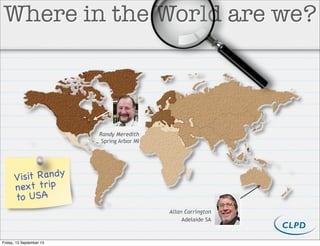
Allan Carrington
Adelaide SA
Randy Meredith
Spring Arbor MI
Where in the World are we?
Visit Randy
next trip
to USA
Friday, 13 September 13
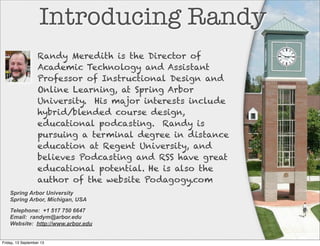
Introducing Randy
Spring Arbor University
Spring Arbor, Michigan, USA
Telephone: +1 517 750 6647
Email: randym@arbor.edu
Website: http://www.arbor.edu
Randy Meredith is the Director of
Academic Technology and Assistant
Professor of Instructional Design and
Online Learning, at Spring Arbor
University. His major interests include
hybrid/blended course design,
educational podcasting. Randy is
pursuing a terminal degree in distance
education at Regent University, and
believes Podcasting and RSS have great
educational potential. He is also the
author of the website Podagogy.com
Friday, 13 September 13
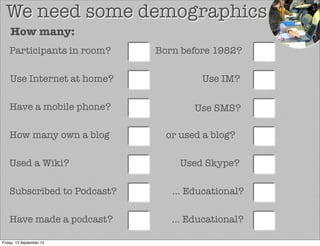
We need some demographics
Participants in room? Born before 1982?
... Educational?
Use Internet at home? Use IM?
How many own a blog
How many:
Used a Wiki?
Have made a podcast?
Have a mobile phone? Use SMS?
Subscribed to Podcast?
Used Skype?
... Educational?
or used a blog?
Friday, 13 September 13
Overview a pedagogical framework and
characteristics for using podcasting for
education
Introduce participants to excellent online
resources to help get them started using
these technologies and provide the next
steps to begin using them.
Learning
Aims
Friday, 13 September 13
Learning Outcomes
List the reasons why podcasting has
good pedagogical potential
Use online resources to make an
educational podcast
By the time you finish this webinar you should
be able to:
Friday, 13 September 13
Emerging Technologies as
Teaching/Learning Tools
Podcasting: Rich Instruction
Blogging: Rich Reflection
Wiki: Rich Collaboration
Social Bookmarking: Rich
Categorisation
VoIP: Rich Communication
Friday, 13 September 13
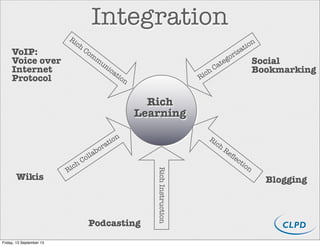
Integration
Rich
Learning
Rich
Com
m
unication
Rich Collaboration
RichInstruction
Rich
Reflection
Rich Categorisation
Podcasting
VoIP:
Voice over
Internet
Protocol
Wikis Blogging
Social
Bookmarking
Friday, 13 September 13
Questions for Discussion
Tell us about how you
have used podcasting,
blogs or wikis?
Tell us about how you
would like to use these
technologies?
Any specific questions
you have about these
technologies?
Disruptive technologies often
come from outside the
mainstream. The light bulb
was not invented by the candle
industry looking to improve
output.
Friday, 13 September 13
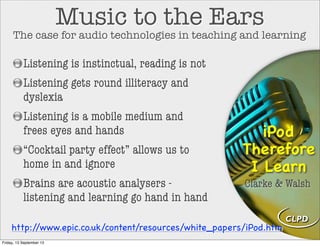
Music to the Ears
Listening is instinctual, reading is not
Listening gets round illiteracy and
dyslexia
Listening is a mobile medium and
frees eyes and hands
“Cocktail party effect” allows us to
home in and ignore
Brains are acoustic analysers -
listening and learning go hand in hand
Clarke & Walsh
iPod
Therefore
I Learn
http://www.epic.co.uk/content/resources/white_papers/iPod.htm
The case for audio technologies in teaching and learning
Friday, 13 September 13
Why Use Educational Audio
Aural source material for analysis or reaction.
Breathe life into ideas.
For tasks which could be disruptive when
using text.
Help the learners practise skills.
Make the teaching more human
and personal.
Say things that are not so easily
expressed in print.
Encourage or motivate the learners.
http://www1.worldbank.org/disted/Teaching/Delivery/aud-01.html
Friday, 13 September 13
Influence the learners' feelings
and attitudes
Contributions from people unlikely
to write.
Voices of experts, users, clients
other learners, etc.
New ideas to learners who won’t
or can’t read
Provide necessary variety in the
learners' learning.
A trigger for group sharing of
ideas and experience
Why Use Educational Audio
http://www1.worldbank.org/disted/Teaching/Delivery/aud-01.html
Friday, 13 September 13
So What is Podcasting?
Began as audio only
“Casting” refers to the publishing or
distribution method
Uses RSS (Really Simple Syndication) -
scripting that pushes file to subscriber
Went mainstream when Apple built in
capability into iTunes (free software for
PC and Mac)
Now we have Enhanced and Vodcasting
“Podcasting and Vodcasting in Higher Education How
Disruptive Will They Be” by Robin Goode
http://www.masternewmedia.org/news/2005/04/16/
podcasting_and_vodcasting_in_higher.htm
Friday, 13 September 13
Has anyone heard a bad
podcast? Please give details as
to why you thought so.
Has anyone heard a podcast/
educational audio they
thought was really good? Why
did you think so.
Has anyone got an example of
good pedagogy for using
audio? Please give us details.
Questions for Discussion
Disruptive technologies often
come from outside the
mainstream. The light bulb
was not invented by the candle
industry looking to improve
output.
Friday, 13 September 13
Pedagogical Framework
Context
Connect with prior learning,
connect with learning objectives,
establish relevance, provide
advance organizers
Content
Present high level overview,
clearly structured (mapped to
outcomes), small “chunks”, enable
student to create a cognitive
“map” of the content
(relationships, sequence,
precedence, dependencies, etc.)
Friday, 13 September 13
Review
Using “audio bullet points”
Connect
Reflective assignment (personal reflection -
journal/blog entry)
Reflective assignment (collaborative assessment -
discussion posting and responses)
Next steps (online course resources: self assessment,
supplemental readings, case studies, problems, transcript
of podcast, webliographies, bibliographies, media, etc.)
Connect to assigned reading
Advance connection to next topic in sequence
Pedagogical Framework
Friday, 13 September 13
Five Steps to Designing
Podcasts that Teach
1.Select appropriate content
2.Determine your instructional goal
3.Design your content
4.Produce your podcast
5.Incorporate the podcast into your course
http://engage.doit.wisc.edu/podcasting/teachAndLearn
podcasting@university of wisconsin - madison
Friday, 13 September 13
Getting Started
Easy first steps would be interview style
Download, play with/use Audio software
Audacity http://audacity.sourceforge.net/
Upbeat, informal spontaneous genre
with humour - not a broadcasting model
Publish to free podcast sites
Odeo http://www.odeo.com
Pod-O-Matic http://www.podomatic.com
Publish to iTunes
Download & Read Podcast Creation Guide: http://images.apple.com/education/
solutions/podcasting/pdf/PodcastCreationGuide.pdf
SwitchPod http://www.switchpod.com
OurMedia http://www.ourmedia.org
Friday, 13 September 13
References
Allan Carrington
http://del.icio.us/AllanADL/edayz290906
University of Adelaide
Centre for Learning and Professional Development
Adelaide South Australia
Telephone: +61 8 8303 8085
Email: allan.carrington@adelaide.edu.au
Website:http://www.adelaide.edu.au/clpd/about/clpdstaff/carringtona.html
Academic Rigour is Del.icio.usly Simple
PLEASE NOTE:
All online
references for
this webinar
can be found at
this addressSpring Arbor University
Spring Arbor, Michigan, USA
Telephone: +1 517 750 6647
Email: randym@arbor.edu
Website: http://www.arbor.edu
Randy Meredith
Friday, 13 September 13

Educational Podcasting

  • 1.
    It’s All Aboutthe Students The eLearning Team The University of Adelaide Australia December 2011 Their engagement, their learning, their outcomes and their future success Introducing Podcasting From Pedagogy to Podagogy Friday, 13 September 13
  • 2.
    Introducing Allan Allan isa Learning Designer with the CLPD at the University of Adelaide and has a background in printing, publishing, web development and educational multimedia. As well he has worked in learning and teaching in the VET sector and higher education. Allan has led schools (courses) in Hawaii and Texas USA, as well as Paraguay. He has taught in communications, marketing and research, print production and using the Internet for education. Allan has extensive experience in online collaboration and facilitation. University of Adelaide Centre for Learning and Professional Development Adelaide South Australia Telephone: +61 8 8303 8085 Email: allan.carrington@adelaide.edu.au Website:http://www.adelaide.edu.au/clpd/about/clpdstaff/carringtona.html Friday, 13 September 13
  • 3.
    Allan Carrington Adelaide SA RandyMeredith Spring Arbor MI Where in the World are we? Visit Randy next trip to USA Friday, 13 September 13
  • 4.
    Introducing Randy Spring ArborUniversity Spring Arbor, Michigan, USA Telephone: +1 517 750 6647 Email: randym@arbor.edu Website: http://www.arbor.edu Randy Meredith is the Director of Academic Technology and Assistant Professor of Instructional Design and Online Learning, at Spring Arbor University. His major interests include hybrid/blended course design, educational podcasting. Randy is pursuing a terminal degree in distance education at Regent University, and believes Podcasting and RSS have great educational potential. He is also the author of the website Podagogy.com Friday, 13 September 13
  • 5.
    We need somedemographics Participants in room? Born before 1982? ... Educational? Use Internet at home? Use IM? How many own a blog How many: Used a Wiki? Have made a podcast? Have a mobile phone? Use SMS? Subscribed to Podcast? Used Skype? ... Educational? or used a blog? Friday, 13 September 13
  • 6.
    Overview a pedagogicalframework and characteristics for using podcasting for education Introduce participants to excellent online resources to help get them started using these technologies and provide the next steps to begin using them. Learning Aims Friday, 13 September 13
  • 7.
    Learning Outcomes List thereasons why podcasting has good pedagogical potential Use online resources to make an educational podcast By the time you finish this webinar you should be able to: Friday, 13 September 13
  • 8.
    Emerging Technologies as Teaching/LearningTools Podcasting: Rich Instruction Blogging: Rich Reflection Wiki: Rich Collaboration Social Bookmarking: Rich Categorisation VoIP: Rich Communication Friday, 13 September 13
  • 9.
  • 10.
    Questions for Discussion Tellus about how you have used podcasting, blogs or wikis? Tell us about how you would like to use these technologies? Any specific questions you have about these technologies? Disruptive technologies often come from outside the mainstream. The light bulb was not invented by the candle industry looking to improve output. Friday, 13 September 13
  • 11.
    Music to theEars Listening is instinctual, reading is not Listening gets round illiteracy and dyslexia Listening is a mobile medium and frees eyes and hands “Cocktail party effect” allows us to home in and ignore Brains are acoustic analysers - listening and learning go hand in hand Clarke & Walsh iPod Therefore I Learn http://www.epic.co.uk/content/resources/white_papers/iPod.htm The case for audio technologies in teaching and learning Friday, 13 September 13
  • 12.
    Why Use EducationalAudio Aural source material for analysis or reaction. Breathe life into ideas. For tasks which could be disruptive when using text. Help the learners practise skills. Make the teaching more human and personal. Say things that are not so easily expressed in print. Encourage or motivate the learners. http://www1.worldbank.org/disted/Teaching/Delivery/aud-01.html Friday, 13 September 13
  • 13.
    Influence the learners'feelings and attitudes Contributions from people unlikely to write. Voices of experts, users, clients other learners, etc. New ideas to learners who won’t or can’t read Provide necessary variety in the learners' learning. A trigger for group sharing of ideas and experience Why Use Educational Audio http://www1.worldbank.org/disted/Teaching/Delivery/aud-01.html Friday, 13 September 13
  • 14.
    So What isPodcasting? Began as audio only “Casting” refers to the publishing or distribution method Uses RSS (Really Simple Syndication) - scripting that pushes file to subscriber Went mainstream when Apple built in capability into iTunes (free software for PC and Mac) Now we have Enhanced and Vodcasting “Podcasting and Vodcasting in Higher Education How Disruptive Will They Be” by Robin Goode http://www.masternewmedia.org/news/2005/04/16/ podcasting_and_vodcasting_in_higher.htm Friday, 13 September 13
  • 15.
    Has anyone hearda bad podcast? Please give details as to why you thought so. Has anyone heard a podcast/ educational audio they thought was really good? Why did you think so. Has anyone got an example of good pedagogy for using audio? Please give us details. Questions for Discussion Disruptive technologies often come from outside the mainstream. The light bulb was not invented by the candle industry looking to improve output. Friday, 13 September 13
  • 16.
    Pedagogical Framework Context Connect withprior learning, connect with learning objectives, establish relevance, provide advance organizers Content Present high level overview, clearly structured (mapped to outcomes), small “chunks”, enable student to create a cognitive “map” of the content (relationships, sequence, precedence, dependencies, etc.) Friday, 13 September 13
  • 17.
    Review Using “audio bulletpoints” Connect Reflective assignment (personal reflection - journal/blog entry) Reflective assignment (collaborative assessment - discussion posting and responses) Next steps (online course resources: self assessment, supplemental readings, case studies, problems, transcript of podcast, webliographies, bibliographies, media, etc.) Connect to assigned reading Advance connection to next topic in sequence Pedagogical Framework Friday, 13 September 13
  • 18.
    Five Steps toDesigning Podcasts that Teach 1.Select appropriate content 2.Determine your instructional goal 3.Design your content 4.Produce your podcast 5.Incorporate the podcast into your course http://engage.doit.wisc.edu/podcasting/teachAndLearn podcasting@university of wisconsin - madison Friday, 13 September 13
  • 19.
    Getting Started Easy firststeps would be interview style Download, play with/use Audio software Audacity http://audacity.sourceforge.net/ Upbeat, informal spontaneous genre with humour - not a broadcasting model Publish to free podcast sites Odeo http://www.odeo.com Pod-O-Matic http://www.podomatic.com Publish to iTunes Download & Read Podcast Creation Guide: http://images.apple.com/education/ solutions/podcasting/pdf/PodcastCreationGuide.pdf SwitchPod http://www.switchpod.com OurMedia http://www.ourmedia.org Friday, 13 September 13
  • 20.
    References Allan Carrington http://del.icio.us/AllanADL/edayz290906 University ofAdelaide Centre for Learning and Professional Development Adelaide South Australia Telephone: +61 8 8303 8085 Email: allan.carrington@adelaide.edu.au Website:http://www.adelaide.edu.au/clpd/about/clpdstaff/carringtona.html Academic Rigour is Del.icio.usly Simple PLEASE NOTE: All online references for this webinar can be found at this addressSpring Arbor University Spring Arbor, Michigan, USA Telephone: +1 517 750 6647 Email: randym@arbor.edu Website: http://www.arbor.edu Randy Meredith Friday, 13 September 13