

The Master Guide
To Corrugated
Packaging
Corrugated - An Overview
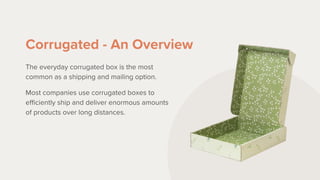
The everyday corrugated box is the most
common as a shipping and mailing option.
Most companies use corrugated boxes to
efficiently ship and deliver enormous amounts
of products over long distances.
What is
Corrugated
Fibreboard?
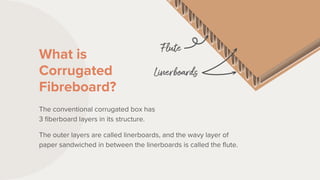
The conventional corrugated box has
3 fiberboard layers in its structure.
The outer layers are called linerboards, and the wavy layer of
paper sandwiched in between the linerboards is called the flute.
What is Cardboard?
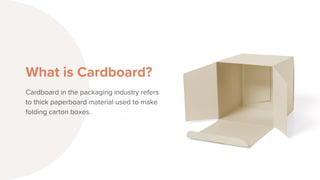
Cardboard in the packaging industry refers
to thick paperboard material used to make
folding carton boxes.
What’s the difference between
corrugated and cardboard?
Raw materials used for the packaging
Durability
How the packaging is used
Key differences between the two include:
The Benefits of
Corrugated Packaging
Protection:
Corrugated is one of the best packaging options
available for those seeking to protect their items
during transit. It can handle the impacts of being
moved around and shipped, and the cushioning
offers a lot of support.
Durability:
Corrugated boxes are durable because of their
protective features. The boxes can withstand a lot
of impact without damaging the products inside.
Environmentally-friendly:
Corrugated boxes are made of recycled fibers
and are easily recycled making them a better
contender for sustainable packaging.
Customizable:
Corrugated boxes are flexible, making them
easy to manipulate into various shapes. The
surface of the linerboards also offer exceptional
opportunities for branding through printing.
The Corrugated Industry
Corrugated packaging is used across the retail
industry and is becoming more needed as
e-commerce sales shoot up.
In 2021, the e-commerce industry is projected to
increase to 2.14 billion shoppers, leading to a
higher demand for this kind of packaging in retail.
Types of Paper Liners
Linerboards are available in a variety of paper grades.
Paper grade choices are made based on branding specifications for businesses.
This could include sustainability efforts, artwork designs and the purpose of the
packaging itself.
Let’s dive into the various types of paper liners.
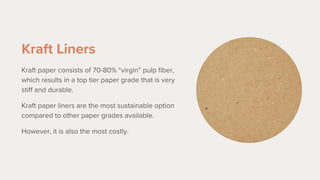
Kraft Liners
Kraft paper consists of 70-80% “virgin” pulp fiber,
which results in a top tier paper grade that is very
stiff and durable.
Kraft paper liners are the most sustainable option
compared to other paper grades available.
However, it is also the most costly.
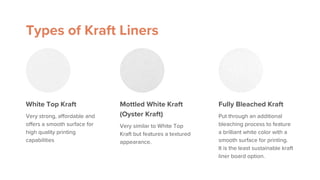
Types of Kraft Liners
White Top Kraft
Very strong, affordable and
offers a smooth surface for
high quality printing
capabilities
Mottled White Kraft
(Oyster Kraft)
Very similar to White Top
Kraft but features a textured
appearance.
Fully Bleached Kraft
Put through an additional
bleaching process to feature
a brilliant white color with a
smooth surface for printing.
It is the least sustainable kraft
liner board option.
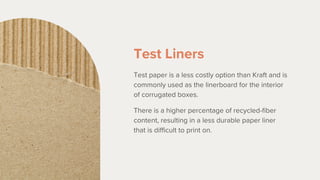
Test Liners
Test paper is a less costly option than Kraft and is
commonly used as the linerboard for the interior
of corrugated boxes.
There is a higher percentage of recycled-fiber
content, resulting in a less durable paper liner
that is difficult to print on.
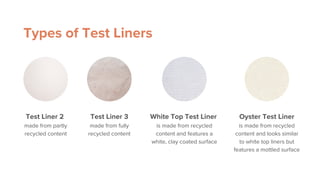
Types of Test Liners
Test Liner 2
made from partly
recycled content
Test Liner 3
made from fully
recycled content
White Top Test Liner
is made from recycled
content and features a
white, clay coated surface
Oyster Test Liner
is made from recycled
content and looks similar
to white top liners but
features a mottled surface
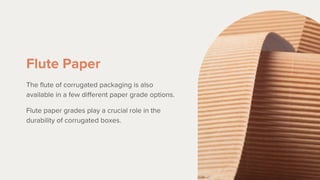
Flute Paper
The flute of corrugated packaging is also
available in a few different paper grade options.
Flute paper grades play a crucial role in the
durability of corrugated boxes.
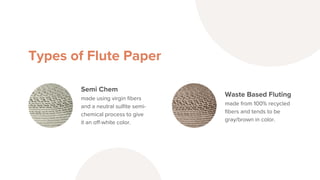
Types of Flute Paper
Semi Chem
made using virgin fibers
and a neutral sulfite semi-
chemical process to give
it an off-white color.
Waste Based Fluting
made from 100% recycled
fibers and tends to be
gray/brown in color.
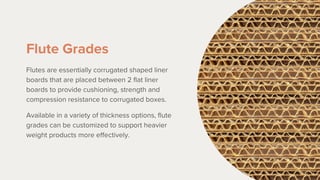
Flute Grades
Flutes are essentially corrugated shaped liner
boards that are placed between 2 flat liner
boards to provide cushioning, strength and
compression resistance to corrugated boxes.
Available in a variety of thickness options, flute
grades can be customized to support heavier
weight products more effectively.
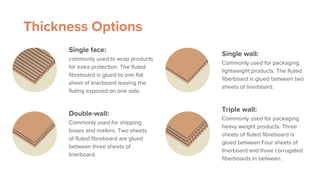
Thickness Options
Single face:
commonly used to wrap products
for extra protection. The fluted
fibreboard is glued to one flat
sheet of linerboard leaving the
fluting exposed on one side.
Double-wall:
Commonly used for shipping
boxes and mailers. Two sheets
of fluted fibreboard are glued
between three sheets of
linerboard.
Single wall:
Commonly used for packaging
lightweight products. The fluted
fiberboard is glued between two
sheets of linerboard.
Triple wall:
Commonly used for packaging
heavy weight products. Three
sheets of fluted fibreboard is
glued between Four sheets of
linerboard and three corrugated
fiberboards in between.
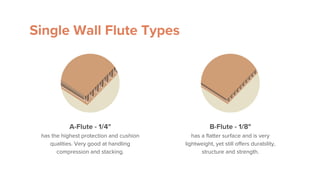
Single Wall Flute Types
A-Flute - 1/4"
has the highest protection and cushion
qualities. Very good at handling
compression and stacking.
B-Flute - 1/8"
has a flatter surface and is very
lightweight, yet still offers durability,
structure and strength.
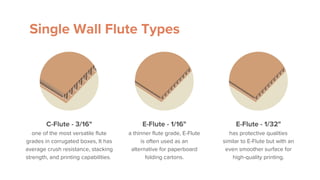
Single Wall Flute Types
C-Flute - 3/16"
one of the most versatile flute
grades in corrugated boxes, It has
average crush resistance, stacking
strength, and printing capabilities.
E-Flute - 1/16"
a thinner flute grade, E-Flute
is often used as an
alternative for paperboard
folding cartons.
E-Flute - 1/32"
has protective qualities
similar to E-Flute but with an
even smoother surface for
high-quality printing.
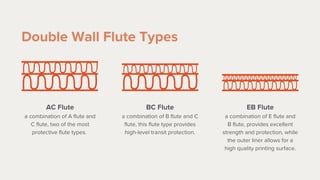
Double Wall Flute Types
AC Flute
a combination of A flute and
C flute, two of the most
protective flute types.
BC Flute
a combination of B flute and C
flute, this flute type provides
high-level transit protection.
EB Flute
a combination of E flute and
B flute, provides excellent
strength and protection, while
the outer liner allows for a
high quality printing surface.
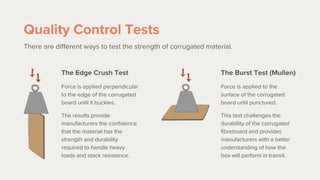
Quality Control Tests
The Edge Crush Test
Force is applied perpendicular
to the edge of the corrugated
board until it buckles.
The results provide
manufacturers the confidence
that the material has the
strength and durability
required to handle heavy
loads and stack resistance.
The Burst Test (Mullen)
Force is applied to the
surface of the corrugated
board until punctured.
This test challenges the
durability of the corrugated
fibreboard and provides
manufacturers with a better
understanding of how the
box will perform in transit.
There are different ways to test the strength of corrugated material.
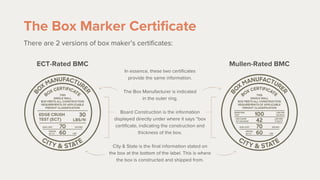
In essence, these two certificates
provide the same information.


The Box Manufacturer is indicated
in the outer ring.


Board Construction is the information
displayed directly under where it says “box
certificate, indicating the construction and
thickness of the box.


City & State is the final information stated on
the box at the bottom of the label. This is where
the box is constructed and shipped from.
The Box Marker Certificate
ECT-Rated BMC Mullen-Rated BMC
There are 2 versions of box maker’s certificates:
With a good understanding of corrugated
packaging, businesses have the power to
establish brand credibility and an exceptional
customer experience.
Contact our packaging specialists today to
find out more about how you can use
corrugated packaging for your product!
www.pakfactory.com/contact-us

The Master Guide To Corrugated Packaging

  • 1.
    The Master Guide ToCorrugated Packaging
  • 2.
    Corrugated - AnOverview The everyday corrugated box is the most common as a shipping and mailing option. Most companies use corrugated boxes to efficiently ship and deliver enormous amounts of products over long distances.
  • 3.
    What is Corrugated Fibreboard? The conventionalcorrugated box has 3 fiberboard layers in its structure. The outer layers are called linerboards, and the wavy layer of paper sandwiched in between the linerboards is called the flute.
  • 4.
    What is Cardboard? Cardboardin the packaging industry refers to thick paperboard material used to make folding carton boxes.
  • 5.
    What’s the differencebetween corrugated and cardboard? Raw materials used for the packaging Durability How the packaging is used Key differences between the two include:
  • 6.
    The Benefits of CorrugatedPackaging Protection: Corrugated is one of the best packaging options available for those seeking to protect their items during transit. It can handle the impacts of being moved around and shipped, and the cushioning offers a lot of support. Durability: Corrugated boxes are durable because of their protective features. The boxes can withstand a lot of impact without damaging the products inside. Environmentally-friendly: Corrugated boxes are made of recycled fibers and are easily recycled making them a better contender for sustainable packaging. Customizable: Corrugated boxes are flexible, making them easy to manipulate into various shapes. The surface of the linerboards also offer exceptional opportunities for branding through printing.
  • 7.
    The Corrugated Industry Corrugatedpackaging is used across the retail industry and is becoming more needed as e-commerce sales shoot up. In 2021, the e-commerce industry is projected to increase to 2.14 billion shoppers, leading to a higher demand for this kind of packaging in retail.
  • 8.
    Types of PaperLiners Linerboards are available in a variety of paper grades. Paper grade choices are made based on branding specifications for businesses. This could include sustainability efforts, artwork designs and the purpose of the packaging itself. Let’s dive into the various types of paper liners.
  • 9.
    Kraft Liners Kraft paperconsists of 70-80% “virgin” pulp fiber, which results in a top tier paper grade that is very stiff and durable. Kraft paper liners are the most sustainable option compared to other paper grades available. However, it is also the most costly.
  • 10.
    Types of KraftLiners White Top Kraft Very strong, affordable and offers a smooth surface for high quality printing capabilities Mottled White Kraft (Oyster Kraft) Very similar to White Top Kraft but features a textured appearance. Fully Bleached Kraft Put through an additional bleaching process to feature a brilliant white color with a smooth surface for printing. It is the least sustainable kraft liner board option.
  • 11.
    Test Liners Test paperis a less costly option than Kraft and is commonly used as the linerboard for the interior of corrugated boxes. There is a higher percentage of recycled-fiber content, resulting in a less durable paper liner that is difficult to print on.
  • 12.
    Types of TestLiners Test Liner 2 made from partly recycled content Test Liner 3 made from fully recycled content White Top Test Liner is made from recycled content and features a white, clay coated surface Oyster Test Liner is made from recycled content and looks similar to white top liners but features a mottled surface
  • 13.
    Flute Paper The fluteof corrugated packaging is also available in a few different paper grade options. Flute paper grades play a crucial role in the durability of corrugated boxes.
  • 14.
    Types of FlutePaper Semi Chem made using virgin fibers and a neutral sulfite semi- chemical process to give it an off-white color. Waste Based Fluting made from 100% recycled fibers and tends to be gray/brown in color.
  • 15.
    Flute Grades Flutes areessentially corrugated shaped liner boards that are placed between 2 flat liner boards to provide cushioning, strength and compression resistance to corrugated boxes. Available in a variety of thickness options, flute grades can be customized to support heavier weight products more effectively.
  • 16.
    Thickness Options Single face: commonlyused to wrap products for extra protection. The fluted fibreboard is glued to one flat sheet of linerboard leaving the fluting exposed on one side. Double-wall: Commonly used for shipping boxes and mailers. Two sheets of fluted fibreboard are glued between three sheets of linerboard. Single wall: Commonly used for packaging lightweight products. The fluted fiberboard is glued between two sheets of linerboard. Triple wall: Commonly used for packaging heavy weight products. Three sheets of fluted fibreboard is glued between Four sheets of linerboard and three corrugated fiberboards in between.
  • 17.
    Single Wall FluteTypes A-Flute - 1/4" has the highest protection and cushion qualities. Very good at handling compression and stacking. B-Flute - 1/8" has a flatter surface and is very lightweight, yet still offers durability, structure and strength.
  • 18.
    Single Wall FluteTypes C-Flute - 3/16" one of the most versatile flute grades in corrugated boxes, It has average crush resistance, stacking strength, and printing capabilities. E-Flute - 1/16" a thinner flute grade, E-Flute is often used as an alternative for paperboard folding cartons. E-Flute - 1/32" has protective qualities similar to E-Flute but with an even smoother surface for high-quality printing.
  • 19.
    Double Wall FluteTypes AC Flute a combination of A flute and C flute, two of the most protective flute types. BC Flute a combination of B flute and C flute, this flute type provides high-level transit protection. EB Flute a combination of E flute and B flute, provides excellent strength and protection, while the outer liner allows for a high quality printing surface.
  • 20.
    Quality Control Tests TheEdge Crush Test Force is applied perpendicular to the edge of the corrugated board until it buckles. The results provide manufacturers the confidence that the material has the strength and durability required to handle heavy loads and stack resistance. The Burst Test (Mullen) Force is applied to the surface of the corrugated board until punctured. This test challenges the durability of the corrugated fibreboard and provides manufacturers with a better understanding of how the box will perform in transit. There are different ways to test the strength of corrugated material.
  • 21.
    In essence, thesetwo certificates provide the same information. The Box Manufacturer is indicated in the outer ring. Board Construction is the information displayed directly under where it says “box certificate, indicating the construction and thickness of the box. City & State is the final information stated on the box at the bottom of the label. This is where the box is constructed and shipped from. The Box Marker Certificate ECT-Rated BMC Mullen-Rated BMC There are 2 versions of box maker’s certificates:
  • 22.
    With a goodunderstanding of corrugated packaging, businesses have the power to establish brand credibility and an exceptional customer experience. Contact our packaging specialists today to find out more about how you can use corrugated packaging for your product! www.pakfactory.com/contact-us