

Common network
protocols I.
Page 2
Instructor, PACE-IT Program – Edmonds Community College
Areas of Expertise Industry Certifications
 PC Hardware
 Network Administration
 IT Project Management
 Network Design
 User Training
 IT Troubleshooting
Qualifications Summary
Education
 M.B.A., IT Management, Western Governor’s University
 B.S., IT Security, Western Governor’s University
Entrepreneur, executive leader, and proven manger
with 10+ years of experience turning complex issues
into efficient and effective solutions.
Strengths include developing and mentoring diverse
workforces, improving processes, analyzing
business needs and creating the solutions
required— with a focus on technology.
Page 3
PACE-IT.
– IPv4 and IPv6.
– Network storage protocols.
Page 4
Common network protocols I.
Page 5
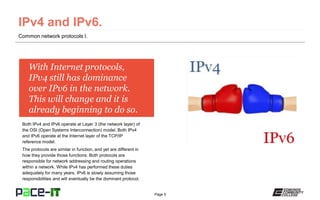
With Internet protocols,
IPv4 still has dominance
over IPv6 in the network.
This will change and it is
already beginning to do so.
Both IPv4 and IPv6 operate at Layer 3 (the network layer) of
the OSI (Open Systems Interconnection) model. Both IPv4
and IPv6 operate at the Internet layer of the TCP/IP
reference model.
The protocols are similar in function, and yet are different in
how they provide those functions. Both protocols are
responsible for network addressing and routing operations
within a network. While IPv4 has performed these duties
adequately for many years, IPv6 is slowly assuming those
responsibilities and will eventually be the dominant protocol.
Common network protocols I.
Page 6
Common network protocols I.
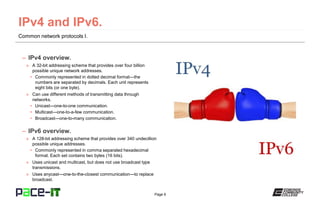
– IPv4 overview.
» A 32-bit addressing scheme that provides over four billion
possible unique network addresses.
• Commonly represented in dotted decimal format—the
numbers are separated by decimals. Each unit represents
eight bits (or one byte).
» Can use different methods of transmitting data through
networks.
• Unicast—one-to-one communication.
• Multicast—one-to-a-few communication.
• Broadcast—one-to-many communication.
– IPv6 overview.
» A 128-bit addressing scheme that provides over 340 undecillion
possible unique addresses.
• Commonly represented in comma separated hexadecimal
format. Each set contains two bytes (16 bits).
» Uses unicast and multicast, but does not use broadcast type
transmissions.
» Uses anycast—one-to-the-closest communication—to replace
broadcast.
Page 7
Common network protocols I.
Page 8
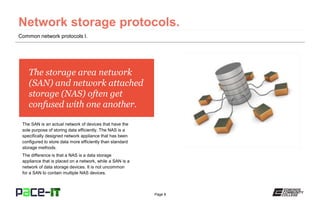
The storage area network
(SAN) and network attached
storage (NAS) often get
confused with one another.
The SAN is an actual network of devices that have the
sole purpose of storing data efficiently. The NAS is a
specifically designed network appliance that has been
configured to store data more efficiently than standard
storage methods.
The difference is that a NAS is a data storage
appliance that is placed on a network, while a SAN is a
network of data storage devices. It is not uncommon
for a SAN to contain multiple NAS devices.
Common network protocols I.
Page 9
Common network protocols I.
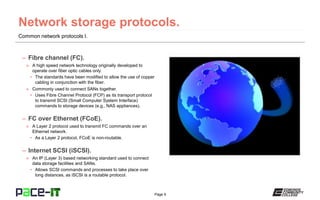
– Fibre channel (FC).
» A high speed network technology originally developed to
operate over fiber optic cables only.
• The standards have been modified to allow the use of copper
cabling in conjunction with the fiber.
» Commonly used to connect SANs together.
• Uses Fibre Channel Protocol (FCP) as its transport protocol
to transmit SCSI (Small Computer System Interface)
commands to storage devices (e.g., NAS appliances).
– FC over Ethernet (FCoE).
» A Layer 2 protocol used to transmit FC commands over an
Ethernet network.
• As a Layer 2 protocol, FCoE is non-routable.
– Internet SCSI (iSCSI).
» An IP (Layer 3) based networking standard used to connect
data storage facilities and SANs.
• Allows SCSI commands and processes to take place over
long distances, as iSCSI is a routable protocol.
Page 10
Common network protocols I.
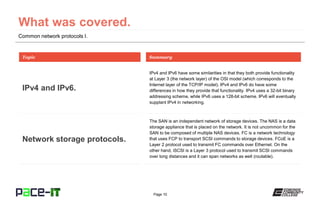
IPv4 and IPv6 have some similarities in that they both provide functionality
at Layer 3 (the network layer) of the OSI model (which corresponds to the
Internet layer of the TCP/IP model). IPv4 and IPv6 do have some
differences in how they provide that functionality. IPv4 uses a 32-bit binary
addressing scheme, while IPv6 uses a 128-bit scheme. IPv6 will eventually
supplant IPv4 in networking.
Topic
IPv4 and IPv6.
Summary
The SAN is an independent network of storage devices. The NAS is a data
storage appliance that is placed on the network. It is not uncommon for the
SAN to be composed of multiple NAS devices. FC is a network technology
that uses FCP to transport SCSI commands to storage devices. FCoE is a
Layer 2 protocol used to transmit FC commands over Ethernet. On the
other hand, iSCSI is a Layer 3 protocol used to transmit SCSI commands
over long distances and it can span networks as well (routable).
Network storage protocols.
Page 11
THANK YOU!
This workforce solution was 100 percent funded by a $3 million grant awarded by the
U.S. Department of Labor's Employment and Training Administration. The solution was
created by the grantee and does not necessarily reflect the official position of the U.S.
Department of Labor. The Department of Labor makes no guarantees, warranties, or
assurances of any kind, express or implied, with respect to such information, including
any information on linked sites and including, but not limited to, accuracy of the
information or its completeness, timeliness, usefulness, adequacy, continued availability
or ownership. Funded by the Department of Labor, Employment and Training
Administration, Grant #TC-23745-12-60-A-53.
PACE-IT is an equal opportunity employer/program and auxiliary aids and services are
available upon request to individuals with disabilities. For those that are hearing
impaired, a video phone is available at the Services for Students with Disabilities (SSD)
office in Mountlake Terrace Hall 159. Check www.edcc.edu/ssd for office hours. Call
425.354.3113 on a video phone for more information about the PACE-IT program. For
any additional special accommodations needed, call the SSD office at 425.640.1814.
Edmonds Community College does not discriminate on the basis of race; color; religion;
national origin; sex; disability; sexual orientation; age; citizenship, marital, or veteran
status; or genetic information in its programs and activities.

PACE-IT, Security+1.4: Common Network Protocols (part 1)

  • 1.
  • 2.
    Page 2 Instructor, PACE-ITProgram – Edmonds Community College Areas of Expertise Industry Certifications  PC Hardware  Network Administration  IT Project Management  Network Design  User Training  IT Troubleshooting Qualifications Summary Education  M.B.A., IT Management, Western Governor’s University  B.S., IT Security, Western Governor’s University Entrepreneur, executive leader, and proven manger with 10+ years of experience turning complex issues into efficient and effective solutions. Strengths include developing and mentoring diverse workforces, improving processes, analyzing business needs and creating the solutions required— with a focus on technology.
  • 3.
    Page 3 PACE-IT. – IPv4and IPv6. – Network storage protocols.
  • 4.
  • 5.
    Page 5 With Internetprotocols, IPv4 still has dominance over IPv6 in the network. This will change and it is already beginning to do so. Both IPv4 and IPv6 operate at Layer 3 (the network layer) of the OSI (Open Systems Interconnection) model. Both IPv4 and IPv6 operate at the Internet layer of the TCP/IP reference model. The protocols are similar in function, and yet are different in how they provide those functions. Both protocols are responsible for network addressing and routing operations within a network. While IPv4 has performed these duties adequately for many years, IPv6 is slowly assuming those responsibilities and will eventually be the dominant protocol. Common network protocols I.
  • 6.
    Page 6 Common networkprotocols I. – IPv4 overview. » A 32-bit addressing scheme that provides over four billion possible unique network addresses. • Commonly represented in dotted decimal format—the numbers are separated by decimals. Each unit represents eight bits (or one byte). » Can use different methods of transmitting data through networks. • Unicast—one-to-one communication. • Multicast—one-to-a-few communication. • Broadcast—one-to-many communication. – IPv6 overview. » A 128-bit addressing scheme that provides over 340 undecillion possible unique addresses. • Commonly represented in comma separated hexadecimal format. Each set contains two bytes (16 bits). » Uses unicast and multicast, but does not use broadcast type transmissions. » Uses anycast—one-to-the-closest communication—to replace broadcast.
  • 7.
  • 8.
    Page 8 The storagearea network (SAN) and network attached storage (NAS) often get confused with one another. The SAN is an actual network of devices that have the sole purpose of storing data efficiently. The NAS is a specifically designed network appliance that has been configured to store data more efficiently than standard storage methods. The difference is that a NAS is a data storage appliance that is placed on a network, while a SAN is a network of data storage devices. It is not uncommon for a SAN to contain multiple NAS devices. Common network protocols I.
  • 9.
    Page 9 Common networkprotocols I. – Fibre channel (FC). » A high speed network technology originally developed to operate over fiber optic cables only. • The standards have been modified to allow the use of copper cabling in conjunction with the fiber. » Commonly used to connect SANs together. • Uses Fibre Channel Protocol (FCP) as its transport protocol to transmit SCSI (Small Computer System Interface) commands to storage devices (e.g., NAS appliances). – FC over Ethernet (FCoE). » A Layer 2 protocol used to transmit FC commands over an Ethernet network. • As a Layer 2 protocol, FCoE is non-routable. – Internet SCSI (iSCSI). » An IP (Layer 3) based networking standard used to connect data storage facilities and SANs. • Allows SCSI commands and processes to take place over long distances, as iSCSI is a routable protocol.
  • 10.
    Page 10 Common networkprotocols I. IPv4 and IPv6 have some similarities in that they both provide functionality at Layer 3 (the network layer) of the OSI model (which corresponds to the Internet layer of the TCP/IP model). IPv4 and IPv6 do have some differences in how they provide that functionality. IPv4 uses a 32-bit binary addressing scheme, while IPv6 uses a 128-bit scheme. IPv6 will eventually supplant IPv4 in networking. Topic IPv4 and IPv6. Summary The SAN is an independent network of storage devices. The NAS is a data storage appliance that is placed on the network. It is not uncommon for the SAN to be composed of multiple NAS devices. FC is a network technology that uses FCP to transport SCSI commands to storage devices. FCoE is a Layer 2 protocol used to transmit FC commands over Ethernet. On the other hand, iSCSI is a Layer 3 protocol used to transmit SCSI commands over long distances and it can span networks as well (routable). Network storage protocols.
  • 11.
  • 12.
    This workforce solutionwas 100 percent funded by a $3 million grant awarded by the U.S. Department of Labor's Employment and Training Administration. The solution was created by the grantee and does not necessarily reflect the official position of the U.S. Department of Labor. The Department of Labor makes no guarantees, warranties, or assurances of any kind, express or implied, with respect to such information, including any information on linked sites and including, but not limited to, accuracy of the information or its completeness, timeliness, usefulness, adequacy, continued availability or ownership. Funded by the Department of Labor, Employment and Training Administration, Grant #TC-23745-12-60-A-53. PACE-IT is an equal opportunity employer/program and auxiliary aids and services are available upon request to individuals with disabilities. For those that are hearing impaired, a video phone is available at the Services for Students with Disabilities (SSD) office in Mountlake Terrace Hall 159. Check www.edcc.edu/ssd for office hours. Call 425.354.3113 on a video phone for more information about the PACE-IT program. For any additional special accommodations needed, call the SSD office at 425.640.1814. Edmonds Community College does not discriminate on the basis of race; color; religion; national origin; sex; disability; sexual orientation; age; citizenship, marital, or veteran status; or genetic information in its programs and activities.