Polynomial and Rational
Expressions
College Algebra
Polynomials
A polynomial is an expression that can be written in the form
𝑎𝑛𝑥𝑛 + ⋯ + 𝑎2𝑥2 + 𝑎1𝑥 + 𝑎0
Each real number ai is called a coefficient. The number 𝑎0 that is not
multiplied by a variable is called a constant. Each product 𝑎𝑖𝑥𝑖 is a term of a
polynomial. The highest power of the variable is called the degree of a
polynomial. The leading term is the term with the highest power, and its
coefficient is called the leading coefficient.
Add and Subtract Polynomials
1. Combine like terms
2. Simplify and write in standard form
Example:
(12𝑥2 + 9𝑥 − 21) + (4𝑥3 + 8𝑥2 − 5𝑥 + 20)
Solution:
4𝑥3 + 12𝑥2 + 8𝑥2 + 9𝑥 − 5𝑥 + −21 + 20
4𝑥3 + 20𝑥2 + 4𝑥 − 1
Multiply Polynomials Using the Distributive
Property
1. Multiply each term of the first polynomial by each term of the second
2. Combine like terms
3. Simplify
Example:
(2𝑥 + 1)(3𝑥2 − 𝑥 + 4)
Solution:
2𝑥 3𝑥2 − 𝑥 + 4 + 1 3𝑥2 − 𝑥 + 4
6𝑥3
− 2𝑥2
+ 8𝑥 + 3𝑥2
− 𝑥 + 4
6𝑥3 + −2𝑥2 + 3𝑥2 + 8𝑥 − 𝑥 + 4
6𝑥3 + 𝑥2 + 7𝑥 + 4
Using FOIL to Multiply Binomials
1. Multiply the First terms of each binomial
2. Multiply the Outer terms of the binomials
3. Multiply the Inner terms of the binomials
4. Multiply the Last terms of each binomial
5. Add the products
6. Combine like terms and simplify
Perfect Square Trinomials
When a binomial is squared, the result is called a perfect square trinomial:
the first term squared added to double the product of both terms and the last
term squared
(𝑥 + 𝑎)2= 𝑥 + 𝑎 𝑥 + 𝑎 = 𝑥2 + 2𝑎𝑥 + 𝑎2
Given a Binomial, Square it Using the Formula for Perfect Square
Trinomials
1. Square the first term of the binomial
2. Square the last term of the binomial
3. For the middle term of the trinomial, double the product of the two terms
4. Add and simplify
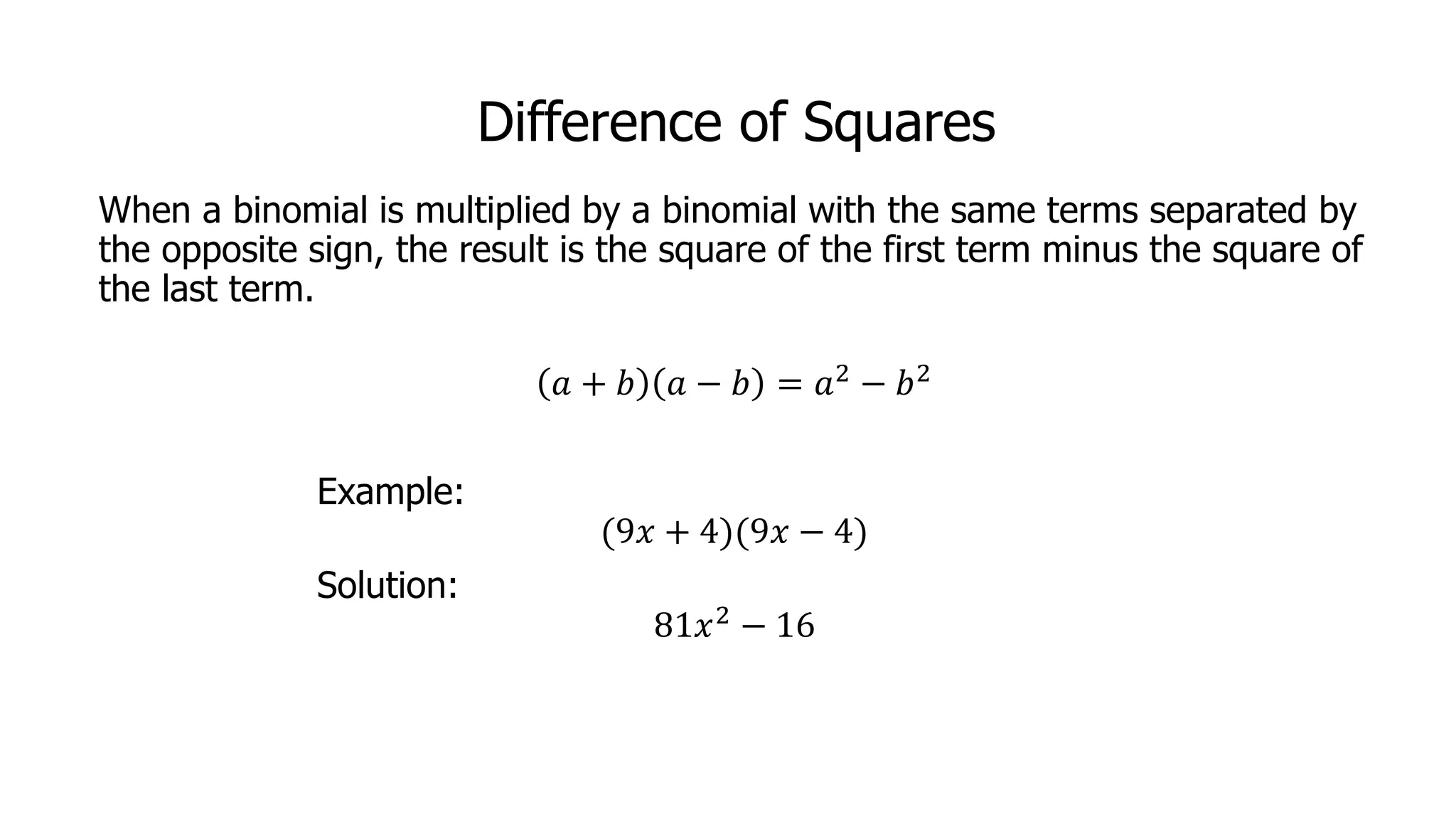
Difference of Squares
When a binomial is multiplied by a binomial with the same terms separated by
the opposite sign, the result is the square of the first term minus the square of
the last term.
𝑎 + 𝑏 𝑎 − 𝑏 = 𝑎2 − 𝑏2
Example:
(9𝑥 + 4)(9𝑥 − 4)
Solution:
81𝑥2 − 16
Performing Operations with Polynomials of Several
Variables
We have looked at polynomials containing only one variable. However, a
polynomial can contain several variables. All of the same rules apply when
working with polynomials containing several variables.
Consider an example:
𝑎 + 2𝑏 4𝑎 − 𝑏 − 𝑐
𝑎 4𝑎 − 𝑏 − 𝑐 + 2𝑏 4𝑎 − 𝑏 − 𝑐
4𝑎2
− 𝑎𝑏 − 𝑎𝑐 + 8𝑎𝑏 − 2𝑏2
− 2𝑏𝑐
4𝑎2
+ −𝑎𝑏 + 8𝑎𝑏 − 𝑎𝑐 − 2𝑏2
− 2𝑏𝑐
4𝑎2
+ 7𝑎𝑏 − 𝑎𝑐 − 2𝑏𝑐 − 2𝑏2
Factoring Basics
The greatest common factor (GCF) of polynomials is the largest polynomial
that divides evenly into the polynomials.
Given a Polynomial Expression, Factor out the GCF
1. Identify the GCF of the coefficients
2. Identify the GCF of the variables
3. Combine to find the GCF of the expression
4. Determine what the GCF needs to be multiplied by to obtain each term in
the expression
5. Write the factored expression as the product of the GCF and the sum of the
terms we need to multiply by
Factoring a Trinomial with Leading Coefficient 1
Given a Trinomial in the Form 𝒙𝟐 + 𝒃𝒙 + 𝒄, Factor it
1. List factors of 𝑐
2. Find 𝑝 and 𝑞, a pair of factors of 𝑐 with a sum of 𝑏
3. Write the factored expression (𝑥 + 𝑝)(𝑥 + 𝑞)
Example:
𝑥2 + 2𝑥 − 15
Solution:
Need to find two numbers with a product of −15 and a sum of 2: −3 and 5.
(𝑥 − 3)(𝑥 + 5)
Factoring by Grouping
To factor a trinomial in the form 𝑎𝑥2 + 𝑏𝑥 + 𝑐 by grouping, we find two
numbers with a product of 𝑎𝑐 and a sum of 𝑏. We use these numbers to divide
the 𝑥 term into the sum of two terms and factor each portion of the
expression separately, then factor out the GCF of the entire expression.
For a Trinomial in the Form 𝒂𝒙𝟐 + 𝒃𝒙 + 𝒄, Factor by Grouping:
1. List the factors of 𝑎𝑐.
2. Find 𝑝 and 𝑞, a pair of factors of 𝑎𝑐 with a sum of 𝑏.
3. Rewrite the original expression as 𝑎𝑥2 + 𝑝𝑥 + 𝑞𝑥 + 𝑐.
4. Pull out the GCF of 𝑎𝑥2
+ 𝑝𝑥.
5. Pull out the GCF of 𝑞𝑥 + 𝑐.
6. Factor out the GCF of the expression.
Factor a Perfect Square Trinomial
A perfect square trinomial can be written as the square of a binomial:
𝑎2 + 2𝑎𝑏 + 𝑏2 = (𝑎 + 𝑏)2
For a Perfect Square Trinomial, Factor it into the Square of a Binomial
1. Confirm that the first and last term are perfect squares
2. Confirm that the middle term is twice the product of 𝑎𝑏
3. Write the factored form as (𝑎 + 𝑏)2
Factoring a Difference of Squares
A difference of squares can be rewritten as two factors containing the same
terms but opposite signs
𝑎2 − 𝑏2 = 𝑎 + 𝑏 𝑎 − 𝑏
Given a Difference of Squares, Factor it into Binomials
1. Confirm that the first and last term are perfect squares
2. Write the factored form as 𝑎 + 𝑏 𝑎 − 𝑏
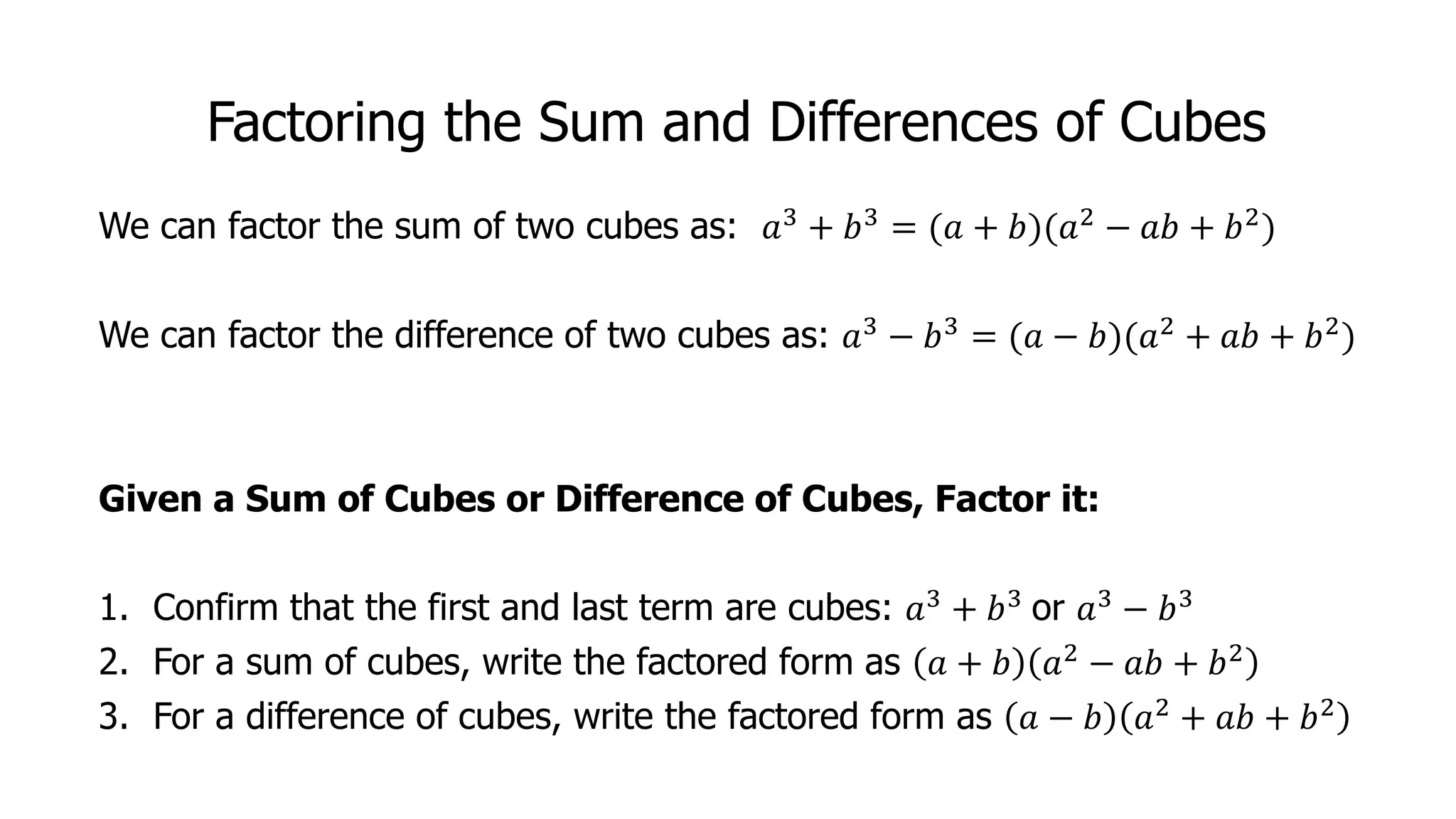
Factoring the Sum and Differences of Cubes
We can factor the sum of two cubes as: 𝑎3 + 𝑏3 = (𝑎 + 𝑏)(𝑎2 − 𝑎𝑏 + 𝑏2)
We can factor the difference of two cubes as: 𝑎3
− 𝑏3
= (𝑎 − 𝑏)(𝑎2
+ 𝑎𝑏 + 𝑏2
)
Given a Sum of Cubes or Difference of Cubes, Factor it:
1. Confirm that the first and last term are cubes: 𝑎3 + 𝑏3 or 𝑎3 − 𝑏3
2. For a sum of cubes, write the factored form as 𝑎 + 𝑏 𝑎2 − 𝑎𝑏 + 𝑏2
3. For a difference of cubes, write the factored form as 𝑎 − 𝑏 𝑎2 + 𝑎𝑏 + 𝑏2
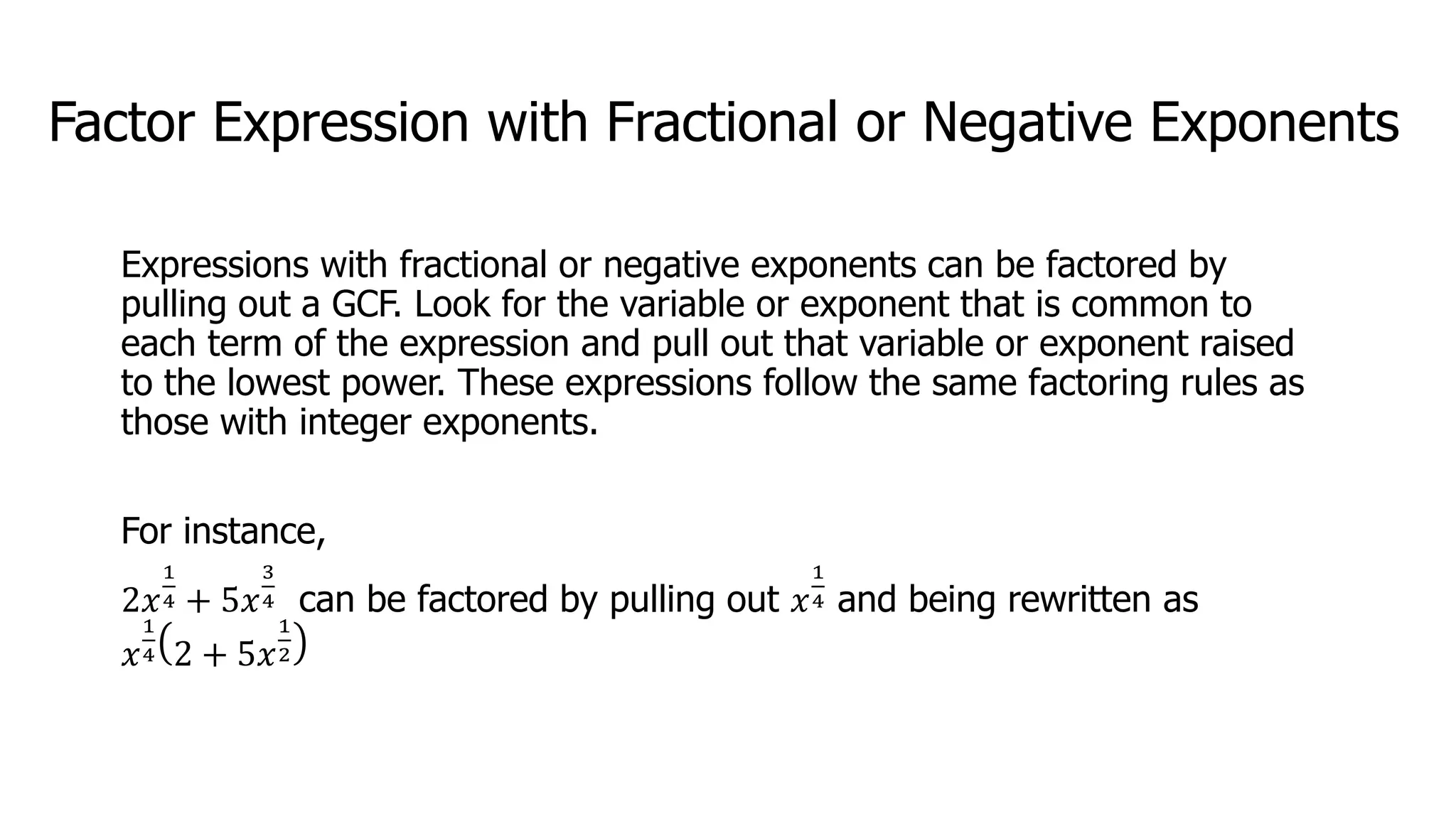
Factor Expression with Fractional or Negative Exponents
Expressions with fractional or negative exponents can be factored by
pulling out a GCF. Look for the variable or exponent that is common to
each term of the expression and pull out that variable or exponent raised
to the lowest power. These expressions follow the same factoring rules as
those with integer exponents.
For instance,
2𝑥
1
4 + 5𝑥
3
4 can be factored by pulling out 𝑥
1
4 and being rewritten as
𝑥
1
4 2 + 5𝑥
1
2
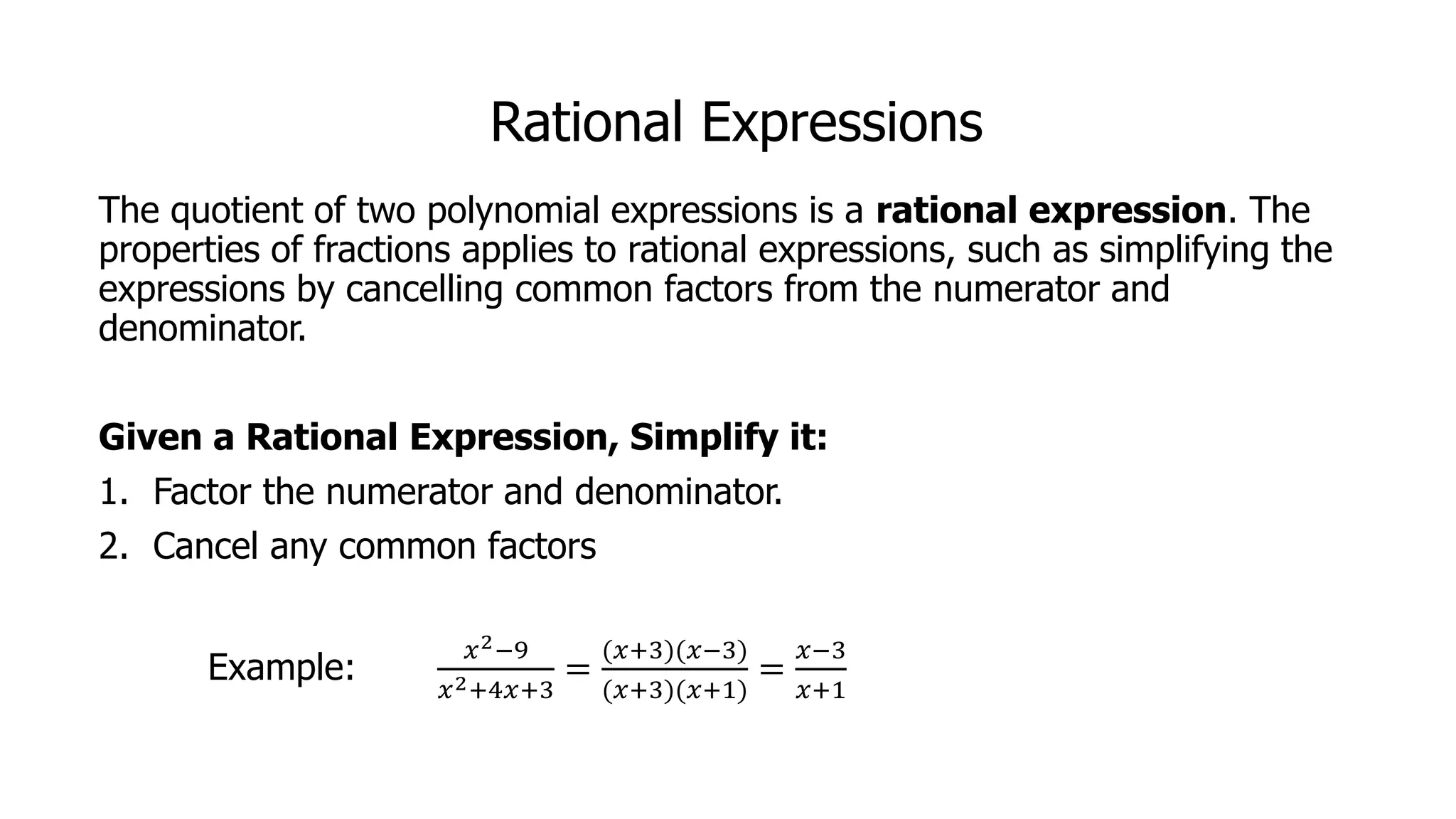
Rational Expressions
The quotient of two polynomial expressions is a rational expression. The
properties of fractions applies to rational expressions, such as simplifying the
expressions by cancelling common factors from the numerator and
denominator.
Given a Rational Expression, Simplify it:
1. Factor the numerator and denominator.
2. Cancel any common factors
Example:
𝑥2−9
𝑥2+4𝑥+3
=
(𝑥+3)(𝑥−3)
(𝑥+3)(𝑥+1)
=
𝑥−3
𝑥+1
Multiplying Rational Expressions
Given Two Rational Expressions, Multiply them
1. Factor the numerator and denominator
2. Multiply the numerators
3. Multiply the denominators
4. Simplify
Example:
𝑥2
+ 4𝑥 − 5
4𝑥 − 4
∙
2𝑥 + 4
𝑥 + 5
=
𝑥 + 5 𝑥 − 1 2 𝑥 + 2
4 𝑥 − 1 𝑥 + 5
=
𝑥 + 2
2
Dividing Rational Expressions
Given Two Rational Expressions, Divide them
1. Rewrite as the first rational expression multiplied by the reciprocal of the
second
2. Factor the numerators and denominators
3. Multiply the numerators
4. Multiply the denominators
5. Simplify
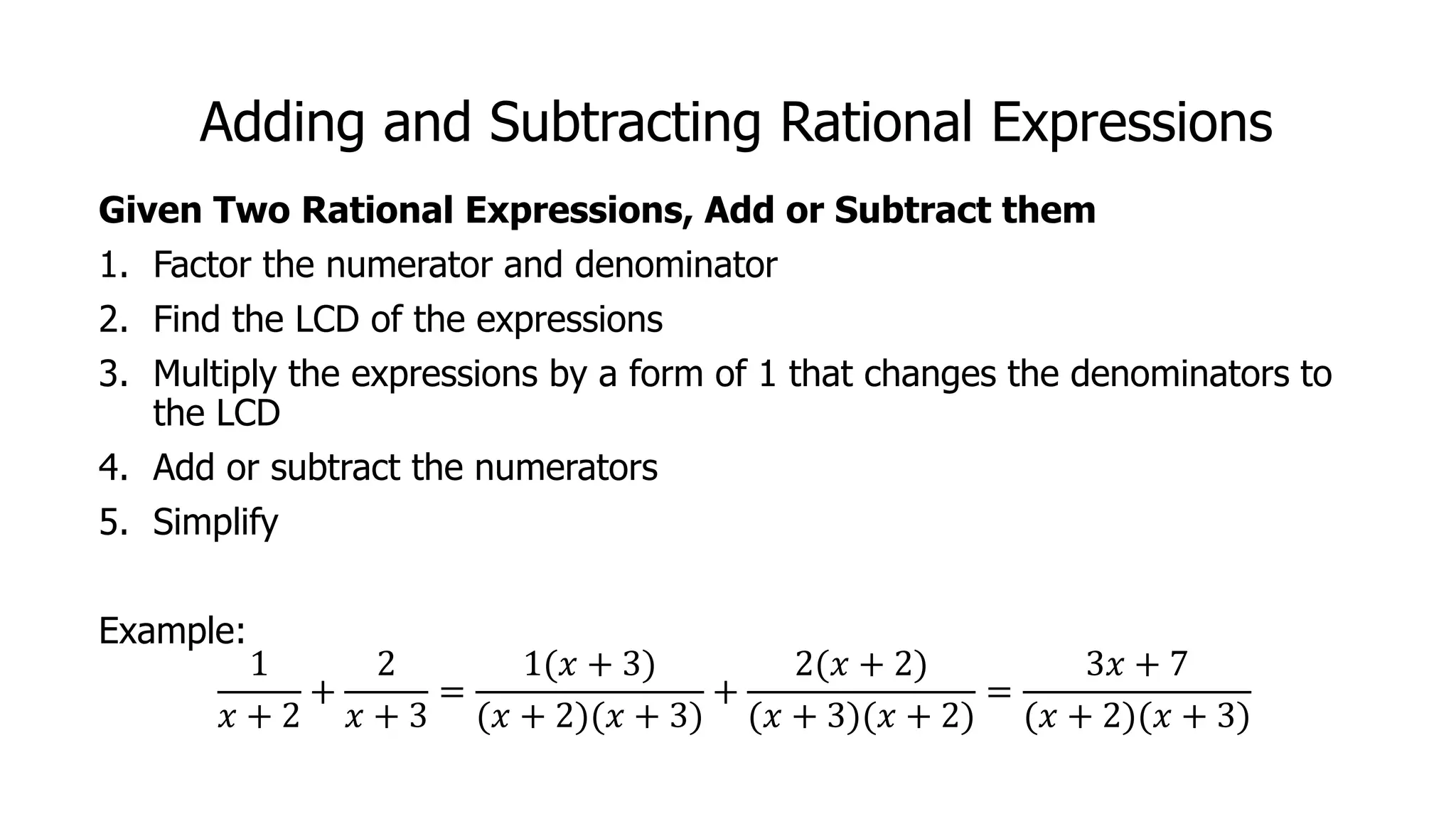
Adding and Subtracting Rational Expressions
Given Two Rational Expressions, Add or Subtract them
1. Factor the numerator and denominator
2. Find the LCD of the expressions
3. Multiply the expressions by a form of 1 that changes the denominators to
the LCD
4. Add or subtract the numerators
5. Simplify
Example:
1
𝑥 + 2
+
2
𝑥 + 3
=
1(𝑥 + 3)
(𝑥 + 2)(𝑥 + 3)
+
2(𝑥 + 2)
(𝑥 + 3)(𝑥 + 2)
=
3𝑥 + 7
(𝑥 + 2)(𝑥 + 3)
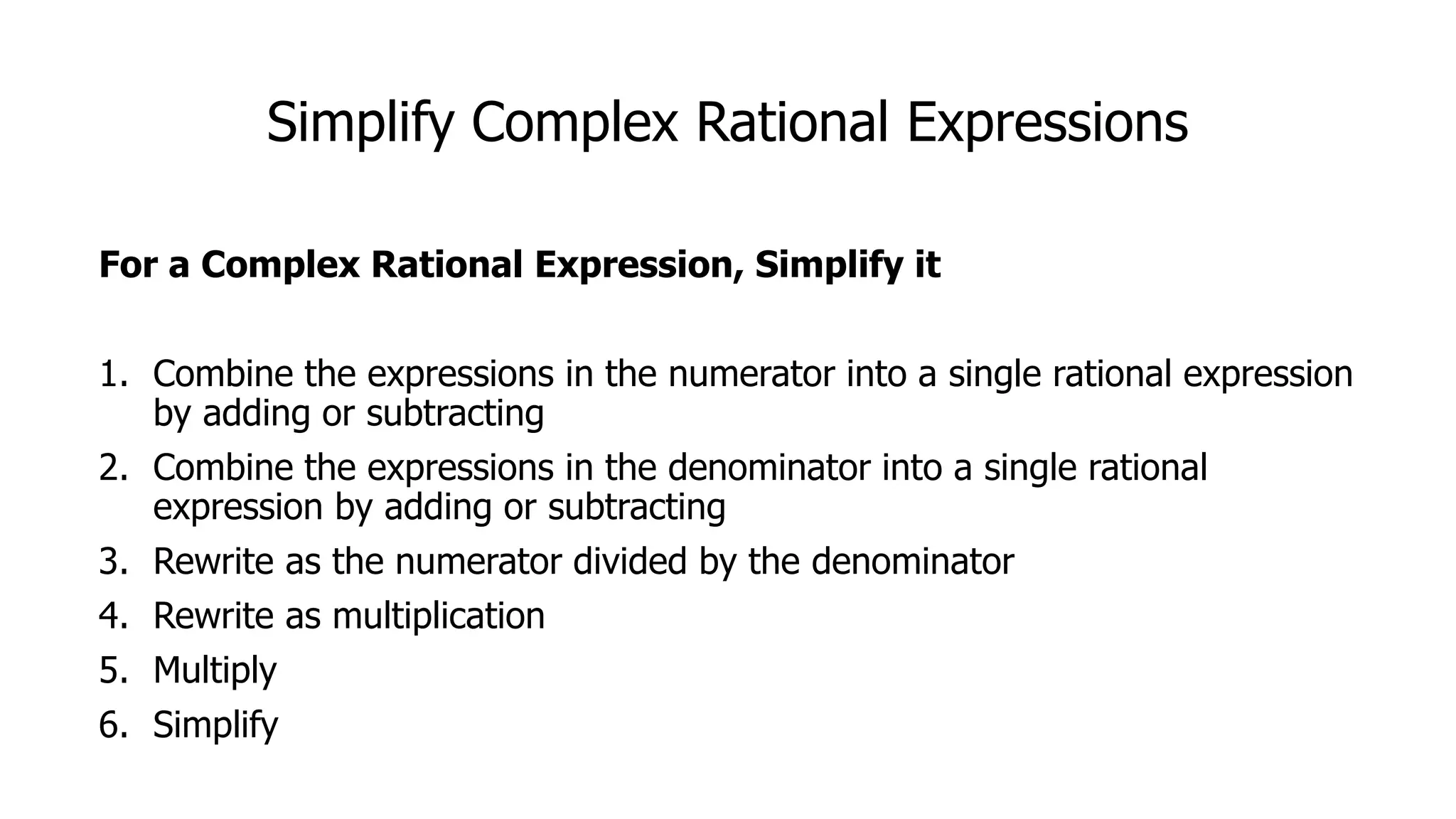
Simplify Complex Rational Expressions
For a Complex Rational Expression, Simplify it
1. Combine the expressions in the numerator into a single rational expression
by adding or subtracting
2. Combine the expressions in the denominator into a single rational
expression by adding or subtracting
3. Rewrite as the numerator divided by the denominator
4. Rewrite as multiplication
5. Multiply
6. Simplify
Quick Review
• What is a polynomial?
• How do you multiply polynomials?
• What does FOIL refer to with respect to binomials?
• What is a perfect square trinomial?
• What is the Greatest Common Factor (GCF) of polynomials?
• How do you factor a binomial that is the difference of squares?
• What are the two polynomial factors of a sum of cubes?
• How do you factor by grouping?
• What is a rational expression?
• How do you multiply rational expressions?
• How do you add two rational expressions?

CollegeAlgebra_02_PolynomialandRational_.pptx

  • 1.
  • 2.
    Polynomials A polynomial isan expression that can be written in the form 𝑎𝑛𝑥𝑛 + ⋯ + 𝑎2𝑥2 + 𝑎1𝑥 + 𝑎0 Each real number ai is called a coefficient. The number 𝑎0 that is not multiplied by a variable is called a constant. Each product 𝑎𝑖𝑥𝑖 is a term of a polynomial. The highest power of the variable is called the degree of a polynomial. The leading term is the term with the highest power, and its coefficient is called the leading coefficient.
  • 3.
    Add and SubtractPolynomials 1. Combine like terms 2. Simplify and write in standard form Example: (12𝑥2 + 9𝑥 − 21) + (4𝑥3 + 8𝑥2 − 5𝑥 + 20) Solution: 4𝑥3 + 12𝑥2 + 8𝑥2 + 9𝑥 − 5𝑥 + −21 + 20 4𝑥3 + 20𝑥2 + 4𝑥 − 1
  • 4.
    Multiply Polynomials Usingthe Distributive Property 1. Multiply each term of the first polynomial by each term of the second 2. Combine like terms 3. Simplify Example: (2𝑥 + 1)(3𝑥2 − 𝑥 + 4) Solution: 2𝑥 3𝑥2 − 𝑥 + 4 + 1 3𝑥2 − 𝑥 + 4 6𝑥3 − 2𝑥2 + 8𝑥 + 3𝑥2 − 𝑥 + 4 6𝑥3 + −2𝑥2 + 3𝑥2 + 8𝑥 − 𝑥 + 4 6𝑥3 + 𝑥2 + 7𝑥 + 4
  • 5.
    Using FOIL toMultiply Binomials 1. Multiply the First terms of each binomial 2. Multiply the Outer terms of the binomials 3. Multiply the Inner terms of the binomials 4. Multiply the Last terms of each binomial 5. Add the products 6. Combine like terms and simplify
  • 6.
    Perfect Square Trinomials Whena binomial is squared, the result is called a perfect square trinomial: the first term squared added to double the product of both terms and the last term squared (𝑥 + 𝑎)2= 𝑥 + 𝑎 𝑥 + 𝑎 = 𝑥2 + 2𝑎𝑥 + 𝑎2 Given a Binomial, Square it Using the Formula for Perfect Square Trinomials 1. Square the first term of the binomial 2. Square the last term of the binomial 3. For the middle term of the trinomial, double the product of the two terms 4. Add and simplify
  • 7.
    Difference of Squares Whena binomial is multiplied by a binomial with the same terms separated by the opposite sign, the result is the square of the first term minus the square of the last term. 𝑎 + 𝑏 𝑎 − 𝑏 = 𝑎2 − 𝑏2 Example: (9𝑥 + 4)(9𝑥 − 4) Solution: 81𝑥2 − 16
  • 8.
    Performing Operations withPolynomials of Several Variables We have looked at polynomials containing only one variable. However, a polynomial can contain several variables. All of the same rules apply when working with polynomials containing several variables. Consider an example: 𝑎 + 2𝑏 4𝑎 − 𝑏 − 𝑐 𝑎 4𝑎 − 𝑏 − 𝑐 + 2𝑏 4𝑎 − 𝑏 − 𝑐 4𝑎2 − 𝑎𝑏 − 𝑎𝑐 + 8𝑎𝑏 − 2𝑏2 − 2𝑏𝑐 4𝑎2 + −𝑎𝑏 + 8𝑎𝑏 − 𝑎𝑐 − 2𝑏2 − 2𝑏𝑐 4𝑎2 + 7𝑎𝑏 − 𝑎𝑐 − 2𝑏𝑐 − 2𝑏2
  • 9.
    Factoring Basics The greatestcommon factor (GCF) of polynomials is the largest polynomial that divides evenly into the polynomials. Given a Polynomial Expression, Factor out the GCF 1. Identify the GCF of the coefficients 2. Identify the GCF of the variables 3. Combine to find the GCF of the expression 4. Determine what the GCF needs to be multiplied by to obtain each term in the expression 5. Write the factored expression as the product of the GCF and the sum of the terms we need to multiply by
  • 10.
    Factoring a Trinomialwith Leading Coefficient 1 Given a Trinomial in the Form 𝒙𝟐 + 𝒃𝒙 + 𝒄, Factor it 1. List factors of 𝑐 2. Find 𝑝 and 𝑞, a pair of factors of 𝑐 with a sum of 𝑏 3. Write the factored expression (𝑥 + 𝑝)(𝑥 + 𝑞) Example: 𝑥2 + 2𝑥 − 15 Solution: Need to find two numbers with a product of −15 and a sum of 2: −3 and 5. (𝑥 − 3)(𝑥 + 5)
  • 11.
    Factoring by Grouping Tofactor a trinomial in the form 𝑎𝑥2 + 𝑏𝑥 + 𝑐 by grouping, we find two numbers with a product of 𝑎𝑐 and a sum of 𝑏. We use these numbers to divide the 𝑥 term into the sum of two terms and factor each portion of the expression separately, then factor out the GCF of the entire expression. For a Trinomial in the Form 𝒂𝒙𝟐 + 𝒃𝒙 + 𝒄, Factor by Grouping: 1. List the factors of 𝑎𝑐. 2. Find 𝑝 and 𝑞, a pair of factors of 𝑎𝑐 with a sum of 𝑏. 3. Rewrite the original expression as 𝑎𝑥2 + 𝑝𝑥 + 𝑞𝑥 + 𝑐. 4. Pull out the GCF of 𝑎𝑥2 + 𝑝𝑥. 5. Pull out the GCF of 𝑞𝑥 + 𝑐. 6. Factor out the GCF of the expression.
  • 12.
    Factor a PerfectSquare Trinomial A perfect square trinomial can be written as the square of a binomial: 𝑎2 + 2𝑎𝑏 + 𝑏2 = (𝑎 + 𝑏)2 For a Perfect Square Trinomial, Factor it into the Square of a Binomial 1. Confirm that the first and last term are perfect squares 2. Confirm that the middle term is twice the product of 𝑎𝑏 3. Write the factored form as (𝑎 + 𝑏)2
  • 13.
    Factoring a Differenceof Squares A difference of squares can be rewritten as two factors containing the same terms but opposite signs 𝑎2 − 𝑏2 = 𝑎 + 𝑏 𝑎 − 𝑏 Given a Difference of Squares, Factor it into Binomials 1. Confirm that the first and last term are perfect squares 2. Write the factored form as 𝑎 + 𝑏 𝑎 − 𝑏
  • 14.
    Factoring the Sumand Differences of Cubes We can factor the sum of two cubes as: 𝑎3 + 𝑏3 = (𝑎 + 𝑏)(𝑎2 − 𝑎𝑏 + 𝑏2) We can factor the difference of two cubes as: 𝑎3 − 𝑏3 = (𝑎 − 𝑏)(𝑎2 + 𝑎𝑏 + 𝑏2 ) Given a Sum of Cubes or Difference of Cubes, Factor it: 1. Confirm that the first and last term are cubes: 𝑎3 + 𝑏3 or 𝑎3 − 𝑏3 2. For a sum of cubes, write the factored form as 𝑎 + 𝑏 𝑎2 − 𝑎𝑏 + 𝑏2 3. For a difference of cubes, write the factored form as 𝑎 − 𝑏 𝑎2 + 𝑎𝑏 + 𝑏2
  • 15.
    Factor Expression withFractional or Negative Exponents Expressions with fractional or negative exponents can be factored by pulling out a GCF. Look for the variable or exponent that is common to each term of the expression and pull out that variable or exponent raised to the lowest power. These expressions follow the same factoring rules as those with integer exponents. For instance, 2𝑥 1 4 + 5𝑥 3 4 can be factored by pulling out 𝑥 1 4 and being rewritten as 𝑥 1 4 2 + 5𝑥 1 2
  • 16.
    Rational Expressions The quotientof two polynomial expressions is a rational expression. The properties of fractions applies to rational expressions, such as simplifying the expressions by cancelling common factors from the numerator and denominator. Given a Rational Expression, Simplify it: 1. Factor the numerator and denominator. 2. Cancel any common factors Example: 𝑥2−9 𝑥2+4𝑥+3 = (𝑥+3)(𝑥−3) (𝑥+3)(𝑥+1) = 𝑥−3 𝑥+1
  • 17.
    Multiplying Rational Expressions GivenTwo Rational Expressions, Multiply them 1. Factor the numerator and denominator 2. Multiply the numerators 3. Multiply the denominators 4. Simplify Example: 𝑥2 + 4𝑥 − 5 4𝑥 − 4 ∙ 2𝑥 + 4 𝑥 + 5 = 𝑥 + 5 𝑥 − 1 2 𝑥 + 2 4 𝑥 − 1 𝑥 + 5 = 𝑥 + 2 2
  • 18.
    Dividing Rational Expressions GivenTwo Rational Expressions, Divide them 1. Rewrite as the first rational expression multiplied by the reciprocal of the second 2. Factor the numerators and denominators 3. Multiply the numerators 4. Multiply the denominators 5. Simplify
  • 19.
    Adding and SubtractingRational Expressions Given Two Rational Expressions, Add or Subtract them 1. Factor the numerator and denominator 2. Find the LCD of the expressions 3. Multiply the expressions by a form of 1 that changes the denominators to the LCD 4. Add or subtract the numerators 5. Simplify Example: 1 𝑥 + 2 + 2 𝑥 + 3 = 1(𝑥 + 3) (𝑥 + 2)(𝑥 + 3) + 2(𝑥 + 2) (𝑥 + 3)(𝑥 + 2) = 3𝑥 + 7 (𝑥 + 2)(𝑥 + 3)
  • 20.
    Simplify Complex RationalExpressions For a Complex Rational Expression, Simplify it 1. Combine the expressions in the numerator into a single rational expression by adding or subtracting 2. Combine the expressions in the denominator into a single rational expression by adding or subtracting 3. Rewrite as the numerator divided by the denominator 4. Rewrite as multiplication 5. Multiply 6. Simplify
  • 21.
    Quick Review • Whatis a polynomial? • How do you multiply polynomials? • What does FOIL refer to with respect to binomials? • What is a perfect square trinomial? • What is the Greatest Common Factor (GCF) of polynomials? • How do you factor a binomial that is the difference of squares? • What are the two polynomial factors of a sum of cubes? • How do you factor by grouping? • What is a rational expression? • How do you multiply rational expressions? • How do you add two rational expressions?

Editor's Notes

  • #2 Title: Cape Canaveral Air Force Station, United States. Author: SpaceX Located at: https://unsplash.com/@spacex?photo=TV2gg2kZD1o All text in these slides is taken from https://courses.lumenlearning.com/waymakercollegealgebra/ where it is published under one or more open licenses. All images in these slides are attributed in the notes of the slide on which they appear and licensed as indicated.
  • #3 Revision and Adaptation. Provided by: Lumen Learning. License: CC BY: Attribution
  • #4 Revision and Adaptation. Provided by: Lumen Learning. License: CC BY: Attribution
  • #5 Revision and Adaptation. Provided by: Lumen Learning. License: CC BY: Attribution
  • #6 Revision and Adaptation. Provided by: Lumen Learning. License: CC BY: Attribution
  • #7 Revision and Adaptation. Provided by: Lumen Learning. License: CC BY: Attribution
  • #8 Revision and Adaptation. Provided by: Lumen Learning. License: CC BY: Attribution
  • #9 Revision and Adaptation. Provided by: Lumen Learning. License: CC BY: Attribution
  • #10 Revision and Adaptation. Provided by: Lumen Learning. License: CC BY: Attribution
  • #11 Revision and Adaptation. Provided by: Lumen Learning. License: CC BY: Attribution
  • #12 Revision and Adaptation. Provided by: Lumen Learning. License: CC BY: Attribution
  • #13 Revision and Adaptation. Provided by: Lumen Learning. License: CC BY: Attribution
  • #14 Revision and Adaptation. Provided by: Lumen Learning. License: CC BY: Attribution
  • #15 Revision and Adaptation. Provided by: Lumen Learning. License: CC BY: Attribution
  • #16 Revision and Adaptation. Provided by: Lumen Learning. License: CC BY: Attribution
  • #17 Revision and Adaptation. Provided by: Lumen Learning. License: CC BY: Attribution
  • #18 Revision and Adaptation. Provided by: Lumen Learning. License: CC BY: Attribution
  • #19 Revision and Adaptation. Provided by: Lumen Learning. License: CC BY: Attribution
  • #20 Revision and Adaptation. Provided by: Lumen Learning. License: CC BY: Attribution
  • #21 Revision and Adaptation. Provided by: Lumen Learning. License: CC BY: Attribution