Nigel Boulton
Briony Ladbury
Marisa De Jager
The vision
‘to identify and make safe at the earliest opportunity all
vulnerable people in our communities through the
sharing of information and intelligence across the
safeguarding partnership’
The need for change
• Catalogue of learning and missed opportunity
• Evidential and research base
• Inhibitors to information sharing and inter-professional
practice
• No single intelligence view – Structural barriers
• Early intervention or unsustainable dependency
The model and outcomes
• Rules which make it work – inhibitor driven
• Three outcomes
Early identification and understanding of risk & harm
Victim identification and intervention
Harm identification and reduction
• Children & adults – intelligence prerogative
• Power of inter-professional practice
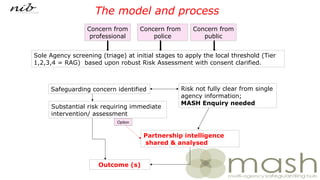
Concern from
police
Concern from
public
Concern from
professional
Risk not fully clear from single
agency information;
MASH Enquiry needed
Partnership intelligence
shared & analysed
Sole Agency screening (triage) at initial stages to apply the local threshold (Tier
1,2,3,4 = RAG) based upon robust Risk Assessment with consent clarified.
Substantial risk requiring immediate
intervention/ assessment
Outcome (s)
Safeguarding concern identified
Option
The model and process
Children and families embedded in decisions
• Eileen Munro recommendation (2011)
• Connectivity and risk assessment - Proportionate decisions
drive early intervention
• Step up and down reflect continuum of need levels
• Early intervention at any age for child or young person
• Early help services co-ordinated to improve outcomes
• Earliest identification essential to deliver 3 outcomes
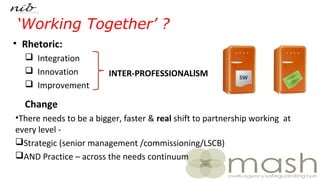
‘Working Together’ ?
• Rhetoric:
 Integration
 Innovation
 Improvement
INTER-PROFESSIONALlSM
Change
•There needs to be a bigger, faster & real shift to partnership working at
every level -
Strategic (senior management /commissioning/LSCB)
AND Practice – across the needs continuum
SW
Others
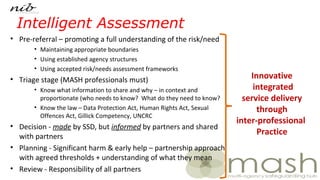
Intelligent Assessment
• Pre-referral – promoting a full understanding of the risk/need
• Maintaining appropriate boundaries
• Using established agency structures
• Using accepted risk/needs assessment frameworks
• Triage stage (MASH professionals must)
• Know what information to share and why – in context and
proportionate (who needs to know? What do they need to know?
• Know the law – Data Protection Act, Human Rights Act, Sexual
Offences Act, Gillick Competency, UNCRC
• Decision - made by SSD, but informed by partners and shared
with partners
• Planning - Significant harm & early help – partnership approach
with agreed thresholds + understanding of what they mean
• Review - Responsibility of all partners
Innovative
integrated
service delivery
through
inter-professional
Practice
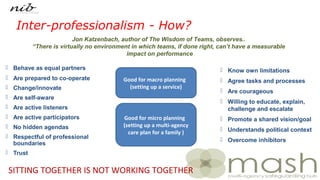
Inter-professionalism - How?
 Behave as equal partners
 Are prepared to co-operate
 Change/innovate
 Are self-aware
 Are active listeners
 Are active participators
 No hidden agendas
 Respectful of professional
boundaries
 Trust
 Know own limitations
 Agree tasks and processes
 Are courageous
 Willing to educate, explain,
challenge and escalate
 Promote a shared vision/goal
 Understands political context
 Overcome inhibitors
Good for macro planning
(setting up a service)
Good for micro planning
(setting up a multi-agency
care plan for a family )
Jon Katzenbach, author of The Wisdom of Teams, observes..
“There is virtually no environment in which teams, if done right, can’t have a measurable
impact on performance
SITTING TOGETHER IS NOT WORKING TOGETHER
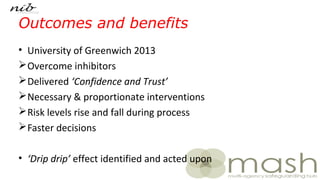
Outcomes and benefits
• University of Greenwich 2013
Overcome inhibitors
Delivered ‘Confidence and Trust’
Necessary & proportionate interventions
Risk levels rise and fall during process
Faster decisions
• ‘Drip drip’ effect identified and acted upon
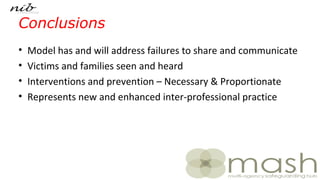
Conclusions
• Model has and will address failures to share and communicate
• Victims and families seen and heard
• Interventions and prevention – Necessary & Proportionate
• Represents new and enhanced inter-professional practice
nibconsulting.co.uk
nib (consulting) ltd
email - info@nibconsulting.co.uk
nigel@nibconsultinguk
- delivering a whole new way of working together

MASH - multi-agency safeguarding hub

  • 1.
  • 2.
    The vision ‘to identifyand make safe at the earliest opportunity all vulnerable people in our communities through the sharing of information and intelligence across the safeguarding partnership’
  • 3.
    The need forchange • Catalogue of learning and missed opportunity • Evidential and research base • Inhibitors to information sharing and inter-professional practice • No single intelligence view – Structural barriers • Early intervention or unsustainable dependency
  • 4.
    The model andoutcomes • Rules which make it work – inhibitor driven • Three outcomes Early identification and understanding of risk & harm Victim identification and intervention Harm identification and reduction • Children & adults – intelligence prerogative • Power of inter-professional practice
  • 5.
    Concern from police Concern from public Concernfrom professional Risk not fully clear from single agency information; MASH Enquiry needed Partnership intelligence shared & analysed Sole Agency screening (triage) at initial stages to apply the local threshold (Tier 1,2,3,4 = RAG) based upon robust Risk Assessment with consent clarified. Substantial risk requiring immediate intervention/ assessment Outcome (s) Safeguarding concern identified Option The model and process
  • 6.
    Children and familiesembedded in decisions • Eileen Munro recommendation (2011) • Connectivity and risk assessment - Proportionate decisions drive early intervention • Step up and down reflect continuum of need levels • Early intervention at any age for child or young person • Early help services co-ordinated to improve outcomes • Earliest identification essential to deliver 3 outcomes
  • 7.
    ‘Working Together’ ? •Rhetoric:  Integration  Innovation  Improvement INTER-PROFESSIONALlSM Change •There needs to be a bigger, faster & real shift to partnership working at every level - Strategic (senior management /commissioning/LSCB) AND Practice – across the needs continuum SW Others
  • 8.
    Intelligent Assessment • Pre-referral– promoting a full understanding of the risk/need • Maintaining appropriate boundaries • Using established agency structures • Using accepted risk/needs assessment frameworks • Triage stage (MASH professionals must) • Know what information to share and why – in context and proportionate (who needs to know? What do they need to know? • Know the law – Data Protection Act, Human Rights Act, Sexual Offences Act, Gillick Competency, UNCRC • Decision - made by SSD, but informed by partners and shared with partners • Planning - Significant harm & early help – partnership approach with agreed thresholds + understanding of what they mean • Review - Responsibility of all partners Innovative integrated service delivery through inter-professional Practice
  • 9.
    Inter-professionalism - How? Behave as equal partners  Are prepared to co-operate  Change/innovate  Are self-aware  Are active listeners  Are active participators  No hidden agendas  Respectful of professional boundaries  Trust  Know own limitations  Agree tasks and processes  Are courageous  Willing to educate, explain, challenge and escalate  Promote a shared vision/goal  Understands political context  Overcome inhibitors Good for macro planning (setting up a service) Good for micro planning (setting up a multi-agency care plan for a family ) Jon Katzenbach, author of The Wisdom of Teams, observes.. “There is virtually no environment in which teams, if done right, can’t have a measurable impact on performance SITTING TOGETHER IS NOT WORKING TOGETHER
  • 10.
    Outcomes and benefits •University of Greenwich 2013 Overcome inhibitors Delivered ‘Confidence and Trust’ Necessary & proportionate interventions Risk levels rise and fall during process Faster decisions • ‘Drip drip’ effect identified and acted upon
  • 11.
    Conclusions • Model hasand will address failures to share and communicate • Victims and families seen and heard • Interventions and prevention – Necessary & Proportionate • Represents new and enhanced inter-professional practice
  • 12.
    nibconsulting.co.uk nib (consulting) ltd email- info@nibconsulting.co.uk nigel@nibconsultinguk - delivering a whole new way of working together