KWAMI SAKA MANFUL
manfulk@hotmail.com
1
: Institutional child care as an alternative care
arrangement for children is under attack
Global debate about the effectiveness of
institutional child care
• The ‘last resort argument’
• Last resort argument’ points to challenges
and problems of child care in general
2
• However differences exist in the
environment of global village of the rich
developed north and poor developing
south
• This differences also affect institutional
child care as alternative care arrangement
being
3
Varying definitions all of which however include the
following three dimensions:
• Adult caregivers provide support services and
resources to address vulnerability and risk of
children - abuse and neglect
• address levels of (absolute) deprivation deemed
unacceptable – food, clothing, shelter, health,
water
• form of intervention which is both social-(cultural)
and public in character and acceptable
4
 Social – Demography
 Economic
 Cultural
 Political
 Policies / Programs for Children
5
◦ Reform highly focussed on institutional
child care and less on fostering and
adoption
◦ Suggesting a freeze on establishing new
institutional child care in the face
deepening poverty of families
◦ Nonetheless, institutional care is rising in
Ghana especially private children homes
6
• How could we reform institutional care from
inside, rather than outside?
• Search for new thinking or theoretical /conceptual
models in the face of institutional care challenges
• This calls for exploring resources in public children
homes that could be invested to yield returns
• Institutional capital is argued here as invaluable
resource with high investment potentials to yield
returns in the lives of the children in care
7
• Starter - Salazer (1997; 2001; 2004; 2010)
definition of institutional capital
• Linking Institutional Capital to Social Capital
• ‘Institutional Agents and Actors ’ are vital
institutional capital
• Who Are Institutional Agents / Actors?
8
• Mainly employed qualitative research
methods and data collection techniques
• Key informant interviews with purposely
selected 6 adult caregivers
• Child drawings and generating informal
conversations with purposively selected 12
children in care about their drawings
9
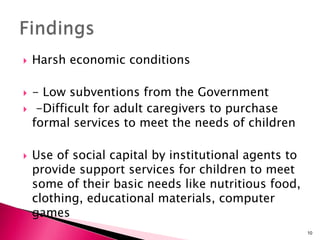
 Harsh economic conditions
 - Low subventions from the Government
 -Difficult for adult caregivers to purchase
formal services to meet the needs of children
 Use of social capital by institutional agents to
provide support services for children to meet
some of their basic needs like nutritious food,
clothing, educational materials, computer
games
10
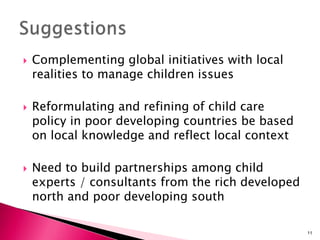
 Complementing global initiatives with local
realities to manage children issues
 Reformulating and refining of child care
policy in poor developing countries be based
on local knowledge and reflect local context
 Need to build partnerships among child
experts / consultants from the rich developed
north and poor developing south
11
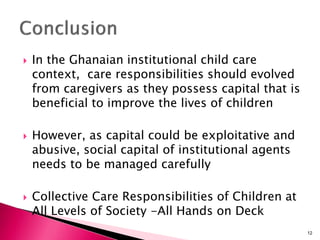
 In the Ghanaian institutional child care
context, care responsibilities should evolved
from caregivers as they possess capital that is
beneficial to improve the lives of children
 However, as capital could be exploitative and
abusive, social capital of institutional agents
needs to be managed carefully
 Collective Care Responsibilities of Children at
All Levels of Society -All Hands on Deck
12

Exploring an Alternative Approach to Improve the Lives of Children in Public Care in Ghana

  • 1.
  • 2.
    : Institutional childcare as an alternative care arrangement for children is under attack Global debate about the effectiveness of institutional child care • The ‘last resort argument’ • Last resort argument’ points to challenges and problems of child care in general 2
  • 3.
    • However differencesexist in the environment of global village of the rich developed north and poor developing south • This differences also affect institutional child care as alternative care arrangement being 3
  • 4.
    Varying definitions allof which however include the following three dimensions: • Adult caregivers provide support services and resources to address vulnerability and risk of children - abuse and neglect • address levels of (absolute) deprivation deemed unacceptable – food, clothing, shelter, health, water • form of intervention which is both social-(cultural) and public in character and acceptable 4
  • 5.
     Social –Demography  Economic  Cultural  Political  Policies / Programs for Children 5
  • 6.
    ◦ Reform highlyfocussed on institutional child care and less on fostering and adoption ◦ Suggesting a freeze on establishing new institutional child care in the face deepening poverty of families ◦ Nonetheless, institutional care is rising in Ghana especially private children homes 6
  • 7.
    • How couldwe reform institutional care from inside, rather than outside? • Search for new thinking or theoretical /conceptual models in the face of institutional care challenges • This calls for exploring resources in public children homes that could be invested to yield returns • Institutional capital is argued here as invaluable resource with high investment potentials to yield returns in the lives of the children in care 7
  • 8.
    • Starter -Salazer (1997; 2001; 2004; 2010) definition of institutional capital • Linking Institutional Capital to Social Capital • ‘Institutional Agents and Actors ’ are vital institutional capital • Who Are Institutional Agents / Actors? 8
  • 9.
    • Mainly employedqualitative research methods and data collection techniques • Key informant interviews with purposely selected 6 adult caregivers • Child drawings and generating informal conversations with purposively selected 12 children in care about their drawings 9
  • 10.
     Harsh economicconditions  - Low subventions from the Government  -Difficult for adult caregivers to purchase formal services to meet the needs of children  Use of social capital by institutional agents to provide support services for children to meet some of their basic needs like nutritious food, clothing, educational materials, computer games 10
  • 11.
     Complementing globalinitiatives with local realities to manage children issues  Reformulating and refining of child care policy in poor developing countries be based on local knowledge and reflect local context  Need to build partnerships among child experts / consultants from the rich developed north and poor developing south 11
  • 12.
     In theGhanaian institutional child care context, care responsibilities should evolved from caregivers as they possess capital that is beneficial to improve the lives of children  However, as capital could be exploitative and abusive, social capital of institutional agents needs to be managed carefully  Collective Care Responsibilities of Children at All Levels of Society -All Hands on Deck 12