
www.england.nhs.uk
Improvement analytics: innovation
to improve care and efficiency
Adam Steventon, Director of Analytics, The Health Foundation
Martin Caunt, Project Director, NHS England
www.england.nhs.uk
This workshop is split into five sections (with audience participation)
1. Why there is a need to assess the impact of innovations in delivery of care
and some of the challenges of doing so
2. Group discussion of your experience of the challenges of assessing the
impacts of your innovations to the delivery of care
3. Case study examples of how these challenges have been addressed in
previous analytical studies
4. Introduction to the Improvement Analytics Unit project aims and ambition,
and implementation plans
5. General discussion focussing on how we could help people like you meet
the challenge of assessing the impacts of innovations to the delivery of
care
Introducing the Improvement Analytics Unit:
a new partnership between
NHS England and The Health Foundation
www.england.nhs.uk
The NHS will take decisive steps to break down
the barriers in how care is provided
England is too diverse for a ‘one size fits all’ care
model to apply everywhere. Different local health
communities will be supported by the NHS’s national
leadership to choose from amongst a small number of
radical new care delivery options
…we will expand NHS operational research, RCT
capability and other methods to promote more
rigorous ways of answering high impact questions in
health services redesign
NHS England’s programmes of work have
their roots in the Five Year Forward View
www.england.nhs.uk
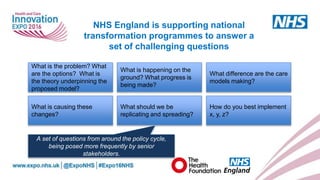
What is the problem? What
are the options? What is
the theory underpinning the
proposed model?
What is causing these
changes?
What is happening on the
ground? What progress is
being made?
What should we be
replicating and spreading?
What difference are the care
models making?
How do you best implement
x, y, z?
A set of questions from around the policy cycle,
being posed more frequently by senior
stakeholders.
NHS England is supporting national
transformation programmes to answer a
set of challenging questions
www.england.nhs.uk
Our values: clinical engagement, patient involvement, local ownership, national support
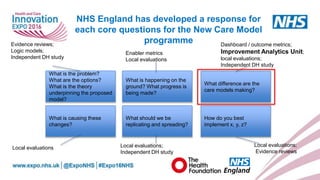
What is the problem?
What are the options?
What is the theory
underpinning the proposed
model?
What is causing these
changes?
What is happening on the
ground? What progress is
being made?
What should we be
replicating and spreading?
What difference are the
care models making?
How do you best
implement x, y, z?
Dashboard / outcome metrics;
Improvement Analytics Unit;
local evaluations;
Independent DH study
Evidence reviews;
Logic models;
Independent DH study
Enabler metrics
Local evaluations
Local evaluations Local evaluations;
Independent DH study
Local evaluations;
Evidence reviews
NHS England has developed a response for
each core questions for the New Care Model
programme
www.england.nhs.uk
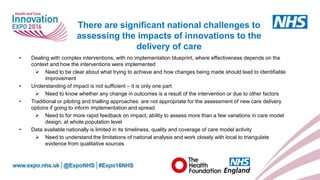
• Dealing with complex interventions, with no implementation blueprint, where effectiveness depends on the
context and how the interventions were implemented
 Need to be clear about what trying to achieve and how changes being made should lead to identifiable
improvement
• Understanding of impact is not sufficient – it is only one part
 Need to know whether any change in outcomes is a result of the intervention or due to other factors
• Traditional or piloting and trialling approaches are not appropriate for the assessment of new care delivery
options if going to inform implementation and spread
 Need to for more rapid feedback on impact, ability to assess more than a few variations in care model
design, at whole population level
• Data available nationally is limited in its timeliness, quality and coverage of care model activity
 Need to understand the limitations of national analysis and work closely with local to triangulate
evidence from qualitative sources
There are significant national challenges to
assessing the impacts of innovations to the
delivery of care
www.england.nhs.uk
• How are you approaching the challenge of assessing the impacts of
your innovations to the delivery of care?
AUDIENCE PARTICIPATION
www.england.nhs.uk
How do you evaluate things like…
• Intermediate care following hospital discharge
• Integrated health and social care teams
• Integrated care teams in the community
• Case management
• Telephone health coaching
• Telehealth
• Telecare
• Third-sector support following hospital discharge
• A national early warning system for COPD
• Nursing support at the end of life
• Virtual wards
• Rapid-response services
• Support workers for community matrons
• Short-term assessment and signposting services
• Structured care for dementia
• Structured care for diabetes
• Named accountable GPs
• Financial penalties for readmissions
www.england.nhs.uk
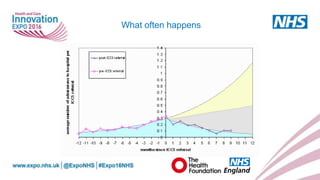
What often happens
www.england.nhs.uk
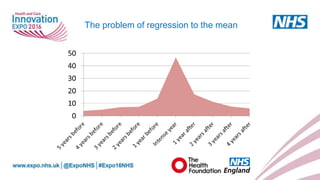
The problem of regression to the mean
www.england.nhs.uk
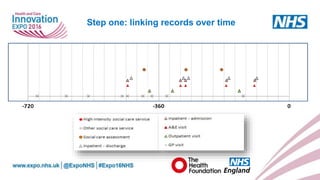
Step one: linking records over time
www.england.nhs.uk
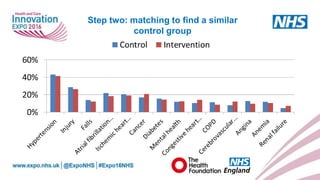
Step two: matching to find a similar
control group
www.england.nhs.uk
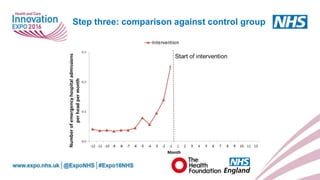
Step three: comparison against control group
www.england.nhs.uk
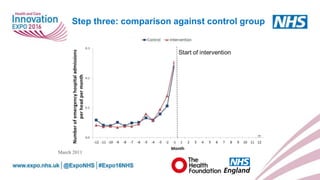
Step three: comparison against control group
www.england.nhs.uk
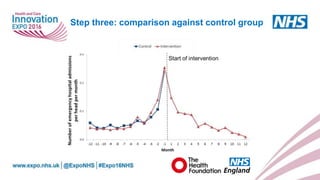
Step three: comparison against control group
www.england.nhs.uk
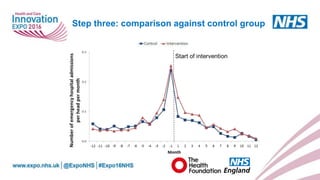
Step three: comparison against control group
www.england.nhs.uk
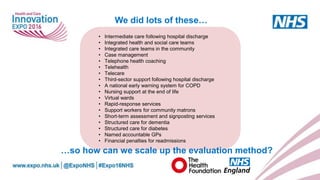
We did lots of these…
• Intermediate care following hospital discharge
• Integrated health and social care teams
• Integrated care teams in the community
• Case management
• Telephone health coaching
• Telehealth
• Telecare
• Third-sector support following hospital discharge
• A national early warning system for COPD
• Nursing support at the end of life
• Virtual wards
• Rapid-response services
• Support workers for community matrons
• Short-term assessment and signposting services
• Structured care for dementia
• Structured care for diabetes
• Named accountable GPs
• Financial penalties for readmissions
…so how can we scale up the evaluation method?
www.england.nhs.uk
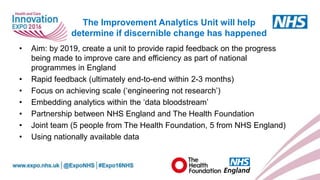
• Aim: by 2019, create a unit to provide rapid feedback on the progress
being made to improve care and efficiency as part of national
programmes in England
• Rapid feedback (ultimately end-to-end within 2-3 months)
• Focus on achieving scale (‘engineering not research’)
• Embedding analytics within the ‘data bloodstream’
• Partnership between NHS England and The Health Foundation
• Joint team (5 people from The Health Foundation, 5 from NHS England)
• Using nationally available data
The Improvement Analytics Unit will help
determine if discernible change has happened
www.england.nhs.uk
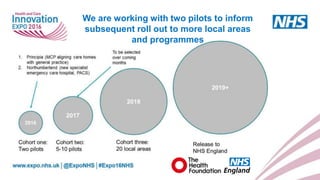
We are working with two pilots to inform
subsequent roll out to more local areas
and programmes
www.england.nhs.uk
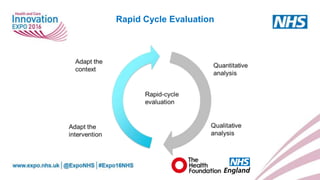
Rapid Cycle Evaluation
www.england.nhs.uk
• How could we help people like you meet the challenge of assessing the
impacts of innovations to the delivery of care?
• …and questions?
For more information please visit
http://www.health.org.uk/improvement-analytics-unit-faqs
AUDIENCE PARTICIPATION
www.england.nhs.uk
Annex – Supporting Slides
www.england.nhs.uk
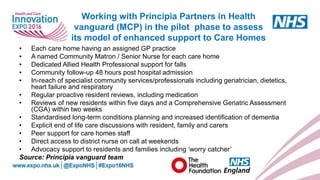
• Each care home having an assigned GP practice
• A named Community Matron / Senior Nurse for each care home
• Dedicated Allied Health Professional support for falls
• Community follow-up 48 hours post hospital admission
• In-reach of specialist community services/professionals including geriatrician, dietetics,
heart failure and respiratory
• Regular proactive resident reviews, including medication
• Reviews of new residents within five days and a Comprehensive Geriatric Assessment
(CGA) within two weeks
• Standardised long-term conditions planning and increased identification of dementia
• Explicit end of life care discussions with resident, family and carers
• Peer support for care homes staff
• Direct access to district nurse on call at weekends
• Advocacy support to residents and families including ‘worry catcher’
Source: Principia vanguard team
Working with Principia Partners in Health
vanguard (MCP) in the pilot phase to assess
its model of enhanced support to Care Homes
www.england.nhs.uk
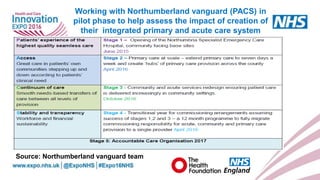
Working with Northumberland vanguard (PACS) in
pilot phase to help assess the impact of creation of
their integrated primary and acute care system
Source: Northumberland vanguard team

Improvement analytics: innovation to improve care and efficiency

  • 1.
    www.england.nhs.uk Improvement analytics: innovation toimprove care and efficiency Adam Steventon, Director of Analytics, The Health Foundation Martin Caunt, Project Director, NHS England
  • 2.
    www.england.nhs.uk This workshop issplit into five sections (with audience participation) 1. Why there is a need to assess the impact of innovations in delivery of care and some of the challenges of doing so 2. Group discussion of your experience of the challenges of assessing the impacts of your innovations to the delivery of care 3. Case study examples of how these challenges have been addressed in previous analytical studies 4. Introduction to the Improvement Analytics Unit project aims and ambition, and implementation plans 5. General discussion focussing on how we could help people like you meet the challenge of assessing the impacts of innovations to the delivery of care Introducing the Improvement Analytics Unit: a new partnership between NHS England and The Health Foundation
  • 3.
    www.england.nhs.uk The NHS willtake decisive steps to break down the barriers in how care is provided England is too diverse for a ‘one size fits all’ care model to apply everywhere. Different local health communities will be supported by the NHS’s national leadership to choose from amongst a small number of radical new care delivery options …we will expand NHS operational research, RCT capability and other methods to promote more rigorous ways of answering high impact questions in health services redesign NHS England’s programmes of work have their roots in the Five Year Forward View
  • 4.
    www.england.nhs.uk What is theproblem? What are the options? What is the theory underpinning the proposed model? What is causing these changes? What is happening on the ground? What progress is being made? What should we be replicating and spreading? What difference are the care models making? How do you best implement x, y, z? A set of questions from around the policy cycle, being posed more frequently by senior stakeholders. NHS England is supporting national transformation programmes to answer a set of challenging questions
  • 5.
    www.england.nhs.uk Our values: clinicalengagement, patient involvement, local ownership, national support What is the problem? What are the options? What is the theory underpinning the proposed model? What is causing these changes? What is happening on the ground? What progress is being made? What should we be replicating and spreading? What difference are the care models making? How do you best implement x, y, z? Dashboard / outcome metrics; Improvement Analytics Unit; local evaluations; Independent DH study Evidence reviews; Logic models; Independent DH study Enabler metrics Local evaluations Local evaluations Local evaluations; Independent DH study Local evaluations; Evidence reviews NHS England has developed a response for each core questions for the New Care Model programme
  • 6.
    www.england.nhs.uk • Dealing withcomplex interventions, with no implementation blueprint, where effectiveness depends on the context and how the interventions were implemented  Need to be clear about what trying to achieve and how changes being made should lead to identifiable improvement • Understanding of impact is not sufficient – it is only one part  Need to know whether any change in outcomes is a result of the intervention or due to other factors • Traditional or piloting and trialling approaches are not appropriate for the assessment of new care delivery options if going to inform implementation and spread  Need to for more rapid feedback on impact, ability to assess more than a few variations in care model design, at whole population level • Data available nationally is limited in its timeliness, quality and coverage of care model activity  Need to understand the limitations of national analysis and work closely with local to triangulate evidence from qualitative sources There are significant national challenges to assessing the impacts of innovations to the delivery of care
  • 7.
    www.england.nhs.uk • How areyou approaching the challenge of assessing the impacts of your innovations to the delivery of care? AUDIENCE PARTICIPATION
  • 8.
    www.england.nhs.uk How do youevaluate things like… • Intermediate care following hospital discharge • Integrated health and social care teams • Integrated care teams in the community • Case management • Telephone health coaching • Telehealth • Telecare • Third-sector support following hospital discharge • A national early warning system for COPD • Nursing support at the end of life • Virtual wards • Rapid-response services • Support workers for community matrons • Short-term assessment and signposting services • Structured care for dementia • Structured care for diabetes • Named accountable GPs • Financial penalties for readmissions
  • 9.
  • 10.
    www.england.nhs.uk The problem ofregression to the mean
  • 11.
  • 12.
    www.england.nhs.uk Step two: matchingto find a similar control group
  • 13.
  • 14.
  • 15.
  • 16.
  • 17.
    www.england.nhs.uk We did lotsof these… • Intermediate care following hospital discharge • Integrated health and social care teams • Integrated care teams in the community • Case management • Telephone health coaching • Telehealth • Telecare • Third-sector support following hospital discharge • A national early warning system for COPD • Nursing support at the end of life • Virtual wards • Rapid-response services • Support workers for community matrons • Short-term assessment and signposting services • Structured care for dementia • Structured care for diabetes • Named accountable GPs • Financial penalties for readmissions …so how can we scale up the evaluation method?
  • 18.
    www.england.nhs.uk • Aim: by2019, create a unit to provide rapid feedback on the progress being made to improve care and efficiency as part of national programmes in England • Rapid feedback (ultimately end-to-end within 2-3 months) • Focus on achieving scale (‘engineering not research’) • Embedding analytics within the ‘data bloodstream’ • Partnership between NHS England and The Health Foundation • Joint team (5 people from The Health Foundation, 5 from NHS England) • Using nationally available data The Improvement Analytics Unit will help determine if discernible change has happened
  • 19.
    www.england.nhs.uk We are workingwith two pilots to inform subsequent roll out to more local areas and programmes
  • 20.
  • 21.
    www.england.nhs.uk • How couldwe help people like you meet the challenge of assessing the impacts of innovations to the delivery of care? • …and questions? For more information please visit http://www.health.org.uk/improvement-analytics-unit-faqs AUDIENCE PARTICIPATION
  • 22.
  • 23.
    www.england.nhs.uk • Each carehome having an assigned GP practice • A named Community Matron / Senior Nurse for each care home • Dedicated Allied Health Professional support for falls • Community follow-up 48 hours post hospital admission • In-reach of specialist community services/professionals including geriatrician, dietetics, heart failure and respiratory • Regular proactive resident reviews, including medication • Reviews of new residents within five days and a Comprehensive Geriatric Assessment (CGA) within two weeks • Standardised long-term conditions planning and increased identification of dementia • Explicit end of life care discussions with resident, family and carers • Peer support for care homes staff • Direct access to district nurse on call at weekends • Advocacy support to residents and families including ‘worry catcher’ Source: Principia vanguard team Working with Principia Partners in Health vanguard (MCP) in the pilot phase to assess its model of enhanced support to Care Homes
  • 24.
    www.england.nhs.uk Working with Northumberlandvanguard (PACS) in pilot phase to help assess the impact of creation of their integrated primary and acute care system Source: Northumberland vanguard team