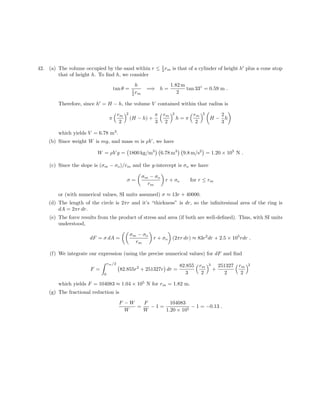
42. (a) The volume occupied by the sand within r ≤ 1 rm is that of a cylinder of height h plus a cone atop
                                                   2
        that of height h. To find h, we consider
                                                    h                    1.82 m
                                      tan θ =     1       =⇒ h =                tan 33◦ = 0.59 m .
                                                  2 rm
                                                                            2

         Therefore, since h = H − h, the volume V contained within that radius is

                                         rm   2               π     rm   2          rm   2     2
                                  π               (H − h) +                  h=π             H− h
                                          2                   3      2               2         3

         which yields V = 6.78 m3 .
    (b) Since weight W is mg, and mass m is ρV , we have

                          W = ρV g = 1800 kg/m3                    6.78 m3     9.8 m/s2 = 1.20 × 10⁵ N .

     (c) Since the slope is (σm − σo )/rm and the y-intercept is σo we have

                                                         σm − σo
                                              σ=                     r + σo        for r ≤ rm
                                                           rm

         or (with numerical values, SI units assumed) σ ≈ 13r + 40000.
    (d) The length of the circle is 2πr and it’s “thickness” is dr, so the infinitesimal area of the ring is
        dA = 2πr dr.
     (e) The force results from the product of stress and area (if both are well-defined). Thus, with SI units
         understood,

                                                  σm − σo
                       dF = σ dA =                            r + σo (2πr dr) ≈ 83r2 dr + 2.5 × 10⁵ rdr .
                                                    rm

     (f) We integrate our expression (using the precise numerical values) for dF and find
                                 rm /2                                                       3                   2
                                                                              82.855 rm              251327 rm
                       F =               82.855r2 + 251327r dr =                                 +
                             0                                                  3     2                2     2

         which yields F = 104083 ≈ 1.04 × 10⁵ N for rm = 1.82 m.
    (g) The fractional reduction is

                                         F −W   F       104083
                                              =   −1=            − 1 = −0.13 .
                                           W    W     1.20 × 10⁵

P13 042

  • 1.
    42. (a) Thevolume occupied by the sand within r ≤ 1 rm is that of a cylinder of height h plus a cone atop 2 that of height h. To find h, we consider h 1.82 m tan θ = 1 =⇒ h = tan 33◦ = 0.59 m . 2 rm 2 Therefore, since h = H − h, the volume V contained within that radius is rm 2 π rm 2 rm 2 2 π (H − h) + h=π H− h 2 3 2 2 3 which yields V = 6.78 m3 . (b) Since weight W is mg, and mass m is ρV , we have W = ρV g = 1800 kg/m3 6.78 m3 9.8 m/s2 = 1.20 × 10⁵ N . (c) Since the slope is (σm − σo )/rm and the y-intercept is σo we have σm − σo σ= r + σo for r ≤ rm rm or (with numerical values, SI units assumed) σ ≈ 13r + 40000. (d) The length of the circle is 2πr and it’s “thickness” is dr, so the infinitesimal area of the ring is dA = 2πr dr. (e) The force results from the product of stress and area (if both are well-defined). Thus, with SI units understood, σm − σo dF = σ dA = r + σo (2πr dr) ≈ 83r2 dr + 2.5 × 10⁵ rdr . rm (f) We integrate our expression (using the precise numerical values) for dF and find rm /2 3 2 82.855 rm 251327 rm F = 82.855r2 + 251327r dr = + 0 3 2 2 2 which yields F = 104083 ≈ 1.04 × 10⁵ N for rm = 1.82 m. (g) The fractional reduction is F −W F 104083 = −1= − 1 = −0.13 . W W 1.20 × 10⁵