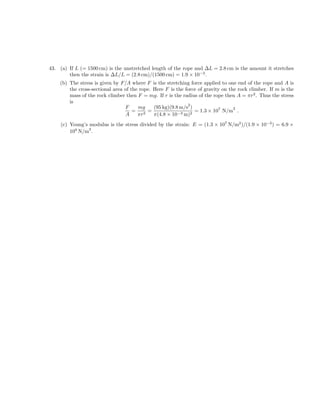
43. (a) If L (= 1500 cm) is the unstretched length of the rope and ∆L = 2.8 cm is the amount it stretches
        then the strain is ∆L/L = (2.8 cm)/(1500 cm) = 1.9 × 10⁻³ .
    (b) The stress is given by F/A where F is the stretching force applied to one end of the rope and A is
        the cross-sectional area of the rope. Here F is the force of gravity on the rock climber. If m is the
        mass of the rock climber then F = mg. If r is the radius of the rope then A = πr2 . Thus the stress
        is
                                                             2
                                 F     mg     (95 kg)(9.8 m/s )                   2
                                     = 2 =                      = 1.3 × 10⁷ N/m .
                                 A     πr     π(4.8 × 10⁻³ m)2
     (c) Young’s modulus is the stress divided by the strain: E = (1.3 × 10⁷ N/m2 )/(1.9 × 10−3 ) = 6.9 ×
                 2
         109 N/m .

P13 043

  • 1.
    43. (a) IfL (= 1500 cm) is the unstretched length of the rope and ∆L = 2.8 cm is the amount it stretches then the strain is ∆L/L = (2.8 cm)/(1500 cm) = 1.9 × 10⁻³ . (b) The stress is given by F/A where F is the stretching force applied to one end of the rope and A is the cross-sectional area of the rope. Here F is the force of gravity on the rock climber. If m is the mass of the rock climber then F = mg. If r is the radius of the rope then A = πr2 . Thus the stress is 2 F mg (95 kg)(9.8 m/s ) 2 = 2 = = 1.3 × 10⁷ N/m . A πr π(4.8 × 10⁻³ m)2 (c) Young’s modulus is the stress divided by the strain: E = (1.3 × 10⁷ N/m2 )/(1.9 × 10−3 ) = 6.9 × 2 109 N/m .