Mahirajsinh S. Parmar Int. Journal of Engineering Research and Applications www.ijera.com
ISSN : 2248-9622, Vol. 4, Issue 12( Part 3), December 2014, pp.94-96
www.ijera.com 1 | P a g e
Project Definition Rating Index with Feasibility Study in
Infrastructure Projects
Mahirajsinh S. Parmar,
(Department of Civil Engineering, Dr.D.Y.Patil School of Engineering And Technology, Pune)
ABSTRACT
Project Definition Rating Index is a rating tool which helps in predicting the outcome of project. Infrastructure
projects are very complex as number of organizations involved is more, the money involved is also too big. In
spite of feasibility study done on infrastructure project there are many cases where huge projects have failed
having positive feasibility study. PDRI combined with feasibility study can help in achieving knowledge of
different hidden areas which might not be seen in feasibility study and vice versa. Combination of these two
predicting tools can help in making pre-planning work even better.
Keywords – Combination, Feasibility study, Infrastructure projects, PDRI, Predicting tools
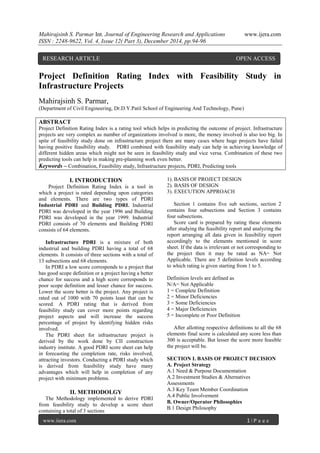
I. INTRODUCTION
Project Definition Rating Index is a tool in
which a project is rated depending upon categories
and elements. There are two types of PDRI
Industrial PDRI and Building PDRI. Industrial
PDRI was developed in the year 1996 and Building
PDRI was developed in the year 1999. Industrial
PDRI consists of 70 elements and Building PDRI
consists of 64 elements.
Infrastructure PDRI is a mixture of both
industrial and building PDRI having a total of 68
elements. It consists of three sections with a total of
13 subsections and 68 elements.
In PDRI a low score corresponds to a project that
has good scope definition or a project having a better
chance for success and a high score corresponds to
poor scope definition and lesser chance for success.
Lower the score better is the project. Any project is
rated out of 1000 with 70 points least that can be
scored. A PDRI rating that is derived from
feasibility study can cover more points regarding
project aspects and will increase the success
percentage of project by identifying hidden risks
involved.
The PDRI sheet for infrastructure project is
derived by the work done by CII construction
industry institute. A good PDRI score sheet can help
in forecasting the completion rate, risks involved,
attracting investors. Conducting a PDRI study which
is derived from feasibility study have many
advantages which will help in completion of any
project with minimum problems.
II. METHODOLGY
The Methodology implemented to derive PDRI
from feasibility study to develop a score sheet
containing a total of 3 sections
1). BASIS OF PROJECT DESIGN
2). BASIS OF DESIGN
3). EXECUTION APPROACH
Section 1 contains five sub sections, section 2
contains four subsections and Section 3 contains
four subsections.
Score card is prepared by rating these elements
after studying the feasibility report and analyzing the
report arranging all data given in feasibility report
accordingly to the elements mentioned in score
sheet. If the data is irrelevant or not corresponding to
the project then it may be rated as NA= Not
Applicable. There are 5 definition levels according
to which rating is given starting from 1 to 5.
Definition levels are defined as
N/A= Not Applicable
1 = Complete Definition
2 = Minor Deficiencies
3 = Some Deficiencies
4 = Major Deficiencies
5 = Incomplete or Poor Definition
After allotting respective definitions to all the 68
elements final score is calculated any score less than
300 is acceptable. But lesser the score more feasible
the project will be.
SECTION I. BASIS OF PROJECT DECISION
A. Project Strategy
A.1 Need & Purpose Documentation
A.2 Investment Studies & Alternatives
Assessments
A.3 Key Team Member Coordination
A.4 Public Involvement
B. Owner/Operator Philosophies
B.1 Design Philosophy
RESEARCH ARTICLE OPEN ACCESS
Mahirajsinh S. Parmar Int. Journal of Engineering Research and Applications www.ijera.com
ISSN : 2248-9622, Vol. 4, Issue 12( Part 3), December 2014, pp.94-96
www.ijera.com 2 | P a g e
B.2 Operating Philosophy
B.3 Maintenance Philosophy
B.4 Future Expansion & Alteration
Considerations
C. Project Funding and Timing
C.1 Funding & Programming
C.2 Preliminary Project Schedule
C.3 Contingencies
D. Project Requirements
D.1 Project Objectives Statement
D.2 Functional Classification & Use
D.3 Evaluation of Compliance Requirements
D.4 Existing Environmental Conditions
D.5 Site Characteristics Available vs. Required
D.6 Dismantling & Demolition Requirements
D.7 Determination of Utility Impacts
D.8 Lead/Discipline Scope of Work
E. Value Analysis
E.1 Value Engineering Procedures
E.2 Design Simplification
E.3 Material Alternatives Considered
E.4 Constructability Procedures
SECTION II. BASIS OF DESIGN
F. Site Information
F.1 Geotechnical Characteristics
F.2 Hydrological Characteristics
F.3 Surveys & Mapping
F.4 Permitting Requirements
F.5 Environmental Documentation
F.6 Environmental Commitments & Mitigation
F.7 Property Descriptions
F.8 Right-of-Way Mapping & Site Issues
G. Location and Geometry
G.1 Schematic Layouts
G.2 Horizontal & Vertical Alignment
G.3 Cross-Sectional Elements
G.4 Control of Access
H. Associated Structures and Equipment
H.1 Support Structures
H.2 Hydraulic Structures
H.3 Miscellaneous Elements
H.4 Equipment List
H.5 Equipment Utility Requirements
I. Project Design Parameters
I.1 Capacity
I.2 Safety & Hazards
I.3 Civil/Structural
I.4 Mechanical/Equipment
I.5 Electrical/Controls
I.6 Operations/Maintenance
SECTION III. EXECUTION APPROACH
J. Land Acquisition Strategy
J.1 Local Public Agencies Contracts &
Agreements
J.2 Long-Lead Parcel & Utility Adjustment
Identification & Acquisition
J.3 Utility Agreement & Joint-Use Contracts
J.4 Land Appraisal Requirements
J.5 Advance Land Acquisition Requirements
K. Procurement Strategy
K.1 Project Delivery Method & Contracting
Strategies
K.2 Long-Lead/Critical Equipment & Materials
Identification
K.3 Procurement Procedures & Plans
K.4 Procurement Responsibility Matrix
L. Project Control
L.1 Right-of-Way & Utilities Cost Estimates
L.2 Design & Construction Cost Estimates
L.3 Project Cost Control
L.4 Project Schedule Control
L.5 Project Quality Assurance & Control
M. Project Execution Plan
M.1 Safety Procedures
M.2 Owner Approval Requirements
M.3 Documentation/Deliverables
M.4 Computing & CADD/Model Requirements
M.5 Design/Construction Plan & Approach
M.6 Intercompany & Interagency Coordination
& agreements
M.7 Work Zone and Transportation Plan
M.8 Project Completion Requirements
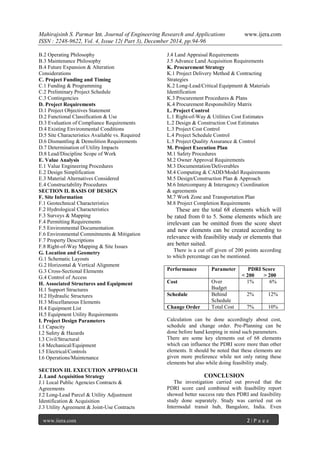
These are the total 68 elements which will
be rated from 0 to 5. Some elements which are
irrelevant can be omitted from the score sheet
and new elements can be created according to
relevance with feasibility study or elements that
are better suited.
There is a cut off given of 200 points according
to which percentage can be mentioned.
Performance Parameter PDRI Score
< 200 > 200
Cost Over
Budget
1% 6%
Schedule Behind
Schedule
2% 12%
Change Order Total Cost 7% 10%
Calculation can be done accordingly about cost,
schedule and change order. Pre-Planning can be
done before hand keeping in mind such parameters.
There are some key elements out of 68 elements
which can influence the PDRI score more than other
elements. It should be noted that these elements are
given more preference while not only rating these
elements but also while doing feasibility study.
CONCLUSION
The investigation carried out proved that the
PDRI score card combined with feasibility report
showed better success rate then PDRI and feasibility
study done separately. Study was carried out on
Intermodal transit hub, Bangalore, India. Even
Mahirajsinh S. Parmar Int. Journal of Engineering Research and Applications www.ijera.com
ISSN : 2248-9622, Vol. 4, Issue 12( Part 3), December 2014, pp.94-96
www.ijera.com 3 | P a g e
though there were some problems regarding revenue
generation from the project PDRI with feasibility
report combined were able to generate some strong
result.
REFERENCES
Journal Paper:
[1]. Peter R. Dumont, SCOPE MANAGEMENT
USING PROJECT DEFINITION RATING
INDEX.
Theses:
[2]. Evan Bingham, Development of the Project
Definition Rating Index (PDRI) For
Infrastructure Projects. ARIZONA STATE
UNIVERSITY, Dec-2010
[3]. Wang, Applying The Project Definition
Rating Index Into Project Risk
Management.Aug-2002
[4]. NASA pre-planning team, Project Definition
Rating Index Used On NASA Facilities. April-
2000

Project Definition Rating Index with Feasibility Study in Infrastructure Projects

  • 1.
    Mahirajsinh S. ParmarInt. Journal of Engineering Research and Applications www.ijera.com ISSN : 2248-9622, Vol. 4, Issue 12( Part 3), December 2014, pp.94-96 www.ijera.com 1 | P a g e Project Definition Rating Index with Feasibility Study in Infrastructure Projects Mahirajsinh S. Parmar, (Department of Civil Engineering, Dr.D.Y.Patil School of Engineering And Technology, Pune) ABSTRACT Project Definition Rating Index is a rating tool which helps in predicting the outcome of project. Infrastructure projects are very complex as number of organizations involved is more, the money involved is also too big. In spite of feasibility study done on infrastructure project there are many cases where huge projects have failed having positive feasibility study. PDRI combined with feasibility study can help in achieving knowledge of different hidden areas which might not be seen in feasibility study and vice versa. Combination of these two predicting tools can help in making pre-planning work even better. Keywords – Combination, Feasibility study, Infrastructure projects, PDRI, Predicting tools I. INTRODUCTION Project Definition Rating Index is a tool in which a project is rated depending upon categories and elements. There are two types of PDRI Industrial PDRI and Building PDRI. Industrial PDRI was developed in the year 1996 and Building PDRI was developed in the year 1999. Industrial PDRI consists of 70 elements and Building PDRI consists of 64 elements. Infrastructure PDRI is a mixture of both industrial and building PDRI having a total of 68 elements. It consists of three sections with a total of 13 subsections and 68 elements. In PDRI a low score corresponds to a project that has good scope definition or a project having a better chance for success and a high score corresponds to poor scope definition and lesser chance for success. Lower the score better is the project. Any project is rated out of 1000 with 70 points least that can be scored. A PDRI rating that is derived from feasibility study can cover more points regarding project aspects and will increase the success percentage of project by identifying hidden risks involved. The PDRI sheet for infrastructure project is derived by the work done by CII construction industry institute. A good PDRI score sheet can help in forecasting the completion rate, risks involved, attracting investors. Conducting a PDRI study which is derived from feasibility study have many advantages which will help in completion of any project with minimum problems. II. METHODOLGY The Methodology implemented to derive PDRI from feasibility study to develop a score sheet containing a total of 3 sections 1). BASIS OF PROJECT DESIGN 2). BASIS OF DESIGN 3). EXECUTION APPROACH Section 1 contains five sub sections, section 2 contains four subsections and Section 3 contains four subsections. Score card is prepared by rating these elements after studying the feasibility report and analyzing the report arranging all data given in feasibility report accordingly to the elements mentioned in score sheet. If the data is irrelevant or not corresponding to the project then it may be rated as NA= Not Applicable. There are 5 definition levels according to which rating is given starting from 1 to 5. Definition levels are defined as N/A= Not Applicable 1 = Complete Definition 2 = Minor Deficiencies 3 = Some Deficiencies 4 = Major Deficiencies 5 = Incomplete or Poor Definition After allotting respective definitions to all the 68 elements final score is calculated any score less than 300 is acceptable. But lesser the score more feasible the project will be. SECTION I. BASIS OF PROJECT DECISION A. Project Strategy A.1 Need & Purpose Documentation A.2 Investment Studies & Alternatives Assessments A.3 Key Team Member Coordination A.4 Public Involvement B. Owner/Operator Philosophies B.1 Design Philosophy RESEARCH ARTICLE OPEN ACCESS
  • 2.
    Mahirajsinh S. ParmarInt. Journal of Engineering Research and Applications www.ijera.com ISSN : 2248-9622, Vol. 4, Issue 12( Part 3), December 2014, pp.94-96 www.ijera.com 2 | P a g e B.2 Operating Philosophy B.3 Maintenance Philosophy B.4 Future Expansion & Alteration Considerations C. Project Funding and Timing C.1 Funding & Programming C.2 Preliminary Project Schedule C.3 Contingencies D. Project Requirements D.1 Project Objectives Statement D.2 Functional Classification & Use D.3 Evaluation of Compliance Requirements D.4 Existing Environmental Conditions D.5 Site Characteristics Available vs. Required D.6 Dismantling & Demolition Requirements D.7 Determination of Utility Impacts D.8 Lead/Discipline Scope of Work E. Value Analysis E.1 Value Engineering Procedures E.2 Design Simplification E.3 Material Alternatives Considered E.4 Constructability Procedures SECTION II. BASIS OF DESIGN F. Site Information F.1 Geotechnical Characteristics F.2 Hydrological Characteristics F.3 Surveys & Mapping F.4 Permitting Requirements F.5 Environmental Documentation F.6 Environmental Commitments & Mitigation F.7 Property Descriptions F.8 Right-of-Way Mapping & Site Issues G. Location and Geometry G.1 Schematic Layouts G.2 Horizontal & Vertical Alignment G.3 Cross-Sectional Elements G.4 Control of Access H. Associated Structures and Equipment H.1 Support Structures H.2 Hydraulic Structures H.3 Miscellaneous Elements H.4 Equipment List H.5 Equipment Utility Requirements I. Project Design Parameters I.1 Capacity I.2 Safety & Hazards I.3 Civil/Structural I.4 Mechanical/Equipment I.5 Electrical/Controls I.6 Operations/Maintenance SECTION III. EXECUTION APPROACH J. Land Acquisition Strategy J.1 Local Public Agencies Contracts & Agreements J.2 Long-Lead Parcel & Utility Adjustment Identification & Acquisition J.3 Utility Agreement & Joint-Use Contracts J.4 Land Appraisal Requirements J.5 Advance Land Acquisition Requirements K. Procurement Strategy K.1 Project Delivery Method & Contracting Strategies K.2 Long-Lead/Critical Equipment & Materials Identification K.3 Procurement Procedures & Plans K.4 Procurement Responsibility Matrix L. Project Control L.1 Right-of-Way & Utilities Cost Estimates L.2 Design & Construction Cost Estimates L.3 Project Cost Control L.4 Project Schedule Control L.5 Project Quality Assurance & Control M. Project Execution Plan M.1 Safety Procedures M.2 Owner Approval Requirements M.3 Documentation/Deliverables M.4 Computing & CADD/Model Requirements M.5 Design/Construction Plan & Approach M.6 Intercompany & Interagency Coordination & agreements M.7 Work Zone and Transportation Plan M.8 Project Completion Requirements These are the total 68 elements which will be rated from 0 to 5. Some elements which are irrelevant can be omitted from the score sheet and new elements can be created according to relevance with feasibility study or elements that are better suited. There is a cut off given of 200 points according to which percentage can be mentioned. Performance Parameter PDRI Score < 200 > 200 Cost Over Budget 1% 6% Schedule Behind Schedule 2% 12% Change Order Total Cost 7% 10% Calculation can be done accordingly about cost, schedule and change order. Pre-Planning can be done before hand keeping in mind such parameters. There are some key elements out of 68 elements which can influence the PDRI score more than other elements. It should be noted that these elements are given more preference while not only rating these elements but also while doing feasibility study. CONCLUSION The investigation carried out proved that the PDRI score card combined with feasibility report showed better success rate then PDRI and feasibility study done separately. Study was carried out on Intermodal transit hub, Bangalore, India. Even
  • 3.
    Mahirajsinh S. ParmarInt. Journal of Engineering Research and Applications www.ijera.com ISSN : 2248-9622, Vol. 4, Issue 12( Part 3), December 2014, pp.94-96 www.ijera.com 3 | P a g e though there were some problems regarding revenue generation from the project PDRI with feasibility report combined were able to generate some strong result. REFERENCES Journal Paper: [1]. Peter R. Dumont, SCOPE MANAGEMENT USING PROJECT DEFINITION RATING INDEX. Theses: [2]. Evan Bingham, Development of the Project Definition Rating Index (PDRI) For Infrastructure Projects. ARIZONA STATE UNIVERSITY, Dec-2010 [3]. Wang, Applying The Project Definition Rating Index Into Project Risk Management.Aug-2002 [4]. NASA pre-planning team, Project Definition Rating Index Used On NASA Facilities. April- 2000