Oginni and Ojoawo, Int. Journal of Engineering Research and Applications www.ijera.com
ISSN: 2248-9622, Vol. 4, Issue 12 (Part 1), December 2014, pp.94-104
www.ijera.com 94 | P a g e
Assessment of sanitation levels of sources of water in Osun State
Capital, Nigeria
Felix A. Oginni1
and Samson O. Ojoawo2
*
1
Department of Civil Engineering, Osun State University, PMB 4494, Oshogbo, Nigeria.
2
Department of Civil Engineering, NMAM Institute of Technology, Nitte-574110,
Udupi District, Karnataka, India.
Abstract
A study of the physicochemical and bacteriological analysis including BOD and COD was carried out for sources of
water in Oshogbo the Capital of the State of Osun. Seven water sampling areas were selected to cover the low,
medium and high population density areas of the State Capital. Water samples were collected from five sources of
water, namely, shallow well, borehole, stream, rain and river. Water samples were collected from the well, borehole
and stream water sources from Dada Estate and Isale Oshun for low density population, Ayetoro, Ogo-Oluwa and
Oke-Ayepe for medium density, and Oke-Bale and Igbona for high density population areas. Three sampling points
were undertaken for the rain water source while River Oshun source at Isale-Oshun was the 25th
water sampling
point. A total of 25 water quality parameters were analyzed for each of the 25 water sources sampled using the
facility at the Rural Water And Environmental Sanitation Agency, RUWESA in Osun State Government Secretariat
in Abere. Results indicated that 8 of the water quality parameters, pH, Turbidity; Magnesium hardness, Free
Chlorine, Nitrite, Bacteriological, BOD and COD were not within Standards Organization of Nigeria (SON)
permitted water quality standards and are of concern to sanitation of potable water in the State Capital. The level of
each parameter differs from source to source as well as from level of population densities. The sources that were
adjudged polluted were Ogo-Oluwa and Oke-Ayepe well sources; Ogo-Oluwa, Oke-Bale and Igbona stream sources
Oke-Bale Rain source.R and the River source at Isale-Oshun. The polluted sources are all within the medium and
high population density areas of the State Capital.
Keywords : Population density; Water source; Sanitation level; Permissible level; Physicochemical;
Bacteriological
I. General Introduction
Osun State, a 23 year-old state in the South
Western part of Nigeria was one of the nine States
created in 1991to make a total of 30 States, then. The
Capital of the State is Oshogbo. Oshogbo is the
economic center of Osun State even prior to its being
elevated to the status of a State Capital in 1991. The
map of Osun State located in Nigeria is shown in Figure
1.
RESEARCH ARTICLE OPEN ACCESS
Oginni and Ojoawo, Int. Journal of Engineering Research and Applications www.ijera.com
ISSN: 2248-9622, Vol. 4, Issue 12 (Part 1), December 2014, pp.94-104
www.ijera.com 95 | P a g e
Figure 1: Map of Nigeria with Osun State carved within.
Oshogbo, a 23 years old Capital city is considered for
this study because of its peculiarities. It is a developing
residential city in the Southwestern part of Nigeria.
shares the same similarities with Ibadan, one of the
large and old cities in Africa. Fadare and Hay (1990)
noted that there exist three distinct residential densities
(low, medium and high residential densities) in Ibadan.
Olawuni (1999) identified similar pattern of three
residential densities in Oshogbo as high, medium and
low residential densities. The high residential density
area in Oshogbo is comprised of housing that are laid
out in traditional compounds with many small rooms,
limited open space, almost no road, or formal recreation
space, and homogeneous population. The medium
residential density area is mostly well laid out, with a
regular street plan, having many plots almost
completely occupied by two or three-storey buildings.
Although, there is an attempt to control land use,
numerous retail services and other commercial activities
exist within the zone, but industries are largely absent.
The population in these areas is less homogenous,
consisting of people of diverse ethnic origins. The low
residential density area was initially established to
provide low rent accommodation for public sector
employees in government institutions.
Oshogbo with a population of 131, 761 at the 2006
census on an area of 97 km² is administratively divided
into two local government areas. These are Oshogbo
and Olorunda Local Government Areas.
Water forms about 70 per cent of human’s body fluids
and serves many other purposes among which are
domestic, industrial, agricultural, fire protection and
others (Ojoawo and Ogunrombi, 2014). Quality is
mostly believed to best describe any given water more
than other yardsticks; water quality assessment is
therefore a worthwhile study (Ojoawo et al., 2014).
Monitoring of quality of water sources is required in
determination of sanitation level of any community.
Marmot, et al., (1997) emphasized on implications of
social inequalities in health as a sanitation issue. Satone,
et al., (2011) recommended measures on the need to
monitor drinking water quality. Access to safe water
facilities is estimated at 43% for rural areas and 71% for
urban centers while rural sanitation coverage is 32%
and urban 75%. And that as a result of inadequate safe
water supply and sanitation facilities, people suffer
from water related diseases such as diarrhea, cholera,
typhoid, and guinea worm in many communities (ADF,
2007). Fadare and Olawuni, (2008) indicated that there
is a significant relationship between water sources and
ill health in the three residential densities in osogbo.
There is therefore the need to stem this trend. Workers
in this field include Kaonga et al., (2013), Yusuf et al.,
Oginni, (2013), Oginni and Isiorho, (2014), Jiboye,
(2004), Akindele and Adeniyi, (2013), Akan et al.,
(2012), Olajire and Imeokparia, (2011).
Sanitation level of this State Capital City has been
assessed in this paper to serve as bases for justifying
Government’s steps towards the Urban renewal
programs on the water supply platform within the State.
This will be at tandem with the commitment of the State
Government to improvement of the environment.
II. Methods and materials
Oginni and Ojoawo, Int. Journal of Engineering Research and Applications www.ijera.com
ISSN: 2248-9622, Vol. 4, Issue 12 (Part 1), December 2014, pp.94-104
www.ijera.com 96 | P a g e
The method employed focused on collection of samples
of water from various sources available within the two
Local Government areas in the State Capital and
evaluation of the quality of the various sources for their
physical, chemical, and biological characteristics.
2.1 Study Area and water source types
The study area considered out is shown in Figure 2. The
carved area covers all the three distinct residential
densities known as low, medium and high residential
densities. And the area covers as much as 80% of the
entire City.
The sites for the water sources were selected randomly
but representative of the carved area.
Various types of sources of water considered in this
study are obtained from:
(i) Well (ii) Borehole
(iii) Rain (iv) Stream
(v) River
The common sources of water which this community
depend upon for their water needs are well, borehole,
stream and rainfall sources in that order. The entire City
is being drained by the major river, River Osun, that
gave the State its name to bear. This source is only
considered as one of the sources.
2.2 Selection of Sub-areas for water sources
In considering the population structure of the State
Capital, a total of seven areas were selected within the
area demarcated by the City ring road. The areas
represented the low density, medium density and the
high density population structure of Oshogbo. The
following areas and their population density of the City
were selected:
(i) Dada Estate - Low density
(ii) Isale Oshun - Low density
(iii) Ayetoro - Medium density
(iv) Ogooluwa - Medium density
(v) Oke Ayepe - Medium density
(vi) Oke Baale - High density
(vii) Igbona - High density
The sampling points are located in the Google earth
map shown in Figure 2.
Figure 2: Google Earth Map of Water Sources and Sampling Points
2.3 Layout of water source sampling Well water, borehole water rain water and stream
water sources were identified for each of the
Oginni and Ojoawo, Int. Journal of Engineering Research and Applications www.ijera.com
ISSN: 2248-9622, Vol. 4, Issue 12 (Part 1), December 2014, pp.94-104
www.ijera.com 97 | P a g e
population structures/densities identified in section
2.2. Water samples for each type of source were then
collected from all the identified sources. This should
give a total of 28(No) water sources from the four
source types over the seven identified population
sectors. Because of the unpredictability of rainfall,
rain water could only be obtained for testing from
only four of the population sectors.
The river as a source was only sampled at a location,
Isale-oshun. Thus a total of 26 sampling points were
assessed for their physical, chemical and biological
quality parameters.
2.4 Determination of Water Quality of each
Source
Physico-Chemical and bacteriological analysis are
required for each source in order to determine the
qualities of the sources. The water quality parameters
determined include the following:
Colour Odour
Taste Temperature
Ph Conductivity
Turbidity T.D.S
T. Hardness Ca. Hardness
Mg. Hardness Alkalinity
Chloride Fluoride
Free Chlorine Total Chlorine
Nitrate Nitrite
Iron Manganese
Arsenic Zinc
Bacteriological BOD
COD
The physicochemical and bacteriological analysis
including BOD and COD of various sources of water
obtained from office of Rural Water and Sanitation
Agency, RWESA in Osun State Government
Secretariat in Abere.
2.5 Collections of Samples and Sampling
materials
Much care is required and was taken in the collection
of the water samples used in this study to ensure the
sample is representative of the water and waste water
desired to be examined and to avoid accidental
contamination of the samples.
The sampling materials include the following:
Sterile petri dishes
Cuvet
Air-tight plastic containers
Measuring cylinder
Distilled water 70% ethanol
Cotton wool
pH meter Turbidity meter
Reagents
Photometer
2.6 Sterilization of media and materials
All media were prepared from dehydrated
commercial product with strict adherence to
manufacturer’s instructions and sterilizing by
autoclaving at 121°C for 15 minutes (Fawole and
Oso, 2004). All glass wares were thoroughly washed
with detergent solution, rinsed with several changes
of distilled water and subsequently allowed to drain,
after they were sterilized in the oven at 170°C for 1
hour before use (Fawole and Oso, 2004). Heat
sensitive wares were disinfected with 70% ethanol.
The working bench was also swabbed with 70%
alcohol to have a sterile environment.
III. Results and analysis
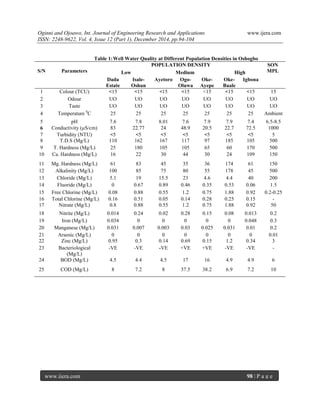
Results of the well water quality parameters
listed in section 2.4 for the various sources are
presented in Table 1. The water quality parameters
whose levels were not within permissible levels
specified by the Standards Organization of Nigeria,
SON, for all samples from all the sources and
sampling points are presented in Table 2 for all
samples from well, borehole, stream, rain and river.
Oginni and Ojoawo, Int. Journal of Engineering Research and Applications www.ijera.com
ISSN: 2248-9622, Vol. 4, Issue 12 (Part 1), December 2014, pp.94-104
www.ijera.com 98 | P a g e
Table 1:Well Water Quality at Different Population Densities in Oshogbo
S/N Parameters
POPULATION DENSITY SON
MPLLow Medium High
Dada
Estate
Isale-
Oshun
Ayetoro Ogo-
Oluwa
Oke-
Ayepe
Oke-
Baale
Igbona
1 Colour (TCU) <15 <15 <15 <15 <15 <15 <15 15
2 Odour UO UO UO UO UO UO UO UO
3 Taste UO UO UO UO UO UO UO UO
4 Temperature 0
C 25 25 25 25 25 25 25 Ambient
5 pH 7.6 7.8 8.01 7.6 7.9 7.9 7.4 6.5-8.5
6 Conductivity (µS/cm) 83 22.77 24 48.9 20.5 22.7 72.5 1000
7 Turbidity (NTU) <5 <5 <5 <5 <5 <5 <5 5
8 T.D.S (Mg/L) 110 162 167 117 97 185 105 500
9 T. Hardness (Mg/L) 25 180 105 105 65 60 170 500
10 Ca. Hardness (Mg/L) 16 22 30 44 30 24 109 150
11 Mg. Hardness (Mg/L) 61 83 45 35 36 174 61 150
12 Alkalinity (Mg/L) 100 85 75 80 55 178 45 500
13 Chloride (Mg/L) 5.1 19 15.5 23 4.6 4.4 40 200
14 Fluoride (Mg/L) 0 0.67 0.89 0.46 0.35 0.53 0.06 1.5
15 Free Chlorine (Mg/L) 0.08 0.88 0.55 1.2 0.75 1.88 0.92 0.2-0.25
16 Total Chlorine (Mg/L) 0.16 0.51 0.05 0.14 0.28 0.25 0.15 -
17 Nitrate (Mg/L) 0.8 0.88 0.55 1.2 0.75 1.88 0.92 50
18 Nitrite (Mg/L) 0.014 0.24 0.02 0.28 0.15 0.08 0.013 0.2
19 Iron (Mg/L) 0.034 0 0 0 0 0 0.048 0.3
20 Manganese (Mg/L) 0.031 0.007 0.003 0.03 0.025 0.031 0.01 0.2
21 Arsenic (Mg/L) 0 0 0 0 0 0 0 0.01
22 Zinc (Mg/L) 0.95 0.3 0.14 0.69 0.15 1.2 0.34 3
23 Bacteriological
(Mg/L)
-VE -VE -VE +VE +VE -VE -VE -
24 BOD (Mg/L) 4.5 4.4 4.5 17 16 4.9 4.9 6
25 COD (Mg/L) 8 7.2 8 37.5 38.2 6.9 7.2 10
Oginni and Ojoawo, Int. Journal of Engineering Research and Applications www.ijera.com
ISSN: 2248-9622, Vol. 4, Issue 12 ( Part 1), December 2014, pp.94-104
www.ijera.com 99 | P a g e
Table 2: Water Quality Parameters Not Within SON Levels For Water Sources at different Population
Density Areas of Oshogbo
WELL POPULATION DENSITY
S/N Parameters LOW MEDIUM HIGH SON
Parameters Dada
Estate
Isale-
Oshun
Ayeto
ro
Ogo-
Oluwa
Oke-
Ayepe
Oke-
Baale
Igbona MPL
WELL
11 Mg. Hardness (Mg/L) 61 83 45 35 36 174 61 150
15 Free Chlorine (Mg/L) 0.08 0.88 0.55 1.2 0.75 1.88 0.92 0.2-0.25
18 Nitrite (Mg/L) 0.014 0.24 0.02 0.28 0.15 0.08 0.013 0.2
23 Bacteriological (Mg/L) -VE -VE -VE +VE +VE -VE -VE
24 BOD (Mg/L) 4.5 4.4 4.5 17 16 4.9 4.9 6
25 COD (Mg/L) 8 7.2 8 37.5 38.2 6.9 7.2 10
BORE-HOLE
15 Free Chlorine (Mg/L) 0.34 0.08 0.58 0.08 0.1 0.15 0.17 0.2-0.25
STREAM
5 pH 8.13 9.06 8.72 9.02 8.73 8.72 8.39 6.5-8.5
7 Turbidity (NTU) >5 >5 >5 <5 <5 >5 >5 5
11 Mg. Hardness (Mg/L) 98 32 134 146 78 60 221 150
15 Free Chlorine (Mg/L) 0.24 0.12 0.2 0.24 0.28 0.22 0.19 0.2-0.25
23 Bacteriological (Mg/L) -VE -VE -VE +VE -VE +VE +VE
24 BOD (Mg/L) 5.1 4.9 4.3 26 4.1 23.2 22 6
25 COD (Mg/L) 7.3 7 6.5 47.2 7.7 45 49 10
RAIN OKE-
BALE.
R
OKE-
BALE.
D
5 pH 8.72 8.89 8.12 6.5-8.5
11 Mg. Hardness (Mg/L) 140 225 135 150
23 Bacteriological (Mg/L) -VE +VE -VE
24 BOD (Mg/L) 3.7 15.4 4.5 6
25 COD (Mg/L) 8.2 34.6 7.2 10
RIVER
15 Free Chlorine (Mg/L) 0.16 0.2-0.25
23 Bacteriological (Mg/L) +VE
24 BOD (Mg/L) 13.6 6
25 COD (Mg/L) 36.5 10
Oginni and Ojoawo, Int. Journal of Engineering Research and Applications www.ijera.com
ISSN: 2248-9622, Vol. 4, Issue 12 ( Part 1), December 2014, pp.94-104
www.ijera.com 100 | P a g e
3.1 Quality of Well and Borehole Water
Sources
The well water quality parameters greater than the SON
permissible levels are Magnesium hardness, Free
Chlorine, Nitrite, Bacteriological, BOD and COD. The
Magnesium hardness level was below the SON
permitted level only at Oke-Bale, a high density area of
Oshogbo. This is shown in Figure 3a. Free Chlorine and
Nitrite levels are charted in Figure 3b showing that Free
Chlorine is above in all the areas except at Dada estate,
a low density population area. This shows that the
various communities apply Chlorine to their wells
without consideration to known dosage. Nitrite level is
higher than SON level at low density Isale-Oshun and
medium density Ogo-Oluwa. Bacteriological levels at
Ogo-Oluwa and Oke-Ayepe, both within medium
population density, are positive and their BOD and
COD levels are also greater than their SON permissible
levels as shown in Figure 3c.
Most borehole water quality parameters are within
permissible levels. It is only Free Chlorine at Dada
estate and Ayetoro (low and medium population density
areas) that are above the permissible level. This is
shown in Figure 4.
Figure 3b: Well water: Free Chlorine and Nitrite LevelsFigure 3a: Well water: Magnesium Hardness
Levels
Figure 4: Borehole water: Free ChlorineFigure 3c: Well water: BOD and COD Levels
Oginni and Ojoawo, Int. Journal of Engineering Research and Applications www.ijera.com
ISSN: 2248-9622, Vol. 4, Issue 12 ( Part 1), December 2014, pp.94-104
www.ijera.com 101 | P a g e
3.2 Stream Water Quality Assessment
Stream water quality parameters of concern are
indicated in Table 2 as pH, Turbidity, Magnesium
hardness, Free Chlorine, Bacteriological, BOD and
COD. pH values are generally high in the stream water
and are only within permissible SON level in Dada
Estate (low density) and Igbona (high density) as shown
in Figure 5a. Turbidity is lower than permissible level
only at two medium population density locations, Ogo-
Oluwa and Oke- Ayepe. Magnesium hardness is shown
in Figure 5b to be above SON level only at Igbona, high
density area. Stream water sources that are not within
SON Free Chlorine levels are from Isale_Oshun, Oke-
Ayepe and Igbona. This can be deduced in Figure 5c.
Positive bacteriological water sources are from Ogo-
Oluwa, Oke-Baale and Igbona. Similarly, BOD and
COD levels are above SON permissible level for the
medium density Ogo-Oluwa area, and high density
areas, Oke-Baale and Igbona. This is presented in
Figure 5d.
3.3 Rain Water Quality AnalysisRain water
quality parameters of concern are pH, Magnesium
hardness, Bacteriological, BOD and COD. pH of rain
water is above the SON maximum permissible level at
Isale-Oshun and Oke-Baale respectively low and high
density population areas of Oshogbo as indicated in
Figure 6a.
Figure 5b: Stream water Mg. Hardness and SON
MPL Level
Figure 5a: Stream water pH and SON
Maximum and Minimum Levels
Figure 5d: Stream water BOD; COD and SON MPL
Levels
Figure 5c: Stream water Free Chlorine and
SON Maximum and Minimum
Levels
Oginni and Ojoawo, Int. Journal of Engineering Research and Applications www.ijera.com
ISSN: 2248-9622, Vol. 4, Issue 12 ( Part 1), December 2014, pp.94-104
www.ijera.com 102 | P a g e
The levels specified by the Standards Organization of
Nigeria, SON, for all samples from all the sources and
sampling points are presented in Table 2 for all samples
from well, borehole, stream, rain and river.
Magnesium level is above the SON permissible level at
Oke-Baale.R, high population density area, indicated in
Figure 6b. The BOD and COD levels of the rain water
source also for Oke-Baale.R are above the SON levels
as shown in Figure 6c. This source has a positive
Bacteriological level which shows that the rain water at
this source is polluted.
3.4 Analysis of River Water Quality
River water quality parameters of concern are Free
Chlorine, Bacteriological, BOD and COD. Free
Chlorine is below the lower range permissible by SON.
Positive Bacteriological level is obtained for the river
while the BOD and COD levels are higher than the
SON permissible levels as shown in Figure 7.
IV. Conclusions and Recommendations
The water quality parameters identified as being of
concern to sanitation of potable water in the State
Capital are as follows:
(i) pH (ii) Turbidity
(iii) Magnesium Hardness
(iv) Free Chlorine (v) Nitrite
(vi) Bacteriological
(vii) BOD (viii) COD
Level of each parameter differs from source to source
as well as from level of population densities. The
concern of pH is only noticeable in the stream and rain
water sources. Turbidity is expected to be of concern in
water flowing sources such as in streams and the river.
Turbidity of the river at Isale-Oshun is stable, while
Figure 7: River water BOD, COD and SON MPL
Levels
Figure 6c: Rain water BOD, COD and SON
Maximum and Minimum Levels
Figure 6b: Rain water Magnessium and SON MPL
Levels
Figure 6a: Rain water pH and SON Maximum
and Minimum Levels
Oginni and Ojoawo, Int. Journal of Engineering Research and Applications www.ijera.com
ISSN: 2248-9622, Vol. 4, Issue 12 ( Part 1), December 2014, pp.94-104
www.ijera.com 103 | P a g e
water from stream sources of Ogo-Oluwa and Oke-
Ayepe have turbidity levels greater than 5, the
permissible level by SON standards.
Magnesium hardness levels are greater than permissible
levels for the well, stream and rain water sources.
Sanitation level can be measured by the level of Free
Chlorine when it is below the minimum SON
permissible range. These cases were observed only in
Dada Estate for well sources; in all the Borehole
sources except Dada Estate and Ayetoro; In Isale-
Oshun and Igbona stream sources and in the River at
Isale-Oshun.
The Bacteriological, BOD and COD levels were above
SON standards in all the sources except the Borehole
waters. Thus, giving the Borehole waters a clean bill of
health. The positive bacteriological test and BOD and
COD levels greater than the SON permissible levels
show that the following sources are polluted: Ogo-
Oluwa and Oke-Ayepe well sources; Ogo-Oluwa, Oke-
Bale and Igbona stream sources Oke-Bale Rain
source.R and the River source at Isale-Oshun.
The polluted sources are all within the medium and
high population density parts of the State Capital.
In order to improve the sanitation level of the State
Capital the following are recommended:
The use of Chlorine for sanitizing wells should be
encouraged.
There is need for bringing the borehole water
Chlorine levels to SON permissible range
by the Communities concerned.
Awareness should be brought to the notice of the
medium and high population areas that they
should be weary of the use of the stream water
being polluted.
This is an indication that toilet facilities are not
adequate within these communities. Stakeholders
should therefore take drastic measures towards this.
Ordinarily, rain water should not be polluted. But it was
polluted in Oke-Bale. Since rain water is usually
collected through roofs, owners of very old buildings,
rusted roofs and asbestos cement roofs should be
sanctioned in the use of rain water. There should be a
campaign against the use or rain water for drinking
without treatment.
There is need for Government to set up a Regulatory
Agency to look into these sanitation issues raised in this
paper.
Regular monitoring of the water quality parameters
before they degenerate to an epidemic level is also
recommended.
More studies should be carried out extending the water
quality parameters to other areas not covered by this
study.
References
Akan, Joseph Clement, Mohammed Taha Abbagambo,
Zaynab Muhammad Chellube, and Fanna
Inna Abdulrahman, 2012: Assessment of
Pollutants in Water and Sediment Samples
in Lake Chad, Baga, North Eastern Nigeria.
Journal of Environmental Protection, 2012,
3, 1428-1441
http://dx.doi.org/10.4236/jep.2012.311161
Published Online November 2012
(http://www.SciRP.org/journal/jep)
Akindele, E. O. and I. F. Adeniyi, 2013: A study of the
physico-chemical water quality, hydrology
and zooplankton fauna of Opa Reservoir
catchment area, Ile-Ife, Nigeria. African
Journal of Environmental Science and
Technology, Vol. 7(5), pp. 192-203, May
2013. DOI: 10.5897/AJEST2013.1444.
ISSN 1996-0786 ©2013 Academic
Journals.
http://www.academicjournals.org/AJEST
African Development Fund, ADF, 2007: Rural Water
Supply And Sanitation Sub-Programmes In
Yobe And Osun States, Nigeria. Appraisal
Report by Water and Sanitation
Department (OWAS) of ADF, May 2007.
Fadare SO, Hay AM (1990). Housing Densities, Life
Style and Travel Behaviour in a Third
World city, The Example of Ibadan”, Nig.
J. Econ and Soc. Stud. 32: 2
Fadare, S. O. and Olawuni, P. O., 2008: Domestic
Water Supply and Health of Households in
the Three Residential Densities in Osogbo,
Osun State, Nigeria. Ethiopian Journal of
Environmental Studies and Management
Vol.1 No.2 June, 2008.
Oginni and Ojoawo, Int. Journal of Engineering Research and Applications www.ijera.com
ISSN: 2248-9622, Vol. 4, Issue 12 ( Part 1), December 2014, pp.94-104
www.ijera.com 104 | P a g e
Fawole, M. O. and B. A. Oso, 2004: Staining Methods
and Characterization of Bacteria.
Laboratory Manual of Microbiology, Pg
16-79.
Jiboye, Adesoji, 2004: The Socio–Cultural
Responsiveness of Household Size on
Housing Quality In Osogbo, Nigeria.
Kamla-Raj 2004 Anthropologist, 6(3): 169-
174 (2004)
Kaonga, Chikumbusko Chiziwa, Christabel Kambala,
Chikondi Mwendera and Theresa
Mkandawire, 2013: Water quality
assessment in Bangwe Township, Blantyre
City, Malawi. African Journal of
Environmental Science and Technology,
Vol 7(5), pp. 259-266, May, 2013. DOI:
10.5897/AJEST12.196 ISSN 1996-0786
©2013 Academic Journals
http://www.academicjournals.org/AJEST
Marmot M. G., C. D. Ryff, L. L. Bumpass, M. Shipley,
N. F. Marks. (1997). Social Inequalities in
Health – A Major Public Health Problem.
Social Science and Medicine 44:901-910
Nigerian Industrial Standard, (NIS), 2007: Nigerian
Standard for Drinking Water Quality.
Nigerian Industrial Standard NIS 554,
Standard Organization of Nigeria, pp: 30.
Oginni, F. A., 2013: Variations in the Water Quality of
an Urban River in Nigeria. Computational
Water, Energy, and Environmental
Engineering 2, 81-91
doi:10.4236/cweee.2013.22B014. Online
April 2013
(http://www.scirp.org/journal/cweee)
Oginni, F. A. and Isiorho, S. I., 2014: Evaluation of a
constructed wetland for removal of
physicochemical and microbiological
contaminants from wastewater in a
residential tertiary institution in Nigeria.
Agricultural Engineering International:
CIGR Journal. Corresponding Author: Vol
16 No 3 (2014) pp 1-9
Ojoawo, S.O and Ogunronbi, J.A., 2014: A pre-
upgrading performance evaluation of
Ogbomoso Waterworks, Nigeria.
International Journal of Innovative
Research in Engineering and Science, Vol.
3, No. 10, pp 16-27.
Ojoawo, S.O, Udayakumar, G and Shetty, S., 2014:
Potability assessment of notable water
sources in Nitte community, India. IISTE
Civil and Environmental Research Journal,
Vol 6, No 11, November 2014, pp 65-71
Olajire, A. A. and Imeokparia, F. E., 2001: Water
Quality Assessment of Osun River: Study
of Inorganic Nutrients. Environmental
Monitoring and Assessment 69: 17-28,
2001. Kluwer Academic Publishers,
Printed in the Netherlands.
Olawuni, P.O. (1999): ‘A Study of the Rights of
Tenants in Rental Housing in Osogbo,
Nigeria’. An Unpublished M.Sc. Thesis,
submitted to the Department of Urban and
Regional Planning, Obafemi Awolowo
University, Ile-Ife. Nigeria.
Yusuf, K. O., Ibrahim, A. M. and Famakinwa, J. O.,
2012: Productivity and quality analysis of
selected boreholes in Osun and Kwara
States, Nigeria. Agric Eng Int: CIGR
Journal Open access at
http://www.cigrjournal.org Vol. 14, No.3 8
September, 2012.
Satone, A. K., J. R. Bajoria, P. V. Tekade and N. P.
Mohabansi, 2011: Monitoring of Drinking
Water Quality of M.I.D.C. of Wardha City,
Maharashtra. RASAYAN Journal of
Chemistry, Vol.4, No.4 (2011), 910-913
ISSN: 0974-1496. CODEN: RJCABP
World Health Organisation (WHO), 2007: Water for
Pharmaceuticals Use. In: Quality
Assurance of Pharmaceuticals: A
Compendium of Guidelines and Related
Materials. 2ndUpdated Edn. World Health
Organization, Geneva, 2: 170-187.

Assessment of sanitation levels of sources of water in Osun State Capital, Nigeria

  • 1.
    Oginni and Ojoawo,Int. Journal of Engineering Research and Applications www.ijera.com ISSN: 2248-9622, Vol. 4, Issue 12 (Part 1), December 2014, pp.94-104 www.ijera.com 94 | P a g e Assessment of sanitation levels of sources of water in Osun State Capital, Nigeria Felix A. Oginni1 and Samson O. Ojoawo2 * 1 Department of Civil Engineering, Osun State University, PMB 4494, Oshogbo, Nigeria. 2 Department of Civil Engineering, NMAM Institute of Technology, Nitte-574110, Udupi District, Karnataka, India. Abstract A study of the physicochemical and bacteriological analysis including BOD and COD was carried out for sources of water in Oshogbo the Capital of the State of Osun. Seven water sampling areas were selected to cover the low, medium and high population density areas of the State Capital. Water samples were collected from five sources of water, namely, shallow well, borehole, stream, rain and river. Water samples were collected from the well, borehole and stream water sources from Dada Estate and Isale Oshun for low density population, Ayetoro, Ogo-Oluwa and Oke-Ayepe for medium density, and Oke-Bale and Igbona for high density population areas. Three sampling points were undertaken for the rain water source while River Oshun source at Isale-Oshun was the 25th water sampling point. A total of 25 water quality parameters were analyzed for each of the 25 water sources sampled using the facility at the Rural Water And Environmental Sanitation Agency, RUWESA in Osun State Government Secretariat in Abere. Results indicated that 8 of the water quality parameters, pH, Turbidity; Magnesium hardness, Free Chlorine, Nitrite, Bacteriological, BOD and COD were not within Standards Organization of Nigeria (SON) permitted water quality standards and are of concern to sanitation of potable water in the State Capital. The level of each parameter differs from source to source as well as from level of population densities. The sources that were adjudged polluted were Ogo-Oluwa and Oke-Ayepe well sources; Ogo-Oluwa, Oke-Bale and Igbona stream sources Oke-Bale Rain source.R and the River source at Isale-Oshun. The polluted sources are all within the medium and high population density areas of the State Capital. Keywords : Population density; Water source; Sanitation level; Permissible level; Physicochemical; Bacteriological I. General Introduction Osun State, a 23 year-old state in the South Western part of Nigeria was one of the nine States created in 1991to make a total of 30 States, then. The Capital of the State is Oshogbo. Oshogbo is the economic center of Osun State even prior to its being elevated to the status of a State Capital in 1991. The map of Osun State located in Nigeria is shown in Figure 1. RESEARCH ARTICLE OPEN ACCESS
  • 2.
    Oginni and Ojoawo,Int. Journal of Engineering Research and Applications www.ijera.com ISSN: 2248-9622, Vol. 4, Issue 12 (Part 1), December 2014, pp.94-104 www.ijera.com 95 | P a g e Figure 1: Map of Nigeria with Osun State carved within. Oshogbo, a 23 years old Capital city is considered for this study because of its peculiarities. It is a developing residential city in the Southwestern part of Nigeria. shares the same similarities with Ibadan, one of the large and old cities in Africa. Fadare and Hay (1990) noted that there exist three distinct residential densities (low, medium and high residential densities) in Ibadan. Olawuni (1999) identified similar pattern of three residential densities in Oshogbo as high, medium and low residential densities. The high residential density area in Oshogbo is comprised of housing that are laid out in traditional compounds with many small rooms, limited open space, almost no road, or formal recreation space, and homogeneous population. The medium residential density area is mostly well laid out, with a regular street plan, having many plots almost completely occupied by two or three-storey buildings. Although, there is an attempt to control land use, numerous retail services and other commercial activities exist within the zone, but industries are largely absent. The population in these areas is less homogenous, consisting of people of diverse ethnic origins. The low residential density area was initially established to provide low rent accommodation for public sector employees in government institutions. Oshogbo with a population of 131, 761 at the 2006 census on an area of 97 km² is administratively divided into two local government areas. These are Oshogbo and Olorunda Local Government Areas. Water forms about 70 per cent of human’s body fluids and serves many other purposes among which are domestic, industrial, agricultural, fire protection and others (Ojoawo and Ogunrombi, 2014). Quality is mostly believed to best describe any given water more than other yardsticks; water quality assessment is therefore a worthwhile study (Ojoawo et al., 2014). Monitoring of quality of water sources is required in determination of sanitation level of any community. Marmot, et al., (1997) emphasized on implications of social inequalities in health as a sanitation issue. Satone, et al., (2011) recommended measures on the need to monitor drinking water quality. Access to safe water facilities is estimated at 43% for rural areas and 71% for urban centers while rural sanitation coverage is 32% and urban 75%. And that as a result of inadequate safe water supply and sanitation facilities, people suffer from water related diseases such as diarrhea, cholera, typhoid, and guinea worm in many communities (ADF, 2007). Fadare and Olawuni, (2008) indicated that there is a significant relationship between water sources and ill health in the three residential densities in osogbo. There is therefore the need to stem this trend. Workers in this field include Kaonga et al., (2013), Yusuf et al., Oginni, (2013), Oginni and Isiorho, (2014), Jiboye, (2004), Akindele and Adeniyi, (2013), Akan et al., (2012), Olajire and Imeokparia, (2011). Sanitation level of this State Capital City has been assessed in this paper to serve as bases for justifying Government’s steps towards the Urban renewal programs on the water supply platform within the State. This will be at tandem with the commitment of the State Government to improvement of the environment. II. Methods and materials
  • 3.
    Oginni and Ojoawo,Int. Journal of Engineering Research and Applications www.ijera.com ISSN: 2248-9622, Vol. 4, Issue 12 (Part 1), December 2014, pp.94-104 www.ijera.com 96 | P a g e The method employed focused on collection of samples of water from various sources available within the two Local Government areas in the State Capital and evaluation of the quality of the various sources for their physical, chemical, and biological characteristics. 2.1 Study Area and water source types The study area considered out is shown in Figure 2. The carved area covers all the three distinct residential densities known as low, medium and high residential densities. And the area covers as much as 80% of the entire City. The sites for the water sources were selected randomly but representative of the carved area. Various types of sources of water considered in this study are obtained from: (i) Well (ii) Borehole (iii) Rain (iv) Stream (v) River The common sources of water which this community depend upon for their water needs are well, borehole, stream and rainfall sources in that order. The entire City is being drained by the major river, River Osun, that gave the State its name to bear. This source is only considered as one of the sources. 2.2 Selection of Sub-areas for water sources In considering the population structure of the State Capital, a total of seven areas were selected within the area demarcated by the City ring road. The areas represented the low density, medium density and the high density population structure of Oshogbo. The following areas and their population density of the City were selected: (i) Dada Estate - Low density (ii) Isale Oshun - Low density (iii) Ayetoro - Medium density (iv) Ogooluwa - Medium density (v) Oke Ayepe - Medium density (vi) Oke Baale - High density (vii) Igbona - High density The sampling points are located in the Google earth map shown in Figure 2. Figure 2: Google Earth Map of Water Sources and Sampling Points 2.3 Layout of water source sampling Well water, borehole water rain water and stream water sources were identified for each of the
  • 4.
    Oginni and Ojoawo,Int. Journal of Engineering Research and Applications www.ijera.com ISSN: 2248-9622, Vol. 4, Issue 12 (Part 1), December 2014, pp.94-104 www.ijera.com 97 | P a g e population structures/densities identified in section 2.2. Water samples for each type of source were then collected from all the identified sources. This should give a total of 28(No) water sources from the four source types over the seven identified population sectors. Because of the unpredictability of rainfall, rain water could only be obtained for testing from only four of the population sectors. The river as a source was only sampled at a location, Isale-oshun. Thus a total of 26 sampling points were assessed for their physical, chemical and biological quality parameters. 2.4 Determination of Water Quality of each Source Physico-Chemical and bacteriological analysis are required for each source in order to determine the qualities of the sources. The water quality parameters determined include the following: Colour Odour Taste Temperature Ph Conductivity Turbidity T.D.S T. Hardness Ca. Hardness Mg. Hardness Alkalinity Chloride Fluoride Free Chlorine Total Chlorine Nitrate Nitrite Iron Manganese Arsenic Zinc Bacteriological BOD COD The physicochemical and bacteriological analysis including BOD and COD of various sources of water obtained from office of Rural Water and Sanitation Agency, RWESA in Osun State Government Secretariat in Abere. 2.5 Collections of Samples and Sampling materials Much care is required and was taken in the collection of the water samples used in this study to ensure the sample is representative of the water and waste water desired to be examined and to avoid accidental contamination of the samples. The sampling materials include the following: Sterile petri dishes Cuvet Air-tight plastic containers Measuring cylinder Distilled water 70% ethanol Cotton wool pH meter Turbidity meter Reagents Photometer 2.6 Sterilization of media and materials All media were prepared from dehydrated commercial product with strict adherence to manufacturer’s instructions and sterilizing by autoclaving at 121°C for 15 minutes (Fawole and Oso, 2004). All glass wares were thoroughly washed with detergent solution, rinsed with several changes of distilled water and subsequently allowed to drain, after they were sterilized in the oven at 170°C for 1 hour before use (Fawole and Oso, 2004). Heat sensitive wares were disinfected with 70% ethanol. The working bench was also swabbed with 70% alcohol to have a sterile environment. III. Results and analysis Results of the well water quality parameters listed in section 2.4 for the various sources are presented in Table 1. The water quality parameters whose levels were not within permissible levels specified by the Standards Organization of Nigeria, SON, for all samples from all the sources and sampling points are presented in Table 2 for all samples from well, borehole, stream, rain and river.
  • 5.
    Oginni and Ojoawo,Int. Journal of Engineering Research and Applications www.ijera.com ISSN: 2248-9622, Vol. 4, Issue 12 (Part 1), December 2014, pp.94-104 www.ijera.com 98 | P a g e Table 1:Well Water Quality at Different Population Densities in Oshogbo S/N Parameters POPULATION DENSITY SON MPLLow Medium High Dada Estate Isale- Oshun Ayetoro Ogo- Oluwa Oke- Ayepe Oke- Baale Igbona 1 Colour (TCU) <15 <15 <15 <15 <15 <15 <15 15 2 Odour UO UO UO UO UO UO UO UO 3 Taste UO UO UO UO UO UO UO UO 4 Temperature 0 C 25 25 25 25 25 25 25 Ambient 5 pH 7.6 7.8 8.01 7.6 7.9 7.9 7.4 6.5-8.5 6 Conductivity (µS/cm) 83 22.77 24 48.9 20.5 22.7 72.5 1000 7 Turbidity (NTU) <5 <5 <5 <5 <5 <5 <5 5 8 T.D.S (Mg/L) 110 162 167 117 97 185 105 500 9 T. Hardness (Mg/L) 25 180 105 105 65 60 170 500 10 Ca. Hardness (Mg/L) 16 22 30 44 30 24 109 150 11 Mg. Hardness (Mg/L) 61 83 45 35 36 174 61 150 12 Alkalinity (Mg/L) 100 85 75 80 55 178 45 500 13 Chloride (Mg/L) 5.1 19 15.5 23 4.6 4.4 40 200 14 Fluoride (Mg/L) 0 0.67 0.89 0.46 0.35 0.53 0.06 1.5 15 Free Chlorine (Mg/L) 0.08 0.88 0.55 1.2 0.75 1.88 0.92 0.2-0.25 16 Total Chlorine (Mg/L) 0.16 0.51 0.05 0.14 0.28 0.25 0.15 - 17 Nitrate (Mg/L) 0.8 0.88 0.55 1.2 0.75 1.88 0.92 50 18 Nitrite (Mg/L) 0.014 0.24 0.02 0.28 0.15 0.08 0.013 0.2 19 Iron (Mg/L) 0.034 0 0 0 0 0 0.048 0.3 20 Manganese (Mg/L) 0.031 0.007 0.003 0.03 0.025 0.031 0.01 0.2 21 Arsenic (Mg/L) 0 0 0 0 0 0 0 0.01 22 Zinc (Mg/L) 0.95 0.3 0.14 0.69 0.15 1.2 0.34 3 23 Bacteriological (Mg/L) -VE -VE -VE +VE +VE -VE -VE - 24 BOD (Mg/L) 4.5 4.4 4.5 17 16 4.9 4.9 6 25 COD (Mg/L) 8 7.2 8 37.5 38.2 6.9 7.2 10
  • 6.
    Oginni and Ojoawo,Int. Journal of Engineering Research and Applications www.ijera.com ISSN: 2248-9622, Vol. 4, Issue 12 ( Part 1), December 2014, pp.94-104 www.ijera.com 99 | P a g e Table 2: Water Quality Parameters Not Within SON Levels For Water Sources at different Population Density Areas of Oshogbo WELL POPULATION DENSITY S/N Parameters LOW MEDIUM HIGH SON Parameters Dada Estate Isale- Oshun Ayeto ro Ogo- Oluwa Oke- Ayepe Oke- Baale Igbona MPL WELL 11 Mg. Hardness (Mg/L) 61 83 45 35 36 174 61 150 15 Free Chlorine (Mg/L) 0.08 0.88 0.55 1.2 0.75 1.88 0.92 0.2-0.25 18 Nitrite (Mg/L) 0.014 0.24 0.02 0.28 0.15 0.08 0.013 0.2 23 Bacteriological (Mg/L) -VE -VE -VE +VE +VE -VE -VE 24 BOD (Mg/L) 4.5 4.4 4.5 17 16 4.9 4.9 6 25 COD (Mg/L) 8 7.2 8 37.5 38.2 6.9 7.2 10 BORE-HOLE 15 Free Chlorine (Mg/L) 0.34 0.08 0.58 0.08 0.1 0.15 0.17 0.2-0.25 STREAM 5 pH 8.13 9.06 8.72 9.02 8.73 8.72 8.39 6.5-8.5 7 Turbidity (NTU) >5 >5 >5 <5 <5 >5 >5 5 11 Mg. Hardness (Mg/L) 98 32 134 146 78 60 221 150 15 Free Chlorine (Mg/L) 0.24 0.12 0.2 0.24 0.28 0.22 0.19 0.2-0.25 23 Bacteriological (Mg/L) -VE -VE -VE +VE -VE +VE +VE 24 BOD (Mg/L) 5.1 4.9 4.3 26 4.1 23.2 22 6 25 COD (Mg/L) 7.3 7 6.5 47.2 7.7 45 49 10 RAIN OKE- BALE. R OKE- BALE. D 5 pH 8.72 8.89 8.12 6.5-8.5 11 Mg. Hardness (Mg/L) 140 225 135 150 23 Bacteriological (Mg/L) -VE +VE -VE 24 BOD (Mg/L) 3.7 15.4 4.5 6 25 COD (Mg/L) 8.2 34.6 7.2 10 RIVER 15 Free Chlorine (Mg/L) 0.16 0.2-0.25 23 Bacteriological (Mg/L) +VE 24 BOD (Mg/L) 13.6 6 25 COD (Mg/L) 36.5 10
  • 7.
    Oginni and Ojoawo,Int. Journal of Engineering Research and Applications www.ijera.com ISSN: 2248-9622, Vol. 4, Issue 12 ( Part 1), December 2014, pp.94-104 www.ijera.com 100 | P a g e 3.1 Quality of Well and Borehole Water Sources The well water quality parameters greater than the SON permissible levels are Magnesium hardness, Free Chlorine, Nitrite, Bacteriological, BOD and COD. The Magnesium hardness level was below the SON permitted level only at Oke-Bale, a high density area of Oshogbo. This is shown in Figure 3a. Free Chlorine and Nitrite levels are charted in Figure 3b showing that Free Chlorine is above in all the areas except at Dada estate, a low density population area. This shows that the various communities apply Chlorine to their wells without consideration to known dosage. Nitrite level is higher than SON level at low density Isale-Oshun and medium density Ogo-Oluwa. Bacteriological levels at Ogo-Oluwa and Oke-Ayepe, both within medium population density, are positive and their BOD and COD levels are also greater than their SON permissible levels as shown in Figure 3c. Most borehole water quality parameters are within permissible levels. It is only Free Chlorine at Dada estate and Ayetoro (low and medium population density areas) that are above the permissible level. This is shown in Figure 4. Figure 3b: Well water: Free Chlorine and Nitrite LevelsFigure 3a: Well water: Magnesium Hardness Levels Figure 4: Borehole water: Free ChlorineFigure 3c: Well water: BOD and COD Levels
  • 8.
    Oginni and Ojoawo,Int. Journal of Engineering Research and Applications www.ijera.com ISSN: 2248-9622, Vol. 4, Issue 12 ( Part 1), December 2014, pp.94-104 www.ijera.com 101 | P a g e 3.2 Stream Water Quality Assessment Stream water quality parameters of concern are indicated in Table 2 as pH, Turbidity, Magnesium hardness, Free Chlorine, Bacteriological, BOD and COD. pH values are generally high in the stream water and are only within permissible SON level in Dada Estate (low density) and Igbona (high density) as shown in Figure 5a. Turbidity is lower than permissible level only at two medium population density locations, Ogo- Oluwa and Oke- Ayepe. Magnesium hardness is shown in Figure 5b to be above SON level only at Igbona, high density area. Stream water sources that are not within SON Free Chlorine levels are from Isale_Oshun, Oke- Ayepe and Igbona. This can be deduced in Figure 5c. Positive bacteriological water sources are from Ogo- Oluwa, Oke-Baale and Igbona. Similarly, BOD and COD levels are above SON permissible level for the medium density Ogo-Oluwa area, and high density areas, Oke-Baale and Igbona. This is presented in Figure 5d. 3.3 Rain Water Quality AnalysisRain water quality parameters of concern are pH, Magnesium hardness, Bacteriological, BOD and COD. pH of rain water is above the SON maximum permissible level at Isale-Oshun and Oke-Baale respectively low and high density population areas of Oshogbo as indicated in Figure 6a. Figure 5b: Stream water Mg. Hardness and SON MPL Level Figure 5a: Stream water pH and SON Maximum and Minimum Levels Figure 5d: Stream water BOD; COD and SON MPL Levels Figure 5c: Stream water Free Chlorine and SON Maximum and Minimum Levels
  • 9.
    Oginni and Ojoawo,Int. Journal of Engineering Research and Applications www.ijera.com ISSN: 2248-9622, Vol. 4, Issue 12 ( Part 1), December 2014, pp.94-104 www.ijera.com 102 | P a g e The levels specified by the Standards Organization of Nigeria, SON, for all samples from all the sources and sampling points are presented in Table 2 for all samples from well, borehole, stream, rain and river. Magnesium level is above the SON permissible level at Oke-Baale.R, high population density area, indicated in Figure 6b. The BOD and COD levels of the rain water source also for Oke-Baale.R are above the SON levels as shown in Figure 6c. This source has a positive Bacteriological level which shows that the rain water at this source is polluted. 3.4 Analysis of River Water Quality River water quality parameters of concern are Free Chlorine, Bacteriological, BOD and COD. Free Chlorine is below the lower range permissible by SON. Positive Bacteriological level is obtained for the river while the BOD and COD levels are higher than the SON permissible levels as shown in Figure 7. IV. Conclusions and Recommendations The water quality parameters identified as being of concern to sanitation of potable water in the State Capital are as follows: (i) pH (ii) Turbidity (iii) Magnesium Hardness (iv) Free Chlorine (v) Nitrite (vi) Bacteriological (vii) BOD (viii) COD Level of each parameter differs from source to source as well as from level of population densities. The concern of pH is only noticeable in the stream and rain water sources. Turbidity is expected to be of concern in water flowing sources such as in streams and the river. Turbidity of the river at Isale-Oshun is stable, while Figure 7: River water BOD, COD and SON MPL Levels Figure 6c: Rain water BOD, COD and SON Maximum and Minimum Levels Figure 6b: Rain water Magnessium and SON MPL Levels Figure 6a: Rain water pH and SON Maximum and Minimum Levels
  • 10.
    Oginni and Ojoawo,Int. Journal of Engineering Research and Applications www.ijera.com ISSN: 2248-9622, Vol. 4, Issue 12 ( Part 1), December 2014, pp.94-104 www.ijera.com 103 | P a g e water from stream sources of Ogo-Oluwa and Oke- Ayepe have turbidity levels greater than 5, the permissible level by SON standards. Magnesium hardness levels are greater than permissible levels for the well, stream and rain water sources. Sanitation level can be measured by the level of Free Chlorine when it is below the minimum SON permissible range. These cases were observed only in Dada Estate for well sources; in all the Borehole sources except Dada Estate and Ayetoro; In Isale- Oshun and Igbona stream sources and in the River at Isale-Oshun. The Bacteriological, BOD and COD levels were above SON standards in all the sources except the Borehole waters. Thus, giving the Borehole waters a clean bill of health. The positive bacteriological test and BOD and COD levels greater than the SON permissible levels show that the following sources are polluted: Ogo- Oluwa and Oke-Ayepe well sources; Ogo-Oluwa, Oke- Bale and Igbona stream sources Oke-Bale Rain source.R and the River source at Isale-Oshun. The polluted sources are all within the medium and high population density parts of the State Capital. In order to improve the sanitation level of the State Capital the following are recommended: The use of Chlorine for sanitizing wells should be encouraged. There is need for bringing the borehole water Chlorine levels to SON permissible range by the Communities concerned. Awareness should be brought to the notice of the medium and high population areas that they should be weary of the use of the stream water being polluted. This is an indication that toilet facilities are not adequate within these communities. Stakeholders should therefore take drastic measures towards this. Ordinarily, rain water should not be polluted. But it was polluted in Oke-Bale. Since rain water is usually collected through roofs, owners of very old buildings, rusted roofs and asbestos cement roofs should be sanctioned in the use of rain water. There should be a campaign against the use or rain water for drinking without treatment. There is need for Government to set up a Regulatory Agency to look into these sanitation issues raised in this paper. Regular monitoring of the water quality parameters before they degenerate to an epidemic level is also recommended. More studies should be carried out extending the water quality parameters to other areas not covered by this study. References Akan, Joseph Clement, Mohammed Taha Abbagambo, Zaynab Muhammad Chellube, and Fanna Inna Abdulrahman, 2012: Assessment of Pollutants in Water and Sediment Samples in Lake Chad, Baga, North Eastern Nigeria. Journal of Environmental Protection, 2012, 3, 1428-1441 http://dx.doi.org/10.4236/jep.2012.311161 Published Online November 2012 (http://www.SciRP.org/journal/jep) Akindele, E. O. and I. F. Adeniyi, 2013: A study of the physico-chemical water quality, hydrology and zooplankton fauna of Opa Reservoir catchment area, Ile-Ife, Nigeria. African Journal of Environmental Science and Technology, Vol. 7(5), pp. 192-203, May 2013. DOI: 10.5897/AJEST2013.1444. ISSN 1996-0786 ©2013 Academic Journals. http://www.academicjournals.org/AJEST African Development Fund, ADF, 2007: Rural Water Supply And Sanitation Sub-Programmes In Yobe And Osun States, Nigeria. Appraisal Report by Water and Sanitation Department (OWAS) of ADF, May 2007. Fadare SO, Hay AM (1990). Housing Densities, Life Style and Travel Behaviour in a Third World city, The Example of Ibadan”, Nig. J. Econ and Soc. Stud. 32: 2 Fadare, S. O. and Olawuni, P. O., 2008: Domestic Water Supply and Health of Households in the Three Residential Densities in Osogbo, Osun State, Nigeria. Ethiopian Journal of Environmental Studies and Management Vol.1 No.2 June, 2008.
  • 11.
    Oginni and Ojoawo,Int. Journal of Engineering Research and Applications www.ijera.com ISSN: 2248-9622, Vol. 4, Issue 12 ( Part 1), December 2014, pp.94-104 www.ijera.com 104 | P a g e Fawole, M. O. and B. A. Oso, 2004: Staining Methods and Characterization of Bacteria. Laboratory Manual of Microbiology, Pg 16-79. Jiboye, Adesoji, 2004: The Socio–Cultural Responsiveness of Household Size on Housing Quality In Osogbo, Nigeria. Kamla-Raj 2004 Anthropologist, 6(3): 169- 174 (2004) Kaonga, Chikumbusko Chiziwa, Christabel Kambala, Chikondi Mwendera and Theresa Mkandawire, 2013: Water quality assessment in Bangwe Township, Blantyre City, Malawi. African Journal of Environmental Science and Technology, Vol 7(5), pp. 259-266, May, 2013. DOI: 10.5897/AJEST12.196 ISSN 1996-0786 ©2013 Academic Journals http://www.academicjournals.org/AJEST Marmot M. G., C. D. Ryff, L. L. Bumpass, M. Shipley, N. F. Marks. (1997). Social Inequalities in Health – A Major Public Health Problem. Social Science and Medicine 44:901-910 Nigerian Industrial Standard, (NIS), 2007: Nigerian Standard for Drinking Water Quality. Nigerian Industrial Standard NIS 554, Standard Organization of Nigeria, pp: 30. Oginni, F. A., 2013: Variations in the Water Quality of an Urban River in Nigeria. Computational Water, Energy, and Environmental Engineering 2, 81-91 doi:10.4236/cweee.2013.22B014. Online April 2013 (http://www.scirp.org/journal/cweee) Oginni, F. A. and Isiorho, S. I., 2014: Evaluation of a constructed wetland for removal of physicochemical and microbiological contaminants from wastewater in a residential tertiary institution in Nigeria. Agricultural Engineering International: CIGR Journal. Corresponding Author: Vol 16 No 3 (2014) pp 1-9 Ojoawo, S.O and Ogunronbi, J.A., 2014: A pre- upgrading performance evaluation of Ogbomoso Waterworks, Nigeria. International Journal of Innovative Research in Engineering and Science, Vol. 3, No. 10, pp 16-27. Ojoawo, S.O, Udayakumar, G and Shetty, S., 2014: Potability assessment of notable water sources in Nitte community, India. IISTE Civil and Environmental Research Journal, Vol 6, No 11, November 2014, pp 65-71 Olajire, A. A. and Imeokparia, F. E., 2001: Water Quality Assessment of Osun River: Study of Inorganic Nutrients. Environmental Monitoring and Assessment 69: 17-28, 2001. Kluwer Academic Publishers, Printed in the Netherlands. Olawuni, P.O. (1999): ‘A Study of the Rights of Tenants in Rental Housing in Osogbo, Nigeria’. An Unpublished M.Sc. Thesis, submitted to the Department of Urban and Regional Planning, Obafemi Awolowo University, Ile-Ife. Nigeria. Yusuf, K. O., Ibrahim, A. M. and Famakinwa, J. O., 2012: Productivity and quality analysis of selected boreholes in Osun and Kwara States, Nigeria. Agric Eng Int: CIGR Journal Open access at http://www.cigrjournal.org Vol. 14, No.3 8 September, 2012. Satone, A. K., J. R. Bajoria, P. V. Tekade and N. P. Mohabansi, 2011: Monitoring of Drinking Water Quality of M.I.D.C. of Wardha City, Maharashtra. RASAYAN Journal of Chemistry, Vol.4, No.4 (2011), 910-913 ISSN: 0974-1496. CODEN: RJCABP World Health Organisation (WHO), 2007: Water for Pharmaceuticals Use. In: Quality Assurance of Pharmaceuticals: A Compendium of Guidelines and Related Materials. 2ndUpdated Edn. World Health Organization, Geneva, 2: 170-187.