Presentation Theme:- Water Supply and Sanitation in India
Team Details:-
Co-ordinator:-Mr. Ajay Kumar Keshari
Members-
→Aman Kumar
→Vikash Ranjan
→Lal Bahadur Sharma
→Ritesh Kumar Singh
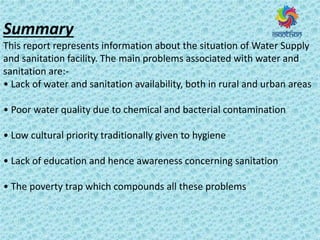
Water Supply and Sanitation in India
Summary
This report represents information about the situation of Water Supply
and sanitation facility. The main problems associated with water and
sanitation are:-
• La k of ate a d sa itatio a aila ilit , oth i u al a d u a areas
• Poo ate ualit due to he i al a d a te ial o ta i atio
• Lo ultu al p io it t aditio all gi e to hygiene
• La k of edu atio a d he e a a e ess o e i g sanitation
• The po e t t ap hi h o pou ds all these p o le s
Global Issues:-
Of the many essential elements for human existence, water is of the
greatest
importance. Over two-thirds of the human body is constituted of water.
No form of
life, be it plant, animal or human, can exist without water. Civilisations
have evolved
and developed around water bodies as most human activities, including
agriculture
and industry, depend on water. At the same time water is also a source
of conflict and
problems.
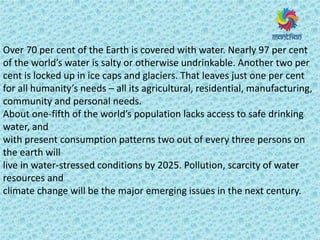
Over 70 per cent of the Earth is covered with water. Nearly 97 per cent
of the o ld s water is salty or otherwise undrinkable. Another two per
cent is locked up in ice caps and glaciers. That leaves just one per cent
fo all hu a it s eeds – all its agricultural, residential, manufacturing,
community and personal needs.
About one-fifth of the o ld s populatio la ks a ess to safe d i ki g
water, and
with present consumption patterns two out of every three persons on
the earth will
live in water-stressed conditions by 2025. Pollution, scarcity of water
resources and
climate change will be the major emerging issues in the next century.
Water pollution adds enormously to existing
problems of water scarcity by removing large
volumes of water from the available supply. The
pollution threat is particularly serious when it
affects ground water supplies, where
contamination is slow to dilute and purification
measures are costly.
Indian Overview :-
Most of the rainfall in India takes place under the influence of South
West monsoon
between June and September. Rainfall in India shows great
variations, unequal
seasonal distribution, still more unequal geographical distribution,
and frequent
departures from the normal. India is also criss-crossed by a large
number of small and
big rivers.
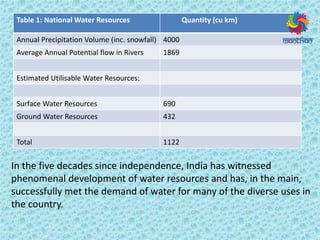
Table 1: National Water Resources Quantity (cu km)
Annual Precipitation Volume (inc. snowfall) 4000
Average Annual Potential flow in Rivers 1869
Estimated Utilisable Water Resources:
Surface Water Resources 690
Ground Water Resources 432
Total 1122
In the five decades since independence, India has witnessed
phenomenal development of water resources and has, in the main,
successfully met the demand of water for many of the diverse uses in
the country.
Investments made during the last fifty years in water related
infrastructure in the country have resulted in rapid expansion in the
urban, energy and industrial sectors. Infrastructure for safe drinking
water has been provided to a out 8 pe e t of I dia s u a a d
rural population.However, there remain significant challenges in
providing sustainable services, especially for the poorest and hard to
reach.
I dia s i igated ag i ultu e se to has ee fu da e tal to its
economic development and poverty alleviation. The rapid expansion of
irrigation and drainage infrastructure has ee o e of I dia s ajo
achievements. From 1951 to 1997, gross irrigated areas expanded four-
fold, from 23 million ha to 90 million ha.However, this achievement
has been at the cost of groundwater depletion, water-logging and in
increasing salinity levels affecting large areas.
With the rapid population growth since
independence, water is becoming an increasingly
scarce resource in the country. Despite this, water
continues to be used inefficiently on a daily basis in
all sectors. At independence, the population was
less than 400 million and per capita water
availability over 5,000 cubic meters per year
(m3/cap/yr). Today, fifty years later, the population
has grown to 1 billion and water availability has
fallen to hardly more than 2,000 (m3
/cap/yr).
I dia s fi ite a d f agile ate esou es a e
stressed and depleting, while sector demands
(including drinking water, industry, agriculture, and
others) are growing rapidly in line with
urbanisation, population increases, rising incomes
and industrial growth. This has resulted in declining
per capita availability and deteriorating quality.
Inter-sector allocations, planning, and management
of increasingly fragile water resources have thus
emerged as a major challenge before the nation.
Problems
One can break up the main problems associated with water supply into
two categories: those of quantity and those of quality.
Quantity
To describe how accessible a water source is to a person one needs to
make several
definitions:
• A usage of litres per capita per day (lpcd) of safe drinking water for
humans.
• lpcd for their livestock.
• The ate sou e e ists ithi a dista e of . k i plai s o
elevation difference in hills.
• Safe ate is defi ed as f ee f o a te ia a i g ate o e
disease and chemical contamination.
Rural
Using these definitions the current level of coverage of drinking
water supply
a o gst I dia s u al i ha ita ts is 8 % full o e ed , % pa tiall
o e ed a d
% ot o e ed .8
These shortage problems persist even though there is a backbone of
at least 3 million
boreholes with hand-pumps and over 150,000 piped water supplies
throughout the
country. In fact, investments in the water supply and sanitation
sector presently
constitute about 3% of the national budget, with 60% of this being
earmarked for rural
areas.
Hand-pumps and bore-wells are the primary source of drinking
water, used by 42 % of the population. The traditional open
well1serves about 27 % and 5 % of people still collect drinking
water from exposed sources such as rivers, lakes and ponds.
In many parts of the country, however, an open well is still the
main source of water.
As in most developing countries, in India it is mostly women who
are responsible for collecting water and managing its household
use. A 1989 Knowledge, Attitudes and Practices (KAP) study showed
that women in rural India spent between one and four hours a day
collecting water. They make an average of nine trips to a water
source, collecting 192 litres of water for an average six-member
household (32 lpcd). Carrying water is hard physical labour, studies
sho that a edu tio of th ee hou s work fetching water resulted
in a saving of 350 kilo calories. Bringing water closer,
therefore, has important nutritional and other health benefits,
especially for the malnourished.
However, national guidelines and investments in the rural water
supply and sanitation
sector, which have traditionally focused on extending coverage to
rural areas,
neglected to ensure that the quality of services to rural areas
remained adequate. The
Accelerated Rural Water Supply Programme (ARWSP)14 was totally
government run
without the participation of stakeholders. This created a scenario in
which users
considered water a free commodity with the government having
the entire
responsibility for running the operation. This has stifled the
development of more
efficient, low cost options for service delivery and denied users as
consumers the
opportunity to demand better services.
Furthermore, due to the lack of consumer participation, users did not
feel they owned
their water extraction equipment and hence did not adequately
maintain it. When
maintenance was needed, government mechanics would have to be
called out. These
mechanics would be covering hundreds of villages each, so a broken
pump could have
to wait months to be fixed, leaving without water the community
dependent on its use.
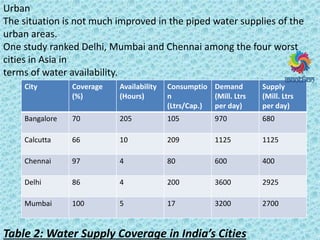
Urban
The situation is not much improved in the piped water supplies of the
urban areas.
One study ranked Delhi, Mumbai and Chennai among the four worst
cities in Asia in
terms of water availability.
Table 2: Water Supply Coverage in India’s Cities
City Coverage
(%)
Availability
(Hours)
Consumptio
n
(Ltrs/Cap.)
Demand
(Mill. Ltrs
per day)
Supply
(Mill. Ltrs
per day)
Bangalore 70 205 105 970 680
Calcutta 66 10 209 1125 1125
Chennai 97 4 80 600 400
Delhi 86 4 200 3600 2925
Mumbai 100 5 17 3200 2700
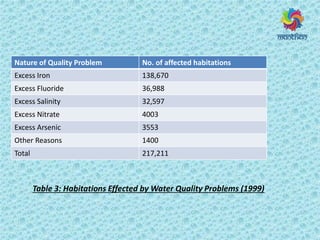
Nature of Quality Problem No. of affected habitations
Excess Iron 138,670
Excess Fluoride 36,988
Excess Salinity 32,597
Excess Nitrate 4003
Excess Arsenic 3553
Other Reasons 1400
Total 217,211
Table 3: Habitations Effected by Water Quality Problems (1999)
Sanitation
Population coverage in rural areas by sanitary latrines is at about
16% and overall in
the country coverage is about 48%.23 Most people in rural India
defecate outdoors,
near the village itself or in the fields. Some people believe it is more
hygienic than
using a latrine because excreta is deposited away from their homes.
However, the
majority of people who defecate outside do not cover or dispose of
their excreta. This
causes serious problems in the rainy season.
In densely populated rural areas the lack of privacy and the need
to walk long
distances to find a suitable spot to defecate are also a recognisable
problem. It is
difficult to defecate outdoors during the rainy season or at night.
Nevertheless, many
women must go early in the morning before it is light or wait till
night time to urinate
or defecate to ensure privacy. Some women avoid drinking during
the day, even in the
scorching summer months, because they have no place to urinate
in privacy.
Furthermore, it is fair to say that sanitation is not really a cultural
priority in India.
Even when facilities exist for improved hygiene they are not
always taken advantage
of. Studies have shown that about two-thirds of the rural
population think that
exposed excreta are harmful to health, yet less than a quarter
understands the faecaloral danger. Most people think that
hild e s faeces are not harmful, which explains why they are
often disposed of close to the household. Most people in India
wash their hands after defecating, although it is estimated that
about one-quarter wash
without any form of soap.
The problem is therefore not just of a lack of latrines and soap
but also of creating
demand for them - educating people in the importance of
washing their hands, of
using latrines etc.
Solutions
Supporting effective and inclusive decentralisation by empowering local
communities in rural areas.
• Buildi g a d i ple e ti g o se sus o ke poli a d i stitutio al
reforms.
• Fu di g i est e ts i u al i f ast u tu e li ked to efo s i
service delivery.
• Usi g NGO s a d alte ati e se i e p o ide s.
• Ta geti g the poo est a d ost ul e a le g oups.
• A fo us o illage le el apa it uildi g.
• The ai te a e of a i teg ated app oa h to ate suppl ,
sanitation and hygiene promotion.
• A e ui e e t fo pa tial apital ost e o e a d full ope atio s a d
maintenance financing by users.
• The p o otio of g ou d ate o se atio a d ai ate
harvesting.
Appendix:-
http://www.tristanfletcher.co.uk/WaterSupply.pdf
NCERT Books
Articles
Newspapers
Magazines
News Channels
Thank You

Ajay5

  • 1.
    Presentation Theme:- WaterSupply and Sanitation in India Team Details:- Co-ordinator:-Mr. Ajay Kumar Keshari Members- →Aman Kumar →Vikash Ranjan →Lal Bahadur Sharma →Ritesh Kumar Singh
  • 2.
    Water Supply andSanitation in India
  • 3.
    Summary This report representsinformation about the situation of Water Supply and sanitation facility. The main problems associated with water and sanitation are:- • La k of ate a d sa itatio a aila ilit , oth i u al a d u a areas • Poo ate ualit due to he i al a d a te ial o ta i atio • Lo ultu al p io it t aditio all gi e to hygiene • La k of edu atio a d he e a a e ess o e i g sanitation • The po e t t ap hi h o pou ds all these p o le s
  • 4.
    Global Issues:- Of themany essential elements for human existence, water is of the greatest importance. Over two-thirds of the human body is constituted of water. No form of life, be it plant, animal or human, can exist without water. Civilisations have evolved and developed around water bodies as most human activities, including agriculture and industry, depend on water. At the same time water is also a source of conflict and problems.
  • 5.
    Over 70 percent of the Earth is covered with water. Nearly 97 per cent of the o ld s water is salty or otherwise undrinkable. Another two per cent is locked up in ice caps and glaciers. That leaves just one per cent fo all hu a it s eeds – all its agricultural, residential, manufacturing, community and personal needs. About one-fifth of the o ld s populatio la ks a ess to safe d i ki g water, and with present consumption patterns two out of every three persons on the earth will live in water-stressed conditions by 2025. Pollution, scarcity of water resources and climate change will be the major emerging issues in the next century.
  • 6.
    Water pollution addsenormously to existing problems of water scarcity by removing large volumes of water from the available supply. The pollution threat is particularly serious when it affects ground water supplies, where contamination is slow to dilute and purification measures are costly.
  • 7.
    Indian Overview :- Mostof the rainfall in India takes place under the influence of South West monsoon between June and September. Rainfall in India shows great variations, unequal seasonal distribution, still more unequal geographical distribution, and frequent departures from the normal. India is also criss-crossed by a large number of small and big rivers.
  • 8.
    Table 1: NationalWater Resources Quantity (cu km) Annual Precipitation Volume (inc. snowfall) 4000 Average Annual Potential flow in Rivers 1869 Estimated Utilisable Water Resources: Surface Water Resources 690 Ground Water Resources 432 Total 1122 In the five decades since independence, India has witnessed phenomenal development of water resources and has, in the main, successfully met the demand of water for many of the diverse uses in the country.
  • 9.
    Investments made duringthe last fifty years in water related infrastructure in the country have resulted in rapid expansion in the urban, energy and industrial sectors. Infrastructure for safe drinking water has been provided to a out 8 pe e t of I dia s u a a d rural population.However, there remain significant challenges in providing sustainable services, especially for the poorest and hard to reach. I dia s i igated ag i ultu e se to has ee fu da e tal to its economic development and poverty alleviation. The rapid expansion of irrigation and drainage infrastructure has ee o e of I dia s ajo achievements. From 1951 to 1997, gross irrigated areas expanded four- fold, from 23 million ha to 90 million ha.However, this achievement has been at the cost of groundwater depletion, water-logging and in increasing salinity levels affecting large areas.
  • 10.
    With the rapidpopulation growth since independence, water is becoming an increasingly scarce resource in the country. Despite this, water continues to be used inefficiently on a daily basis in all sectors. At independence, the population was less than 400 million and per capita water availability over 5,000 cubic meters per year (m3/cap/yr). Today, fifty years later, the population has grown to 1 billion and water availability has fallen to hardly more than 2,000 (m3 /cap/yr).
  • 11.
    I dia sfi ite a d f agile ate esou es a e stressed and depleting, while sector demands (including drinking water, industry, agriculture, and others) are growing rapidly in line with urbanisation, population increases, rising incomes and industrial growth. This has resulted in declining per capita availability and deteriorating quality. Inter-sector allocations, planning, and management of increasingly fragile water resources have thus emerged as a major challenge before the nation.
  • 12.
    Problems One can breakup the main problems associated with water supply into two categories: those of quantity and those of quality. Quantity To describe how accessible a water source is to a person one needs to make several definitions: • A usage of litres per capita per day (lpcd) of safe drinking water for humans. • lpcd for their livestock. • The ate sou e e ists ithi a dista e of . k i plai s o elevation difference in hills. • Safe ate is defi ed as f ee f o a te ia a i g ate o e disease and chemical contamination.
  • 13.
    Rural Using these definitionsthe current level of coverage of drinking water supply a o gst I dia s u al i ha ita ts is 8 % full o e ed , % pa tiall o e ed a d % ot o e ed .8 These shortage problems persist even though there is a backbone of at least 3 million boreholes with hand-pumps and over 150,000 piped water supplies throughout the country. In fact, investments in the water supply and sanitation sector presently constitute about 3% of the national budget, with 60% of this being earmarked for rural areas.
  • 14.
    Hand-pumps and bore-wellsare the primary source of drinking water, used by 42 % of the population. The traditional open well1serves about 27 % and 5 % of people still collect drinking water from exposed sources such as rivers, lakes and ponds. In many parts of the country, however, an open well is still the main source of water.
  • 15.
    As in mostdeveloping countries, in India it is mostly women who are responsible for collecting water and managing its household use. A 1989 Knowledge, Attitudes and Practices (KAP) study showed that women in rural India spent between one and four hours a day collecting water. They make an average of nine trips to a water source, collecting 192 litres of water for an average six-member household (32 lpcd). Carrying water is hard physical labour, studies sho that a edu tio of th ee hou s work fetching water resulted in a saving of 350 kilo calories. Bringing water closer, therefore, has important nutritional and other health benefits, especially for the malnourished.
  • 16.
    However, national guidelinesand investments in the rural water supply and sanitation sector, which have traditionally focused on extending coverage to rural areas, neglected to ensure that the quality of services to rural areas remained adequate. The Accelerated Rural Water Supply Programme (ARWSP)14 was totally government run without the participation of stakeholders. This created a scenario in which users considered water a free commodity with the government having the entire responsibility for running the operation. This has stifled the development of more efficient, low cost options for service delivery and denied users as consumers the opportunity to demand better services.
  • 17.
    Furthermore, due tothe lack of consumer participation, users did not feel they owned their water extraction equipment and hence did not adequately maintain it. When maintenance was needed, government mechanics would have to be called out. These mechanics would be covering hundreds of villages each, so a broken pump could have to wait months to be fixed, leaving without water the community dependent on its use.
  • 18.
    Urban The situation isnot much improved in the piped water supplies of the urban areas. One study ranked Delhi, Mumbai and Chennai among the four worst cities in Asia in terms of water availability. Table 2: Water Supply Coverage in India’s Cities City Coverage (%) Availability (Hours) Consumptio n (Ltrs/Cap.) Demand (Mill. Ltrs per day) Supply (Mill. Ltrs per day) Bangalore 70 205 105 970 680 Calcutta 66 10 209 1125 1125 Chennai 97 4 80 600 400 Delhi 86 4 200 3600 2925 Mumbai 100 5 17 3200 2700
  • 19.
    Nature of QualityProblem No. of affected habitations Excess Iron 138,670 Excess Fluoride 36,988 Excess Salinity 32,597 Excess Nitrate 4003 Excess Arsenic 3553 Other Reasons 1400 Total 217,211 Table 3: Habitations Effected by Water Quality Problems (1999)
  • 20.
    Sanitation Population coverage inrural areas by sanitary latrines is at about 16% and overall in the country coverage is about 48%.23 Most people in rural India defecate outdoors, near the village itself or in the fields. Some people believe it is more hygienic than using a latrine because excreta is deposited away from their homes. However, the majority of people who defecate outside do not cover or dispose of their excreta. This causes serious problems in the rainy season.
  • 21.
    In densely populatedrural areas the lack of privacy and the need to walk long distances to find a suitable spot to defecate are also a recognisable problem. It is difficult to defecate outdoors during the rainy season or at night. Nevertheless, many women must go early in the morning before it is light or wait till night time to urinate or defecate to ensure privacy. Some women avoid drinking during the day, even in the scorching summer months, because they have no place to urinate in privacy.
  • 22.
    Furthermore, it isfair to say that sanitation is not really a cultural priority in India. Even when facilities exist for improved hygiene they are not always taken advantage of. Studies have shown that about two-thirds of the rural population think that exposed excreta are harmful to health, yet less than a quarter understands the faecaloral danger. Most people think that hild e s faeces are not harmful, which explains why they are often disposed of close to the household. Most people in India wash their hands after defecating, although it is estimated that about one-quarter wash without any form of soap.
  • 23.
    The problem istherefore not just of a lack of latrines and soap but also of creating demand for them - educating people in the importance of washing their hands, of using latrines etc.
  • 24.
    Solutions Supporting effective andinclusive decentralisation by empowering local communities in rural areas. • Buildi g a d i ple e ti g o se sus o ke poli a d i stitutio al reforms. • Fu di g i est e ts i u al i f ast u tu e li ked to efo s i service delivery. • Usi g NGO s a d alte ati e se i e p o ide s. • Ta geti g the poo est a d ost ul e a le g oups. • A fo us o illage le el apa it uildi g. • The ai te a e of a i teg ated app oa h to ate suppl , sanitation and hygiene promotion. • A e ui e e t fo pa tial apital ost e o e a d full ope atio s a d maintenance financing by users. • The p o otio of g ou d ate o se atio a d ai ate harvesting.
  • 25.