PH AND SHAMPOO
By: Izzy Nuta
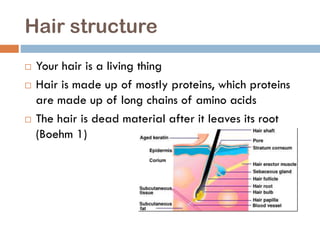
Hair structure
 Your hair is a living thing
 Hair is made up of mostly proteins, which proteins
are made up of long chains of amino acids
 The hair is dead material after it leaves its root
(Boehm 1)
Function of Shampoo
 There are different shampoo’s for certain types of
hairs.
 Wash the hair effectively.
 Remove filth completely.
 Not have any side effects or irritations to the skin
and eyes.
 To prevent dandruff.
Potential of Hydrogen (pH)
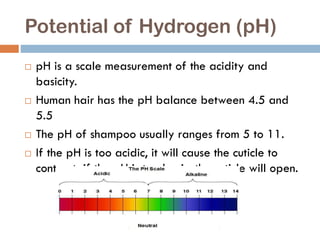
 pH is a scale measurement of the acidity and
basicity.
 Human hair has the pH balance between 4.5 and
5.5
 The pH of shampoo usually ranges from 5 to 11.
 If the pH is too acidic, it will cause the cuticle to
contract; if the pH is too basic, the cuticle will open.
Chemistry of Shampoo
 There are four main ingredients in shampoos:
cleaning agents, modifying agents, pH adjuster, and
fragrance.
 The main ingredient in shampoos is water.
 The surfactant is another important ingredient in
shampoos.
 The surfactant helps to clean the hair and strips it of
oil which is similar to what soap does.
 Shampoo acts as a detergent for the hair.
Implications
 Shampoo is an everyday household item that
people use.
 Shampoo is a meant to remove grease and dirt of
hair.
 Shampoo could cause damage to hair depending
on the pH level of the shampoo and the frequency
of use of the shampoo.
 Foam actually does not do anything to hair but to
satisfy the consumers
Summary
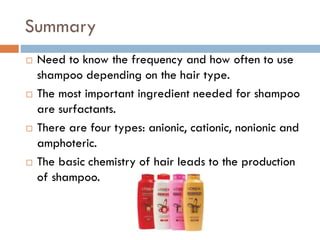
 Need to know the frequency and how often to use
shampoo depending on the hair type.
 The most important ingredient needed for shampoo
are surfactants.
 There are four types: anionic, cationic, nonionic and
amphoteric.
 The basic chemistry of hair leads to the production
of shampoo.
Works cited
 Boehm, Gregory , Vitor Dasilva, Daniel Fulcher, and Jun Wang.
"CE457/527." Table of Contents. N.p., 9 Apr. 2002. Web. 27
Apr. 2014.
<http://www.eng.buffalo.edu/Courses/ce457_527/ce457_pr
o/g7_doc.htm>.
 Chemistry for Life. American Chemical Society, n.d. Web. 3
Apr. 2014.
<http://www.acs.org/content/acs/en/pressroom/newsreleases/
2008/august/ heads-up-study-of-hair-dynamics-may-lead-to-
better-hair-care-products.html>.

P h and shampoo

  • 1.
  • 2.
    Hair structure  Yourhair is a living thing  Hair is made up of mostly proteins, which proteins are made up of long chains of amino acids  The hair is dead material after it leaves its root (Boehm 1)
  • 3.
    Function of Shampoo There are different shampoo’s for certain types of hairs.  Wash the hair effectively.  Remove filth completely.  Not have any side effects or irritations to the skin and eyes.  To prevent dandruff.
  • 4.
    Potential of Hydrogen(pH)  pH is a scale measurement of the acidity and basicity.  Human hair has the pH balance between 4.5 and 5.5  The pH of shampoo usually ranges from 5 to 11.  If the pH is too acidic, it will cause the cuticle to contract; if the pH is too basic, the cuticle will open.
  • 5.
    Chemistry of Shampoo There are four main ingredients in shampoos: cleaning agents, modifying agents, pH adjuster, and fragrance.  The main ingredient in shampoos is water.  The surfactant is another important ingredient in shampoos.  The surfactant helps to clean the hair and strips it of oil which is similar to what soap does.  Shampoo acts as a detergent for the hair.
  • 6.
    Implications  Shampoo isan everyday household item that people use.  Shampoo is a meant to remove grease and dirt of hair.  Shampoo could cause damage to hair depending on the pH level of the shampoo and the frequency of use of the shampoo.  Foam actually does not do anything to hair but to satisfy the consumers
  • 7.
    Summary  Need toknow the frequency and how often to use shampoo depending on the hair type.  The most important ingredient needed for shampoo are surfactants.  There are four types: anionic, cationic, nonionic and amphoteric.  The basic chemistry of hair leads to the production of shampoo.
  • 8.
    Works cited  Boehm,Gregory , Vitor Dasilva, Daniel Fulcher, and Jun Wang. "CE457/527." Table of Contents. N.p., 9 Apr. 2002. Web. 27 Apr. 2014. <http://www.eng.buffalo.edu/Courses/ce457_527/ce457_pr o/g7_doc.htm>.  Chemistry for Life. American Chemical Society, n.d. Web. 3 Apr. 2014. <http://www.acs.org/content/acs/en/pressroom/newsreleases/ 2008/august/ heads-up-study-of-hair-dynamics-may-lead-to- better-hair-care-products.html>.