-Anasuya Das
formation
 The photochemical mechanisms that give rise to the ozone layer were discovered
                 by the British physicist Sidney Chapman in 1930.
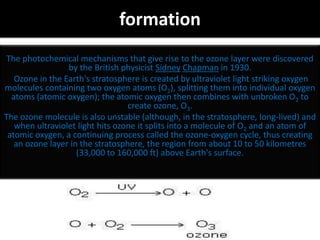
   Ozone in the Earth's stratosphere is created by ultraviolet light striking oxygen
molecules containing two oxygen atoms (O2), splitting them into individual oxygen
  atoms (atomic oxygen); the atomic oxygen then combines with unbroken O2 to
                                  create ozone, O3.
The ozone molecule is also unstable (although, in the stratosphere, long-lived) and
   when ultraviolet light hits ozone it splits into a molecule of O2 and an atom of
 atomic oxygen, a continuing process called the ozone-oxygen cycle, thus creating
   an ozone layer in the stratosphere, the region from about 10 to 50 kilometres
                    (33,000 to 160,000 ft) above Earth's surface.
Bad news 
• The amount of ozone layer began to drop sharply in
  1980s. This decrease has been linked to synthetic
  chemicals like chlorofluorocarbons(CFCs) which are
  used in refrigerators, fire extinguishers etc
• In 1987, the united Nations Environment
  Programme (UNEP) succeeded in forging and
  agreement to freeze CFC 1986 levels.

ozone layer

  • 1.
  • 4.
    formation The photochemicalmechanisms that give rise to the ozone layer were discovered by the British physicist Sidney Chapman in 1930. Ozone in the Earth's stratosphere is created by ultraviolet light striking oxygen molecules containing two oxygen atoms (O2), splitting them into individual oxygen atoms (atomic oxygen); the atomic oxygen then combines with unbroken O2 to create ozone, O3. The ozone molecule is also unstable (although, in the stratosphere, long-lived) and when ultraviolet light hits ozone it splits into a molecule of O2 and an atom of atomic oxygen, a continuing process called the ozone-oxygen cycle, thus creating an ozone layer in the stratosphere, the region from about 10 to 50 kilometres (33,000 to 160,000 ft) above Earth's surface.
  • 5.
    Bad news  •The amount of ozone layer began to drop sharply in 1980s. This decrease has been linked to synthetic chemicals like chlorofluorocarbons(CFCs) which are used in refrigerators, fire extinguishers etc • In 1987, the united Nations Environment Programme (UNEP) succeeded in forging and agreement to freeze CFC 1986 levels.