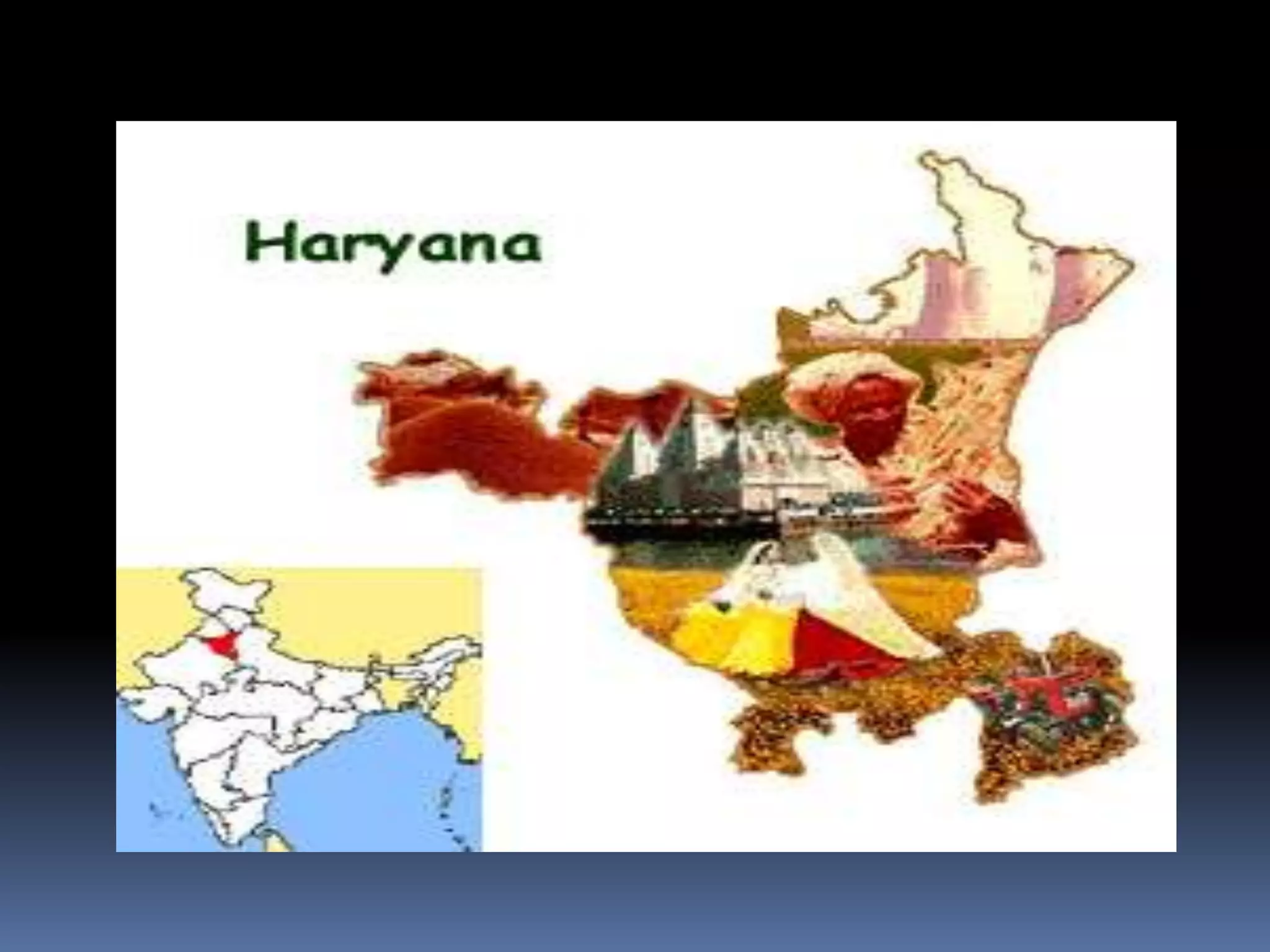
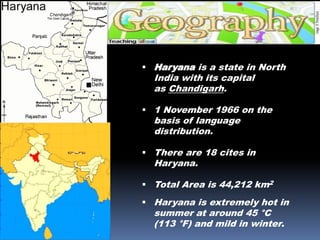
 Haryana is a state in North
India with its capital
as Chandigarh.
 1 November 1966 on the
basis of language
distribution.
 There are 18 cites in
Haryana.
 Total Area is 44,212 km2
 Haryana is extremely hot in
summer at around 45 °C
(113 °F) and mild in winter.
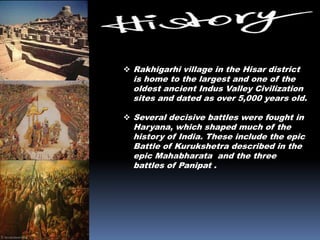
 Rakhigarhi village in the Hisar district
is home to the largest and one of the
oldest ancient Indus Valley Civilization
sites and dated as over 5,000 years old.
 Several decisive battles were fought in
Haryana, which shaped much of the
history of India. These include the epic
Battle of Kurukshetra described in the
epic Mahabharata and the three
battles of Panipat .
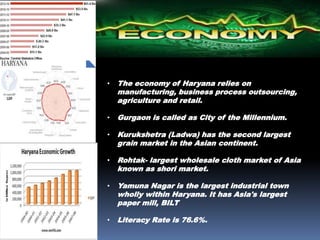
• The economy of Haryana relies on
manufacturing, business process outsourcing,
agriculture and retail.
• Gurgaon is called as City of the Millennium.
• Kurukshetra (Ladwa) has the second largest
grain market in the Asian continent.
• Rohtak- largest wholesale cloth market of Asia
known as shori market.
• Yamuna Nagar is the largest industrial town
wholly within Haryana. It has Asia's largest
paper mill, BILT
• Literacy Rate is 76.6%.
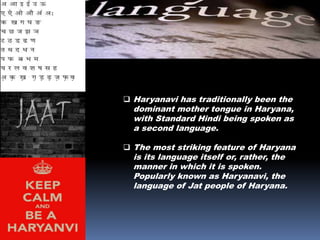
 Haryanavi has traditionally been the
dominant mother tongue in Haryana,
with Standard Hindi being spoken as
a second language.
 The most striking feature of Haryana
is its language itself or, rather, the
manner in which it is spoken.
Popularly known as Haryanavi, the
language of Jat people of Haryana.
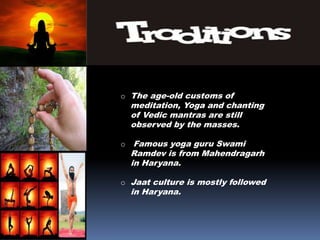
o The age-old customs of
meditation, Yoga and chanting
of Vedic mantras are still
observed by the masses.
o Famous yoga guru Swami
Ramdev is from Mahendragarh
in Haryana.
o Jaat culture is mostly followed
in Haryana.
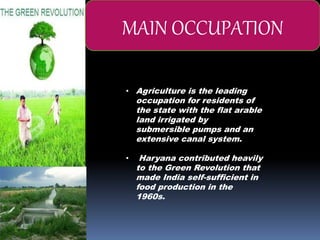
• Agriculture is the leading
occupation for residents of
the state with the flat arable
land irrigated by
submersible pumps and an
extensive canal system.
• Haryana contributed heavily
to the Green Revolution that
made India self-sufficient in
food production in the
1960s.
MAIN OCCUPATION
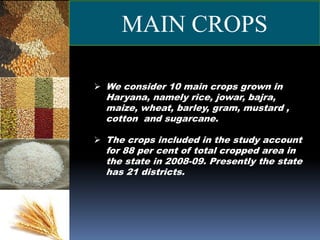
 We consider 10 main crops grown in
Haryana, namely rice, jowar, bajra,
maize, wheat, barley, gram, mustard ,
cotton and sugarcane.
 The crops included in the study account
for 88 per cent of total cropped area in
the state in 2008-09. Presently the state
has 21 districts.
MAIN CROPS
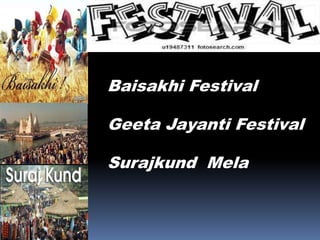
Baisakhi Festival
Geeta Jayanti Festival
Surajkund Mela
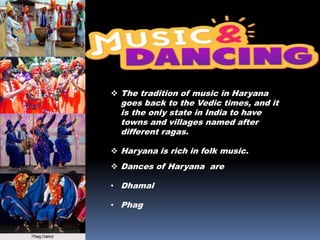
 Dances of Haryana are
• Dhamal
• Phag
 The tradition of music in Haryana
goes back to the Vedic times, and it
is the only state in India to have
towns and villages named after
different ragas.
 Haryana is rich in folk music.
Haryana is a unique state in terms of literacy
activities as well.
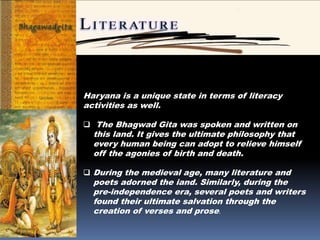
 The Bhagwad Gita was spoken and written on
this land. It gives the ultimate philosophy that
every human being can adopt to relieve himself
off the agonies of birth and death.
 During the medieval age, many literature and
poets adorned the iand. Similarly, during the
pre-independence era, several poets and writers
found their ultimate salvation through the
creation of verses and prose.
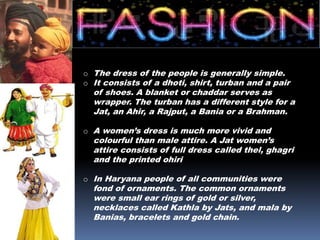
o The dress of the people is generally simple.
o It consists of a dhoti, shirt, turban and a pair
of shoes. A blanket or chaddar serves as
wrapper. The turban has a different style for a
Jat, an Ahir, a Rajput, a Bania or a Brahman.
o A women’s dress is much more vivid and
colourful than male attire. A Jat women’s
attire consists of full dress called thel, ghagri
and the printed ohiri
o In Haryana people of all communities were
fond of ornaments. The common ornaments
were small ear rings of gold or silver,
necklaces called Kathla by Jats, and mala by
Banias, bracelets and gold chain.
PRESENTATION BY
MAHALAKSHMI

Haryana

  • 2.
     Haryana isa state in North India with its capital as Chandigarh.  1 November 1966 on the basis of language distribution.  There are 18 cites in Haryana.  Total Area is 44,212 km2  Haryana is extremely hot in summer at around 45 °C (113 °F) and mild in winter.
  • 3.
     Rakhigarhi villagein the Hisar district is home to the largest and one of the oldest ancient Indus Valley Civilization sites and dated as over 5,000 years old.  Several decisive battles were fought in Haryana, which shaped much of the history of India. These include the epic Battle of Kurukshetra described in the epic Mahabharata and the three battles of Panipat .
  • 4.
    • The economyof Haryana relies on manufacturing, business process outsourcing, agriculture and retail. • Gurgaon is called as City of the Millennium. • Kurukshetra (Ladwa) has the second largest grain market in the Asian continent. • Rohtak- largest wholesale cloth market of Asia known as shori market. • Yamuna Nagar is the largest industrial town wholly within Haryana. It has Asia's largest paper mill, BILT • Literacy Rate is 76.6%.
  • 5.
     Haryanavi hastraditionally been the dominant mother tongue in Haryana, with Standard Hindi being spoken as a second language.  The most striking feature of Haryana is its language itself or, rather, the manner in which it is spoken. Popularly known as Haryanavi, the language of Jat people of Haryana.
  • 6.
    o The age-oldcustoms of meditation, Yoga and chanting of Vedic mantras are still observed by the masses. o Famous yoga guru Swami Ramdev is from Mahendragarh in Haryana. o Jaat culture is mostly followed in Haryana.
  • 7.
    • Agriculture isthe leading occupation for residents of the state with the flat arable land irrigated by submersible pumps and an extensive canal system. • Haryana contributed heavily to the Green Revolution that made India self-sufficient in food production in the 1960s. MAIN OCCUPATION
  • 8.
     We consider10 main crops grown in Haryana, namely rice, jowar, bajra, maize, wheat, barley, gram, mustard , cotton and sugarcane.  The crops included in the study account for 88 per cent of total cropped area in the state in 2008-09. Presently the state has 21 districts. MAIN CROPS
  • 9.
    Baisakhi Festival Geeta JayantiFestival Surajkund Mela
  • 10.
     Dances ofHaryana are • Dhamal • Phag  The tradition of music in Haryana goes back to the Vedic times, and it is the only state in India to have towns and villages named after different ragas.  Haryana is rich in folk music.
  • 11.
    Haryana is aunique state in terms of literacy activities as well.  The Bhagwad Gita was spoken and written on this land. It gives the ultimate philosophy that every human being can adopt to relieve himself off the agonies of birth and death.  During the medieval age, many literature and poets adorned the iand. Similarly, during the pre-independence era, several poets and writers found their ultimate salvation through the creation of verses and prose.
  • 12.
    o The dressof the people is generally simple. o It consists of a dhoti, shirt, turban and a pair of shoes. A blanket or chaddar serves as wrapper. The turban has a different style for a Jat, an Ahir, a Rajput, a Bania or a Brahman. o A women’s dress is much more vivid and colourful than male attire. A Jat women’s attire consists of full dress called thel, ghagri and the printed ohiri o In Haryana people of all communities were fond of ornaments. The common ornaments were small ear rings of gold or silver, necklaces called Kathla by Jats, and mala by Banias, bracelets and gold chain.
  • 13.