OUR ENVIRONMENT

&

MANAGEMENT OF
NATURAL RESOUCES

Maha.
i) Biodegradable wastes :- are wastes which are
decomposed into harmless substances by
microorganisms.
   Eg :- vegetables, fruits, pulses, cereals, cotton, jute,
wool,
wood, leather, paper, animal dung, animal bones etc.
ii) Non biodegradable wastes :- are wastes which are
not
decomposed by microorganisms.
   Eg :- polythene bags, plastics, synthetic fibres,
glass,
metals, synthetic rubber, insecticides, pesticides etc.
Ecosystem :-         An ecosystem consists of all the living organisms in an
    area along with the non living components and their interaction.
    There are different types of ecosystems. They are :-
 i) Natural ecosystems :- like forests, deserts, grass lands, mountains,
    ponds, lakes, rivers, oceans etc.
ii) Artificial ecosystems :- like gardens, parks, crop fields, aquarium, zoo
etc.

Components of an ecosystem :-
    An ecosystem consists of two main components. They are biotic and
abiotic
    components.
 i) Biotic components :- are the living components like plants, animals
and
   microorganisms. They consist of producers, consumers and decomposers.
   Producers :- are green plants which produce food by photosynthesis.
   Consumers :- are herbivores which get their food directly from plants,
   carnivores which get their food indirectly from plants and omnivores
which
   get their food directly or indirectly from plants.
   Decomposers :- are microorganisms which decompose dead plants and
   animals. They decompose complex organic substances into simple
inorganic
   substances in the soil which are again used by plants.
ii) Abiotic components :- are the non living components like air, water,
soil,
   minerals, sunlight , temperature, wind etc.
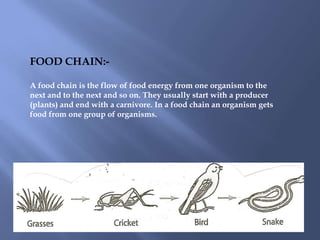
FOOD CHAIN:-

A food chain is the flow of food energy from one organism to the
next and to the next and so on. They usually start with a producer
(plants) and end with a carnivore. In a food chain an organism gets
food from one group of organisms.
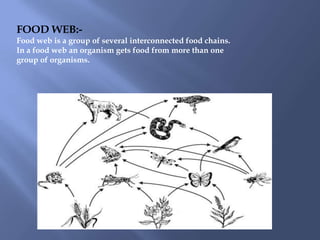
FOOD WEB:-
Food web is a group of several interconnected food chains.
In a food web an organism gets food from more than one
group of organisms.
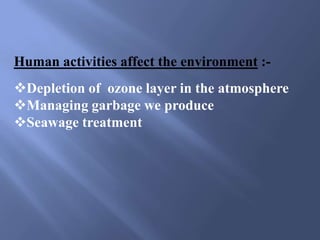
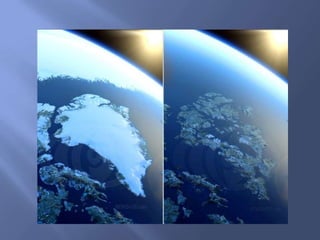
Human activities affect the environment :-
Depletion of ozone layer in the atmosphere
Managing garbage we produce
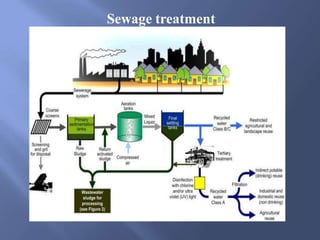
Seawage treatment
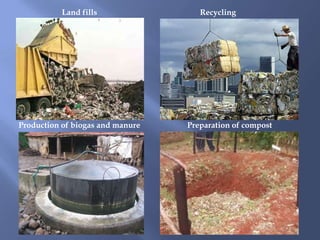
Land fills                Recycling


Production of biogas and manure   Preparation of compost
Sewage treatment
Natural resources:-
Natural resources are the resources available in a nature like
air, water, sunlight, soil, minerals, forests, wild life etc.
  Natural resources are of two main types. They are renewable and non
renewable natural resources.
 i) Renewable natural resources :-
   Are the resources which can be replenished in a short period of time
like air, water, sunlight, forests etc.
ii) Non renewable natural resources :-
  Are the resources which cannot be replenished in a short period of
time like minerals (coal, petroleum, natural gas, metals etc.) because
they take millions of years to be formed.
    Human activities produce a lot of waste materials which are thrown
away into the environment. These wastes cause pollution of natural
resources like air, water and soil.
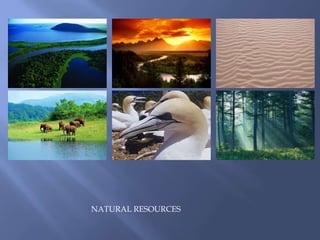
NATURAL RESOURCES
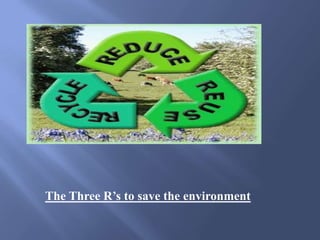
The Three R’s to save the environment
WE ARE GOING TO KNOW ABOUT:
NEED FOR MANAGEMENTING NATURAL
RESOURCES
IMPORTANCE OF FORESTS
CONSERVATION OF FORESTS
USES OF WATER
ADVATAGES &DISADVANTAGES OF DAMS
IMPORTANCE OF WILDLIFE
CONSERVATION OF WILDLIFE
COAL AND PETROLEUM
ACID RAIN FORMATION
Maha bio

Maha bio

  • 1.
  • 2.
    i) Biodegradable wastes:- are wastes which are decomposed into harmless substances by microorganisms. Eg :- vegetables, fruits, pulses, cereals, cotton, jute, wool, wood, leather, paper, animal dung, animal bones etc. ii) Non biodegradable wastes :- are wastes which are not decomposed by microorganisms. Eg :- polythene bags, plastics, synthetic fibres, glass, metals, synthetic rubber, insecticides, pesticides etc.
  • 3.
    Ecosystem :- An ecosystem consists of all the living organisms in an area along with the non living components and their interaction. There are different types of ecosystems. They are :- i) Natural ecosystems :- like forests, deserts, grass lands, mountains, ponds, lakes, rivers, oceans etc. ii) Artificial ecosystems :- like gardens, parks, crop fields, aquarium, zoo etc. Components of an ecosystem :- An ecosystem consists of two main components. They are biotic and abiotic components. i) Biotic components :- are the living components like plants, animals and microorganisms. They consist of producers, consumers and decomposers. Producers :- are green plants which produce food by photosynthesis. Consumers :- are herbivores which get their food directly from plants, carnivores which get their food indirectly from plants and omnivores which get their food directly or indirectly from plants. Decomposers :- are microorganisms which decompose dead plants and animals. They decompose complex organic substances into simple inorganic substances in the soil which are again used by plants. ii) Abiotic components :- are the non living components like air, water, soil, minerals, sunlight , temperature, wind etc.
  • 4.
    FOOD CHAIN:- A foodchain is the flow of food energy from one organism to the next and to the next and so on. They usually start with a producer (plants) and end with a carnivore. In a food chain an organism gets food from one group of organisms.
  • 5.
    FOOD WEB:- Food webis a group of several interconnected food chains. In a food web an organism gets food from more than one group of organisms.
  • 6.
    Human activities affectthe environment :- Depletion of ozone layer in the atmosphere Managing garbage we produce Seawage treatment
  • 8.
    Land fills Recycling Production of biogas and manure Preparation of compost
  • 9.
  • 10.
    Natural resources:- Natural resourcesare the resources available in a nature like air, water, sunlight, soil, minerals, forests, wild life etc. Natural resources are of two main types. They are renewable and non renewable natural resources. i) Renewable natural resources :- Are the resources which can be replenished in a short period of time like air, water, sunlight, forests etc. ii) Non renewable natural resources :- Are the resources which cannot be replenished in a short period of time like minerals (coal, petroleum, natural gas, metals etc.) because they take millions of years to be formed. Human activities produce a lot of waste materials which are thrown away into the environment. These wastes cause pollution of natural resources like air, water and soil.
  • 11.
  • 12.
    The Three R’sto save the environment
  • 13.
    WE ARE GOINGTO KNOW ABOUT: NEED FOR MANAGEMENTING NATURAL RESOURCES IMPORTANCE OF FORESTS CONSERVATION OF FORESTS USES OF WATER ADVATAGES &DISADVANTAGES OF DAMS IMPORTANCE OF WILDLIFE CONSERVATION OF WILDLIFE COAL AND PETROLEUM ACID RAIN FORMATION