Oxygen Scavenger Use's &
Safety Precaution
Prepared By : -
Umar Farooq
Chemist “A” Chemical Section
107301@se.com.sa
umar7325@yahoo.com
SEC Shuaibah Jeddah
Saudi Arabia 1
Exposure
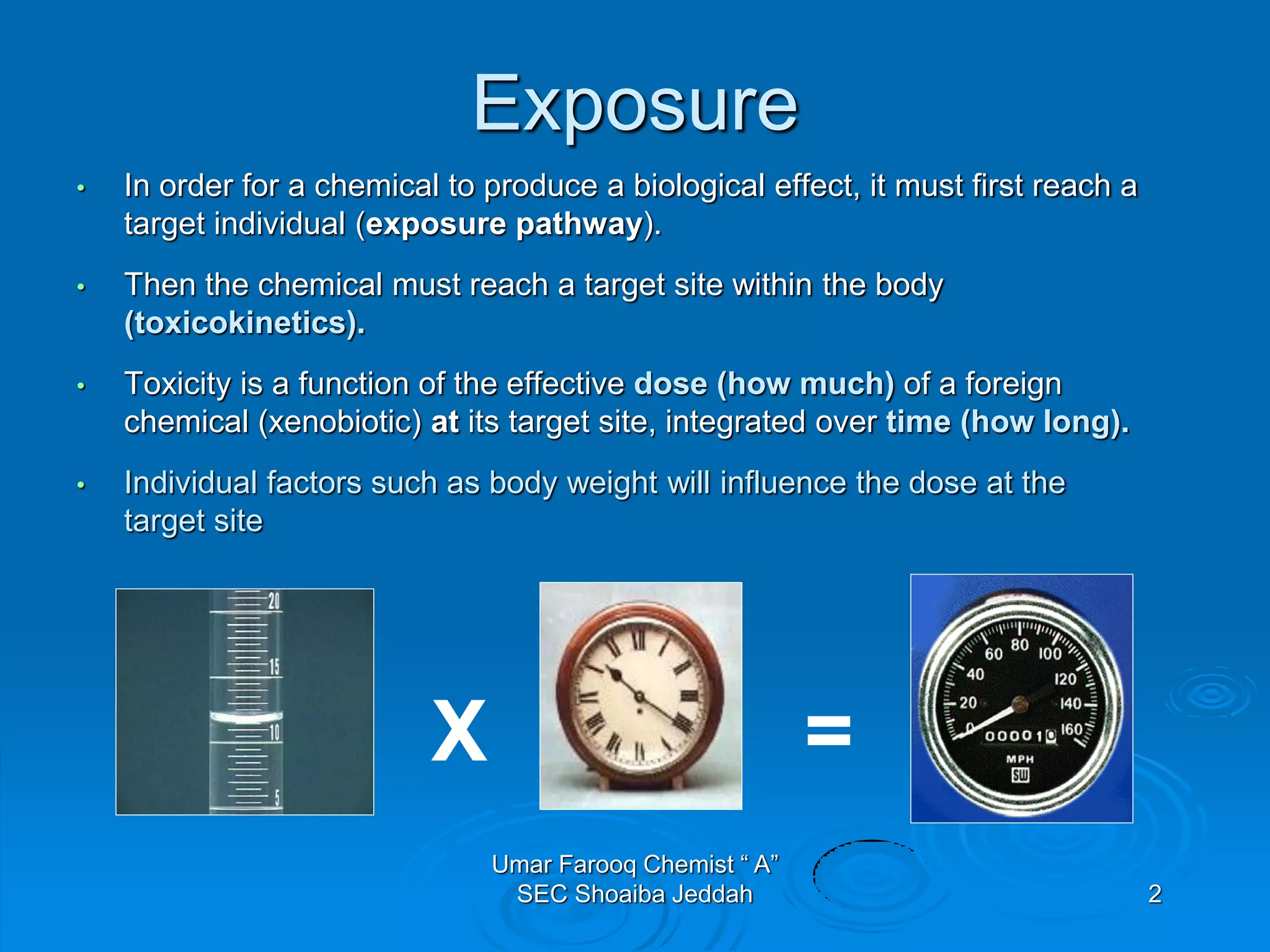
• In order for a chemical to produce a biological effect, it must first reach a
target individual (exposure pathway).
• Then the chemical must reach a target site within the body
(toxicokinetics).
• Toxicity is a function of the effective dose (how much) of a foreign
chemical (xenobiotic) at its target site, integrated over time (how long).
• Individual factors such as body weight will influence the dose at the
target site
X =
2
Umar Farooq Chemist “ A”
SEC Shoaiba Jeddah
Route of Exposure
Route of Exposure
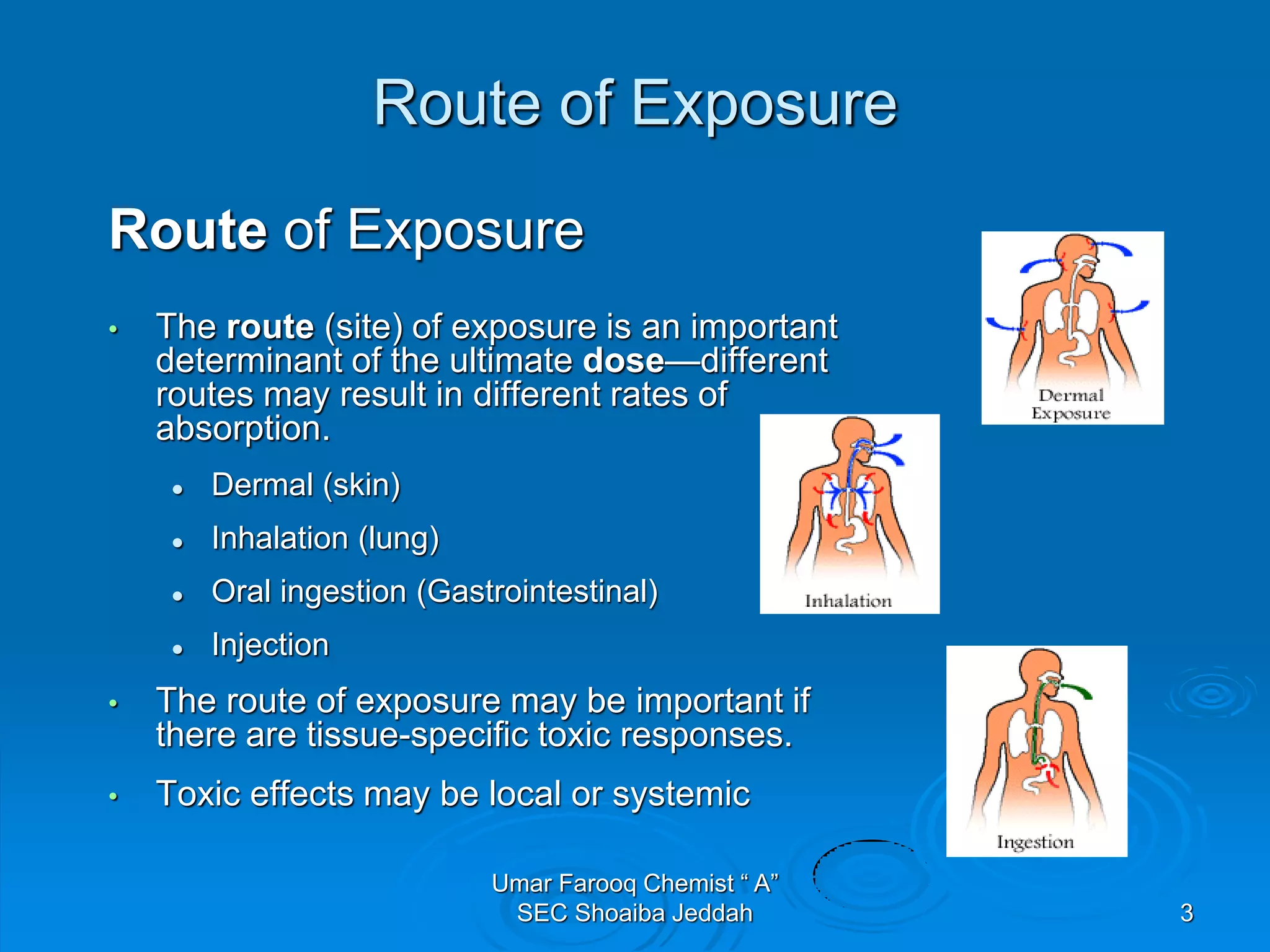
• The route (site) of exposure is an important
determinant of the ultimate dose—different
routes may result in different rates of
absorption.
 Dermal (skin)
 Inhalation (lung)
 Oral ingestion (Gastrointestinal)
 Injection
• The route of exposure may be important if
there are tissue-specific toxic responses.
• Toxic effects may be local or systemic
3
Umar Farooq Chemist “ A”
SEC Shoaiba Jeddah
Time of Exposure
Time of Exposure
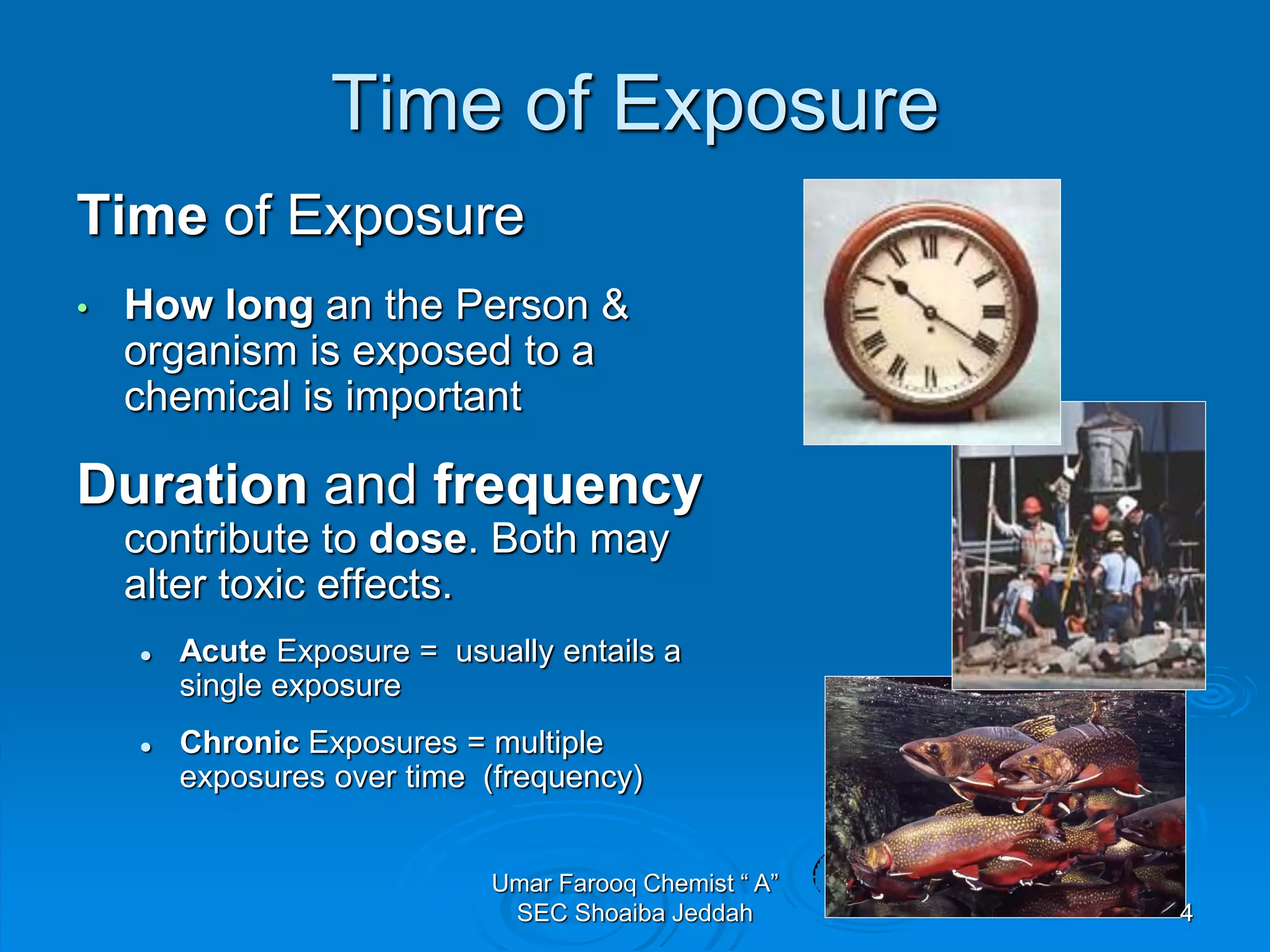
• How long an the Person &
organism is exposed to a
chemical is important
Duration and frequency
contribute to dose. Both may
alter toxic effects.
 Acute Exposure = usually entails a
single exposure
 Chronic Exposures = multiple
exposures over time (frequency)
4
Umar Farooq Chemist “ A”
SEC Shoaiba Jeddah
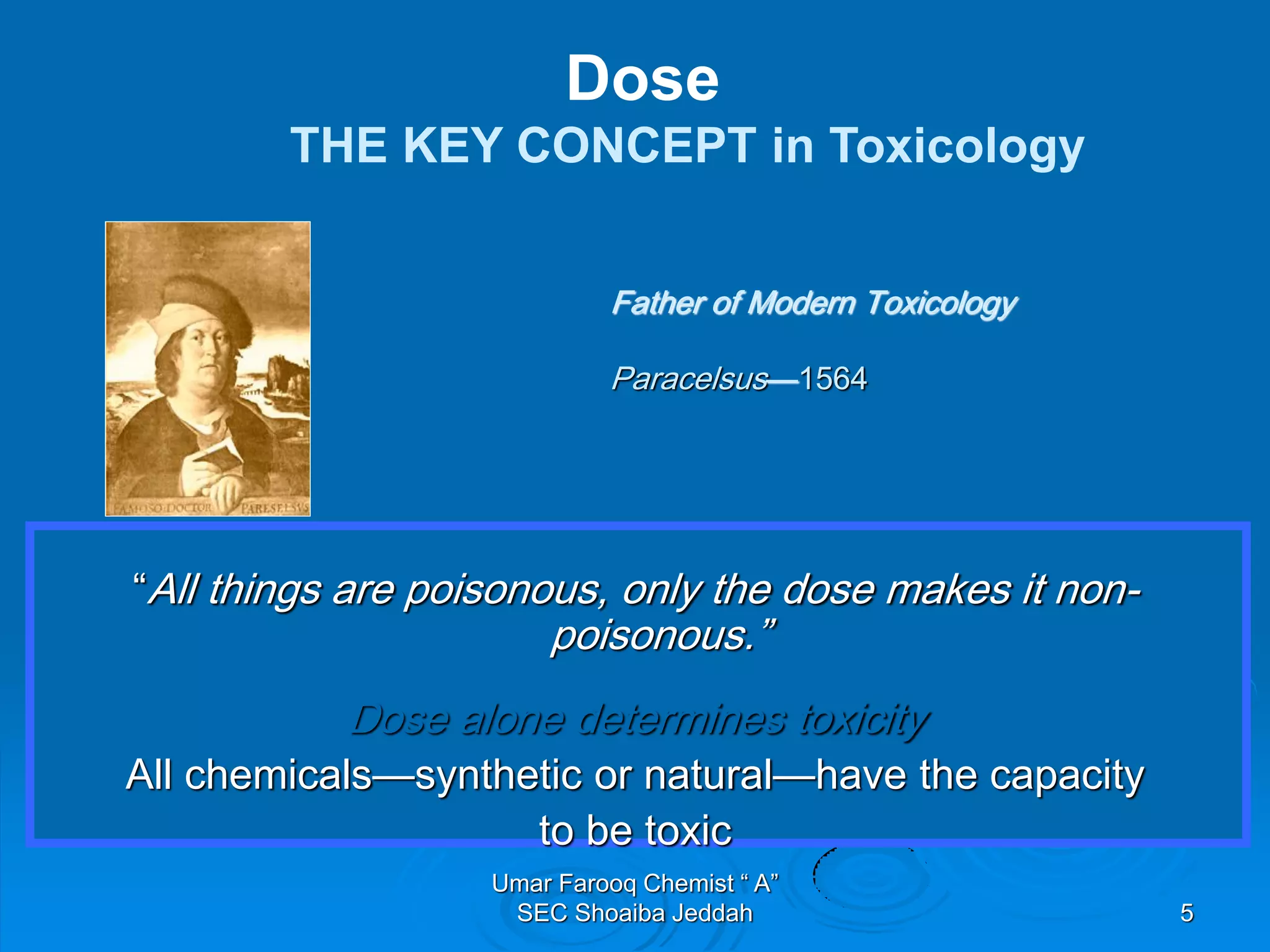
Father of Modern Toxicology
Paracelsus—1564
“All things are poisonous, only the dose makes it non-
poisonous.”
Dose alone determines toxicity
All chemicals—synthetic or natural—have the capacity
to be toxic
Dose
THE KEY CONCEPT in Toxicology
5
Umar Farooq Chemist “ A”
SEC Shoaiba Jeddah
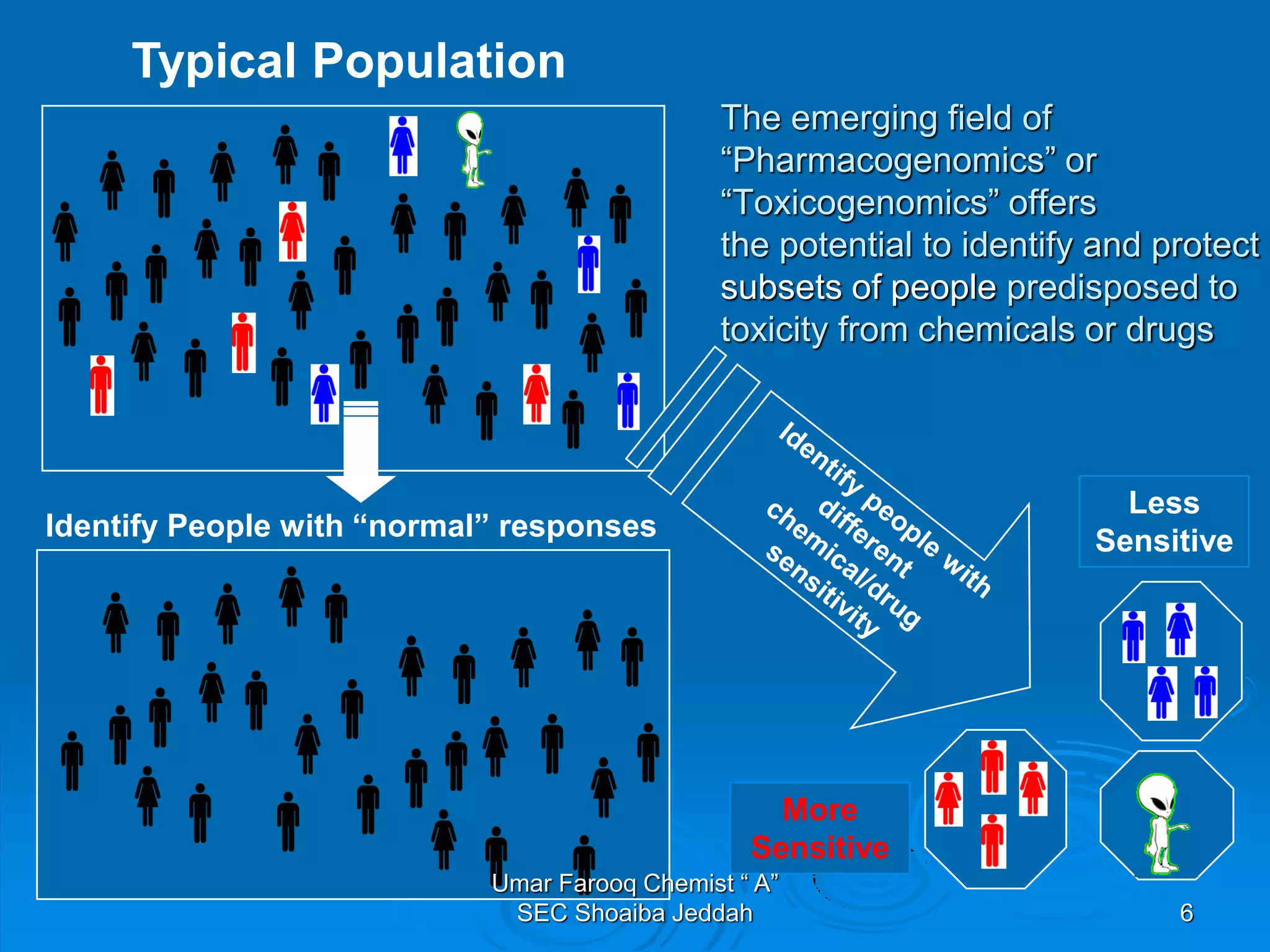
The emerging field of
“Pharmacogenomics” or
“Toxicogenomics” offers
the potential to identify and protect
subsets of people predisposed to
toxicity from chemicals or drugs
Typical Population
Identify People with “normal” responses
More
Sensitive
Less
Sensitive
6
Umar Farooq Chemist “ A”
SEC Shoaiba Jeddah
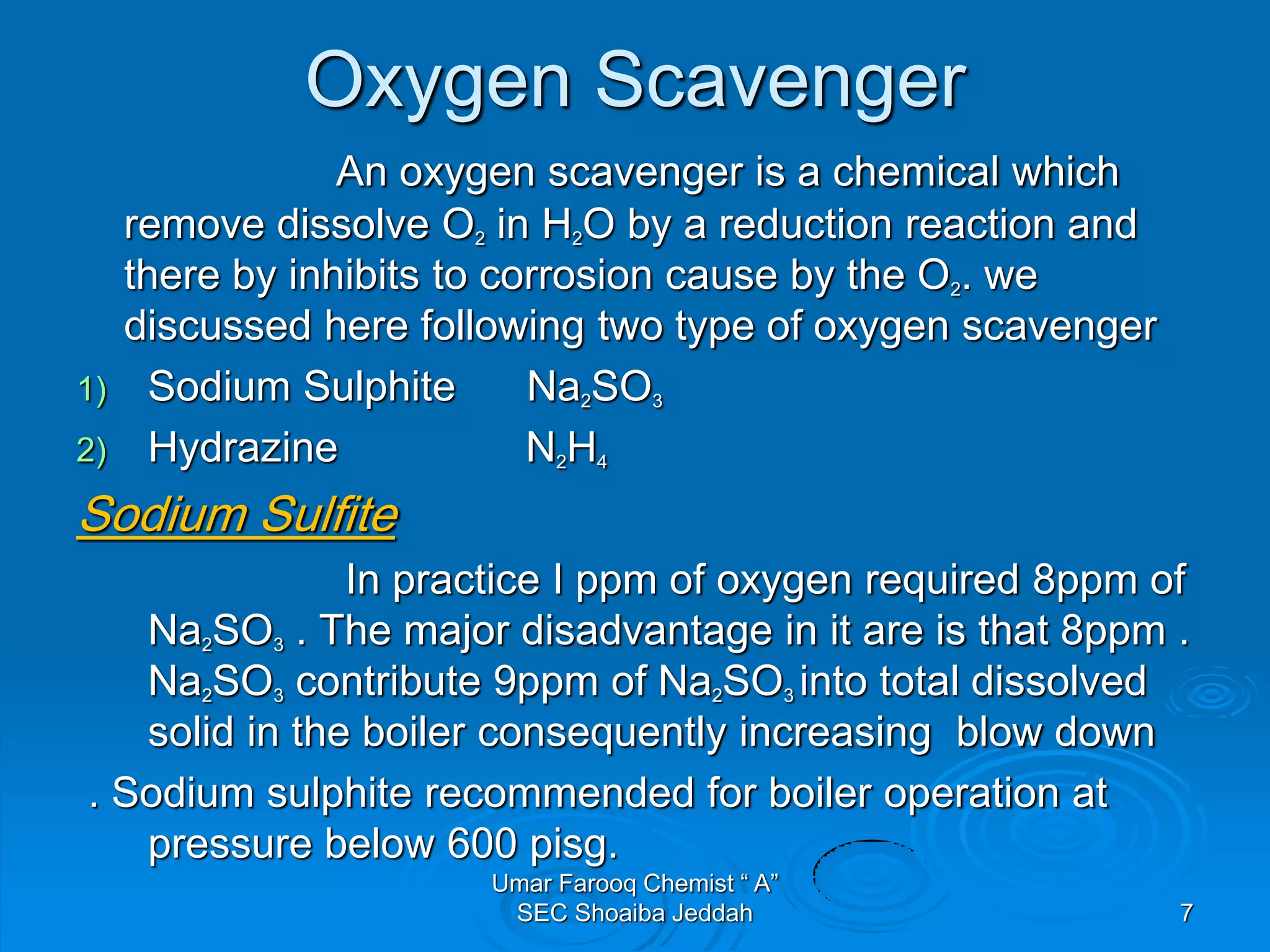
Oxygen Scavenger
An oxygen scavenger is a chemical which
remove dissolve O2 in H2O by a reduction reaction and
there by inhibits to corrosion cause by the O2. we
discussed here following two type of oxygen scavenger
1) Sodium Sulphite Na2SO3
2) Hydrazine N2H4
Sodium Sulfite
In practice I ppm of oxygen required 8ppm of
Na2SO3 . The major disadvantage in it are is that 8ppm .
Na2SO3 contribute 9ppm of Na2SO3 into total dissolved
solid in the boiler consequently increasing blow down
. Sodium sulphite recommended for boiler operation at
pressure below 600 pisg.
Umar Farooq Chemist “ A”
SEC Shoaiba Jeddah 7
Sodium Sulphite
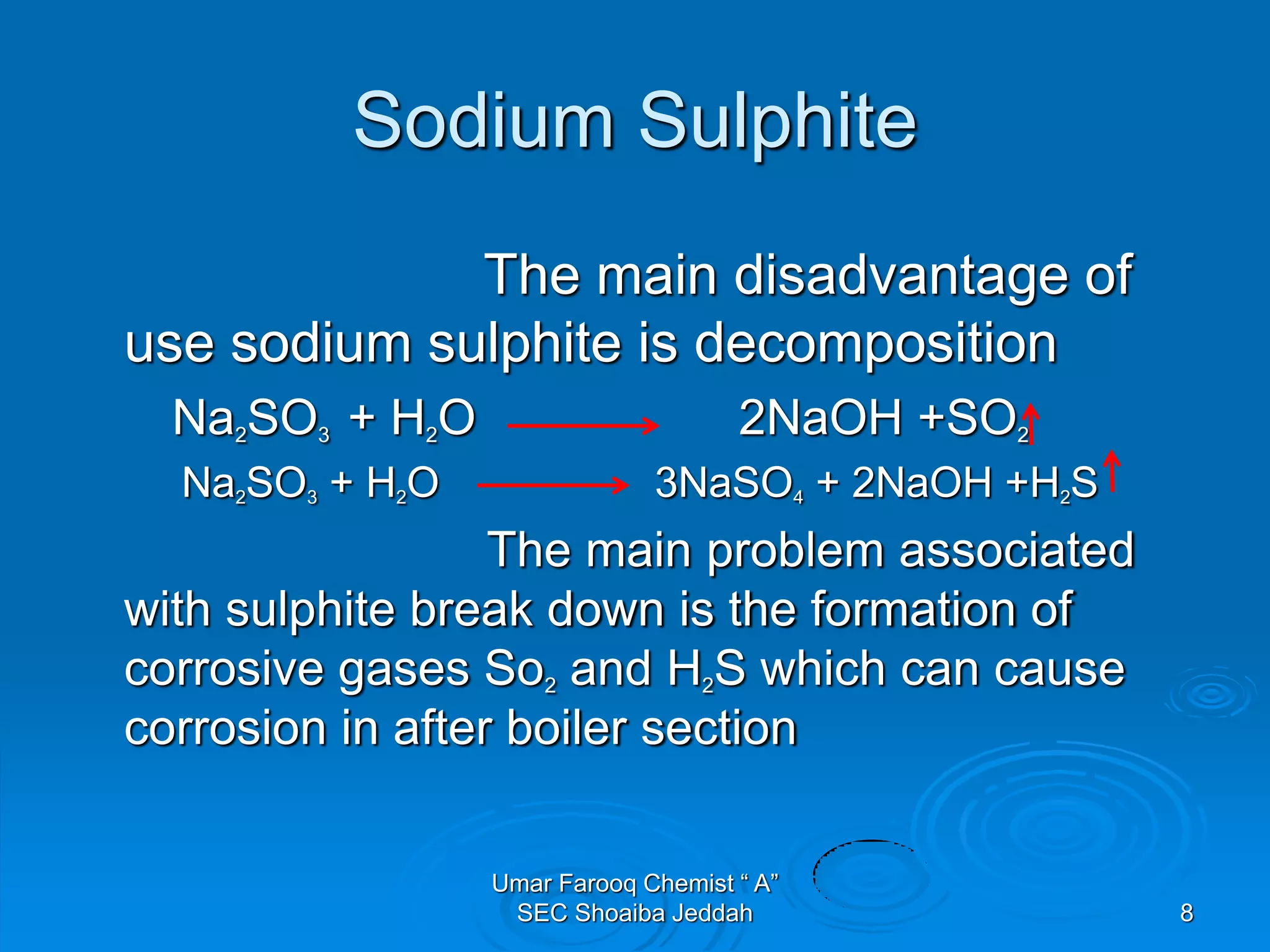
The main disadvantage of
use sodium sulphite is decomposition
Na2SO3 + H2O 2NaOH +SO2
Na2SO3 + H2O 3NaSO4 + 2NaOH +H2S
The main problem associated
with sulphite break down is the formation of
corrosive gases So2 and H2S which can cause
corrosion in after boiler section
Umar Farooq Chemist “ A”
SEC Shoaiba Jeddah 8
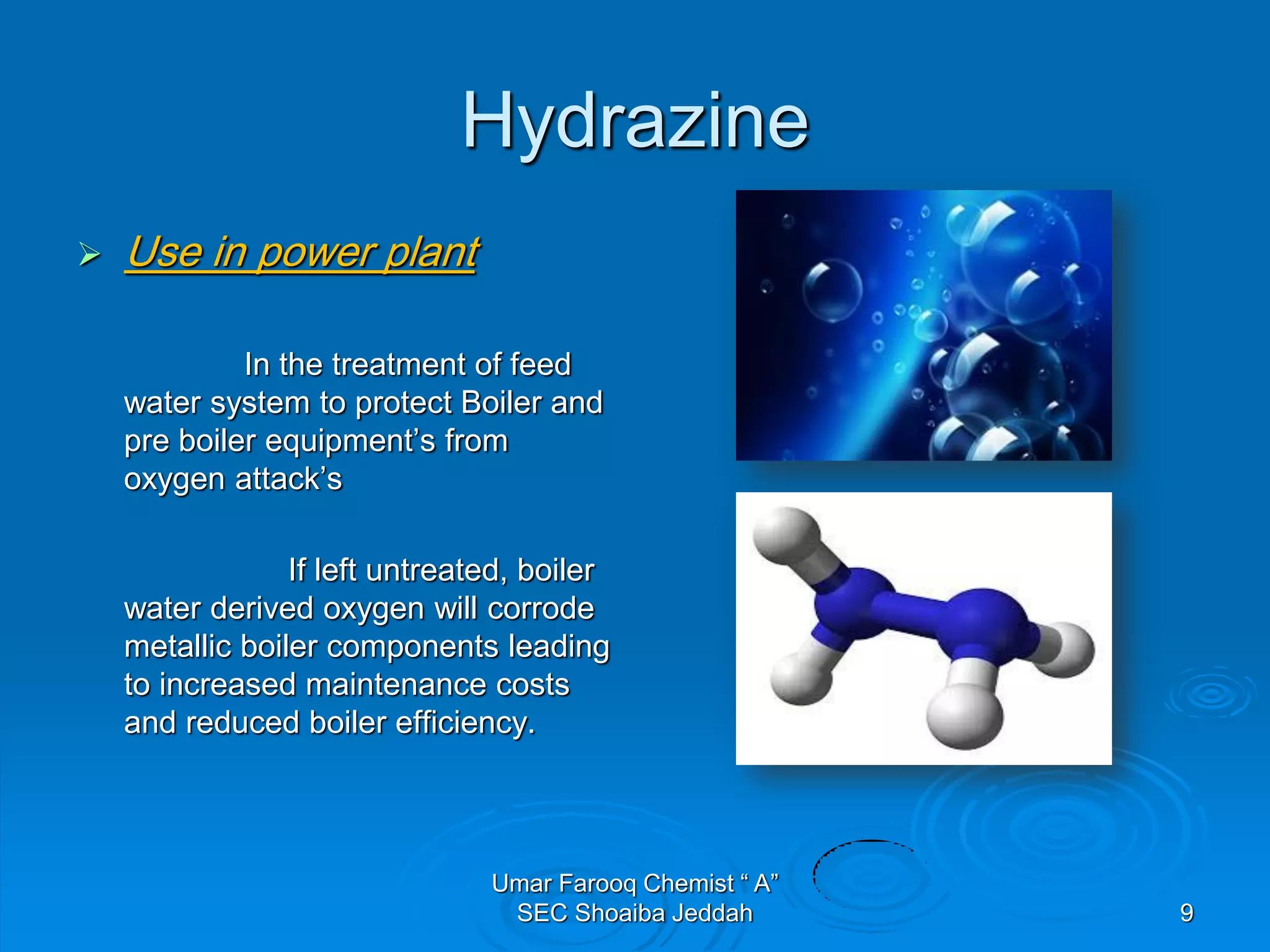
Hydrazine
 Use in power plant
In the treatment of feed
water system to protect Boiler and
pre boiler equipment’s from
oxygen attack’s
If left untreated, boiler
water derived oxygen will corrode
metallic boiler components leading
to increased maintenance costs
and reduced boiler efficiency.
Umar Farooq Chemist “ A”
SEC Shoaiba Jeddah 9
Hydrazine Treatment
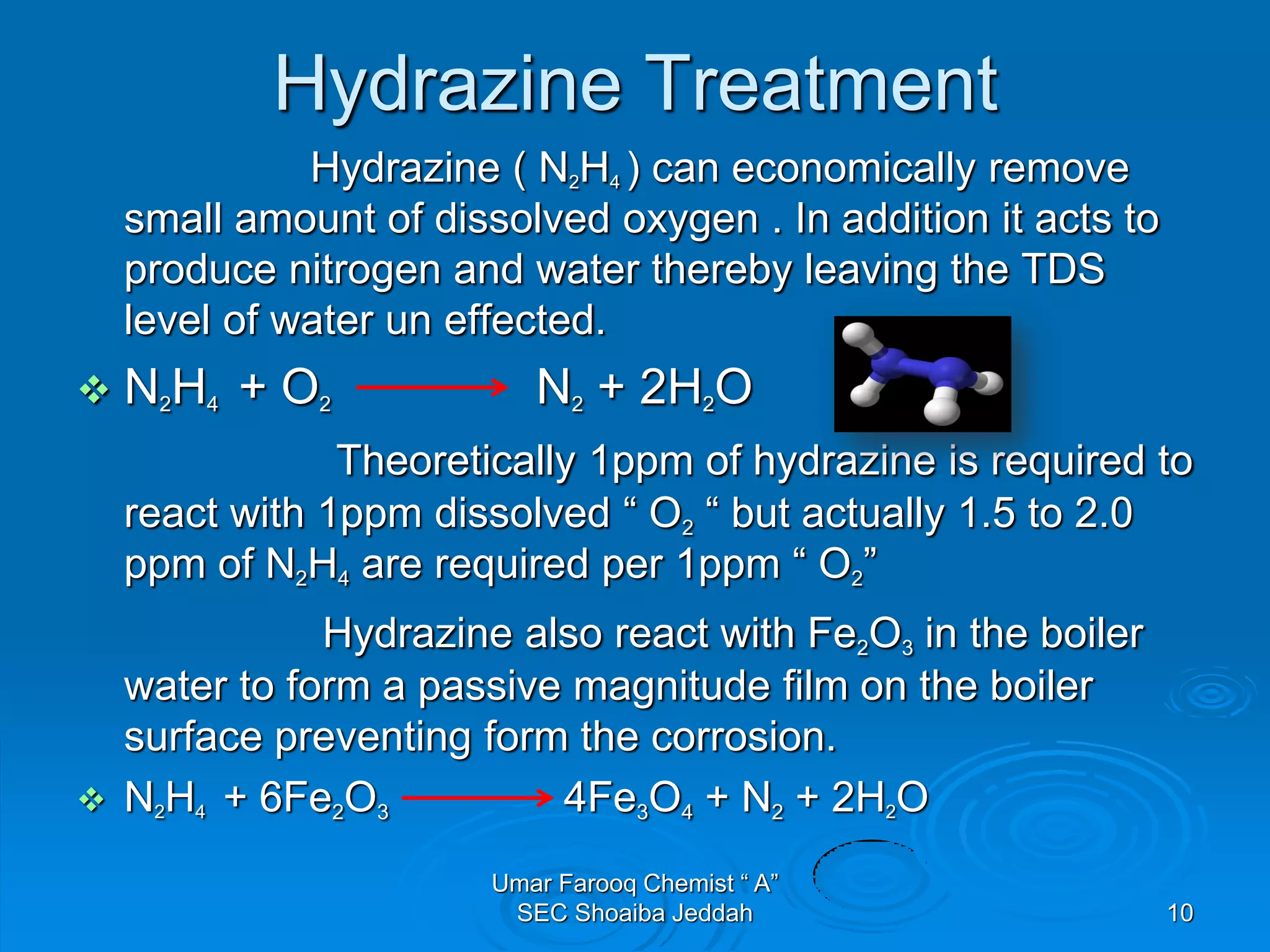
Hydrazine ( N2H4 ) can economically remove
small amount of dissolved oxygen . In addition it acts to
produce nitrogen and water thereby leaving the TDS
level of water un effected.
 N2H4 + O2 N2 + 2H2O
Theoretically 1ppm of hydrazine is required to
react with 1ppm dissolved “ O2 “ but actually 1.5 to 2.0
ppm of N2H4 are required per 1ppm “ O2”
Hydrazine also react with Fe2O3 in the boiler
water to form a passive magnitude film on the boiler
surface preventing form the corrosion.
 N2H4 + 6Fe2O3 4Fe3O4 + N2 + 2H2O
Umar Farooq Chemist “ A”
SEC Shoaiba Jeddah 10
Hydrazine Decomposition
Thermal decomposition of hydrazine
takes place above ( 270 C° ) ( 518 F ° ) Through
it influence by reaction time .
N2H4 NH3 + N2
270 c°
Since NH3 is produced by
decomposing of hydrazine , Normally copper
material is used in the steam and condensate
piping . The injection of excess hydrazine should
be avoided.
Umar Farooq Chemist “ A”
SEC Shoaiba Jeddah 11
Other use of Hydrazine
Rocket Fuel:
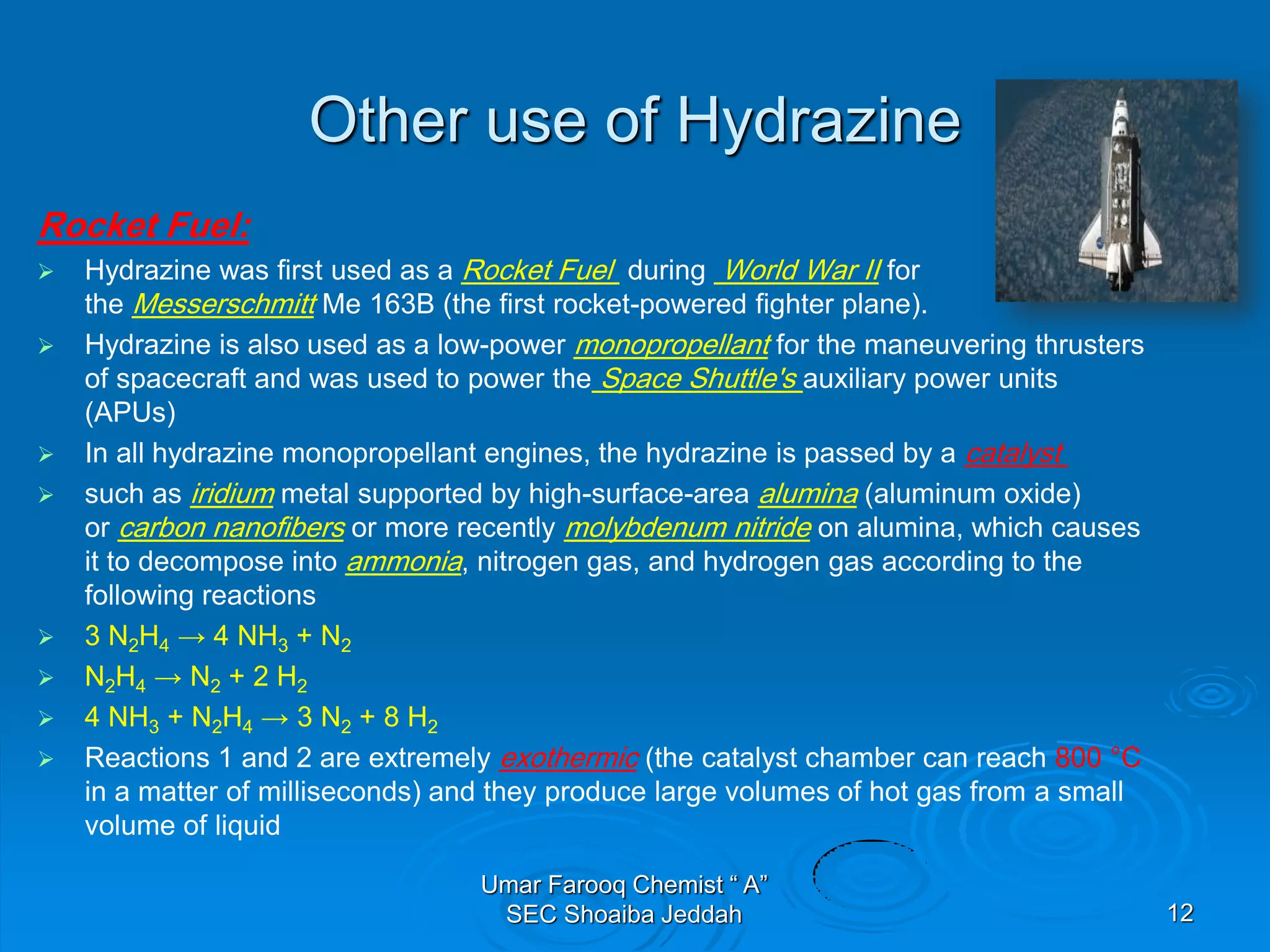
 Hydrazine was first used as a Rocket Fuel during World War II for
the Messerschmitt Me 163B (the first rocket-powered fighter plane).
 Hydrazine is also used as a low-power monopropellant for the maneuvering thrusters
of spacecraft and was used to power the Space Shuttle's auxiliary power units
(APUs)
 In all hydrazine monopropellant engines, the hydrazine is passed by a catalyst
 such as iridium metal supported by high-surface-area alumina (aluminum oxide)
or carbon nanofibers or more recently molybdenum nitride on alumina, which causes
it to decompose into ammonia, nitrogen gas, and hydrogen gas according to the
following reactions
 3 N2H4 → 4 NH3 + N2
 N2H4 → N2 + 2 H2
 4 NH3 + N2H4 → 3 N2 + 8 H2
 Reactions 1 and 2 are extremely exothermic (the catalyst chamber can reach 800 °C
in a matter of milliseconds) and they produce large volumes of hot gas from a small
volume of liquid
Umar Farooq Chemist “ A”
SEC Shoaiba Jeddah 12
13
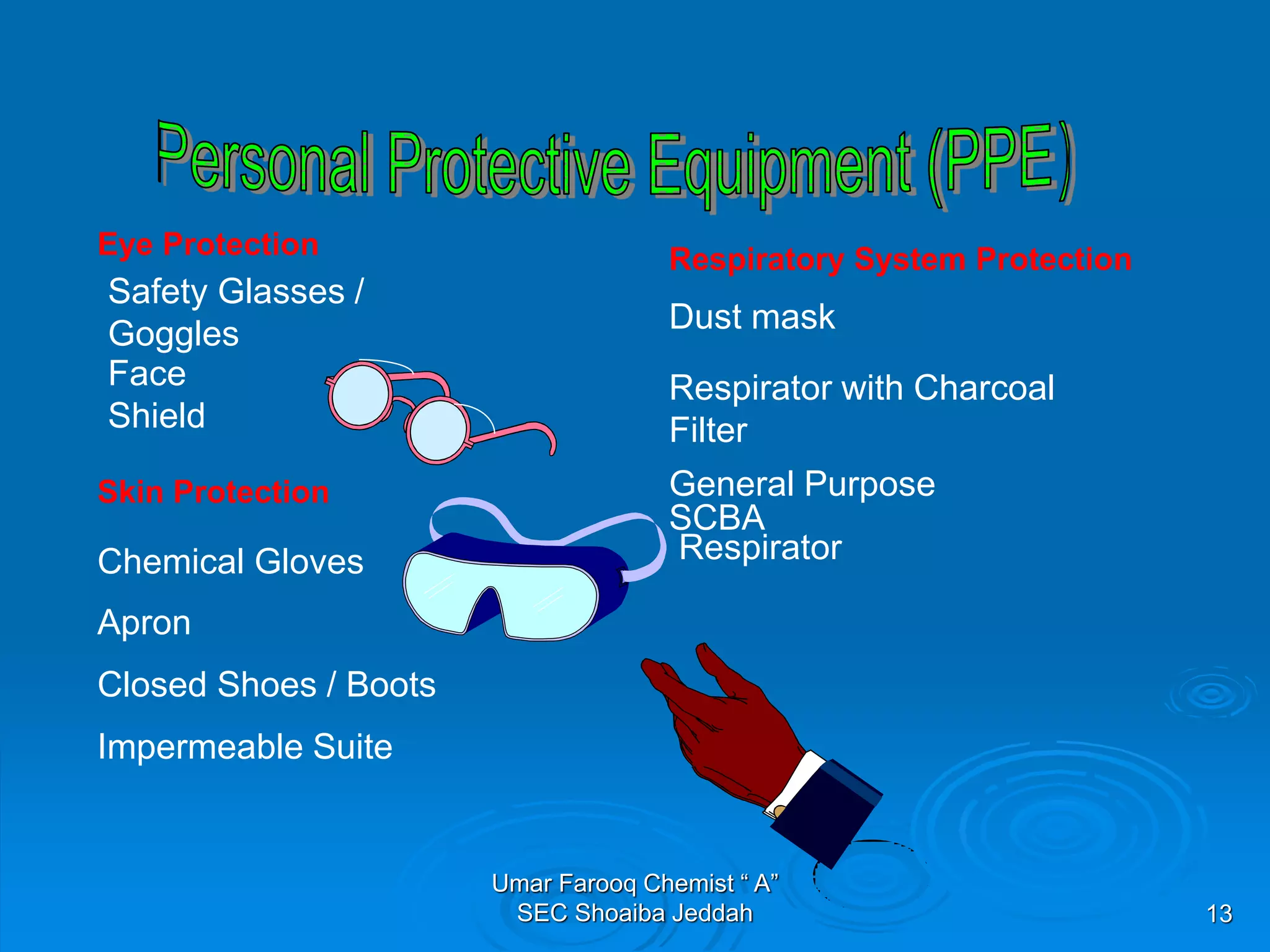
Eye Protection
Safety Glasses /
Goggles
Face
Shield
Respiratory System Protection
Dust mask
Respirator with Charcoal
Filter
General Purpose
Respirator
SCBA
Skin Protection
Apron
Closed Shoes / Boots
Chemical Gloves
Impermeable Suite
Umar Farooq Chemist “ A”
SEC Shoaiba Jeddah
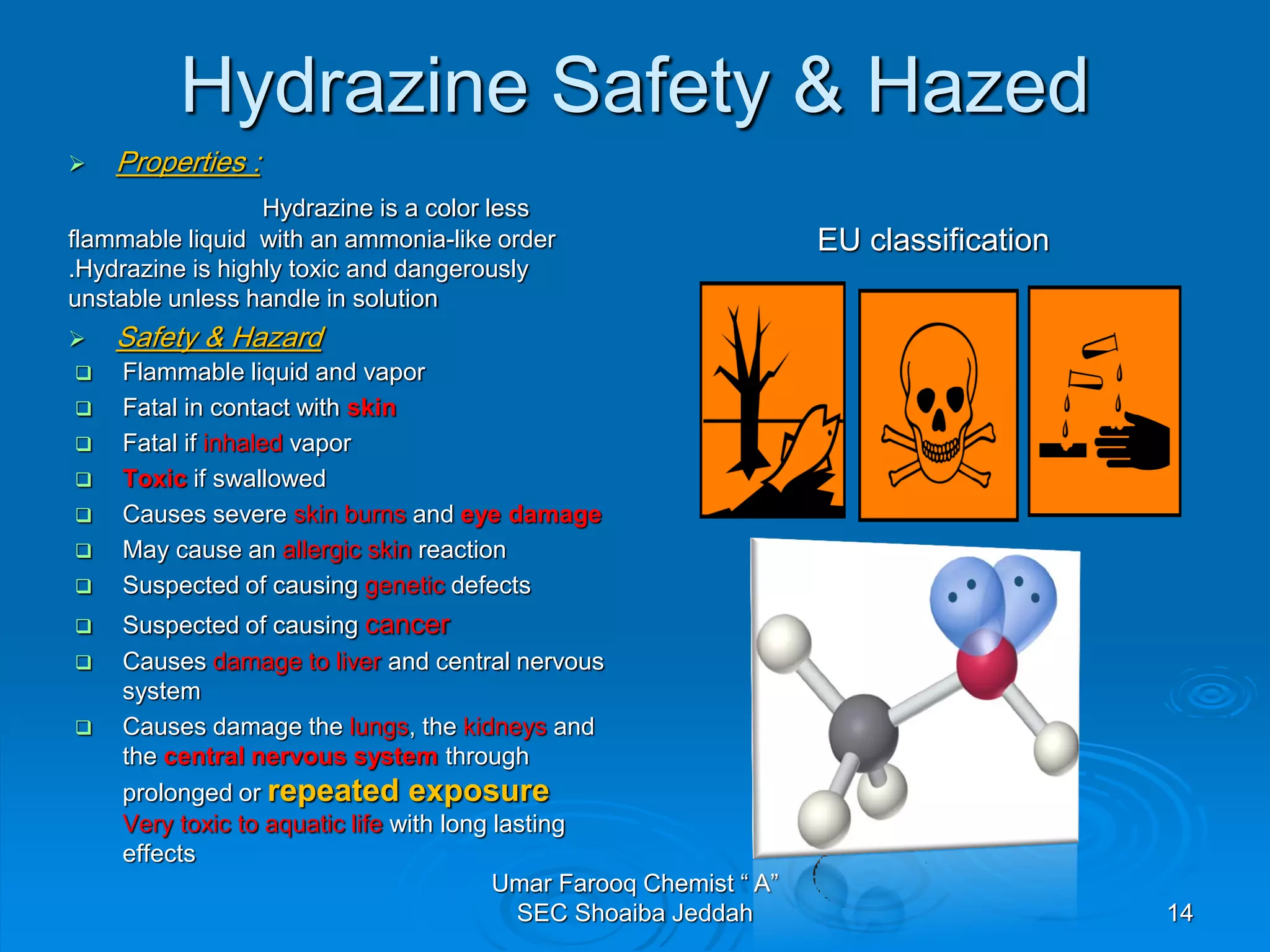
Hydrazine Safety & Hazed
 Properties :
Hydrazine is a color less
flammable liquid with an ammonia-like order
.Hydrazine is highly toxic and dangerously
unstable unless handle in solution
 Safety & Hazard
EU classification
 Flammable liquid and vapor
 Fatal in contact with skin
 Fatal if inhaled vapor
 Toxic if swallowed
 Causes severe skin burns and eye damage
 May cause an allergic skin reaction
 Suspected of causing genetic defects
 Suspected of causing cancer
 Causes damage to liver and central nervous
system
 Causes damage the lungs, the kidneys and
the central nervous system through
prolonged or repeated exposure
Very toxic to aquatic life with long lasting
effects
Umar Farooq Chemist “ A”
SEC Shoaiba Jeddah 14
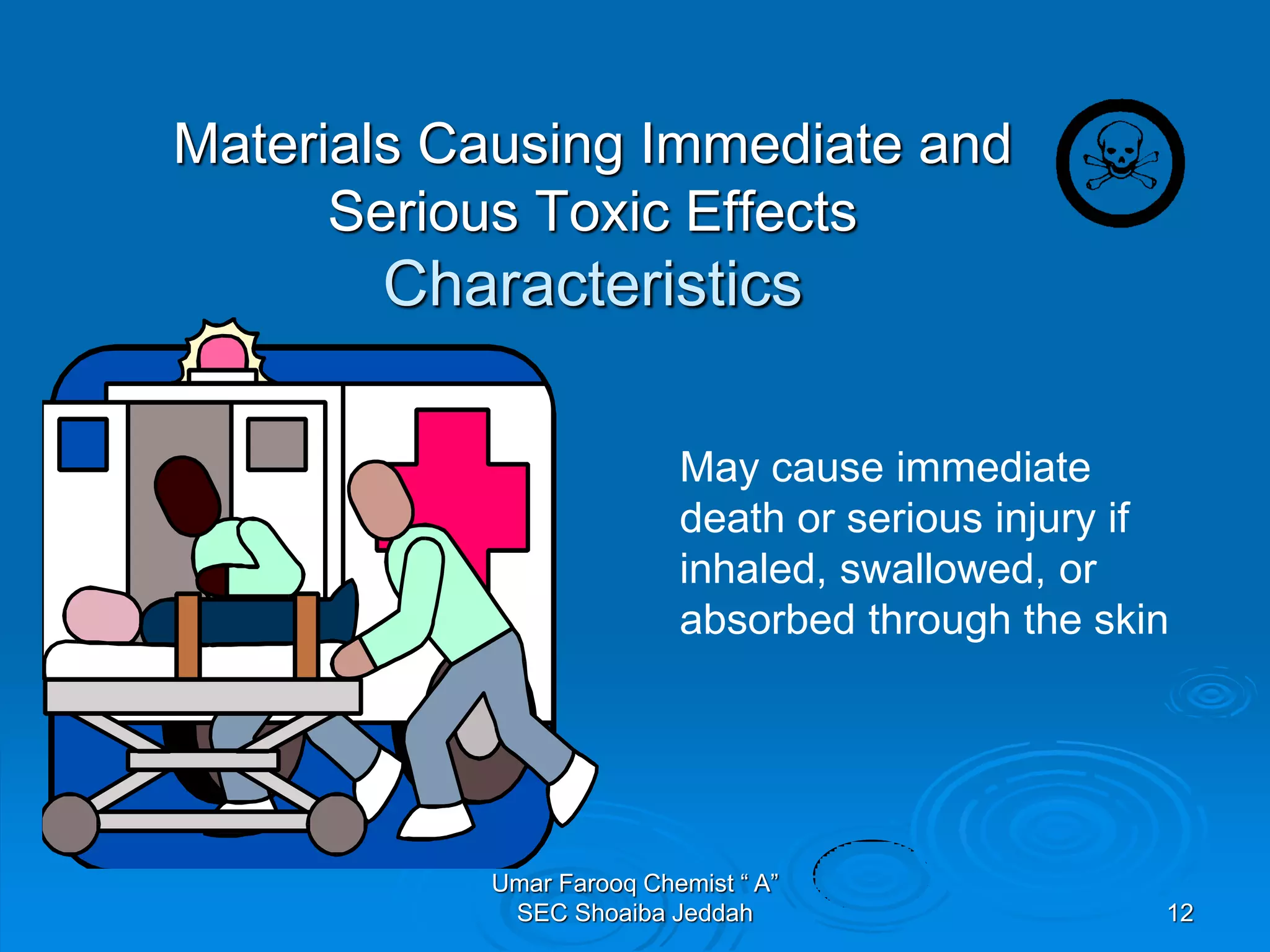
Materials Causing Immediate and
Serious Toxic Effects
Characteristics
May cause immediate
death or serious injury if
inhaled, swallowed, or
absorbed through the skin
12
Umar Farooq Chemist “ A”
SEC Shoaiba Jeddah
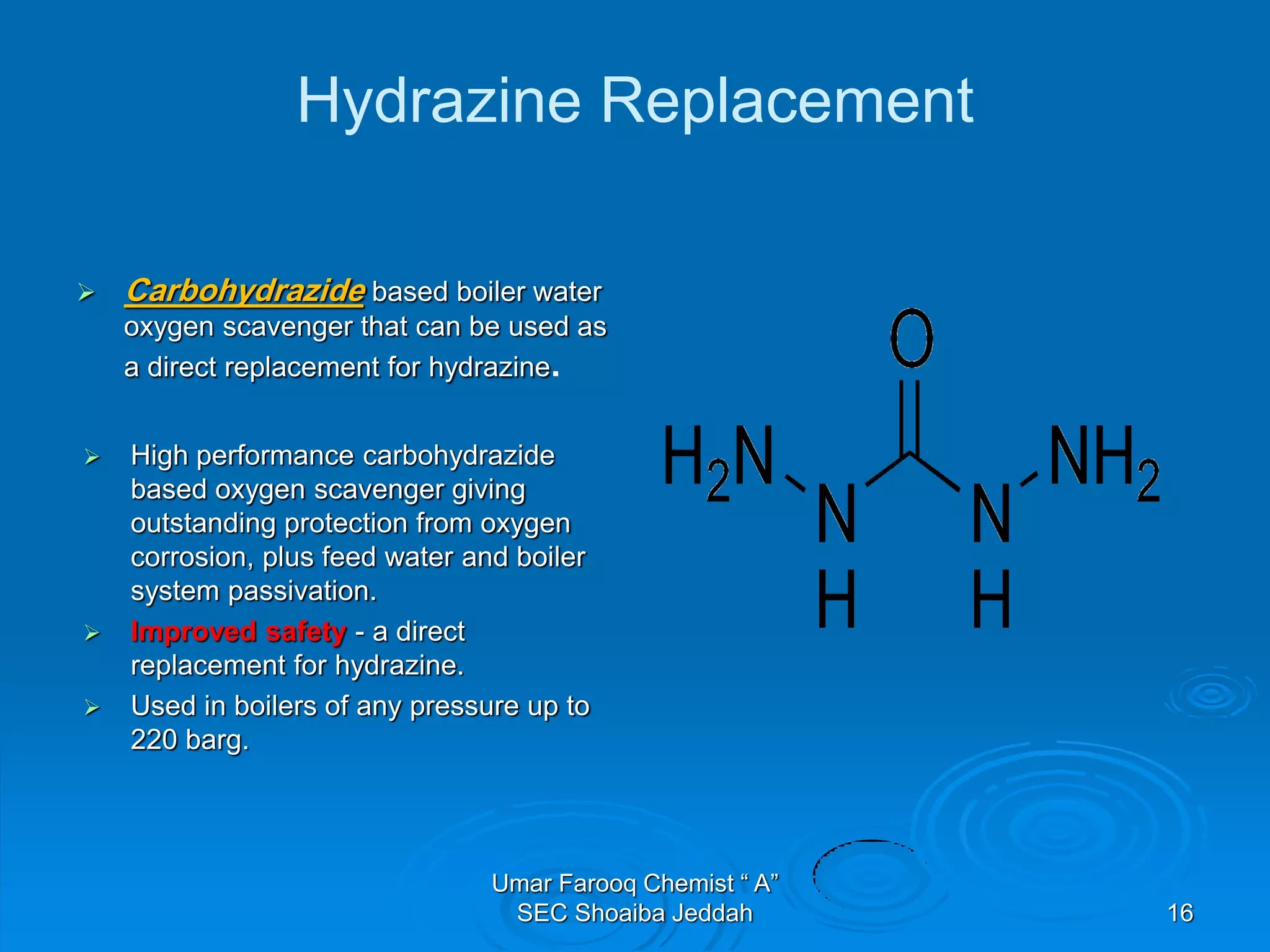
Hydrazine Replacement
 Carbohydrazide based boiler water
oxygen scavenger that can be used as
a direct replacement for hydrazine.
 High performance carbohydrazide
based oxygen scavenger giving
outstanding protection from oxygen
corrosion, plus feed water and boiler
system passivation.
 Improved safety - a direct
replacement for hydrazine.
 Used in boilers of any pressure up to
220 barg.
Umar Farooq Chemist “ A”
SEC Shoaiba Jeddah 16
Umar Farooq Chemist “ A”
SEC Shoaiba Jeddah 17

Oxygen scavenger presentation

  • 1.
    Oxygen Scavenger Use's& Safety Precaution Prepared By : - Umar Farooq Chemist “A” Chemical Section 107301@se.com.sa umar7325@yahoo.com SEC Shuaibah Jeddah Saudi Arabia 1
  • 2.
    Exposure • In orderfor a chemical to produce a biological effect, it must first reach a target individual (exposure pathway). • Then the chemical must reach a target site within the body (toxicokinetics). • Toxicity is a function of the effective dose (how much) of a foreign chemical (xenobiotic) at its target site, integrated over time (how long). • Individual factors such as body weight will influence the dose at the target site X = 2 Umar Farooq Chemist “ A” SEC Shoaiba Jeddah
  • 3.
    Route of Exposure Routeof Exposure • The route (site) of exposure is an important determinant of the ultimate dose—different routes may result in different rates of absorption.  Dermal (skin)  Inhalation (lung)  Oral ingestion (Gastrointestinal)  Injection • The route of exposure may be important if there are tissue-specific toxic responses. • Toxic effects may be local or systemic 3 Umar Farooq Chemist “ A” SEC Shoaiba Jeddah
  • 4.
    Time of Exposure Timeof Exposure • How long an the Person & organism is exposed to a chemical is important Duration and frequency contribute to dose. Both may alter toxic effects.  Acute Exposure = usually entails a single exposure  Chronic Exposures = multiple exposures over time (frequency) 4 Umar Farooq Chemist “ A” SEC Shoaiba Jeddah
  • 5.
    Father of ModernToxicology Paracelsus—1564 “All things are poisonous, only the dose makes it non- poisonous.” Dose alone determines toxicity All chemicals—synthetic or natural—have the capacity to be toxic Dose THE KEY CONCEPT in Toxicology 5 Umar Farooq Chemist “ A” SEC Shoaiba Jeddah
  • 6.
    The emerging fieldof “Pharmacogenomics” or “Toxicogenomics” offers the potential to identify and protect subsets of people predisposed to toxicity from chemicals or drugs Typical Population Identify People with “normal” responses More Sensitive Less Sensitive 6 Umar Farooq Chemist “ A” SEC Shoaiba Jeddah
  • 7.
    Oxygen Scavenger An oxygenscavenger is a chemical which remove dissolve O2 in H2O by a reduction reaction and there by inhibits to corrosion cause by the O2. we discussed here following two type of oxygen scavenger 1) Sodium Sulphite Na2SO3 2) Hydrazine N2H4 Sodium Sulfite In practice I ppm of oxygen required 8ppm of Na2SO3 . The major disadvantage in it are is that 8ppm . Na2SO3 contribute 9ppm of Na2SO3 into total dissolved solid in the boiler consequently increasing blow down . Sodium sulphite recommended for boiler operation at pressure below 600 pisg. Umar Farooq Chemist “ A” SEC Shoaiba Jeddah 7
  • 8.
    Sodium Sulphite The maindisadvantage of use sodium sulphite is decomposition Na2SO3 + H2O 2NaOH +SO2 Na2SO3 + H2O 3NaSO4 + 2NaOH +H2S The main problem associated with sulphite break down is the formation of corrosive gases So2 and H2S which can cause corrosion in after boiler section Umar Farooq Chemist “ A” SEC Shoaiba Jeddah 8
  • 9.
    Hydrazine  Use inpower plant In the treatment of feed water system to protect Boiler and pre boiler equipment’s from oxygen attack’s If left untreated, boiler water derived oxygen will corrode metallic boiler components leading to increased maintenance costs and reduced boiler efficiency. Umar Farooq Chemist “ A” SEC Shoaiba Jeddah 9
  • 10.
    Hydrazine Treatment Hydrazine (N2H4 ) can economically remove small amount of dissolved oxygen . In addition it acts to produce nitrogen and water thereby leaving the TDS level of water un effected.  N2H4 + O2 N2 + 2H2O Theoretically 1ppm of hydrazine is required to react with 1ppm dissolved “ O2 “ but actually 1.5 to 2.0 ppm of N2H4 are required per 1ppm “ O2” Hydrazine also react with Fe2O3 in the boiler water to form a passive magnitude film on the boiler surface preventing form the corrosion.  N2H4 + 6Fe2O3 4Fe3O4 + N2 + 2H2O Umar Farooq Chemist “ A” SEC Shoaiba Jeddah 10
  • 11.
    Hydrazine Decomposition Thermal decompositionof hydrazine takes place above ( 270 C° ) ( 518 F ° ) Through it influence by reaction time . N2H4 NH3 + N2 270 c° Since NH3 is produced by decomposing of hydrazine , Normally copper material is used in the steam and condensate piping . The injection of excess hydrazine should be avoided. Umar Farooq Chemist “ A” SEC Shoaiba Jeddah 11
  • 12.
    Other use ofHydrazine Rocket Fuel:  Hydrazine was first used as a Rocket Fuel during World War II for the Messerschmitt Me 163B (the first rocket-powered fighter plane).  Hydrazine is also used as a low-power monopropellant for the maneuvering thrusters of spacecraft and was used to power the Space Shuttle's auxiliary power units (APUs)  In all hydrazine monopropellant engines, the hydrazine is passed by a catalyst  such as iridium metal supported by high-surface-area alumina (aluminum oxide) or carbon nanofibers or more recently molybdenum nitride on alumina, which causes it to decompose into ammonia, nitrogen gas, and hydrogen gas according to the following reactions  3 N2H4 → 4 NH3 + N2  N2H4 → N2 + 2 H2  4 NH3 + N2H4 → 3 N2 + 8 H2  Reactions 1 and 2 are extremely exothermic (the catalyst chamber can reach 800 °C in a matter of milliseconds) and they produce large volumes of hot gas from a small volume of liquid Umar Farooq Chemist “ A” SEC Shoaiba Jeddah 12
  • 13.
    13 Eye Protection Safety Glasses/ Goggles Face Shield Respiratory System Protection Dust mask Respirator with Charcoal Filter General Purpose Respirator SCBA Skin Protection Apron Closed Shoes / Boots Chemical Gloves Impermeable Suite Umar Farooq Chemist “ A” SEC Shoaiba Jeddah
  • 14.
    Hydrazine Safety &Hazed  Properties : Hydrazine is a color less flammable liquid with an ammonia-like order .Hydrazine is highly toxic and dangerously unstable unless handle in solution  Safety & Hazard EU classification  Flammable liquid and vapor  Fatal in contact with skin  Fatal if inhaled vapor  Toxic if swallowed  Causes severe skin burns and eye damage  May cause an allergic skin reaction  Suspected of causing genetic defects  Suspected of causing cancer  Causes damage to liver and central nervous system  Causes damage the lungs, the kidneys and the central nervous system through prolonged or repeated exposure Very toxic to aquatic life with long lasting effects Umar Farooq Chemist “ A” SEC Shoaiba Jeddah 14
  • 15.
    Materials Causing Immediateand Serious Toxic Effects Characteristics May cause immediate death or serious injury if inhaled, swallowed, or absorbed through the skin 12 Umar Farooq Chemist “ A” SEC Shoaiba Jeddah
  • 16.
    Hydrazine Replacement  Carbohydrazidebased boiler water oxygen scavenger that can be used as a direct replacement for hydrazine.  High performance carbohydrazide based oxygen scavenger giving outstanding protection from oxygen corrosion, plus feed water and boiler system passivation.  Improved safety - a direct replacement for hydrazine.  Used in boilers of any pressure up to 220 barg. Umar Farooq Chemist “ A” SEC Shoaiba Jeddah 16
  • 17.
    Umar Farooq Chemist“ A” SEC Shoaiba Jeddah 17