Chlorine Use & Safety
Precaution
Prepared By : -
Umar Farooq
Chemist “A” Chemical Section
107301@se.com.sa
umar7325@yahoo.com
SEC Shuaibah Jeddah
Saudi Arabia 1
Chlorine Usage
1. Chlorine is used in power plant for kill
microorganism in Cooling Water System .
2.Residual chlorine of 0.3-0.5 ppm is to be
maintained in the system just before the
TBS Intake and Outfall Water .
3.Chlorine existing in water as hypochlorus
and hypochlorus acid ion ( Hypochlorite )
Define as free available chlorine.
Umar Farooq Chemist “ A “
Shuaibah Jeddah 2
Chlorination
 HOCl <7 8> H + OCl
Hypochlorous Acid
 At the higher pH range as the ratio of Ocl
increase as the sterilization effect of chlorine
compound decrease.
 It is practically observed that the sterilization
force of Ocl is approximately 20 time less as that
of HOCl
 HOCl has significantly higher effect than Ocl
Umar Farooq Chemist “ A “
Shuaibah Jeddah 3
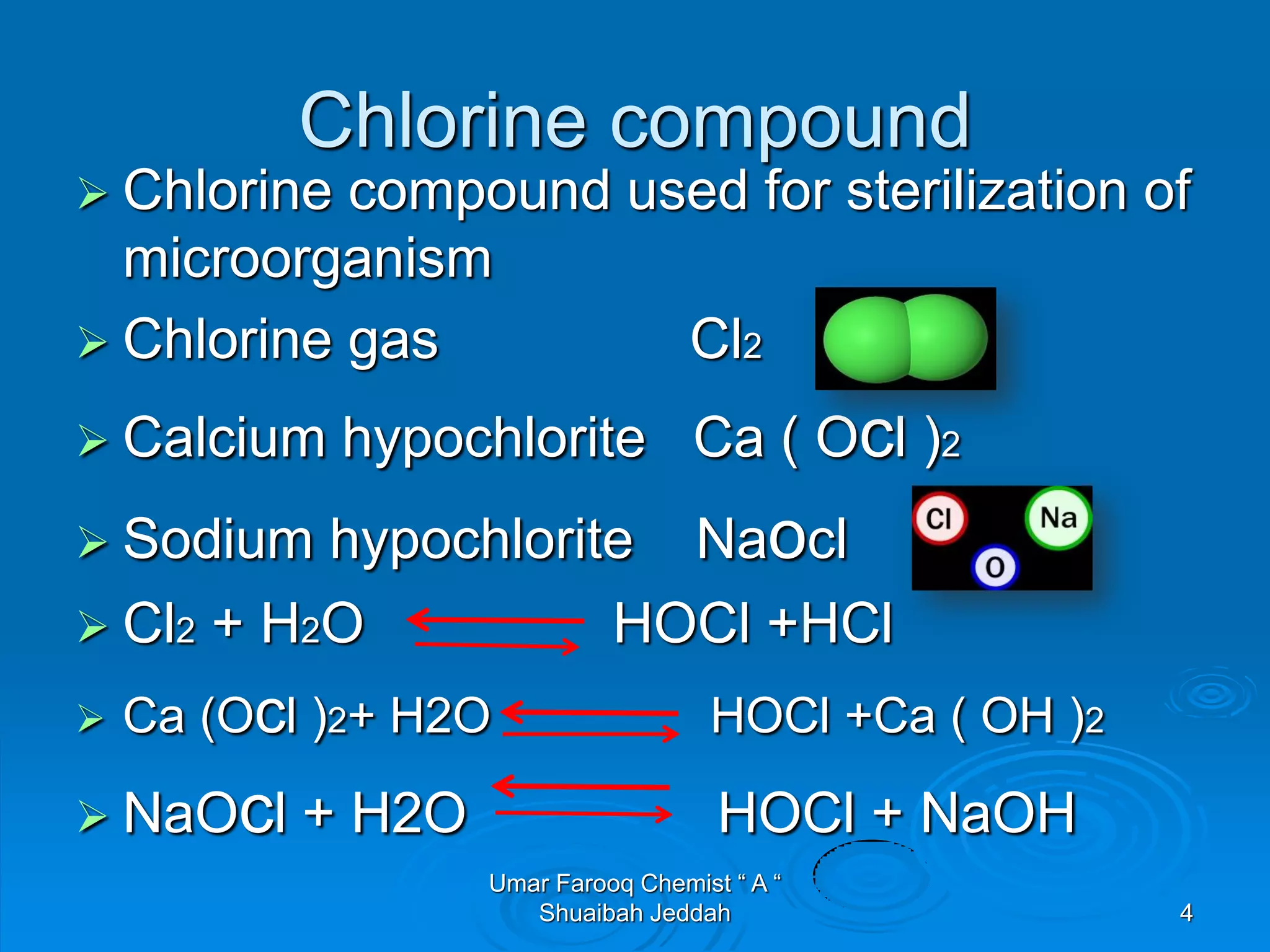
Chlorine compound
 Chlorine compound used for sterilization of
microorganism
 Chlorine gas Cl2
 Calcium hypochlorite Ca ( Ocl )2
 Sodium hypochlorite Naocl
 Cl2 + H2O HOCl +HCl
 Ca (Ocl )2+ H2O HOCl +Ca ( OH )2
 NaOcl + H2O HOCl + NaOH
Umar Farooq Chemist “ A “
Shuaibah Jeddah 4
Chlorine dioxide
 5Naclo2 + 4Hcl 4Clo2 +5Nacl +2H2o
 Chlorine dioxide use for potable water
disinfection
 To protect drinking water from disease causing
organisms, or pathogens
 Chlorine has been hailed as the savior against
cholera an acute infectious disease of the small intestine ,and
various other water-borne diseases
Chlorine dioxide
Umar Farooq Chemist “ A “
Shuaibah Jeddah 5
Immediately Dangerous To Life or Health Concentrations (IDLHs)
National Institute for Occupational Safety and Health ( NIOSH )
Substance
Original IDLH Value
ppm
Revised IDLH Value
ppm
Carbon Mono Oxide 1500 1200
Chlorine 30 10
Chlorine dioxide 10 05
Chloroform 1000 500
Hydrazine 80 50
Iodine 10 2
Ammonia 500 300
Bromine 10 3
Nitrogen dioxide
50 20
Umar Farooq Chemist “ A “
Shuaibah Jeddah 6
Chlorine Health Effects Table
Bulletin work safe Alberta CH 067-Chemical Hazards
Chlorine Concentration ppm Health Effect
0.03-0.04 Range of odor threshold
1-3 Mid irritation of the eyes, nose and throat
3-6
Stinging or burring in the eyes, nose and
throat, headache, watering eyes, sneezing,
coughing, breathing difficulty, bloody nose.
5-10
Severe irritation of the eyes, nose and
respiratory tract
10
Immediately dangerous to life and health
( IDLH ) Concentration
10-25 May be fatal after 30 minutes of exposure.
>25
Immediate breathing difficulty, build up of fluid
in the lungs ( pulmonary edema)possibly
causing suffocation and death. Pulmonary
edema may be immediate or delayed
>1000 Fatal after a few breaths
Umar Farooq Chemist “ A “
Shuaibah Jeddah 7
Safety Precaution of Chlorine
 It is a very corrosive chemical
 It causes burns to skin and eyes
 It is harmful if ingested, inhaled
 it may cause skin irritation
 If it comes in contact with skin, immediately
wash the skin with plenty of water
 Flush the eyes if it comes in contact with the
eyes
Umar Farooq Chemist “ A “
Shuaibah Jeddah 8
Chlorine Effect On Respiratory System
External Effect
1. Directly attack to cilia
2. Na & K pump damage
3. Surfactant damage
Internal Effect
1. GHS activate nephritic factor
2. Capillary damage
3. Sensory nerve
4. Interstitium
Abbreviation
Alveoli
ASC Ascorbate
Surfactant defensive system to
prevent shrinking
X Secondary Intermediate
IL8 To digest to kill
Umar Farooq Chemist “ A “
Shuaibah Jeddah 9
 If inhaled, the person should be
immediately removed to fresh air and
medical attention should be sought if signs
of suffocation
 Eyes should be protected
 Chlorine is corrosive to metallic material
 To avoid corrosion should be maintain
proper dosing
Umar Farooq Chemist “ A “
Shuaibah Jeddah 10
Acute Effects of Chlorine
 Tickling of the nose at 0.014 to 0.054(ppm);
 Tickling of the throat at 0.04 to 0.097 ppm;
 Tickling of the nose and cough, stinging, or
dryness of the nose and throat at 0.06 to 0.3
ppm;
 Burning of the conjunctiva and pain after 15
minutes at 0.35 to 0.72 ppm;
 Discomfort ranging from ocular and respiratory
irritation to coughing, shortness of breath, and
headaches above 1.0 ppm.
Umar Farooq Chemist “ A “
Shuaibah Jeddah 11
Materials Causing Immediate and
Serious Toxic Effects
Characteristics
May cause immediate
death or serious injury if
inhaled, swallowed, or
absorbed through the skin
12
Umar Farooq Chemist “ A “
Shuaibah Jeddah
Chlorine Advantages
 Economical
 Traditional technology
 Chlorine kill microorganism by destroying
cell wall of the microorganism with there
oxidizing forces
Umar Farooq Chemist “ A “
Shuaibah Jeddah 13
MicrobiologyThe most
prevalent
problems
in
Cooling
water
systems
are related
to
microbiolo
gy Proteins
Phospholipids Hydrophilic groups
Hydrophobic groups
Phospholipid molecules
Glycocalyx
Outer Membrane
DNA
Periplasmic
Space
Flagellum
Cell Membrane
Cytoplasm
Proteins
Umar Farooq Chemist “ A “
Shuaibah Jeddah 14
Bacteria
Slime Formers
Iron DepositingAnaerobic
Typical Rods
Umar Farooq Chemist “ A “
Shuaibah Jeddah 15
Chlorine Disadvantages
 Slower kill at high pH
 Consumed by ammonia, sulfides, iron, manganese, &
hydrocarbons
 Volatile and easily stripped, thus high usage rates
 High feed rates and residuals can cause higher
corrosion rates
 Poor control (or slug treatment) leads to degradation of
water treatment compounds -- e.g. organic phosphate
and tolyltriazole
 Chlorinated organics, e.g., THM’s, are toxic, regulated,
and persistent in the environment
Umar Farooq Chemist “ A “
Shuaibah Jeddah 16
Umar Farooq Chemist “ A “
Shuaibah Jeddah 17

Chlorine uses &amp; safety

  • 1.
    Chlorine Use &Safety Precaution Prepared By : - Umar Farooq Chemist “A” Chemical Section 107301@se.com.sa umar7325@yahoo.com SEC Shuaibah Jeddah Saudi Arabia 1
  • 2.
    Chlorine Usage 1. Chlorineis used in power plant for kill microorganism in Cooling Water System . 2.Residual chlorine of 0.3-0.5 ppm is to be maintained in the system just before the TBS Intake and Outfall Water . 3.Chlorine existing in water as hypochlorus and hypochlorus acid ion ( Hypochlorite ) Define as free available chlorine. Umar Farooq Chemist “ A “ Shuaibah Jeddah 2
  • 3.
    Chlorination  HOCl <78> H + OCl Hypochlorous Acid  At the higher pH range as the ratio of Ocl increase as the sterilization effect of chlorine compound decrease.  It is practically observed that the sterilization force of Ocl is approximately 20 time less as that of HOCl  HOCl has significantly higher effect than Ocl Umar Farooq Chemist “ A “ Shuaibah Jeddah 3
  • 4.
    Chlorine compound  Chlorinecompound used for sterilization of microorganism  Chlorine gas Cl2  Calcium hypochlorite Ca ( Ocl )2  Sodium hypochlorite Naocl  Cl2 + H2O HOCl +HCl  Ca (Ocl )2+ H2O HOCl +Ca ( OH )2  NaOcl + H2O HOCl + NaOH Umar Farooq Chemist “ A “ Shuaibah Jeddah 4
  • 5.
    Chlorine dioxide  5Naclo2+ 4Hcl 4Clo2 +5Nacl +2H2o  Chlorine dioxide use for potable water disinfection  To protect drinking water from disease causing organisms, or pathogens  Chlorine has been hailed as the savior against cholera an acute infectious disease of the small intestine ,and various other water-borne diseases Chlorine dioxide Umar Farooq Chemist “ A “ Shuaibah Jeddah 5
  • 6.
    Immediately Dangerous ToLife or Health Concentrations (IDLHs) National Institute for Occupational Safety and Health ( NIOSH ) Substance Original IDLH Value ppm Revised IDLH Value ppm Carbon Mono Oxide 1500 1200 Chlorine 30 10 Chlorine dioxide 10 05 Chloroform 1000 500 Hydrazine 80 50 Iodine 10 2 Ammonia 500 300 Bromine 10 3 Nitrogen dioxide 50 20 Umar Farooq Chemist “ A “ Shuaibah Jeddah 6
  • 7.
    Chlorine Health EffectsTable Bulletin work safe Alberta CH 067-Chemical Hazards Chlorine Concentration ppm Health Effect 0.03-0.04 Range of odor threshold 1-3 Mid irritation of the eyes, nose and throat 3-6 Stinging or burring in the eyes, nose and throat, headache, watering eyes, sneezing, coughing, breathing difficulty, bloody nose. 5-10 Severe irritation of the eyes, nose and respiratory tract 10 Immediately dangerous to life and health ( IDLH ) Concentration 10-25 May be fatal after 30 minutes of exposure. >25 Immediate breathing difficulty, build up of fluid in the lungs ( pulmonary edema)possibly causing suffocation and death. Pulmonary edema may be immediate or delayed >1000 Fatal after a few breaths Umar Farooq Chemist “ A “ Shuaibah Jeddah 7
  • 8.
    Safety Precaution ofChlorine  It is a very corrosive chemical  It causes burns to skin and eyes  It is harmful if ingested, inhaled  it may cause skin irritation  If it comes in contact with skin, immediately wash the skin with plenty of water  Flush the eyes if it comes in contact with the eyes Umar Farooq Chemist “ A “ Shuaibah Jeddah 8
  • 9.
    Chlorine Effect OnRespiratory System External Effect 1. Directly attack to cilia 2. Na & K pump damage 3. Surfactant damage Internal Effect 1. GHS activate nephritic factor 2. Capillary damage 3. Sensory nerve 4. Interstitium Abbreviation Alveoli ASC Ascorbate Surfactant defensive system to prevent shrinking X Secondary Intermediate IL8 To digest to kill Umar Farooq Chemist “ A “ Shuaibah Jeddah 9
  • 10.
     If inhaled,the person should be immediately removed to fresh air and medical attention should be sought if signs of suffocation  Eyes should be protected  Chlorine is corrosive to metallic material  To avoid corrosion should be maintain proper dosing Umar Farooq Chemist “ A “ Shuaibah Jeddah 10
  • 11.
    Acute Effects ofChlorine  Tickling of the nose at 0.014 to 0.054(ppm);  Tickling of the throat at 0.04 to 0.097 ppm;  Tickling of the nose and cough, stinging, or dryness of the nose and throat at 0.06 to 0.3 ppm;  Burning of the conjunctiva and pain after 15 minutes at 0.35 to 0.72 ppm;  Discomfort ranging from ocular and respiratory irritation to coughing, shortness of breath, and headaches above 1.0 ppm. Umar Farooq Chemist “ A “ Shuaibah Jeddah 11
  • 12.
    Materials Causing Immediateand Serious Toxic Effects Characteristics May cause immediate death or serious injury if inhaled, swallowed, or absorbed through the skin 12 Umar Farooq Chemist “ A “ Shuaibah Jeddah
  • 13.
    Chlorine Advantages  Economical Traditional technology  Chlorine kill microorganism by destroying cell wall of the microorganism with there oxidizing forces Umar Farooq Chemist “ A “ Shuaibah Jeddah 13
  • 14.
    MicrobiologyThe most prevalent problems in Cooling water systems are related to microbiolo gyProteins Phospholipids Hydrophilic groups Hydrophobic groups Phospholipid molecules Glycocalyx Outer Membrane DNA Periplasmic Space Flagellum Cell Membrane Cytoplasm Proteins Umar Farooq Chemist “ A “ Shuaibah Jeddah 14
  • 15.
    Bacteria Slime Formers Iron DepositingAnaerobic TypicalRods Umar Farooq Chemist “ A “ Shuaibah Jeddah 15
  • 16.
    Chlorine Disadvantages  Slowerkill at high pH  Consumed by ammonia, sulfides, iron, manganese, & hydrocarbons  Volatile and easily stripped, thus high usage rates  High feed rates and residuals can cause higher corrosion rates  Poor control (or slug treatment) leads to degradation of water treatment compounds -- e.g. organic phosphate and tolyltriazole  Chlorinated organics, e.g., THM’s, are toxic, regulated, and persistent in the environment Umar Farooq Chemist “ A “ Shuaibah Jeddah 16
  • 17.
    Umar Farooq Chemist“ A “ Shuaibah Jeddah 17