go-to-market
Transforming how clients
Contributes to Information
Overload
Challenges moving outside of
comfort zone and creating
demand
Diminishing Returns
on Cost Cutting Initiatives
Legacy Culture is
Internally Focused
Increases Complexity of
New Way of Working
Mounting a solution selling engine
on a product selling chassis
Functional Waste
Overlays and complexity are
too cumbersome and costly
Lack of an Ability to Rapidly
Assimilate Cultures
Inconsistent content and
Knowledge management
unravel change investments
Inefficiencies
Across Silos
Non-Scalable Knowledge
Transfer and Execution
Strategies
Create new
capabili es
Increase
effic
i
ency/cut costs
Improve customer
rela onships
Adjust Go To Market
strategy
CEO
STAKEHOLDER FORCES
INDUSTRY FORCES MARKET FORCES
Improve shareholder value
109.98 +.14
Share Price
Profit Margins
R
I
6%
Investors
Directors
Analysts
Technology Disrup ons
New / Evolving Trends
Compe tors Commodi za on
Increased buyer op ons
Expanding role of purchasing
Evolving buying pa erns
Increasing power of suppliers
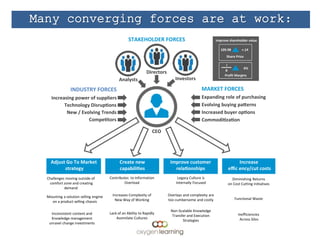
Many converging forces are at work:
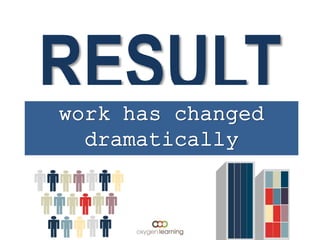
RESULTwork has changed
dramatically
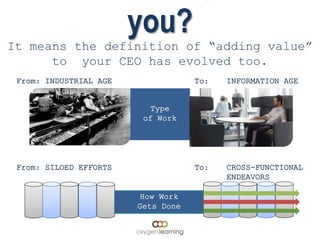
From: INDUSTRIAL AGE
From: SILOED EFFORTS
To: INFORMATION AGE
To: CROSS-FUNCTIONAL
ENDEAVORS
you?
It means the definition of “adding value”
to your CEO has evolved too.
How Work
Gets Done
Type
of Work
5
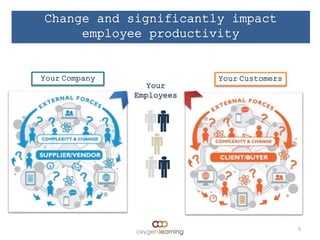
Your Company Your Customers
Your
Employees
Change and significantly impact
employee productivity
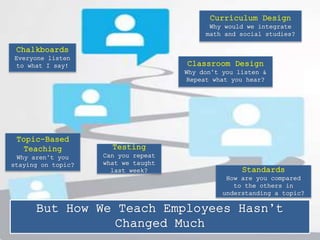
But How We Teach Employees Hasn’t
Changed Much
Chalkboards
Everyone listen
to what I say!
Curriculum Design
Why would we integrate
math and social studies?
Classroom Design
Why don’t you listen &
Repeat what you hear?
Topic-Based
Teaching
Why aren’t you
staying on topic?
Testing
Can you repeat
what we taught
last week? Standards
How are you compared
to the others in
understanding a topic?
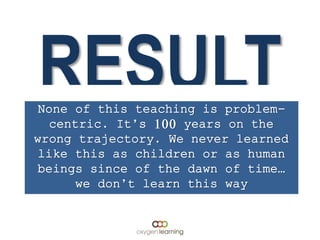
RESULTNone of this teaching is problem-
centric. It’s 100 years on the
wrong trajectory. We never learned
like this as children or as human
beings since of the dawn of time…
we don’t learn this way
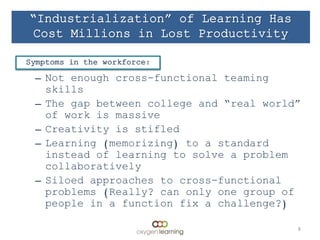
– Not enough cross-functional teaming
skills
– The gap between college and “real world”
of work is massive
– Creativity is stifled
– Learning (memorizing) to a standard
instead of learning to solve a problem
collaboratively
– Siloed approaches to cross-functional
problems (Really? can only one group of
people in a function fix a challenge?)
8
“Industrialization” of Learning Has
Cost Millions in Lost Productivity
Symptoms in the workforce:
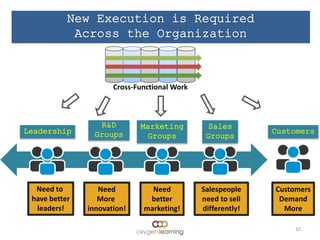
Leadership
10
Cross-Functional Work
R&D
Groups
Marketing
Groups
Sales
Groups
Customers
Need to
have better
leaders!
Need
More
innovation!
Need
better
marketing!
Salespeople
need to sell
differently!
Customers
Demand
More
New Execution is Required
Across the Organization
11
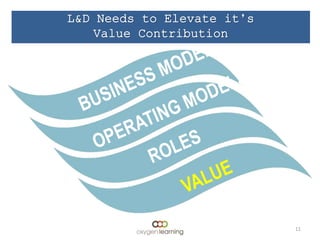
L&D Needs to Elevate it’s
Value Contribution
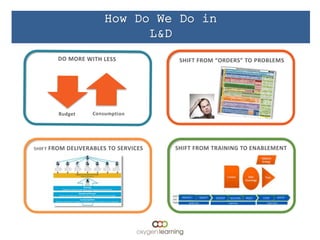
SHIFT FROM “ORDERS” TO PROBLEMS
SHIFT FROM DELIVERABLES TO SERVICES SHIFT FROM TRAINING TO ENABLEMENT
How Do We Do in
L&D
THANKS

Oxygen message _creative_sparkle

  • 1.
  • 2.
    Contributes to Information Overload Challengesmoving outside of comfort zone and creating demand Diminishing Returns on Cost Cutting Initiatives Legacy Culture is Internally Focused Increases Complexity of New Way of Working Mounting a solution selling engine on a product selling chassis Functional Waste Overlays and complexity are too cumbersome and costly Lack of an Ability to Rapidly Assimilate Cultures Inconsistent content and Knowledge management unravel change investments Inefficiencies Across Silos Non-Scalable Knowledge Transfer and Execution Strategies Create new capabili es Increase effic i ency/cut costs Improve customer rela onships Adjust Go To Market strategy CEO STAKEHOLDER FORCES INDUSTRY FORCES MARKET FORCES Improve shareholder value 109.98 +.14 Share Price Profit Margins R I 6% Investors Directors Analysts Technology Disrup ons New / Evolving Trends Compe tors Commodi za on Increased buyer op ons Expanding role of purchasing Evolving buying pa erns Increasing power of suppliers Many converging forces are at work:
  • 3.
  • 4.
    From: INDUSTRIAL AGE From:SILOED EFFORTS To: INFORMATION AGE To: CROSS-FUNCTIONAL ENDEAVORS you? It means the definition of “adding value” to your CEO has evolved too. How Work Gets Done Type of Work
  • 5.
    5 Your Company YourCustomers Your Employees Change and significantly impact employee productivity
  • 6.
    But How WeTeach Employees Hasn’t Changed Much Chalkboards Everyone listen to what I say! Curriculum Design Why would we integrate math and social studies? Classroom Design Why don’t you listen & Repeat what you hear? Topic-Based Teaching Why aren’t you staying on topic? Testing Can you repeat what we taught last week? Standards How are you compared to the others in understanding a topic?
  • 7.
    RESULTNone of thisteaching is problem- centric. It’s 100 years on the wrong trajectory. We never learned like this as children or as human beings since of the dawn of time… we don’t learn this way
  • 8.
    – Not enoughcross-functional teaming skills – The gap between college and “real world” of work is massive – Creativity is stifled – Learning (memorizing) to a standard instead of learning to solve a problem collaboratively – Siloed approaches to cross-functional problems (Really? can only one group of people in a function fix a challenge?) 8 “Industrialization” of Learning Has Cost Millions in Lost Productivity Symptoms in the workforce:
  • 9.
    Leadership 10 Cross-Functional Work R&D Groups Marketing Groups Sales Groups Customers Need to havebetter leaders! Need More innovation! Need better marketing! Salespeople need to sell differently! Customers Demand More New Execution is Required Across the Organization
  • 10.
    11 L&D Needs toElevate it’s Value Contribution
  • 11.
    SHIFT FROM “ORDERS”TO PROBLEMS SHIFT FROM DELIVERABLES TO SERVICES SHIFT FROM TRAINING TO ENABLEMENT How Do We Do in L&D
  • 12.

Editor's Notes

  • #4 The livelihood of companies in this modern world is dependent on its ability to continuously innovate and adapt. Both factors are a direct result of the aptitude and attitude of its employees. i.e. the intellectual assets
  • #8 The livelihood of companies in this modern world is dependent on its ability to continuously innovate and adapt. Both factors are a direct result of the aptitude and attitude of its employees. i.e. the intellectual assets
  • #12 Business models are creating new operating models where this shift happens, forcing many leaders to adapt and re-think their value contribution In today's information economy, critical roles must add value to the business strategy, and create competitive advantage — it's not a nice to have — it's not optional If individuals in critical roles can't learn, then the company can't execute, and you can't grow This creates pressure for CEOs and executives who want to build an environment where people can work together differently, so they can compete Because of this, learning leaders such as yourself have begun to treat learning as a "verb" and not a "noun" in order to lay the critical foundation for execution their CEOs are looking for Leaders have to focus on increasing the rate and return on learning in order to increase the earning potential and growth of your company