OWASP TOP 10 2013
Compliance Report
16 June 2017
Generated by Acunetix
Description
The primary aim of the OWASP Top 10 is to educate developers, designers, architects, managers, and organizations about the
consequences of the most important web application security weaknesses. The Top 10 provides basic techniques to protect
against these high risk problem areas - and also provides guidance on where to go from here.
Disclaimer
This document or any of its content cannot account for, or be included in any form of legal advice. The outcome of a vulnerability
scan (or security evaluation) should be utilized to ensure that diligent measures are taken to lower the risk of potential exploits
carried out to compromise data.
Legal advice must be supplied according to its legal context. All laws and the environments in which they are applied, are
constantly changed and revised. Therefore no information provided in this document may ever be used as an alternative to a
qualified legal body or representative.
A portion of this report is taken from OWASP's Top Ten 2013 Project document, that can be found at http://www.owasp.org.
Scan
URL http://www.ambato.gob.ec/
Scan date
Duration
Profile
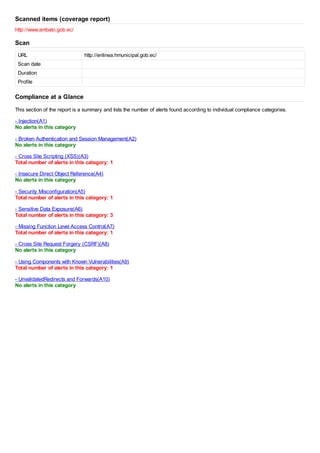
Compliance at a Glance
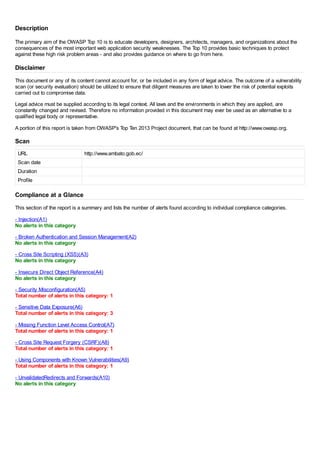
This section of the report is a summary and lists the number of alerts found according to individual compliance categories.
- Injection(A1)
No alerts in this category
- Broken Authentication and Session Management(A2)
No alerts in this category
- Cross Site Scripting (XSS)(A3)
No alerts in this category
- Insecure Direct Object Reference(A4)
No alerts in this category
- Security Misconfiguration(A5)
Total number of alerts in this category: 1
- Sensitive Data Exposure(A6)
Total number of alerts in this category: 3
- Missing Function Level Access Control(A7)
Total number of alerts in this category: 1
- Cross Site Request Forgery (CSRF)(A8)
Total number of alerts in this category: 1
- Using Components with Known Vulnerabilities(A9)
Total number of alerts in this category: 1
- UnvalidatedRedirects and Forwards(A10)
No alerts in this category
Compliance According to Categories: A Detailed Report
This section is a detailed report that explains each vulnerability found according to individual compliance categories.
(A1)Injection
Injection flaws, such as SQL, OS, and LDAP injection occur when untrusted data is sent to an interpreter as part of a command or
query. The attacker's hostile data can trick the interpreter into executing unintended commands or accessing data without proper
authorization.
No alerts in this category.
(A2)Broken Authentication and Session Management
Application functions related to authentication and session management are often not implemented correctly, allowing attackers to
compromise passwords, keys, or session tokens, or to exploit other implementation flaws to assume other users' identities.
No alerts in this category.
(A3)Cross Site Scripting (XSS)
XSS flaws occur whenever an application takes untrusted data and sends it to a web browser without proper validation or
escaping. XSS allows attackers to execute scripts in the victim's browser which can hijack user sessions, deface web sites, or
redirect the user to malicious sites.
No alerts in this category.
(A4)Insecure Direct Object Reference
A direct object reference occurs when a developer exposes a reference to an internal implementation object, such as a file,
directory, or database key. Without an access control check or other protection, attackers can manipulate these references to
access unauthorized data.
No alerts in this category.
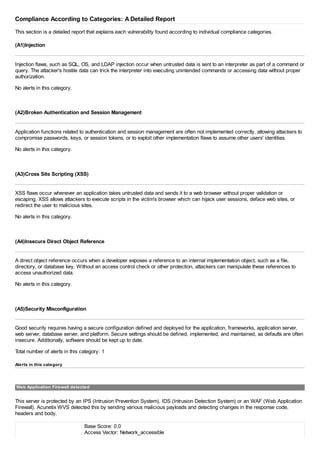
(A5)Security Misconfiguration
Good security requires having a secure configuration defined and deployed for the application, frameworks, application server,
web server, database server, and platform. Secure settings should be defined, implemented, and maintained, as defaults are often
insecure. Additionally, software should be kept up to date.
Total number of alerts in this category: 1
Alerts in this category
Web Application Firewall detected
This server is protected by an IPS (Intrusion Prevention System), IDS (Intrusion Detection System) or an WAF (Web Application
Firewall). Acunetix WVS detected this by sending various malicious payloads and detecting changes in the response code,
headers and body.
Base Score: 0.0
Access Vector: Network_accessible
CVSS2
Access Complexity: Low
Authentication: None
Confidentiality Impact: None
Integrity Impact: None
Availability Impact: None
Exploitability: Not_defined
Remediation Level: Not_defined
Report Confidence: Not_defined
Availability Requirement: Not_defined
Collateral Damage Potential: Not_defined
Confidentiality Requirement: Not_defined
Integrity Requirement: Not_defined
Target Distribution: Not_defined
CVSS3
Base Score: 0.0
Attack Vector: Network
Attack Complexity: Low
Privileges Required: None
User Interaction: None
Scope: Unchanged
Confidentiality Impact: None
Integrity Impact: None
Availability Impact: None
CWE CWE-16
Affected item Web Server
Affected parameter
Variants
(A6)Sensitive Data Exposure
Many web applications do not properly protect sensitive data, such as credit cards, tax IDs, and authentication credentials.
Attackers may steal or modify such weakly protected data to conduct credit card fraud, identity theft, or other crimes. Sensitive
data deserves extra protection such as encryption at rest or in transit, as well as special precautions when exchanged with the
browser.
Total number of alerts in this category: 3
Alerts in this category
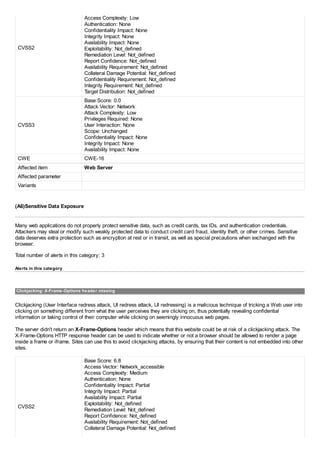
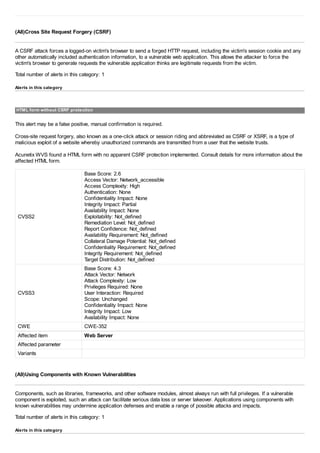
Clickjacking: X-Frame-Options header missing
Clickjacking (User Interface redress attack, UI redress attack, UI redressing) is a malicious technique of tricking a Web user into
clicking on something different from what the user perceives they are clicking on, thus potentially revealing confidential
information or taking control of their computer while clicking on seemingly innocuous web pages.
The server didn't return an X-Frame-Options header which means that this website could be at risk of a clickjacking attack. The
X-Frame-Options HTTP response header can be used to indicate whether or not a browser should be allowed to render a page
inside a frame or iframe. Sites can use this to avoid clickjacking attacks, by ensuring that their content is not embedded into other
sites.
CVSS2
Base Score: 6.8
Access Vector: Network_accessible
Access Complexity: Medium
Authentication: None
Confidentiality Impact: Partial
Integrity Impact: Partial
Availability Impact: Partial
Exploitability: Not_defined
Remediation Level: Not_defined
Report Confidence: Not_defined
Availability Requirement: Not_defined
Collateral Damage Potential: Not_defined
Confidentiality Requirement: Not_defined
Integrity Requirement: Not_defined
Target Distribution: Not_defined
CWE CWE-693
Affected item Web Server
Affected parameter
Variants
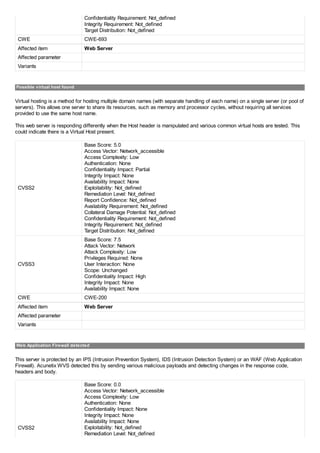
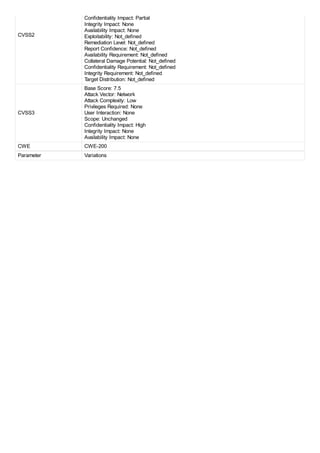
Possible virtual host found
Virtual hosting is a method for hosting multiple domain names (with separate handling of each name) on a single server (or pool of
servers). This allows one server to share its resources, such as memory and processor cycles, without requiring all services
provided to use the same host name.
This web server is responding differently when the Host header is manipulated and various common virtual hosts are tested. This
could indicate there is a Virtual Host present.
CVSS2
Base Score: 5.0
Access Vector: Network_accessible
Access Complexity: Low
Authentication: None
Confidentiality Impact: Partial
Integrity Impact: None
Availability Impact: None
Exploitability: Not_defined
Remediation Level: Not_defined
Report Confidence: Not_defined
Availability Requirement: Not_defined
Collateral Damage Potential: Not_defined
Confidentiality Requirement: Not_defined
Integrity Requirement: Not_defined
Target Distribution: Not_defined
CVSS3
Base Score: 7.5
Attack Vector: Network
Attack Complexity: Low
Privileges Required: None
User Interaction: None
Scope: Unchanged
Confidentiality Impact: High
Integrity Impact: None
Availability Impact: None
CWE CWE-200
Affected item Web Server
Affected parameter
Variants
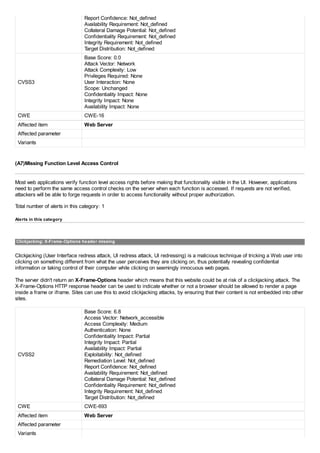
Web Application Firewall detected
This server is protected by an IPS (Intrusion Prevention System), IDS (Intrusion Detection System) or an WAF (Web Application
Firewall). Acunetix WVS detected this by sending various malicious payloads and detecting changes in the response code,
headers and body.
CVSS2
Base Score: 0.0
Access Vector: Network_accessible
Access Complexity: Low
Authentication: None
Confidentiality Impact: None
Integrity Impact: None
Availability Impact: None
Exploitability: Not_defined
Remediation Level: Not_defined
Report Confidence: Not_defined
Availability Requirement: Not_defined
Collateral Damage Potential: Not_defined
Confidentiality Requirement: Not_defined
Integrity Requirement: Not_defined
Target Distribution: Not_defined
CVSS3
Base Score: 0.0
Attack Vector: Network
Attack Complexity: Low
Privileges Required: None
User Interaction: None
Scope: Unchanged
Confidentiality Impact: None
Integrity Impact: None
Availability Impact: None
CWE CWE-16
Affected item Web Server
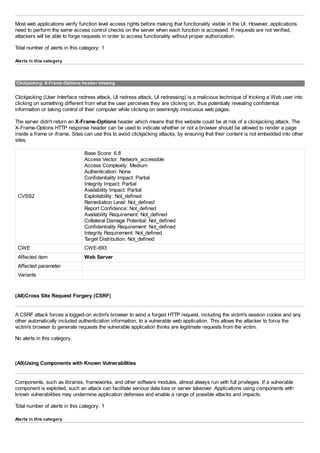
Affected parameter
Variants
(A7)Missing Function Level Access Control
Most web applications verify function level access rights before making that functionality visible in the UI. However, applications
need to perform the same access control checks on the server when each function is accessed. If requests are not verified,
attackers will be able to forge requests in order to access functionality without proper authorization.
Total number of alerts in this category: 1
Alerts in this category
Clickjacking: X-Frame-Options header missing
Clickjacking (User Interface redress attack, UI redress attack, UI redressing) is a malicious technique of tricking a Web user into
clicking on something different from what the user perceives they are clicking on, thus potentially revealing confidential
information or taking control of their computer while clicking on seemingly innocuous web pages.
The server didn't return an X-Frame-Options header which means that this website could be at risk of a clickjacking attack. The
X-Frame-Options HTTP response header can be used to indicate whether or not a browser should be allowed to render a page
inside a frame or iframe. Sites can use this to avoid clickjacking attacks, by ensuring that their content is not embedded into other
sites.
CVSS2
Base Score: 6.8
Access Vector: Network_accessible
Access Complexity: Medium
Authentication: None
Confidentiality Impact: Partial
Integrity Impact: Partial
Availability Impact: Partial
Exploitability: Not_defined
Remediation Level: Not_defined
Report Confidence: Not_defined
Availability Requirement: Not_defined
Collateral Damage Potential: Not_defined
Confidentiality Requirement: Not_defined
Integrity Requirement: Not_defined
Target Distribution: Not_defined
CWE CWE-693
Affected item Web Server
Affected parameter
Variants
(A8)Cross Site Request Forgery (CSRF)
A CSRF attack forces a logged-on victim's browser to send a forged HTTP request, including the victim's session cookie and any
other automatically included authentication information, to a vulnerable web application. This allows the attacker to force the
victim's browser to generate requests the vulnerable application thinks are legitimate requests from the victim.
Total number of alerts in this category: 1
Alerts in this category
HTML form without CSRF protection
This alert may be a false positive, manual confirmation is required.
Cross-site request forgery, also known as a one-click attack or session riding and abbreviated as CSRF or XSRF, is a type of
malicious exploit of a website whereby unauthorized commands are transmitted from a user that the website trusts.
Acunetix WVS found a HTML form with no apparent CSRF protection implemented. Consult details for more information about the
affected HTML form.
CVSS2
Base Score: 2.6
Access Vector: Network_accessible
Access Complexity: High
Authentication: None
Confidentiality Impact: None
Integrity Impact: Partial
Availability Impact: None
Exploitability: Not_defined
Remediation Level: Not_defined
Report Confidence: Not_defined
Availability Requirement: Not_defined
Collateral Damage Potential: Not_defined
Confidentiality Requirement: Not_defined
Integrity Requirement: Not_defined
Target Distribution: Not_defined
CVSS3
Base Score: 4.3
Attack Vector: Network
Attack Complexity: Low
Privileges Required: None
User Interaction: Required
Scope: Unchanged
Confidentiality Impact: None
Integrity Impact: Low
Availability Impact: None
CWE CWE-352
Affected item Web Server
Affected parameter
Variants
(A9)Using Components with Known Vulnerabilities
Components, such as libraries, frameworks, and other software modules, almost always run with full privileges. If a vulnerable
component is exploited, such an attack can facilitate serious data loss or server takeover. Applications using components with
known vulnerabilities may undermine application defenses and enable a range of possible attacks and impacts.
Total number of alerts in this category: 1
Alerts in this category
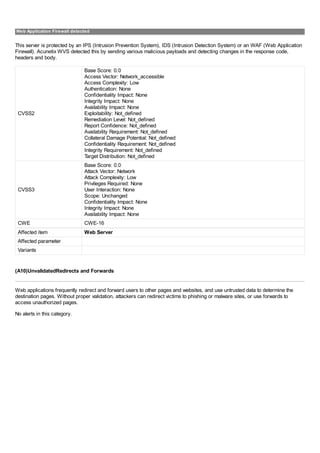
Web Application Firewall detected
This server is protected by an IPS (Intrusion Prevention System), IDS (Intrusion Detection System) or an WAF (Web Application
Firewall). Acunetix WVS detected this by sending various malicious payloads and detecting changes in the response code,
headers and body.
CVSS2
Base Score: 0.0
Access Vector: Network_accessible
Access Complexity: Low
Authentication: None
Confidentiality Impact: None
Integrity Impact: None
Availability Impact: None
Exploitability: Not_defined
Remediation Level: Not_defined
Report Confidence: Not_defined
Availability Requirement: Not_defined
Collateral Damage Potential: Not_defined
Confidentiality Requirement: Not_defined
Integrity Requirement: Not_defined
Target Distribution: Not_defined
CVSS3
Base Score: 0.0
Attack Vector: Network
Attack Complexity: Low
Privileges Required: None
User Interaction: None
Scope: Unchanged
Confidentiality Impact: None
Integrity Impact: None
Availability Impact: None
CWE CWE-16
Affected item Web Server
Affected parameter
Variants
(A10)UnvalidatedRedirects and Forwards
Web applications frequently redirect and forward users to other pages and websites, and use untrusted data to determine the
destination pages. Without proper validation, attackers can redirect victims to phishing or malware sites, or use forwards to
access unauthorized pages.
No alerts in this category.
Affected Items: A Detailed Report
This section provides full details of the types of vulnerabilities found according to individual affected items.
Web Server
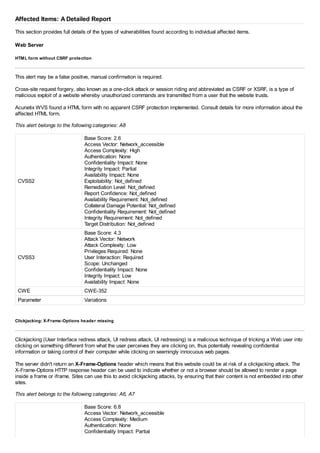
HTML form without CSRF protection
This alert may be a false positive, manual confirmation is required.
Cross-site request forgery, also known as a one-click attack or session riding and abbreviated as CSRF or XSRF, is a type of
malicious exploit of a website whereby unauthorized commands are transmitted from a user that the website trusts.
Acunetix WVS found a HTML form with no apparent CSRF protection implemented. Consult details for more information about the
affected HTML form.
This alert belongs to the following categories: A8
CVSS2
Base Score: 2.6
Access Vector: Network_accessible
Access Complexity: High
Authentication: None
Confidentiality Impact: None
Integrity Impact: Partial
Availability Impact: None
Exploitability: Not_defined
Remediation Level: Not_defined
Report Confidence: Not_defined
Availability Requirement: Not_defined
Collateral Damage Potential: Not_defined
Confidentiality Requirement: Not_defined
Integrity Requirement: Not_defined
Target Distribution: Not_defined
CVSS3
Base Score: 4.3
Attack Vector: Network
Attack Complexity: Low
Privileges Required: None
User Interaction: Required
Scope: Unchanged
Confidentiality Impact: None
Integrity Impact: Low
Availability Impact: None
CWE CWE-352
Parameter Variations
Clickjacking: X-Frame-Options header missing
Clickjacking (User Interface redress attack, UI redress attack, UI redressing) is a malicious technique of tricking a Web user into
clicking on something different from what the user perceives they are clicking on, thus potentially revealing confidential
information or taking control of their computer while clicking on seemingly innocuous web pages.
The server didn't return an X-Frame-Options header which means that this website could be at risk of a clickjacking attack. The
X-Frame-Options HTTP response header can be used to indicate whether or not a browser should be allowed to render a page
inside a frame or iframe. Sites can use this to avoid clickjacking attacks, by ensuring that their content is not embedded into other
sites.
This alert belongs to the following categories: A6, A7
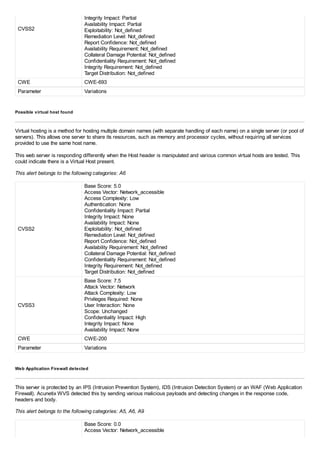
Base Score: 6.8
Access Vector: Network_accessible
Access Complexity: Medium
Authentication: None
Confidentiality Impact: Partial
CVSS2
Integrity Impact: Partial
Availability Impact: Partial
Exploitability: Not_defined
Remediation Level: Not_defined
Report Confidence: Not_defined
Availability Requirement: Not_defined
Collateral Damage Potential: Not_defined
Confidentiality Requirement: Not_defined
Integrity Requirement: Not_defined
Target Distribution: Not_defined
CWE CWE-693
Parameter Variations
Possible virtual host found
Virtual hosting is a method for hosting multiple domain names (with separate handling of each name) on a single server (or pool of
servers). This allows one server to share its resources, such as memory and processor cycles, without requiring all services
provided to use the same host name.
This web server is responding differently when the Host header is manipulated and various common virtual hosts are tested. This
could indicate there is a Virtual Host present.
This alert belongs to the following categories: A6
CVSS2
Base Score: 5.0
Access Vector: Network_accessible
Access Complexity: Low
Authentication: None
Confidentiality Impact: Partial
Integrity Impact: None
Availability Impact: None
Exploitability: Not_defined
Remediation Level: Not_defined
Report Confidence: Not_defined
Availability Requirement: Not_defined
Collateral Damage Potential: Not_defined
Confidentiality Requirement: Not_defined
Integrity Requirement: Not_defined
Target Distribution: Not_defined
CVSS3
Base Score: 7.5
Attack Vector: Network
Attack Complexity: Low
Privileges Required: None
User Interaction: None
Scope: Unchanged
Confidentiality Impact: High
Integrity Impact: None
Availability Impact: None
CWE CWE-200
Parameter Variations
Web Application Firewall detected
This server is protected by an IPS (Intrusion Prevention System), IDS (Intrusion Detection System) or an WAF (Web Application
Firewall). Acunetix WVS detected this by sending various malicious payloads and detecting changes in the response code,
headers and body.
This alert belongs to the following categories: A5, A6, A9
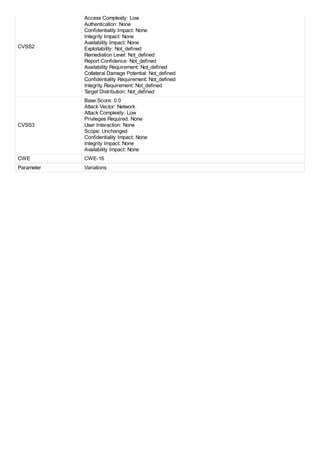
Base Score: 0.0
Access Vector: Network_accessible
CVSS2
Access Complexity: Low
Authentication: None
Confidentiality Impact: None
Integrity Impact: None
Availability Impact: None
Exploitability: Not_defined
Remediation Level: Not_defined
Report Confidence: Not_defined
Availability Requirement: Not_defined
Collateral Damage Potential: Not_defined
Confidentiality Requirement: Not_defined
Integrity Requirement: Not_defined
Target Distribution: Not_defined
CVSS3
Base Score: 0.0
Attack Vector: Network
Attack Complexity: Low
Privileges Required: None
User Interaction: None
Scope: Unchanged
Confidentiality Impact: None
Integrity Impact: None
Availability Impact: None
CWE CWE-16
Parameter Variations
Scanned items (coverage report)
http://www.ambato.gob.ec/
Scan
URL http://enlinea.hmunicipal.gob.ec/
Scan date
Duration
Profile
Compliance at a Glance
This section of the report is a summary and lists the number of alerts found according to individual compliance categories.
- Injection(A1)
No alerts in this category
- Broken Authentication and Session Management(A2)
No alerts in this category
- Cross Site Scripting (XSS)(A3)
Total number of alerts in this category: 1
- Insecure Direct Object Reference(A4)
No alerts in this category
- Security Misconfiguration(A5)
Total number of alerts in this category: 1
- Sensitive Data Exposure(A6)
Total number of alerts in this category: 3
- Missing Function Level Access Control(A7)
Total number of alerts in this category: 1
- Cross Site Request Forgery (CSRF)(A8)
No alerts in this category
- Using Components with Known Vulnerabilities(A9)
Total number of alerts in this category: 1
- UnvalidatedRedirects and Forwards(A10)
No alerts in this category
Compliance According to Categories: A Detailed Report
This section is a detailed report that explains each vulnerability found according to individual compliance categories.
(A1)Injection
Injection flaws, such as SQL, OS, and LDAP injection occur when untrusted data is sent to an interpreter as part of a command or
query. The attacker's hostile data can trick the interpreter into executing unintended commands or accessing data without proper
authorization.
No alerts in this category.
(A2)Broken Authentication and Session Management
Application functions related to authentication and session management are often not implemented correctly, allowing attackers to
compromise passwords, keys, or session tokens, or to exploit other implementation flaws to assume other users' identities.
No alerts in this category.
(A3)Cross Site Scripting (XSS)
XSS flaws occur whenever an application takes untrusted data and sends it to a web browser without proper validation or
escaping. XSS allows attackers to execute scripts in the victim's browser which can hijack user sessions, deface web sites, or
redirect the user to malicious sites.
Total number of alerts in this category: 1
Alerts in this category
Cross site scripting
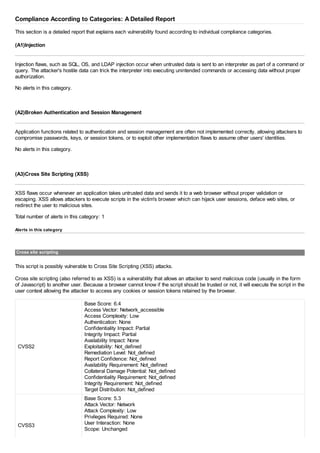
This script is possibly vulnerable to Cross Site Scripting (XSS) attacks.
Cross site scripting (also referred to as XSS) is a vulnerability that allows an attacker to send malicious code (usually in the form
of Javascript) to another user. Because a browser cannot know if the script should be trusted or not, it will execute the script in the
user context allowing the attacker to access any cookies or session tokens retained by the browser.
CVSS2
Base Score: 6.4
Access Vector: Network_accessible
Access Complexity: Low
Authentication: None
Confidentiality Impact: Partial
Integrity Impact: Partial
Availability Impact: None
Exploitability: Not_defined
Remediation Level: Not_defined
Report Confidence: Not_defined
Availability Requirement: Not_defined
Collateral Damage Potential: Not_defined
Confidentiality Requirement: Not_defined
Integrity Requirement: Not_defined
Target Distribution: Not_defined
CVSS3
Base Score: 5.3
Attack Vector: Network
Attack Complexity: Low
Privileges Required: None
User Interaction: None
Scope: Unchanged
Confidentiality Impact: None
Integrity Impact: Low
Availability Impact: None
CWE CWE-79
Affected item Web Server
Affected parameter
Variants
(A4)Insecure Direct Object Reference
A direct object reference occurs when a developer exposes a reference to an internal implementation object, such as a file,
directory, or database key. Without an access control check or other protection, attackers can manipulate these references to
access unauthorized data.
No alerts in this category.
(A5)Security Misconfiguration
Good security requires having a secure configuration defined and deployed for the application, frameworks, application server,
web server, database server, and platform. Secure settings should be defined, implemented, and maintained, as defaults are often
insecure. Additionally, software should be kept up to date.
Total number of alerts in this category: 1
Alerts in this category
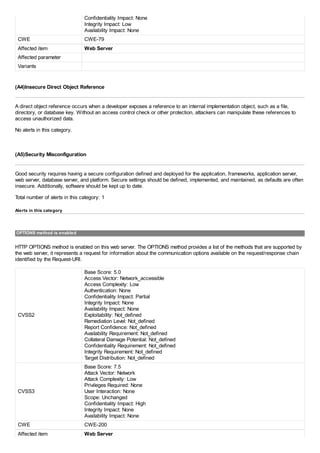
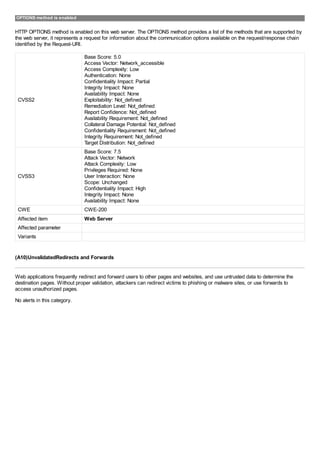
OPTIONS method is enabled
HTTP OPTIONS method is enabled on this web server. The OPTIONS method provides a list of the methods that are supported by
the web server, it represents a request for information about the communication options available on the request/response chain
identified by the Request-URI.
CVSS2
Base Score: 5.0
Access Vector: Network_accessible
Access Complexity: Low
Authentication: None
Confidentiality Impact: Partial
Integrity Impact: None
Availability Impact: None
Exploitability: Not_defined
Remediation Level: Not_defined
Report Confidence: Not_defined
Availability Requirement: Not_defined
Collateral Damage Potential: Not_defined
Confidentiality Requirement: Not_defined
Integrity Requirement: Not_defined
Target Distribution: Not_defined
CVSS3
Base Score: 7.5
Attack Vector: Network
Attack Complexity: Low
Privileges Required: None
User Interaction: None
Scope: Unchanged
Confidentiality Impact: High
Integrity Impact: None
Availability Impact: None
CWE CWE-200
Affected item Web Server
Affected parameter
Variants
(A6)Sensitive Data Exposure
Many web applications do not properly protect sensitive data, such as credit cards, tax IDs, and authentication credentials.
Attackers may steal or modify such weakly protected data to conduct credit card fraud, identity theft, or other crimes. Sensitive
data deserves extra protection such as encryption at rest or in transit, as well as special precautions when exchanged with the
browser.
Total number of alerts in this category: 3
Alerts in this category
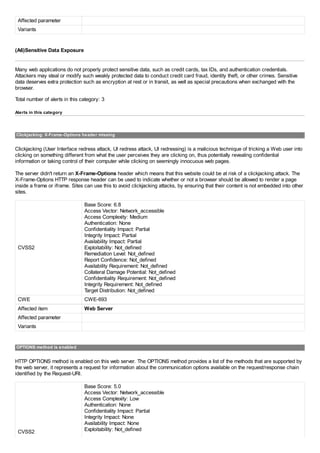
Clickjacking: X-Frame-Options header missing
Clickjacking (User Interface redress attack, UI redress attack, UI redressing) is a malicious technique of tricking a Web user into
clicking on something different from what the user perceives they are clicking on, thus potentially revealing confidential
information or taking control of their computer while clicking on seemingly innocuous web pages.
The server didn't return an X-Frame-Options header which means that this website could be at risk of a clickjacking attack. The
X-Frame-Options HTTP response header can be used to indicate whether or not a browser should be allowed to render a page
inside a frame or iframe. Sites can use this to avoid clickjacking attacks, by ensuring that their content is not embedded into other
sites.
CVSS2
Base Score: 6.8
Access Vector: Network_accessible
Access Complexity: Medium
Authentication: None
Confidentiality Impact: Partial
Integrity Impact: Partial
Availability Impact: Partial
Exploitability: Not_defined
Remediation Level: Not_defined
Report Confidence: Not_defined
Availability Requirement: Not_defined
Collateral Damage Potential: Not_defined
Confidentiality Requirement: Not_defined
Integrity Requirement: Not_defined
Target Distribution: Not_defined
CWE CWE-693
Affected item Web Server
Affected parameter
Variants
OPTIONS method is enabled
HTTP OPTIONS method is enabled on this web server. The OPTIONS method provides a list of the methods that are supported by
the web server, it represents a request for information about the communication options available on the request/response chain
identified by the Request-URI.
CVSS2
Base Score: 5.0
Access Vector: Network_accessible
Access Complexity: Low
Authentication: None
Confidentiality Impact: Partial
Integrity Impact: None
Availability Impact: None
Exploitability: Not_defined
Remediation Level: Not_defined
Report Confidence: Not_defined
Availability Requirement: Not_defined
Collateral Damage Potential: Not_defined
Confidentiality Requirement: Not_defined
Integrity Requirement: Not_defined
Target Distribution: Not_defined
CVSS3
Base Score: 7.5
Attack Vector: Network
Attack Complexity: Low
Privileges Required: None
User Interaction: None
Scope: Unchanged
Confidentiality Impact: High
Integrity Impact: None
Availability Impact: None
CWE CWE-200
Affected item Web Server
Affected parameter
Variants
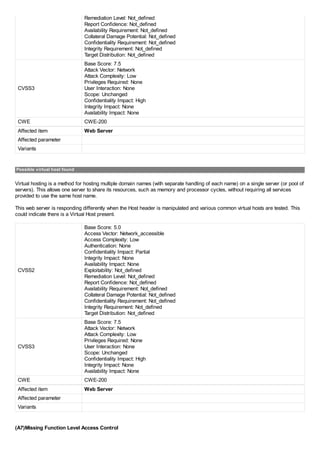
Possible virtual host found
Virtual hosting is a method for hosting multiple domain names (with separate handling of each name) on a single server (or pool of
servers). This allows one server to share its resources, such as memory and processor cycles, without requiring all services
provided to use the same host name.
This web server is responding differently when the Host header is manipulated and various common virtual hosts are tested. This
could indicate there is a Virtual Host present.
CVSS2
Base Score: 5.0
Access Vector: Network_accessible
Access Complexity: Low
Authentication: None
Confidentiality Impact: Partial
Integrity Impact: None
Availability Impact: None
Exploitability: Not_defined
Remediation Level: Not_defined
Report Confidence: Not_defined
Availability Requirement: Not_defined
Collateral Damage Potential: Not_defined
Confidentiality Requirement: Not_defined
Integrity Requirement: Not_defined
Target Distribution: Not_defined
CVSS3
Base Score: 7.5
Attack Vector: Network
Attack Complexity: Low
Privileges Required: None
User Interaction: None
Scope: Unchanged
Confidentiality Impact: High
Integrity Impact: None
Availability Impact: None
CWE CWE-200
Affected item Web Server
Affected parameter
Variants
(A7)Missing Function Level Access Control
Most web applications verify function level access rights before making that functionality visible in the UI. However, applications
need to perform the same access control checks on the server when each function is accessed. If requests are not verified,
attackers will be able to forge requests in order to access functionality without proper authorization.
Total number of alerts in this category: 1
Alerts in this category
Clickjacking: X-Frame-Options header missing
Clickjacking (User Interface redress attack, UI redress attack, UI redressing) is a malicious technique of tricking a Web user into
clicking on something different from what the user perceives they are clicking on, thus potentially revealing confidential
information or taking control of their computer while clicking on seemingly innocuous web pages.
The server didn't return an X-Frame-Options header which means that this website could be at risk of a clickjacking attack. The
X-Frame-Options HTTP response header can be used to indicate whether or not a browser should be allowed to render a page
inside a frame or iframe. Sites can use this to avoid clickjacking attacks, by ensuring that their content is not embedded into other
sites.
CVSS2
Base Score: 6.8
Access Vector: Network_accessible
Access Complexity: Medium
Authentication: None
Confidentiality Impact: Partial
Integrity Impact: Partial
Availability Impact: Partial
Exploitability: Not_defined
Remediation Level: Not_defined
Report Confidence: Not_defined
Availability Requirement: Not_defined
Collateral Damage Potential: Not_defined
Confidentiality Requirement: Not_defined
Integrity Requirement: Not_defined
Target Distribution: Not_defined
CWE CWE-693
Affected item Web Server
Affected parameter
Variants
(A8)Cross Site Request Forgery (CSRF)
A CSRF attack forces a logged-on victim's browser to send a forged HTTP request, including the victim's session cookie and any
other automatically included authentication information, to a vulnerable web application. This allows the attacker to force the
victim's browser to generate requests the vulnerable application thinks are legitimate requests from the victim.
No alerts in this category.
(A9)Using Components with Known Vulnerabilities
Components, such as libraries, frameworks, and other software modules, almost always run with full privileges. If a vulnerable
component is exploited, such an attack can facilitate serious data loss or server takeover. Applications using components with
known vulnerabilities may undermine application defenses and enable a range of possible attacks and impacts.
Total number of alerts in this category: 1
Alerts in this category
OPTIONS method is enabled
HTTP OPTIONS method is enabled on this web server. The OPTIONS method provides a list of the methods that are supported by
the web server, it represents a request for information about the communication options available on the request/response chain
identified by the Request-URI.
CVSS2
Base Score: 5.0
Access Vector: Network_accessible
Access Complexity: Low
Authentication: None
Confidentiality Impact: Partial
Integrity Impact: None
Availability Impact: None
Exploitability: Not_defined
Remediation Level: Not_defined
Report Confidence: Not_defined
Availability Requirement: Not_defined
Collateral Damage Potential: Not_defined
Confidentiality Requirement: Not_defined
Integrity Requirement: Not_defined
Target Distribution: Not_defined
CVSS3
Base Score: 7.5
Attack Vector: Network
Attack Complexity: Low
Privileges Required: None
User Interaction: None
Scope: Unchanged
Confidentiality Impact: High
Integrity Impact: None
Availability Impact: None
CWE CWE-200
Affected item Web Server
Affected parameter
Variants
(A10)UnvalidatedRedirects and Forwards
Web applications frequently redirect and forward users to other pages and websites, and use untrusted data to determine the
destination pages. Without proper validation, attackers can redirect victims to phishing or malware sites, or use forwards to
access unauthorized pages.
No alerts in this category.
Affected Items: A Detailed Report
This section provides full details of the types of vulnerabilities found according to individual affected items.
Web Server
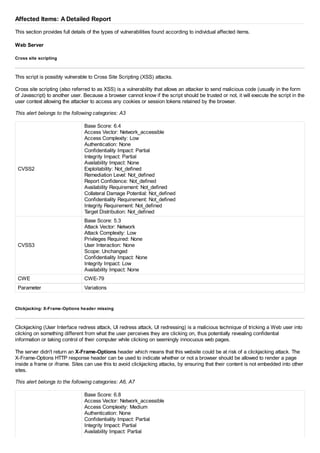
Cross site scripting
This script is possibly vulnerable to Cross Site Scripting (XSS) attacks.
Cross site scripting (also referred to as XSS) is a vulnerability that allows an attacker to send malicious code (usually in the form
of Javascript) to another user. Because a browser cannot know if the script should be trusted or not, it will execute the script in the
user context allowing the attacker to access any cookies or session tokens retained by the browser.
This alert belongs to the following categories: A3
CVSS2
Base Score: 6.4
Access Vector: Network_accessible
Access Complexity: Low
Authentication: None
Confidentiality Impact: Partial
Integrity Impact: Partial
Availability Impact: None
Exploitability: Not_defined
Remediation Level: Not_defined
Report Confidence: Not_defined
Availability Requirement: Not_defined
Collateral Damage Potential: Not_defined
Confidentiality Requirement: Not_defined
Integrity Requirement: Not_defined
Target Distribution: Not_defined
CVSS3
Base Score: 5.3
Attack Vector: Network
Attack Complexity: Low
Privileges Required: None
User Interaction: None
Scope: Unchanged
Confidentiality Impact: None
Integrity Impact: Low
Availability Impact: None
CWE CWE-79
Parameter Variations
Clickjacking: X-Frame-Options header missing
Clickjacking (User Interface redress attack, UI redress attack, UI redressing) is a malicious technique of tricking a Web user into
clicking on something different from what the user perceives they are clicking on, thus potentially revealing confidential
information or taking control of their computer while clicking on seemingly innocuous web pages.
The server didn't return an X-Frame-Options header which means that this website could be at risk of a clickjacking attack. The
X-Frame-Options HTTP response header can be used to indicate whether or not a browser should be allowed to render a page
inside a frame or iframe. Sites can use this to avoid clickjacking attacks, by ensuring that their content is not embedded into other
sites.
This alert belongs to the following categories: A6, A7
Base Score: 6.8
Access Vector: Network_accessible
Access Complexity: Medium
Authentication: None
Confidentiality Impact: Partial
Integrity Impact: Partial
Availability Impact: Partial
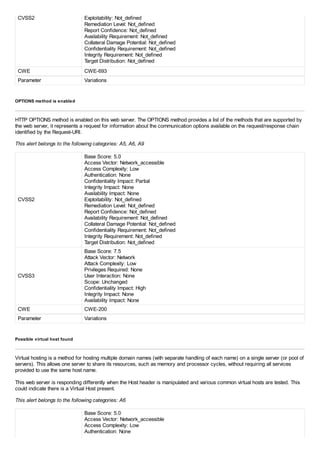
CVSS2 Exploitability: Not_defined
Remediation Level: Not_defined
Report Confidence: Not_defined
Availability Requirement: Not_defined
Collateral Damage Potential: Not_defined
Confidentiality Requirement: Not_defined
Integrity Requirement: Not_defined
Target Distribution: Not_defined
CWE CWE-693
Parameter Variations
OPTIONS method is enabled
HTTP OPTIONS method is enabled on this web server. The OPTIONS method provides a list of the methods that are supported by
the web server, it represents a request for information about the communication options available on the request/response chain
identified by the Request-URI.
This alert belongs to the following categories: A5, A6, A9
CVSS2
Base Score: 5.0
Access Vector: Network_accessible
Access Complexity: Low
Authentication: None
Confidentiality Impact: Partial
Integrity Impact: None
Availability Impact: None
Exploitability: Not_defined
Remediation Level: Not_defined
Report Confidence: Not_defined
Availability Requirement: Not_defined
Collateral Damage Potential: Not_defined
Confidentiality Requirement: Not_defined
Integrity Requirement: Not_defined
Target Distribution: Not_defined
CVSS3
Base Score: 7.5
Attack Vector: Network
Attack Complexity: Low
Privileges Required: None
User Interaction: None
Scope: Unchanged
Confidentiality Impact: High
Integrity Impact: None
Availability Impact: None
CWE CWE-200
Parameter Variations
Possible virtual host found
Virtual hosting is a method for hosting multiple domain names (with separate handling of each name) on a single server (or pool of
servers). This allows one server to share its resources, such as memory and processor cycles, without requiring all services
provided to use the same host name.
This web server is responding differently when the Host header is manipulated and various common virtual hosts are tested. This
could indicate there is a Virtual Host present.
This alert belongs to the following categories: A6
Base Score: 5.0
Access Vector: Network_accessible
Access Complexity: Low
Authentication: None
CVSS2
Confidentiality Impact: Partial
Integrity Impact: None
Availability Impact: None
Exploitability: Not_defined
Remediation Level: Not_defined
Report Confidence: Not_defined
Availability Requirement: Not_defined
Collateral Damage Potential: Not_defined
Confidentiality Requirement: Not_defined
Integrity Requirement: Not_defined
Target Distribution: Not_defined
CVSS3
Base Score: 7.5
Attack Vector: Network
Attack Complexity: Low
Privileges Required: None
User Interaction: None
Scope: Unchanged
Confidentiality Impact: High
Integrity Impact: None
Availability Impact: None
CWE CWE-200
Parameter Variations
Scanned items (coverage report)
http://enlinea.hmunicipal.gob.ec/

Owasp top 10 2013

  • 1.
    OWASP TOP 102013 Compliance Report 16 June 2017 Generated by Acunetix
  • 2.
    Description The primary aimof the OWASP Top 10 is to educate developers, designers, architects, managers, and organizations about the consequences of the most important web application security weaknesses. The Top 10 provides basic techniques to protect against these high risk problem areas - and also provides guidance on where to go from here. Disclaimer This document or any of its content cannot account for, or be included in any form of legal advice. The outcome of a vulnerability scan (or security evaluation) should be utilized to ensure that diligent measures are taken to lower the risk of potential exploits carried out to compromise data. Legal advice must be supplied according to its legal context. All laws and the environments in which they are applied, are constantly changed and revised. Therefore no information provided in this document may ever be used as an alternative to a qualified legal body or representative. A portion of this report is taken from OWASP's Top Ten 2013 Project document, that can be found at http://www.owasp.org. Scan URL http://www.ambato.gob.ec/ Scan date Duration Profile Compliance at a Glance This section of the report is a summary and lists the number of alerts found according to individual compliance categories. - Injection(A1) No alerts in this category - Broken Authentication and Session Management(A2) No alerts in this category - Cross Site Scripting (XSS)(A3) No alerts in this category - Insecure Direct Object Reference(A4) No alerts in this category - Security Misconfiguration(A5) Total number of alerts in this category: 1 - Sensitive Data Exposure(A6) Total number of alerts in this category: 3 - Missing Function Level Access Control(A7) Total number of alerts in this category: 1 - Cross Site Request Forgery (CSRF)(A8) Total number of alerts in this category: 1 - Using Components with Known Vulnerabilities(A9) Total number of alerts in this category: 1 - UnvalidatedRedirects and Forwards(A10) No alerts in this category
  • 3.
    Compliance According toCategories: A Detailed Report This section is a detailed report that explains each vulnerability found according to individual compliance categories. (A1)Injection Injection flaws, such as SQL, OS, and LDAP injection occur when untrusted data is sent to an interpreter as part of a command or query. The attacker's hostile data can trick the interpreter into executing unintended commands or accessing data without proper authorization. No alerts in this category. (A2)Broken Authentication and Session Management Application functions related to authentication and session management are often not implemented correctly, allowing attackers to compromise passwords, keys, or session tokens, or to exploit other implementation flaws to assume other users' identities. No alerts in this category. (A3)Cross Site Scripting (XSS) XSS flaws occur whenever an application takes untrusted data and sends it to a web browser without proper validation or escaping. XSS allows attackers to execute scripts in the victim's browser which can hijack user sessions, deface web sites, or redirect the user to malicious sites. No alerts in this category. (A4)Insecure Direct Object Reference A direct object reference occurs when a developer exposes a reference to an internal implementation object, such as a file, directory, or database key. Without an access control check or other protection, attackers can manipulate these references to access unauthorized data. No alerts in this category. (A5)Security Misconfiguration Good security requires having a secure configuration defined and deployed for the application, frameworks, application server, web server, database server, and platform. Secure settings should be defined, implemented, and maintained, as defaults are often insecure. Additionally, software should be kept up to date. Total number of alerts in this category: 1 Alerts in this category Web Application Firewall detected This server is protected by an IPS (Intrusion Prevention System), IDS (Intrusion Detection System) or an WAF (Web Application Firewall). Acunetix WVS detected this by sending various malicious payloads and detecting changes in the response code, headers and body. Base Score: 0.0 Access Vector: Network_accessible
  • 4.
    CVSS2 Access Complexity: Low Authentication:None Confidentiality Impact: None Integrity Impact: None Availability Impact: None Exploitability: Not_defined Remediation Level: Not_defined Report Confidence: Not_defined Availability Requirement: Not_defined Collateral Damage Potential: Not_defined Confidentiality Requirement: Not_defined Integrity Requirement: Not_defined Target Distribution: Not_defined CVSS3 Base Score: 0.0 Attack Vector: Network Attack Complexity: Low Privileges Required: None User Interaction: None Scope: Unchanged Confidentiality Impact: None Integrity Impact: None Availability Impact: None CWE CWE-16 Affected item Web Server Affected parameter Variants (A6)Sensitive Data Exposure Many web applications do not properly protect sensitive data, such as credit cards, tax IDs, and authentication credentials. Attackers may steal or modify such weakly protected data to conduct credit card fraud, identity theft, or other crimes. Sensitive data deserves extra protection such as encryption at rest or in transit, as well as special precautions when exchanged with the browser. Total number of alerts in this category: 3 Alerts in this category Clickjacking: X-Frame-Options header missing Clickjacking (User Interface redress attack, UI redress attack, UI redressing) is a malicious technique of tricking a Web user into clicking on something different from what the user perceives they are clicking on, thus potentially revealing confidential information or taking control of their computer while clicking on seemingly innocuous web pages. The server didn't return an X-Frame-Options header which means that this website could be at risk of a clickjacking attack. The X-Frame-Options HTTP response header can be used to indicate whether or not a browser should be allowed to render a page inside a frame or iframe. Sites can use this to avoid clickjacking attacks, by ensuring that their content is not embedded into other sites. CVSS2 Base Score: 6.8 Access Vector: Network_accessible Access Complexity: Medium Authentication: None Confidentiality Impact: Partial Integrity Impact: Partial Availability Impact: Partial Exploitability: Not_defined Remediation Level: Not_defined Report Confidence: Not_defined Availability Requirement: Not_defined Collateral Damage Potential: Not_defined
  • 5.
    Confidentiality Requirement: Not_defined IntegrityRequirement: Not_defined Target Distribution: Not_defined CWE CWE-693 Affected item Web Server Affected parameter Variants Possible virtual host found Virtual hosting is a method for hosting multiple domain names (with separate handling of each name) on a single server (or pool of servers). This allows one server to share its resources, such as memory and processor cycles, without requiring all services provided to use the same host name. This web server is responding differently when the Host header is manipulated and various common virtual hosts are tested. This could indicate there is a Virtual Host present. CVSS2 Base Score: 5.0 Access Vector: Network_accessible Access Complexity: Low Authentication: None Confidentiality Impact: Partial Integrity Impact: None Availability Impact: None Exploitability: Not_defined Remediation Level: Not_defined Report Confidence: Not_defined Availability Requirement: Not_defined Collateral Damage Potential: Not_defined Confidentiality Requirement: Not_defined Integrity Requirement: Not_defined Target Distribution: Not_defined CVSS3 Base Score: 7.5 Attack Vector: Network Attack Complexity: Low Privileges Required: None User Interaction: None Scope: Unchanged Confidentiality Impact: High Integrity Impact: None Availability Impact: None CWE CWE-200 Affected item Web Server Affected parameter Variants Web Application Firewall detected This server is protected by an IPS (Intrusion Prevention System), IDS (Intrusion Detection System) or an WAF (Web Application Firewall). Acunetix WVS detected this by sending various malicious payloads and detecting changes in the response code, headers and body. CVSS2 Base Score: 0.0 Access Vector: Network_accessible Access Complexity: Low Authentication: None Confidentiality Impact: None Integrity Impact: None Availability Impact: None Exploitability: Not_defined Remediation Level: Not_defined
  • 6.
    Report Confidence: Not_defined AvailabilityRequirement: Not_defined Collateral Damage Potential: Not_defined Confidentiality Requirement: Not_defined Integrity Requirement: Not_defined Target Distribution: Not_defined CVSS3 Base Score: 0.0 Attack Vector: Network Attack Complexity: Low Privileges Required: None User Interaction: None Scope: Unchanged Confidentiality Impact: None Integrity Impact: None Availability Impact: None CWE CWE-16 Affected item Web Server Affected parameter Variants (A7)Missing Function Level Access Control Most web applications verify function level access rights before making that functionality visible in the UI. However, applications need to perform the same access control checks on the server when each function is accessed. If requests are not verified, attackers will be able to forge requests in order to access functionality without proper authorization. Total number of alerts in this category: 1 Alerts in this category Clickjacking: X-Frame-Options header missing Clickjacking (User Interface redress attack, UI redress attack, UI redressing) is a malicious technique of tricking a Web user into clicking on something different from what the user perceives they are clicking on, thus potentially revealing confidential information or taking control of their computer while clicking on seemingly innocuous web pages. The server didn't return an X-Frame-Options header which means that this website could be at risk of a clickjacking attack. The X-Frame-Options HTTP response header can be used to indicate whether or not a browser should be allowed to render a page inside a frame or iframe. Sites can use this to avoid clickjacking attacks, by ensuring that their content is not embedded into other sites. CVSS2 Base Score: 6.8 Access Vector: Network_accessible Access Complexity: Medium Authentication: None Confidentiality Impact: Partial Integrity Impact: Partial Availability Impact: Partial Exploitability: Not_defined Remediation Level: Not_defined Report Confidence: Not_defined Availability Requirement: Not_defined Collateral Damage Potential: Not_defined Confidentiality Requirement: Not_defined Integrity Requirement: Not_defined Target Distribution: Not_defined CWE CWE-693 Affected item Web Server Affected parameter Variants
  • 7.
    (A8)Cross Site RequestForgery (CSRF) A CSRF attack forces a logged-on victim's browser to send a forged HTTP request, including the victim's session cookie and any other automatically included authentication information, to a vulnerable web application. This allows the attacker to force the victim's browser to generate requests the vulnerable application thinks are legitimate requests from the victim. Total number of alerts in this category: 1 Alerts in this category HTML form without CSRF protection This alert may be a false positive, manual confirmation is required. Cross-site request forgery, also known as a one-click attack or session riding and abbreviated as CSRF or XSRF, is a type of malicious exploit of a website whereby unauthorized commands are transmitted from a user that the website trusts. Acunetix WVS found a HTML form with no apparent CSRF protection implemented. Consult details for more information about the affected HTML form. CVSS2 Base Score: 2.6 Access Vector: Network_accessible Access Complexity: High Authentication: None Confidentiality Impact: None Integrity Impact: Partial Availability Impact: None Exploitability: Not_defined Remediation Level: Not_defined Report Confidence: Not_defined Availability Requirement: Not_defined Collateral Damage Potential: Not_defined Confidentiality Requirement: Not_defined Integrity Requirement: Not_defined Target Distribution: Not_defined CVSS3 Base Score: 4.3 Attack Vector: Network Attack Complexity: Low Privileges Required: None User Interaction: Required Scope: Unchanged Confidentiality Impact: None Integrity Impact: Low Availability Impact: None CWE CWE-352 Affected item Web Server Affected parameter Variants (A9)Using Components with Known Vulnerabilities Components, such as libraries, frameworks, and other software modules, almost always run with full privileges. If a vulnerable component is exploited, such an attack can facilitate serious data loss or server takeover. Applications using components with known vulnerabilities may undermine application defenses and enable a range of possible attacks and impacts. Total number of alerts in this category: 1 Alerts in this category
  • 8.
    Web Application Firewalldetected This server is protected by an IPS (Intrusion Prevention System), IDS (Intrusion Detection System) or an WAF (Web Application Firewall). Acunetix WVS detected this by sending various malicious payloads and detecting changes in the response code, headers and body. CVSS2 Base Score: 0.0 Access Vector: Network_accessible Access Complexity: Low Authentication: None Confidentiality Impact: None Integrity Impact: None Availability Impact: None Exploitability: Not_defined Remediation Level: Not_defined Report Confidence: Not_defined Availability Requirement: Not_defined Collateral Damage Potential: Not_defined Confidentiality Requirement: Not_defined Integrity Requirement: Not_defined Target Distribution: Not_defined CVSS3 Base Score: 0.0 Attack Vector: Network Attack Complexity: Low Privileges Required: None User Interaction: None Scope: Unchanged Confidentiality Impact: None Integrity Impact: None Availability Impact: None CWE CWE-16 Affected item Web Server Affected parameter Variants (A10)UnvalidatedRedirects and Forwards Web applications frequently redirect and forward users to other pages and websites, and use untrusted data to determine the destination pages. Without proper validation, attackers can redirect victims to phishing or malware sites, or use forwards to access unauthorized pages. No alerts in this category.
  • 9.
    Affected Items: ADetailed Report This section provides full details of the types of vulnerabilities found according to individual affected items. Web Server HTML form without CSRF protection This alert may be a false positive, manual confirmation is required. Cross-site request forgery, also known as a one-click attack or session riding and abbreviated as CSRF or XSRF, is a type of malicious exploit of a website whereby unauthorized commands are transmitted from a user that the website trusts. Acunetix WVS found a HTML form with no apparent CSRF protection implemented. Consult details for more information about the affected HTML form. This alert belongs to the following categories: A8 CVSS2 Base Score: 2.6 Access Vector: Network_accessible Access Complexity: High Authentication: None Confidentiality Impact: None Integrity Impact: Partial Availability Impact: None Exploitability: Not_defined Remediation Level: Not_defined Report Confidence: Not_defined Availability Requirement: Not_defined Collateral Damage Potential: Not_defined Confidentiality Requirement: Not_defined Integrity Requirement: Not_defined Target Distribution: Not_defined CVSS3 Base Score: 4.3 Attack Vector: Network Attack Complexity: Low Privileges Required: None User Interaction: Required Scope: Unchanged Confidentiality Impact: None Integrity Impact: Low Availability Impact: None CWE CWE-352 Parameter Variations Clickjacking: X-Frame-Options header missing Clickjacking (User Interface redress attack, UI redress attack, UI redressing) is a malicious technique of tricking a Web user into clicking on something different from what the user perceives they are clicking on, thus potentially revealing confidential information or taking control of their computer while clicking on seemingly innocuous web pages. The server didn't return an X-Frame-Options header which means that this website could be at risk of a clickjacking attack. The X-Frame-Options HTTP response header can be used to indicate whether or not a browser should be allowed to render a page inside a frame or iframe. Sites can use this to avoid clickjacking attacks, by ensuring that their content is not embedded into other sites. This alert belongs to the following categories: A6, A7 Base Score: 6.8 Access Vector: Network_accessible Access Complexity: Medium Authentication: None Confidentiality Impact: Partial
  • 10.
    CVSS2 Integrity Impact: Partial AvailabilityImpact: Partial Exploitability: Not_defined Remediation Level: Not_defined Report Confidence: Not_defined Availability Requirement: Not_defined Collateral Damage Potential: Not_defined Confidentiality Requirement: Not_defined Integrity Requirement: Not_defined Target Distribution: Not_defined CWE CWE-693 Parameter Variations Possible virtual host found Virtual hosting is a method for hosting multiple domain names (with separate handling of each name) on a single server (or pool of servers). This allows one server to share its resources, such as memory and processor cycles, without requiring all services provided to use the same host name. This web server is responding differently when the Host header is manipulated and various common virtual hosts are tested. This could indicate there is a Virtual Host present. This alert belongs to the following categories: A6 CVSS2 Base Score: 5.0 Access Vector: Network_accessible Access Complexity: Low Authentication: None Confidentiality Impact: Partial Integrity Impact: None Availability Impact: None Exploitability: Not_defined Remediation Level: Not_defined Report Confidence: Not_defined Availability Requirement: Not_defined Collateral Damage Potential: Not_defined Confidentiality Requirement: Not_defined Integrity Requirement: Not_defined Target Distribution: Not_defined CVSS3 Base Score: 7.5 Attack Vector: Network Attack Complexity: Low Privileges Required: None User Interaction: None Scope: Unchanged Confidentiality Impact: High Integrity Impact: None Availability Impact: None CWE CWE-200 Parameter Variations Web Application Firewall detected This server is protected by an IPS (Intrusion Prevention System), IDS (Intrusion Detection System) or an WAF (Web Application Firewall). Acunetix WVS detected this by sending various malicious payloads and detecting changes in the response code, headers and body. This alert belongs to the following categories: A5, A6, A9 Base Score: 0.0 Access Vector: Network_accessible
  • 11.
    CVSS2 Access Complexity: Low Authentication:None Confidentiality Impact: None Integrity Impact: None Availability Impact: None Exploitability: Not_defined Remediation Level: Not_defined Report Confidence: Not_defined Availability Requirement: Not_defined Collateral Damage Potential: Not_defined Confidentiality Requirement: Not_defined Integrity Requirement: Not_defined Target Distribution: Not_defined CVSS3 Base Score: 0.0 Attack Vector: Network Attack Complexity: Low Privileges Required: None User Interaction: None Scope: Unchanged Confidentiality Impact: None Integrity Impact: None Availability Impact: None CWE CWE-16 Parameter Variations
  • 12.
    Scanned items (coveragereport) http://www.ambato.gob.ec/ Scan URL http://enlinea.hmunicipal.gob.ec/ Scan date Duration Profile Compliance at a Glance This section of the report is a summary and lists the number of alerts found according to individual compliance categories. - Injection(A1) No alerts in this category - Broken Authentication and Session Management(A2) No alerts in this category - Cross Site Scripting (XSS)(A3) Total number of alerts in this category: 1 - Insecure Direct Object Reference(A4) No alerts in this category - Security Misconfiguration(A5) Total number of alerts in this category: 1 - Sensitive Data Exposure(A6) Total number of alerts in this category: 3 - Missing Function Level Access Control(A7) Total number of alerts in this category: 1 - Cross Site Request Forgery (CSRF)(A8) No alerts in this category - Using Components with Known Vulnerabilities(A9) Total number of alerts in this category: 1 - UnvalidatedRedirects and Forwards(A10) No alerts in this category
  • 13.
    Compliance According toCategories: A Detailed Report This section is a detailed report that explains each vulnerability found according to individual compliance categories. (A1)Injection Injection flaws, such as SQL, OS, and LDAP injection occur when untrusted data is sent to an interpreter as part of a command or query. The attacker's hostile data can trick the interpreter into executing unintended commands or accessing data without proper authorization. No alerts in this category. (A2)Broken Authentication and Session Management Application functions related to authentication and session management are often not implemented correctly, allowing attackers to compromise passwords, keys, or session tokens, or to exploit other implementation flaws to assume other users' identities. No alerts in this category. (A3)Cross Site Scripting (XSS) XSS flaws occur whenever an application takes untrusted data and sends it to a web browser without proper validation or escaping. XSS allows attackers to execute scripts in the victim's browser which can hijack user sessions, deface web sites, or redirect the user to malicious sites. Total number of alerts in this category: 1 Alerts in this category Cross site scripting This script is possibly vulnerable to Cross Site Scripting (XSS) attacks. Cross site scripting (also referred to as XSS) is a vulnerability that allows an attacker to send malicious code (usually in the form of Javascript) to another user. Because a browser cannot know if the script should be trusted or not, it will execute the script in the user context allowing the attacker to access any cookies or session tokens retained by the browser. CVSS2 Base Score: 6.4 Access Vector: Network_accessible Access Complexity: Low Authentication: None Confidentiality Impact: Partial Integrity Impact: Partial Availability Impact: None Exploitability: Not_defined Remediation Level: Not_defined Report Confidence: Not_defined Availability Requirement: Not_defined Collateral Damage Potential: Not_defined Confidentiality Requirement: Not_defined Integrity Requirement: Not_defined Target Distribution: Not_defined CVSS3 Base Score: 5.3 Attack Vector: Network Attack Complexity: Low Privileges Required: None User Interaction: None Scope: Unchanged
  • 14.
    Confidentiality Impact: None IntegrityImpact: Low Availability Impact: None CWE CWE-79 Affected item Web Server Affected parameter Variants (A4)Insecure Direct Object Reference A direct object reference occurs when a developer exposes a reference to an internal implementation object, such as a file, directory, or database key. Without an access control check or other protection, attackers can manipulate these references to access unauthorized data. No alerts in this category. (A5)Security Misconfiguration Good security requires having a secure configuration defined and deployed for the application, frameworks, application server, web server, database server, and platform. Secure settings should be defined, implemented, and maintained, as defaults are often insecure. Additionally, software should be kept up to date. Total number of alerts in this category: 1 Alerts in this category OPTIONS method is enabled HTTP OPTIONS method is enabled on this web server. The OPTIONS method provides a list of the methods that are supported by the web server, it represents a request for information about the communication options available on the request/response chain identified by the Request-URI. CVSS2 Base Score: 5.0 Access Vector: Network_accessible Access Complexity: Low Authentication: None Confidentiality Impact: Partial Integrity Impact: None Availability Impact: None Exploitability: Not_defined Remediation Level: Not_defined Report Confidence: Not_defined Availability Requirement: Not_defined Collateral Damage Potential: Not_defined Confidentiality Requirement: Not_defined Integrity Requirement: Not_defined Target Distribution: Not_defined CVSS3 Base Score: 7.5 Attack Vector: Network Attack Complexity: Low Privileges Required: None User Interaction: None Scope: Unchanged Confidentiality Impact: High Integrity Impact: None Availability Impact: None CWE CWE-200 Affected item Web Server
  • 15.
    Affected parameter Variants (A6)Sensitive DataExposure Many web applications do not properly protect sensitive data, such as credit cards, tax IDs, and authentication credentials. Attackers may steal or modify such weakly protected data to conduct credit card fraud, identity theft, or other crimes. Sensitive data deserves extra protection such as encryption at rest or in transit, as well as special precautions when exchanged with the browser. Total number of alerts in this category: 3 Alerts in this category Clickjacking: X-Frame-Options header missing Clickjacking (User Interface redress attack, UI redress attack, UI redressing) is a malicious technique of tricking a Web user into clicking on something different from what the user perceives they are clicking on, thus potentially revealing confidential information or taking control of their computer while clicking on seemingly innocuous web pages. The server didn't return an X-Frame-Options header which means that this website could be at risk of a clickjacking attack. The X-Frame-Options HTTP response header can be used to indicate whether or not a browser should be allowed to render a page inside a frame or iframe. Sites can use this to avoid clickjacking attacks, by ensuring that their content is not embedded into other sites. CVSS2 Base Score: 6.8 Access Vector: Network_accessible Access Complexity: Medium Authentication: None Confidentiality Impact: Partial Integrity Impact: Partial Availability Impact: Partial Exploitability: Not_defined Remediation Level: Not_defined Report Confidence: Not_defined Availability Requirement: Not_defined Collateral Damage Potential: Not_defined Confidentiality Requirement: Not_defined Integrity Requirement: Not_defined Target Distribution: Not_defined CWE CWE-693 Affected item Web Server Affected parameter Variants OPTIONS method is enabled HTTP OPTIONS method is enabled on this web server. The OPTIONS method provides a list of the methods that are supported by the web server, it represents a request for information about the communication options available on the request/response chain identified by the Request-URI. CVSS2 Base Score: 5.0 Access Vector: Network_accessible Access Complexity: Low Authentication: None Confidentiality Impact: Partial Integrity Impact: None Availability Impact: None Exploitability: Not_defined
  • 16.
    Remediation Level: Not_defined ReportConfidence: Not_defined Availability Requirement: Not_defined Collateral Damage Potential: Not_defined Confidentiality Requirement: Not_defined Integrity Requirement: Not_defined Target Distribution: Not_defined CVSS3 Base Score: 7.5 Attack Vector: Network Attack Complexity: Low Privileges Required: None User Interaction: None Scope: Unchanged Confidentiality Impact: High Integrity Impact: None Availability Impact: None CWE CWE-200 Affected item Web Server Affected parameter Variants Possible virtual host found Virtual hosting is a method for hosting multiple domain names (with separate handling of each name) on a single server (or pool of servers). This allows one server to share its resources, such as memory and processor cycles, without requiring all services provided to use the same host name. This web server is responding differently when the Host header is manipulated and various common virtual hosts are tested. This could indicate there is a Virtual Host present. CVSS2 Base Score: 5.0 Access Vector: Network_accessible Access Complexity: Low Authentication: None Confidentiality Impact: Partial Integrity Impact: None Availability Impact: None Exploitability: Not_defined Remediation Level: Not_defined Report Confidence: Not_defined Availability Requirement: Not_defined Collateral Damage Potential: Not_defined Confidentiality Requirement: Not_defined Integrity Requirement: Not_defined Target Distribution: Not_defined CVSS3 Base Score: 7.5 Attack Vector: Network Attack Complexity: Low Privileges Required: None User Interaction: None Scope: Unchanged Confidentiality Impact: High Integrity Impact: None Availability Impact: None CWE CWE-200 Affected item Web Server Affected parameter Variants (A7)Missing Function Level Access Control
  • 17.
    Most web applicationsverify function level access rights before making that functionality visible in the UI. However, applications need to perform the same access control checks on the server when each function is accessed. If requests are not verified, attackers will be able to forge requests in order to access functionality without proper authorization. Total number of alerts in this category: 1 Alerts in this category Clickjacking: X-Frame-Options header missing Clickjacking (User Interface redress attack, UI redress attack, UI redressing) is a malicious technique of tricking a Web user into clicking on something different from what the user perceives they are clicking on, thus potentially revealing confidential information or taking control of their computer while clicking on seemingly innocuous web pages. The server didn't return an X-Frame-Options header which means that this website could be at risk of a clickjacking attack. The X-Frame-Options HTTP response header can be used to indicate whether or not a browser should be allowed to render a page inside a frame or iframe. Sites can use this to avoid clickjacking attacks, by ensuring that their content is not embedded into other sites. CVSS2 Base Score: 6.8 Access Vector: Network_accessible Access Complexity: Medium Authentication: None Confidentiality Impact: Partial Integrity Impact: Partial Availability Impact: Partial Exploitability: Not_defined Remediation Level: Not_defined Report Confidence: Not_defined Availability Requirement: Not_defined Collateral Damage Potential: Not_defined Confidentiality Requirement: Not_defined Integrity Requirement: Not_defined Target Distribution: Not_defined CWE CWE-693 Affected item Web Server Affected parameter Variants (A8)Cross Site Request Forgery (CSRF) A CSRF attack forces a logged-on victim's browser to send a forged HTTP request, including the victim's session cookie and any other automatically included authentication information, to a vulnerable web application. This allows the attacker to force the victim's browser to generate requests the vulnerable application thinks are legitimate requests from the victim. No alerts in this category. (A9)Using Components with Known Vulnerabilities Components, such as libraries, frameworks, and other software modules, almost always run with full privileges. If a vulnerable component is exploited, such an attack can facilitate serious data loss or server takeover. Applications using components with known vulnerabilities may undermine application defenses and enable a range of possible attacks and impacts. Total number of alerts in this category: 1 Alerts in this category
  • 18.
    OPTIONS method isenabled HTTP OPTIONS method is enabled on this web server. The OPTIONS method provides a list of the methods that are supported by the web server, it represents a request for information about the communication options available on the request/response chain identified by the Request-URI. CVSS2 Base Score: 5.0 Access Vector: Network_accessible Access Complexity: Low Authentication: None Confidentiality Impact: Partial Integrity Impact: None Availability Impact: None Exploitability: Not_defined Remediation Level: Not_defined Report Confidence: Not_defined Availability Requirement: Not_defined Collateral Damage Potential: Not_defined Confidentiality Requirement: Not_defined Integrity Requirement: Not_defined Target Distribution: Not_defined CVSS3 Base Score: 7.5 Attack Vector: Network Attack Complexity: Low Privileges Required: None User Interaction: None Scope: Unchanged Confidentiality Impact: High Integrity Impact: None Availability Impact: None CWE CWE-200 Affected item Web Server Affected parameter Variants (A10)UnvalidatedRedirects and Forwards Web applications frequently redirect and forward users to other pages and websites, and use untrusted data to determine the destination pages. Without proper validation, attackers can redirect victims to phishing or malware sites, or use forwards to access unauthorized pages. No alerts in this category.
  • 19.
    Affected Items: ADetailed Report This section provides full details of the types of vulnerabilities found according to individual affected items. Web Server Cross site scripting This script is possibly vulnerable to Cross Site Scripting (XSS) attacks. Cross site scripting (also referred to as XSS) is a vulnerability that allows an attacker to send malicious code (usually in the form of Javascript) to another user. Because a browser cannot know if the script should be trusted or not, it will execute the script in the user context allowing the attacker to access any cookies or session tokens retained by the browser. This alert belongs to the following categories: A3 CVSS2 Base Score: 6.4 Access Vector: Network_accessible Access Complexity: Low Authentication: None Confidentiality Impact: Partial Integrity Impact: Partial Availability Impact: None Exploitability: Not_defined Remediation Level: Not_defined Report Confidence: Not_defined Availability Requirement: Not_defined Collateral Damage Potential: Not_defined Confidentiality Requirement: Not_defined Integrity Requirement: Not_defined Target Distribution: Not_defined CVSS3 Base Score: 5.3 Attack Vector: Network Attack Complexity: Low Privileges Required: None User Interaction: None Scope: Unchanged Confidentiality Impact: None Integrity Impact: Low Availability Impact: None CWE CWE-79 Parameter Variations Clickjacking: X-Frame-Options header missing Clickjacking (User Interface redress attack, UI redress attack, UI redressing) is a malicious technique of tricking a Web user into clicking on something different from what the user perceives they are clicking on, thus potentially revealing confidential information or taking control of their computer while clicking on seemingly innocuous web pages. The server didn't return an X-Frame-Options header which means that this website could be at risk of a clickjacking attack. The X-Frame-Options HTTP response header can be used to indicate whether or not a browser should be allowed to render a page inside a frame or iframe. Sites can use this to avoid clickjacking attacks, by ensuring that their content is not embedded into other sites. This alert belongs to the following categories: A6, A7 Base Score: 6.8 Access Vector: Network_accessible Access Complexity: Medium Authentication: None Confidentiality Impact: Partial Integrity Impact: Partial Availability Impact: Partial
  • 20.
    CVSS2 Exploitability: Not_defined RemediationLevel: Not_defined Report Confidence: Not_defined Availability Requirement: Not_defined Collateral Damage Potential: Not_defined Confidentiality Requirement: Not_defined Integrity Requirement: Not_defined Target Distribution: Not_defined CWE CWE-693 Parameter Variations OPTIONS method is enabled HTTP OPTIONS method is enabled on this web server. The OPTIONS method provides a list of the methods that are supported by the web server, it represents a request for information about the communication options available on the request/response chain identified by the Request-URI. This alert belongs to the following categories: A5, A6, A9 CVSS2 Base Score: 5.0 Access Vector: Network_accessible Access Complexity: Low Authentication: None Confidentiality Impact: Partial Integrity Impact: None Availability Impact: None Exploitability: Not_defined Remediation Level: Not_defined Report Confidence: Not_defined Availability Requirement: Not_defined Collateral Damage Potential: Not_defined Confidentiality Requirement: Not_defined Integrity Requirement: Not_defined Target Distribution: Not_defined CVSS3 Base Score: 7.5 Attack Vector: Network Attack Complexity: Low Privileges Required: None User Interaction: None Scope: Unchanged Confidentiality Impact: High Integrity Impact: None Availability Impact: None CWE CWE-200 Parameter Variations Possible virtual host found Virtual hosting is a method for hosting multiple domain names (with separate handling of each name) on a single server (or pool of servers). This allows one server to share its resources, such as memory and processor cycles, without requiring all services provided to use the same host name. This web server is responding differently when the Host header is manipulated and various common virtual hosts are tested. This could indicate there is a Virtual Host present. This alert belongs to the following categories: A6 Base Score: 5.0 Access Vector: Network_accessible Access Complexity: Low Authentication: None
  • 21.
    CVSS2 Confidentiality Impact: Partial IntegrityImpact: None Availability Impact: None Exploitability: Not_defined Remediation Level: Not_defined Report Confidence: Not_defined Availability Requirement: Not_defined Collateral Damage Potential: Not_defined Confidentiality Requirement: Not_defined Integrity Requirement: Not_defined Target Distribution: Not_defined CVSS3 Base Score: 7.5 Attack Vector: Network Attack Complexity: Low Privileges Required: None User Interaction: None Scope: Unchanged Confidentiality Impact: High Integrity Impact: None Availability Impact: None CWE CWE-200 Parameter Variations
  • 22.
    Scanned items (coveragereport) http://enlinea.hmunicipal.gob.ec/