Vulnerability Management
VM Ver1.0
Created : 18 March2015
Agenda
 Understand Vulnerability
 Vulnerability Management
 Identifying Vulnerability (VA)
 Detecting and Prevention mechanism
 Scoring and Classification for Risk (CVE)
 Risk Mitigation
 Sample SI analysis
 Why Pentest
 OWASP top TEN and other common Vulnerabilities
 Security Incident Management
Vulnerable !!!!
 Vulnerability !
 Vulnerability Score
 Security = visibility + control || (CIA)
 Mitigating the Risk: Defense in Depth
a bug, flaw, weakness, or exposure of an application, system, device, or service that could lead to a failure of confidentiality, integrity, or availability.
Vulnerability Management
 Identification of Vulnerability
 Vulnerability Assessment (Auto & Manual)
 Passive and active Scanning (Passive VA - SIEM| Misconfiguration -Telnet )
 IDPS , WAF and Patch system
 Application testing & Code review (IBM AppScan, HP )
 Removal of false positive
 Triage - Categorization and Prioritization
 Risk management (Risk = V+T+AV)
 Vulnerability Mitigations
 Re - coding
 Patching & Virtual Patching (WAF , IDP)
 Initial & Regular Configuration Checking
 Where to place & when to use ?? 4
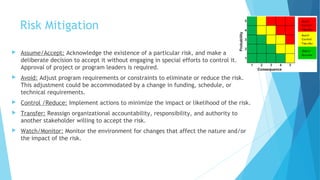
Risk Mitigation
 Assume/Accept: Acknowledge the existence of a particular risk, and make a
deliberate decision to accept it without engaging in special efforts to control it.
Approval of project or program leaders is required.
 Avoid: Adjust program requirements or constraints to eliminate or reduce the risk.
This adjustment could be accommodated by a change in funding, schedule, or
technical requirements.
 Control /Reduce: Implement actions to minimize the impact or likelihood of the risk.
 Transfer: Reassign organizational accountability, responsibility, and authority to
another stakeholder willing to accept the risk.
 Watch/Monitor: Monitor the environment for changes that affect the nature and/or
the impact of the risk.
Sample Security Incidents and Analysis
 SQL
 http://www.example.com/product.php?id=10 AND 1=1
Depending on the API which the web application is using and the DBMS (e.g. PHP + PostgreSQL, ASP+SQL SERVER) it may be possible to
execute multiple queries in one call.
 SELECT * FROM Users WHERE ((Username='1' or '1' = '1'))/*') AND (Password=MD5('$password'))) Due to the inclusion of a comment delimiter in the
$username value the password portion of the query will be ignored.
 Shellshock : Shellshock (CVE-2014-6271, CVE-2014-6277, CVE-2014-6278, CVE-2014-7169, CVE-2014-7186, CVE-2014-7187) is a vulnerability in
GNU's bash shell that gives attackers access to run remote commands on a vulnerable system. If your system has not updated bash in since
Tue Sep 30 2014: 1:32PM EST (See patch history), you're most definitely vulnerable and have been since first boot. This security vulnerability
affects versions 1.14 (released in 1994) to the most recent version 4.3 according to NVD.
 Heartbleed bug allows anyone on the Internet to read the memory of the systems protected by the vulnerable versions of the OpenSSL
software. This compromises the secret keys used to identify the service providers and to encrypt the traffic. ()
 Poodle Attack (TLS_FALLBACK_SCSV)
Why Pentest
 Eliminate false positive vulnerability scan result
 By validating the existence of vulnerability in the machine
 Kali or Backtrack
 Radpid7 – Metasploit framework or Nexpose
 Airodump and Aircrack (Wep Vs WPA2p/e) – Wifi Security
 http://www.shodanhq.com - Computer search with vulnerability in internet
 Duckduckgo.com – Search engine for Security and math's professionals
OWASP Top Ten
 A1-Injection :- Injection flaws, such as SQL, OS, and LDAP injection occur when untrusted data is sent to an interpreter as part of a command or query. The attacker’s hostile
data can trick the interpreter into executing unintended commands or accessing data without proper authorization.
 A2-Broken Authentication and Session Management :- Application functions related to authentication and session management are often not implemented correctly,
allowing attackers to compromise passwords, keys, or session tokens, or to exploit other implementation flaws to assume other users’ identities.
 A3-Cross-Site Scripting (XSS):- XSS flaws occur whenever an application takes untrusted data and sends it to a web browser without proper validation or escaping. XSS
allows attackers to execute scripts in the victim’s browser which can hijack user sessions, deface web sites, or redirect the user to malicious sites.
 A4-Insecure Direct Object References:- A direct object reference occurs when a developer exposes a reference to an internal implementation object, such as a file,
directory, or database key. Without an access control check or other protection, attackers can manipulate these references to access unauthorized data.
 A5-Security Misconfiguration:- Good security requires having a secure configuration defined and deployed for the application, frameworks, application server, web server,
database server, and platform. Secure settings should be defined, implemented, and maintained, as defaults are often insecure. Additionally, software should be kept up to date.
 A6-Sensitive Data Exposure:- Many web applications do not properly protect sensitive data, such as credit cards, tax IDs, and authentication credentials. Attackers may steal
or modify such weakly protected data to conduct credit card fraud, identity theft, or other crimes. Sensitive data deserves extra protection such as encryption at rest or in transit,
as well as special precautions when exchanged with the browser.
 A7-Missing Function Level Access Control:- Most web applications verify function level access rights before making that functionality visible in the UI. However,
applications need to perform the same access control checks on the server when each function is accessed. If requests are not verified, attackers will be able to forge requests in
order to access functionality without proper authorization.
 A8-Cross-Site Request Forgery (CSRF):- A CSRF attack forces a logged-on victim’s browser to send a forged HTTP request, including the victim’s session cookie and any
other automatically included authentication information, to a vulnerable web application. This allows the attacker to force the victim’s browser to generate requests the vulnerable
application thinks are legitimate requests from the victim.
 A9-Using Components with Known Vulnerabilities:- Components, such as libraries, frameworks, and other software modules, almost always run with full privileges. If a
vulnerable component is exploited, such an attack can facilitate serious data loss or server takeover. Applications using components with known vulnerabilities may undermine
application defenses and enable a range of possible attacks and impacts.
 A10-Unvalidated Redirects and Forwards:- Web applications frequently redirect and forward users to other pages and websites, and use untrusted data to determine the
destination pages. Without proper validation, attackers can redirect victims to phishing or malware sites, or use forwards to access unauthorized pages.
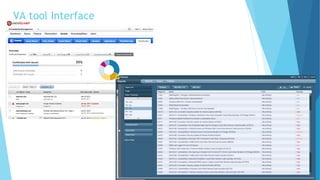
VA tool Interface
Concerns…
 Lots of false Positive
 Lack of security concept understanding of and application and server team
 Additional Cost involved in Mitigations
 Get the Risk acceptance from the stake holder
What’s next !
 Terminologies
 Vulnerability: a bug, flaw, weakness, or exposure of an application, system, device, or service that could lead to a failure
of confidentiality, integrity, or availability.
 Threat: the likelihood or frequency of a harmful event occurring.
 Risk: the relative impact that an exploited vulnerability would have to a user's environment. (Risk = V+T+AV)
 CVSS Calculators -- The NIST CVSSv2 calculator can be found at http://nvd.nist.gov/cvss.cfm?calculator&adv&version=2
 Demo & Practice
 Nessus Retina
 GFI LanGuard
 DVWA
 Certifications : QualysGuard Certified Specialist
 References
 National Vulnerability Database (nvd.nist.gov)
 Common Vulnerabilities and Exposures CVE (https://cve.mitre.org)
 OWASP
 SANS
QA & Thank you
Finto Thomas, CISSP