OWASP
Based Threat
Modeling
Creating a feedback model
in an agile environment
Hello!
I am Chaitanya Bhatt
❏ AppSec Engineer at eBay
❏ MS in Computer Engineering, GIAC-JAVA certified
❏ Threat modeling at eBay, Autodesk, Symantec
❏ Coffee Enthusiast
2
Agenda
3
● Conventional threat modeling
● Threat Modeling Frameworks
● Relevance
● Introduction to the P-S-C Model
● Implementing a P-S-C Threat Model
● The missing piece
● Benefits to the approach
● Key takeaways
Threat Modeling
What is threat modeling?
Why do we need threat modeling?
“Threat modeling is an art
of foreseeing the threats
associated with an
application and getting
them fixed during the early
stages
5
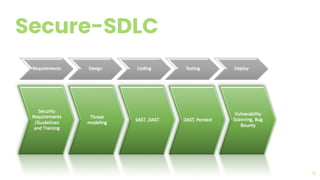
Secure-SDLC
6
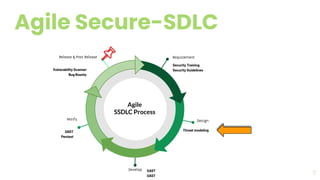
Agile Secure-SDLC
7
Requirement
Release & Post Release
Design
Verify
Develop
DAST
Pentest
Vulnerability Scanner
Bug Bounty
Security Training
Security Guidelines
Threat modeling
SAST
OAST
Agile
SSDLC Process
Existing
Threat
Modeling
Frameworks
8
Some of the commonly used
frameworks
STRIDE
● Spoofing
● Tampering
● Repudiation
● Information disclosure
● Denial of service
● Elevation of privilege
DREAD
● Subjective Rating based on
5 Qs of each threats
● Categories:
○ Damage [potential]
○ Reproducibility
○ Exploitability
○ Affected users
○ Discoverability
PASTA
● Process for Attack
Simulation & Threat
Analysis
● Risk Centric
9
Relevance
● The Changing
Landscape
● Changing attack
scenarios/vectors
● Overlapping threat
categories
● Real life vs Theoretical
10
Introducing
OWASP Based
Threat Modeling
Approach
11
12
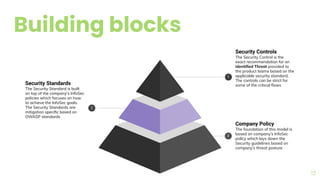
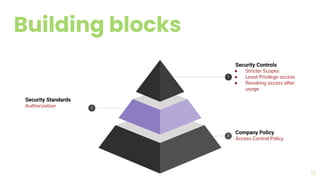
Company Policy
The foundation of this model is
based on company’s InfoSec
policy which lays down the
Security guidelines based on
company’s threat posture
3
Security Standards
The Security Standard is built
on top of the company’s InfoSec
policies which focuses on how
to achieve the InfoSec goals.
The Security Standards are
mitigation specific based on
OWASP standards
2
Security Controls
The Security Control is the
exact recommendation for an
identified Threat provided to
the product teams based on the
applicable security standard.
The controls can be strict for
some of the critical flows
1
Building blocks
13
Company Policy
Access Control Policy
3
Security Standards
Authorization 2
Security Controls
● Stricter Scopes
● Least Privilege access
● Revoking access after
usage
1
Building blocks
Security
Standards
14
RL
AN Authentication
Anti- Automation
AZ Authorization
BR Browser Security
BL Business Logic Abuse
C Compliance
CM Configuration Management
CR Cryptographic Controls
DM Data Management
I Input Validation/Manipulation
L Logging
KV Known Vulnerability
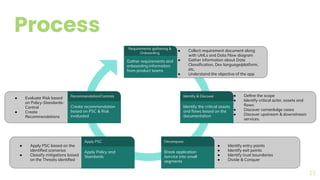
● Evaluate Risk based
on Policy-Standards-
Control
● Create
Recommendations
● Apply PSC based on the
identified scenarios
● Classify mitigations based
on the Threats identified
● Identify entry points
● Identify exit points
● Identify trust boundaries
● Divide & Conquer
● Define the scope
● Identify critical actor, assets and
flows
● Discover corner/edge cases
● Discover upstream & downstream
services.
● Collect requirement document along
with UMLs and Data Flow diagram
● Gather information about Data
Classification, Dev language/platform,
etc.
● Understand the objective of the app
15
Gather requirements and
onboarding information
from product teams
Requirements gathering &
Onboarding
Create recommendation
based on PSC & Risk
evaluated
Recommendation/Controls
Break application
/service into small
segments
Decompose
Apply Policy and
Standards
Apply PSC
Identify the critical assets
and flows based on the
documentation
Identify & Discover
Process
16
Sample Use Case
Library Management System
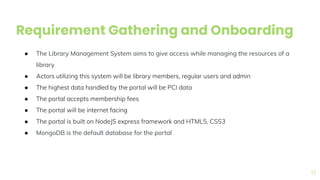
Requirement Gathering and Onboarding
17
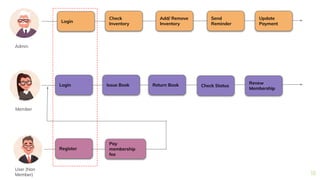
● The Library Management System aims to give access while managing the resources of a
library
● Actors utilizing this system will be library members, regular users and admin
● The highest data handled by the portal will be PCI data
● The portal accepts membership fees
● The portal will be internet facing
● The portal is built on NodeJS express framework and HTML5, CSS3
● MongoDB is the default database for the portal
18
Admin
Member
User (Non
Member)
Login
Check
Inventory
Check Status
Return Book
Issue Book
Send
Reminder
Login
Pay
membership
fee
Register
Renew
Membership
Add/ Remove
Inventory
Update
Payment
19
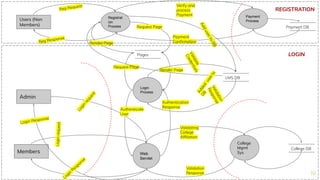
Users (Non
Members)
Admin
Members Web
Servlet
Login
Process
College
Mgmt
Sys
College DB
L
o
g
i
n
r
e
q
u
e
s
t
Login Response
Pages
Request Page
Render Page
LMS DB
V
a
l
i
d
a
t
i
o
n
R
e
s
p
o
n
s
e
V
a
l
i
d
a
t
e
C
r
e
d
e
n
t
i
a
l
s
Authenticate
User
Authentication
Response
Validation
Response
Validating
College
Affiliation
Lo
gin
req
ue
st
Login
Response
Registrat
ion
Process
Payment
Process
Payment DB
Verify and
process
Payment
Payment
Confirmation
Request Page
Render Page
Reg Request
Reg Response
A
d
d
u
s
e
r
t
o
D
B
A
d
d
e
d
u
s
e
r
t
o
D
B
REGISTRATION
LOGIN
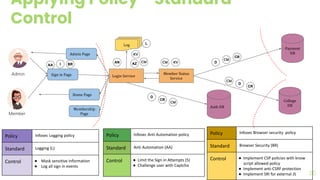
Applying Policy - Standard -
Control
20
Admin
Member
Sign in Page Login Service
Home Page
Admin Page
Auth DB
Payment
DB
Member Status
Service
Membership
Page
Log
College
DB
AA
AN AZ
I BR
L
D
D
D
CR
CM
Policy Infosec Anti Automation policy
Standard Anti Automation (AA)
Control ● Limit the Sign in Attempts (5)
● Challenge user with Captcha
Policy Infosec Browser security policy
Standard Browser Security (BR)
Control ● Implement CSP policies with know
script allowed policy
● Implement anti-CSRF protection
● Implement SRI for external JS
Policy Infosec Logging policy
Standard Logging (L)
Control ● Mask sensitive information
● Log all sign in events
CM KV
KV
CM
CM
CM
CR
CR
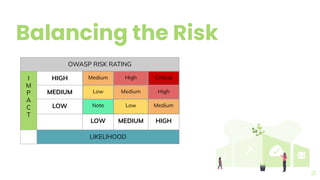
Balancing the Risk
21
OWASP RISK RATING
I
M
P
A
C
T
HIGH Medium High Critical
MEDIUM Low Medium High
LOW Note Low Medium
LOW MEDIUM HIGH
LIKELIHOOD
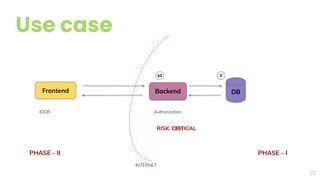
Use case
22
Backend DB
INTERNET
AZ D
Frontend
PHASE - I
PHASE - II
Authorization
IDOR
RISK: HIGH
RISK: CRITICAL
Balancing the Risk
23
OWASP RISK RATING
I
M
P
A
C
T
HIGH High Critical Critical
MEDIUM Medium High Critical
LOW Low Medium High
LOW MEDIUM HIGH
LIKELIHOOD
HIGH E
X
I R
S I
T S
I K
N
G
MEDIUM
LOW
Q. How is success measured in a program ?
Q. What are the 10 biggest threats in your organization ?
Q. What are the 5 products which posses maximum risks
Q. How do you prioritize threat modeling requests ?
Q. How do you handle Threat Modeling request for
incremental changes ?
24
The missing piece
25
INTRODUCING
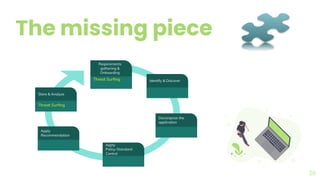
The missing piece
26
Threat Surfing
Requirements
gathering &
Onboarding
Apply
Recommendation
Decompose the
application
Apply
Policy-Standard-
Control
Identify & Discover
Threat Surfing
Store & Analyze
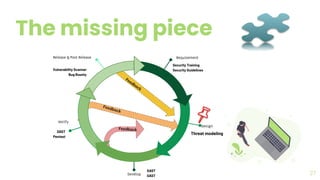
The missing piece
27
Requirement
Release & Post Release
Design
Verify
Develop
DAST
Pentest
Vulnerability Scanner
Bug Bounty
Security Training
Security Guidelines
Threat modeling
SAST
OAST
Feedback
Feedback
Feedback
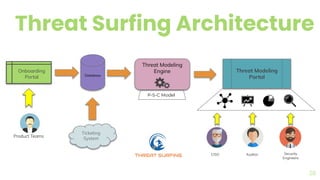
28
Onboarding
Portal Database
Product Teams
Ticketing
System
Threat Modeling
Portal
Threat Modeling
Engine
CISO Auditor Security
Engineers
Threat Surfing Architecture
P-S-C Model
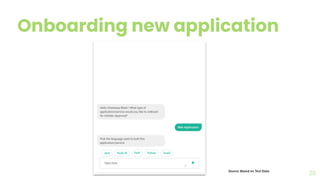
Onboarding new application
29
Source: Based on Test Data
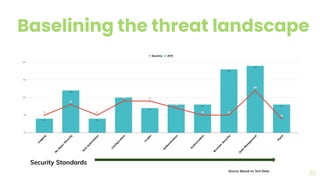
Baselining the threat landscape
30
Source: Based on Test Data
Security Standards
Agile: Relevant to iterative development methodology
Update : Caters to the changing threat landscape for an existing model
Mitigation centric : Focuses on Mitigation rather than attacks
Incremental changes : Handles Incremental changes a lot easier
Developer Friendly : Makes it easier for developers to understand the
outcomes
Aligns with Organizational Goals : The P-S-C Model is built on top of
company’s infosec policy.
Visibility : Better exposure to upstream and downstream services
Benefits
31
Key Takeaways
● A circular process
doesn't necessarily
make it Agile.
32
● Simply joining the first and last ends of
SSDLC process won’t help us keep up
with the pace.
● SSDLC needs to create feedback for
iterative agile approach
Key Takeaways
33
● Focus on OWASP
Top 10 mitigations
Rather than focusing on OWASP TOP 10
vulnerabilities we should be focusing on
OWASP TOP 10 mitigation to connect with the
developers
Key Takeaways
● Threat Modeling
can be the brain of
an S-SDLC process
which yields better
visibility through
Threat Surfing.
34
● Good to have a record for every Threat model
performed rather than a one time document to
accommodate agile
● Threat Surfing can pull information from all
stages of SSDLC process to produce intelligent
analysis of risk and help in foreseeing the
threats in a very earlier stage.
● Helps in maintaining a record of residual risk
Key Takeaways
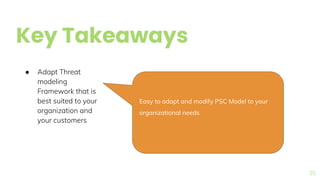
● Adapt Threat
modeling
Framework that is
best suited to your
organization and
your customers
35
Easy to adapt and modify PSC Model to your
organizational needs
Thanks!
Any questions?
You can find me at:
● @iamChaitanya30
● cbhatt@ebay.com
36

OWASP based Threat Modeling Framework

  • 1.
    OWASP Based Threat Modeling Creating afeedback model in an agile environment
  • 2.
    Hello! I am ChaitanyaBhatt ❏ AppSec Engineer at eBay ❏ MS in Computer Engineering, GIAC-JAVA certified ❏ Threat modeling at eBay, Autodesk, Symantec ❏ Coffee Enthusiast 2
  • 3.
    Agenda 3 ● Conventional threatmodeling ● Threat Modeling Frameworks ● Relevance ● Introduction to the P-S-C Model ● Implementing a P-S-C Threat Model ● The missing piece ● Benefits to the approach ● Key takeaways
  • 4.
    Threat Modeling What isthreat modeling? Why do we need threat modeling?
  • 5.
    “Threat modeling isan art of foreseeing the threats associated with an application and getting them fixed during the early stages 5
  • 6.
  • 7.
    Agile Secure-SDLC 7 Requirement Release &Post Release Design Verify Develop DAST Pentest Vulnerability Scanner Bug Bounty Security Training Security Guidelines Threat modeling SAST OAST Agile SSDLC Process
  • 8.
  • 9.
    Some of thecommonly used frameworks STRIDE ● Spoofing ● Tampering ● Repudiation ● Information disclosure ● Denial of service ● Elevation of privilege DREAD ● Subjective Rating based on 5 Qs of each threats ● Categories: ○ Damage [potential] ○ Reproducibility ○ Exploitability ○ Affected users ○ Discoverability PASTA ● Process for Attack Simulation & Threat Analysis ● Risk Centric 9
  • 10.
    Relevance ● The Changing Landscape ●Changing attack scenarios/vectors ● Overlapping threat categories ● Real life vs Theoretical 10
  • 11.
  • 12.
    12 Company Policy The foundationof this model is based on company’s InfoSec policy which lays down the Security guidelines based on company’s threat posture 3 Security Standards The Security Standard is built on top of the company’s InfoSec policies which focuses on how to achieve the InfoSec goals. The Security Standards are mitigation specific based on OWASP standards 2 Security Controls The Security Control is the exact recommendation for an identified Threat provided to the product teams based on the applicable security standard. The controls can be strict for some of the critical flows 1 Building blocks
  • 13.
    13 Company Policy Access ControlPolicy 3 Security Standards Authorization 2 Security Controls ● Stricter Scopes ● Least Privilege access ● Revoking access after usage 1 Building blocks
  • 14.
    Security Standards 14 RL AN Authentication Anti- Automation AZAuthorization BR Browser Security BL Business Logic Abuse C Compliance CM Configuration Management CR Cryptographic Controls DM Data Management I Input Validation/Manipulation L Logging KV Known Vulnerability
  • 15.
    ● Evaluate Riskbased on Policy-Standards- Control ● Create Recommendations ● Apply PSC based on the identified scenarios ● Classify mitigations based on the Threats identified ● Identify entry points ● Identify exit points ● Identify trust boundaries ● Divide & Conquer ● Define the scope ● Identify critical actor, assets and flows ● Discover corner/edge cases ● Discover upstream & downstream services. ● Collect requirement document along with UMLs and Data Flow diagram ● Gather information about Data Classification, Dev language/platform, etc. ● Understand the objective of the app 15 Gather requirements and onboarding information from product teams Requirements gathering & Onboarding Create recommendation based on PSC & Risk evaluated Recommendation/Controls Break application /service into small segments Decompose Apply Policy and Standards Apply PSC Identify the critical assets and flows based on the documentation Identify & Discover Process
  • 16.
    16 Sample Use Case LibraryManagement System
  • 17.
    Requirement Gathering andOnboarding 17 ● The Library Management System aims to give access while managing the resources of a library ● Actors utilizing this system will be library members, regular users and admin ● The highest data handled by the portal will be PCI data ● The portal accepts membership fees ● The portal will be internet facing ● The portal is built on NodeJS express framework and HTML5, CSS3 ● MongoDB is the default database for the portal
  • 18.
    18 Admin Member User (Non Member) Login Check Inventory Check Status ReturnBook Issue Book Send Reminder Login Pay membership fee Register Renew Membership Add/ Remove Inventory Update Payment
  • 19.
    19 Users (Non Members) Admin Members Web Servlet Login Process College Mgmt Sys CollegeDB L o g i n r e q u e s t Login Response Pages Request Page Render Page LMS DB V a l i d a t i o n R e s p o n s e V a l i d a t e C r e d e n t i a l s Authenticate User Authentication Response Validation Response Validating College Affiliation Lo gin req ue st Login Response Registrat ion Process Payment Process Payment DB Verify and process Payment Payment Confirmation Request Page Render Page Reg Request Reg Response A d d u s e r t o D B A d d e d u s e r t o D B REGISTRATION LOGIN
  • 20.
    Applying Policy -Standard - Control 20 Admin Member Sign in Page Login Service Home Page Admin Page Auth DB Payment DB Member Status Service Membership Page Log College DB AA AN AZ I BR L D D D CR CM Policy Infosec Anti Automation policy Standard Anti Automation (AA) Control ● Limit the Sign in Attempts (5) ● Challenge user with Captcha Policy Infosec Browser security policy Standard Browser Security (BR) Control ● Implement CSP policies with know script allowed policy ● Implement anti-CSRF protection ● Implement SRI for external JS Policy Infosec Logging policy Standard Logging (L) Control ● Mask sensitive information ● Log all sign in events CM KV KV CM CM CM CR CR
  • 21.
    Balancing the Risk 21 OWASPRISK RATING I M P A C T HIGH Medium High Critical MEDIUM Low Medium High LOW Note Low Medium LOW MEDIUM HIGH LIKELIHOOD
  • 22.
    Use case 22 Backend DB INTERNET AZD Frontend PHASE - I PHASE - II Authorization IDOR RISK: HIGH RISK: CRITICAL
  • 23.
    Balancing the Risk 23 OWASPRISK RATING I M P A C T HIGH High Critical Critical MEDIUM Medium High Critical LOW Low Medium High LOW MEDIUM HIGH LIKELIHOOD HIGH E X I R S I T S I K N G MEDIUM LOW
  • 24.
    Q. How issuccess measured in a program ? Q. What are the 10 biggest threats in your organization ? Q. What are the 5 products which posses maximum risks Q. How do you prioritize threat modeling requests ? Q. How do you handle Threat Modeling request for incremental changes ? 24
  • 25.
  • 26.
    The missing piece 26 ThreatSurfing Requirements gathering & Onboarding Apply Recommendation Decompose the application Apply Policy-Standard- Control Identify & Discover Threat Surfing Store & Analyze
  • 27.
    The missing piece 27 Requirement Release& Post Release Design Verify Develop DAST Pentest Vulnerability Scanner Bug Bounty Security Training Security Guidelines Threat modeling SAST OAST Feedback Feedback Feedback
  • 28.
    28 Onboarding Portal Database Product Teams Ticketing System ThreatModeling Portal Threat Modeling Engine CISO Auditor Security Engineers Threat Surfing Architecture P-S-C Model
  • 29.
  • 30.
    Baselining the threatlandscape 30 Source: Based on Test Data Security Standards
  • 31.
    Agile: Relevant toiterative development methodology Update : Caters to the changing threat landscape for an existing model Mitigation centric : Focuses on Mitigation rather than attacks Incremental changes : Handles Incremental changes a lot easier Developer Friendly : Makes it easier for developers to understand the outcomes Aligns with Organizational Goals : The P-S-C Model is built on top of company’s infosec policy. Visibility : Better exposure to upstream and downstream services Benefits 31
  • 32.
    Key Takeaways ● Acircular process doesn't necessarily make it Agile. 32 ● Simply joining the first and last ends of SSDLC process won’t help us keep up with the pace. ● SSDLC needs to create feedback for iterative agile approach
  • 33.
    Key Takeaways 33 ● Focuson OWASP Top 10 mitigations Rather than focusing on OWASP TOP 10 vulnerabilities we should be focusing on OWASP TOP 10 mitigation to connect with the developers
  • 34.
    Key Takeaways ● ThreatModeling can be the brain of an S-SDLC process which yields better visibility through Threat Surfing. 34 ● Good to have a record for every Threat model performed rather than a one time document to accommodate agile ● Threat Surfing can pull information from all stages of SSDLC process to produce intelligent analysis of risk and help in foreseeing the threats in a very earlier stage. ● Helps in maintaining a record of residual risk
  • 35.
    Key Takeaways ● AdaptThreat modeling Framework that is best suited to your organization and your customers 35 Easy to adapt and modify PSC Model to your organizational needs
  • 36.
    Thanks! Any questions? You canfind me at: ● @iamChaitanya30 ● cbhatt@ebay.com 36