Overview of Six Sigma
Presentation By: Akanksha B. Puri
M.Pharm (Sem-I)
Dept. of Pharmaceutical Quality Assurance
1
Contents:
Introduction
 History of Six Sigma
 Objective of Six Sigma
 Six Sigma Methodology
 Case Study
 Conclusion
 References
2
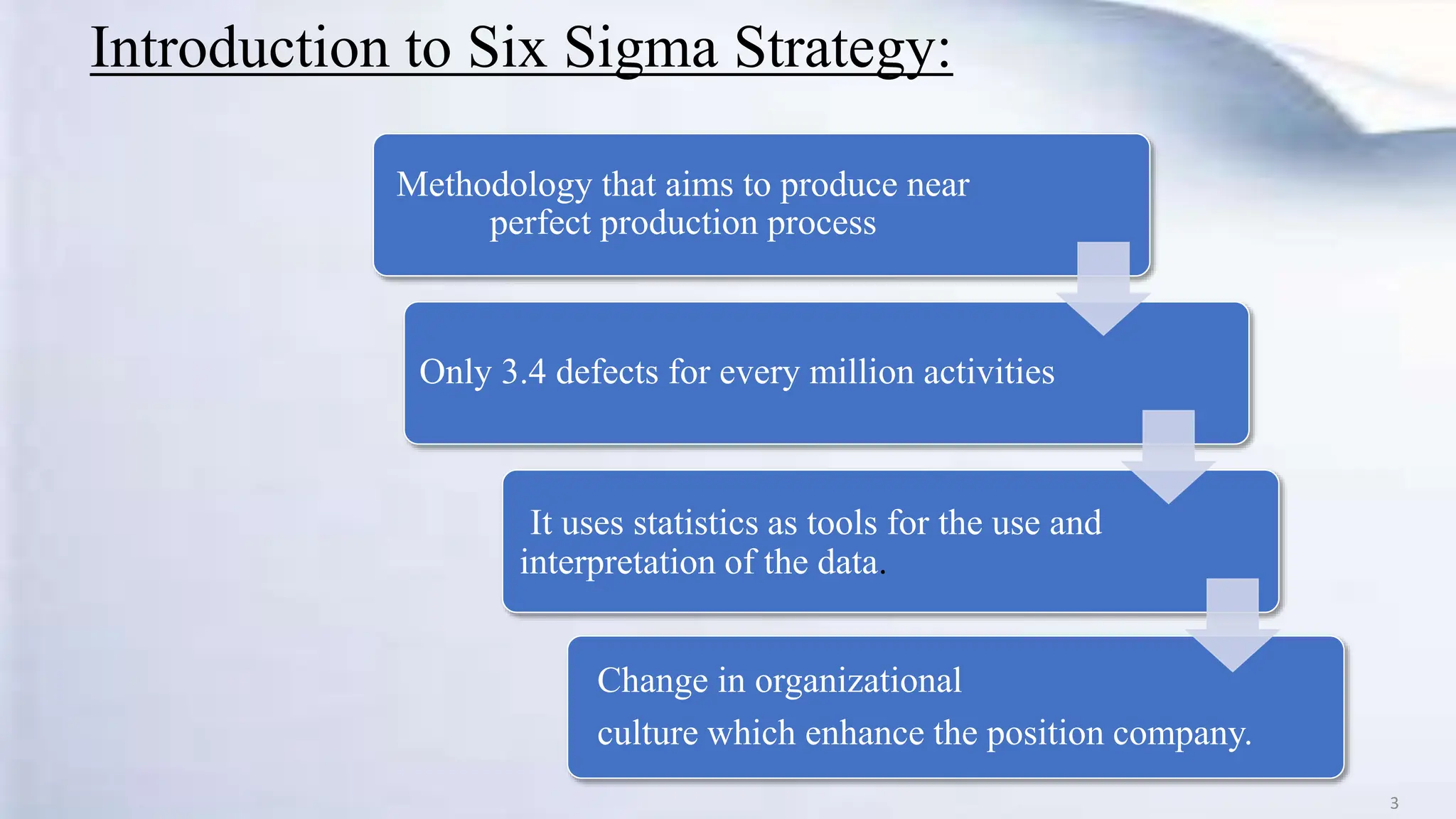
Introduction to Six Sigma Strategy:
3
Methodology that aims to produce near
perfect production process
Only 3.4 defects for every million activities
It uses statistics as tools for the use and
interpretation of the data.
Change in organizational
culture which enhance the position company.
History of Six Sigma:
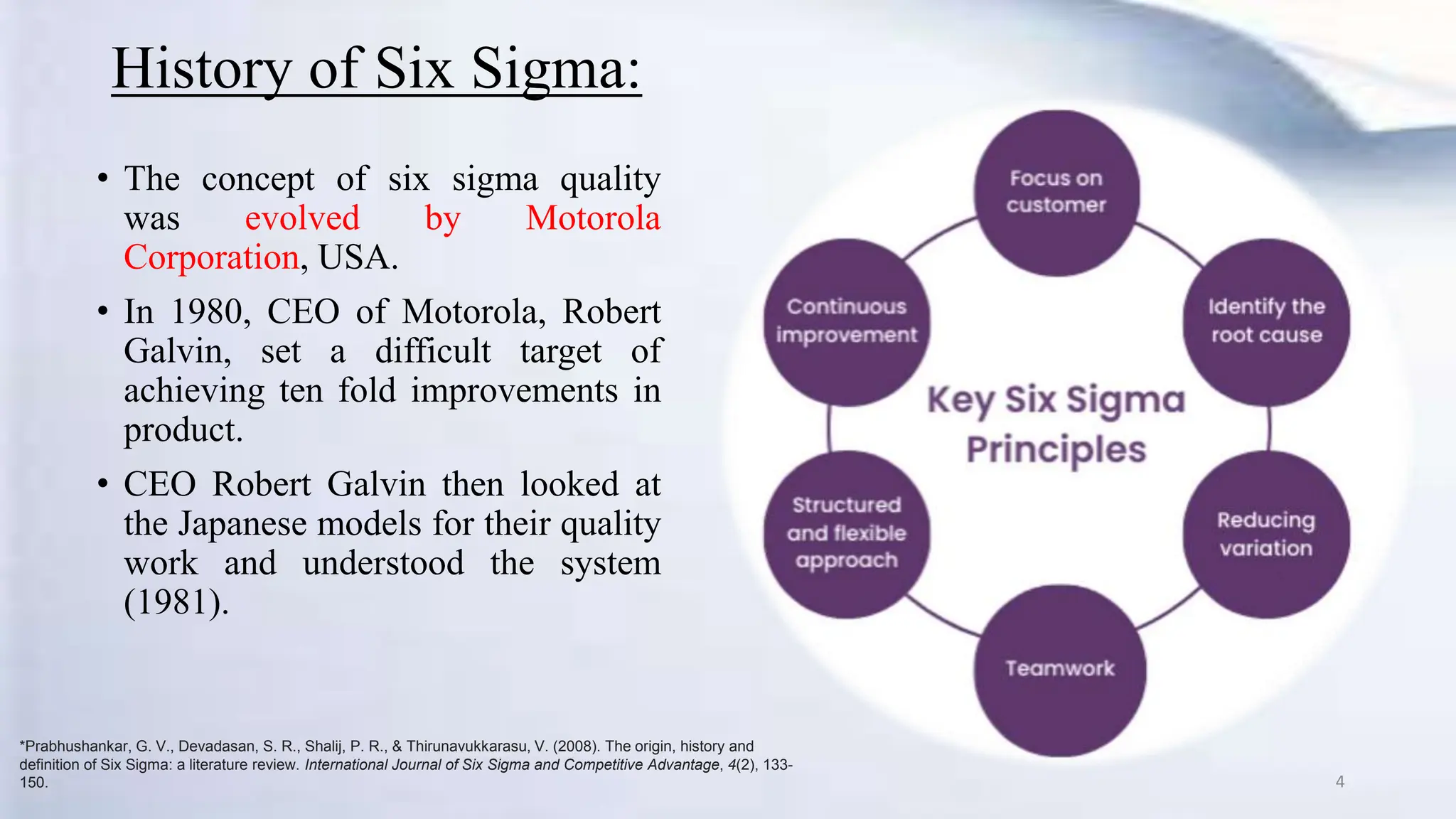
• The concept of six sigma quality
was evolved by Motorola
Corporation, USA.
• In 1980, CEO of Motorola, Robert
Galvin, set a difficult target of
achieving ten fold improvements in
product.
• CEO Robert Galvin then looked at
the Japanese models for their quality
work and understood the system
(1981).
4
*Prabhushankar, G. V., Devadasan, S. R., Shalij, P. R., & Thirunavukkarasu, V. (2008). The origin, history and
definition of Six Sigma: a literature review. International Journal of Six Sigma and Competitive Advantage, 4(2), 133-
150.
Objective of Six Sigma:
5
Reduce cost of
Production
Enhance
Production
Efficacy
Change mindset
and culture in firm
Shorting the time
required to market
the product
Customer
satisfaction
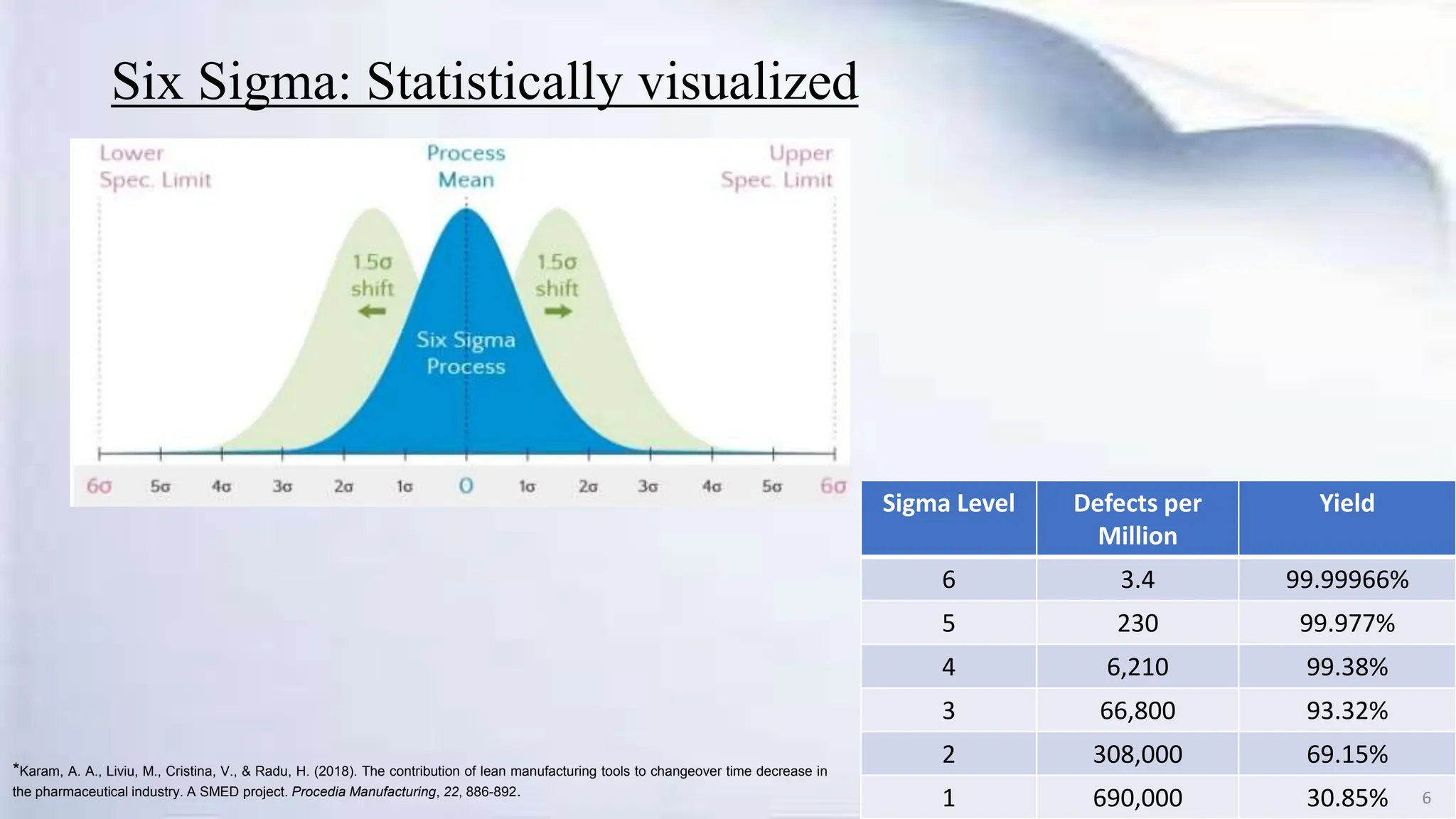
Six Sigma: Statistically visualized
Sigma Level Defects per
Million
Yield
6 3.4 99.99966%
5 230 99.977%
4 6,210 99.38%
3 66,800 93.32%
2 308,000 69.15%
1 690,000 30.85% 6
*Karam, A. A., Liviu, M., Cristina, V., & Radu, H. (2018). The contribution of lean manufacturing tools to changeover time decrease in
the pharmaceutical industry. A SMED project. Procedia Manufacturing, 22, 886-892.
How to Calculate Sigma Levels?
LTL= Lower Tolerance Limit
UTL= Upper Tolerance Limit
σ= Standard Deviation
Process Sigma = MEAN – LTL UTL – MEAN
σ OR σ
Sigma Level = Z = SL – m
SD
Z = Low Sigma / Process Sigma
S= Specification
L=Limit
m= Mean
SD= Standard Deviation
7
Methodology used in Six Sigma:
• Six Sigma at many organizations simply means a measure of quality
that strives for near perfection.
• Six Sigma methodology the DMAIC (Define, Measure, Analyze,
Improve, Control) approach which focuses on improving existing
processes and Design For Six Sigma.
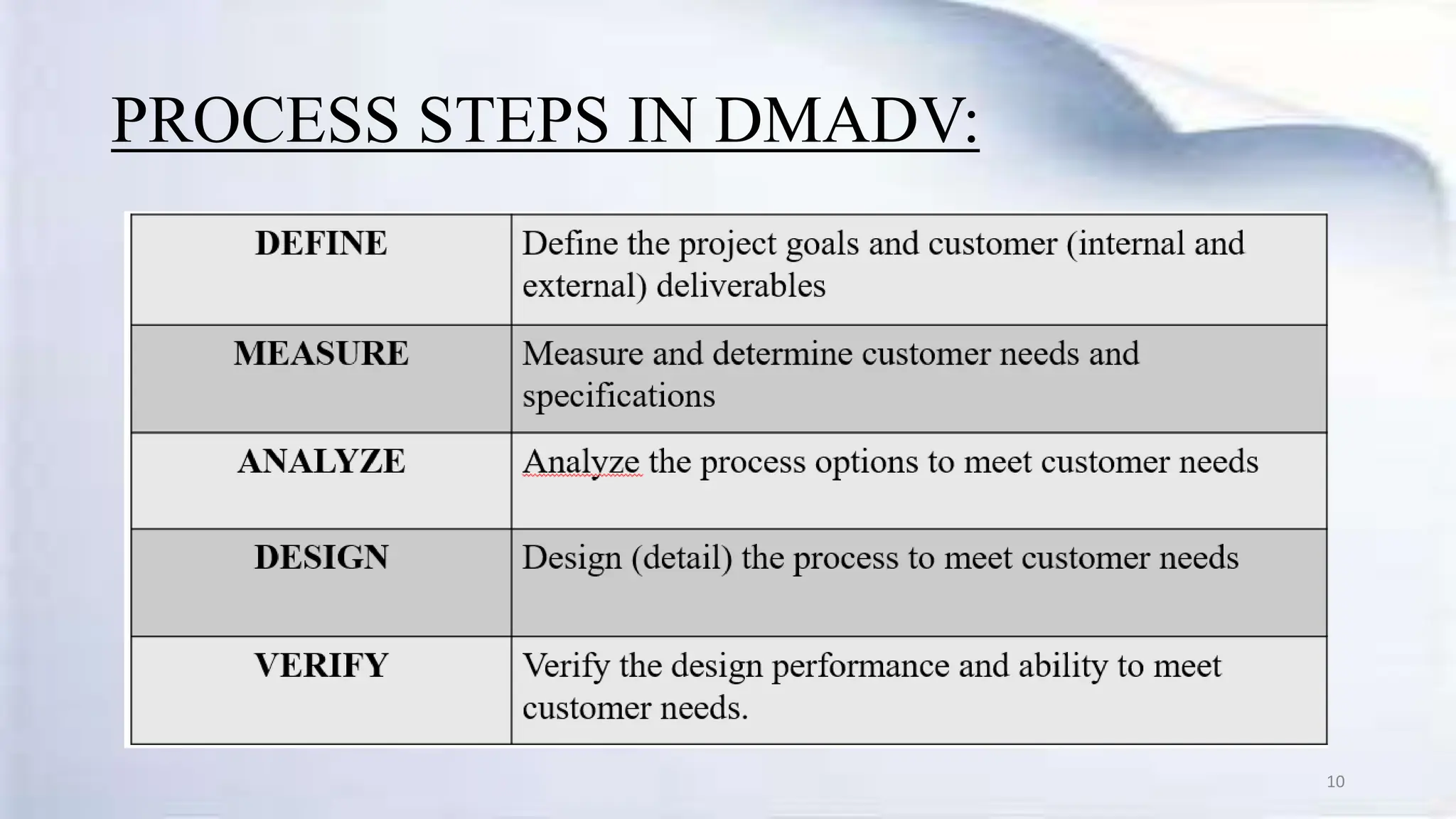
• On the other hand, the Six Sigma DMADV (Define, Measure,
Analyze, Design, Verify) process which focuses on improving and
develop new processes or products.
8
PROCESS STEPS IN DMAIC:
DEFINE
(What is a problem ?)
ANALYZE
(What are significant causes ?)
IMPROVE
(What is a the solution?)
MEASURE
(How deep is the problem ?)
CONTROL
(How to sustain?)
9
PROCESS STEPS IN DMADV:
10
11
Case study:
The problem of high changeover time in dry granulation process of antibiotic tablets in
roll compactor machine.
 This committee reviews and identifies where there is potential opportunity for reducing
the change over time.
Develop project
charter
Select team &
Launch the product
Create project plan
12
DEFINE:
MEASURE:
• Average roll compactor changeover time at 3 sigma level was found to be 628
min.
• To identify potential factors causing an overall effect of the process brain storming
was done using Ishikawa diagram
Fig1 Fishbone diagram for reduction of changeover time
13
Machine Setting Control
Area Arrangement Parts Assembly and Dismantling Machine Part Cleaning
Reduction in
Changeover Time
Cleaning Kit and Mop
availability & gumboots
5S
Exclusive toolbox
Hose pipe
Vaccum cleaner
Trained casuals
Dismantling & assembly time
Nut bolts to be simplify
Recognition & Reward
Regular monitoring
Regular Training
Other
Manpower availability
Tool box and ownership
Analyze
The process problems and their root causes are identified & validated.
Lean setup reduction workshop was conducted.
Time motion study of Type-B changeover activity
Brainstormed to move internal activities to external and streamline internal
activities
*Mohd Ahsan Khan1 , A CASE STUDY ON LEAN SIX SIGMA FOR REDUCTION IN CHANGEOVER TIME OF DRY GRANULATION AREA IN LEADING PHARMACEUTICAL COMPANY
14
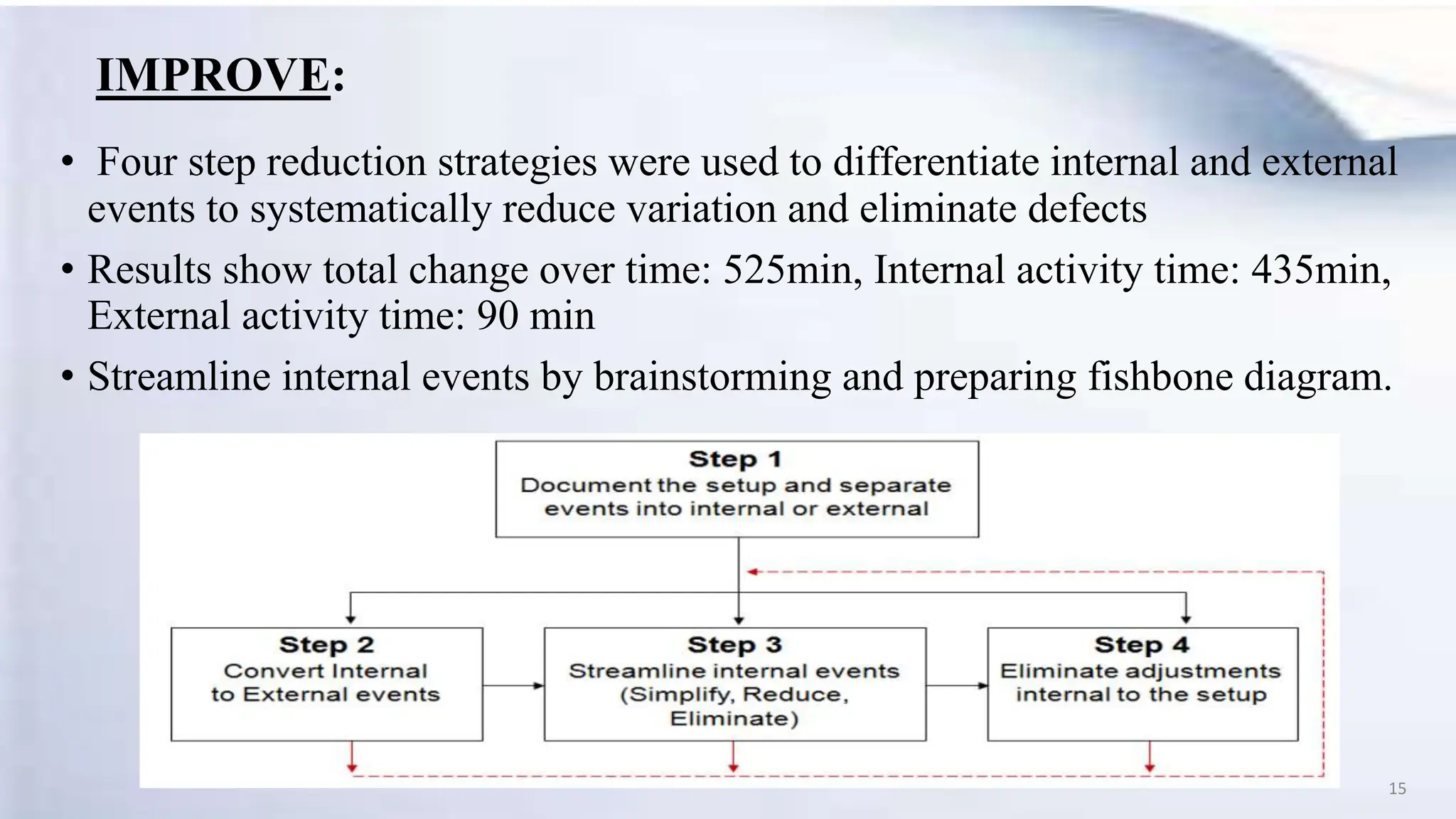
IMPROVE:
• Four step reduction strategies were used to differentiate internal and external
events to systematically reduce variation and eliminate defects
• Results show total change over time: 525min, Internal activity time: 435min,
External activity time: 90 min
• Streamline internal events by brainstorming and preparing fishbone diagram.
15
CONTROL:
Future performances of the process are considered
Results finally achieved 43% reduction in changeover time for
changeover during pilot project
Implemented 5S to eliminate the search time
In this step, document procedures, train all employees for new
processes, and create monitoring and reaction plan for new
processes. 16
Benefits of Six Sigma:
Reduction
in costs
Reduction in
waste chain
customer
requirements
Improves
quality
performance
Provides
critical process
inputs 17
CONCLUSION
• The applicability and appropriateness of lean six sigma to company
support processes, such as management, distribution, replenishment,
usage and control of changeover time.
• Applying Six Sigma tools in production processes to improve
throughput, save time, equal distribution of work, improve revenue,
improve quality and help to ensure benefit of the company
18
*Mohd Ahsan Khan1 , A CASE STUDY ON LEAN SIX SIGMA FOR REDUCTION IN CHANGEOVER TIME OF DRY GRANULATION AREA IN LEADING PHARMACEUTICAL COMPANY
REFERENCES:
1. Byrne, B., McDermott, O., & Noonan, J. (2021). Applying lean six sigma methodology to a
pharmaceutical manufacturing facility: A case study. Processes, 9(3), 550.
2. Karam, A. A., Liviu, M., Cristina, V., & Radu, H. (2018). The contribution of lean
manufacturing tools to changeover time decrease in the pharmaceutical industry. A SMED
project. Procedia Manufacturing, 22, 886-892.
3. Hassan, R., Marimuthu, M., & Mahinderjit-Singh, M. (2016). Application of Six-Sigma for
process improvement in manufacturing industries: A case study.
4. Sharma, A., Bhanot, N., Gupta, A., & Trehan, R. (2022). Application of Lean Six Sigma
framework for improving manufacturing efficiency: a case study in Indian
context. International Journal of Productivity and Performance Management, 71(5), 1561-
1589.
5. Mohd Ahsan Khan*, Priyadarshan Pachorkar, Zeba Khan (2015). a case study on lean six
sigma for reduction in changeover time of dry granulation area in leading pharmaceutical
company, 5(2): 554-560.
6. Prabhushankar, G. V., Devadasan, S. R., Shalij, P. R., & Thirunavukkarasu, V. (2008). The
origin, history and definition of Six Sigma: a literature review. International Journal of Six
Sigma and Competitive Advantage, 4(2), 133-150.
19
THANK YOU !!
20

Overview of six sigma DMAIC & DMADV pptx

  • 1.
    Overview of SixSigma Presentation By: Akanksha B. Puri M.Pharm (Sem-I) Dept. of Pharmaceutical Quality Assurance 1
  • 2.
    Contents: Introduction  History ofSix Sigma  Objective of Six Sigma  Six Sigma Methodology  Case Study  Conclusion  References 2
  • 3.
    Introduction to SixSigma Strategy: 3 Methodology that aims to produce near perfect production process Only 3.4 defects for every million activities It uses statistics as tools for the use and interpretation of the data. Change in organizational culture which enhance the position company.
  • 4.
    History of SixSigma: • The concept of six sigma quality was evolved by Motorola Corporation, USA. • In 1980, CEO of Motorola, Robert Galvin, set a difficult target of achieving ten fold improvements in product. • CEO Robert Galvin then looked at the Japanese models for their quality work and understood the system (1981). 4 *Prabhushankar, G. V., Devadasan, S. R., Shalij, P. R., & Thirunavukkarasu, V. (2008). The origin, history and definition of Six Sigma: a literature review. International Journal of Six Sigma and Competitive Advantage, 4(2), 133- 150.
  • 5.
    Objective of SixSigma: 5 Reduce cost of Production Enhance Production Efficacy Change mindset and culture in firm Shorting the time required to market the product Customer satisfaction
  • 6.
    Six Sigma: Statisticallyvisualized Sigma Level Defects per Million Yield 6 3.4 99.99966% 5 230 99.977% 4 6,210 99.38% 3 66,800 93.32% 2 308,000 69.15% 1 690,000 30.85% 6 *Karam, A. A., Liviu, M., Cristina, V., & Radu, H. (2018). The contribution of lean manufacturing tools to changeover time decrease in the pharmaceutical industry. A SMED project. Procedia Manufacturing, 22, 886-892.
  • 7.
    How to CalculateSigma Levels? LTL= Lower Tolerance Limit UTL= Upper Tolerance Limit σ= Standard Deviation Process Sigma = MEAN – LTL UTL – MEAN σ OR σ Sigma Level = Z = SL – m SD Z = Low Sigma / Process Sigma S= Specification L=Limit m= Mean SD= Standard Deviation 7
  • 8.
    Methodology used inSix Sigma: • Six Sigma at many organizations simply means a measure of quality that strives for near perfection. • Six Sigma methodology the DMAIC (Define, Measure, Analyze, Improve, Control) approach which focuses on improving existing processes and Design For Six Sigma. • On the other hand, the Six Sigma DMADV (Define, Measure, Analyze, Design, Verify) process which focuses on improving and develop new processes or products. 8
  • 9.
    PROCESS STEPS INDMAIC: DEFINE (What is a problem ?) ANALYZE (What are significant causes ?) IMPROVE (What is a the solution?) MEASURE (How deep is the problem ?) CONTROL (How to sustain?) 9
  • 10.
  • 11.
  • 12.
    The problem ofhigh changeover time in dry granulation process of antibiotic tablets in roll compactor machine.  This committee reviews and identifies where there is potential opportunity for reducing the change over time. Develop project charter Select team & Launch the product Create project plan 12 DEFINE:
  • 13.
    MEASURE: • Average rollcompactor changeover time at 3 sigma level was found to be 628 min. • To identify potential factors causing an overall effect of the process brain storming was done using Ishikawa diagram Fig1 Fishbone diagram for reduction of changeover time 13 Machine Setting Control Area Arrangement Parts Assembly and Dismantling Machine Part Cleaning Reduction in Changeover Time Cleaning Kit and Mop availability & gumboots 5S Exclusive toolbox Hose pipe Vaccum cleaner Trained casuals Dismantling & assembly time Nut bolts to be simplify Recognition & Reward Regular monitoring Regular Training Other Manpower availability Tool box and ownership
  • 14.
    Analyze The process problemsand their root causes are identified & validated. Lean setup reduction workshop was conducted. Time motion study of Type-B changeover activity Brainstormed to move internal activities to external and streamline internal activities *Mohd Ahsan Khan1 , A CASE STUDY ON LEAN SIX SIGMA FOR REDUCTION IN CHANGEOVER TIME OF DRY GRANULATION AREA IN LEADING PHARMACEUTICAL COMPANY 14
  • 15.
    IMPROVE: • Four stepreduction strategies were used to differentiate internal and external events to systematically reduce variation and eliminate defects • Results show total change over time: 525min, Internal activity time: 435min, External activity time: 90 min • Streamline internal events by brainstorming and preparing fishbone diagram. 15
  • 16.
    CONTROL: Future performances ofthe process are considered Results finally achieved 43% reduction in changeover time for changeover during pilot project Implemented 5S to eliminate the search time In this step, document procedures, train all employees for new processes, and create monitoring and reaction plan for new processes. 16
  • 17.
    Benefits of SixSigma: Reduction in costs Reduction in waste chain customer requirements Improves quality performance Provides critical process inputs 17
  • 18.
    CONCLUSION • The applicabilityand appropriateness of lean six sigma to company support processes, such as management, distribution, replenishment, usage and control of changeover time. • Applying Six Sigma tools in production processes to improve throughput, save time, equal distribution of work, improve revenue, improve quality and help to ensure benefit of the company 18 *Mohd Ahsan Khan1 , A CASE STUDY ON LEAN SIX SIGMA FOR REDUCTION IN CHANGEOVER TIME OF DRY GRANULATION AREA IN LEADING PHARMACEUTICAL COMPANY
  • 19.
    REFERENCES: 1. Byrne, B.,McDermott, O., & Noonan, J. (2021). Applying lean six sigma methodology to a pharmaceutical manufacturing facility: A case study. Processes, 9(3), 550. 2. Karam, A. A., Liviu, M., Cristina, V., & Radu, H. (2018). The contribution of lean manufacturing tools to changeover time decrease in the pharmaceutical industry. A SMED project. Procedia Manufacturing, 22, 886-892. 3. Hassan, R., Marimuthu, M., & Mahinderjit-Singh, M. (2016). Application of Six-Sigma for process improvement in manufacturing industries: A case study. 4. Sharma, A., Bhanot, N., Gupta, A., & Trehan, R. (2022). Application of Lean Six Sigma framework for improving manufacturing efficiency: a case study in Indian context. International Journal of Productivity and Performance Management, 71(5), 1561- 1589. 5. Mohd Ahsan Khan*, Priyadarshan Pachorkar, Zeba Khan (2015). a case study on lean six sigma for reduction in changeover time of dry granulation area in leading pharmaceutical company, 5(2): 554-560. 6. Prabhushankar, G. V., Devadasan, S. R., Shalij, P. R., & Thirunavukkarasu, V. (2008). The origin, history and definition of Six Sigma: a literature review. International Journal of Six Sigma and Competitive Advantage, 4(2), 133-150. 19
  • 20.