APPROACHES TO
DIGITAL COMPOSITION
INTRODUCTION TO THE PWR DIGITAL COMPOSITION
SAMPLER


Amy Goodloe
PWR Digital Composition Coordinator
March 21, 2012
All rights reserved © 2012
Preface
   What follows is my introduction for the Digital
    Composition Sampler presentation for PWR
    faculty on March 21, 2012.
   The introduction provides an overview of
    approaches to digital composition, which will be
    followed by:
     Michelle discussing audio essays
     Dalyn discussing video projects
     Amy discussing digital storytelling projects


Note: I’m including the “Benefits to Students” section in this version of
the slides, even though that section was not part of the live
presentation.
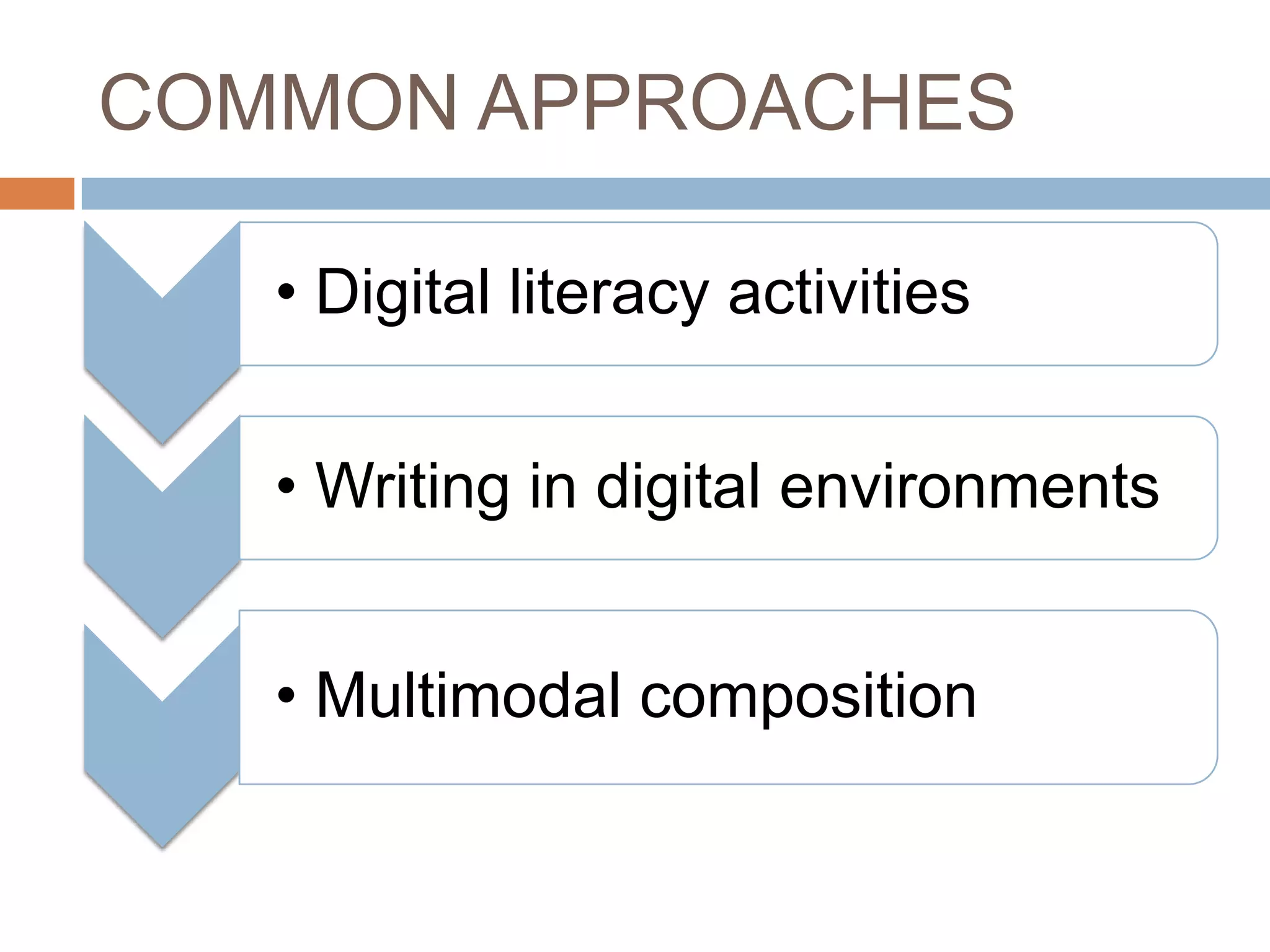
COMMON APPROACHES

   • Digital literacy activities


   • Writing in digital environments


   • Multimodal composition
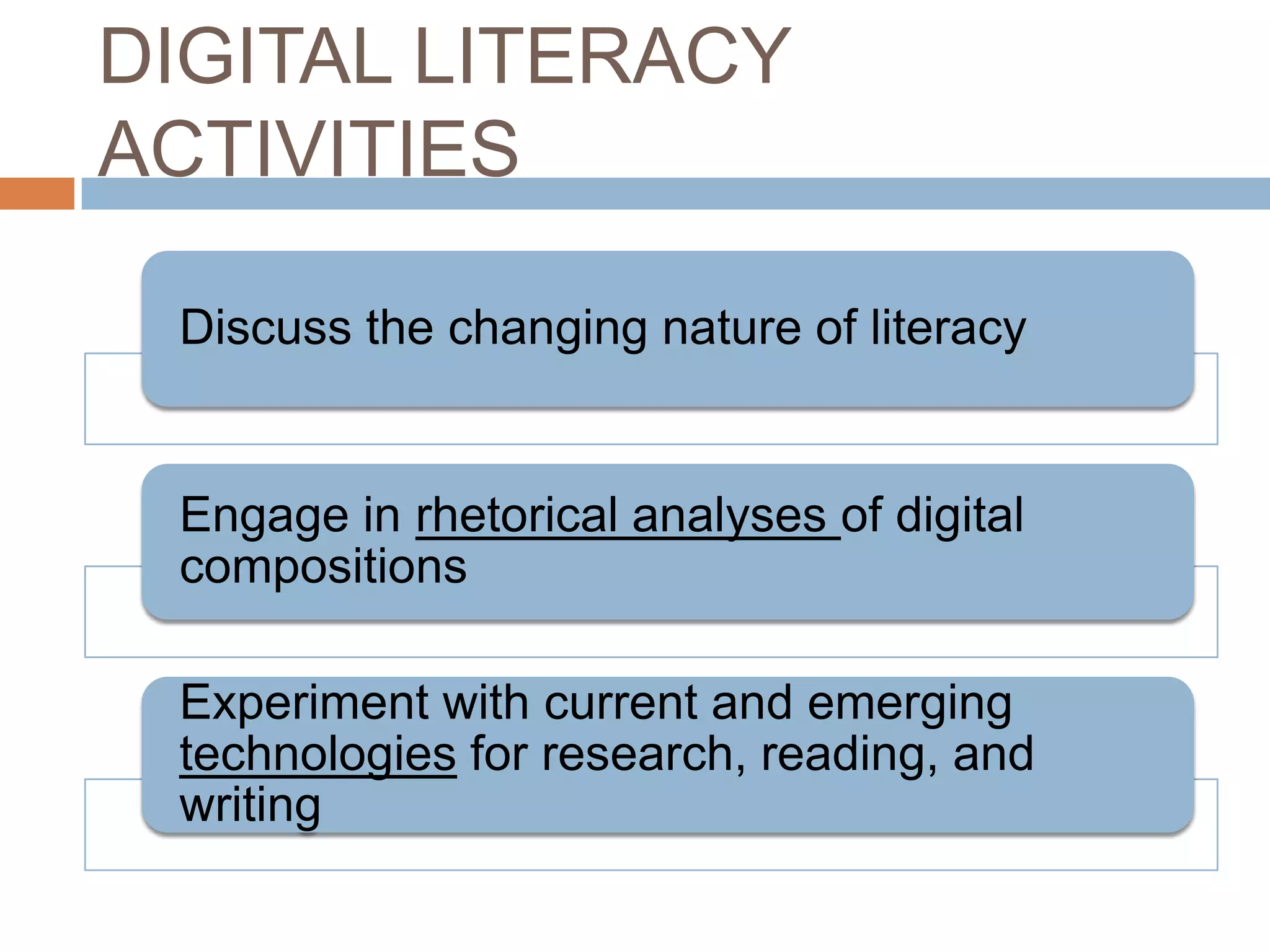
DIGITAL LITERACY
ACTIVITIES

 Discuss the changing nature of literacy


 Engage in rhetorical analyses of digital
 compositions

 Experiment with current and emerging
 technologies for research, reading, and
 writing
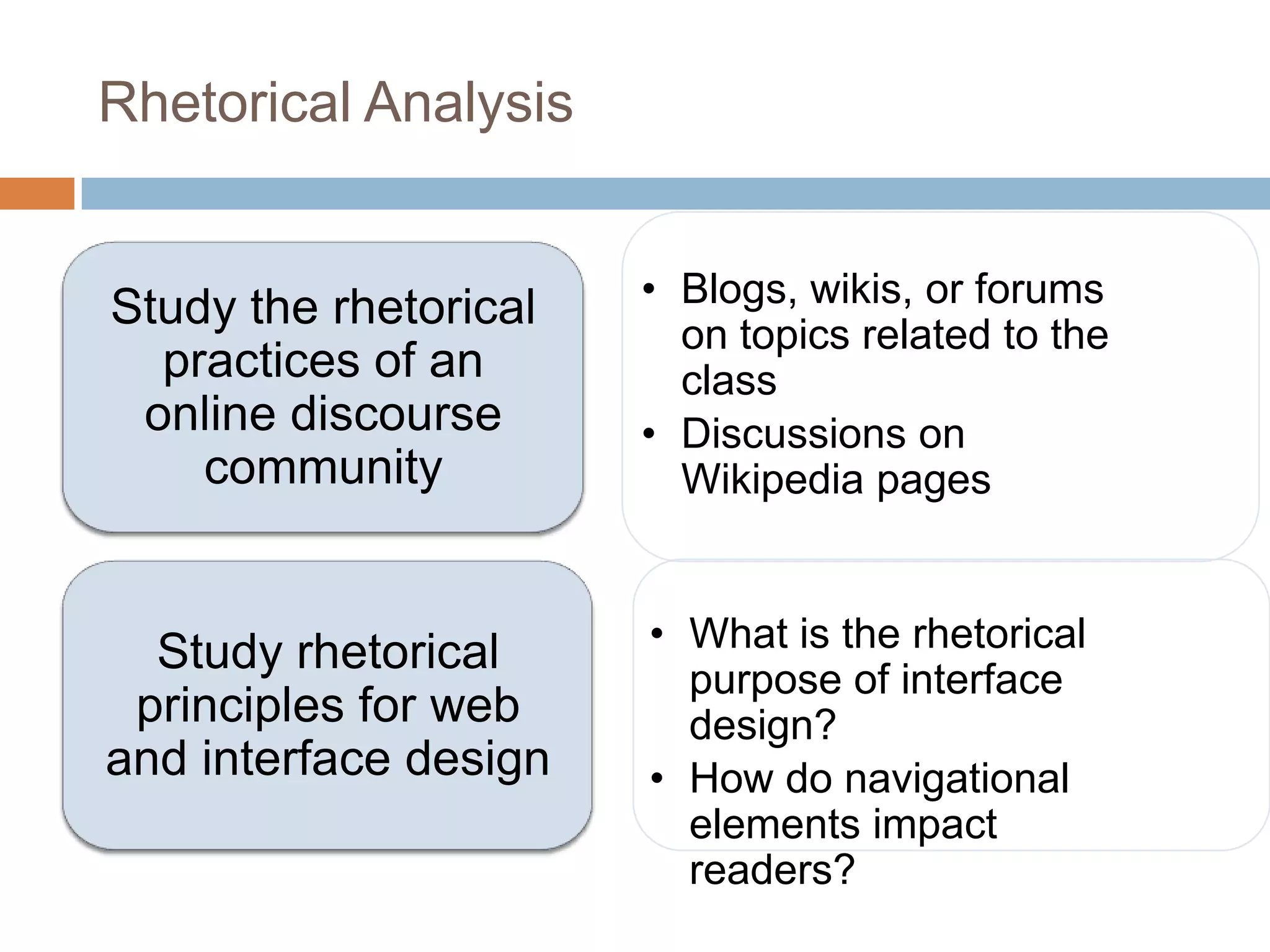
Rhetorical Analysis


Study the rhetorical   • Blogs, wikis, or forums
                         on topics related to the
  practices of an        class
 online discourse      • Discussions on
    community            Wikipedia pages


  Study rhetorical     • What is the rhetorical
                         purpose of interface
 principles for web      design?
and interface design   • How do navigational
                         elements impact
                         readers?
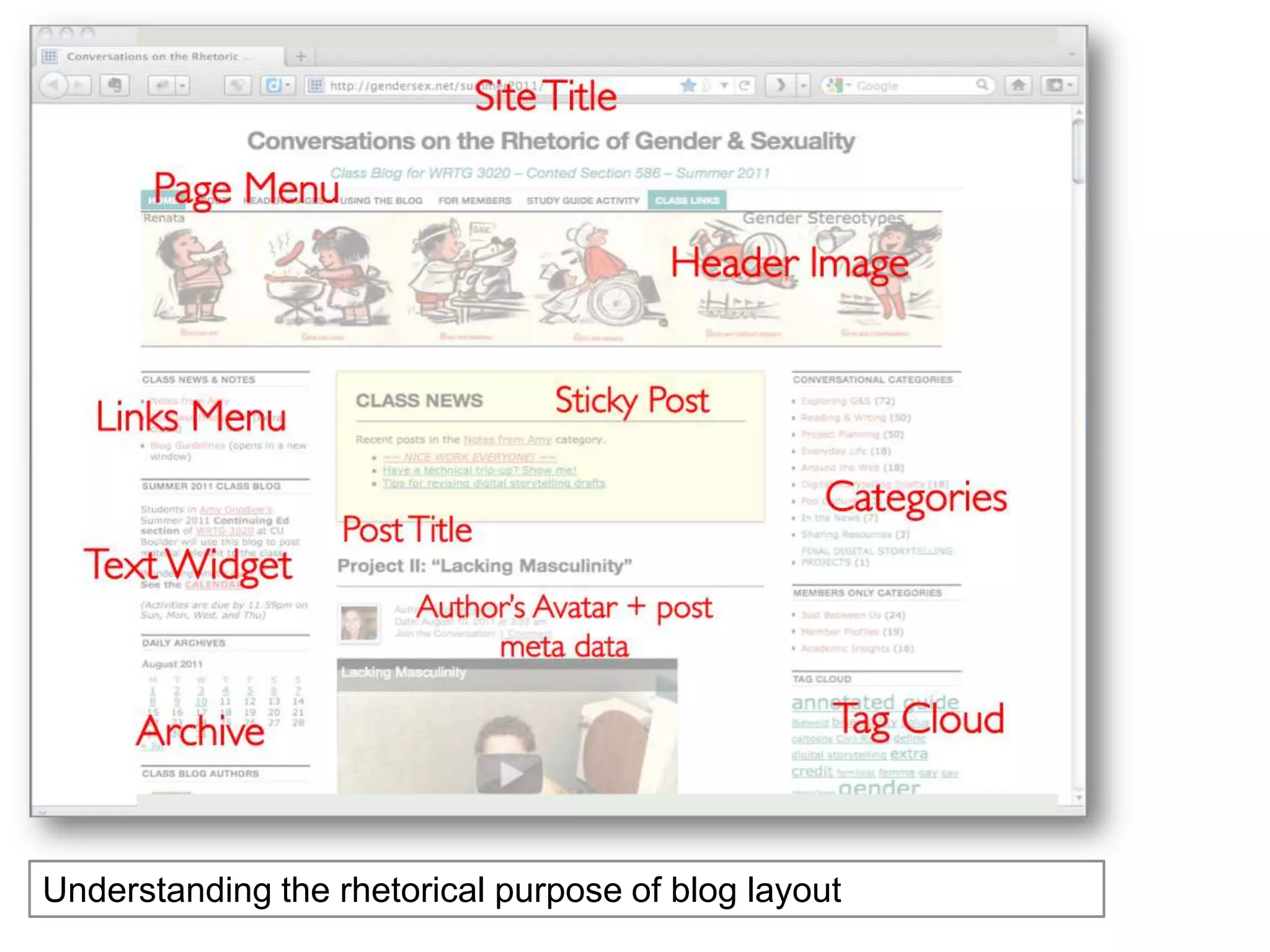
Understanding the rhetorical purpose of blog layout
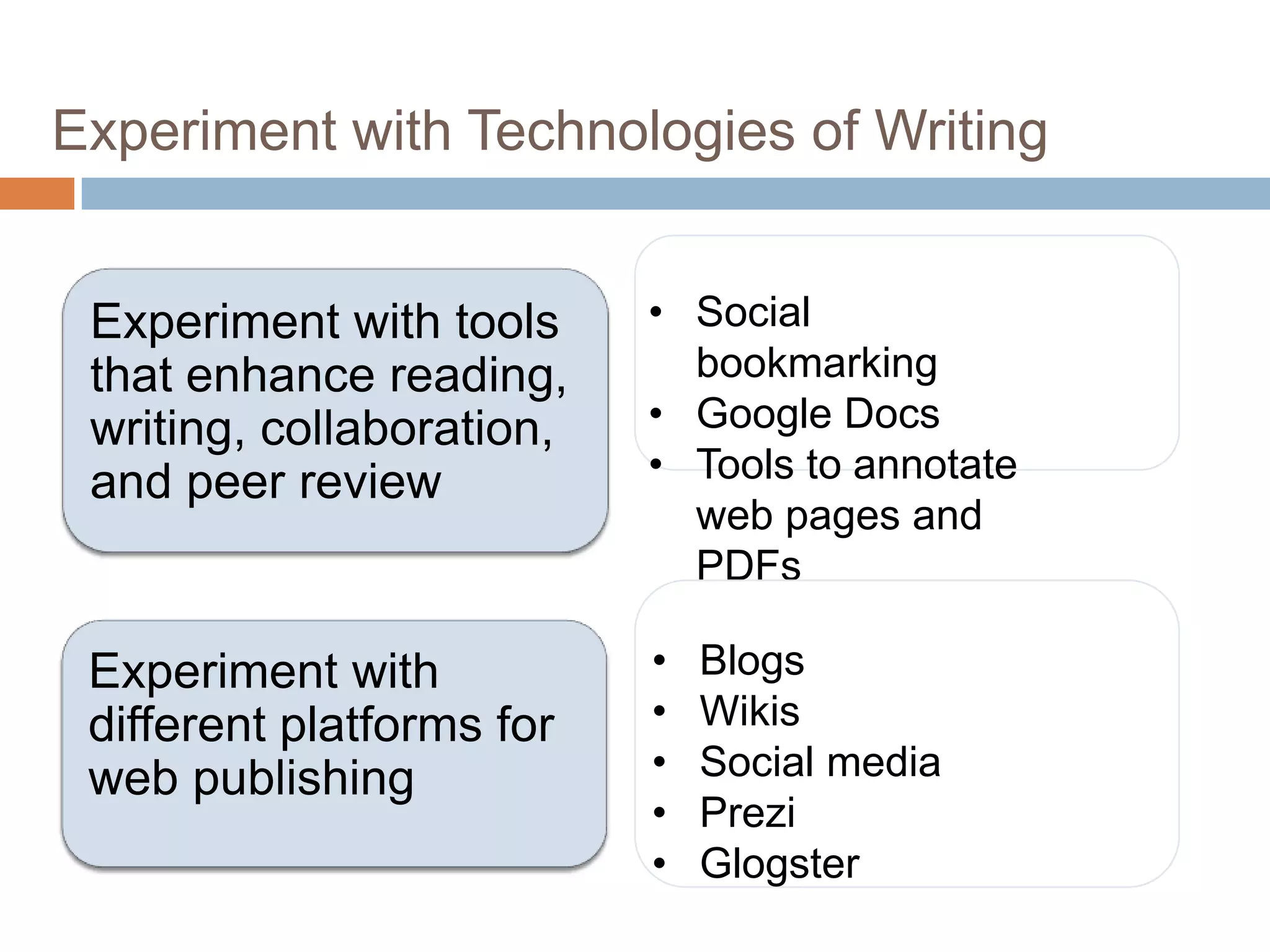
Experiment with Technologies of Writing


 Experiment with tools     • Social
 that enhance reading,       bookmarking
 writing, collaboration,   • Google Docs
 and peer review           • Tools to annotate
                             web pages and
                             PDFs

 Experiment with           •   Blogs
 different platforms for   •   Wikis
 web publishing            •   Social media
                           •   Prezi
                           •   Glogster
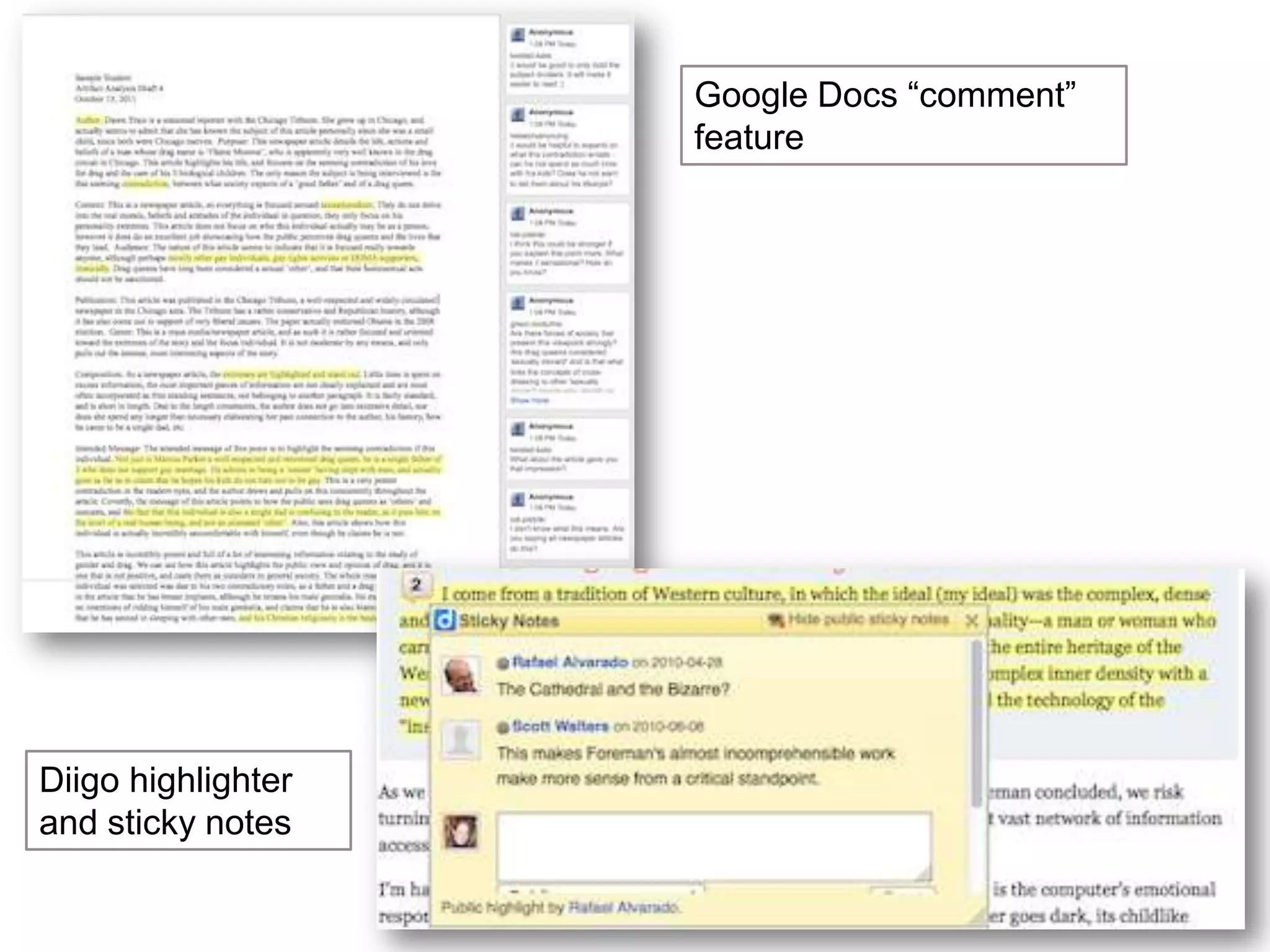
Google Docs “comment”
                    feature


Diigo highlighter
and sticky notes
WRITING IN DIGITAL
ENVIRONMENTS
 Build a blog, wiki, or web site individually, in
 groups, or as a class
 • Build a web site for a service learning partner, for a real or
   hypothetical business, or to showcase research
 • Practice writing in digital genres across multiple sections

 Contribute to existing blog, wiki, forum, or other
 digital environment
 •   Edit or compose a new wikiHow article
 •   Edit a Wikipedia entry
 •   Enter a forum conversation and inspire a response
 •   Make strategic use of social media (Twitter, Facebook, etc.)
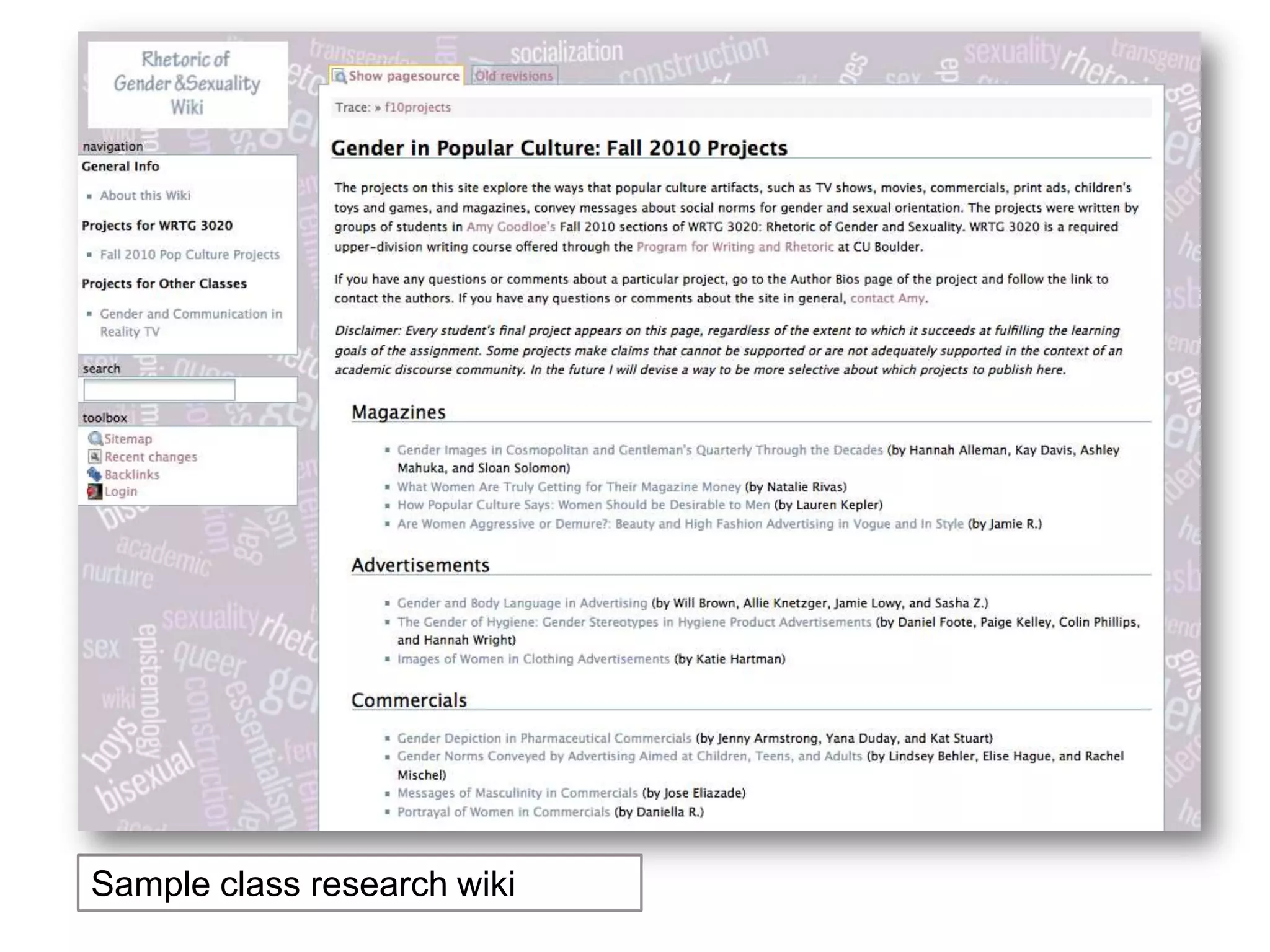
Sample class research wiki
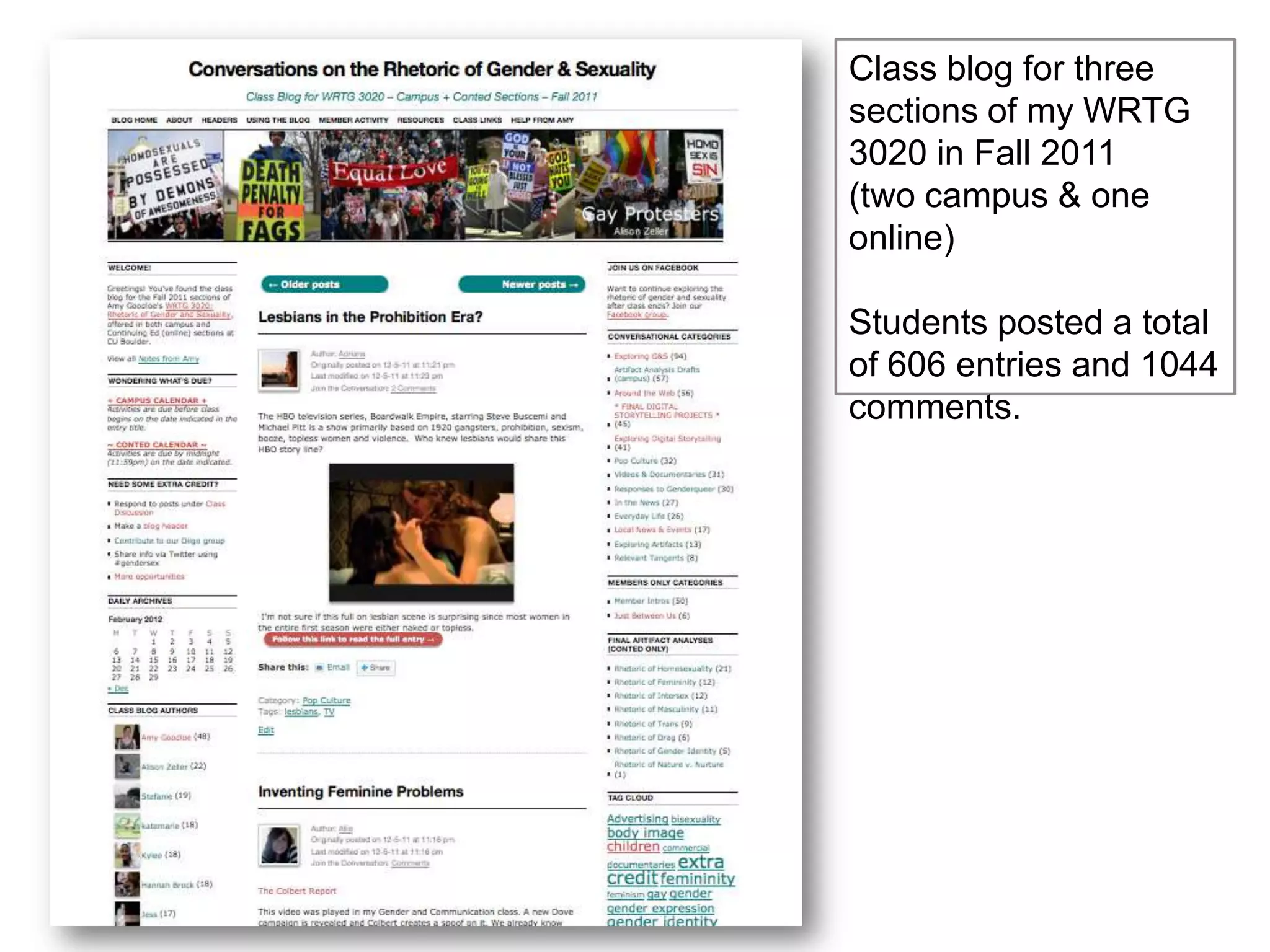
Class blog for three
sections of my WRTG
3020 in Fall 2011
(two campus & one
online)

Students posted a total
of 606 entries and 1044
comments.
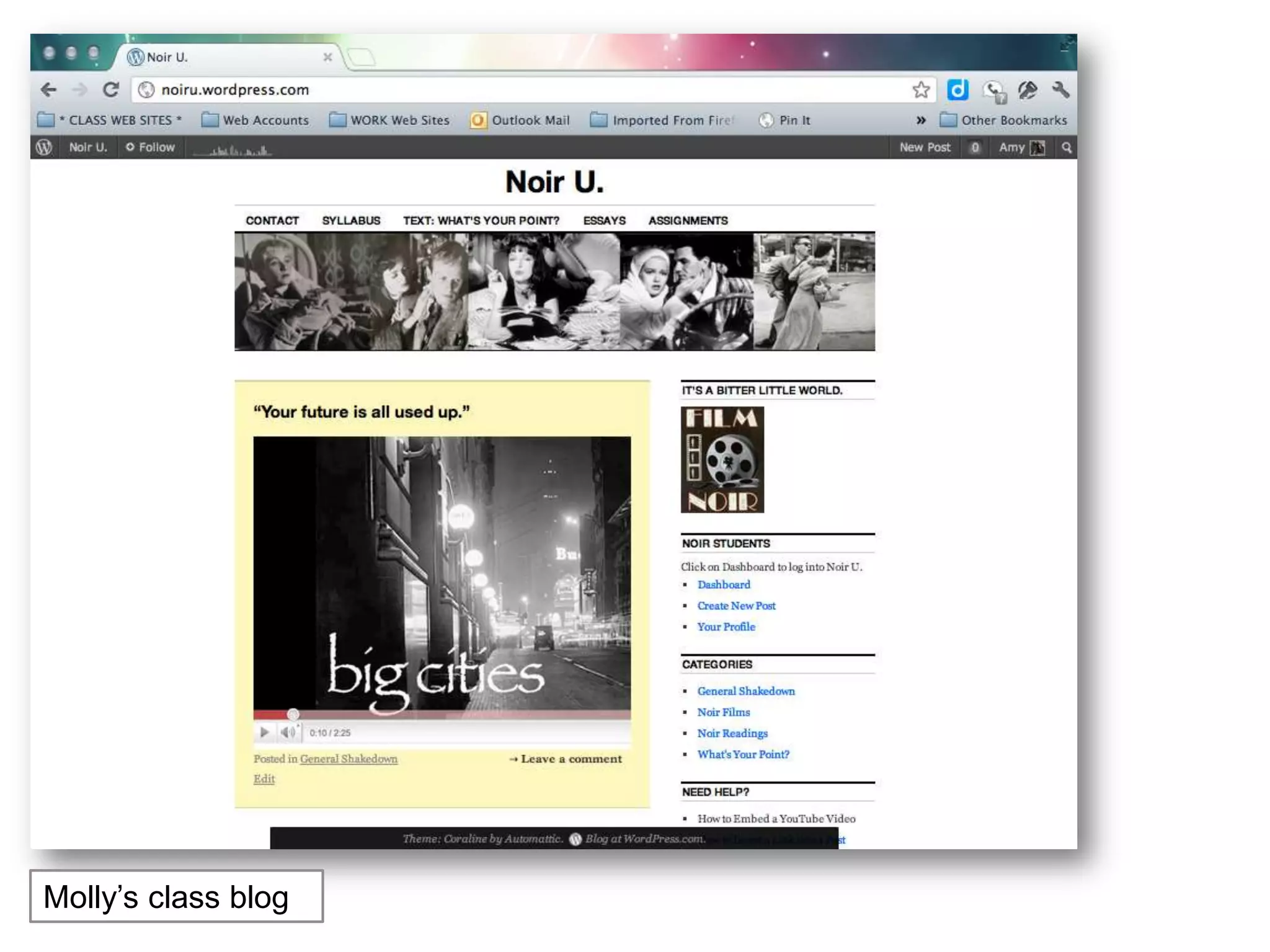
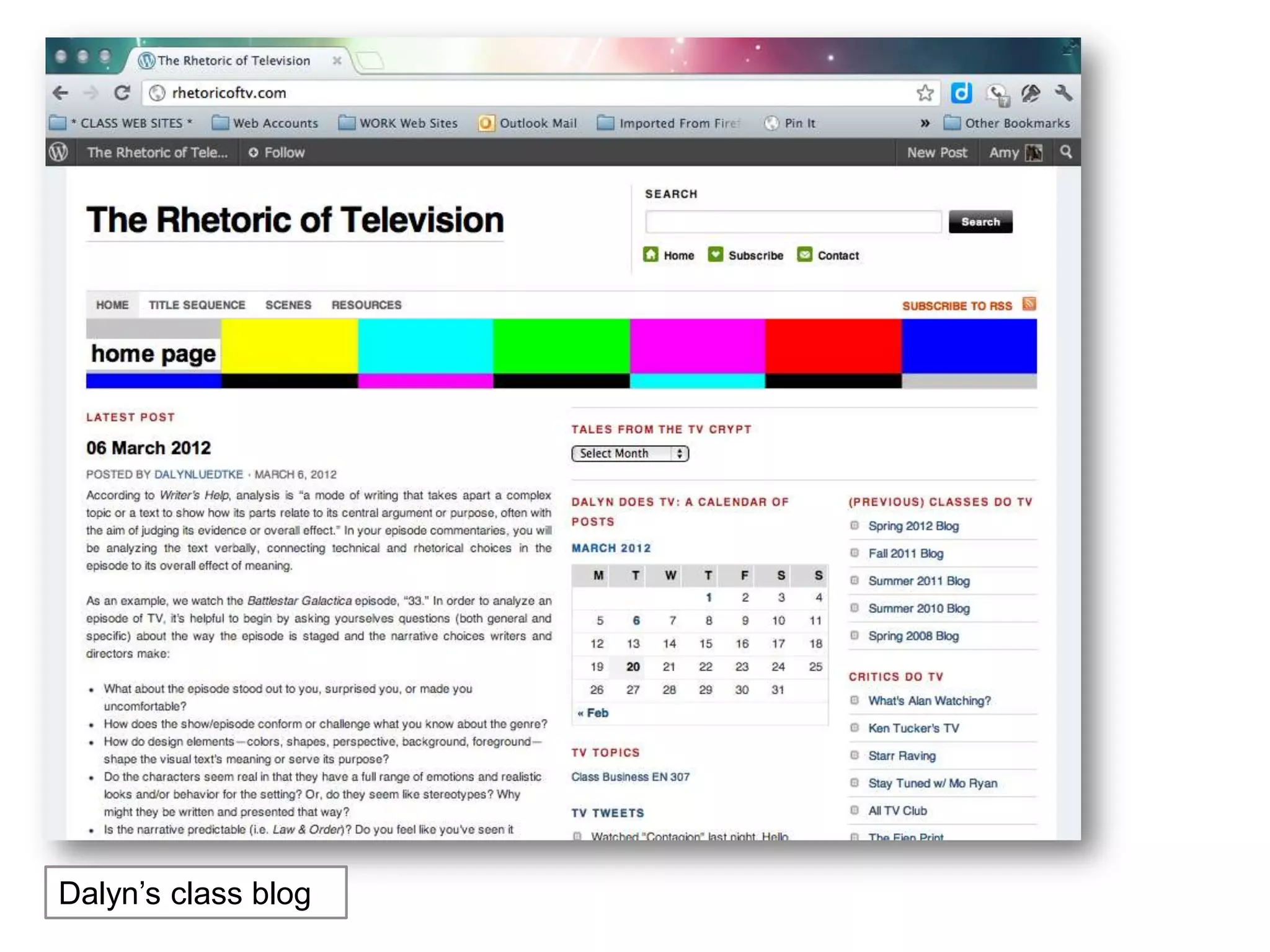
Molly’s class blog
Dalyn’s class blog
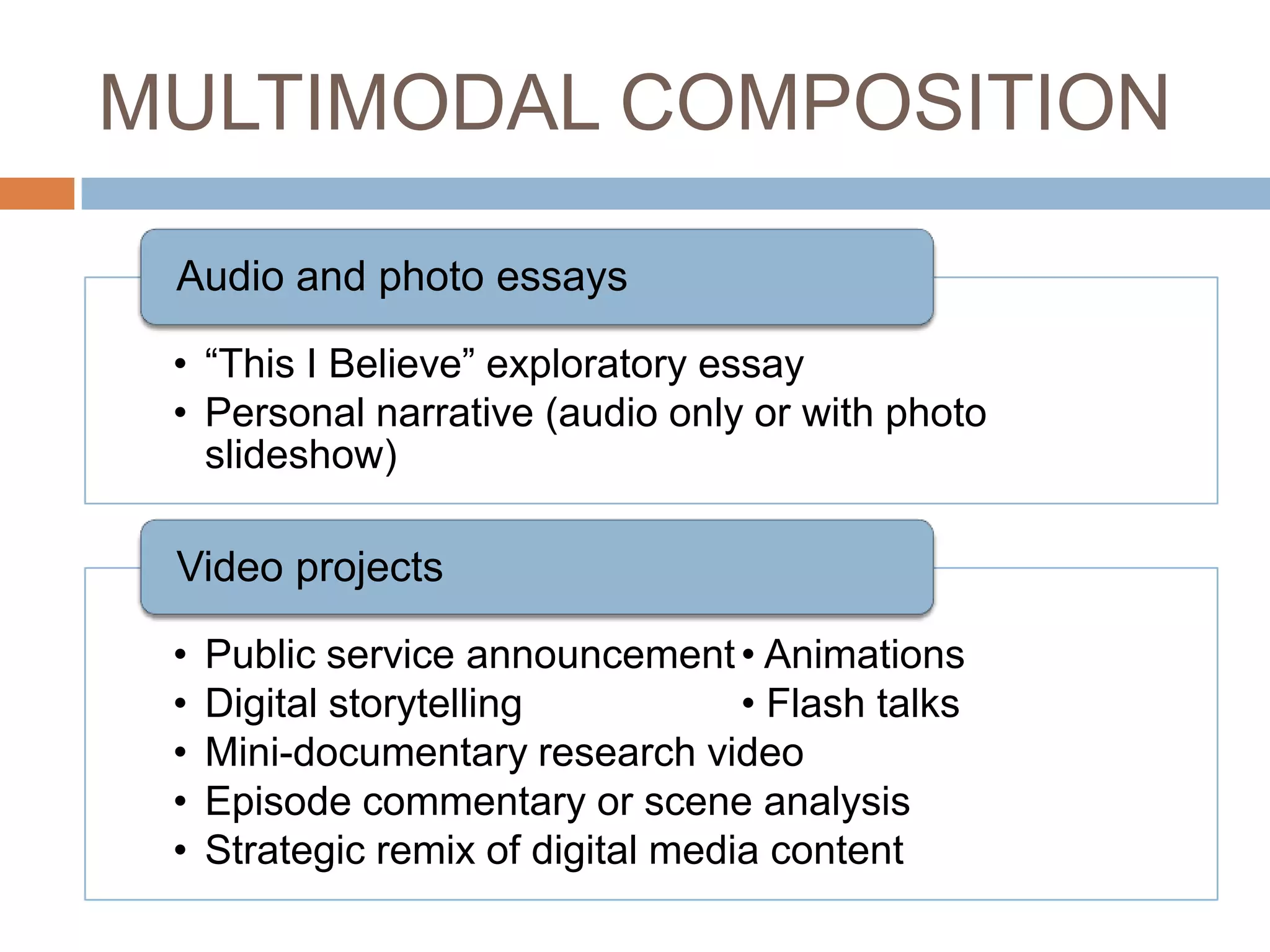
MULTIMODAL COMPOSITION

 Audio and photo essays

 • “This I Believe” exploratory essay
 • Personal narrative (audio only or with photo
   slideshow)

 Video projects

 •   Public service announcement • Animations
 •   Digital storytelling           • Flash talks
 •   Mini-documentary research video
 •   Episode commentary or scene analysis
 •   Strategic remix of digital media content
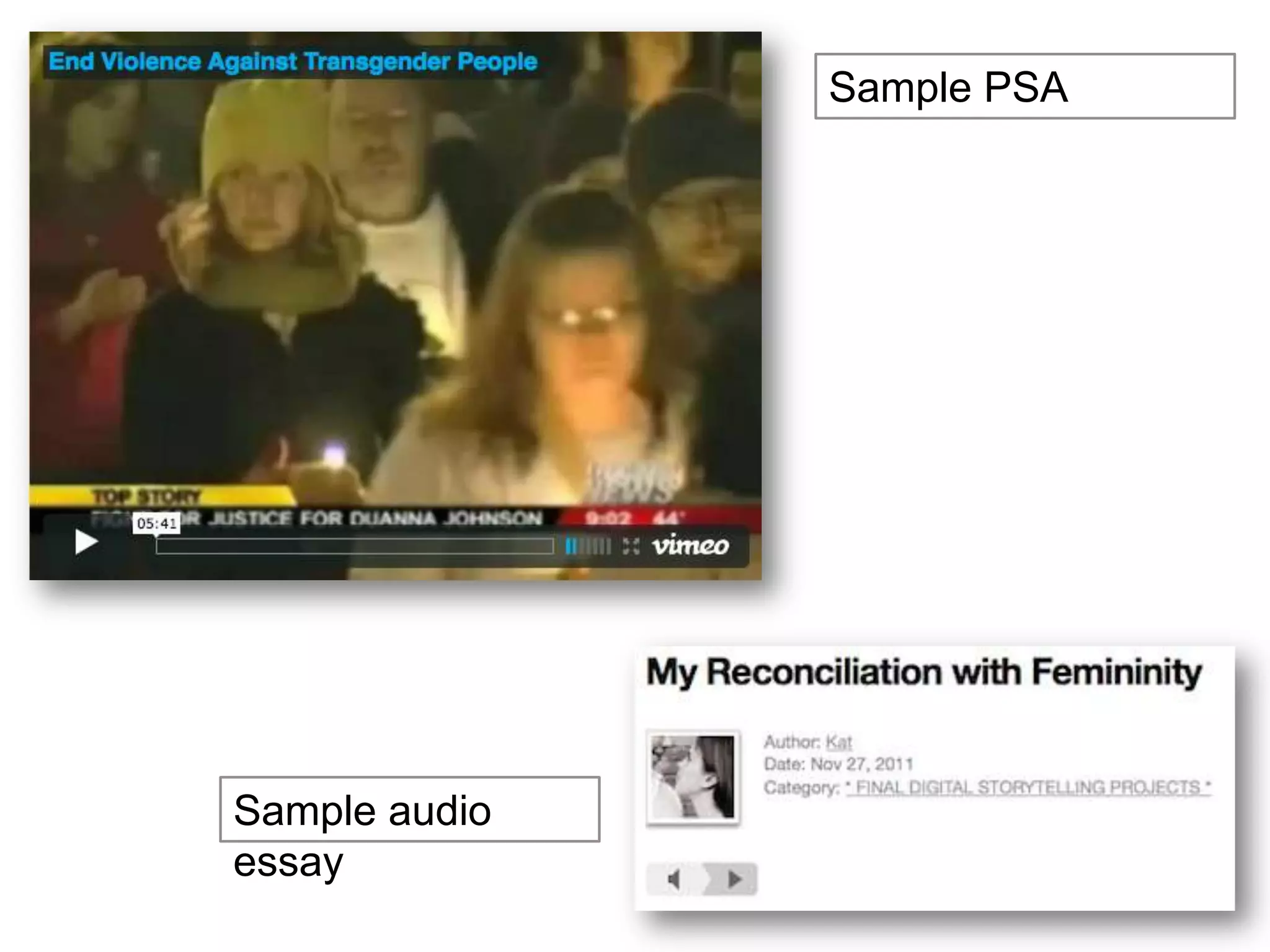
Sample PSA


Sample audio
essay
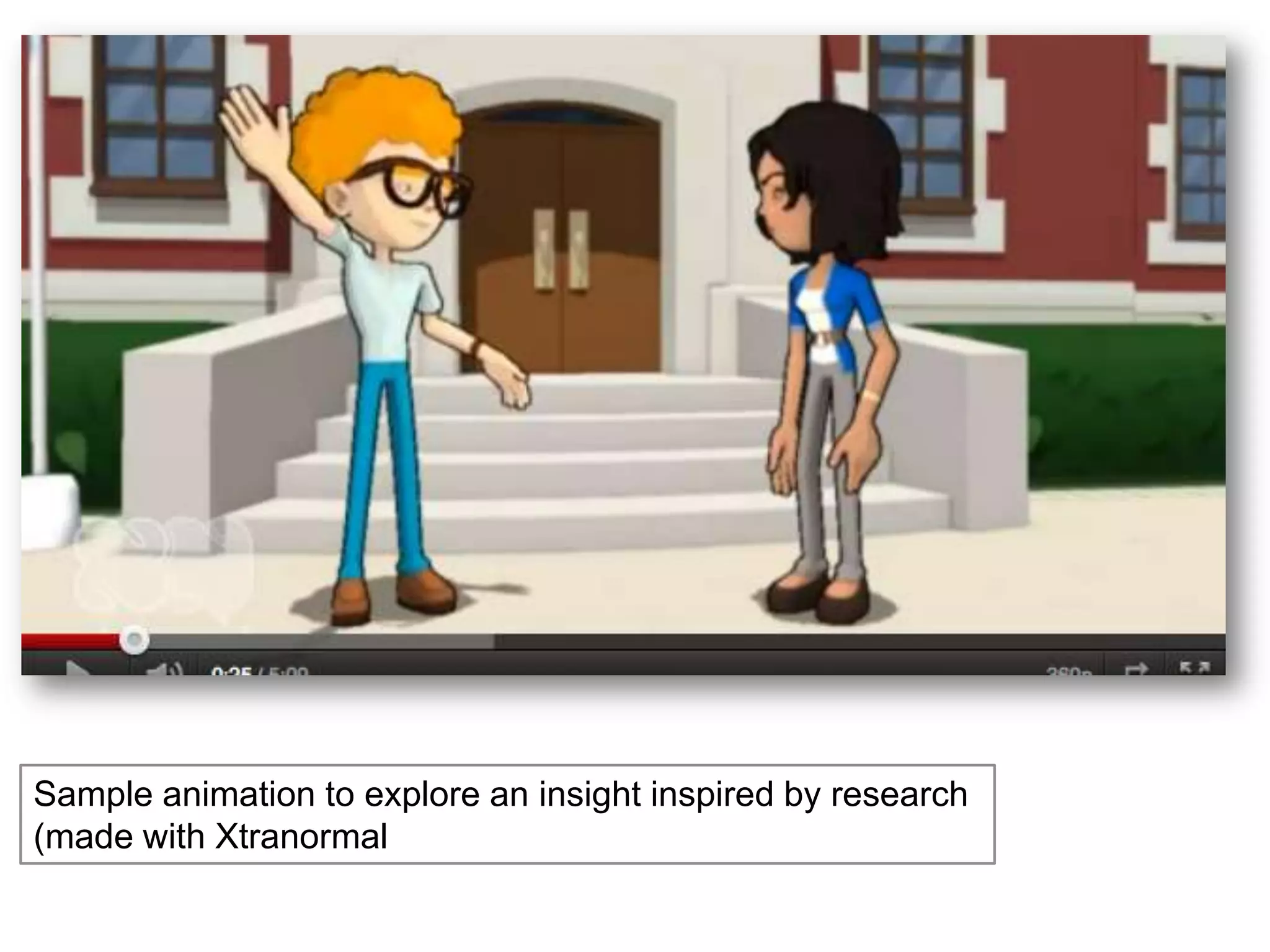
Sample animation to explore an insight inspired by research
(made with Xtranormal
MULTIMODAL COMPOSITION
cont’d
  Presentations
  • PowerPoint or Prezi with text, images, and video

  Visual projects
  • Comic books or cartoons              •
    Infographics
  • Digital posters (Glogster)   • Mind maps
  • Mashups

  Re-mediation
  • Composing the same message in multiple
    modalities to study how the message changes
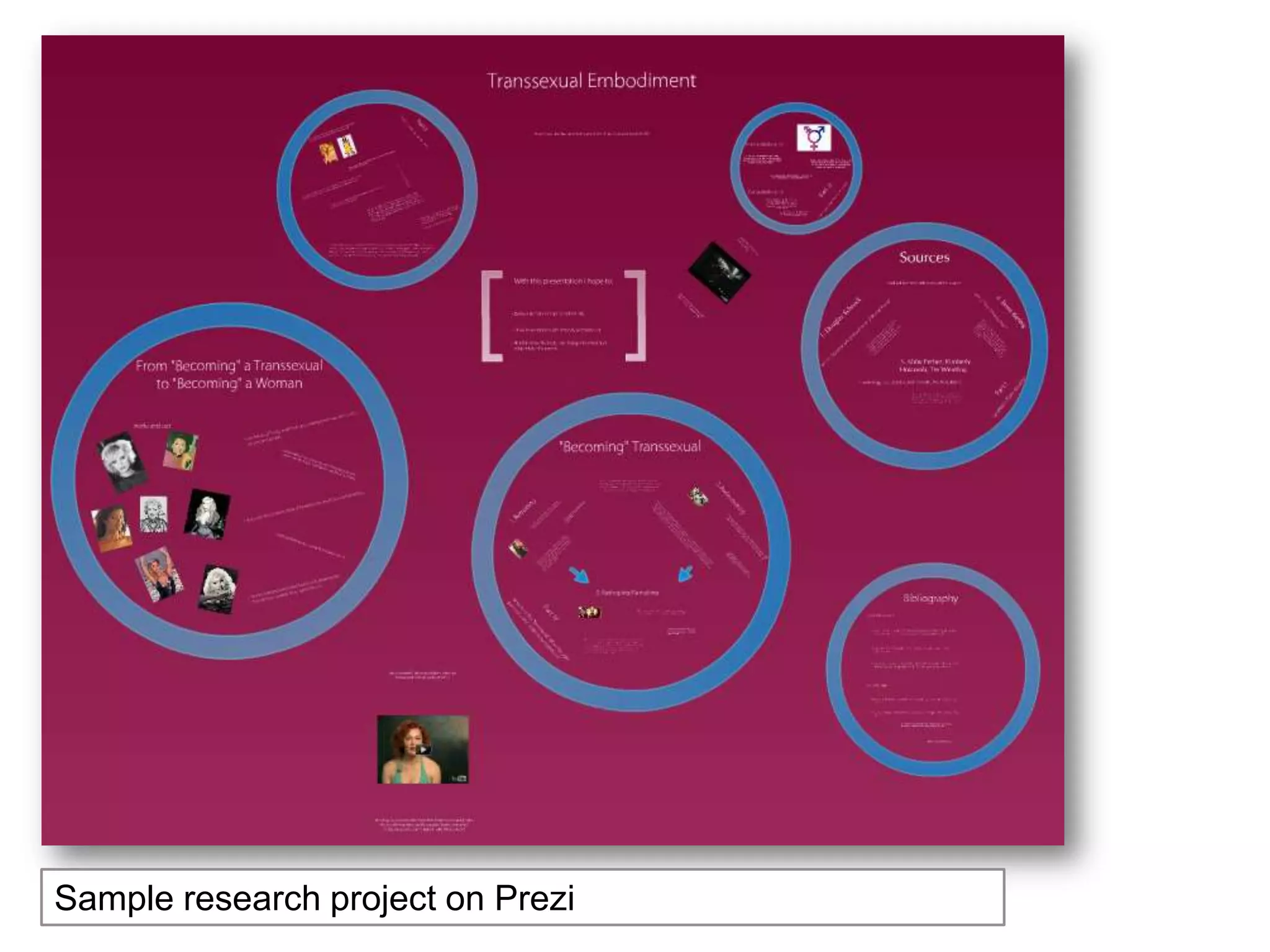
Sample research project on Prezi
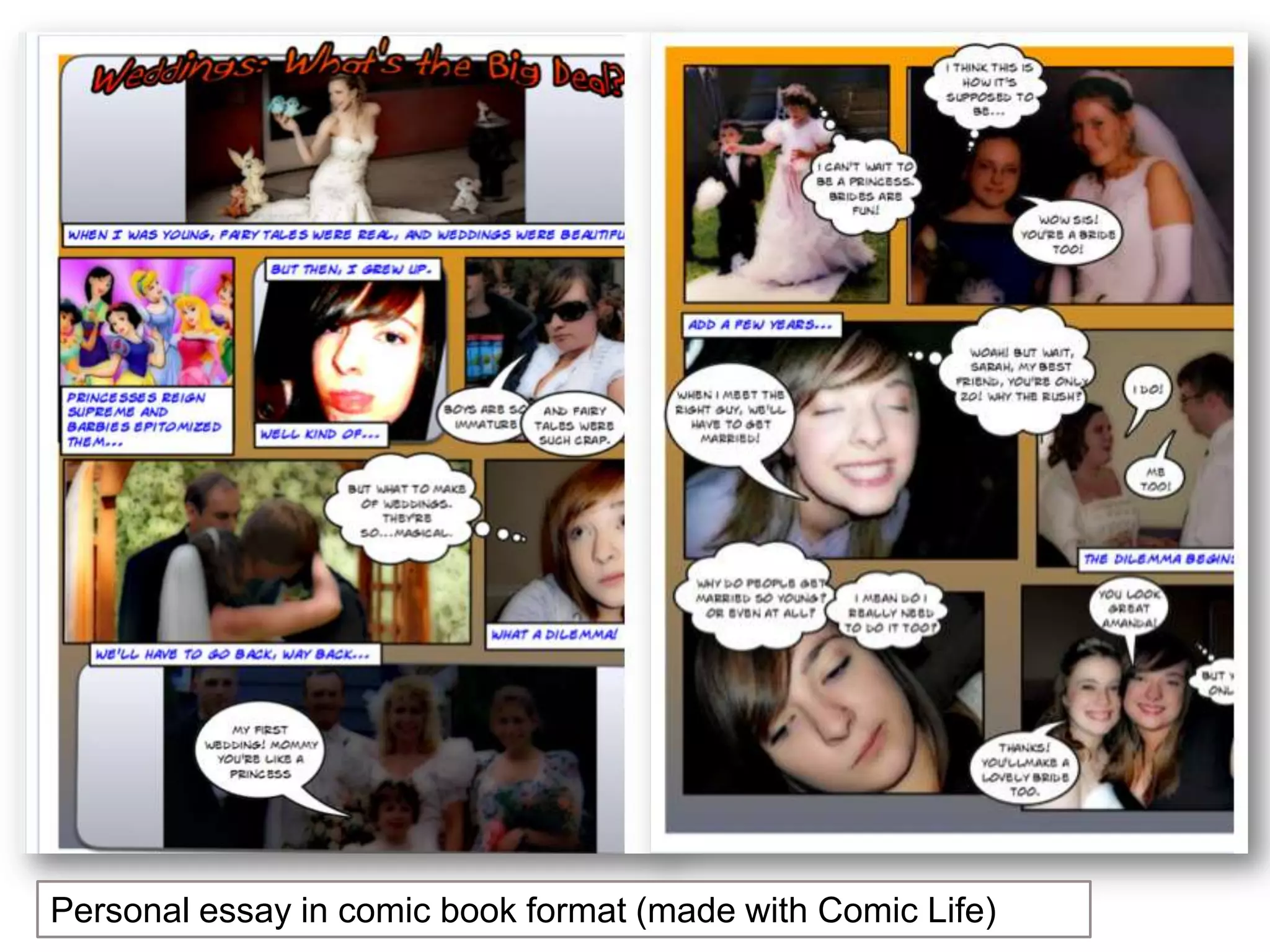
Personal essay in comic book format (made with Comic Life)
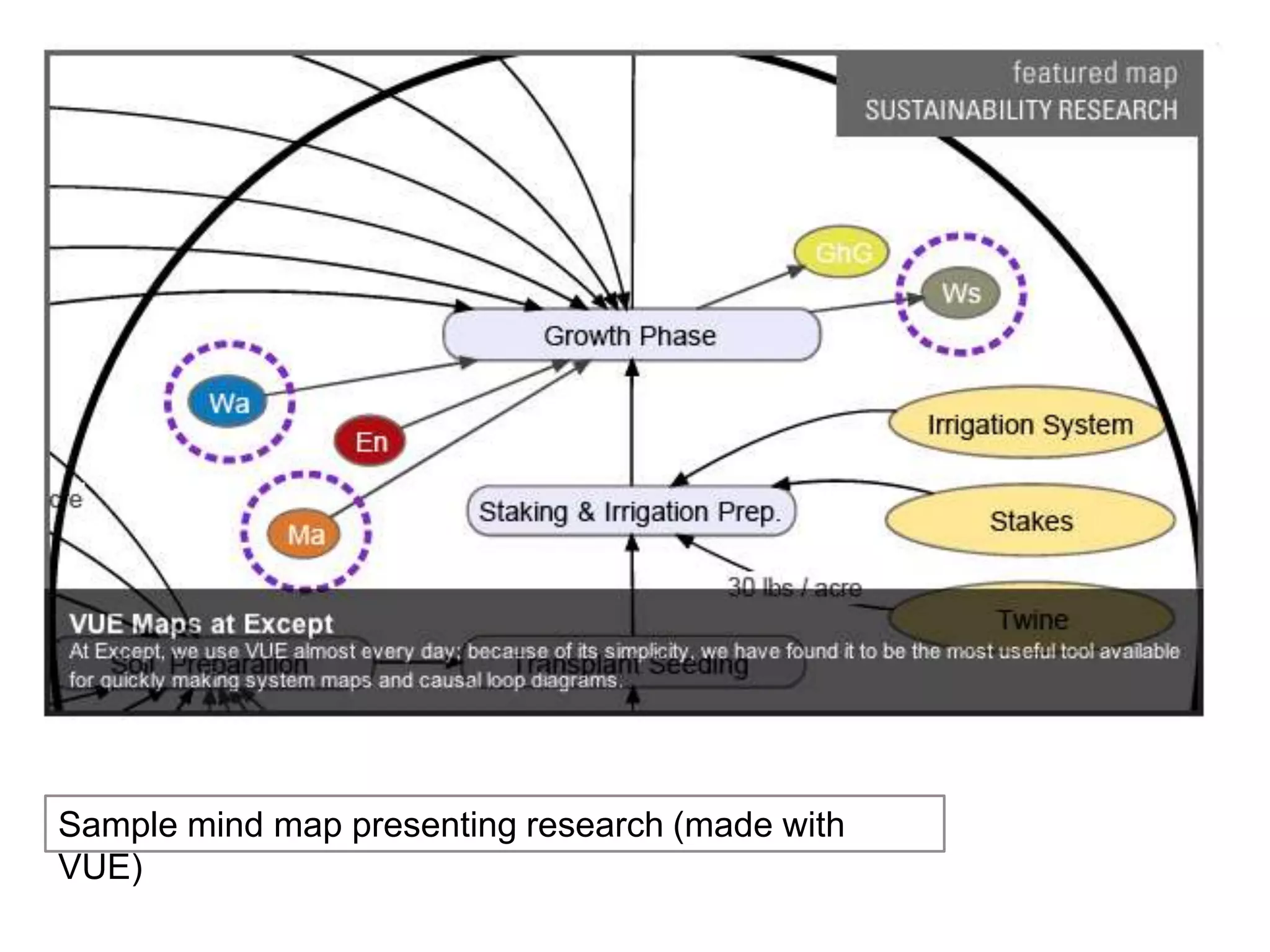
Sample mind map presenting research (made with
VUE)
BENEFITS OF ASSIGNING DIGITAL
COMPOSITION PROJECTS
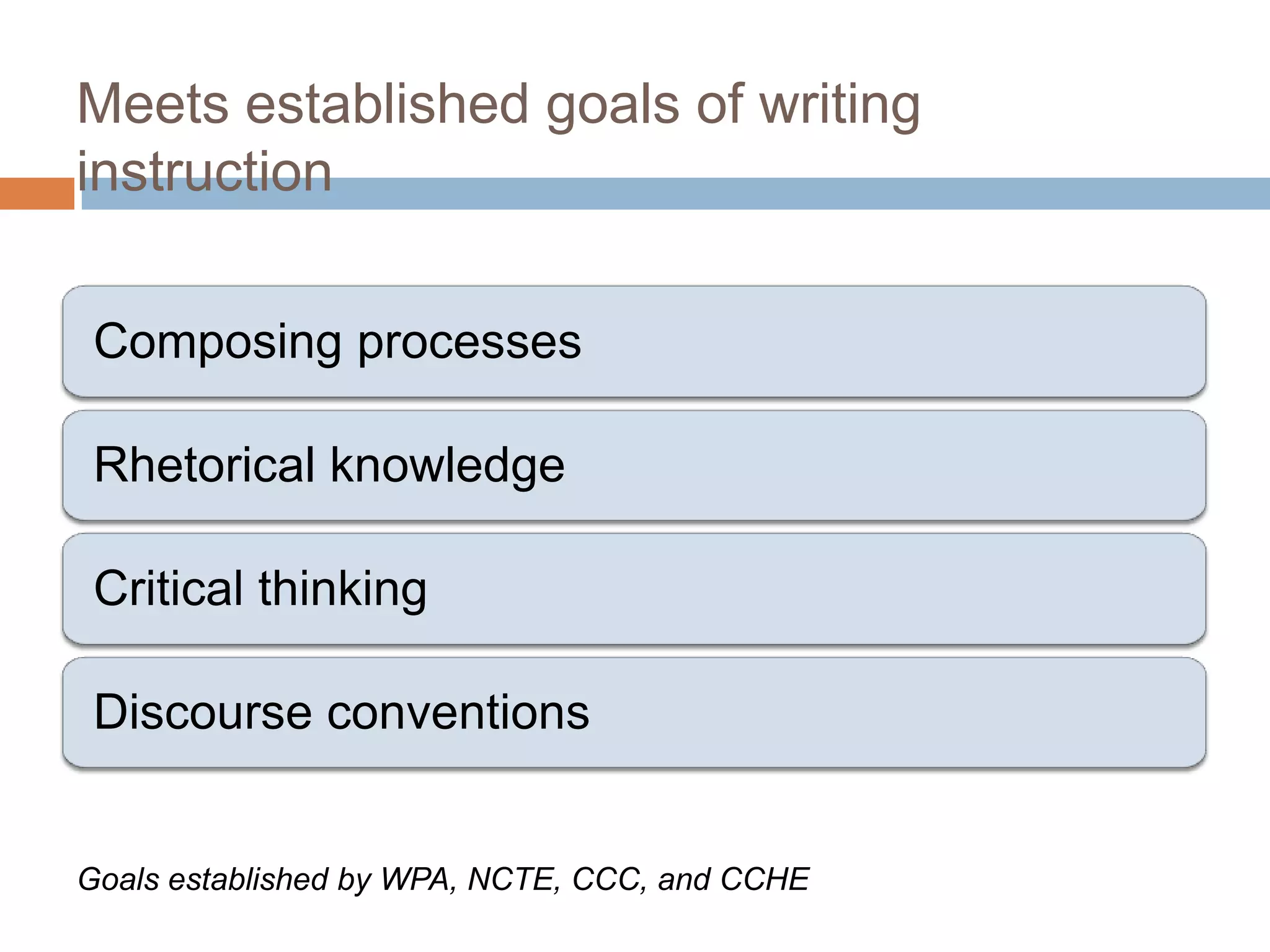
Meets established goals of writing
instruction

 Composing processes

 Rhetorical knowledge

 Critical thinking

 Discourse conventions


Goals established by WPA, NCTE, CCC, and CCHE
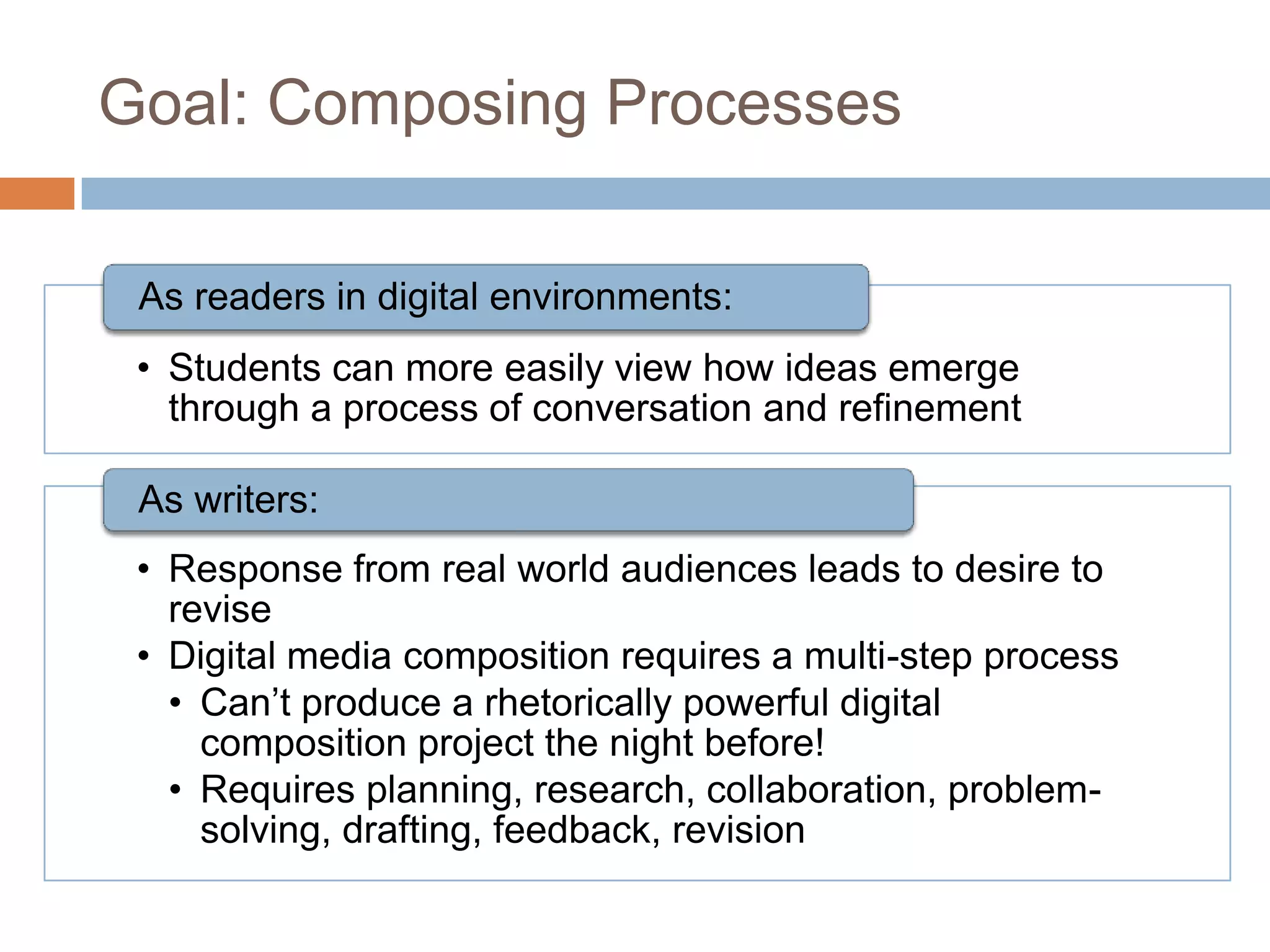
Goal: Composing Processes

 As readers in digital environments:
 • Students can more easily view how ideas emerge
   through a process of conversation and refinement

 As writers:
 • Response from real world audiences leads to desire to
   revise
 • Digital media composition requires a multi-step process
   • Can’t produce a rhetorically powerful digital
     composition project the night before!
   • Requires planning, research, collaboration, problem-
     solving, drafting, feedback, revision
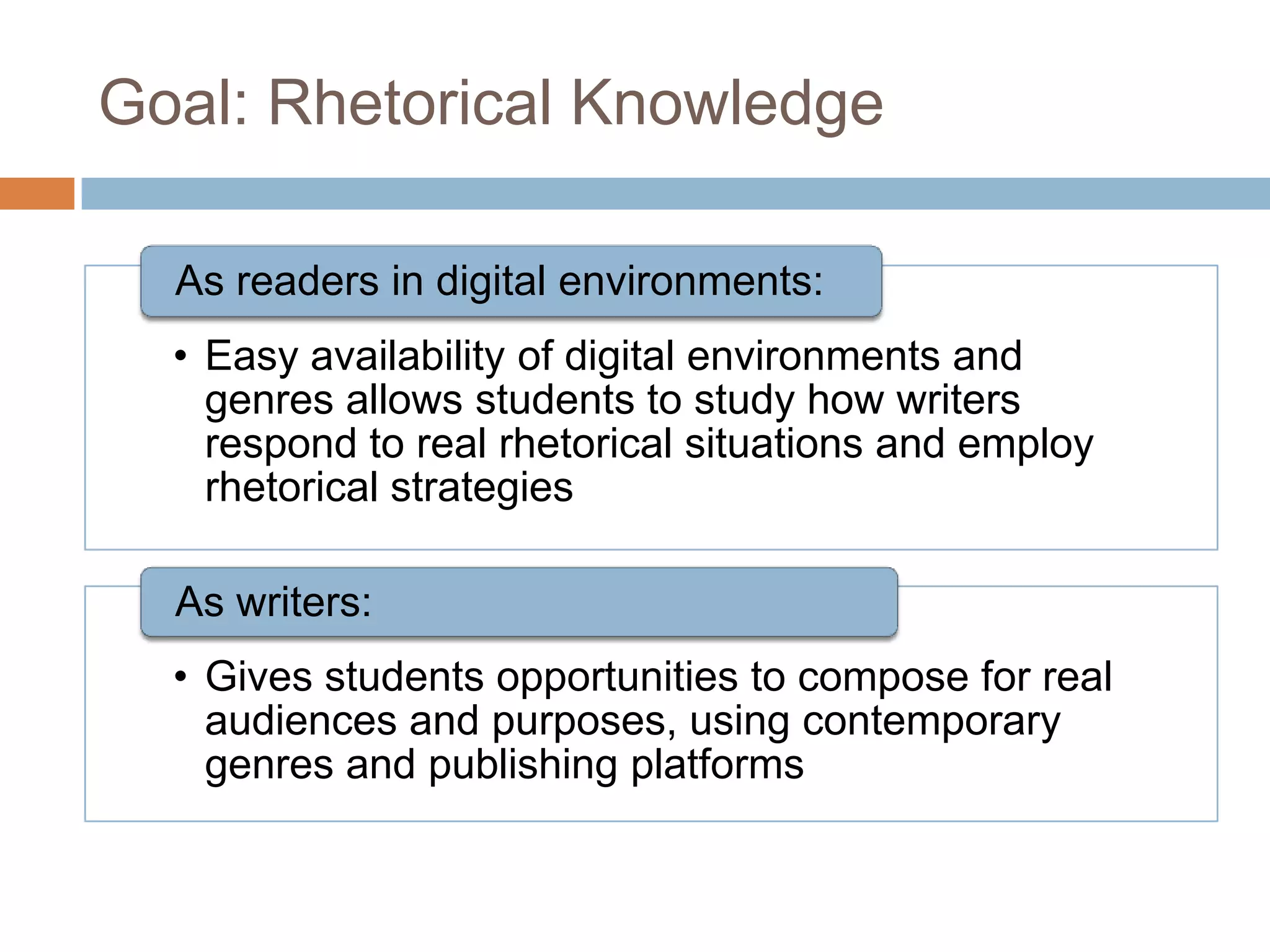
Goal: Rhetorical Knowledge

  As readers in digital environments:
  • Easy availability of digital environments and
    genres allows students to study how writers
    respond to real rhetorical situations and employ
    rhetorical strategies

  As writers:
  • Gives students opportunities to compose for real
    audiences and purposes, using contemporary
    genres and publishing platforms
Goal: Critical Thinking

  As readers in digital environments:
 • Allows us to study how arguments work in action:
   types of evidence, persuasive strategies, impact on
   readers, nature of dialogue and disagreement

  As writers:
 • Gain deeper insight into the rhetorical strategies and
   appeals used in digital formats by composing in them
   • As composers, students start to recognize subtle
     strategies for establishing credibility and
     persuading audiences
Goal: Discourse Conventions

  As readers in digital environments:
  • Reading digital texts helps to raise awareness of the
    role of conventions in both print and digital genres

  As writers:
  • Gives students practice at adapting conventions
    based on their target discourse community
  • Provides insight into the purpose of conventions that
    students often struggle with in print writing
    • Structural elements, such as introductions,
      transitions, “units” of thought, coherent progression
      of ideas
Additional Benefits

Reinforces traditional writing skills

Improves digital literacy skills

Validates multimodal literacies

Inspires greater student engagement

Prepares students for the future of writing
Reinforces Traditional Writing Skills
In their research into the pedagogical benefits of digital
storytelling for college students, Oppermann and
Coventry (2011) found that:

  Being asked to communicate in the ‘new
  language’ of multimedia brings students a
  greater awareness of the component parts
  of traditional writing.
  Digital storytelling helps students develop a
  stronger voice and helps students more
  accurately and firmly place themselves in
  relationship to the arguments of others.
Improves Digital Literacy Skills

Today’s college students don’t have the digital literacy skills
they need to compete against today’s high school students

 • But many don’t realize it, as they’ve been told they’re
   “digital natives”

Digital composition projects enable students to:

 • Identify deficiencies in their digital literacy skills
 • Remedy them while working on a project they find
   meaningful
Validates Multimodal Literacy

Literacy researchers have long emphasized the value of
multiple modalities in human communication (text, sound,
visuals)
• Age of print: printed text is easiest to produce and
  distribute (multimedia is for pros only)
• Digital age: relatively easy and inexpensive to produce
  and distribute text, audio, images, and video

Assigning multimodal composition projects validates the
rhetorical power of multiple modalities
Improves Student Engagement


Composing for real audiences and purposes
inspires greater investment
• Students have a genuine interest in conveying
  a meaningful message

Relevance of assignments spurs greater effort

• Helps students see writing as having a
  legitimate purpose beyond “term papers”
Opperman and Coventry (2011) found that digital
composition projects allow students to:
   • work on authentic assignments
   • develop their personal and academic voice
   • represent knowledge to a community of learners
   • receive situated feedback from their peers
   Due to their affective involvement with this process and
   the novelty effect of the medium, students are more
   engaged than in traditional assignments.
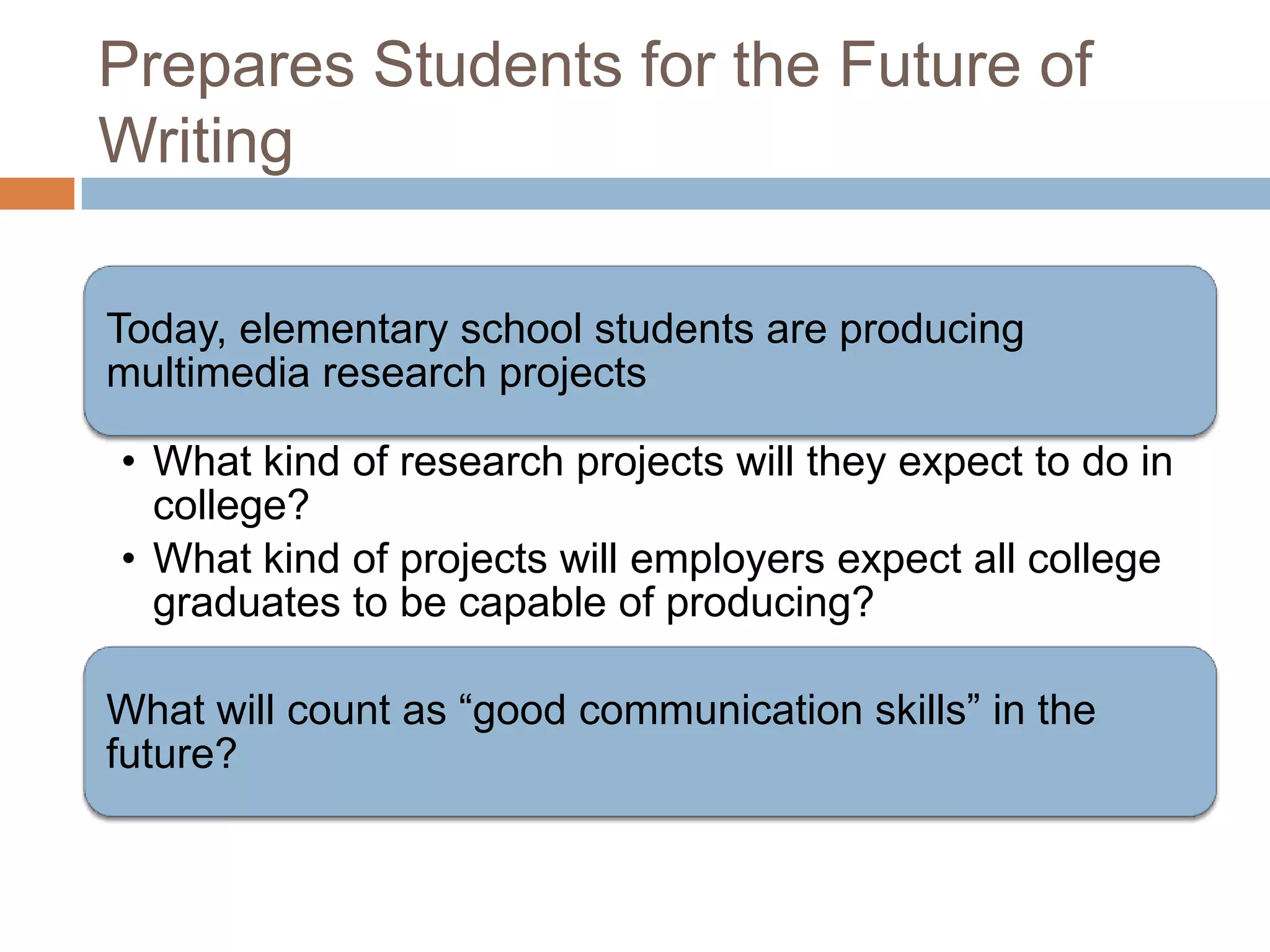
Prepares Students for the Future of
Writing

Today, elementary school students are producing
multimedia research projects

• What kind of research projects will they expect to do in
  college?
• What kind of projects will employers expect all college
  graduates to be capable of producing?

What will count as “good communication skills” in the
future?
For more info…
For a longer version of this presentation, as well
as information on a variety of aspects of digital
composition, see:

             http://digitalwriting101.net
                           &
      http://www.pwrfaculty.net/technology

Overview of Approaches to Digital Composition

  • 1.
    APPROACHES TO DIGITAL COMPOSITION INTRODUCTIONTO THE PWR DIGITAL COMPOSITION SAMPLER Amy Goodloe PWR Digital Composition Coordinator March 21, 2012 All rights reserved © 2012
  • 2.
    Preface  What follows is my introduction for the Digital Composition Sampler presentation for PWR faculty on March 21, 2012.  The introduction provides an overview of approaches to digital composition, which will be followed by:  Michelle discussing audio essays  Dalyn discussing video projects  Amy discussing digital storytelling projects Note: I’m including the “Benefits to Students” section in this version of the slides, even though that section was not part of the live presentation.
  • 3.
    COMMON APPROACHES • Digital literacy activities • Writing in digital environments • Multimodal composition
  • 4.
    DIGITAL LITERACY ACTIVITIES Discussthe changing nature of literacy Engage in rhetorical analyses of digital compositions Experiment with current and emerging technologies for research, reading, and writing
  • 5.
    Rhetorical Analysis Study therhetorical • Blogs, wikis, or forums on topics related to the practices of an class online discourse • Discussions on community Wikipedia pages Study rhetorical • What is the rhetorical purpose of interface principles for web design? and interface design • How do navigational elements impact readers?
  • 6.
    Understanding the rhetoricalpurpose of blog layout
  • 7.
    Experiment with Technologiesof Writing Experiment with tools • Social that enhance reading, bookmarking writing, collaboration, • Google Docs and peer review • Tools to annotate web pages and PDFs Experiment with • Blogs different platforms for • Wikis web publishing • Social media • Prezi • Glogster
  • 8.
    Google Docs “comment” feature Diigo highlighter and sticky notes
  • 9.
    WRITING IN DIGITAL ENVIRONMENTS Build a blog, wiki, or web site individually, in groups, or as a class • Build a web site for a service learning partner, for a real or hypothetical business, or to showcase research • Practice writing in digital genres across multiple sections Contribute to existing blog, wiki, forum, or other digital environment • Edit or compose a new wikiHow article • Edit a Wikipedia entry • Enter a forum conversation and inspire a response • Make strategic use of social media (Twitter, Facebook, etc.)
  • 10.
  • 11.
    Class blog forthree sections of my WRTG 3020 in Fall 2011 (two campus & one online) Students posted a total of 606 entries and 1044 comments.
  • 12.
  • 13.
  • 14.
    MULTIMODAL COMPOSITION Audioand photo essays • “This I Believe” exploratory essay • Personal narrative (audio only or with photo slideshow) Video projects • Public service announcement • Animations • Digital storytelling • Flash talks • Mini-documentary research video • Episode commentary or scene analysis • Strategic remix of digital media content
  • 15.
  • 16.
    Sample animation toexplore an insight inspired by research (made with Xtranormal
  • 17.
    MULTIMODAL COMPOSITION cont’d Presentations • PowerPoint or Prezi with text, images, and video Visual projects • Comic books or cartoons • Infographics • Digital posters (Glogster) • Mind maps • Mashups Re-mediation • Composing the same message in multiple modalities to study how the message changes
  • 18.
  • 19.
    Personal essay incomic book format (made with Comic Life)
  • 20.
    Sample mind mappresenting research (made with VUE)
  • 21.
    BENEFITS OF ASSIGNINGDIGITAL COMPOSITION PROJECTS
  • 22.
    Meets established goalsof writing instruction Composing processes Rhetorical knowledge Critical thinking Discourse conventions Goals established by WPA, NCTE, CCC, and CCHE
  • 23.
    Goal: Composing Processes As readers in digital environments: • Students can more easily view how ideas emerge through a process of conversation and refinement As writers: • Response from real world audiences leads to desire to revise • Digital media composition requires a multi-step process • Can’t produce a rhetorically powerful digital composition project the night before! • Requires planning, research, collaboration, problem- solving, drafting, feedback, revision
  • 24.
    Goal: Rhetorical Knowledge As readers in digital environments: • Easy availability of digital environments and genres allows students to study how writers respond to real rhetorical situations and employ rhetorical strategies As writers: • Gives students opportunities to compose for real audiences and purposes, using contemporary genres and publishing platforms
  • 25.
    Goal: Critical Thinking As readers in digital environments: • Allows us to study how arguments work in action: types of evidence, persuasive strategies, impact on readers, nature of dialogue and disagreement As writers: • Gain deeper insight into the rhetorical strategies and appeals used in digital formats by composing in them • As composers, students start to recognize subtle strategies for establishing credibility and persuading audiences
  • 26.
    Goal: Discourse Conventions As readers in digital environments: • Reading digital texts helps to raise awareness of the role of conventions in both print and digital genres As writers: • Gives students practice at adapting conventions based on their target discourse community • Provides insight into the purpose of conventions that students often struggle with in print writing • Structural elements, such as introductions, transitions, “units” of thought, coherent progression of ideas
  • 27.
    Additional Benefits Reinforces traditionalwriting skills Improves digital literacy skills Validates multimodal literacies Inspires greater student engagement Prepares students for the future of writing
  • 28.
    Reinforces Traditional WritingSkills In their research into the pedagogical benefits of digital storytelling for college students, Oppermann and Coventry (2011) found that: Being asked to communicate in the ‘new language’ of multimedia brings students a greater awareness of the component parts of traditional writing. Digital storytelling helps students develop a stronger voice and helps students more accurately and firmly place themselves in relationship to the arguments of others.
  • 29.
    Improves Digital LiteracySkills Today’s college students don’t have the digital literacy skills they need to compete against today’s high school students • But many don’t realize it, as they’ve been told they’re “digital natives” Digital composition projects enable students to: • Identify deficiencies in their digital literacy skills • Remedy them while working on a project they find meaningful
  • 30.
    Validates Multimodal Literacy Literacyresearchers have long emphasized the value of multiple modalities in human communication (text, sound, visuals) • Age of print: printed text is easiest to produce and distribute (multimedia is for pros only) • Digital age: relatively easy and inexpensive to produce and distribute text, audio, images, and video Assigning multimodal composition projects validates the rhetorical power of multiple modalities
  • 31.
    Improves Student Engagement Composingfor real audiences and purposes inspires greater investment • Students have a genuine interest in conveying a meaningful message Relevance of assignments spurs greater effort • Helps students see writing as having a legitimate purpose beyond “term papers”
  • 32.
    Opperman and Coventry(2011) found that digital composition projects allow students to: • work on authentic assignments • develop their personal and academic voice • represent knowledge to a community of learners • receive situated feedback from their peers Due to their affective involvement with this process and the novelty effect of the medium, students are more engaged than in traditional assignments.
  • 33.
    Prepares Students forthe Future of Writing Today, elementary school students are producing multimedia research projects • What kind of research projects will they expect to do in college? • What kind of projects will employers expect all college graduates to be capable of producing? What will count as “good communication skills” in the future?
  • 34.
    For more info… Fora longer version of this presentation, as well as information on a variety of aspects of digital composition, see: http://digitalwriting101.net & http://www.pwrfaculty.net/technology

Editor's Notes

  • #2 I’m going to review some common approaches to digital composition to give you a taste of the wide variety.Also mention a few PWR colleagues who are using each approachThen Michelle, Dalyn, and I will go into a bit more detail about a few of these approaches.
  • #4 The examples we’ll share in a bit fall under the category of multimodal composition
  • #5 Will move quickly through a few examples of the underlined activities
  • #7 Helps students understand rhetorical principles for document design and layoutFor example: conventions of web writing like hyperlinks, categories, tags, blog post titles, navigation menus(helps students see how different conventions apply to different types of writing)
  • #9 Google Docs is useful for MANY activitiesDiigo is also a social bookmarking tool
  • #10 Class blogs: me, Dalyn, Nancy, Molly, Michelle, and othersWikis: me, Michelle, Nancy, Petger, Patty, and othersWeb site: Sigman asks 3040 students to build a site for a hypothetical business (using free web site builders)Forums: NathanSocial media: NancyWikipedia has a whole section on projects for college classes - editing a Wikipedia page takes good rhetorical awareness (hard to get edits to “stick” if the writing doesn’t meet certain standards)
  • #11 My WRTG 3020 students did primary research into messages about gender and sexuality conveyed in popular culture and presented their research in this wiki
  • #12 Students loved being able to practice blogging with other students they hadn’t met
  • #15 Items in orange: more on these coming up!
  • #16 PSA: mix of clips from movies, documentaries, and news stories along with facts and real stories about violence against transgender peopleAudio essay: explore how you came to understand your gender expression or identity
  • #18 Infgoraphics becoming very popularMashups: combine digital media from multiple sources to convey a new message (combine multiple data streams)
  • #19 Student research project on how transsexual people experience embodimentPrezi allows students to incorporate images and video clips
  • #20 COMIC STRIP(these are just 2 pages from a longer “graphic short story” – short version of Graphic novel)
  • #21 Small screen shot of project on the Tufts web site
  • #22 The following slides show benefits in light of common goals for writing instructionBut in the interest of time, I’ll go over some of these benefits later instead of now, when I talk about digital storytelling
  • #24 MY EXPERIENCE“writing as a process” is hard to teach, esp. the value of drafting, getting feedback, and revisingneed for process becomes much clearer with digital media projects (which also involve lots of traditional writing)
  • #26 Again, the concept of enabling students to become producers, not just consumers - reflected in the NCTE goals for teaching writing and many other places- studentslearn the “inside scoop” on how media messages persuadethat’s partly why we teach essay writing: give students the inside scoop on how knowledge is composedcan’t really understand what you can’t compose
  • #27 STORY:Students engaged in digital media composition often “discover” the rhetorical purpose of conventions like transitionsarticle by professor whose students spent 20 minutes debating the rhetorical value of a particular transition in a video project - students often have intuitive understanding of the value of transitions in video projects - when we point out what they’re doing with the video, students then say they finally “get” the point of using transitions in essays
  • #29 “greater awareness of component parts” – for example, structural elements that help guide readersIn their research into the pedagogical benefits of digital storytelling for college students, Oppermann and Coventry (2011) found that:Being asked to communicate in the ‘new language’ of multimedia brings students a greater awareness of the component parts of traditional writing. Digital storytelling helps students develop a stronger voice and helps students more accurately and firmly place themselves in relationship to the arguments of others.
  • #30 Support: I work closely with students on digital projects, and they often confess how little they know -every semester, I have at least one student who didn’t know she could copy text from one app and paste it into another one - most have never done anything more than check Facebook, watch videos on YouTube, send email, and look up a few things on GoogleRegardless of the digital skills they may have learned in high school, by the time they get to my class, as juniors and seniors, they’ve been thoroughly conditioned to the demands of old school print literacyMany know the basics of navigating digital environments, but not how to participate in them
  • #31 Enables students to move from consumers of multimodal content to producers
  • #32 students who make projects for real audiences tend to work on them long after they’re “due”
  • #33 SOURCE:Digital Storytelling Multimedia Archivehttps://commons.georgetown.edu/projects/digitalstories/https://commons.georgetown.edu/projects/digitalstories/social-pedagogy/
  • #34 We owe it to students to help them develop writing skills of the future, not the writing skills of the pastHow will academic writing change in the future?