Overload Techniques Muscles will strengthen only if it has been forced to work beyond its limits Muscles can be overloaded by: The Intensity – decreasing rest periods The Resistance – Lifting more weight The number of repetitions Number of Sets Speed of muscular action
Overload Techniques Overload techniques specific to strength training include: Blitzing Forced repetitions Pyramid Training Compound training Burn out sets Breathing sets
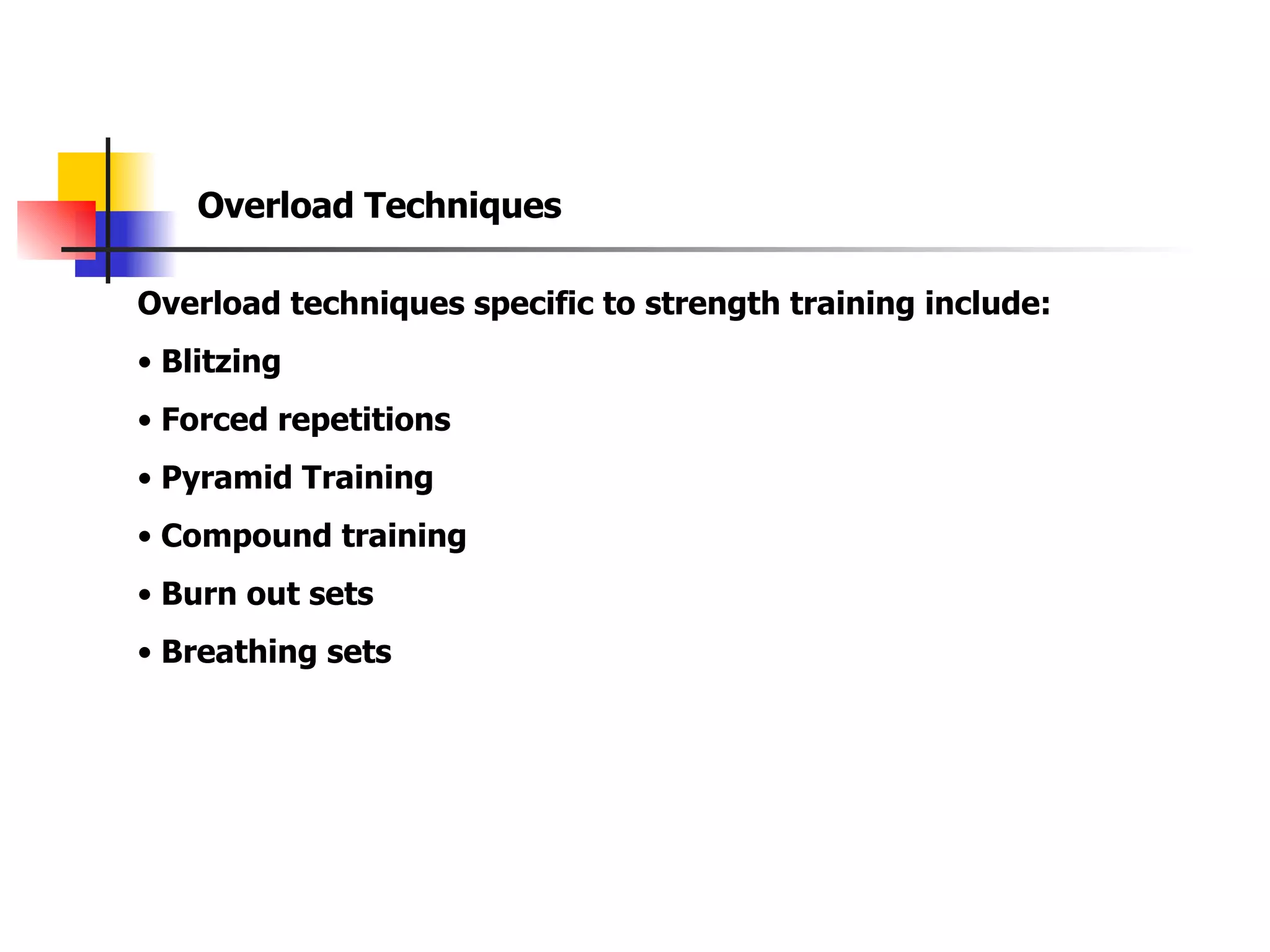
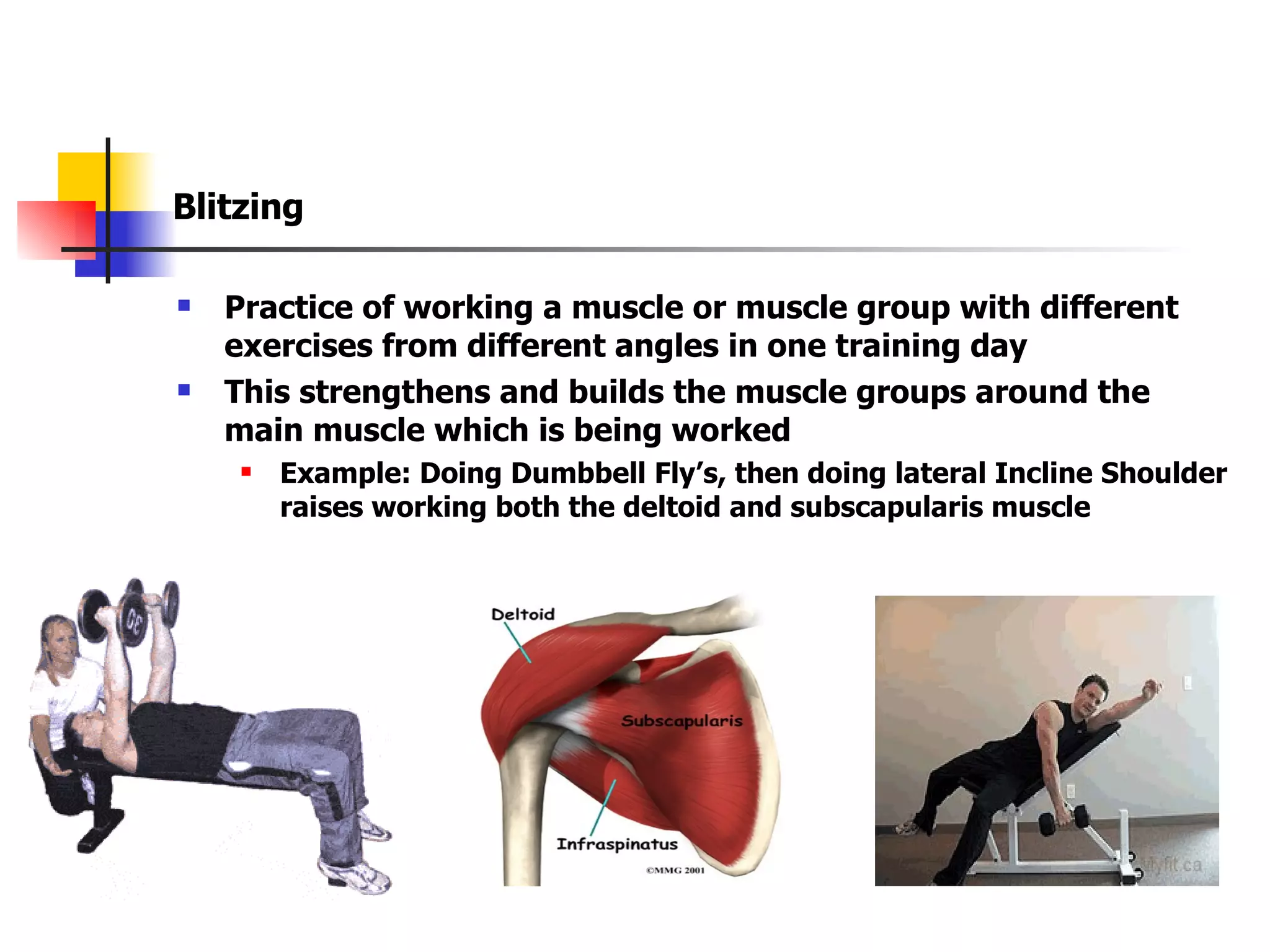
Blitzing Practice of working a muscle or muscle group with different exercises from different angles in one training day This strengthens and builds the muscle groups around the main muscle which is being worked Example: Doing Dumbbell Fly’s, then doing lateral Incline Shoulder raises working both the deltoid and subscapularis muscle
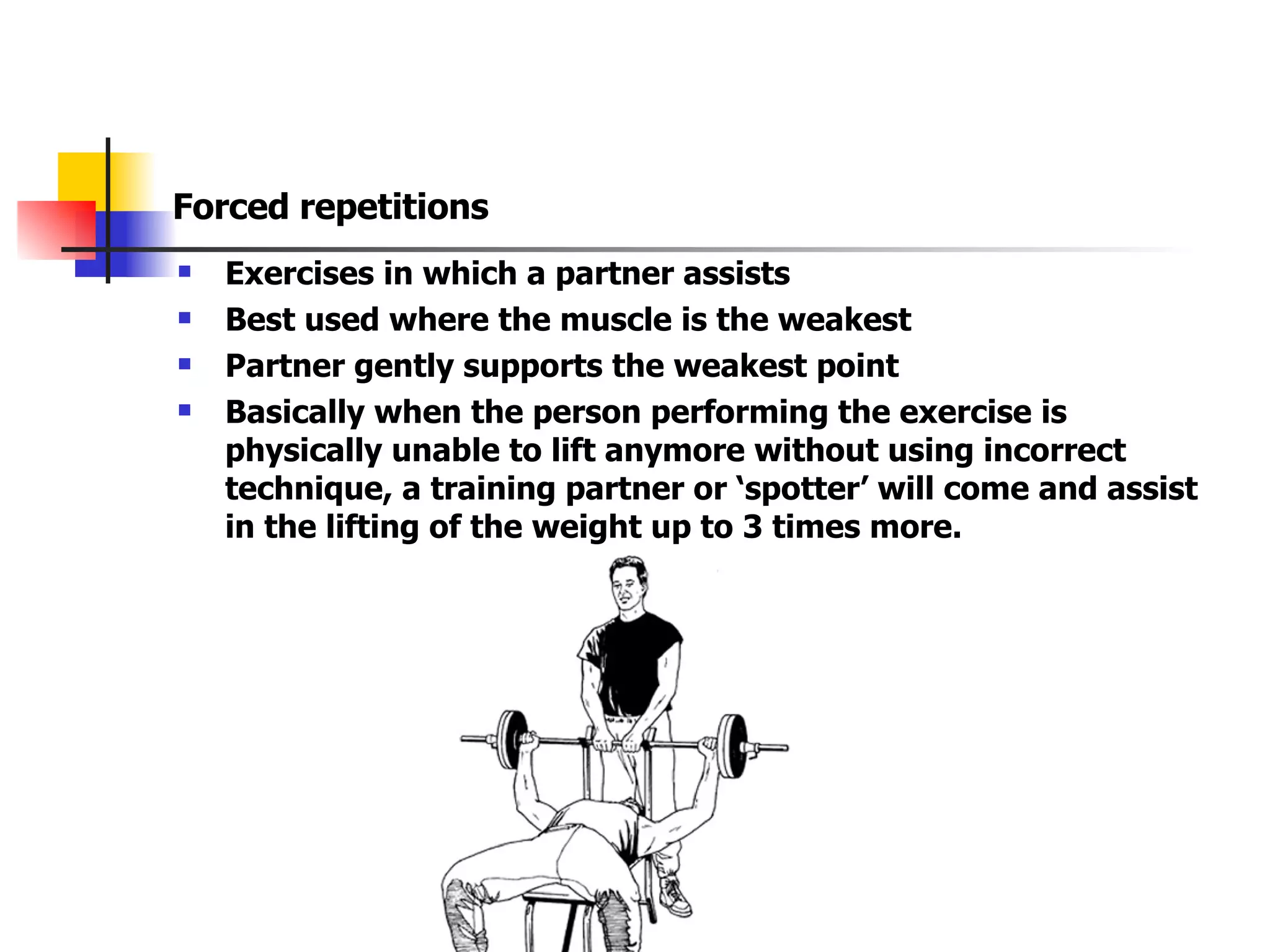
Forced repetitions Exercises in which a partner assists  Best used where the muscle is the weakest  Partner gently supports the weakest point Basically when the person performing the exercise is physically unable to lift anymore without using incorrect technique, a training partner or ‘spotter’ will come and assist in the lifting of the weight up to 3 times more.
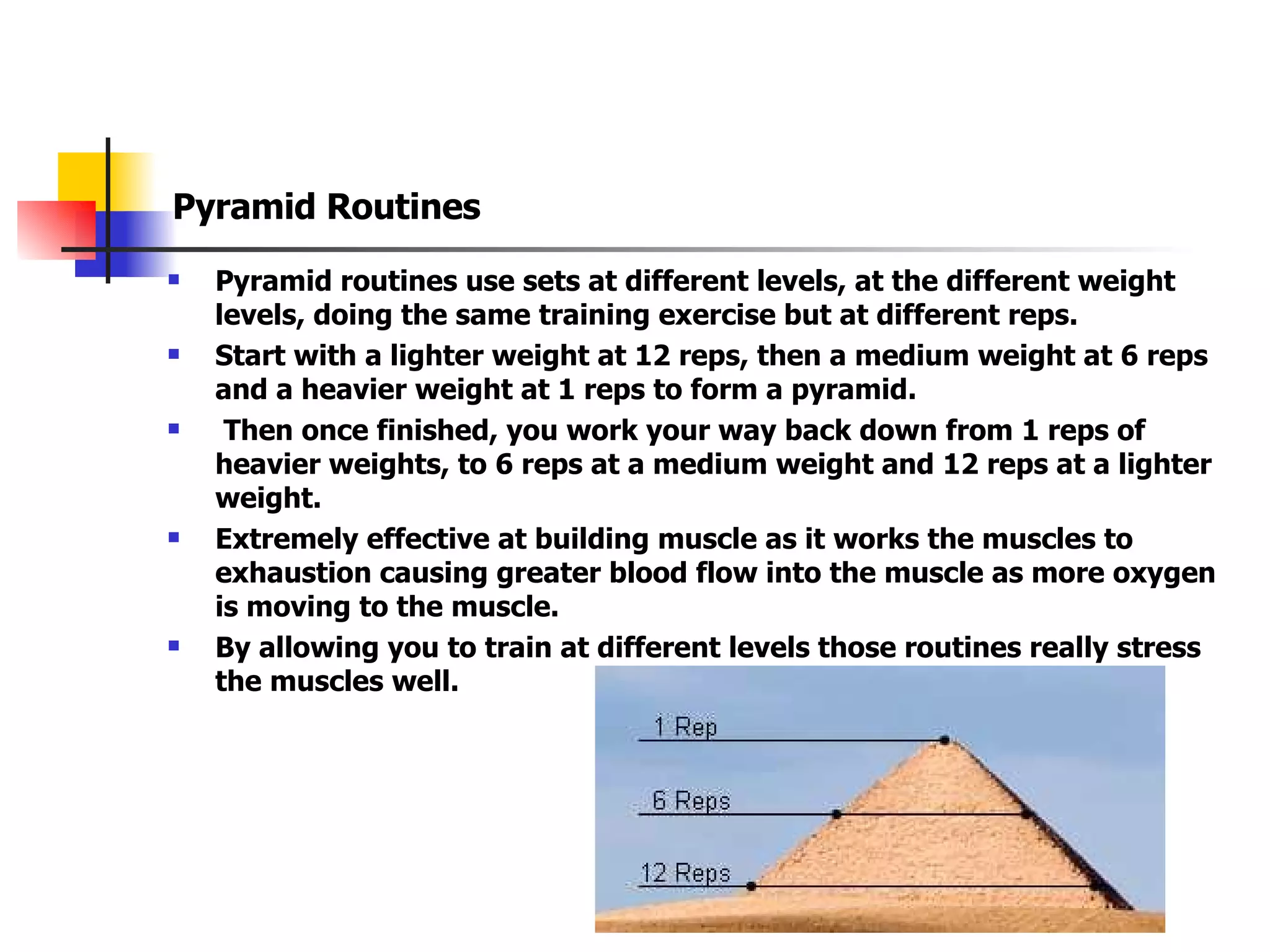
Pyramid Routines Pyramid routines use sets at different levels, at the different weight levels, doing the same training exercise but at different reps. Start with a lighter weight at 12 reps, then a medium weight at 6 reps and a heavier weight at 1 reps to form a pyramid. Then once finished, you work your way back down from 1 reps of heavier weights, to 6 reps at a medium weight and 12 reps at a lighter weight. Extremely effective at building muscle as it works the muscles to exhaustion causing greater blood flow into the muscle as more oxygen is moving to the muscle. By allowing you to train at different levels those routines really stress the muscles well.
Compound Training Involves combining exercises of the same muscle group and the antagonist muscle group with minimal or no rest in between exercises. These include Super sets Tri sets
Supersets Work out using agonist and then antagonist muscles alternatively This can be done by doing a different exercises with the same muscle group. No rests in between sets Example: Doing bicep curls, then immediately after changing to tricep pull downs. http://www.youtube.com/watch?v=RQ9uPGgPZO0&feature=related
Tri - sets Same principles as a super set except doing 3 exercises of the same muscle. This over exhausts the muscle tearing and expanding the muscle fibres which then fill with blood making the muscle group larger. Example: Doing a set of incline leg press, followed by a set of leg press, then a set of squats without rest in between, to exhaust the quadriceps and triceps. This is mainly used for the experienced trainers as it can lead to severe muscle damage if not conditioned before hand. http://www.youtube.com/watch?v=seJ_lO711to
Burn out sets Working the body until completely fatigued It is basically doing supersets but dropping the weight each set until no more can be done. This is completely exhausting the muscles to their physical limit and is effective but requires long rest periods. Example: Doing bench press sets starting at 30 kgs and working it down until just the bar is left. (by this time if done correctly the bar should feel as heavy as the first set)
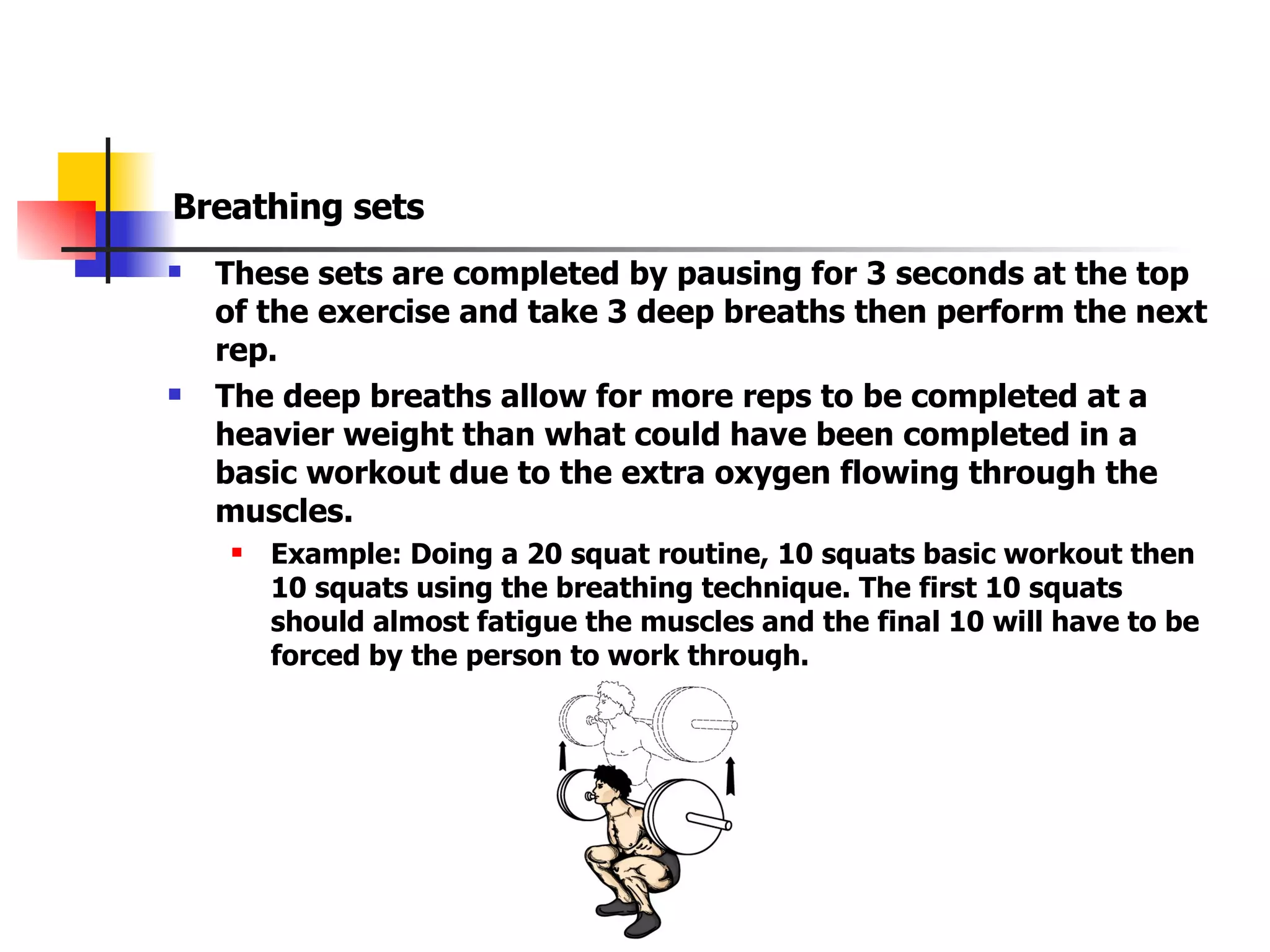
Breathing sets These sets are completed by pausing for 3 seconds at the top of the exercise and take 3 deep breaths then perform the next rep. The deep breaths allow for more reps to be completed at a heavier weight than what could have been completed in a basic workout due to the extra oxygen flowing through the muscles. Example: Doing a 20 squat routine, 10 squats basic workout then 10 squats using the breathing technique. The first 10 squats should almost fatigue the muscles and the final 10 will have to be forced by the person to work through.

Overload Techniques PDHPE

  • 1.
    Overload Techniques Muscleswill strengthen only if it has been forced to work beyond its limits Muscles can be overloaded by: The Intensity – decreasing rest periods The Resistance – Lifting more weight The number of repetitions Number of Sets Speed of muscular action
  • 2.
    Overload Techniques Overloadtechniques specific to strength training include: Blitzing Forced repetitions Pyramid Training Compound training Burn out sets Breathing sets
  • 3.
    Blitzing Practice ofworking a muscle or muscle group with different exercises from different angles in one training day This strengthens and builds the muscle groups around the main muscle which is being worked Example: Doing Dumbbell Fly’s, then doing lateral Incline Shoulder raises working both the deltoid and subscapularis muscle
  • 4.
    Forced repetitions Exercisesin which a partner assists Best used where the muscle is the weakest Partner gently supports the weakest point Basically when the person performing the exercise is physically unable to lift anymore without using incorrect technique, a training partner or ‘spotter’ will come and assist in the lifting of the weight up to 3 times more.
  • 5.
    Pyramid Routines Pyramidroutines use sets at different levels, at the different weight levels, doing the same training exercise but at different reps. Start with a lighter weight at 12 reps, then a medium weight at 6 reps and a heavier weight at 1 reps to form a pyramid. Then once finished, you work your way back down from 1 reps of heavier weights, to 6 reps at a medium weight and 12 reps at a lighter weight. Extremely effective at building muscle as it works the muscles to exhaustion causing greater blood flow into the muscle as more oxygen is moving to the muscle. By allowing you to train at different levels those routines really stress the muscles well.
  • 6.
    Compound Training Involvescombining exercises of the same muscle group and the antagonist muscle group with minimal or no rest in between exercises. These include Super sets Tri sets
  • 7.
    Supersets Work outusing agonist and then antagonist muscles alternatively This can be done by doing a different exercises with the same muscle group. No rests in between sets Example: Doing bicep curls, then immediately after changing to tricep pull downs. http://www.youtube.com/watch?v=RQ9uPGgPZO0&feature=related
  • 8.
    Tri - setsSame principles as a super set except doing 3 exercises of the same muscle. This over exhausts the muscle tearing and expanding the muscle fibres which then fill with blood making the muscle group larger. Example: Doing a set of incline leg press, followed by a set of leg press, then a set of squats without rest in between, to exhaust the quadriceps and triceps. This is mainly used for the experienced trainers as it can lead to severe muscle damage if not conditioned before hand. http://www.youtube.com/watch?v=seJ_lO711to
  • 9.
    Burn out setsWorking the body until completely fatigued It is basically doing supersets but dropping the weight each set until no more can be done. This is completely exhausting the muscles to their physical limit and is effective but requires long rest periods. Example: Doing bench press sets starting at 30 kgs and working it down until just the bar is left. (by this time if done correctly the bar should feel as heavy as the first set)
  • 10.
    Breathing sets Thesesets are completed by pausing for 3 seconds at the top of the exercise and take 3 deep breaths then perform the next rep. The deep breaths allow for more reps to be completed at a heavier weight than what could have been completed in a basic workout due to the extra oxygen flowing through the muscles. Example: Doing a 20 squat routine, 10 squats basic workout then 10 squats using the breathing technique. The first 10 squats should almost fatigue the muscles and the final 10 will have to be forced by the person to work through.