Overlay Networks
1. Architectural Description based
   Overlay Networks
2. Multiple Overlay Networks


                        - Akshay Hegde
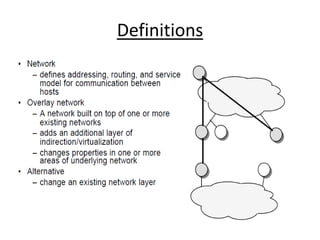
Definitions
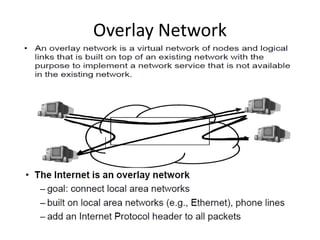
Overlay Network
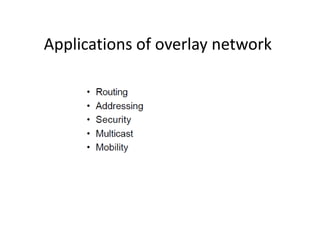
Applications of overlay network
Architectural Description based
             Overlay Networks

• Abstract

 Heavily used in Distributed computing applications.
 Heterogeneous architectures
 A try to abstract architecture of an overlay n/w into a document
  called an ‘Architectural Description’ (AD)
 Contain Roles and Relationships of a particular Overlay n/w
 May be exchanged among nodes and parsed by nodes themselves
  enabling nodes to adopt different Roles and Relationships
 Dynamic formation of Overlay n/w
 Allows heterogeneous networks to work
  collaboratively, maintaining Security
 Allows multiple overlays
 Allows same set of nodes to switch between heterogeneous
  overlays at different time intervals.
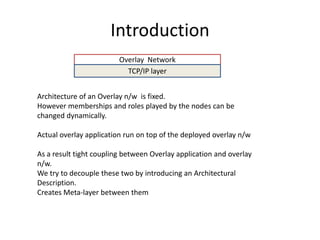
Introduction
                         Overlay Network
                           TCP/IP layer


Architecture of an Overlay n/w is fixed.
However memberships and roles played by the nodes can be
changed dynamically.

Actual overlay application run on top of the deployed overlay n/w

As a result tight coupling between Overlay application and overlay
n/w.
We try to decouple these two by introducing an Architectural
Description.
Creates Meta-layer between them
 Faciliating n/w :


   When AD documents pass through nodes, each node would adopt Roles and
   Relationships defined in AD.
   Enables node to create their own ‘Security roles’
• By using AD documents and Role based approach, each node
  would be able to play multiple roles and adopt relative
  relationships.
• This improves dynamic behavior of Overlays, as AD
  documents are exchanged and executed dynamically.
• Hence AD based architecture facilitates creating new overlay
  architectures.
• By ‘injecting’ a new AD through the node, existing overlay
  may be erased.
• Alternatively may be superimposed or overlapped on an
  existing Overlay.
AD Framework
A. Architectural Description
• Tries to abstract the Overlay n/w architecture to an XML document.
• In this abstraction we try to identify the roles and relationships in a
  particular architecture.
• Ex: Client Server Network, Peer to peer n/w
• In addition to roles & relationships AD would contain parameters
  such as ‘Override’, ‘onFailure’.
• Security tags contains the security settings for a particular AD, such
  as encryption type, algorithm, key size.
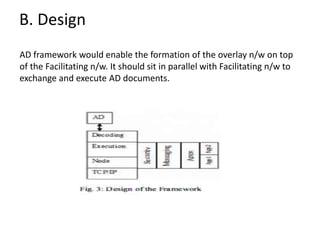
B. Design
AD framework would enable the formation of the overlay n/w on top
of the Facilitating n/w. It should sit in parallel with Facilitating n/w to
exchange and execute AD documents.
Features and applications
1. Integrating Heterogeneous Overlays
2. Super-impose Multiple Overlays
3. Switching between Heterogeneous Overlays
4. Enabling Overlays with Heterogeneous
   Security settings to collaborate
5. Key Exchange & key Management
Future work
• The prototype system needs to be extended to
  an actual distributed implementation. Which
  would make it possible to identify any
  practical issues.
• Current AD documents are concise and do
  carry only essential details. To make the full
  use of the AD based approach, AD documents
  need to have more details about architecture
  of overlay n/w.
• In the future implementation the routing
  information also be embedded in the AD
  document itself. This would allow the overlay n/w
  to dynamically change routing algorithm, adding
  more flexibility.
• ‘Security role’ can be further expanded so that
  networks having different security settings can
  inter-operate. This would allow n/w with
  heterogeneous security settings to work
  collaboratively.
Conclusion
• AD based overlay n/w is a novel concept in
  implementing overlay n/w. it tries to abstract
  architecture of an overlay n/w into ‘Architectural
  Description’ document.
• By exchanging the AD documents and ‘Executing’
  them; each node in n/w may play different roles
  allowing dynamically change the Overlay n/w
  architecture.
• This also allows heterogeneous Overlays to work
  collaboratively.
• Allows n/w with heterogeneous security
  settings to work collaboratively , enabling
  nodes to play different ‘Security Roles’.
• Mean time AD documents serves as a means
  of Security Key Exchange as soon as a node is
  added to an Overlay n/w.

Overlay networks ppt

  • 1.
    Overlay Networks 1. ArchitecturalDescription based Overlay Networks 2. Multiple Overlay Networks - Akshay Hegde
  • 2.
  • 3.
  • 4.
  • 5.
    Architectural Description based Overlay Networks • Abstract  Heavily used in Distributed computing applications.  Heterogeneous architectures  A try to abstract architecture of an overlay n/w into a document called an ‘Architectural Description’ (AD)  Contain Roles and Relationships of a particular Overlay n/w  May be exchanged among nodes and parsed by nodes themselves enabling nodes to adopt different Roles and Relationships
  • 6.
     Dynamic formationof Overlay n/w  Allows heterogeneous networks to work collaboratively, maintaining Security  Allows multiple overlays  Allows same set of nodes to switch between heterogeneous overlays at different time intervals.
  • 7.
    Introduction Overlay Network TCP/IP layer Architecture of an Overlay n/w is fixed. However memberships and roles played by the nodes can be changed dynamically. Actual overlay application run on top of the deployed overlay n/w As a result tight coupling between Overlay application and overlay n/w. We try to decouple these two by introducing an Architectural Description. Creates Meta-layer between them
  • 8.
     Faciliating n/w: When AD documents pass through nodes, each node would adopt Roles and Relationships defined in AD. Enables node to create their own ‘Security roles’
  • 9.
    • By usingAD documents and Role based approach, each node would be able to play multiple roles and adopt relative relationships. • This improves dynamic behavior of Overlays, as AD documents are exchanged and executed dynamically. • Hence AD based architecture facilitates creating new overlay architectures. • By ‘injecting’ a new AD through the node, existing overlay may be erased. • Alternatively may be superimposed or overlapped on an existing Overlay.
  • 10.
    AD Framework A. ArchitecturalDescription • Tries to abstract the Overlay n/w architecture to an XML document. • In this abstraction we try to identify the roles and relationships in a particular architecture. • Ex: Client Server Network, Peer to peer n/w • In addition to roles & relationships AD would contain parameters such as ‘Override’, ‘onFailure’. • Security tags contains the security settings for a particular AD, such as encryption type, algorithm, key size.
  • 12.
    B. Design AD frameworkwould enable the formation of the overlay n/w on top of the Facilitating n/w. It should sit in parallel with Facilitating n/w to exchange and execute AD documents.
  • 13.
    Features and applications 1.Integrating Heterogeneous Overlays 2. Super-impose Multiple Overlays 3. Switching between Heterogeneous Overlays 4. Enabling Overlays with Heterogeneous Security settings to collaborate 5. Key Exchange & key Management
  • 14.
    Future work • Theprototype system needs to be extended to an actual distributed implementation. Which would make it possible to identify any practical issues. • Current AD documents are concise and do carry only essential details. To make the full use of the AD based approach, AD documents need to have more details about architecture of overlay n/w.
  • 15.
    • In thefuture implementation the routing information also be embedded in the AD document itself. This would allow the overlay n/w to dynamically change routing algorithm, adding more flexibility. • ‘Security role’ can be further expanded so that networks having different security settings can inter-operate. This would allow n/w with heterogeneous security settings to work collaboratively.
  • 16.
    Conclusion • AD basedoverlay n/w is a novel concept in implementing overlay n/w. it tries to abstract architecture of an overlay n/w into ‘Architectural Description’ document. • By exchanging the AD documents and ‘Executing’ them; each node in n/w may play different roles allowing dynamically change the Overlay n/w architecture. • This also allows heterogeneous Overlays to work collaboratively.
  • 17.
    • Allows n/wwith heterogeneous security settings to work collaboratively , enabling nodes to play different ‘Security Roles’. • Mean time AD documents serves as a means of Security Key Exchange as soon as a node is added to an Overlay n/w.