Public Key Infrastructure
         in Brief


      January 31, 2002
What is a PKI?

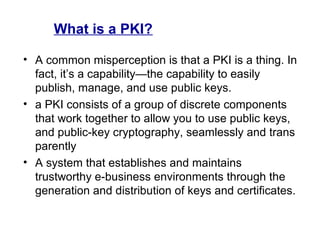
• A common misperception is that a PKI is a thing. In
  fact, it’s a capability—the capability to easily
  publish, manage, and use public keys.
• a PKI consists of a group of discrete components
  that work together to allow you to use public keys,
  and public-key cryptography, seamlessly and trans
  parently
• A system that establishes and maintains
  trustworthy e-business environments through the
  generation and distribution of keys and certificates.
Value-Add of PKI
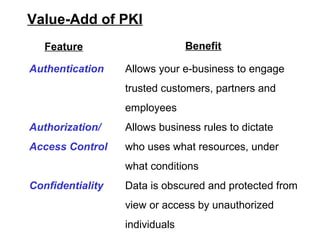
   Feature                      Benefit

Authentication    Allows your e-business to engage
                  trusted customers, partners and
                  employees
Authorization/    Allows business rules to dictate
Access Control    who uses what resources, under
                  what conditions
Confidentiality   Data is obscured and protected from
                  view or access by unauthorized
                  individuals
Value-Add of PKI
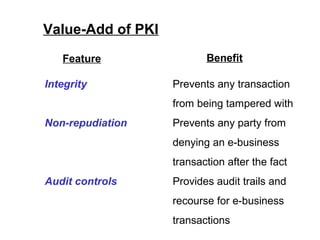
   Feature                Benefit

Integrity          Prevents any transaction
                   from being tampered with
Non-repudiation    Prevents any party from
                   denying an e-business
                   transaction after the fact
Audit controls     Provides audit trails and
                   recourse for e-business
                   transactions
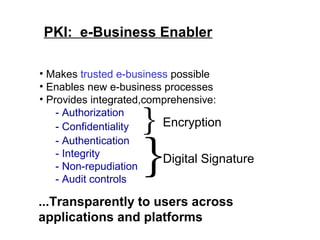
PKI: e-Business Enabler

• Makes trusted e-business possible
• Enables new e-business processes
• Provides integrated,comprehensive:
    - Authorization
                   }
    - Confidentiality    Encryption


                    }
    - Authentication
    - Integrity
                         Digital Signature
    - Non-repudiation
    - Audit controls

...Transparently to users across
applications and platforms
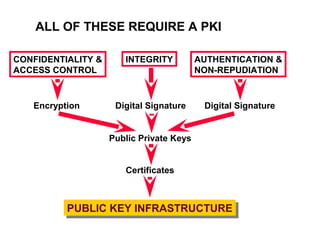
ALL OF THESE REQUIRE A PKI

CONFIDENTIALITY &      INTEGRITY          AUTHENTICATION &
ACCESS CONTROL                            NON-REPUDIATION


   Encryption        Digital Signature     Digital Signature


                    Public Private Keys


                       Certificates


          PUBLIC KEY INFRASTRUCTURE
          PUBLIC KEY INFRASTRUCTURE
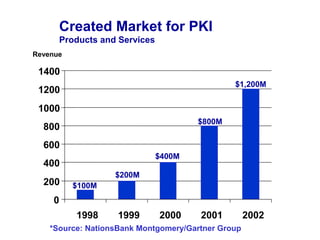
Created Market for PKI
      Products and Services
Revenue

 1400
                                               $1,200M
 1200
 1000
                                      $800M
  800
  600
                              $400M
  400
                   $200M
  200     $100M
     0
          1998      1999      2000     2001         2002
    *Source: NationsBank Montgomery/Gartner Group
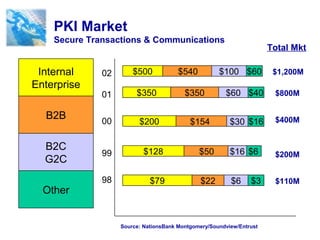
PKI Market
    Secure Transactions & Communications
                                                                      Total Mkt

 Internal     02       $500            $540          $100 $60          $1,200M
Enterprise
              01        $350             $350          $60 $40         $800M

  B2B         00                                                       $400M
                         $200              $154          $30 $16

  B2C                      $128               $50        $16 $6
              99                                                       $200M
  G2C
              98             $79               $22       $6     $3     $110M
  Other


                   Source: NationsBank Montgomery/Soundview/Entrust
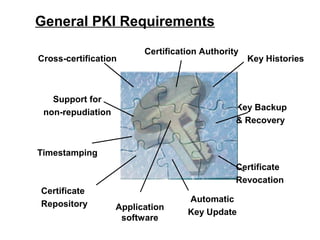
General PKI Requirements
                         Certification Authority
Cross-certification                                Key Histories


   Support for
                                               Key Backup
 non-repudiation
                                               & Recovery


Timestamping
                                               Certificate
                                               Revocation
Certificate
                                   Automatic
Repository         Application
                                   Key Update
                    software
PKIX Standards Participation

PKIX-1: Chaired and edited by Entrust staff
PKIX-2: LDAP portion authored by Sharon Boeyen
PKIX-3: CMP portion authored by Carlisle Adams
PKIX-4: participation by Sharon Boeyen & others
PKIX-5: authored by Carlisle Adams, Robert Zuccherato
PKIX-6: authored by Carlisle Adams, Robert Zuccherato
PKIX Overview for IEEE: authored by
         Carlisle Adams and Steve Lloyd
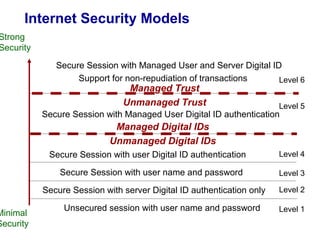
Internet Security Models
Strong
Security

              Secure Session with Managed User and Server Digital ID
                   Support for non-repudiation of transactions      Level 6
                                Managed Trust
                               Unmanaged Trust                         Level 5
           Secure Session with Managed User Digital ID authentication
                             Managed Digital IDs
                            Unmanaged Digital IDs
            Secure Session with user Digital ID authentication         Level 4

               Secure Session with user name and password              Level 3

           Secure Session with server Digital ID authentication only   Level 2

                Unsecured session with user name and password          Level 1
Minimal
Security
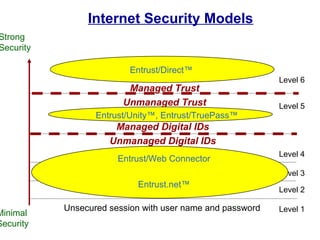
Internet Security Models
Strong
Security

                          Entrust/Direct™
                                                           Level 6
                         Managed Trust
                        Unmanaged Trust                    Level 5
                  Entrust/Unity™, Entrust/TruePass™
                      Managed Digital IDs
                     Unmanaged Digital IDs
                                                           Level 4
                       Entrust/Web Connector
                                                           Level 3
                           Entrust.net™
                                                           Level 2

           Unsecured session with user name and password   Level 1
Minimal
Security
Acrobat Document
Cryptography in Brief


   September 12, 2000
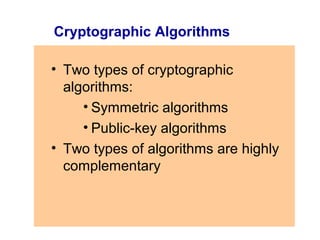
Cryptographic Algorithms

• Two types of cryptographic
  algorithms:
     • Symmetric algorithms
     • Public-key algorithms
• Two types of algorithms are highly
  complementary
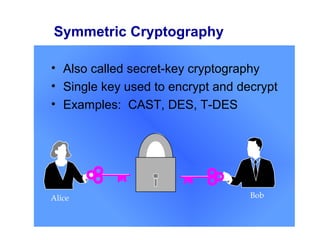
Symmetric Cryptography

• Also called secret-key cryptography
• Single key used to encrypt and decrypt
• Examples: CAST, DES, T-DES


Alice                              Bob
Public-key Cryptography

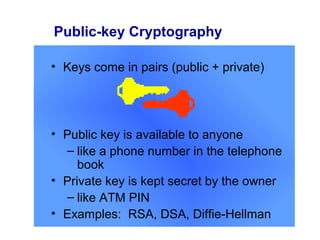
• Keys come in pairs (public + private)


• Public key is available to anyone
  – like a phone number in the telephone
     book
• Private key is kept secret by the owner
  – like ATM PIN
• Examples: RSA, DSA, Diffie-Hellman
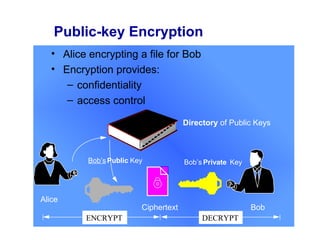
Public-key Encryption
   • Alice encrypting a file for Bob
   • Encryption provides:
      – confidentiality
      – access control

                                       Directory of Public Keys


           Bob’s Public Key            Bob’s Private Key


Alice
                          Ciphertext                       Bob
          ENCRYPT                           DECRYPT
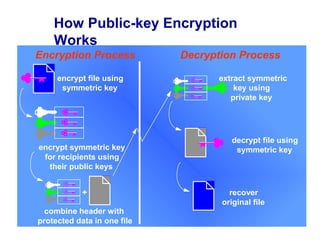
How Public-key Encryption
    Works
Encryption Process           Decryption Process

     encrypt file using            extract symmetric
      symmetric key                    key using
                                      private key


                                      decrypt file using
encrypt symmetric key                  symmetric key
 for recipients using
  their public keys


            +                         recover
                                    original file
  combine header with
protected data in one file
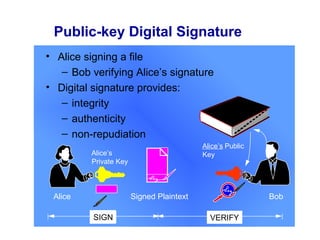
Public-key Digital Signature
• Alice signing a file
   – Bob verifying Alice’s signature
• Digital signature provides:
   – integrity
   – authenticity
   – non-repudiation
                                          Alice’s Public
         Alice’s                          Key
         Private Key


 Alice                 Signed Plaintext                    Bob

          SIGN                              VERIFY
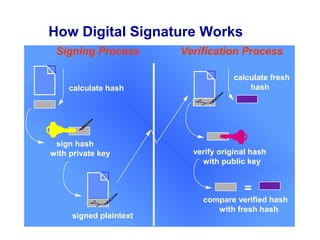
How Digital Signature Works
 Signing Process        Verification Process

                                     calculate fresh
    calculate hash                       hash


 sign hash
with private key          verify original hash
                            with public key


                                        =
                            compare verified hash
                               with fresh hash
     signed plaintext
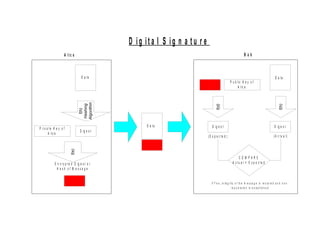
D ig ita l S ig n a tu r e
                     A lic e                                                                                      Bob


                                    D a ta                                                                                                          D a ta
                                                                                                   P u b lic K e y o f
                                                                                                         A lic e
                                 Algorithm
                                 Hashing


                                                                                                                                                        f(h)
                                                                                   f(d)
                                    f(h)


                                                      D a ta                    D ig e s t                                                          D ig e s t
P r iv a t e K e y o f
                                   D ig e s t
        A lic e
                                                                             (E x p e c te d )                                                     ( A c t u a l)
                          f(e)


                                                                                                           C O M PAR E
             E n c r y p te d D ig e s t o r                                                          A c tu a l = E x p e c te d
               H ash of M essage


                                                                               I f Y e s , in t e g r it y o f t h e m e s s a g e is r e s t o r e d a n d n o n -
                                                                                                       r e p u d ia t io n is e s t a b lis h e d
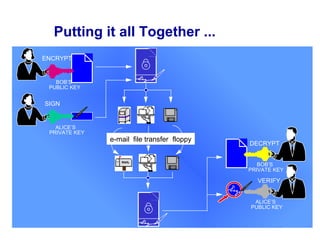
Putting it all Together ...
ENCRYPT


   BOB’S
 PUBLIC KEY


SIGN


   ALICE’S
 PRIVATE KEY
               e-mail file transfer floppy
                                             DECRYPT


                                                BOB’S
                                             PRIVATE KEY

                                               VERIFY


                                              ALICE’S
                                             PUBLIC KEY
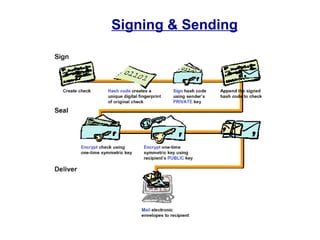
Signing & Sending
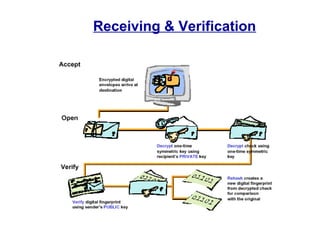
Receiving & Verification

Overall cryptography and pki introduction

  • 1.
    Public Key Infrastructure in Brief January 31, 2002
  • 2.
    What is aPKI? • A common misperception is that a PKI is a thing. In fact, it’s a capability—the capability to easily publish, manage, and use public keys. • a PKI consists of a group of discrete components that work together to allow you to use public keys, and public-key cryptography, seamlessly and trans parently • A system that establishes and maintains trustworthy e-business environments through the generation and distribution of keys and certificates.
  • 3.
    Value-Add of PKI Feature Benefit Authentication Allows your e-business to engage trusted customers, partners and employees Authorization/ Allows business rules to dictate Access Control who uses what resources, under what conditions Confidentiality Data is obscured and protected from view or access by unauthorized individuals
  • 4.
    Value-Add of PKI Feature Benefit Integrity Prevents any transaction from being tampered with Non-repudiation Prevents any party from denying an e-business transaction after the fact Audit controls Provides audit trails and recourse for e-business transactions
  • 5.
    PKI: e-Business Enabler •Makes trusted e-business possible • Enables new e-business processes • Provides integrated,comprehensive: - Authorization } - Confidentiality Encryption } - Authentication - Integrity Digital Signature - Non-repudiation - Audit controls ...Transparently to users across applications and platforms
  • 6.
    ALL OF THESEREQUIRE A PKI CONFIDENTIALITY & INTEGRITY AUTHENTICATION & ACCESS CONTROL NON-REPUDIATION Encryption Digital Signature Digital Signature Public Private Keys Certificates PUBLIC KEY INFRASTRUCTURE PUBLIC KEY INFRASTRUCTURE
  • 7.
    Created Market forPKI Products and Services Revenue 1400 $1,200M 1200 1000 $800M 800 600 $400M 400 $200M 200 $100M 0 1998 1999 2000 2001 2002 *Source: NationsBank Montgomery/Gartner Group
  • 8.
    PKI Market Secure Transactions & Communications Total Mkt Internal 02 $500 $540 $100 $60 $1,200M Enterprise 01 $350 $350 $60 $40 $800M B2B 00 $400M $200 $154 $30 $16 B2C $128 $50 $16 $6 99 $200M G2C 98 $79 $22 $6 $3 $110M Other Source: NationsBank Montgomery/Soundview/Entrust
  • 9.
    General PKI Requirements Certification Authority Cross-certification Key Histories Support for Key Backup non-repudiation & Recovery Timestamping Certificate Revocation Certificate Automatic Repository Application Key Update software
  • 10.
    PKIX Standards Participation PKIX-1:Chaired and edited by Entrust staff PKIX-2: LDAP portion authored by Sharon Boeyen PKIX-3: CMP portion authored by Carlisle Adams PKIX-4: participation by Sharon Boeyen & others PKIX-5: authored by Carlisle Adams, Robert Zuccherato PKIX-6: authored by Carlisle Adams, Robert Zuccherato PKIX Overview for IEEE: authored by Carlisle Adams and Steve Lloyd
  • 11.
    Internet Security Models Strong Security Secure Session with Managed User and Server Digital ID Support for non-repudiation of transactions Level 6 Managed Trust Unmanaged Trust Level 5 Secure Session with Managed User Digital ID authentication Managed Digital IDs Unmanaged Digital IDs Secure Session with user Digital ID authentication Level 4 Secure Session with user name and password Level 3 Secure Session with server Digital ID authentication only Level 2 Unsecured session with user name and password Level 1 Minimal Security
  • 12.
    Internet Security Models Strong Security Entrust/Direct™ Level 6 Managed Trust Unmanaged Trust Level 5 Entrust/Unity™, Entrust/TruePass™ Managed Digital IDs Unmanaged Digital IDs Level 4 Entrust/Web Connector Level 3 Entrust.net™ Level 2 Unsecured session with user name and password Level 1 Minimal Security
  • 13.
  • 14.
    Cryptography in Brief September 12, 2000
  • 15.
    Cryptographic Algorithms • Twotypes of cryptographic algorithms: • Symmetric algorithms • Public-key algorithms • Two types of algorithms are highly complementary
  • 16.
    Symmetric Cryptography • Alsocalled secret-key cryptography • Single key used to encrypt and decrypt • Examples: CAST, DES, T-DES Alice Bob
  • 17.
    Public-key Cryptography • Keyscome in pairs (public + private) • Public key is available to anyone – like a phone number in the telephone book • Private key is kept secret by the owner – like ATM PIN • Examples: RSA, DSA, Diffie-Hellman
  • 18.
    Public-key Encryption • Alice encrypting a file for Bob • Encryption provides: – confidentiality – access control Directory of Public Keys Bob’s Public Key Bob’s Private Key Alice Ciphertext Bob ENCRYPT DECRYPT
  • 19.
    How Public-key Encryption Works Encryption Process Decryption Process encrypt file using extract symmetric symmetric key key using private key decrypt file using encrypt symmetric key symmetric key for recipients using their public keys + recover original file combine header with protected data in one file
  • 20.
    Public-key Digital Signature •Alice signing a file – Bob verifying Alice’s signature • Digital signature provides: – integrity – authenticity – non-repudiation Alice’s Public Alice’s Key Private Key Alice Signed Plaintext Bob SIGN VERIFY
  • 21.
    How Digital SignatureWorks Signing Process Verification Process calculate fresh calculate hash hash sign hash with private key verify original hash with public key = compare verified hash with fresh hash signed plaintext
  • 22.
    D ig ital S ig n a tu r e A lic e Bob D a ta D a ta P u b lic K e y o f A lic e Algorithm Hashing f(h) f(d) f(h) D a ta D ig e s t D ig e s t P r iv a t e K e y o f D ig e s t A lic e (E x p e c te d ) ( A c t u a l) f(e) C O M PAR E E n c r y p te d D ig e s t o r A c tu a l = E x p e c te d H ash of M essage I f Y e s , in t e g r it y o f t h e m e s s a g e is r e s t o r e d a n d n o n - r e p u d ia t io n is e s t a b lis h e d
  • 23.
    Putting it allTogether ... ENCRYPT BOB’S PUBLIC KEY SIGN ALICE’S PRIVATE KEY e-mail file transfer floppy DECRYPT BOB’S PRIVATE KEY VERIFY ALICE’S PUBLIC KEY
  • 24.
  • 25.