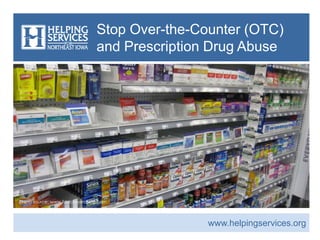
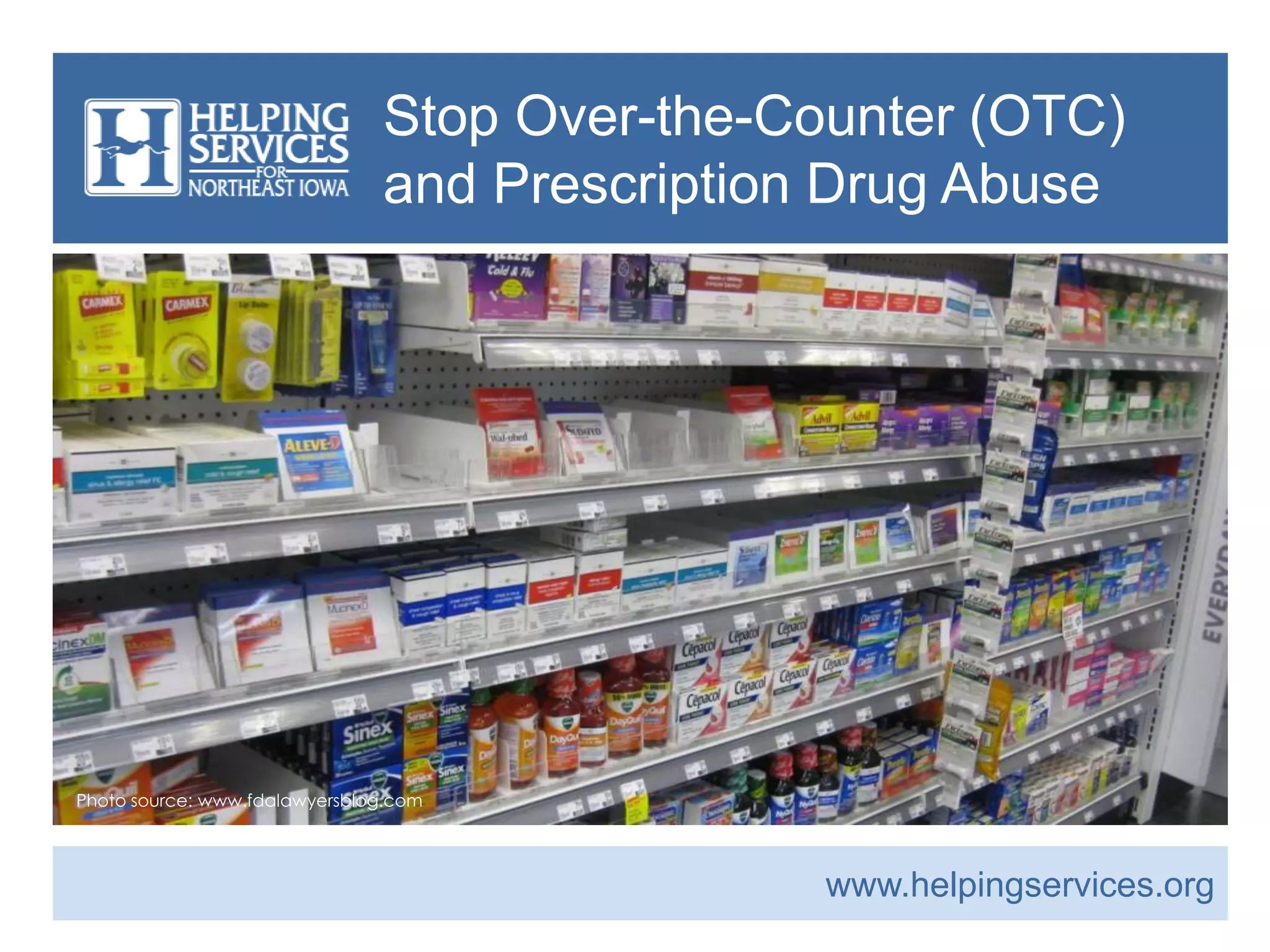

Stop Over-the-Counter (OTC)
and Prescription Drug Abuse
Photo source: www.fdalawyersblog.com
www.helpingservices.org
Over-the-Counter (OTC) and prescription drug abuse
are a growing and dangerous problem, as a retailer
you can play a role in reducing and preventing it.
After viewing this presentation, you will better understand:
Following this online presentation, please take the brief quiz to
receive your certificate of completion.
Thank you for taking this training and helping to prevent and reduce
over-the-counter and prescription drug abuse.
• Types of abused OTC and
prescription drugs
• Potential side effects of misuse
• Best practices to set up and monitor
medication sales in your store
• How to reduce consumer theft
• Right to refuse a sale
• Responsibility to report suspicious
activity
Training Overview
• What’s the problem?
• Why is OTC and prescription drug abuse
becoming more common?
• What are the impacts of misuse?
• Which drugs are abused?
• How can I reduce access and abuse?
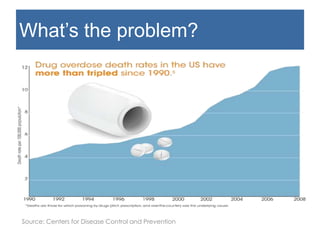
What’s the problem?
Source: Centers for Disease Control and Prevention
The problem
The consequences of abuse of Over the Counter and
Prescription drugs include:
• Unprotected, unplanned, unwanted sexual activity
• Impaired motor vehicle driving/passengers resulting
in accidents, injuries, and death
• Poor academic and athletic performance in youth
• Impacted work performance and attendance
• Experimentation and mixing of other drugs
• Serious injury or death
Why is OTC and Prescription Drug Abuse
Becoming More Common?
Availability
Access
Awareness
Attitude
Availability
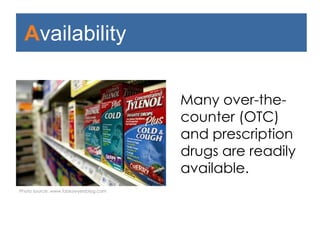
Many over-the-counter
(OTC) and prescription
drugs are readily
available.
Photo source: www.fdalawyersblog.com
Access
• Internet
• Friends and family
• Medicine cabinet
• Legally purchase
• Stolen from retailers
OTC medications are easy to get.
Awareness
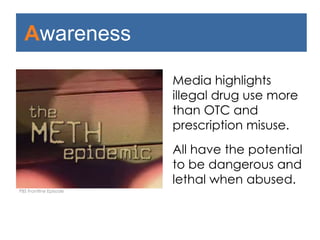
Media highlights illegal
drug use more than
OTC and prescription
misuse.
All have the potential
to be dangerous and
lethal when abused.
PBS Frontline Episode
Attitude
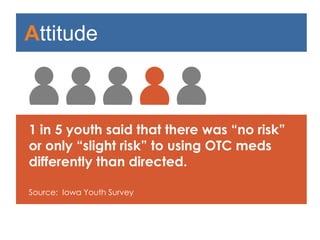
1 in 5 youth said that there was “no risk”
or only “slight risk” to using OTC meds
differently than directed.
Source: Iowa Youth Survey
OTC and prescription drugs are
increasingly abused
because of the current
availability, access, awareness,
and attitude.
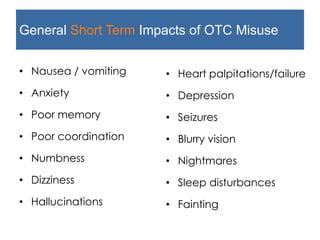
General Short Term Impacts of OTC Misuse
• Nausea / vomiting
• Anxiety
• Poor memory
• Poor coordination
• Numbness
• Dizziness
• Hallucinations
• Heart palpitations/failure
• Depression
• Seizures
• Blurry vision
• Nightmares
• Sleep disturbances
• Fainting
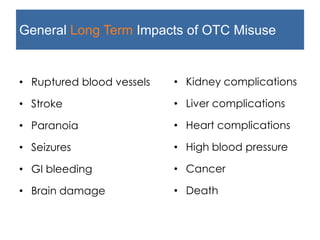
General Long Term Impacts of OTC Misuse
• Ruptured blood vessels
• Stroke
• Paranoia
• Seizures
• GI bleeding
• Brain damage
• Kidney complications
• Liver complications
• Heart complications
• High blood pressure
• Cancer
• Death
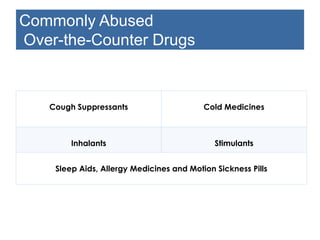
Cough Suppressants Cold Medicines
Inhalants Stimulants
Sleep Aids, Allergy Medicines and Motion Sickness Pills
Commonly Abused
Over-the-Counter Drugs
Cough Suppressant - DXM
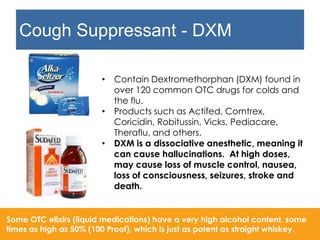
• Contain Dextromethorphan (DXM) found in
over 120 common OTC drugs for colds and
the flu.
• Products such as Actifed, Comtrex,
Coricidin, Robitussin, Vicks, Pediacare,
Theraflu, and others.
• DXM is a dissociative anesthetic, meaning it
can cause hallucinations. At high doses,
may cause loss of muscle control, nausea,
loss of consciousness, seizures, stroke and
death.
Some OTC elixirs (liquid medications) have a very high alcohol content, some
times as high as 50% (100 Proof), which is just as potent as straight whiskey.
Cold Medicine
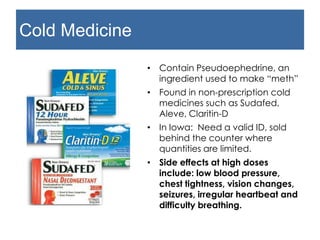
• Contain Pseudoephedrine, an
ingredient used to make “meth”
• Found in non-prescription cold
medicines such as Sudafed,
Aleve, Claritin-D
• In Iowa: Need a valid ID, sold
behind the counter where
quantities are limited.
• Side effects at high doses
include: low blood pressure,
chest tightness, vision changes,
seizures, irregular heartbeat and
difficulty breathing.
Sleep Aids, Allergy Medicines and
Motion Sickness Pills
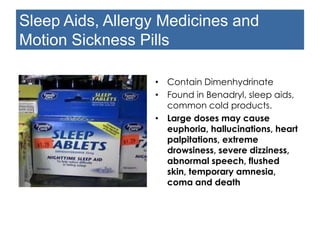
• Contain Dimenhydrinate
• Found in Benadryl, sleep aids,
common cold products.
• Large doses may cause
euphoria, hallucinations, heart
palpitations, extreme
drowsiness, severe dizziness,
abnormal speech, flushed skin,
temporary amnesia, coma
and death
Stimulants
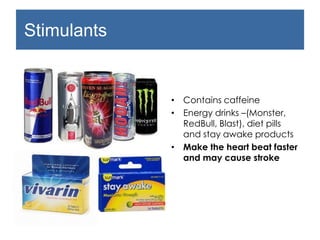
• Contains caffeine
• Energy drinks –(Monster,
RedBull, Blast), diet pills
and stay awake products
• Make the heart beat faster
and may cause stroke
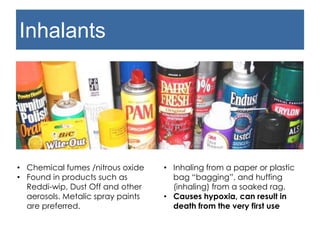
Inhalants
• Chemical fumes /nitrous oxide
• Found in products such as
Reddi-wip, Dust Off and other
aerosols. Metalic spray paints
are preferred.
• Inhaling from a paper or plastic
bag “bagging”, and huffing
(inhaling) from a soaked rag.
• Causes hypoxia, can result in
death from the very first use
Misusing over-the-counter
products and prescription
drugs can be just as
dangerous as using
illegal drugs.
Commonly Abused Prescription Drugs
Stimulants
Central Nervous System Depressants
Opioids
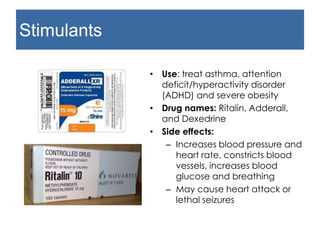
Stimulants
• Use: treat asthma, attention
deficit/hyperactivity disorder
(ADHD) and severe obesity
• Drug names: Ritalin, Adderall,
and Dexedrine
• Side effects:
– Increases blood pressure and
heart rate, constricts blood
vessels, increases blood
glucose and breathing
– May cause heart attack or
lethal seizures
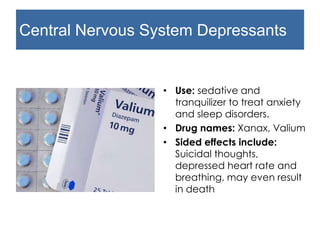
Central Nervous System Depressants
• Use: sedative and
tranquilizer to treat anxiety
and sleep disorders.
• Drug names: Xanax, Valium
• Sided effects include:
Suicidal thoughts,
depressed heart rate and
breathing, may even result
in death
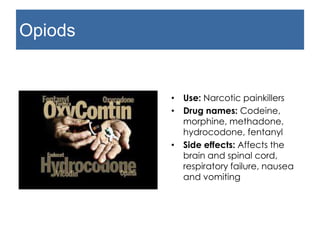
Opioids
• Use: Narcotic painkillers
• Drug names: Codeine,
morphine, methadone,
hydrocodone, fentanyl
• Side effects: Affects the
brain and spinal cord,
respiratory failure, nausea
and vomiting
Prescription drugs can be
dangerous when taken
for non-medical reasons,
by a person other than it
is prescribed for, or in
extreme amounts.
What can we do?
Prepare
Be Aware
Look for Signs
1.
2.
3.
Prepare: Set Up Store
• Train employees to recognize/report suspicious
behavior.
• Install security cameras.
• Place products in sight of counter or near
register.
• Find out your store’s policies on sale of OTC and
prescription drugs and your right to refuse a sale.
• Make policies known to staff and customers.
Don’t have a policy? Contact Helping Services
info@helpingservices.org for assistance in policy
creation or for additional training.
Be Aware: At Point of Sale
Watch for suspicious behavior.
• Persons trying to steal or consume in the
store.
• Persons who are under the influence.
• Persons buying multiple products.
You have the right to refuse the sale.
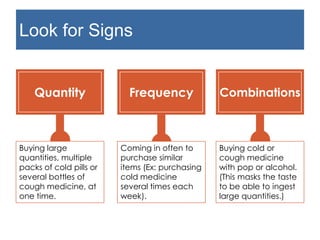
Look for Signs
Quantity Frequency Combinations
Buying large
quantities, multiple
packs of cold pills or
several bottles of
cough medicine, at
one time.
Coming in often to
purchase similar
items (Ex: purchasing
cold medicine
several times each
week).
Buying cold or
cough medicine
with pop or alcohol.
(This masks the taste
to be able to ingest
large quantities.)
What else can you do?
• Keep track of inventory and notice
trends or areas of concern.
• Monitor restrooms for signs that
products are being used or consumed
in the store.
Report suspicious activity to
management and law enforcement.
Reduce OTC and Prescription Drug Misuse
Educate yourself and others about this issue
• Four A’s: Availability, Access, Awareness, and Attitude
• Long and short term consequences and behaviors
• Variety of products to watch for
Prepare your store and employees
• Know the signs: Consumers buying quantity, frequency,
combination
• Be aware of consumers
• Prepare: Set up store, at point of sale, after the customer
leaves
• Make sure all employees are knowledgeable about
policies around these issues.
Use this information to
take action to eliminate
OTC and prescription
drug misuse.
You can help prevent
risky behaviors, health
issues, and even death.
Take the quiz and get your
certificate of completion.
Thank You
Special thanks to Corporal Steve Eastvedt, from the Dubuque
Police Department, for his contribution to this training.
This training was created with funding from the Iowa Department
of Public Health through the Comprehensive Substance Abuse
Prevention grant.
www.helpingservices.org
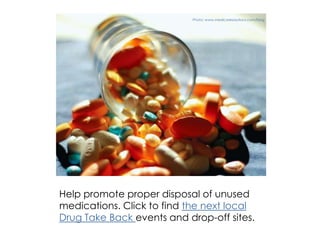
Help promote proper disposal of unused
medications. Click to find the next local
Drug Take Back events and drop-off sites.
Photo: www.medicaresolutions.com/blog
References
• DrugFacts: Prescription and Over-The-Counter Medications. (Revised 2013, May). National Institute on Drug Abuse.
Retrieved January 16, 2014, from http://www.drugabuse.gov/publications/drugfacts/prescription-over-counter-
medications
• Drug Facts: Prescription Drugs. NIDA For Teens. Retrieved January 16, 2014, from http://teens.drugabuse.gov/drug-
facts/prescription-drugs
• Most Commonly Used OTC Drugs. Teen Drug Abuse. Retrieved January 16, 2014, from http://www.teen-drug-
abuse.org/teenoverthecounterdrugabuse/ commonly-used-otc-drugs.htm
• Dextromethorphan. Teen Drug Abuse. Retrieved January 16, 2014, from http://www.teen-drug-
abuse.org/teenoverthecounterdrugabuse/ dextroamphetamine.htm
• Shoplifiting. Reference for Business. Retrieved January 16, 2014, from http://www.referenceforbusiness.com/small/Qu-
Sm/Shoplifting.html
• ShineWideOpen. Inhalants- The Legal Killer. (2013, June 12). Bubbleews. Retrieved January 16, 2014 from
http://www.bubblews.com/news/651340-inhalants-the-legal-killer
• Over the Counter Pain Medication Problems. Doctor Saupto.com. Retrieved January 19, 2014, from
www.doctorsaputo.com/a/over-the-counter-pain-medication-problems
• Dimenhydrinate. MedlinePlus a service of the US National Library of Medicine NIH National Institutes of Health.
Retrieved January 19, 2014, from www.nlm.nih.gov/medlineplus/druginfo/meds/a607046.html
• Over-The-Counter Drugs.(2001). Encyclopedia.com. Retrieved on January 19, 2014 from
http://www.encyclopedia.com/doc/1G2-3437000061.html
• Talking About Prescription Drug Misuse [Pamphlet]. Iowa Governor’s Office of Drug Control Policy.
www.iowa.gov/odcp
• Over The Counter Drug Abuse: More Dangerous Than You Think [Pamphlet]. In the Know, Prevention and Treatment
Resource Press. www.ptrpress.com
• Talking To Kids About Prescription Drug Abuse [Pamphlet]. Iowa Governor’s Office of Drug Control Policy.
www.iowa.gov/odcp
www.helpingservices.org
Additional Resources
• Helping Services for Northeast Iowa
www.helpingservices.org
• Iowa Department of Public Health Bureau of Substance Abuse
www.idph.state.ia.us/bh/substance_abuse.asp
•Iowa Governor’s Office of Drug Control Policy
www.iow.gov/odcp
• Iowa Substance Abuse Information Center
www.drugfreeinfo.org
• Substance Abuse and Mental Health Services Administration
www.samhsa.gov
• The Partnership At DrugFree.Org
www.drugfree.org or 1-855-DRUGFREE
www.helpingservices.org
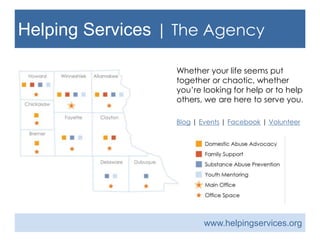
Helping Services | The Agency
Whether your life seems put
together or chaotic, whether
you’re looking for help or to help
others, we are here to serve you.
Blog | Events | Facebook | Volunteer
www.helpingservices.org

Over-the-Counter and Prescription Drug Abuse Prevention Training by Helping Services

  • 1.
    Stop Over-the-Counter (OTC) andPrescription Drug Abuse Photo source: www.fdalawyersblog.com www.helpingservices.org
  • 2.
    Over-the-Counter (OTC) andprescription drug abuse are a growing and dangerous problem, as a retailer you can play a role in reducing and preventing it. After viewing this presentation, you will better understand: Following this online presentation, please take the brief quiz to receive your certificate of completion. Thank you for taking this training and helping to prevent and reduce over-the-counter and prescription drug abuse. • Types of abused OTC and prescription drugs • Potential side effects of misuse • Best practices to set up and monitor medication sales in your store • How to reduce consumer theft • Right to refuse a sale • Responsibility to report suspicious activity
  • 3.
    Training Overview • What’sthe problem? • Why is OTC and prescription drug abuse becoming more common? • What are the impacts of misuse? • Which drugs are abused? • How can I reduce access and abuse?
  • 4.
    What’s the problem? Source:Centers for Disease Control and Prevention
  • 5.
    The problem The consequencesof abuse of Over the Counter and Prescription drugs include: • Unprotected, unplanned, unwanted sexual activity • Impaired motor vehicle driving/passengers resulting in accidents, injuries, and death • Poor academic and athletic performance in youth • Impacted work performance and attendance • Experimentation and mixing of other drugs • Serious injury or death
  • 6.
    Why is OTCand Prescription Drug Abuse Becoming More Common? Availability Access Awareness Attitude
  • 7.
    Availability Many over-the-counter (OTC) andprescription drugs are readily available. Photo source: www.fdalawyersblog.com
  • 8.
    Access • Internet • Friendsand family • Medicine cabinet • Legally purchase • Stolen from retailers OTC medications are easy to get.
  • 9.
    Awareness Media highlights illegal druguse more than OTC and prescription misuse. All have the potential to be dangerous and lethal when abused. PBS Frontline Episode
  • 10.
    Attitude 1 in 5youth said that there was “no risk” or only “slight risk” to using OTC meds differently than directed. Source: Iowa Youth Survey
  • 11.
    OTC and prescriptiondrugs are increasingly abused because of the current availability, access, awareness, and attitude.
  • 12.
    General Short TermImpacts of OTC Misuse • Nausea / vomiting • Anxiety • Poor memory • Poor coordination • Numbness • Dizziness • Hallucinations • Heart palpitations/failure • Depression • Seizures • Blurry vision • Nightmares • Sleep disturbances • Fainting
  • 13.
    General Long TermImpacts of OTC Misuse • Ruptured blood vessels • Stroke • Paranoia • Seizures • GI bleeding • Brain damage • Kidney complications • Liver complications • Heart complications • High blood pressure • Cancer • Death
  • 14.
    Cough Suppressants ColdMedicines Inhalants Stimulants Sleep Aids, Allergy Medicines and Motion Sickness Pills Commonly Abused Over-the-Counter Drugs
  • 15.
    Cough Suppressant -DXM • Contain Dextromethorphan (DXM) found in over 120 common OTC drugs for colds and the flu. • Products such as Actifed, Comtrex, Coricidin, Robitussin, Vicks, Pediacare, Theraflu, and others. • DXM is a dissociative anesthetic, meaning it can cause hallucinations. At high doses, may cause loss of muscle control, nausea, loss of consciousness, seizures, stroke and death. Some OTC elixirs (liquid medications) have a very high alcohol content, some times as high as 50% (100 Proof), which is just as potent as straight whiskey.
  • 16.
    Cold Medicine • ContainPseudoephedrine, an ingredient used to make “meth” • Found in non-prescription cold medicines such as Sudafed, Aleve, Claritin-D • In Iowa: Need a valid ID, sold behind the counter where quantities are limited. • Side effects at high doses include: low blood pressure, chest tightness, vision changes, seizures, irregular heartbeat and difficulty breathing.
  • 17.
    Sleep Aids, AllergyMedicines and Motion Sickness Pills • Contain Dimenhydrinate • Found in Benadryl, sleep aids, common cold products. • Large doses may cause euphoria, hallucinations, heart palpitations, extreme drowsiness, severe dizziness, abnormal speech, flushed skin, temporary amnesia, coma and death
  • 18.
    Stimulants • Contains caffeine •Energy drinks –(Monster, RedBull, Blast), diet pills and stay awake products • Make the heart beat faster and may cause stroke
  • 19.
    Inhalants • Chemical fumes/nitrous oxide • Found in products such as Reddi-wip, Dust Off and other aerosols. Metalic spray paints are preferred. • Inhaling from a paper or plastic bag “bagging”, and huffing (inhaling) from a soaked rag. • Causes hypoxia, can result in death from the very first use
  • 20.
    Misusing over-the-counter products andprescription drugs can be just as dangerous as using illegal drugs.
  • 21.
    Commonly Abused PrescriptionDrugs Stimulants Central Nervous System Depressants Opioids
  • 22.
    Stimulants • Use: treatasthma, attention deficit/hyperactivity disorder (ADHD) and severe obesity • Drug names: Ritalin, Adderall, and Dexedrine • Side effects: – Increases blood pressure and heart rate, constricts blood vessels, increases blood glucose and breathing – May cause heart attack or lethal seizures
  • 23.
    Central Nervous SystemDepressants • Use: sedative and tranquilizer to treat anxiety and sleep disorders. • Drug names: Xanax, Valium • Sided effects include: Suicidal thoughts, depressed heart rate and breathing, may even result in death
  • 24.
    Opioids • Use: Narcoticpainkillers • Drug names: Codeine, morphine, methadone, hydrocodone, fentanyl • Side effects: Affects the brain and spinal cord, respiratory failure, nausea and vomiting
  • 25.
    Prescription drugs canbe dangerous when taken for non-medical reasons, by a person other than it is prescribed for, or in extreme amounts.
  • 26.
    What can wedo? Prepare Be Aware Look for Signs 1. 2. 3.
  • 27.
    Prepare: Set UpStore • Train employees to recognize/report suspicious behavior. • Install security cameras. • Place products in sight of counter or near register. • Find out your store’s policies on sale of OTC and prescription drugs and your right to refuse a sale. • Make policies known to staff and customers. Don’t have a policy? Contact Helping Services info@helpingservices.org for assistance in policy creation or for additional training.
  • 28.
    Be Aware: AtPoint of Sale Watch for suspicious behavior. • Persons trying to steal or consume in the store. • Persons who are under the influence. • Persons buying multiple products. You have the right to refuse the sale.
  • 29.
    Look for Signs QuantityFrequency Combinations Buying large quantities, multiple packs of cold pills or several bottles of cough medicine, at one time. Coming in often to purchase similar items (Ex: purchasing cold medicine several times each week). Buying cold or cough medicine with pop or alcohol. (This masks the taste to be able to ingest large quantities.)
  • 30.
    What else canyou do? • Keep track of inventory and notice trends or areas of concern. • Monitor restrooms for signs that products are being used or consumed in the store. Report suspicious activity to management and law enforcement.
  • 31.
    Reduce OTC andPrescription Drug Misuse Educate yourself and others about this issue • Four A’s: Availability, Access, Awareness, and Attitude • Long and short term consequences and behaviors • Variety of products to watch for Prepare your store and employees • Know the signs: Consumers buying quantity, frequency, combination • Be aware of consumers • Prepare: Set up store, at point of sale, after the customer leaves • Make sure all employees are knowledgeable about policies around these issues.
  • 32.
    Use this informationto take action to eliminate OTC and prescription drug misuse. You can help prevent risky behaviors, health issues, and even death.
  • 33.
    Take the quizand get your certificate of completion.
  • 34.
    Thank You Special thanksto Corporal Steve Eastvedt, from the Dubuque Police Department, for his contribution to this training. This training was created with funding from the Iowa Department of Public Health through the Comprehensive Substance Abuse Prevention grant. www.helpingservices.org
  • 35.
    Help promote properdisposal of unused medications. Click to find the next local Drug Take Back events and drop-off sites. Photo: www.medicaresolutions.com/blog
  • 36.
    References • DrugFacts: Prescriptionand Over-The-Counter Medications. (Revised 2013, May). National Institute on Drug Abuse. Retrieved January 16, 2014, from http://www.drugabuse.gov/publications/drugfacts/prescription-over-counter- medications • Drug Facts: Prescription Drugs. NIDA For Teens. Retrieved January 16, 2014, from http://teens.drugabuse.gov/drug- facts/prescription-drugs • Most Commonly Used OTC Drugs. Teen Drug Abuse. Retrieved January 16, 2014, from http://www.teen-drug- abuse.org/teenoverthecounterdrugabuse/ commonly-used-otc-drugs.htm • Dextromethorphan. Teen Drug Abuse. Retrieved January 16, 2014, from http://www.teen-drug- abuse.org/teenoverthecounterdrugabuse/ dextroamphetamine.htm • Shoplifiting. Reference for Business. Retrieved January 16, 2014, from http://www.referenceforbusiness.com/small/Qu- Sm/Shoplifting.html • ShineWideOpen. Inhalants- The Legal Killer. (2013, June 12). Bubbleews. Retrieved January 16, 2014 from http://www.bubblews.com/news/651340-inhalants-the-legal-killer • Over the Counter Pain Medication Problems. Doctor Saupto.com. Retrieved January 19, 2014, from www.doctorsaputo.com/a/over-the-counter-pain-medication-problems • Dimenhydrinate. MedlinePlus a service of the US National Library of Medicine NIH National Institutes of Health. Retrieved January 19, 2014, from www.nlm.nih.gov/medlineplus/druginfo/meds/a607046.html • Over-The-Counter Drugs.(2001). Encyclopedia.com. Retrieved on January 19, 2014 from http://www.encyclopedia.com/doc/1G2-3437000061.html • Talking About Prescription Drug Misuse [Pamphlet]. Iowa Governor’s Office of Drug Control Policy. www.iowa.gov/odcp • Over The Counter Drug Abuse: More Dangerous Than You Think [Pamphlet]. In the Know, Prevention and Treatment Resource Press. www.ptrpress.com • Talking To Kids About Prescription Drug Abuse [Pamphlet]. Iowa Governor’s Office of Drug Control Policy. www.iowa.gov/odcp www.helpingservices.org
  • 37.
    Additional Resources • HelpingServices for Northeast Iowa www.helpingservices.org • Iowa Department of Public Health Bureau of Substance Abuse www.idph.state.ia.us/bh/substance_abuse.asp •Iowa Governor’s Office of Drug Control Policy www.iow.gov/odcp • Iowa Substance Abuse Information Center www.drugfreeinfo.org • Substance Abuse and Mental Health Services Administration www.samhsa.gov • The Partnership At DrugFree.Org www.drugfree.org or 1-855-DRUGFREE www.helpingservices.org
  • 38.
    Helping Services |The Agency Whether your life seems put together or chaotic, whether you’re looking for help or to help others, we are here to serve you. Blog | Events | Facebook | Volunteer www.helpingservices.org

Editor's Notes

  • #5 Script: including unprotected, unplanned, unwanted sexual activity impaired motor vehicle driving/passenger involvement with juvenile justice system poor academic performance and dropping out
  • #6 Script: including unprotected, unplanned, unwanted sexual activity impaired motor vehicle driving/passenger involvement with juvenile justice system poor academic performance and dropping out
  • #7 Availability: There are just so many over the counter and prescription drugs available now. Access: They are easy to get; from the internet, from friends, from the medicine cabinet and by purchasing them legally or stealing them from retailers. Awareness: Media has made the misuse of drugs much more visible Attitude: There is a mistaken belief that because drugs are available over the counter or from a pharmacy that they are not as dangerous as illegal drugs.
  • #8 Availability: There are just so many over the counter and prescription drugs available now.
  • #9 Access: They are easy to get; from the internet, from friends, from the medicine cabinet and by purchasing them legally or stealing them from retailers.
  • #10 Awareness: Media has made the misuse of drugs much more visible
  • #11 Attitude: There is a mistaken belief that because drugs are available over the counter or from a pharmacy that they are not as dangerous as illegal drugs.
  • #13 Short term: Irregular heartbeat/heart failure, Seizures, Nausea/Vomiting, Dizziness, Anxiety, Nightmares, Hostility, Mood changes, Blurry Vision, Inability to think clearly, Poor Memory, Poor Coordination, Poor performance at work or school, Sleep Disturbances, Confusion, Numbness, Hallucinations
  • #14 Long Term: Liver complications, Ruptured blood vessels, Death, Heart palpitations and failure, Stroke, Harm to the brain, Depression, Seizures, High blood pressure, Hostility/paranoia, cancer
  • #16 DXM is an ingredient in over 120 common over-the-counter drugs for colds and flus, including Alka-Seltzer, Actifed, Bayer, Comtrex, Coricidin, Contac, Vicks, Pediacare, Theraflu, Sudafed, Triaminic, and Tylenol.
  • #20 Teens, and others, use inhalants by sniffing or "snorting" fumes from containers; spraying aerosols directly into the mouth or nose; bagging, by inhaling a substance inside a paper or plastic bag; huffing from an inhalant-soaked rag; or inhaling from balloons filled with nitrous oxide.
  • #22 Opiods: Narcotic painkillers such as Codeine Stimulants: Treat ADHD or other conditions, drugs such as Ritalin Central Nervous System Depressants: Used to treat anxiety and sleep disorders. Drugs such as Xanax and Valium. Dextromethorphan: Cough suppressant such as Robitussin DM.
  • #23 What are Prescription Stimulants? A class of drugs that enhance brain activity. Prescription stimulants were used historically to treat asthma, obesity, neurological disorders, and a variety of other ailments, before their potential for abuse and addiction became apparent. What are their short-term effects? Stimulants increase the amount of norepinephrine and dopamine in the brain, which increases blood pressure and heart rate, constricts blood vessels, increases blood glucose, and increases breathing. Effects can feel like an increase alertness, attention, and energy along with a sense of euphoria. There is also the potential for cardiovascular failure (heart attack) or lethal seizures.
  • #24  What are the possible side effects of alprazolam (Niravam, Xanax, Xanax XR)? Get emergency medical help if you have any of these signs of an allergic reaction: hives; difficult breathing; swelling of your face, lips, tongue, or throat. Stop using alprazolam and call your doctor at once if you have a serious side effect such as: depressed mood, thoughts of suicide or hurting yourself, unusual risk-taking behavior, decreased inhibitions, no fear of danger; confusion, hyperactivity, agitation, hostility, hallucinations; feeling like you might pass out; urinating less than usual or not at all; chest... Read All Potential Side Effects and See Pictures of Xanax » What are the precautions when taking alprazolam (Xanax)? Before taking alprazolam, tell your doctor or pharmacist if you are allergic to it; or to other benzodiazepines (such as diazepam, lorazepam); or if you have any other allergies. This product may contain inactive ingredients, which can cause allergic reactions or other problems. Talk to your pharmacist for more details. Before using this medication, tell your doctor or pharmacist your medical history, especially of: severe lung/breathing problems (such as COPD, sleep apnea), liver disease, kidney disease, drug or alcohol abuse, glaucoma. This drug may make you dizzy or drowsy. Do not drive, use machinery, or do any activity that requires alertness until you are sure you can perform such activities safely. Avoid alcoholic beverages. Before having surgery, tell your...
  • #25  What are the possible side effects of alprazolam (Niravam, Xanax, Xanax XR)? Get emergency medical help if you have any of these signs of an allergic reaction: hives; difficult breathing; swelling of your face, lips, tongue, or throat. Stop using alprazolam and call your doctor at once if you have a serious side effect such as: depressed mood, thoughts of suicide or hurting yourself, unusual risk-taking behavior, decreased inhibitions, no fear of danger; confusion, hyperactivity, agitation, hostility, hallucinations; feeling like you might pass out; urinating less than usual or not at all; chest... Read All Potential Side Effects and See Pictures of Xanax » What are the precautions when taking alprazolam (Xanax)? Before taking alprazolam, tell your doctor or pharmacist if you are allergic to it; or to other benzodiazepines (such as diazepam, lorazepam); or if you have any other allergies. This product may contain inactive ingredients, which can cause allergic reactions or other problems. Talk to your pharmacist for more details. Before using this medication, tell your doctor or pharmacist your medical history, especially of: severe lung/breathing problems (such as COPD, sleep apnea), liver disease, kidney disease, drug or alcohol abuse, glaucoma. This drug may make you dizzy or drowsy. Do not drive, use machinery, or do any activity that requires alertness until you are sure you can perform such activities safely. Avoid alcoholic beverages. Before having surgery, tell your...