© Brian Titley 2012: this may be reproduced for class use solely for the purchaser’s institute
IGCSE®/O Level Economics
6.3 Output and growth
S17
© Brian Titley 2012: this may be reproduced for class use solely for the purchaser’s institute
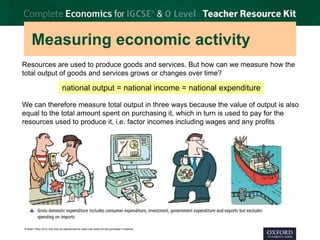
Measuring economic activity
Resources are used to produce goods and services. But how can we measure how the
total output of goods and services grows or changes over time?
We can therefore measure total output in three ways because the value of output is also
equal to the total amount spent on purchasing it, which in turn is used to pay for the
resources used to produce it, i.e. factor incomes including wages and any profits
national output = national income = national expenditure
© Brian Titley 2012: this may be reproduced for class use solely for the purchaser’s institute
Gross domestic product
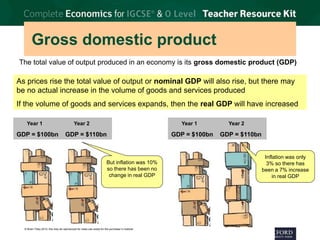
The total value of output produced in an economy is its gross domestic product (GDP)
As prices rise the total value of output or nominal GDP will also rise, but there may
be no actual increase in the volume of goods and services produced
If the volume of goods and services expands, then the real GDP will have increased
Year 1 Year 2
GDP = $100bn GDP = $110bn
But inflation was 10%
so there has been no
change in real GDP
Year 1 Year 2
GDP = $100bn GDP = $110bn
Inflation was only
3% so there has
been a 7% increase
in real GDP
© Brian Titley 2012: this may be reproduced for class use solely for the purchaser’s institute
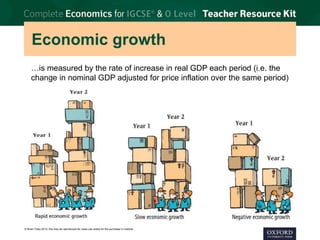
Economic growth
…is measured by the rate of increase in real GDP each period (i.e. the
change in nominal GDP adjusted for price inflation over the same period)
© Brian Titley 2012: this may be reproduced for class use solely for the purchaser’s institute
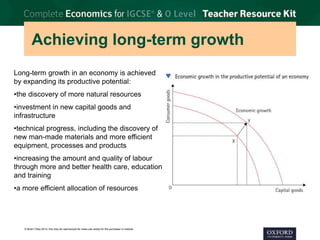
Achieving long-term growth
Long-term growth in an economy is achieved
by expanding its productive potential:
•the discovery of more natural resources
•investment in new capital goods and
infrastructure
•technical progress, including the discovery of
new man-made materials and more efficient
equipment, processes and products
•increasing the amount and quality of labour
through more and better health care, education
and training
•a more efficient allocation of resources
© Brian Titley 2012: this may be reproduced for class use solely for the purchaser’s institute
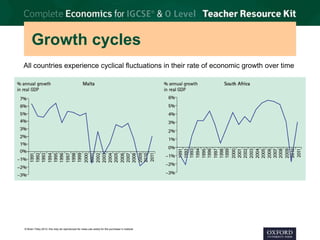
Growth cycles
All countries experience cyclical fluctuations in their rate of economic growth over time
© Brian Titley 2012: this may be reproduced for class use solely for the purchaser’s institute
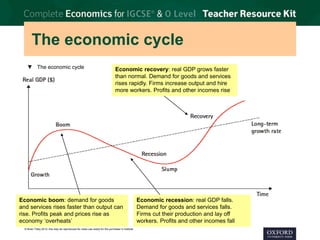
The economic cycle
▼ The economic cycle Economic recovery: real GDP grows faster
than normal. Demand for goods and services
rises rapidly. Firms increase output and hire
more workers. Profits and other incomes rise
Economic recession: real GDP falls.
Demand for goods and services falls.
Firms cut their production and lay off
workers. Profits and other incomes fall
Economic boom: demand for goods
and services rises faster than output can
rise. Profits peak and prices rise as
economy ‘overheats’
© Brian Titley 2012: this may be reproduced for class use solely for the purchaser’s institute
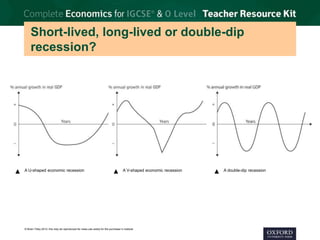
Short-lived, long-lived or double-dip
recession?
▲ A U-shaped economic recession ▲ A V-shaped economic recession ▲ A double-dip recession
© Brian Titley 2012: this may be reproduced for class use solely for the purchaser’s institute
Economic growth or economic welfare?
The benefits of economic growth are:
more goods and services, more wants satisfied
increased employment opportunities and incomes
increased sales, profits and business opportunities
low price inflation if output growth keeps pace with demand
increasing tax revenues for a government to improve public services
and public infrastructure
improved living standards
Possible problems with growth are:
xtechnical progress may replace labour with machines
xscarce resources are used up at a faster rate
xincreasing pollution and damage to natural environment
xpeople are not necessarily better off if growth is achieved, for example
by producing more weapons, cigarettes, coal-fired power stations or
even more cars, televisions and computer games
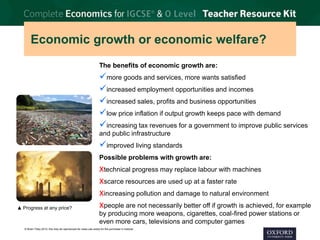
▲ Progress at any price?
© Brian Titley 2012: this may be reproduced for class use solely for the purchaser’s institute
Measuring economic welfare
Simply measuring and monitoring the rate at which real output grows over time reveals
very little about how standards of living are changing, if growth is sustainable, and
whether economic welfare is improving.
Here are two possible measures of living standards:
Real GDP per capita
A measure of the average income per person. If
real GDP grows but the population increases at a
faster rate then average income per head will fall.
But it takes no account of:
•how income is distributed (a few very rich people
can skew the average upwards)
•what people can buy (the availability of goods
and services may be poor)
•the quality of and access to education, health
care, clean water and sanitation
•the impact of growth on the natural environment
Human Development Index (HDI)
A wider measure that includes:
•real GDP per capita (adjusted for
differences in exchange rates between
countries)
•level of education (how many years on
average a person aged 25 will have spent
in education and how many years a young
child entering school now can be expected
to spend in education during his or her life)
•access to health care and having a
healthy lifestyle (measured by life
expectancy)
© Brian Titley 2012: this may be reproduced for class use solely for the purchaser’s institute
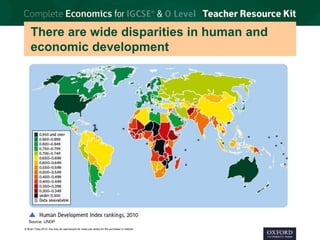
There are wide disparities in human and
economic development
Source: UNDP

Output and Economic Growth.ppt

  • 1.
    © Brian Titley2012: this may be reproduced for class use solely for the purchaser’s institute IGCSE®/O Level Economics 6.3 Output and growth S17
  • 2.
    © Brian Titley2012: this may be reproduced for class use solely for the purchaser’s institute Measuring economic activity Resources are used to produce goods and services. But how can we measure how the total output of goods and services grows or changes over time? We can therefore measure total output in three ways because the value of output is also equal to the total amount spent on purchasing it, which in turn is used to pay for the resources used to produce it, i.e. factor incomes including wages and any profits national output = national income = national expenditure
  • 3.
    © Brian Titley2012: this may be reproduced for class use solely for the purchaser’s institute Gross domestic product The total value of output produced in an economy is its gross domestic product (GDP) As prices rise the total value of output or nominal GDP will also rise, but there may be no actual increase in the volume of goods and services produced If the volume of goods and services expands, then the real GDP will have increased Year 1 Year 2 GDP = $100bn GDP = $110bn But inflation was 10% so there has been no change in real GDP Year 1 Year 2 GDP = $100bn GDP = $110bn Inflation was only 3% so there has been a 7% increase in real GDP
  • 4.
    © Brian Titley2012: this may be reproduced for class use solely for the purchaser’s institute Economic growth …is measured by the rate of increase in real GDP each period (i.e. the change in nominal GDP adjusted for price inflation over the same period)
  • 5.
    © Brian Titley2012: this may be reproduced for class use solely for the purchaser’s institute Achieving long-term growth Long-term growth in an economy is achieved by expanding its productive potential: •the discovery of more natural resources •investment in new capital goods and infrastructure •technical progress, including the discovery of new man-made materials and more efficient equipment, processes and products •increasing the amount and quality of labour through more and better health care, education and training •a more efficient allocation of resources
  • 6.
    © Brian Titley2012: this may be reproduced for class use solely for the purchaser’s institute Growth cycles All countries experience cyclical fluctuations in their rate of economic growth over time
  • 7.
    © Brian Titley2012: this may be reproduced for class use solely for the purchaser’s institute The economic cycle ▼ The economic cycle Economic recovery: real GDP grows faster than normal. Demand for goods and services rises rapidly. Firms increase output and hire more workers. Profits and other incomes rise Economic recession: real GDP falls. Demand for goods and services falls. Firms cut their production and lay off workers. Profits and other incomes fall Economic boom: demand for goods and services rises faster than output can rise. Profits peak and prices rise as economy ‘overheats’
  • 8.
    © Brian Titley2012: this may be reproduced for class use solely for the purchaser’s institute Short-lived, long-lived or double-dip recession? ▲ A U-shaped economic recession ▲ A V-shaped economic recession ▲ A double-dip recession
  • 9.
    © Brian Titley2012: this may be reproduced for class use solely for the purchaser’s institute Economic growth or economic welfare? The benefits of economic growth are: more goods and services, more wants satisfied increased employment opportunities and incomes increased sales, profits and business opportunities low price inflation if output growth keeps pace with demand increasing tax revenues for a government to improve public services and public infrastructure improved living standards Possible problems with growth are: xtechnical progress may replace labour with machines xscarce resources are used up at a faster rate xincreasing pollution and damage to natural environment xpeople are not necessarily better off if growth is achieved, for example by producing more weapons, cigarettes, coal-fired power stations or even more cars, televisions and computer games ▲ Progress at any price?
  • 10.
    © Brian Titley2012: this may be reproduced for class use solely for the purchaser’s institute Measuring economic welfare Simply measuring and monitoring the rate at which real output grows over time reveals very little about how standards of living are changing, if growth is sustainable, and whether economic welfare is improving. Here are two possible measures of living standards: Real GDP per capita A measure of the average income per person. If real GDP grows but the population increases at a faster rate then average income per head will fall. But it takes no account of: •how income is distributed (a few very rich people can skew the average upwards) •what people can buy (the availability of goods and services may be poor) •the quality of and access to education, health care, clean water and sanitation •the impact of growth on the natural environment Human Development Index (HDI) A wider measure that includes: •real GDP per capita (adjusted for differences in exchange rates between countries) •level of education (how many years on average a person aged 25 will have spent in education and how many years a young child entering school now can be expected to spend in education during his or her life) •access to health care and having a healthy lifestyle (measured by life expectancy)
  • 11.
    © Brian Titley2012: this may be reproduced for class use solely for the purchaser’s institute There are wide disparities in human and economic development Source: UNDP