The sources of the economic growth
What is the economic growth ?
gurunEs p1
Chapter One
The sources of the economic growth
What is the economic growth ?
gurunEs p2
Chapter One
a/ What is the economic growth ?
b/ How to measure the economic growth ?
c/ A strong growth means a higher standard of living
d/ Problem : the GDP does not take in account the
quality of life enough, so the HDI is needed
a/ What is the economic growth ?
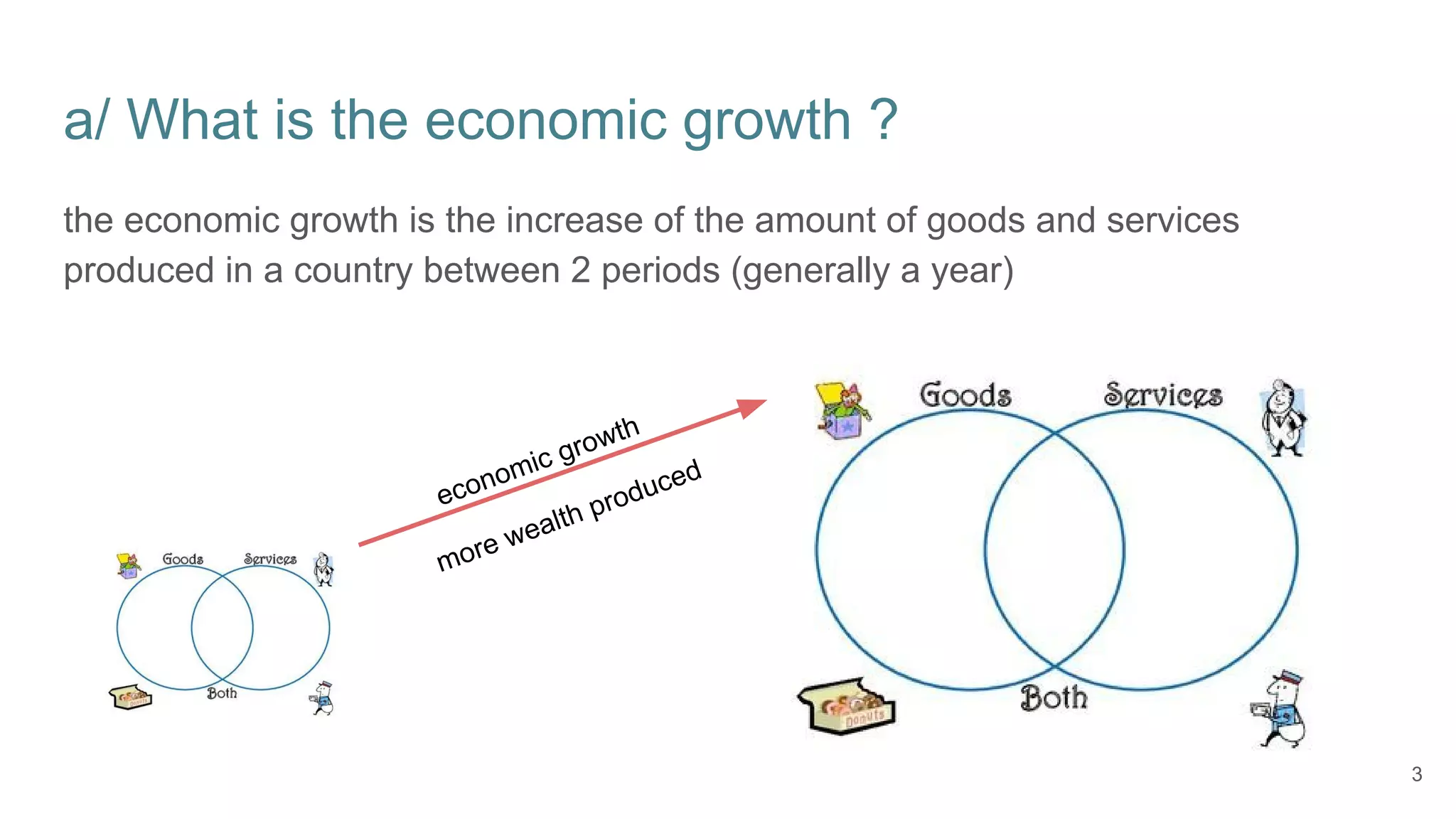
the economic growth is the increase of the amount of goods and services
produced in a country between 2 periods (generally a year)
3
economic growth
more wealth produced
Test : What is the economic growth ?
the economic growth is (several possible answers)
❏ the decrease of the amount of goods and services produced in a country
between 2 periods (generally a year)
❏ the increase of the amount of goods and services produced in a country
between 2 periods (generally a year)
❏ Economic growth is how much more the economy produces than it did before.
Test : What is the economic growth ?
the economic growth is (several possible answers)
❏ the decrease of the amount of goods and services produced in a country
between 2 periods (generally a year)
❏ the increase of the amount of goods and services produced in a country
between 2 periods (generally a year)
❏ Economic growth is how much more the economy produces than it did before.
b/ how to measure the economic growth ?
The economic growth is measured by the increase of the real GDP between 2 periods.
GDP : Gross Domestic Product : sum of the value added in the various activities within a country’s
borders in a specific period.
It is commonly used to
● determine the economic performance of a whole country or region
● make international comparisons.
6
The real GDP : the main difference between nominal and real values is that real values are adjusted for
inflation, while nominal values are not. As a result, nominal GDP will often appear higher than real GDP.
explanation : When the GDP rises, we don’t know whether the prices or the quantity of goods and
services produced have gone up… So we have to calculate the real GDP as if the prices have stayed the
same between the 2 periods.
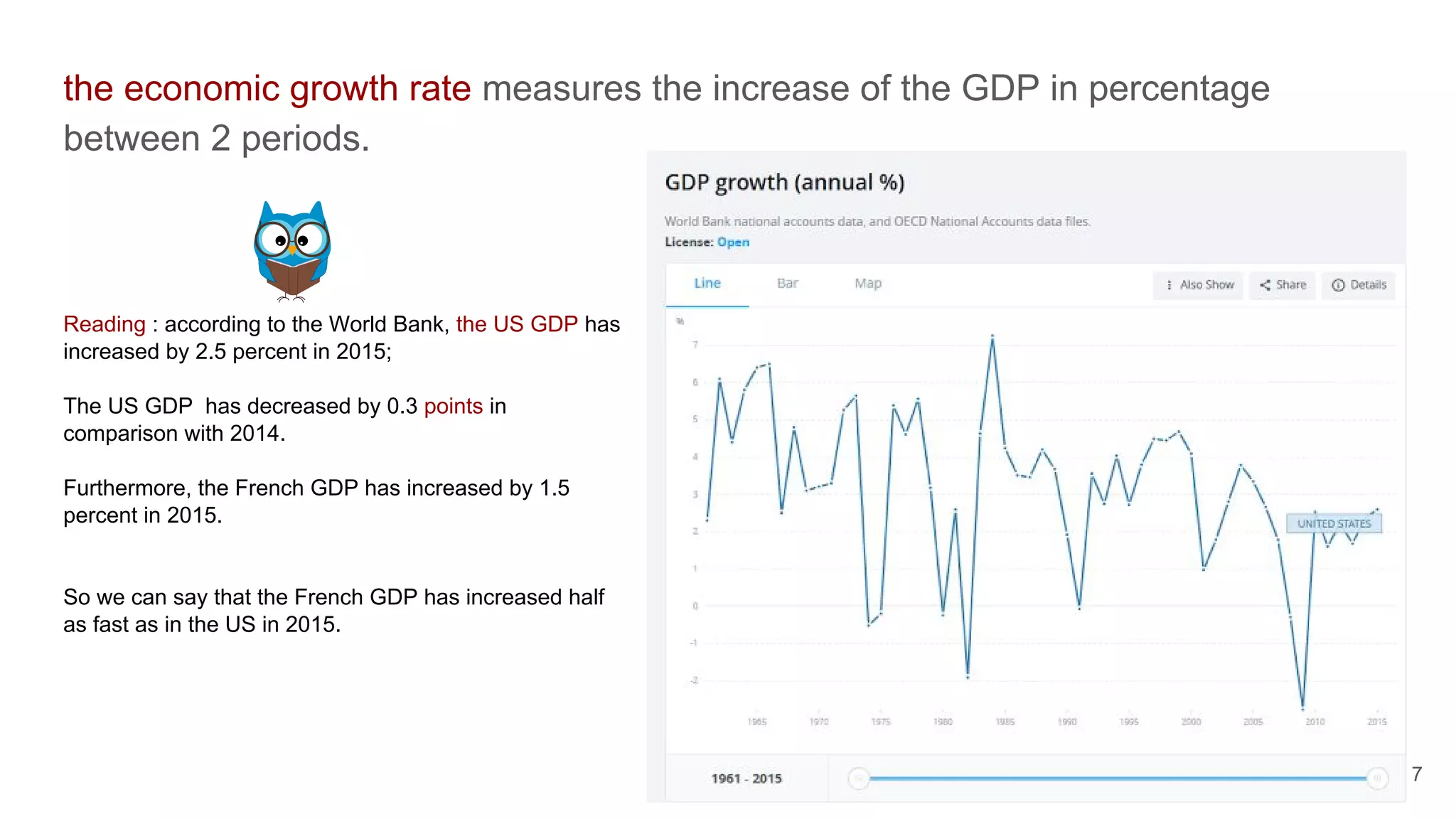
the economic growth rate measures the increase of the GDP in percentage
between 2 periods.
7
Reading : according to the World Bank, the US GDP has
increased by 2.5 percent in 2015;
The US GDP has decreased by 0.3 points in
comparison with 2014.
Furthermore, the French GDP has increased by 1.5
percent in 2015.
So we can say that the French GDP has increased half
as fast as in the US in 2015.
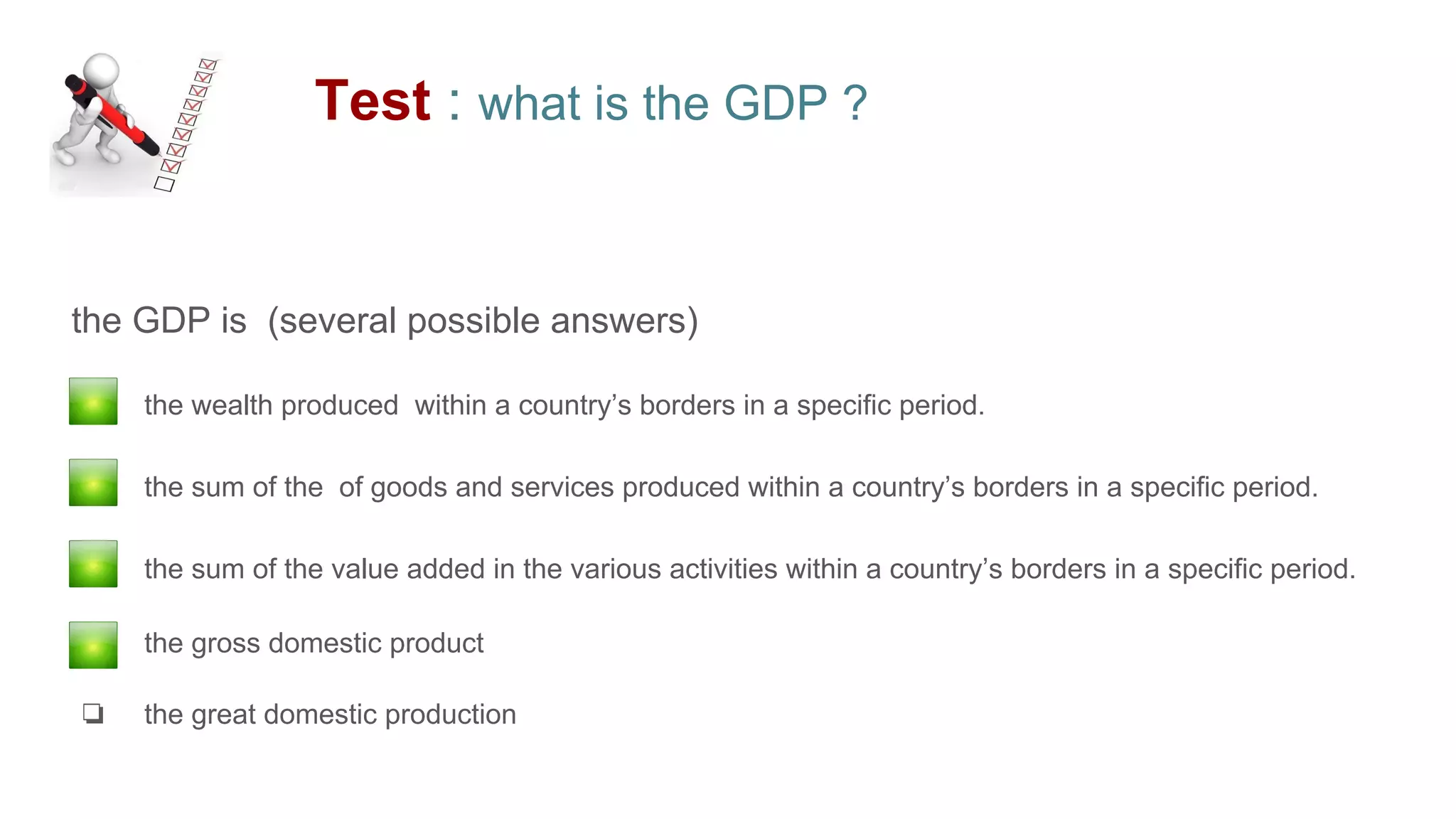
Test : what is the GDP ?
the GDP is (several possible answers)
❏ the wealth produced within a country’s borders in a specific period.
❏ the sum of the of goods and services produced within a country’s borders in a specific period.
❏ the sum of the value added in the various activities within a country’s borders in a specific period.
❏ the gross domestic product
❏ the great domestic production
Test : what is the GDP ?
the GDP is (several possible answers)
❏ the wealth produced within a country’s borders in a specific period.
❏ the sum of the of goods and services produced within a country’s borders in a specific period.
❏ the sum of the value added in the various activities within a country’s borders in a specific period.
❏ the gross domestic product
❏ the great domestic production
Beware !
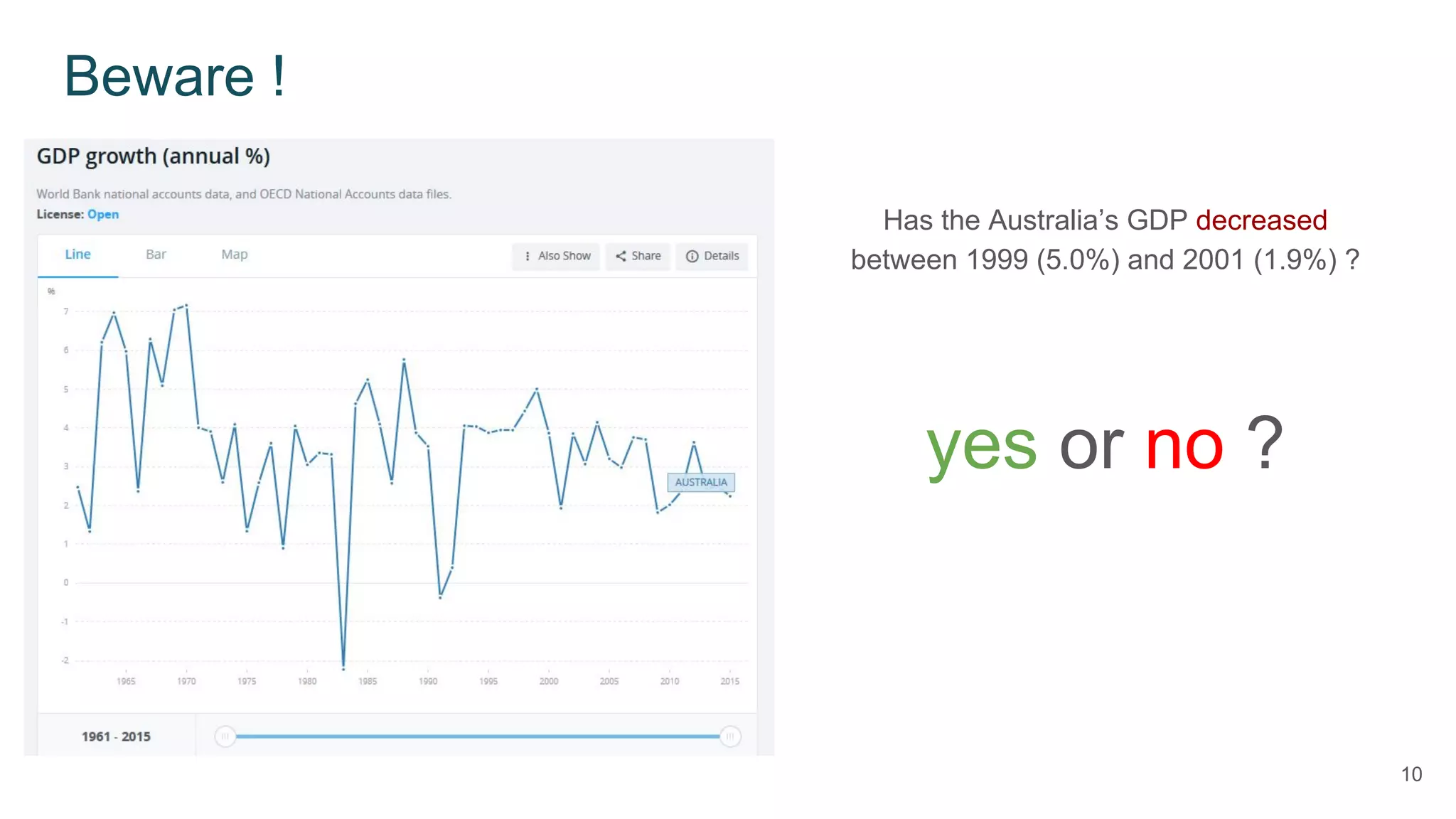
Has the Australia’s GDP decreased
between 1999 (5.0%) and 2001 (1.9%) ?
10
yes or no ?
11
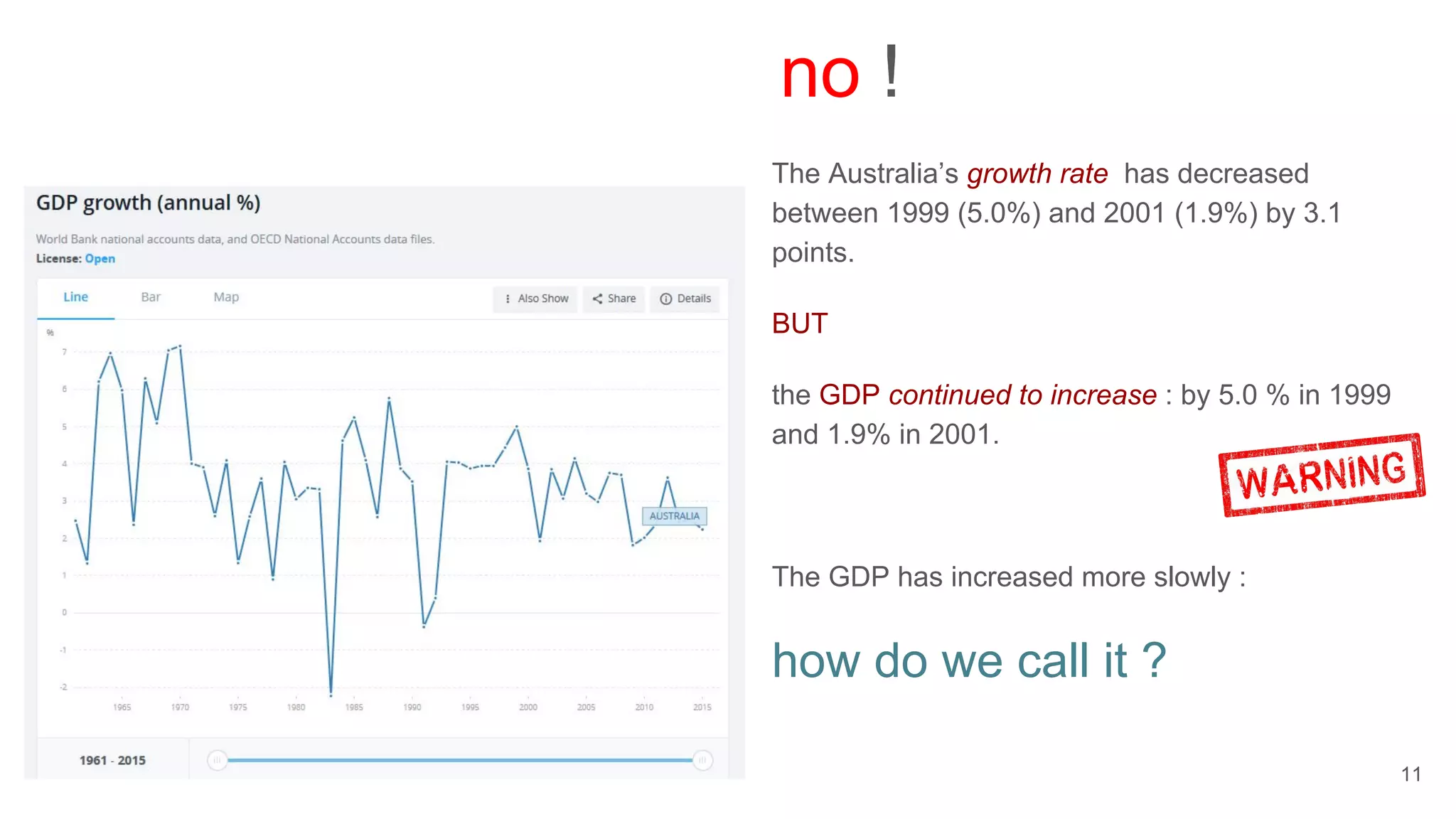
no !
The Australia’s growth rate has decreased
between 1999 (5.0%) and 2001 (1.9%) by 3.1
points.
BUT
the GDP continued to increase : by 5.0 % in 1999
and 1.9% in 2001.
The GDP has increased more slowly :
how do we call it ?
Beware !
12
The Australia’s growth rate has decreased between 1999 (5.0%) and 2001 (1.9%) by 3.1 points.
BUT
The GDP continued to increase : by 5.0 % in 1999 and 1.9% in 2001.
Actually the GDP has increased more slowly :
This is called recession.
A recession is a significant decline in activity across the economy, lasting longer than a few months, usually 2 quarters at least.
Beware !
13
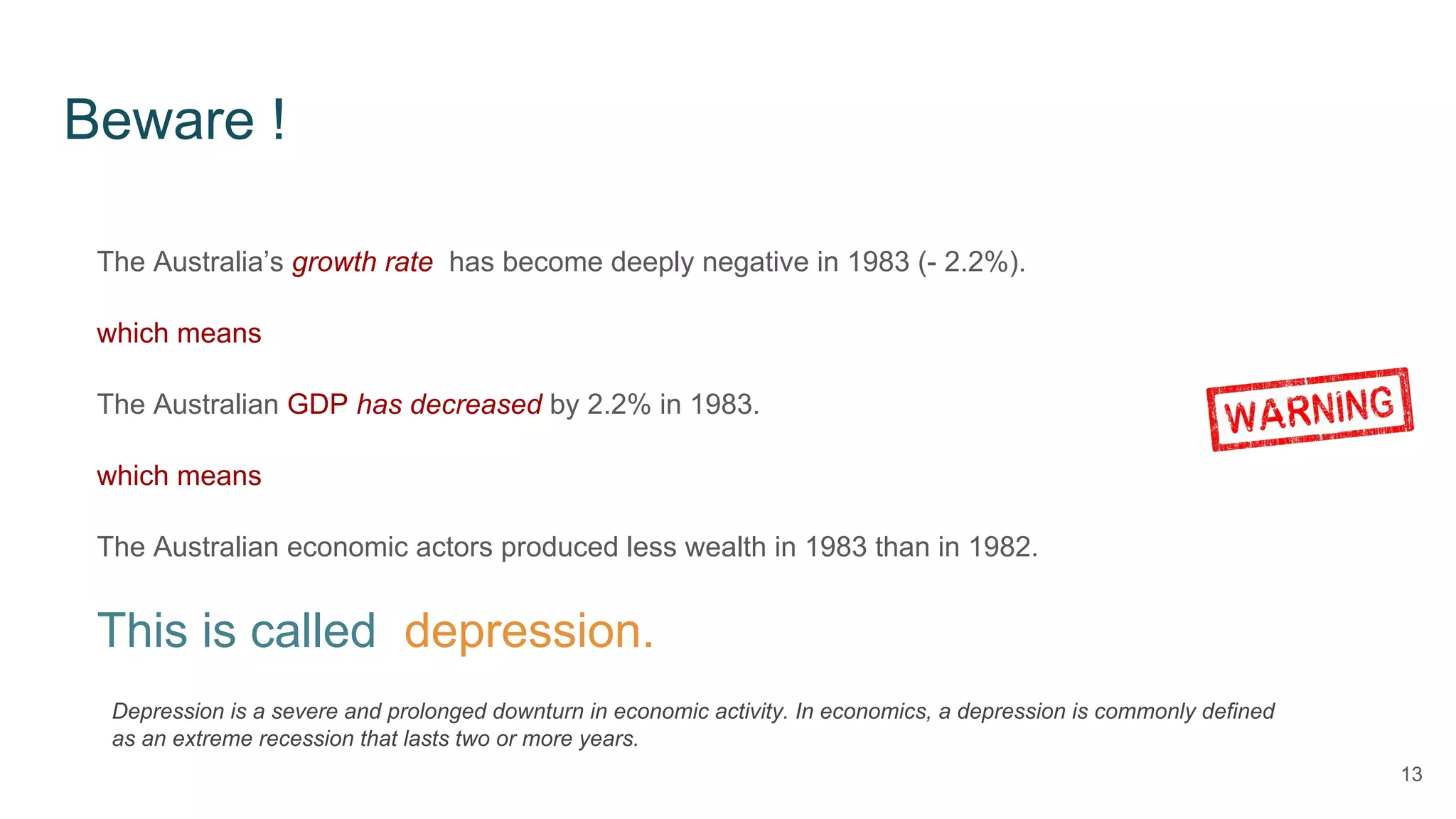
The Australia’s growth rate has become deeply negative in 1983 (- 2.2%).
which means
The Australian GDP has decreased by 2.2% in 1983.
which means
The Australian economic actors produced less wealth in 1983 than in 1982.
This is called depression.
Depression is a severe and prolonged downturn in economic activity. In economics, a depression is commonly defined
as an extreme recession that lasts two or more years.
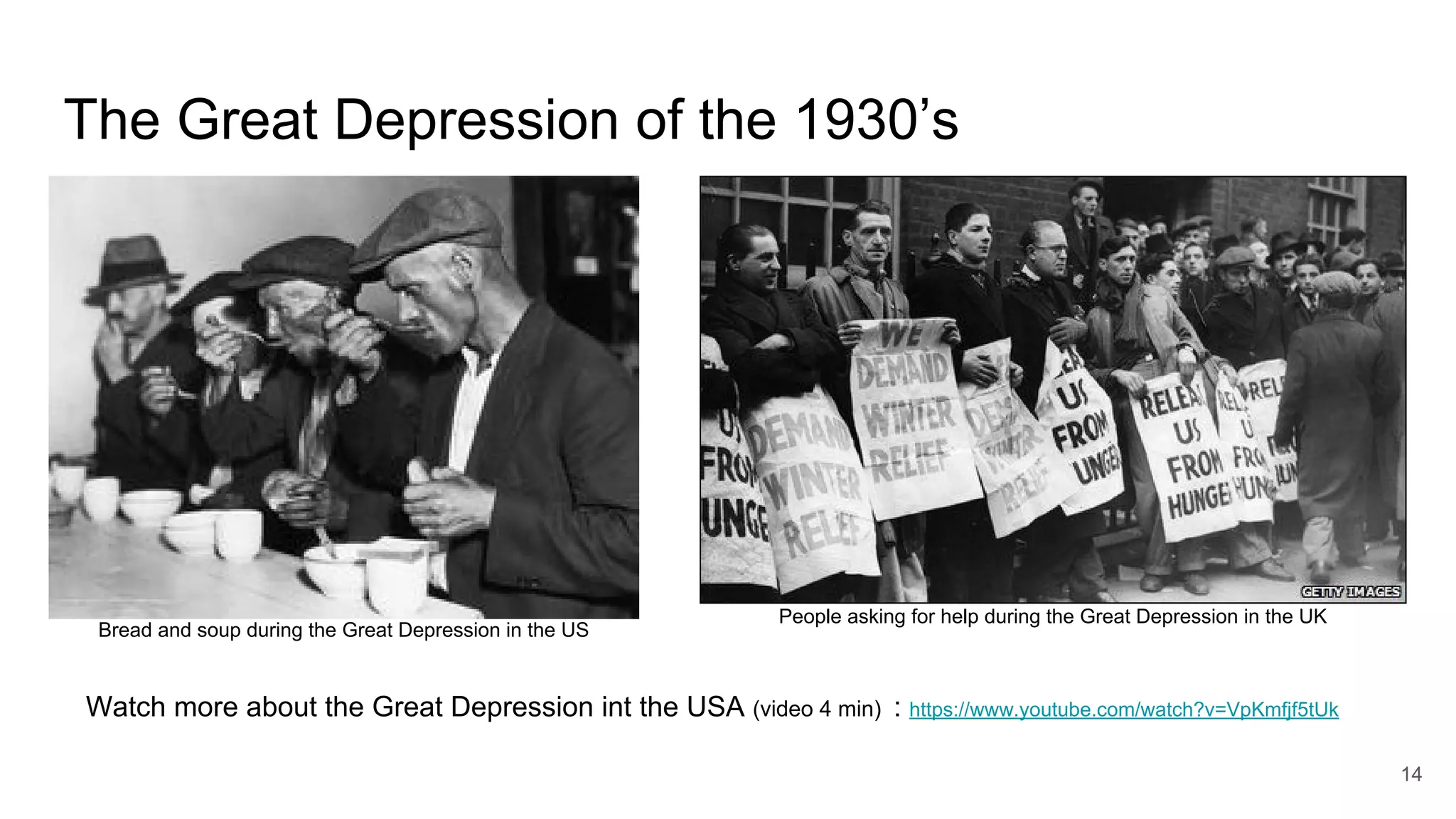
The Great Depression of the 1930’s
14
Bread and soup during the Great Depression in the US
People asking for help during the Great Depression in the UK
Watch more about the Great Depression int the USA (video 4 min) : https://www.youtube.com/watch?v=VpKmfjf5tUk
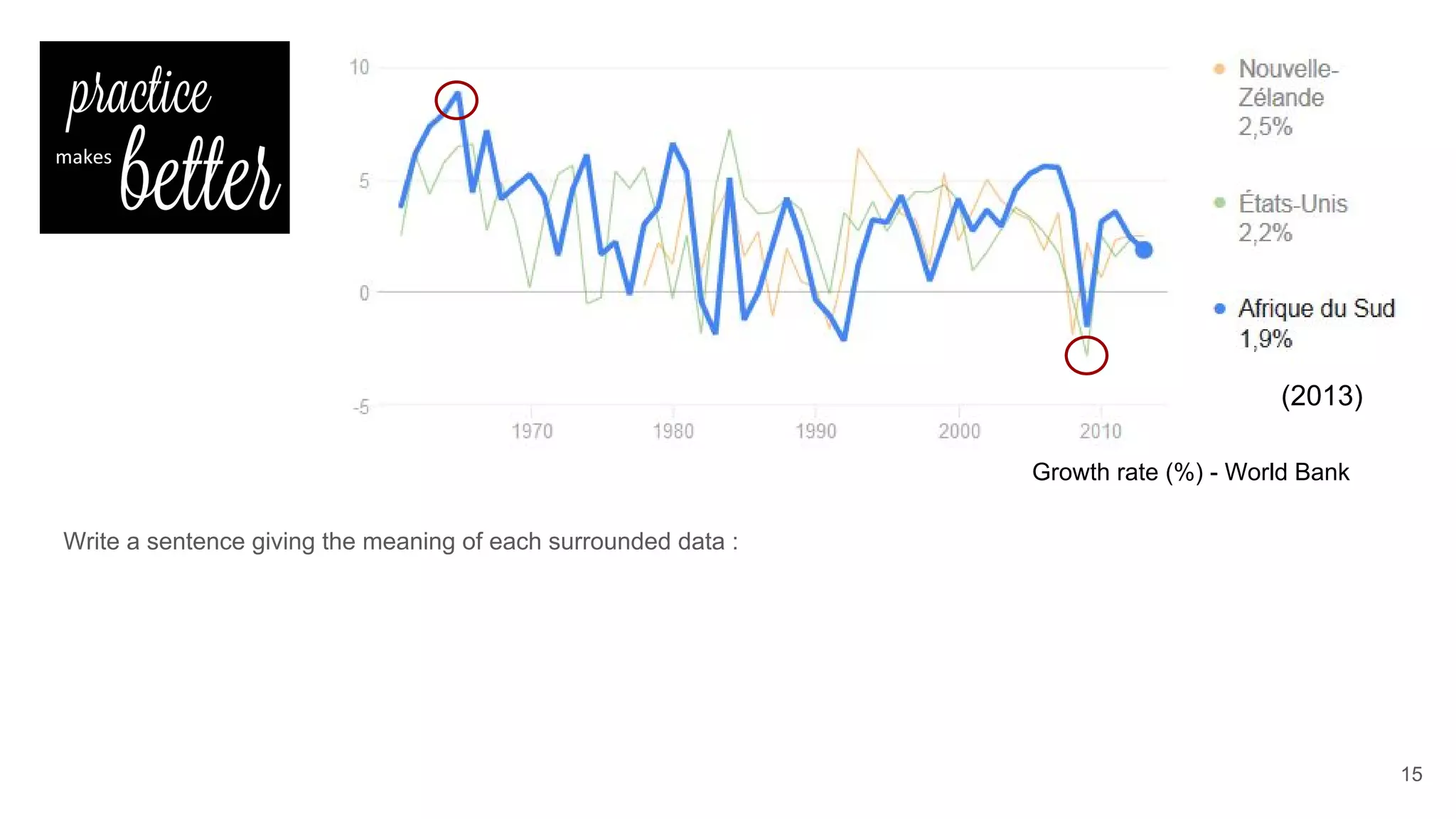
Write a sentence giving the meaning of each surrounded data :
15
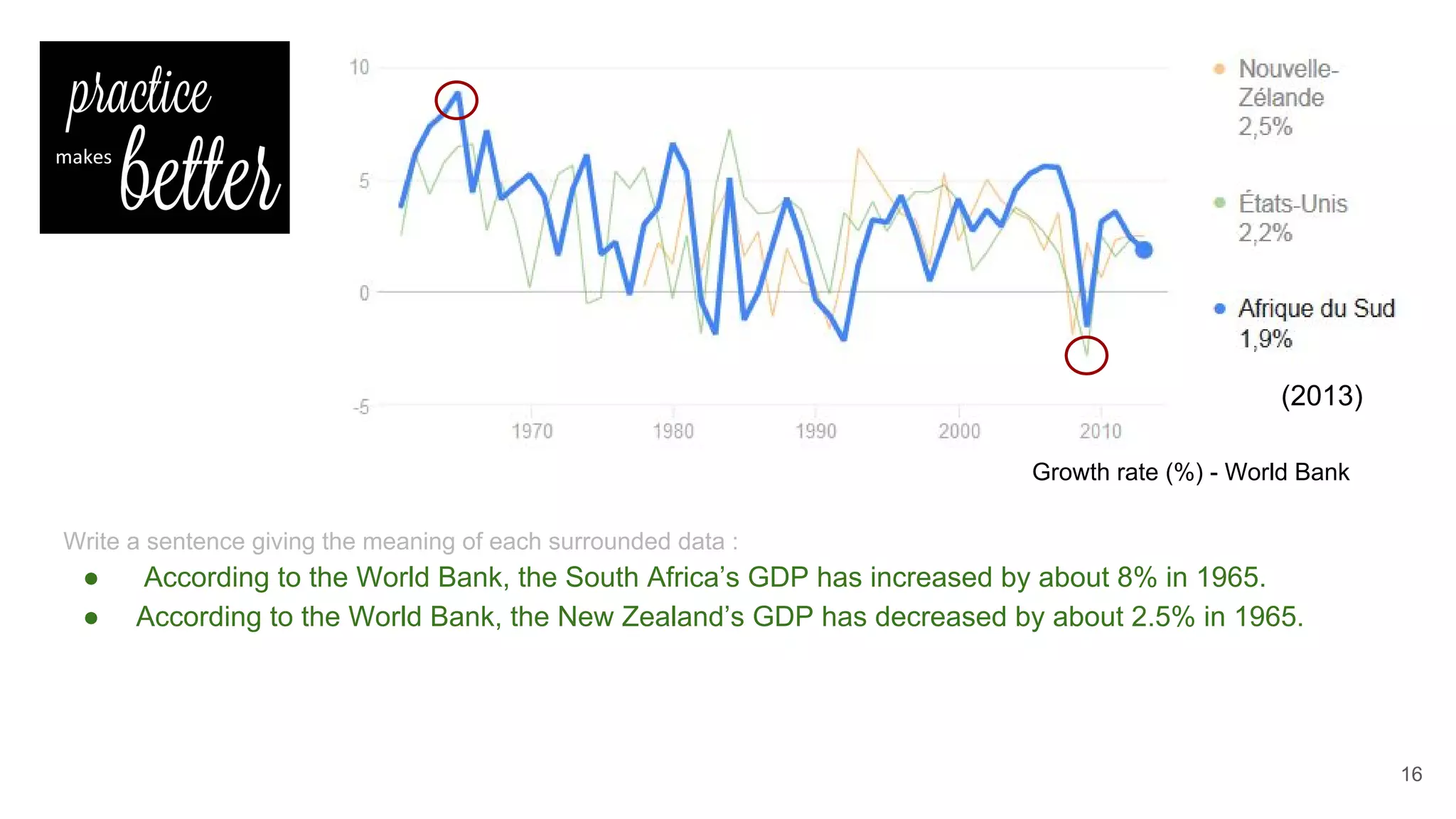
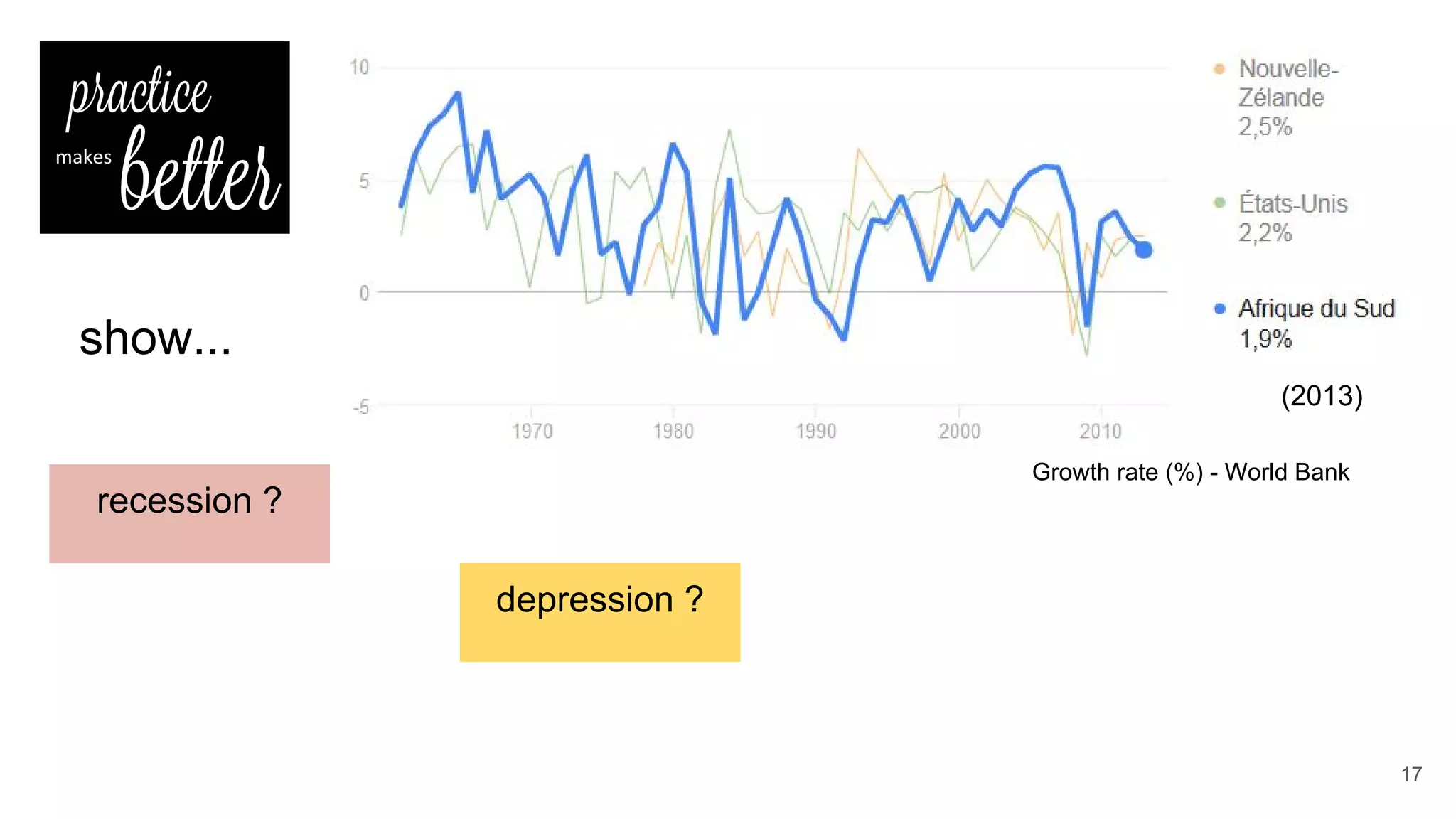
Growth rate (%) - World Bank
(2013)
Write a sentence giving the meaning of each surrounded data :
● According to the World Bank, the South Africa’s GDP has increased by about 8% in 1965.
● According to the World Bank, the New Zealand’s GDP has decreased by about 2.5% in 1965.
16
Growth rate (%) - World Bank
(2013)
recession ?
17
Growth rate (%) - World Bank
(2013)
depression ?
show...
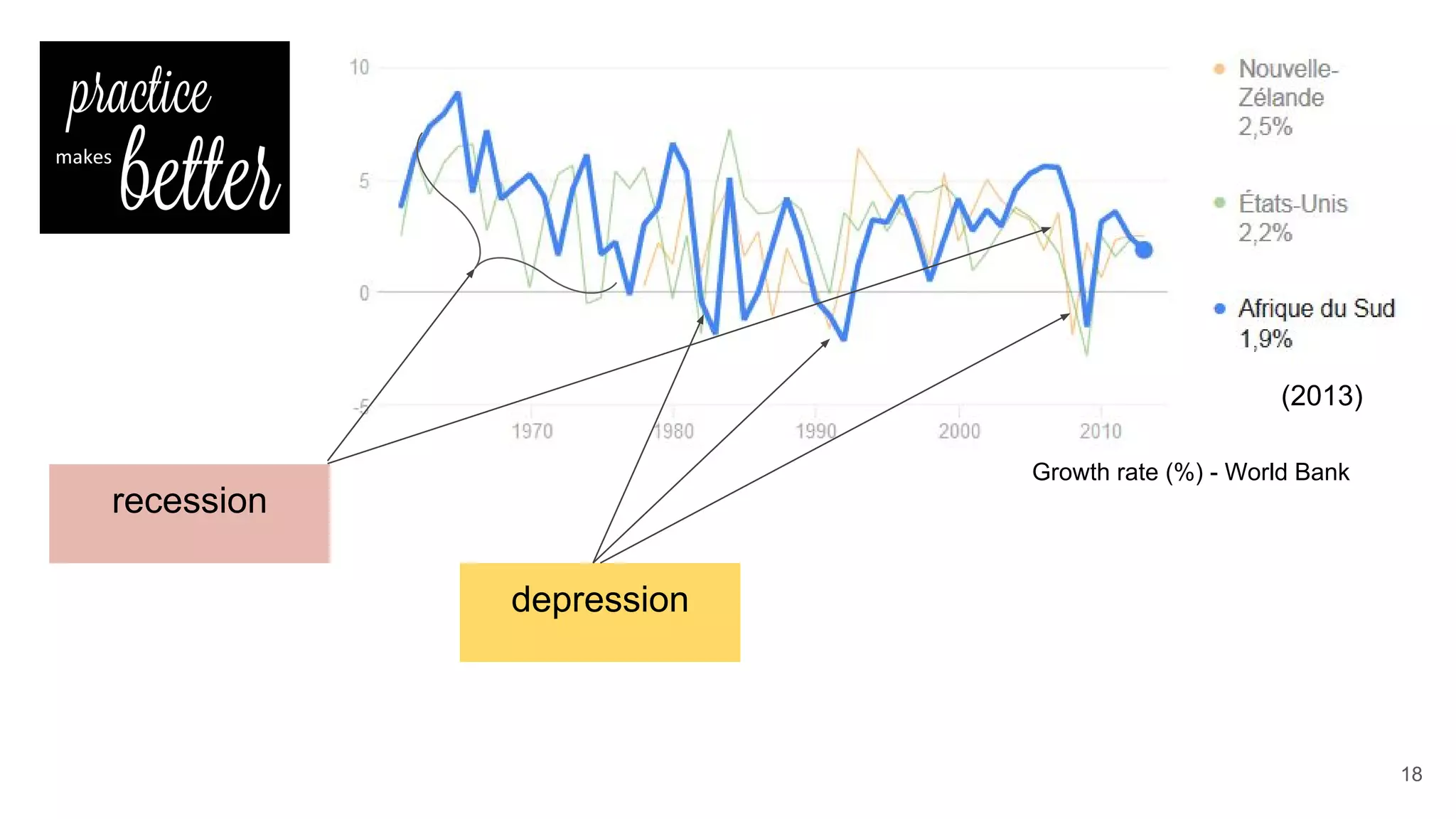
recession
18
Growth rate (%) - World Bank
(2013)
depression
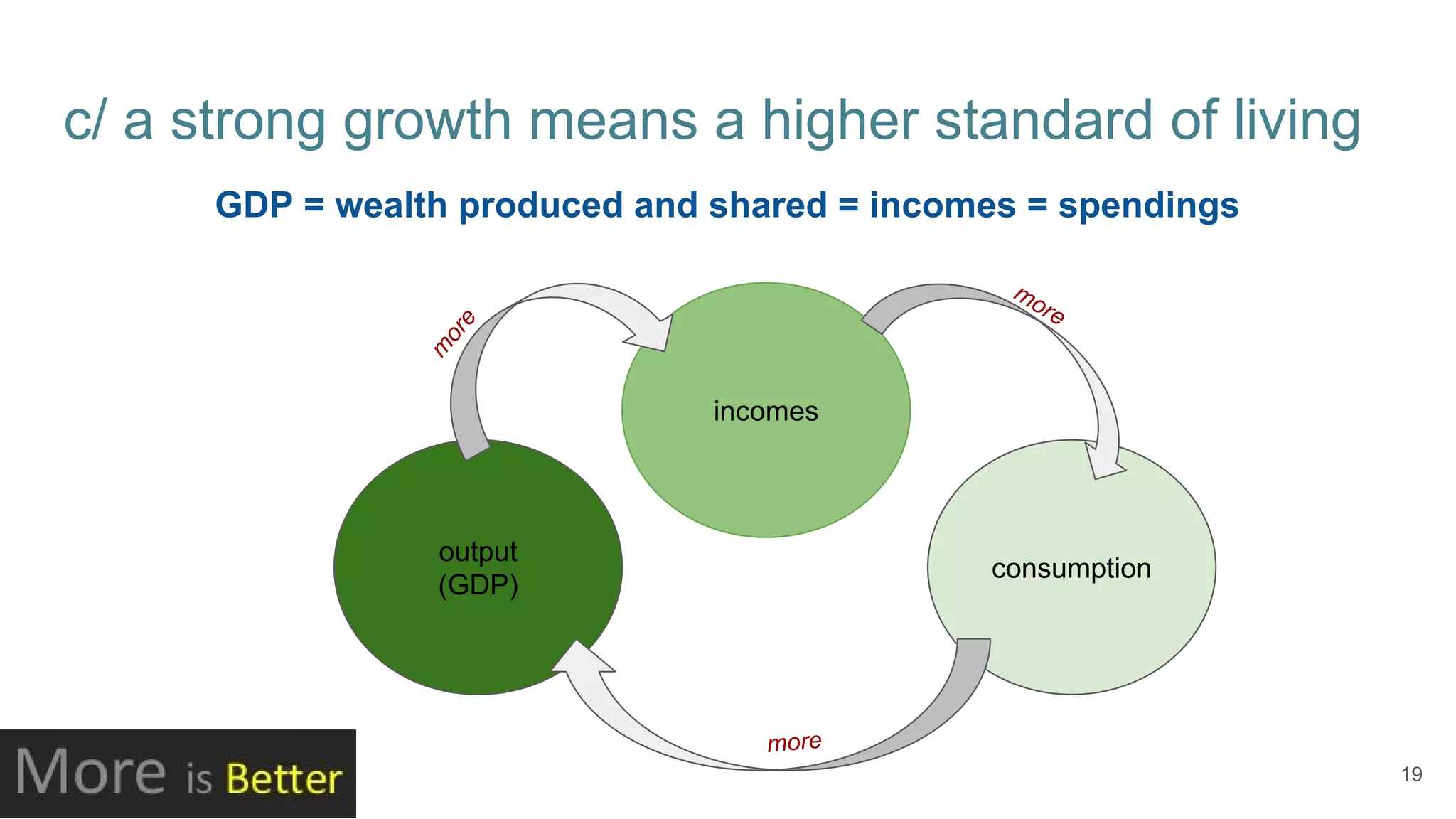
c/ a strong growth means a higher standard of living
GDP = wealth produced and shared = incomes = spendings
19
output
(GDP)
incomes
consumption
more
m
ore
more
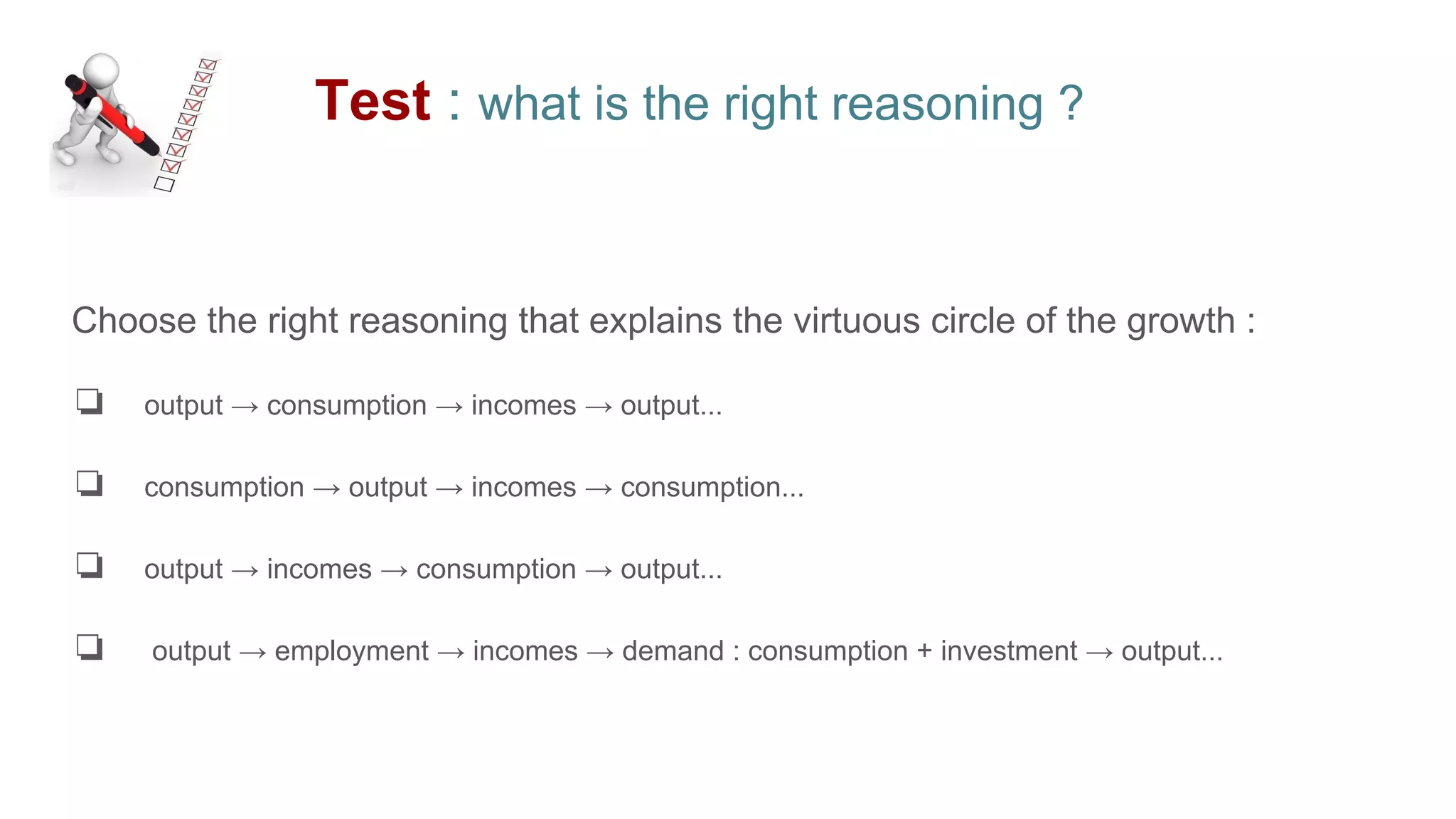
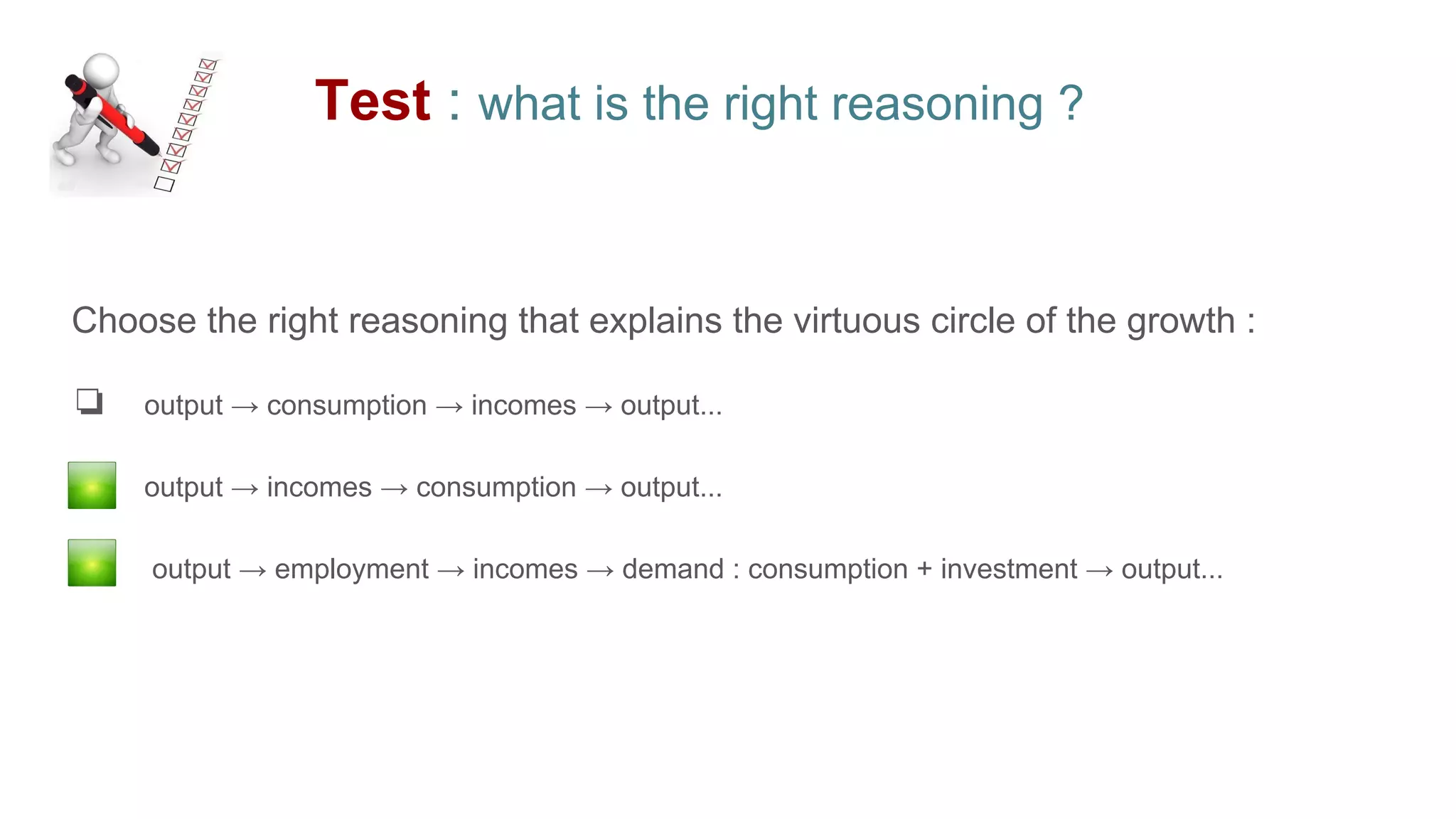
Test : what is the right reasoning ?
Choose the right reasoning that explains the virtuous circle of the growth :
❏ output → consumption → incomes → output...
❏ consumption → output → incomes → consumption...
❏ output → incomes → consumption → output...
❏ output → employment → incomes → demand : consumption + investment → output...
Test : what is the right reasoning ?
Choose the right reasoning that explains the virtuous circle of the growth :
❏ output → consumption → incomes → output...
❏ output → incomes → consumption → output...
❏ output → employment → incomes → demand : consumption + investment → output...
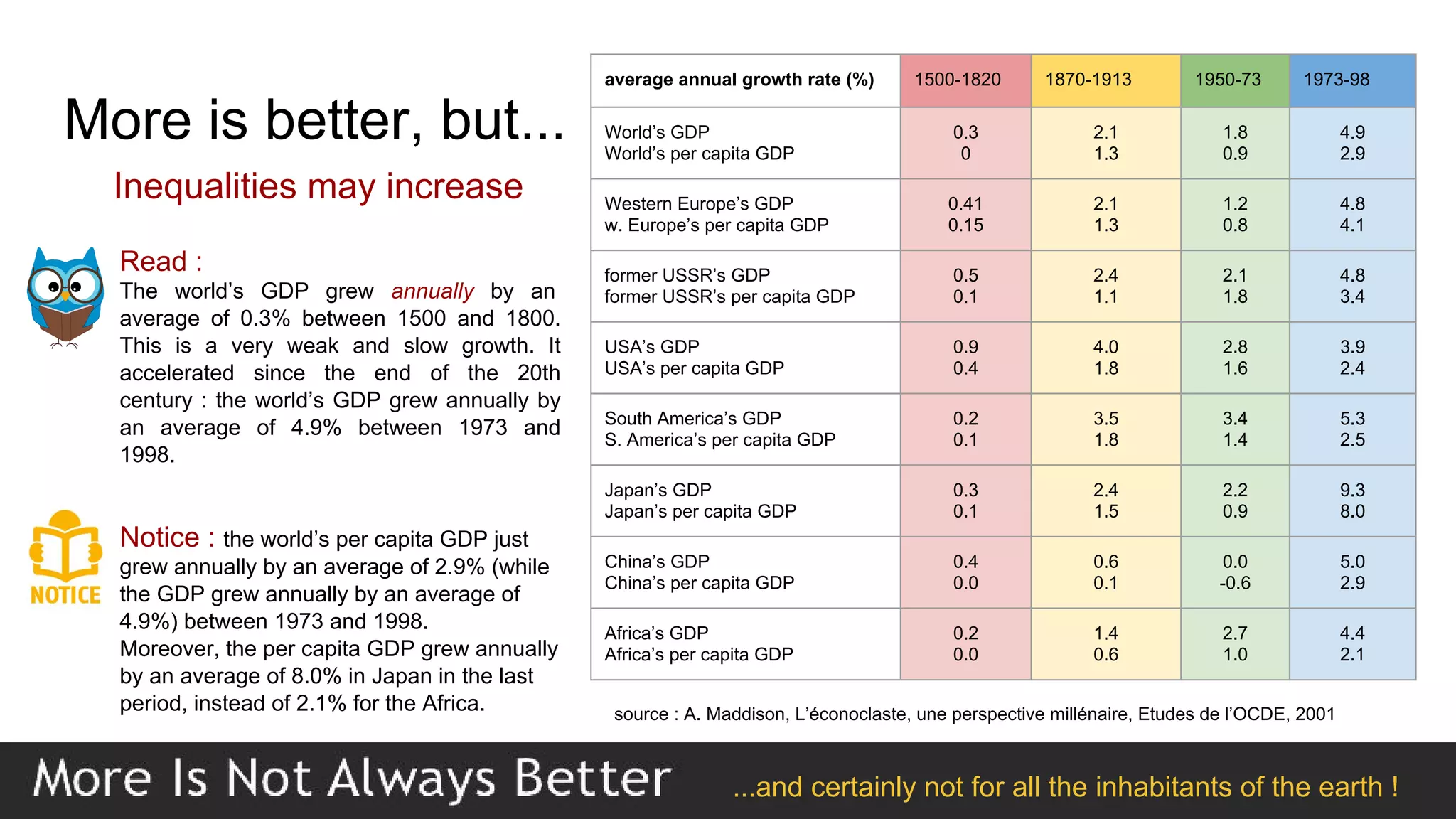
More is better, but...
Inequalities may increase
22
average annual growth rate (%) 1500-1820 1870-1913 1950-73 1973-98
World’s GDP
World’s per capita GDP
0.3
0
2.1
1.3
1.8
0.9
4.9
2.9
Western Europe’s GDP
w. Europe’s per capita GDP
0.41
0.15
2.1
1.3
1.2
0.8
4.8
4.1
former USSR’s GDP
former USSR’s per capita GDP
0.5
0.1
2.4
1.1
2.1
1.8
4.8
3.4
USA’s GDP
USA’s per capita GDP
0.9
0.4
4.0
1.8
2.8
1.6
3.9
2.4
South America’s GDP
S. America’s per capita GDP
0.2
0.1
3.5
1.8
3.4
1.4
5.3
2.5
Japan’s GDP
Japan’s per capita GDP
0.3
0.1
2.4
1.5
2.2
0.9
9.3
8.0
China’s GDP
China’s per capita GDP
0.4
0.0
0.6
0.1
0.0
-0.6
5.0
2.9
Africa’s GDP
Africa’s per capita GDP
0.2
0.0
1.4
0.6
2.7
1.0
4.4
2.1
source : A. Maddison, L’éconoclaste, une perspective millénaire, Etudes de l’OCDE, 2001
Read :
The world’s GDP grew annually by an
average of 0.3% between 1500 and 1800.
This is a very weak and slow growth. It
accelerated since the end of the 20th
century : the world’s GDP grew annually by
an average of 4.9% between 1973 and
1998.
Notice : the world’s per capita GDP just
grew annually by an average of 2.9% (while
the GDP grew annually by an average of
4.9%) between 1973 and 1998.
Moreover, the per capita GDP grew annually
by an average of 8.0% in Japan in the last
period, instead of 2.1% for the Africa.
...and certainly not for all the inhabitants of the earth !
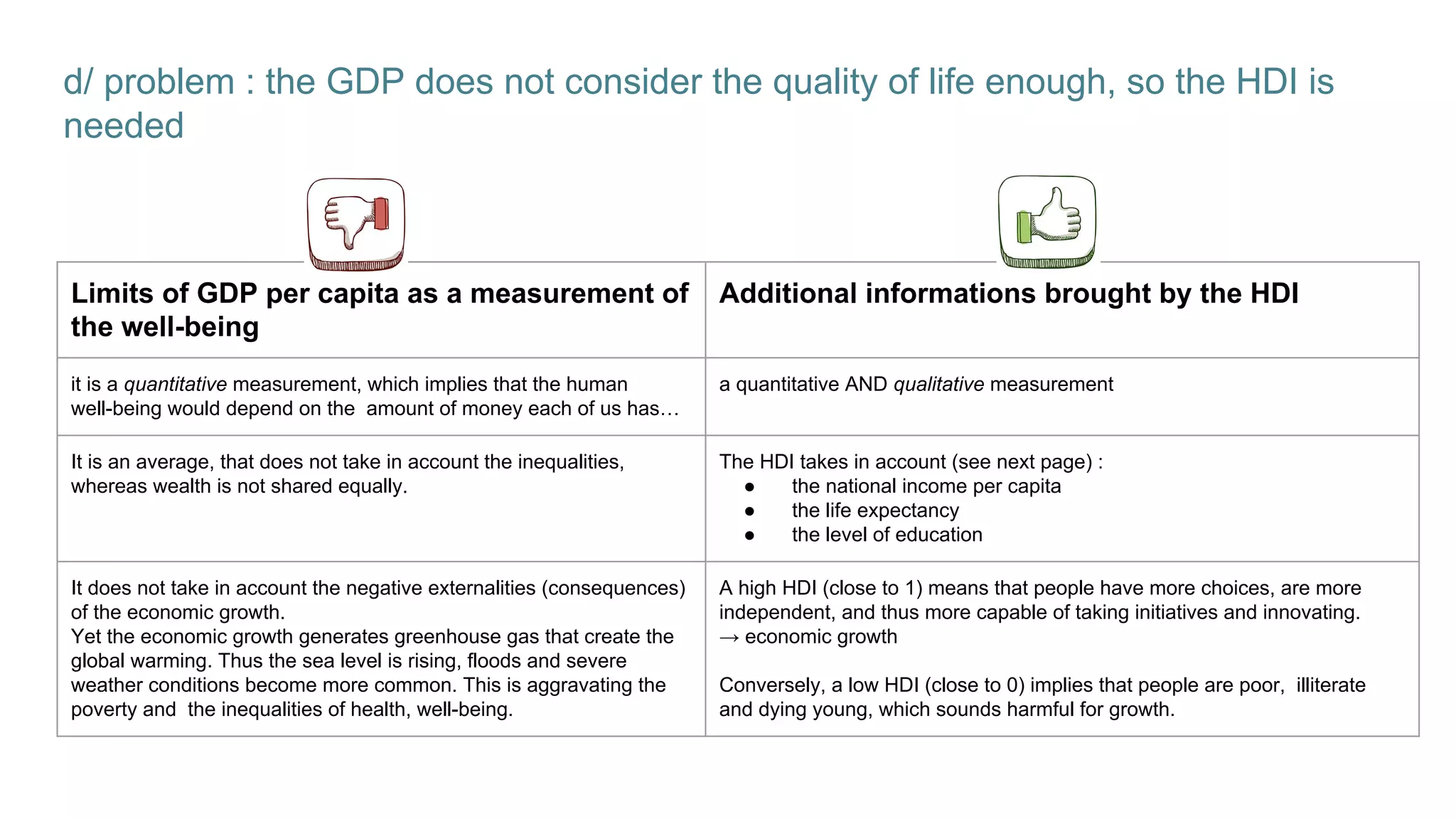
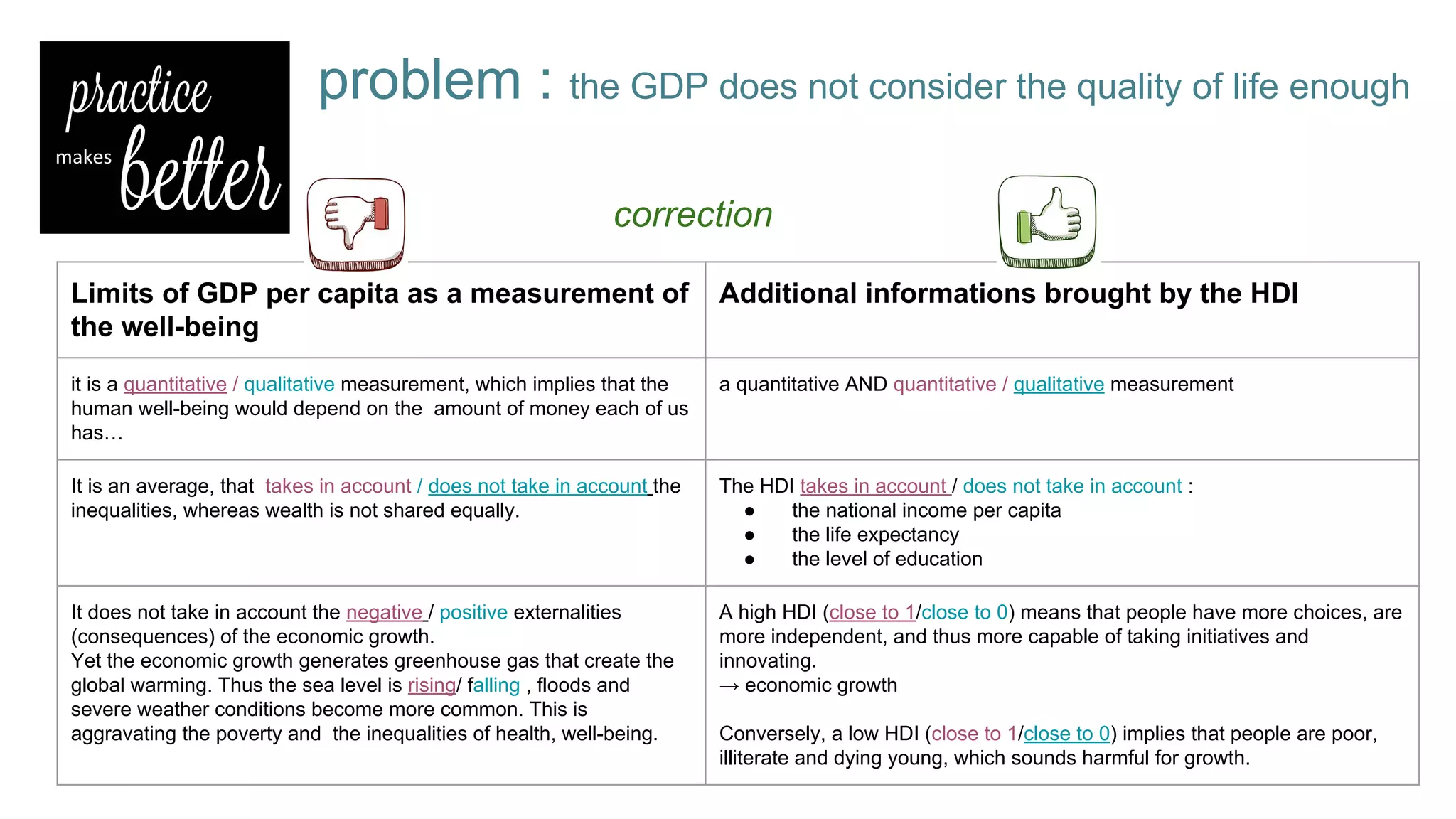
d/ problem : the GDP does not consider the quality of life enough, so the HDI is
needed
Limits of GDP per capita as a measurement of
the well-being
Additional informations brought by the HDI
it is a quantitative measurement, which implies that the human
well-being would depend on the amount of money each of us has…
a quantitative AND qualitative measurement
It is an average, that does not take in account the inequalities,
whereas wealth is not shared equally.
The HDI takes in account (see next page) :
● the national income per capita
● the life expectancy
● the level of education
It does not take in account the negative externalities (consequences)
of the economic growth.
Yet the economic growth generates greenhouse gas that create the
global warming. Thus the sea level is rising, floods and severe
weather conditions become more common. This is aggravating the
poverty and the inequalities of health, well-being.
A high HDI (close to 1) means that people have more choices, are more
independent, and thus more capable of taking initiatives and innovating.
→ economic growth
Conversely, a low HDI (close to 0) implies that people are poor, illiterate
and dying young, which sounds harmful for growth.
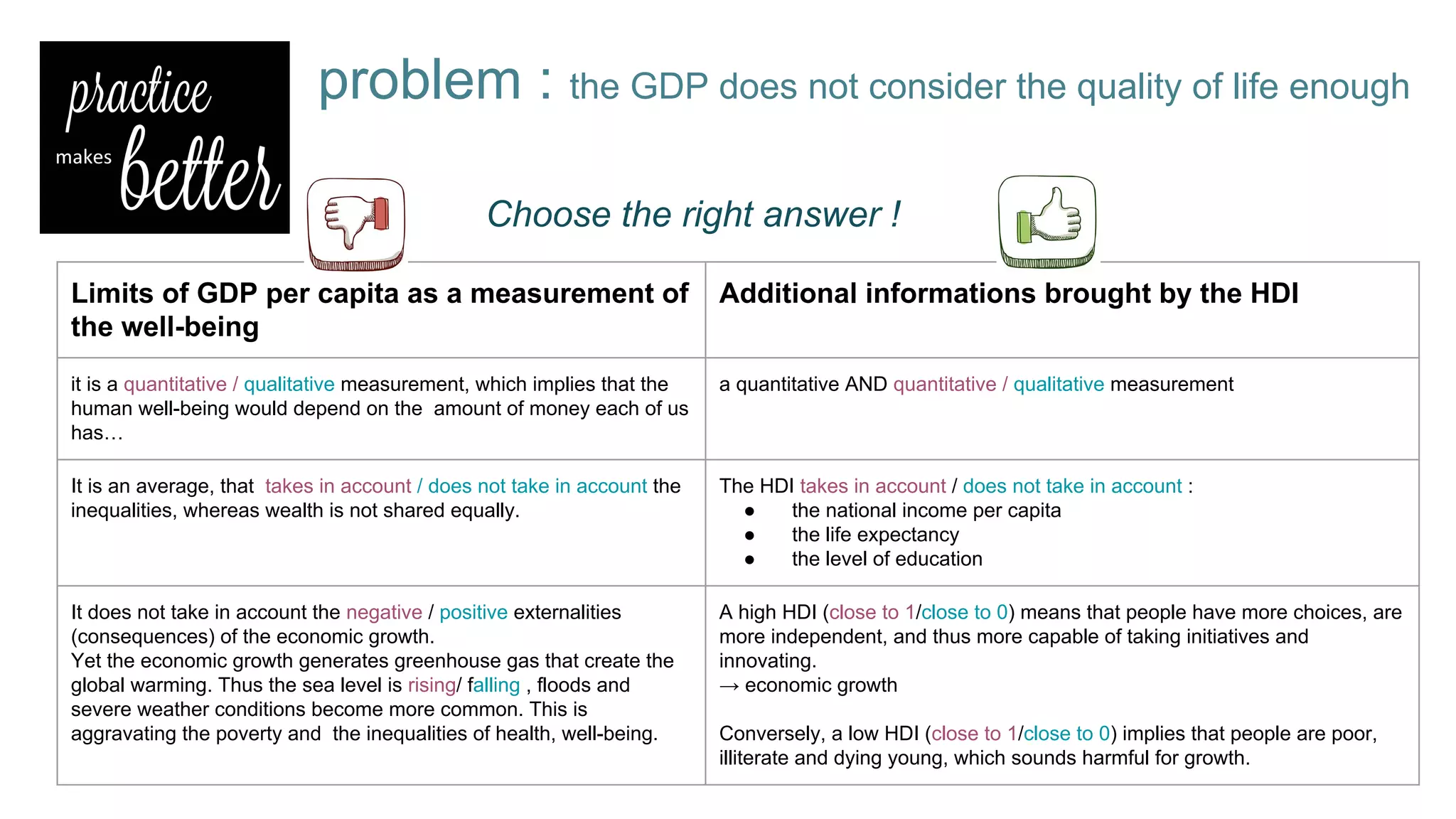
problem : the GDP does not consider the quality of life enough
Limits of GDP per capita as a measurement of
the well-being
Additional informations brought by the HDI
it is a quantitative / qualitative measurement, which implies that the
human well-being would depend on the amount of money each of us
has…
a quantitative AND quantitative / qualitative measurement
It is an average, that takes in account / does not take in account the
inequalities, whereas wealth is not shared equally.
The HDI takes in account / does not take in account :
● the national income per capita
● the life expectancy
● the level of education
It does not take in account the negative / positive externalities
(consequences) of the economic growth.
Yet the economic growth generates greenhouse gas that create the
global warming. Thus the sea level is rising/ falling , floods and
severe weather conditions become more common. This is
aggravating the poverty and the inequalities of health, well-being.
A high HDI (close to 1/close to 0) means that people have more choices, are
more independent, and thus more capable of taking initiatives and
innovating.
→ economic growth
Conversely, a low HDI (close to 1/close to 0) implies that people are poor,
illiterate and dying young, which sounds harmful for growth.
Choose the right answer !
problem : the GDP does not consider the quality of life enough
Limits of GDP per capita as a measurement of
the well-being
Additional informations brought by the HDI
it is a quantitative / qualitative measurement, which implies that the
human well-being would depend on the amount of money each of us
has…
a quantitative AND quantitative / qualitative measurement
It is an average, that takes in account / does not take in account the
inequalities, whereas wealth is not shared equally.
The HDI takes in account / does not take in account :
● the national income per capita
● the life expectancy
● the level of education
It does not take in account the negative / positive externalities
(consequences) of the economic growth.
Yet the economic growth generates greenhouse gas that create the
global warming. Thus the sea level is rising/ falling , floods and
severe weather conditions become more common. This is
aggravating the poverty and the inequalities of health, well-being.
A high HDI (close to 1/close to 0) means that people have more choices, are
more independent, and thus more capable of taking initiatives and
innovating.
→ economic growth
Conversely, a low HDI (close to 1/close to 0) implies that people are poor,
illiterate and dying young, which sounds harmful for growth.
correction
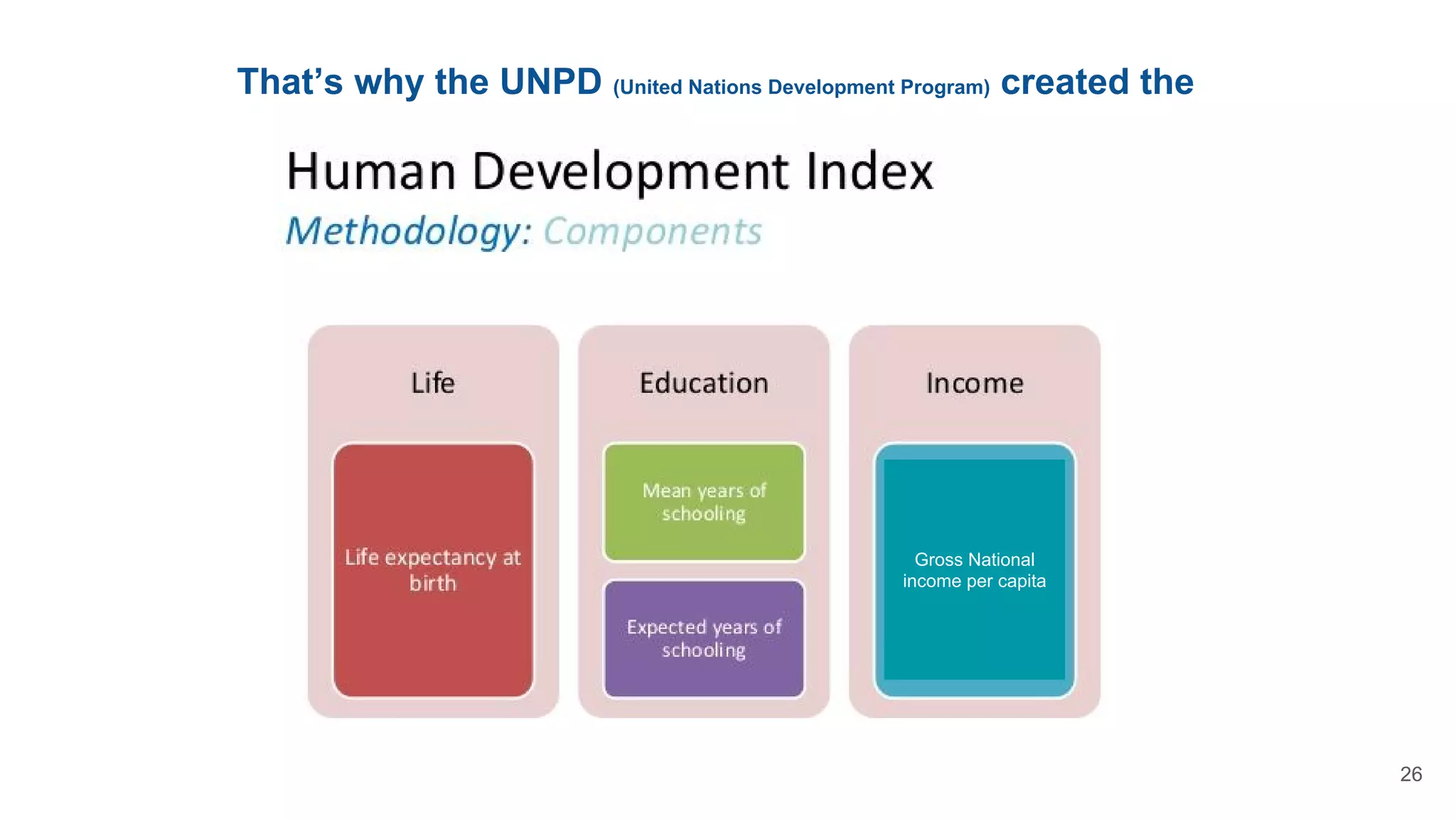
That’s why the UNPD (United Nations Development Program) created the
26
Gross National
income per capita
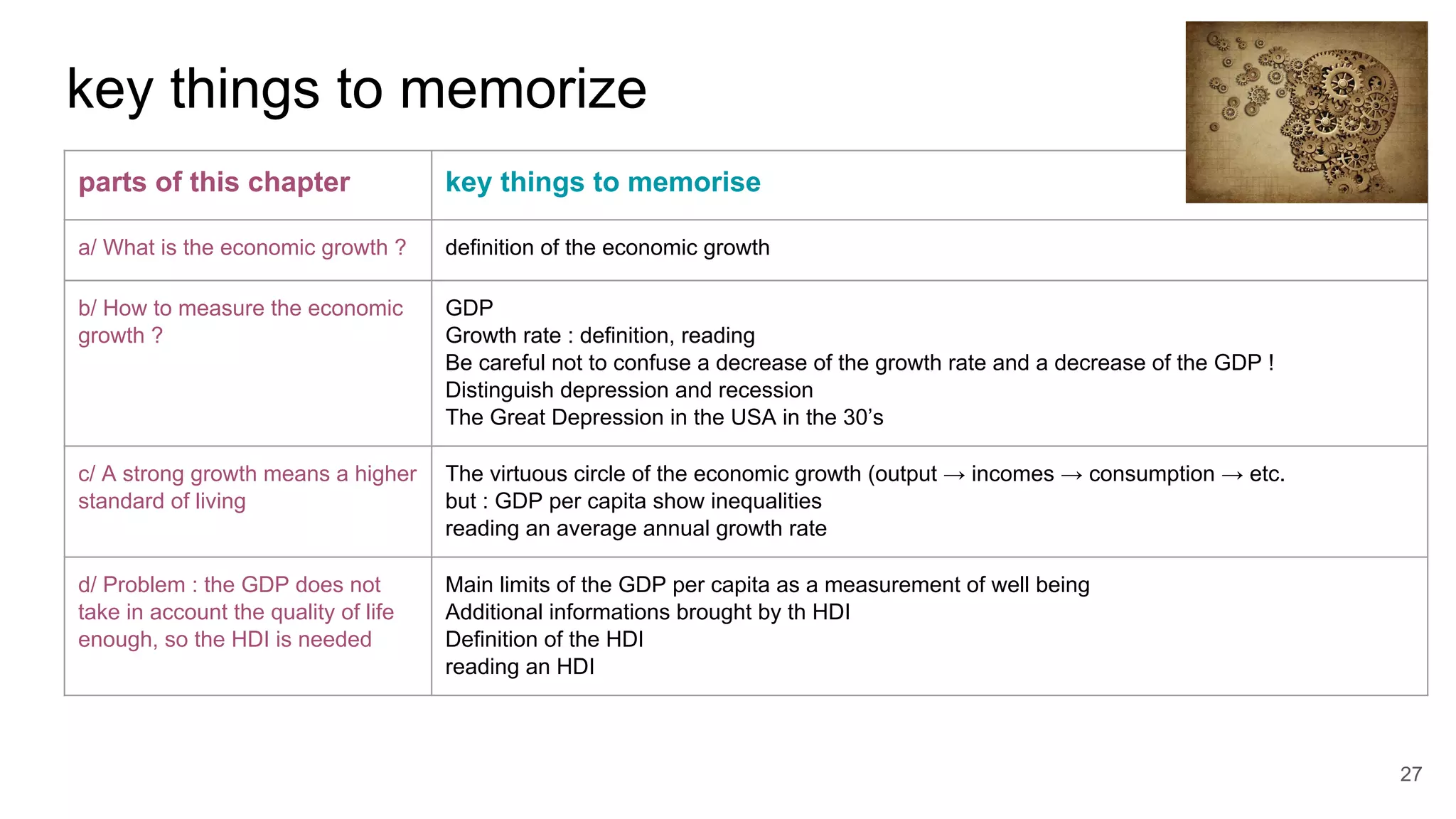
key things to memorize
27
parts of this chapter key things to memorise
a/ What is the economic growth ? definition of the economic growth
b/ How to measure the economic
growth ?
GDP
Growth rate : definition, reading
Be careful not to confuse a decrease of the growth rate and a decrease of the GDP !
Distinguish depression and recession
The Great Depression in the USA in the 30’s
c/ A strong growth means a higher
standard of living
The virtuous circle of the economic growth (output → incomes → consumption → etc.
but : GDP per capita show inequalities
reading an average annual growth rate
d/ Problem : the GDP does not
take in account the quality of life
enough, so the HDI is needed
Main limits of the GDP per capita as a measurement of well being
Additional informations brought by th HDI
Definition of the HDI
reading an HDI
The sources of the economic growth
What is the economic growth ?
gurunEs p28
Chapter One
end of
How to get a stronger economic
growth ?
see chapter 2

Chapter1 sources of the economic growth(1)

  • 1.
    The sources ofthe economic growth What is the economic growth ? gurunEs p1 Chapter One
  • 2.
    The sources ofthe economic growth What is the economic growth ? gurunEs p2 Chapter One a/ What is the economic growth ? b/ How to measure the economic growth ? c/ A strong growth means a higher standard of living d/ Problem : the GDP does not take in account the quality of life enough, so the HDI is needed
  • 3.
    a/ What isthe economic growth ? the economic growth is the increase of the amount of goods and services produced in a country between 2 periods (generally a year) 3 economic growth more wealth produced
  • 4.
    Test : Whatis the economic growth ? the economic growth is (several possible answers) ❏ the decrease of the amount of goods and services produced in a country between 2 periods (generally a year) ❏ the increase of the amount of goods and services produced in a country between 2 periods (generally a year) ❏ Economic growth is how much more the economy produces than it did before.
  • 5.
    Test : Whatis the economic growth ? the economic growth is (several possible answers) ❏ the decrease of the amount of goods and services produced in a country between 2 periods (generally a year) ❏ the increase of the amount of goods and services produced in a country between 2 periods (generally a year) ❏ Economic growth is how much more the economy produces than it did before.
  • 6.
    b/ how tomeasure the economic growth ? The economic growth is measured by the increase of the real GDP between 2 periods. GDP : Gross Domestic Product : sum of the value added in the various activities within a country’s borders in a specific period. It is commonly used to ● determine the economic performance of a whole country or region ● make international comparisons. 6 The real GDP : the main difference between nominal and real values is that real values are adjusted for inflation, while nominal values are not. As a result, nominal GDP will often appear higher than real GDP. explanation : When the GDP rises, we don’t know whether the prices or the quantity of goods and services produced have gone up… So we have to calculate the real GDP as if the prices have stayed the same between the 2 periods.
  • 7.
    the economic growthrate measures the increase of the GDP in percentage between 2 periods. 7 Reading : according to the World Bank, the US GDP has increased by 2.5 percent in 2015; The US GDP has decreased by 0.3 points in comparison with 2014. Furthermore, the French GDP has increased by 1.5 percent in 2015. So we can say that the French GDP has increased half as fast as in the US in 2015.
  • 8.
    Test : whatis the GDP ? the GDP is (several possible answers) ❏ the wealth produced within a country’s borders in a specific period. ❏ the sum of the of goods and services produced within a country’s borders in a specific period. ❏ the sum of the value added in the various activities within a country’s borders in a specific period. ❏ the gross domestic product ❏ the great domestic production
  • 9.
    Test : whatis the GDP ? the GDP is (several possible answers) ❏ the wealth produced within a country’s borders in a specific period. ❏ the sum of the of goods and services produced within a country’s borders in a specific period. ❏ the sum of the value added in the various activities within a country’s borders in a specific period. ❏ the gross domestic product ❏ the great domestic production
  • 10.
    Beware ! Has theAustralia’s GDP decreased between 1999 (5.0%) and 2001 (1.9%) ? 10 yes or no ?
  • 11.
    11 no ! The Australia’sgrowth rate has decreased between 1999 (5.0%) and 2001 (1.9%) by 3.1 points. BUT the GDP continued to increase : by 5.0 % in 1999 and 1.9% in 2001. The GDP has increased more slowly : how do we call it ?
  • 12.
    Beware ! 12 The Australia’sgrowth rate has decreased between 1999 (5.0%) and 2001 (1.9%) by 3.1 points. BUT The GDP continued to increase : by 5.0 % in 1999 and 1.9% in 2001. Actually the GDP has increased more slowly : This is called recession. A recession is a significant decline in activity across the economy, lasting longer than a few months, usually 2 quarters at least.
  • 13.
    Beware ! 13 The Australia’sgrowth rate has become deeply negative in 1983 (- 2.2%). which means The Australian GDP has decreased by 2.2% in 1983. which means The Australian economic actors produced less wealth in 1983 than in 1982. This is called depression. Depression is a severe and prolonged downturn in economic activity. In economics, a depression is commonly defined as an extreme recession that lasts two or more years.
  • 14.
    The Great Depressionof the 1930’s 14 Bread and soup during the Great Depression in the US People asking for help during the Great Depression in the UK Watch more about the Great Depression int the USA (video 4 min) : https://www.youtube.com/watch?v=VpKmfjf5tUk
  • 15.
    Write a sentencegiving the meaning of each surrounded data : 15 Growth rate (%) - World Bank (2013)
  • 16.
    Write a sentencegiving the meaning of each surrounded data : ● According to the World Bank, the South Africa’s GDP has increased by about 8% in 1965. ● According to the World Bank, the New Zealand’s GDP has decreased by about 2.5% in 1965. 16 Growth rate (%) - World Bank (2013)
  • 17.
    recession ? 17 Growth rate(%) - World Bank (2013) depression ? show...
  • 18.
    recession 18 Growth rate (%)- World Bank (2013) depression
  • 19.
    c/ a stronggrowth means a higher standard of living GDP = wealth produced and shared = incomes = spendings 19 output (GDP) incomes consumption more m ore more
  • 20.
    Test : whatis the right reasoning ? Choose the right reasoning that explains the virtuous circle of the growth : ❏ output → consumption → incomes → output... ❏ consumption → output → incomes → consumption... ❏ output → incomes → consumption → output... ❏ output → employment → incomes → demand : consumption + investment → output...
  • 21.
    Test : whatis the right reasoning ? Choose the right reasoning that explains the virtuous circle of the growth : ❏ output → consumption → incomes → output... ❏ output → incomes → consumption → output... ❏ output → employment → incomes → demand : consumption + investment → output...
  • 22.
    More is better,but... Inequalities may increase 22 average annual growth rate (%) 1500-1820 1870-1913 1950-73 1973-98 World’s GDP World’s per capita GDP 0.3 0 2.1 1.3 1.8 0.9 4.9 2.9 Western Europe’s GDP w. Europe’s per capita GDP 0.41 0.15 2.1 1.3 1.2 0.8 4.8 4.1 former USSR’s GDP former USSR’s per capita GDP 0.5 0.1 2.4 1.1 2.1 1.8 4.8 3.4 USA’s GDP USA’s per capita GDP 0.9 0.4 4.0 1.8 2.8 1.6 3.9 2.4 South America’s GDP S. America’s per capita GDP 0.2 0.1 3.5 1.8 3.4 1.4 5.3 2.5 Japan’s GDP Japan’s per capita GDP 0.3 0.1 2.4 1.5 2.2 0.9 9.3 8.0 China’s GDP China’s per capita GDP 0.4 0.0 0.6 0.1 0.0 -0.6 5.0 2.9 Africa’s GDP Africa’s per capita GDP 0.2 0.0 1.4 0.6 2.7 1.0 4.4 2.1 source : A. Maddison, L’éconoclaste, une perspective millénaire, Etudes de l’OCDE, 2001 Read : The world’s GDP grew annually by an average of 0.3% between 1500 and 1800. This is a very weak and slow growth. It accelerated since the end of the 20th century : the world’s GDP grew annually by an average of 4.9% between 1973 and 1998. Notice : the world’s per capita GDP just grew annually by an average of 2.9% (while the GDP grew annually by an average of 4.9%) between 1973 and 1998. Moreover, the per capita GDP grew annually by an average of 8.0% in Japan in the last period, instead of 2.1% for the Africa. ...and certainly not for all the inhabitants of the earth !
  • 23.
    d/ problem :the GDP does not consider the quality of life enough, so the HDI is needed Limits of GDP per capita as a measurement of the well-being Additional informations brought by the HDI it is a quantitative measurement, which implies that the human well-being would depend on the amount of money each of us has… a quantitative AND qualitative measurement It is an average, that does not take in account the inequalities, whereas wealth is not shared equally. The HDI takes in account (see next page) : ● the national income per capita ● the life expectancy ● the level of education It does not take in account the negative externalities (consequences) of the economic growth. Yet the economic growth generates greenhouse gas that create the global warming. Thus the sea level is rising, floods and severe weather conditions become more common. This is aggravating the poverty and the inequalities of health, well-being. A high HDI (close to 1) means that people have more choices, are more independent, and thus more capable of taking initiatives and innovating. → economic growth Conversely, a low HDI (close to 0) implies that people are poor, illiterate and dying young, which sounds harmful for growth.
  • 24.
    problem : theGDP does not consider the quality of life enough Limits of GDP per capita as a measurement of the well-being Additional informations brought by the HDI it is a quantitative / qualitative measurement, which implies that the human well-being would depend on the amount of money each of us has… a quantitative AND quantitative / qualitative measurement It is an average, that takes in account / does not take in account the inequalities, whereas wealth is not shared equally. The HDI takes in account / does not take in account : ● the national income per capita ● the life expectancy ● the level of education It does not take in account the negative / positive externalities (consequences) of the economic growth. Yet the economic growth generates greenhouse gas that create the global warming. Thus the sea level is rising/ falling , floods and severe weather conditions become more common. This is aggravating the poverty and the inequalities of health, well-being. A high HDI (close to 1/close to 0) means that people have more choices, are more independent, and thus more capable of taking initiatives and innovating. → economic growth Conversely, a low HDI (close to 1/close to 0) implies that people are poor, illiterate and dying young, which sounds harmful for growth. Choose the right answer !
  • 25.
    problem : theGDP does not consider the quality of life enough Limits of GDP per capita as a measurement of the well-being Additional informations brought by the HDI it is a quantitative / qualitative measurement, which implies that the human well-being would depend on the amount of money each of us has… a quantitative AND quantitative / qualitative measurement It is an average, that takes in account / does not take in account the inequalities, whereas wealth is not shared equally. The HDI takes in account / does not take in account : ● the national income per capita ● the life expectancy ● the level of education It does not take in account the negative / positive externalities (consequences) of the economic growth. Yet the economic growth generates greenhouse gas that create the global warming. Thus the sea level is rising/ falling , floods and severe weather conditions become more common. This is aggravating the poverty and the inequalities of health, well-being. A high HDI (close to 1/close to 0) means that people have more choices, are more independent, and thus more capable of taking initiatives and innovating. → economic growth Conversely, a low HDI (close to 1/close to 0) implies that people are poor, illiterate and dying young, which sounds harmful for growth. correction
  • 26.
    That’s why theUNPD (United Nations Development Program) created the 26 Gross National income per capita
  • 27.
    key things tomemorize 27 parts of this chapter key things to memorise a/ What is the economic growth ? definition of the economic growth b/ How to measure the economic growth ? GDP Growth rate : definition, reading Be careful not to confuse a decrease of the growth rate and a decrease of the GDP ! Distinguish depression and recession The Great Depression in the USA in the 30’s c/ A strong growth means a higher standard of living The virtuous circle of the economic growth (output → incomes → consumption → etc. but : GDP per capita show inequalities reading an average annual growth rate d/ Problem : the GDP does not take in account the quality of life enough, so the HDI is needed Main limits of the GDP per capita as a measurement of well being Additional informations brought by th HDI Definition of the HDI reading an HDI
  • 28.
    The sources ofthe economic growth What is the economic growth ? gurunEs p28 Chapter One end of How to get a stronger economic growth ? see chapter 2