7th European Conference on
                                      Technology Enhanced Learning (EC-TEL 2012)
                                      September 18-21, 2012
                                      Saarbrücken, Germany


                           The European TEL Projects
                         Community from a Social Network
                              Analysis Perspective

                                    Michael Derntl and Ralf Klamma
                                       RWTH Aachen University
                             Advanced Community Information Systems (ACIS)
                                           Aachen, Germany
                                      derntl@dbis.rwth-aachen.de

Lehrstuhl Informatik 5
(Information Systems)
   Prof. Dr. M. Jarke
          1                These slides are licensed under a Creative Commons Attribution-ShareAlike 3.0 Unported License.
Motivation
                         Collaborative projects are key in the R&D value
                         chain
                         – Cost a lot of (tax payers’) money
                         – Drive research agenda and scientific community building
                            – scientific events (e.g. EC-TEL, summer school)
                            – researcher mobility, seed projects, R&D teams, associate
                              partnerships, etc.
                            – conducting, reporting, and disseminating research
                            – product development and knowledge transfer
                         Stakeholders have an interest in the collaboration
                         structures of their scientific community
Lehrstuhl Informatik 5
(Information Systems)
   Prof. Dr. M. Jarke
                         – Key organizations, key projects, trends
          2
Research Objectives
                         Identify characteristics of the social network of funded
                         R&D collaborations
                         – Organizational collaboration
                         – Project relationships
                         – Central organizations and projects
                         Analyze impact of projects on the collaboration
                         landscape
                         – Conceive impact measure
                         – Find network parameters that may indicate impact
Lehrstuhl Informatik 5
(Information Systems)
   Prof. Dr. M. Jarke
          3
Related Work
                         Several papers on collaboration networks in FP1-6 [2,
                         3, 4] with both one-mode and two-node networks
                         Community detection in collaboration networks [6, 7,
                         8], e.g. location, topics, org. type
                         Analysis of multimodal networks of NoEs (e.g. in
                         STELLAR) [1]
                         Findings
                         – complex scale-free networks; small diameter, high
                           clustering
Lehrstuhl Informatik 5
(Information Systems)
   Prof. Dr. M. Jarke
                         – “oligarchic core” of organizations [5]
          4
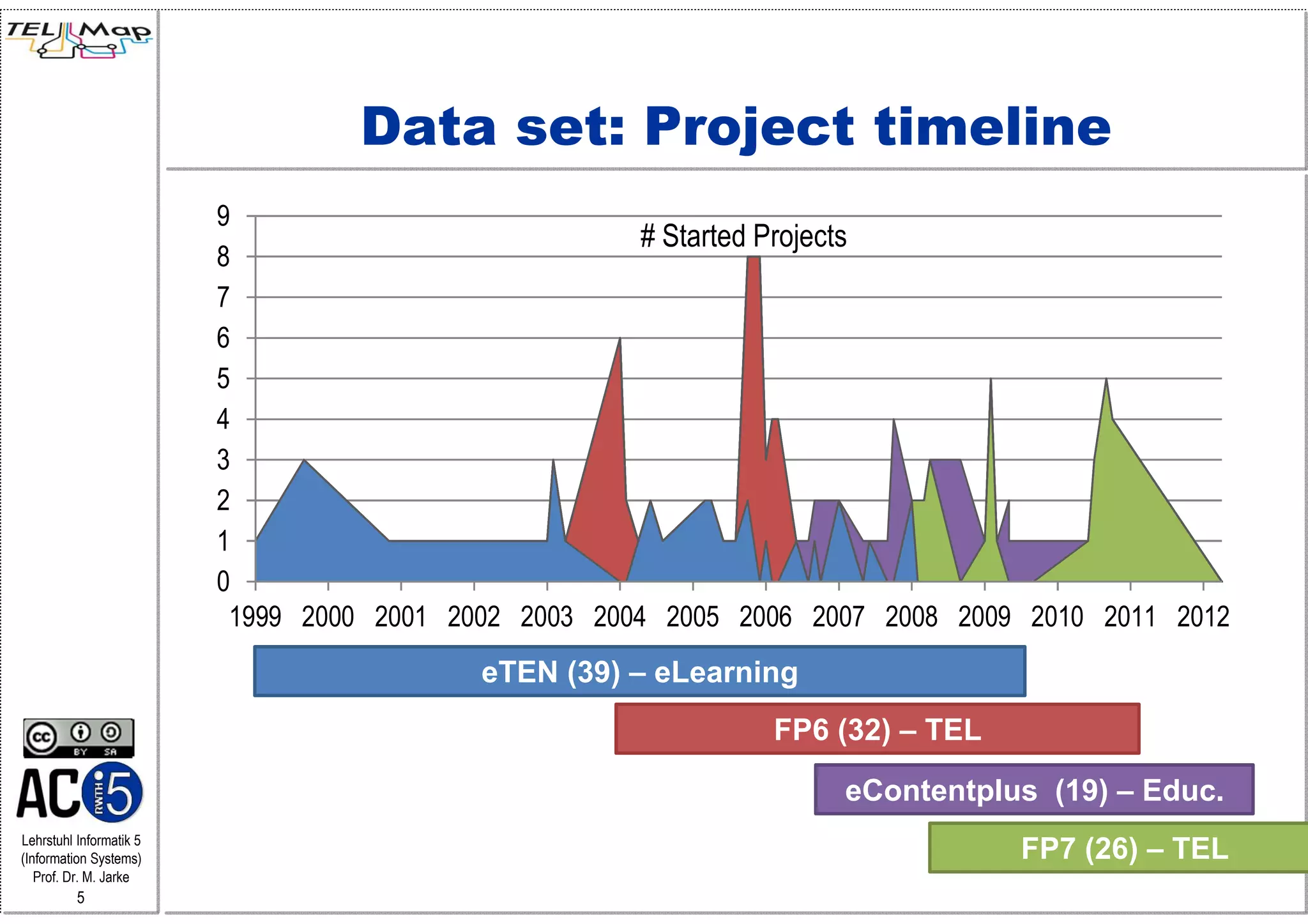
Data set: Project timeline
                         9
                                                       # Started Projects
                         8
                         7
                         6
                         5
                         4
                         3
                         2
                         1
                         0
                          1999 2000 2001 2002 2003 2004 2005 2006 2007 2008 2009 2010 2011 2012
                                           eTEN (39) – eLearning
                                                               FP6 (32) – TEL

                                                                    eContentplus (19) – Educ.
Lehrstuhl Informatik 5
(Information Systems)                                                           FP7 (26) – TEL
   Prof. Dr. M. Jarke
          5
Data set: Project timeline
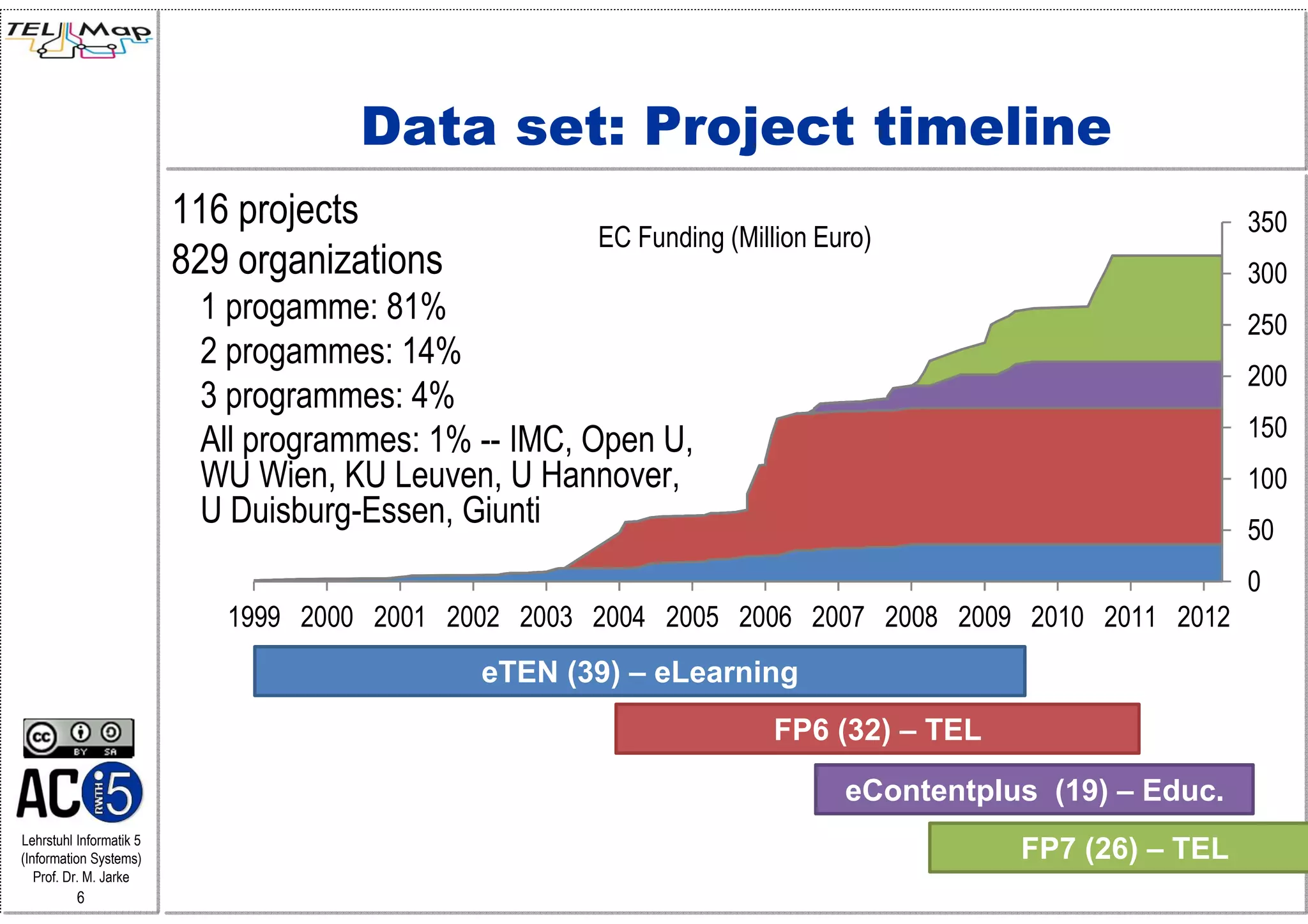
                         116 projects
                           9                                                                           350
                                                        # Started Projects
                                                     EC Funding (Million Euro)
                         829 organizations
                           8
                                                                                                       300
                          17progamme: 81%                                                              250
                          26progammes: 14%
                           5                                                                           200
                          3 programmes: 4%
                           4                                                                           150
                          All programmes: 1% -- IMC, Open U,
                           3
                          WU Wien, KU Leuven, U Hannover,                                              100
                          U2Duisburg-Essen, Giunti                                                50
                           1
                           0                                                                      0
                            1999 2000 2001 2002 2003 2004 2005 2006 2007 2008 2009 2010 2011 2012
                                             eTEN (39) – eLearning
                                                                     FP6 (32) – TEL

                                                                           eContentplus (19) – Educ.
Lehrstuhl Informatik 5
(Information Systems)                                                                 FP7 (26) – TEL
   Prof. Dr. M. Jarke
          6
Projects as Social Networks
                         Projects    Organizations [4]

                           Project consortium progression
                            – Nodes: Projects                    ROLE
                                                                              IMC, RWTH,
                                                                                   OU, ZSI
                            – Edges: Overlap of consortia                                    TEL-Map
                              (directed, weighted)

                           Organizational collaboration
                                                                 The Open      STELLAR, EUROGENE,
                            – Nodes: Organizations               University       ROLE, PROLEARN,
                                                                                   iCOPER, ASPECT
                            – Edges: Collaboration in multiple                                 KU
Lehrstuhl Informatik 5
(Information Systems)
   Prof. Dr. M. Jarke
                              projects (undirected, weighted)                                Leuven
          7
Consortium Progression –
                                     Project Network
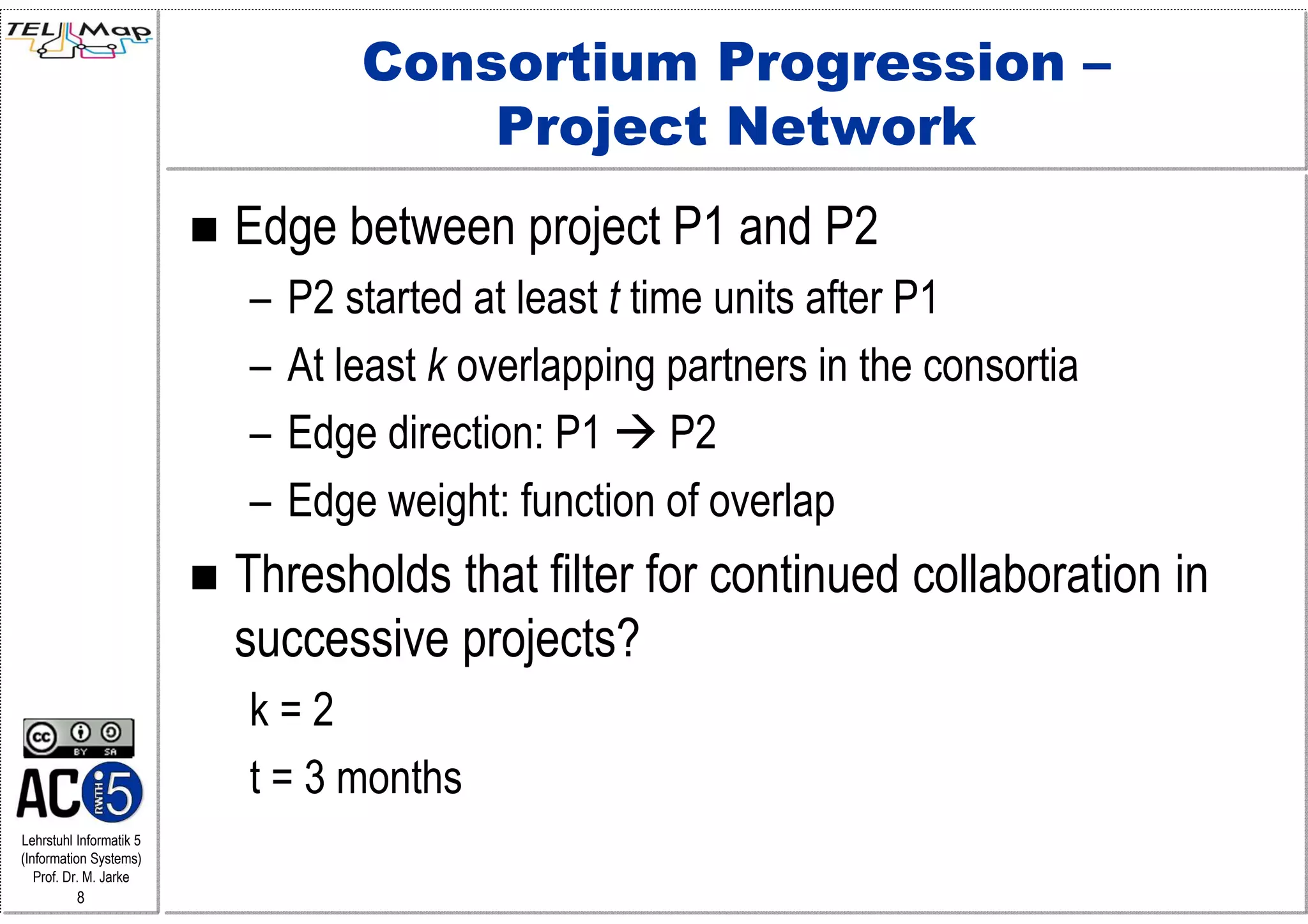
                         Edge between project P1 and P2
                         –   P2 started at least t time units after P1
                         –   At least k overlapping partners in the consortia
                         –   Edge direction: P1 P2
                         –   Edge weight: function of overlap
                         Thresholds that filter for continued collaboration in
                         successive projects?
                         k=2
                         t = 3 months
Lehrstuhl Informatik 5
(Information Systems)
   Prof. Dr. M. Jarke
          8
Consortium
                          Progression
                         k = 2, m = 3 months

                         Nodes                     85
                         Edges                    257
                         Diameter                   4
                         Clustering coeff.        0.2
                         Avg. degree             6.05
                         Avg. weighted degree    16.9
                         Avg. path length        1.78

                         Node size proportional to
                         weighted degree

                         Node color represents
                         cluster [10]


Lehrstuhl Informatik 5
(Information Systems)
   Prof. Dr. M. Jarke
          9
Consortium
                          Progression
                         k = 2, m = 3 months

                         Nodes                     85
                         Edges                    257
                         Diameter                   4
                         Clustering coeff.        0.2
                         Avg. degree             6.05
                         Avg. weighted degree    16.9
                         Avg. path length        1.78

                         Node size proportional to
                         weighted degree

                         Node color represents
                         cluster [10]


Lehrstuhl Informatik 5
(Information Systems)
   Prof. Dr. M. Jarke
         10
Project Impact on the Landscape
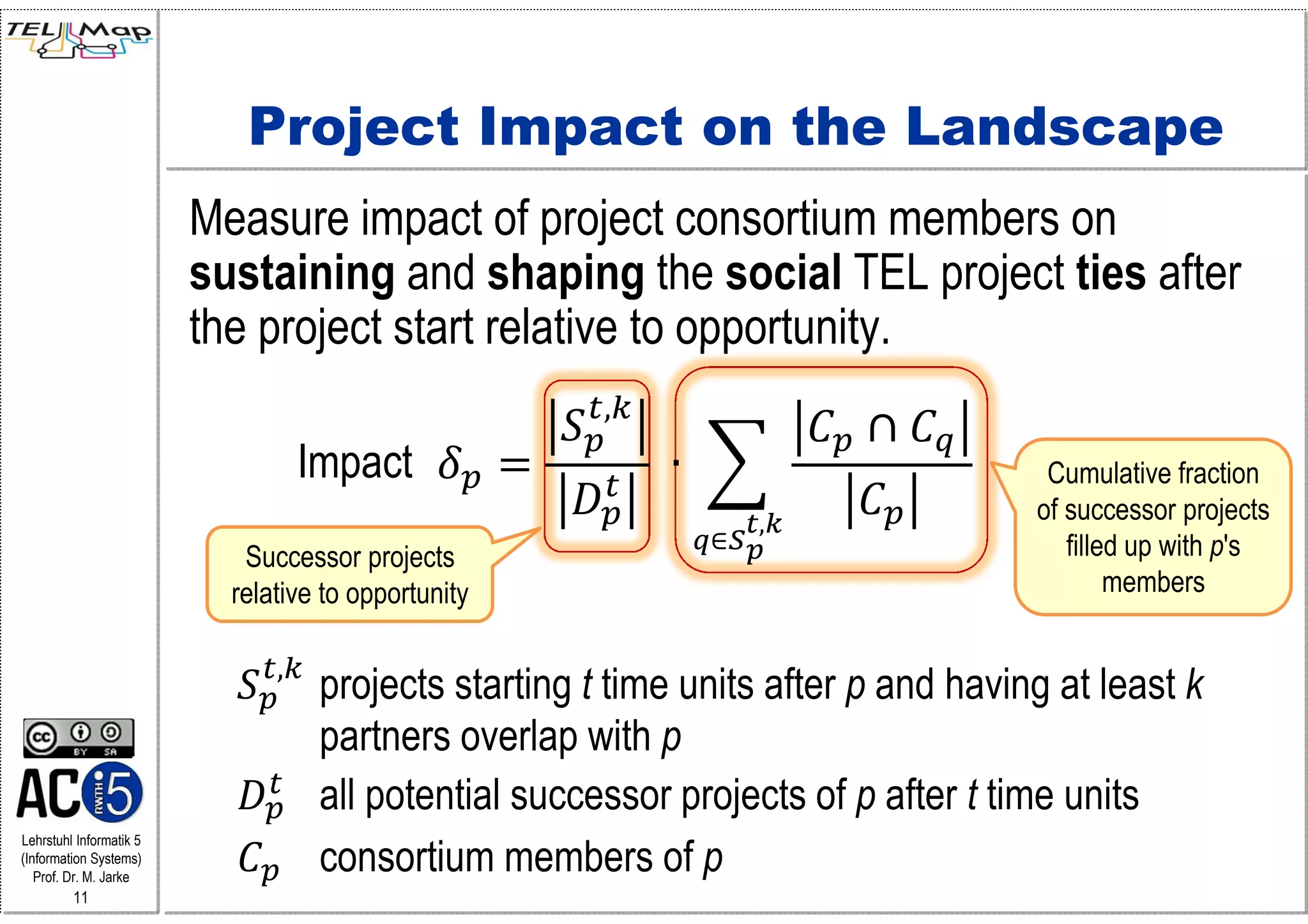
                         Measure impact of project consortium members on
                         sustaining and shaping the social TEL project ties after
                         the project start relative to opportunity.
                                                       ,
                                                                         ∩
                                   Impact                  	∙                        Cumulative fraction
                                                                    ,               of successor projects
                                                                ∈                      filled up with p's
                            Successor projects
                           relative to opportunity                                          members

                               ,
                                    projects starting t time units after p and having at least k
                                    partners overlap with p
                                    all potential successor projects of p after t time units
Lehrstuhl Informatik 5
(Information Systems)
   Prof. Dr. M. Jarke
                                    consortium members of p
         11
Top 15 Projects by Impact
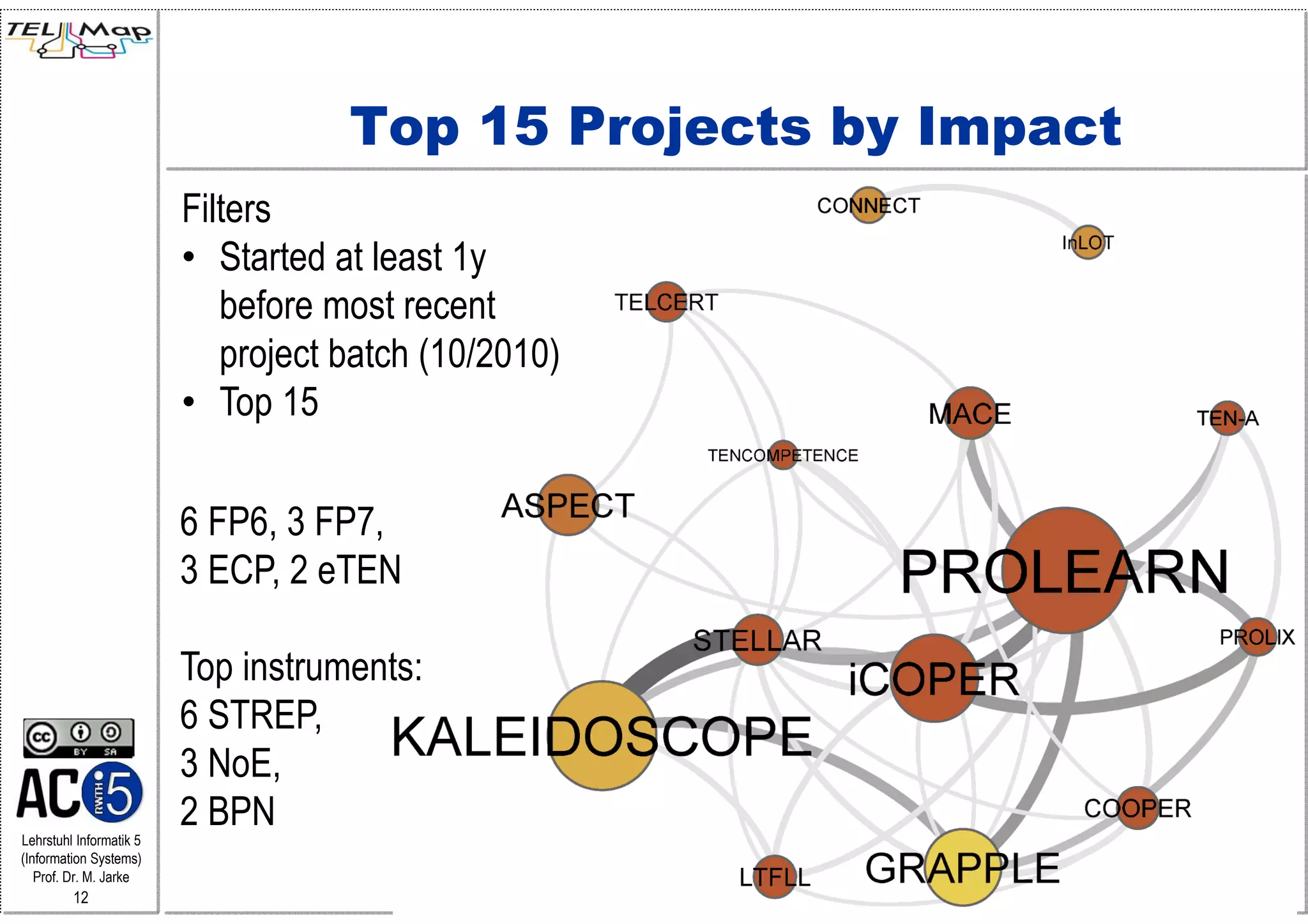
                         Filters
                         • Started at least 1y
                            before most recent
                            project batch (10/2010)
                         • Top 15

                         6 FP6, 3 FP7,
                         3 ECP, 2 eTEN

                         Top instruments:
                         6 STREP,
                         3 NoE,
                         2 BPN
Lehrstuhl Informatik 5
(Information Systems)
   Prof. Dr. M. Jarke
         12
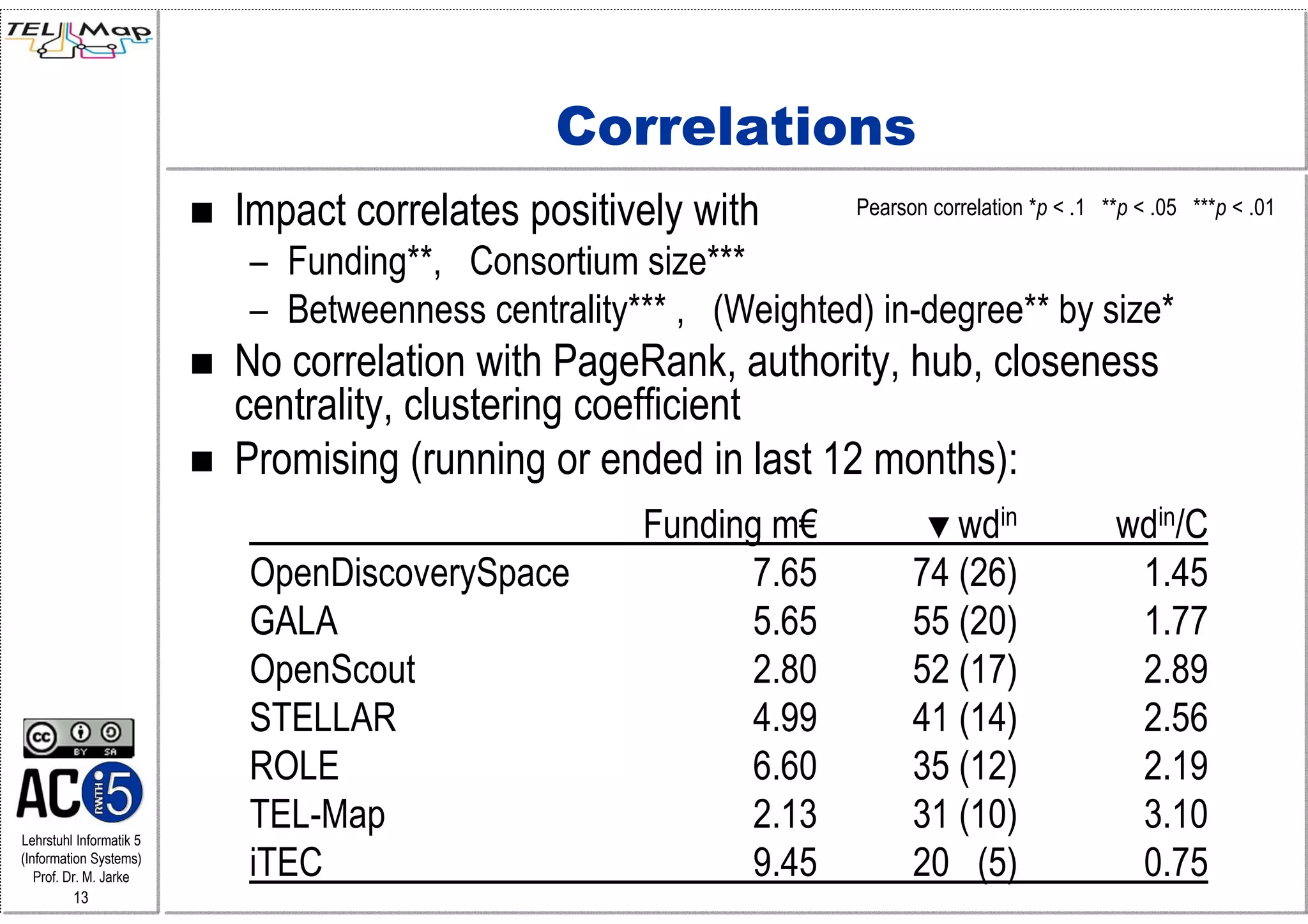
Correlations
                         Impact correlates positively with       Pearson correlation *p < .1 **p < .05 ***p < .01

                         – Funding**, Consortium size***
                         – Betweenness centrality*** , (Weighted) in-degree** by size*
                         No correlation with PageRank, authority, hub, closeness
                         centrality, clustering coefficient
                         Promising (running or ended in last 12 months):
                                                  Funding m€             ▼wdin                wdin/C
                         OpenDiscoverySpace             7.65           74 (26)                 1.45
                         GALA                           5.65           55 (20)                 1.77
                         OpenScout                      2.80           52 (17)                 2.89
                         STELLAR                        4.99           41 (14)                 2.56
                         ROLE                           6.60           35 (12)                 2.19
Lehrstuhl Informatik 5
                         TEL-Map                        2.13           31 (10)                 3.10
(Information Systems)
   Prof. Dr. M. Jarke    iTEC                           9.45           20 (5)                  0.75
         13
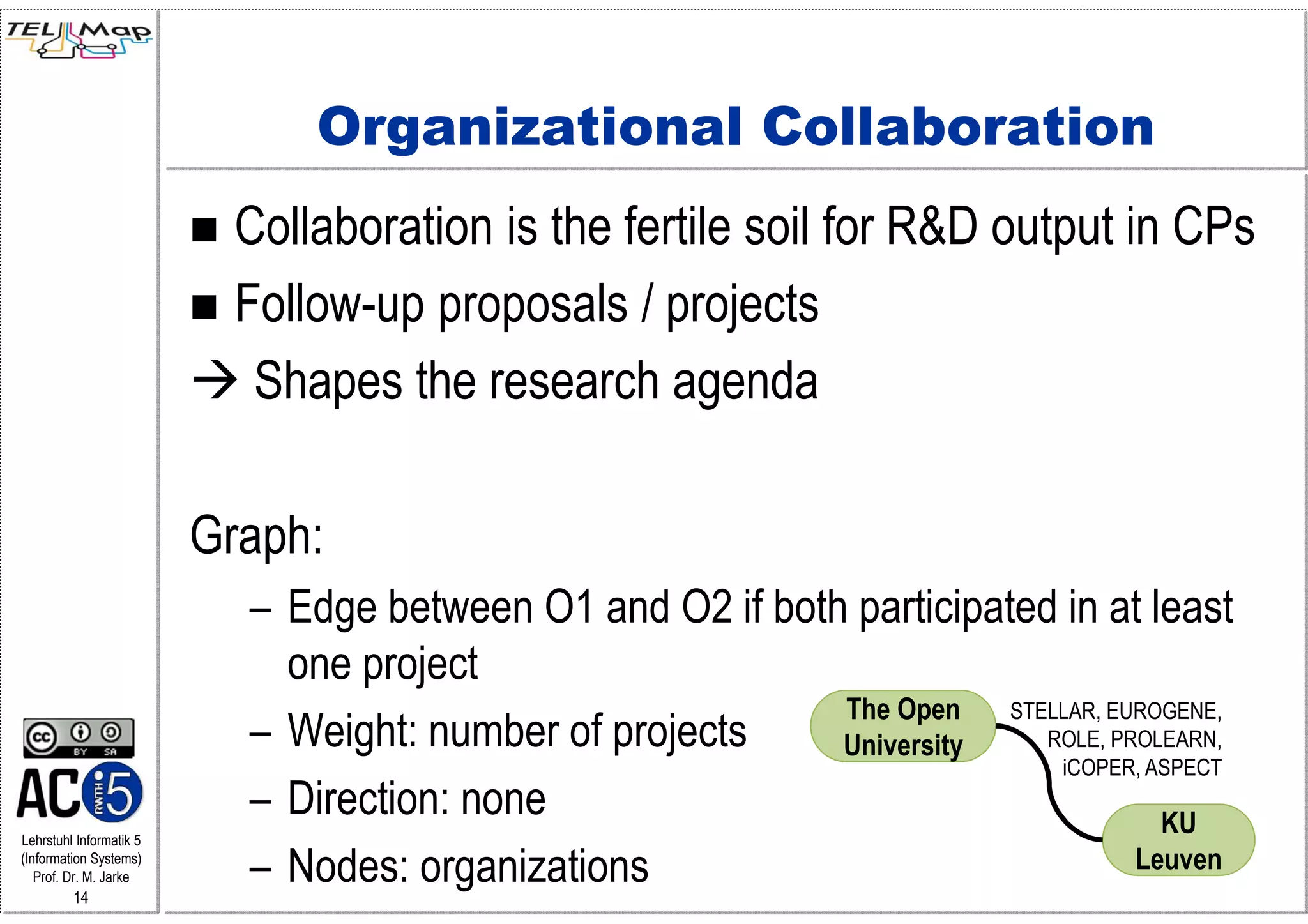
Organizational Collaboration
                           Collaboration is the fertile soil for R&D output in CPs
                           Follow-up proposals / projects
                            Shapes the research agenda

                         Graph:
                           – Edge between O1 and O2 if both participated in at least
                             one project
                                                           The Open   STELLAR, EUROGENE,
                           – Weight: number of projects    University    ROLE, PROLEARN,
                                                                          iCOPER, ASPECT
                           – Direction: none                                       KU
Lehrstuhl Informatik 5
(Information Systems)
   Prof. Dr. M. Jarke      – Nodes: organizations                                Leuven
         14
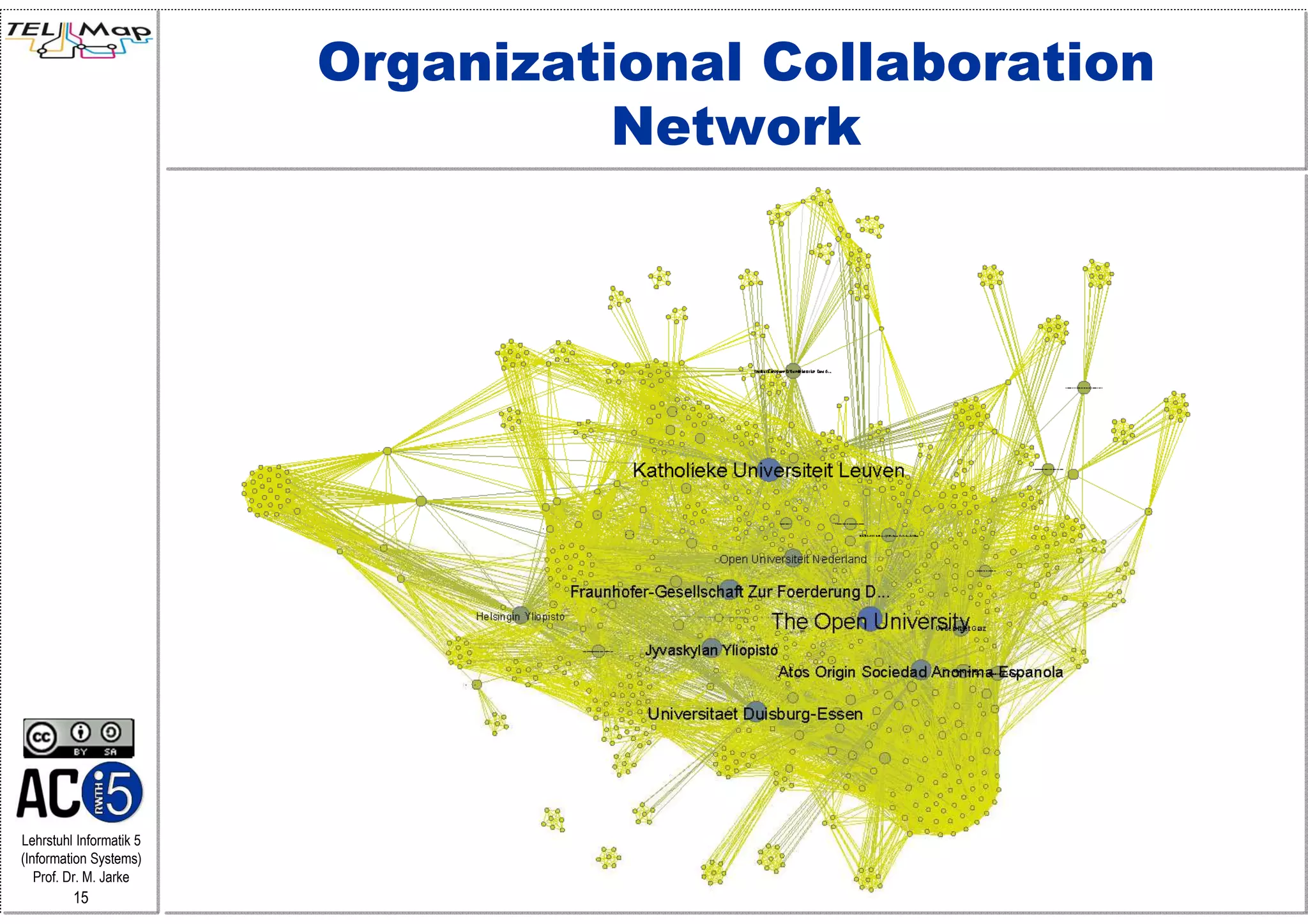
Organizational Collaboration
                                   Network


Lehrstuhl Informatik 5
(Information Systems)
   Prof. Dr. M. Jarke
         15
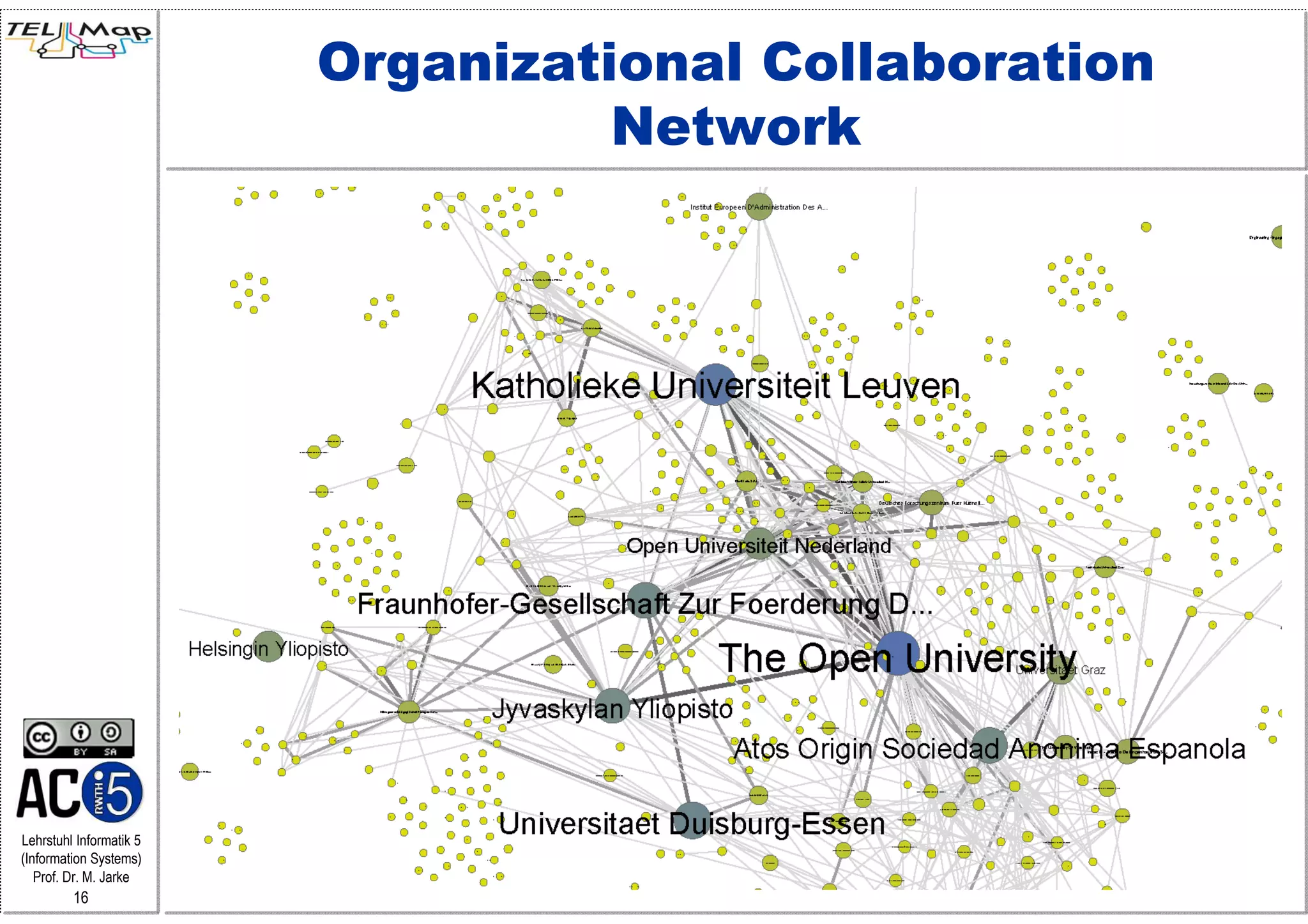
Organizational Collaboration
                                   Network


Lehrstuhl Informatik 5
(Information Systems)
   Prof. Dr. M. Jarke
         16
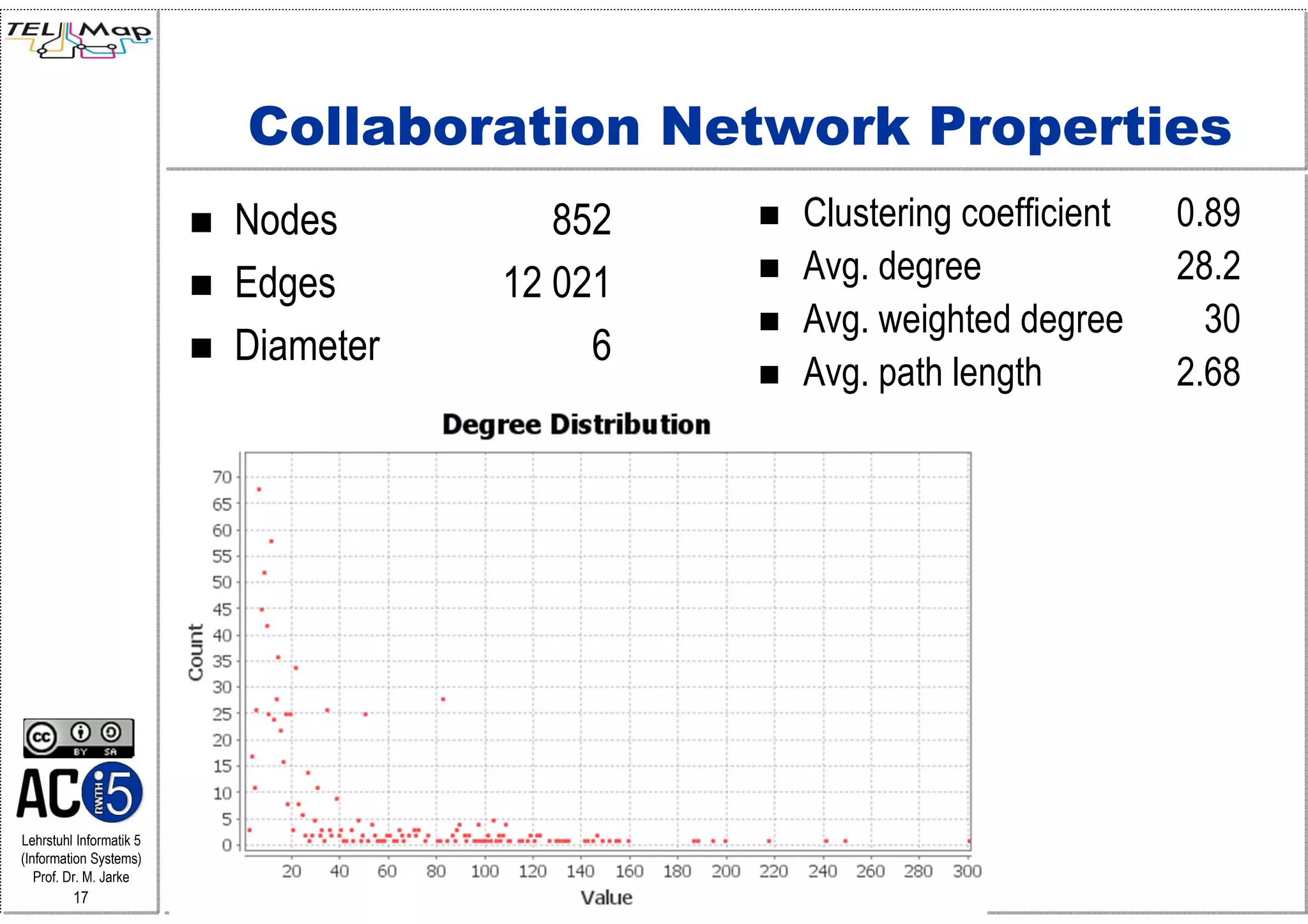
Collaboration Network Properties
                         Nodes         852   Clustering coefficient   0.89
                         Edges      12 021   Avg. degree              28.2
                                             Avg. weighted degree       30
                         Diameter        6
                                             Avg. path length         2.68


Lehrstuhl Informatik 5
(Information Systems)
   Prof. Dr. M. Jarke
         17
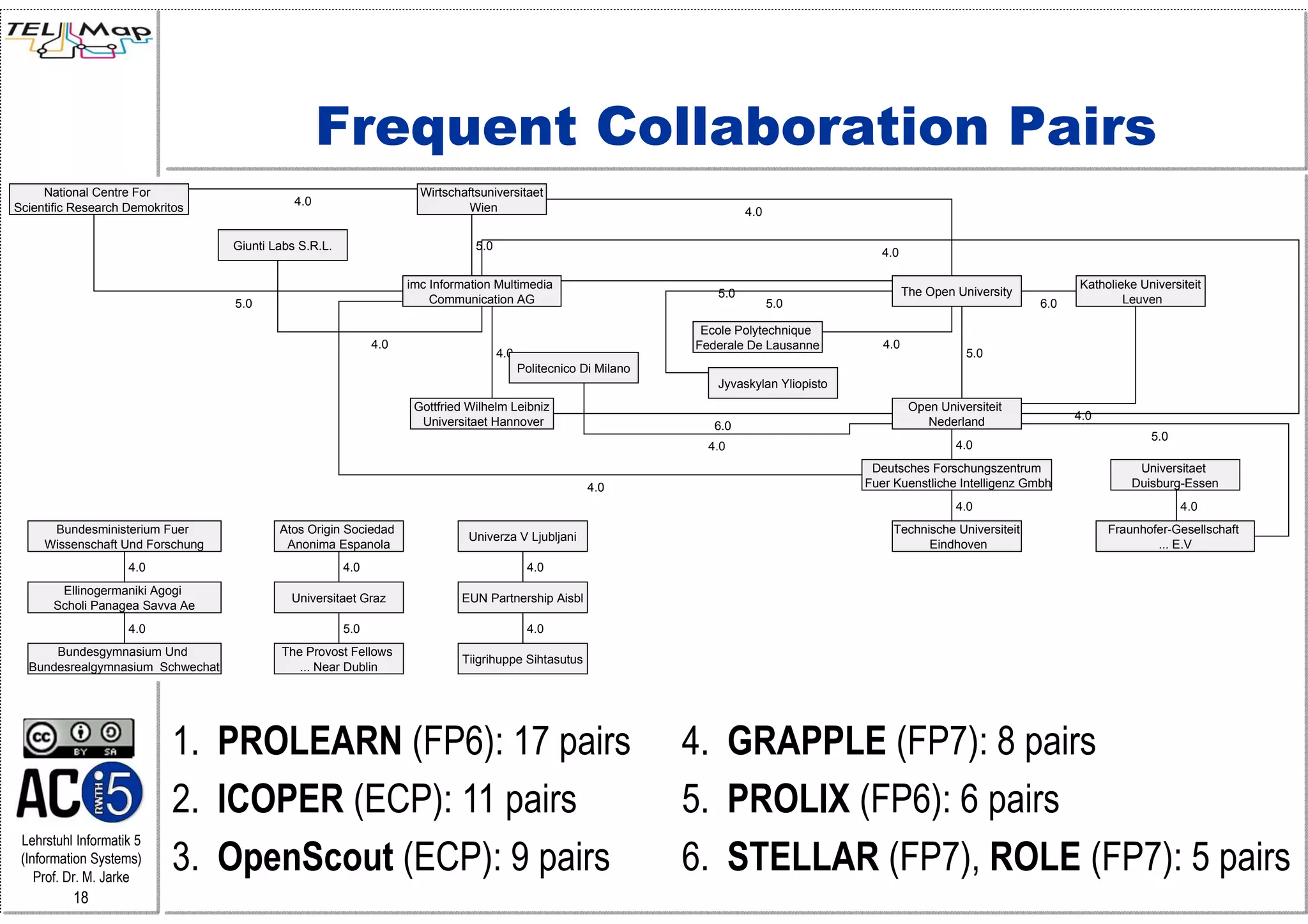
Frequent Collaboration Pairs
     National Centre For                                             Wirtschaftsuniversitaet
                                             4.0
Scientific Research Demokritos                                                Wien                                          4.0

                                  Giunti Labs S.R.L.                           5.0
                                                                                                                                                4.0

                                                                   imc Information Multimedia                                                                                     Katholieke Universiteit
                                                                                                                      5.0                             The Open University
                                  5.0                                  Communication AG                                           5.0                                       6.0           Leuven

                                                                                                                    Ecole Polytechnique
                                                             4.0                                                   Federale De Lausanne         4.0
                                                                                     4.0                                                                         5.0
                                                                                           Politecnico Di Milano
                                                                                                                      Jyvaskylan Yliopisto
                                                                    Gottfried Wilhelm Leibniz                                                          Open Universiteit
                                                                                                                                                                                  4.0
                                                                     Universitaet Hannover                            6.0                                 Nederland
                                                                                                                                                                                               5.0
                                                                                                                     4.0                                       4.0
                                                                                                                                              Deutsches Forschungszentrum                    Universitaet
                                                                                                        4.0                                  Fuer Kuenstliche Intelligenz Gmbh              Duisburg-Essen
                                                                                                                                                               4.0                                   4.0
      Bundesministerium Fuer              Atos Origin Sociedad                                                                                    Technische Universiteit               Fraunhofer-Gesellschaft
                                                                              Univerza V Ljubljani
     Wissenschaft Und Forschung            Anonima Espanola                                                                                             Eindhoven                               ... E.V
                    4.0                                4.0                                  4.0
        Ellinogermaniki Agogi
                                            Universitaet Graz               EUN Partnership Aisbl
       Scholi Panagea Savva Ae
                    4.0                                5.0                                  4.0
      Bundesgymnasium Und                 The Provost Fellows
                                                                            Tiigrihuppe Sihtasutus
  Bundesrealgymnasium Schwechat              ... Near Dublin


                           1. PROLEARN (FP6): 17 pairs                                                             4. GRAPPLE (FP7): 8 pairs
                           2. ICOPER (ECP): 11 pairs                                                               5. PROLIX (FP6): 6 pairs
 Lehrstuhl Informatik 5
 (Information Systems)
    Prof. Dr. M. Jarke
                           3. OpenScout (ECP): 9 pairs                                                             6. STELLAR (FP7), ROLE (FP7): 5 pairs
          18
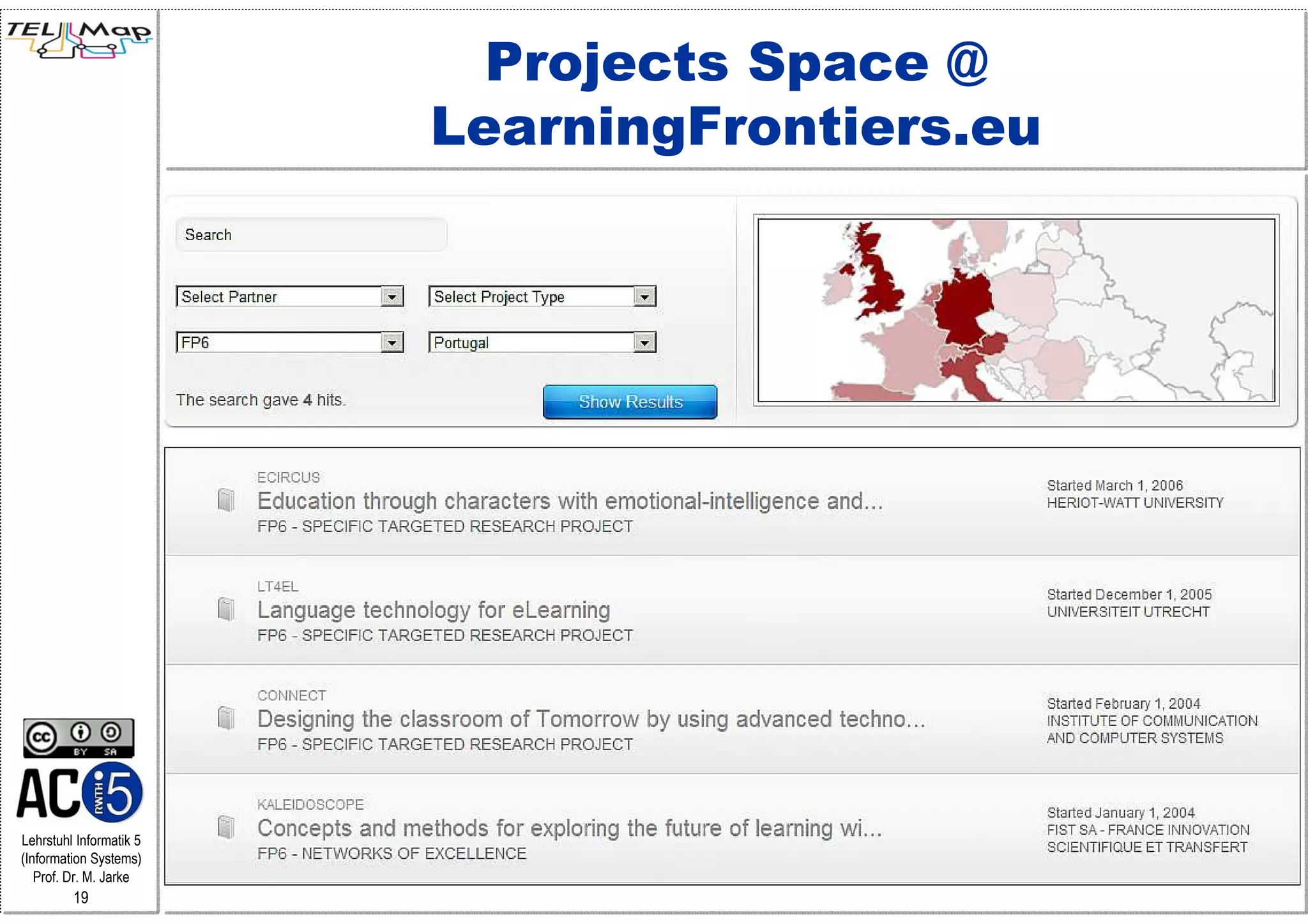
Projects Space @
                         LearningFrontiers.eu


Lehrstuhl Informatik 5
(Information Systems)
   Prof. Dr. M. Jarke
         19
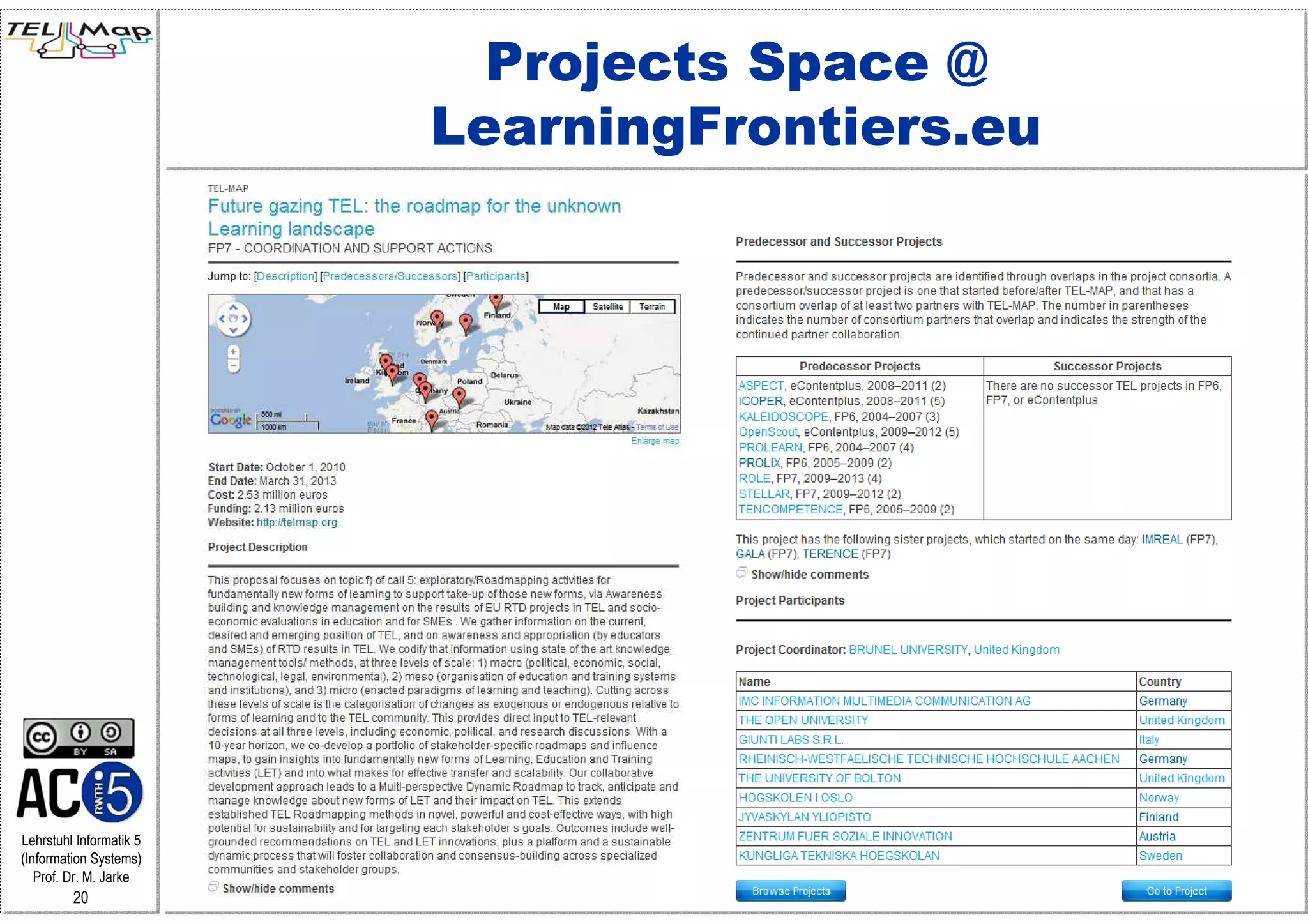
Projects Space @
                         LearningFrontiers.eu


Lehrstuhl Informatik 5
(Information Systems)
   Prof. Dr. M. Jarke
         20
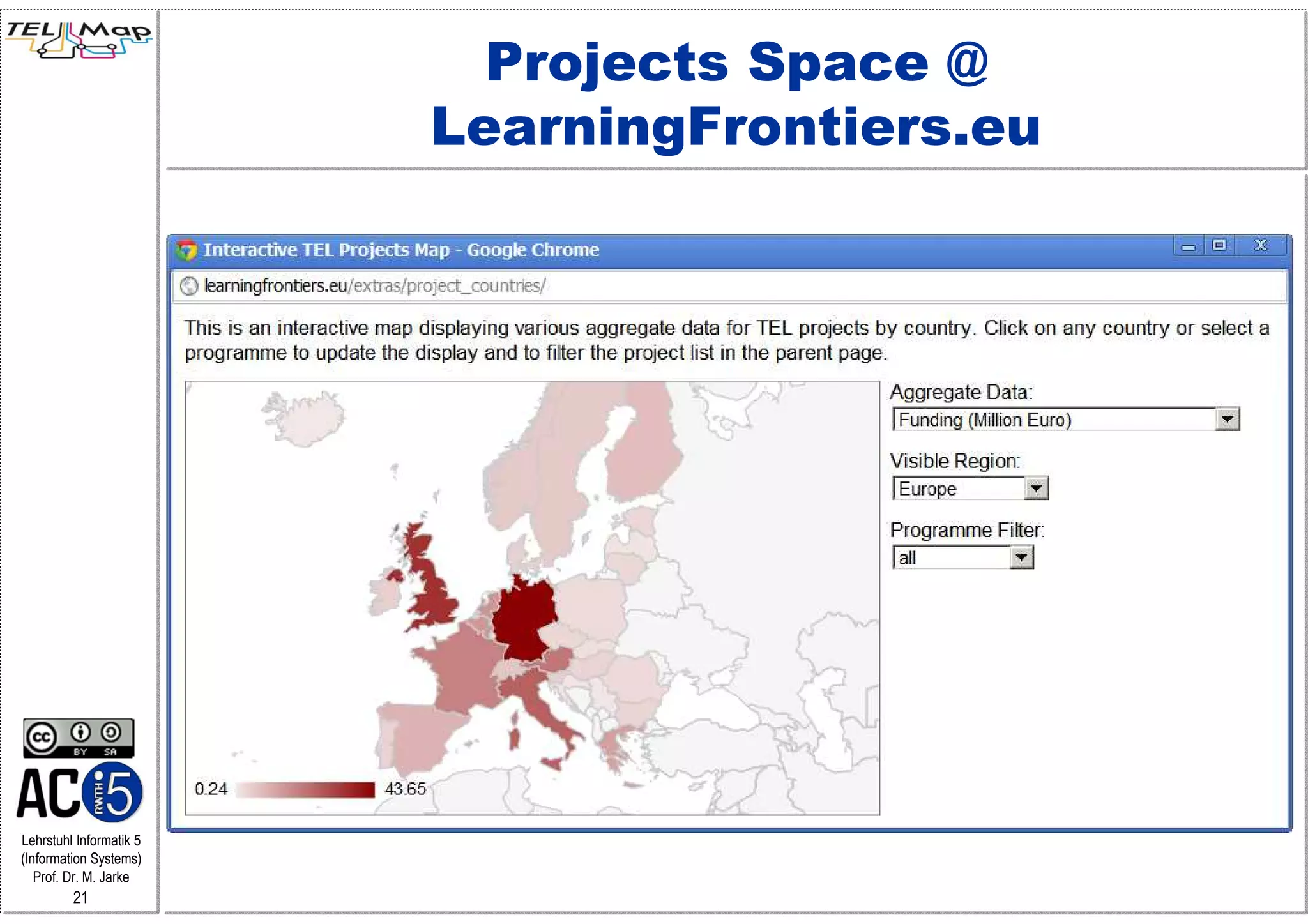
Projects Space @
                         LearningFrontiers.eu


Lehrstuhl Informatik 5
(Information Systems)
   Prof. Dr. M. Jarke
         21
Dashboard


Lehrstuhl Informatik 5
(Information Systems)
   Prof. Dr. M. Jarke    http://learningfrontiers.eu/?q=dashboard [9]
         22
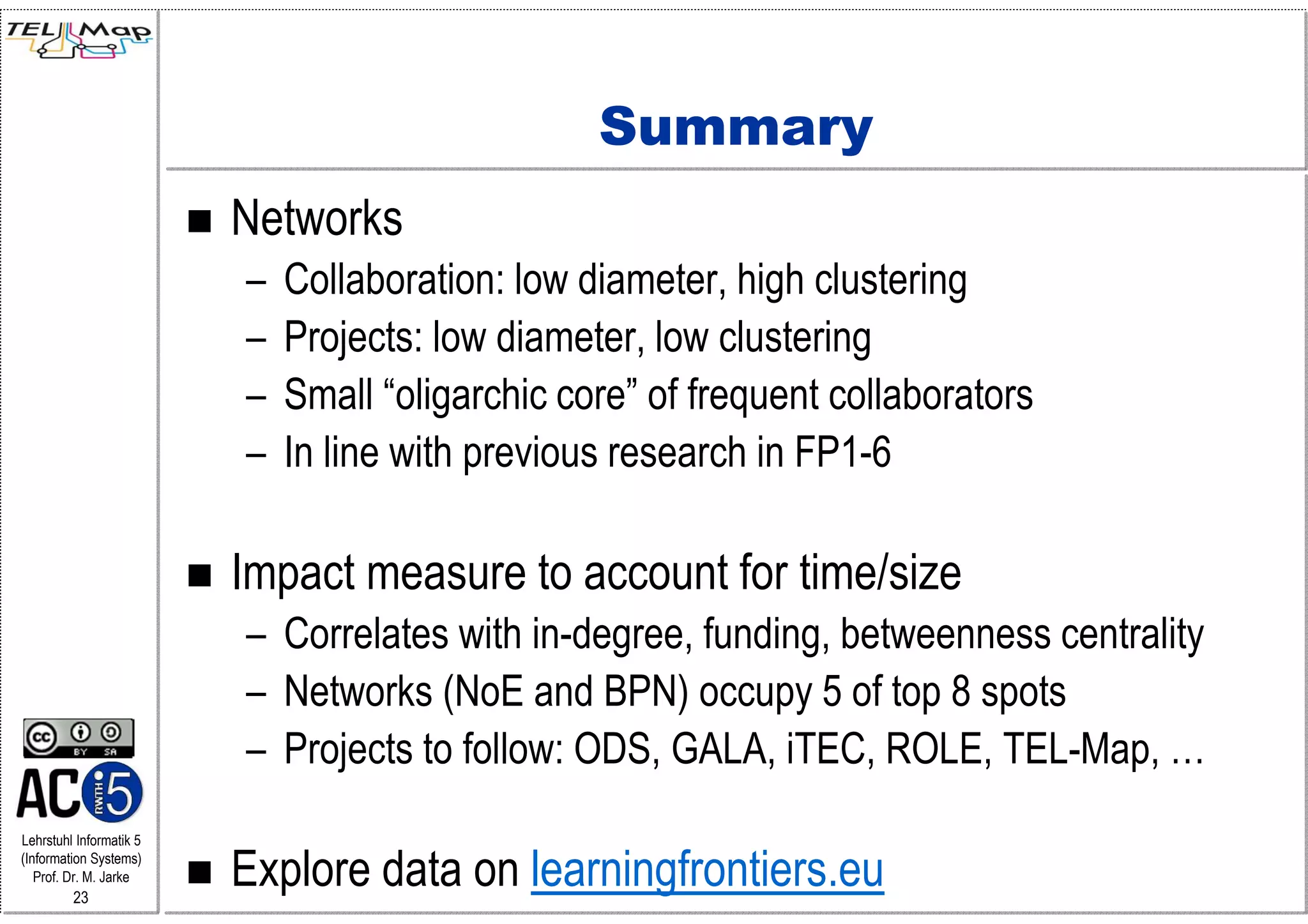
Summary
                         Networks
                         –   Collaboration: low diameter, high clustering
                         –   Projects: low diameter, low clustering
                         –   Small “oligarchic core” of frequent collaborators
                         –   In line with previous research in FP1-6

                         Impact measure to account for time/size
                         – Correlates with in-degree, funding, betweenness centrality
                         – Networks (NoE and BPN) occupy 5 of top 8 spots
                         – Projects to follow: ODS, GALA, iTEC, ROLE, TEL-Map, …
Lehrstuhl Informatik 5
(Information Systems)
   Prof. Dr. M. Jarke
         23
                         Explore data on learningfrontiers.eu
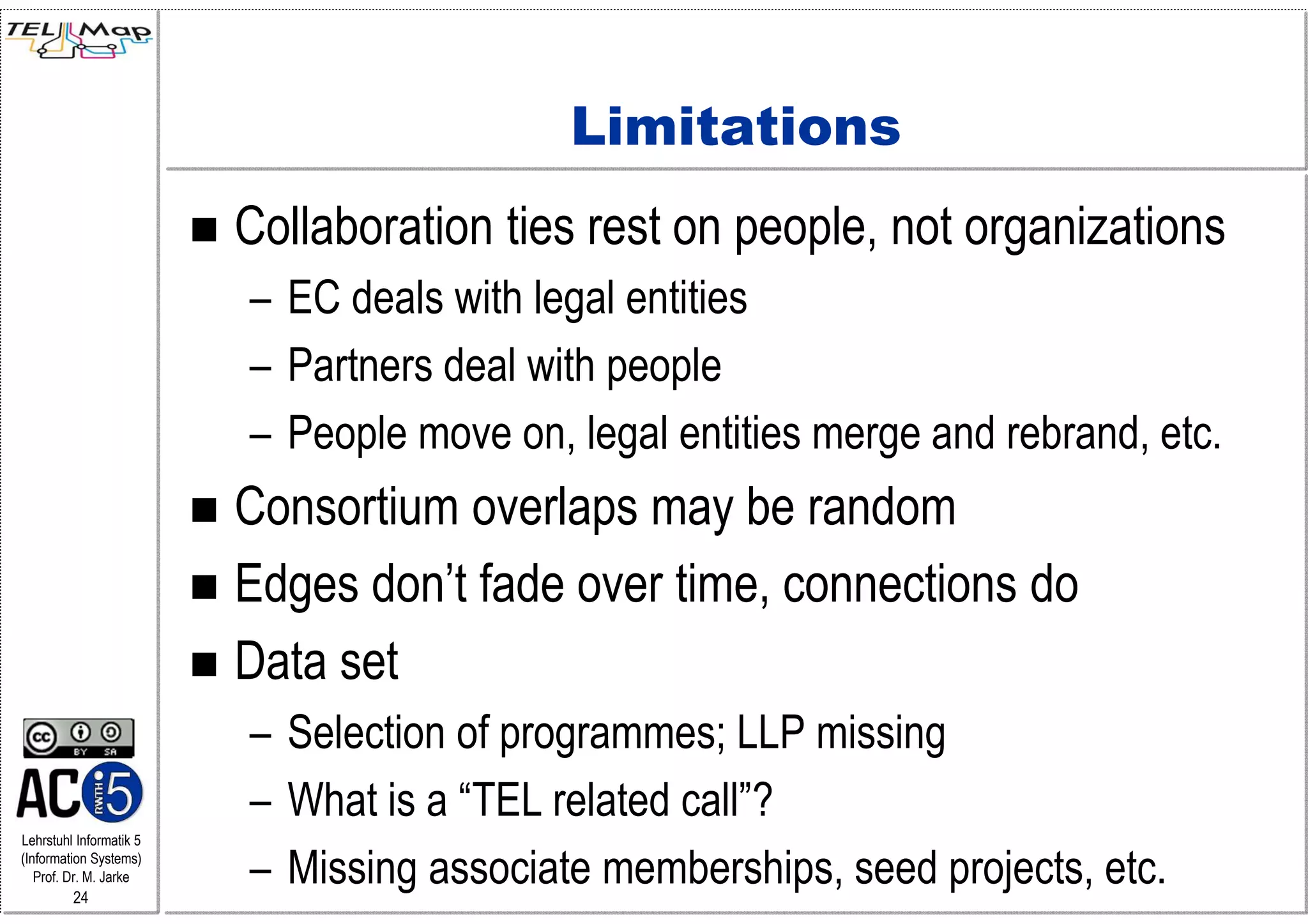
Limitations
                         Collaboration ties rest on people, not organizations
                         – EC deals with legal entities
                         – Partners deal with people
                         – People move on, legal entities merge and rebrand, etc.
                         Consortium overlaps may be random
                         Edges don’t fade over time, connections do
                         Data set
                         – Selection of programmes; LLP missing
                         – What is a “TEL related call”?
Lehrstuhl Informatik 5
(Information Systems)
   Prof. Dr. M. Jarke
         24
                         – Missing associate memberships, seed projects, etc.
References
                         1. Voigt, C. (ed.): Deliverable D7.5, STELLAR Nework of Excellence (2011)
                         2. Barber, M., Krueger, A., Krueger, T., Roediger-Schluga, T.: Network of European Union–funded collaborative
                             research and development projects. Physical Review E 73 (2006)
                         3. Roediger-Schluga, T., Barber, M.J.: R&D collaboration networks in the European Framework Programmes: data
                             processing, network construction and selected results. International Journal of Foresight and Innovation Policy
                             4(3/4), 321–347 (2008)
                         4. Frachisse, D., Billand, P., Massard, N.: The Sixth Framework Program as an Affiliation Network: Representation
                             and Analysis (2008), http://ssrn.com/abstract=1117966
                         5. Breschi, S., Cusmano, L.: Unveiling the texture of a European Research Area: emergence of oligarchic networks
                             under EU Framework Programmes. International Journal of Technology Management 27(8), 747–772 (2004)
                         6. Lozano, S., Duch, J., Arenas, A.: Analysis of large social datasets by community detection. The European Physical
                             Journal Special Topics 143(1), 257–259 (2007)
                         7. Scherngell, T., Barber, M.J.: Spatial interaction modelling of cross-region R&D collaborations: empirical evidence
                             from the 5th EU framework programme. Papers in Regional Science 88(3), 531–546 (2009)
                         8. Roediger-Schluga, T., Dachs, B.: Does technology affect network structure? – A quantitative analysis of
                             collaborative research projects in two specific EU programmes. UNU-MERIT Working Paper Series 041 (2006)
                         9. Derntl, M., Erdtmann, S., Klamma, R.: An Embeddable Dashboard for Widget-Based Visual Analytics on Scientific
                             Communities. In: I-KNOW 2012. ACM (2012)
                         10. Blondel, V. D., Guillaume, J., Lambiotte, R., Lefevre, E.: Fast unfolding of communities in large networks. Journal of
Lehrstuhl Informatik 5       Statistical Mechanics: Theory and Experiment 2008 (10)
(Information Systems)
   Prof. Dr. M. Jarke
         25

The European TEL Projects Community from a Social Network Analysis Perspective

  • 1.
    7th European Conferenceon Technology Enhanced Learning (EC-TEL 2012) September 18-21, 2012 Saarbrücken, Germany The European TEL Projects Community from a Social Network Analysis Perspective Michael Derntl and Ralf Klamma RWTH Aachen University Advanced Community Information Systems (ACIS) Aachen, Germany derntl@dbis.rwth-aachen.de Lehrstuhl Informatik 5 (Information Systems) Prof. Dr. M. Jarke 1 These slides are licensed under a Creative Commons Attribution-ShareAlike 3.0 Unported License.
  • 2.
    Motivation Collaborative projects are key in the R&D value chain – Cost a lot of (tax payers’) money – Drive research agenda and scientific community building – scientific events (e.g. EC-TEL, summer school) – researcher mobility, seed projects, R&D teams, associate partnerships, etc. – conducting, reporting, and disseminating research – product development and knowledge transfer Stakeholders have an interest in the collaboration structures of their scientific community Lehrstuhl Informatik 5 (Information Systems) Prof. Dr. M. Jarke – Key organizations, key projects, trends 2
  • 3.
    Research Objectives Identify characteristics of the social network of funded R&D collaborations – Organizational collaboration – Project relationships – Central organizations and projects Analyze impact of projects on the collaboration landscape – Conceive impact measure – Find network parameters that may indicate impact Lehrstuhl Informatik 5 (Information Systems) Prof. Dr. M. Jarke 3
  • 4.
    Related Work Several papers on collaboration networks in FP1-6 [2, 3, 4] with both one-mode and two-node networks Community detection in collaboration networks [6, 7, 8], e.g. location, topics, org. type Analysis of multimodal networks of NoEs (e.g. in STELLAR) [1] Findings – complex scale-free networks; small diameter, high clustering Lehrstuhl Informatik 5 (Information Systems) Prof. Dr. M. Jarke – “oligarchic core” of organizations [5] 4
  • 5.
    Data set: Projecttimeline 9 # Started Projects 8 7 6 5 4 3 2 1 0 1999 2000 2001 2002 2003 2004 2005 2006 2007 2008 2009 2010 2011 2012 eTEN (39) – eLearning FP6 (32) – TEL eContentplus (19) – Educ. Lehrstuhl Informatik 5 (Information Systems) FP7 (26) – TEL Prof. Dr. M. Jarke 5
  • 6.
    Data set: Projecttimeline 116 projects 9 350 # Started Projects EC Funding (Million Euro) 829 organizations 8 300 17progamme: 81% 250 26progammes: 14% 5 200 3 programmes: 4% 4 150 All programmes: 1% -- IMC, Open U, 3 WU Wien, KU Leuven, U Hannover, 100 U2Duisburg-Essen, Giunti 50 1 0 0 1999 2000 2001 2002 2003 2004 2005 2006 2007 2008 2009 2010 2011 2012 eTEN (39) – eLearning FP6 (32) – TEL eContentplus (19) – Educ. Lehrstuhl Informatik 5 (Information Systems) FP7 (26) – TEL Prof. Dr. M. Jarke 6
  • 7.
    Projects as SocialNetworks Projects Organizations [4] Project consortium progression – Nodes: Projects ROLE IMC, RWTH, OU, ZSI – Edges: Overlap of consortia TEL-Map (directed, weighted) Organizational collaboration The Open STELLAR, EUROGENE, – Nodes: Organizations University ROLE, PROLEARN, iCOPER, ASPECT – Edges: Collaboration in multiple KU Lehrstuhl Informatik 5 (Information Systems) Prof. Dr. M. Jarke projects (undirected, weighted) Leuven 7
  • 8.
    Consortium Progression – Project Network Edge between project P1 and P2 – P2 started at least t time units after P1 – At least k overlapping partners in the consortia – Edge direction: P1 P2 – Edge weight: function of overlap Thresholds that filter for continued collaboration in successive projects? k=2 t = 3 months Lehrstuhl Informatik 5 (Information Systems) Prof. Dr. M. Jarke 8
  • 9.
    Consortium Progression k = 2, m = 3 months Nodes 85 Edges 257 Diameter 4 Clustering coeff. 0.2 Avg. degree 6.05 Avg. weighted degree 16.9 Avg. path length 1.78 Node size proportional to weighted degree Node color represents cluster [10] Lehrstuhl Informatik 5 (Information Systems) Prof. Dr. M. Jarke 9
  • 10.
    Consortium Progression k = 2, m = 3 months Nodes 85 Edges 257 Diameter 4 Clustering coeff. 0.2 Avg. degree 6.05 Avg. weighted degree 16.9 Avg. path length 1.78 Node size proportional to weighted degree Node color represents cluster [10] Lehrstuhl Informatik 5 (Information Systems) Prof. Dr. M. Jarke 10
  • 11.
    Project Impact onthe Landscape Measure impact of project consortium members on sustaining and shaping the social TEL project ties after the project start relative to opportunity. , ∩ Impact ∙ Cumulative fraction , of successor projects ∈ filled up with p's Successor projects relative to opportunity members , projects starting t time units after p and having at least k partners overlap with p all potential successor projects of p after t time units Lehrstuhl Informatik 5 (Information Systems) Prof. Dr. M. Jarke consortium members of p 11
  • 12.
    Top 15 Projectsby Impact Filters • Started at least 1y before most recent project batch (10/2010) • Top 15 6 FP6, 3 FP7, 3 ECP, 2 eTEN Top instruments: 6 STREP, 3 NoE, 2 BPN Lehrstuhl Informatik 5 (Information Systems) Prof. Dr. M. Jarke 12
  • 13.
    Correlations Impact correlates positively with Pearson correlation *p < .1 **p < .05 ***p < .01 – Funding**, Consortium size*** – Betweenness centrality*** , (Weighted) in-degree** by size* No correlation with PageRank, authority, hub, closeness centrality, clustering coefficient Promising (running or ended in last 12 months): Funding m€ ▼wdin wdin/C OpenDiscoverySpace 7.65 74 (26) 1.45 GALA 5.65 55 (20) 1.77 OpenScout 2.80 52 (17) 2.89 STELLAR 4.99 41 (14) 2.56 ROLE 6.60 35 (12) 2.19 Lehrstuhl Informatik 5 TEL-Map 2.13 31 (10) 3.10 (Information Systems) Prof. Dr. M. Jarke iTEC 9.45 20 (5) 0.75 13
  • 14.
    Organizational Collaboration Collaboration is the fertile soil for R&D output in CPs Follow-up proposals / projects Shapes the research agenda Graph: – Edge between O1 and O2 if both participated in at least one project The Open STELLAR, EUROGENE, – Weight: number of projects University ROLE, PROLEARN, iCOPER, ASPECT – Direction: none KU Lehrstuhl Informatik 5 (Information Systems) Prof. Dr. M. Jarke – Nodes: organizations Leuven 14
  • 15.
    Organizational Collaboration Network Lehrstuhl Informatik 5 (Information Systems) Prof. Dr. M. Jarke 15
  • 16.
    Organizational Collaboration Network Lehrstuhl Informatik 5 (Information Systems) Prof. Dr. M. Jarke 16
  • 17.
    Collaboration Network Properties Nodes 852 Clustering coefficient 0.89 Edges 12 021 Avg. degree 28.2 Avg. weighted degree 30 Diameter 6 Avg. path length 2.68 Lehrstuhl Informatik 5 (Information Systems) Prof. Dr. M. Jarke 17
  • 18.
    Frequent Collaboration Pairs National Centre For Wirtschaftsuniversitaet 4.0 Scientific Research Demokritos Wien 4.0 Giunti Labs S.R.L. 5.0 4.0 imc Information Multimedia Katholieke Universiteit 5.0 The Open University 5.0 Communication AG 5.0 6.0 Leuven Ecole Polytechnique 4.0 Federale De Lausanne 4.0 4.0 5.0 Politecnico Di Milano Jyvaskylan Yliopisto Gottfried Wilhelm Leibniz Open Universiteit 4.0 Universitaet Hannover 6.0 Nederland 5.0 4.0 4.0 Deutsches Forschungszentrum Universitaet 4.0 Fuer Kuenstliche Intelligenz Gmbh Duisburg-Essen 4.0 4.0 Bundesministerium Fuer Atos Origin Sociedad Technische Universiteit Fraunhofer-Gesellschaft Univerza V Ljubljani Wissenschaft Und Forschung Anonima Espanola Eindhoven ... E.V 4.0 4.0 4.0 Ellinogermaniki Agogi Universitaet Graz EUN Partnership Aisbl Scholi Panagea Savva Ae 4.0 5.0 4.0 Bundesgymnasium Und The Provost Fellows Tiigrihuppe Sihtasutus Bundesrealgymnasium Schwechat ... Near Dublin 1. PROLEARN (FP6): 17 pairs 4. GRAPPLE (FP7): 8 pairs 2. ICOPER (ECP): 11 pairs 5. PROLIX (FP6): 6 pairs Lehrstuhl Informatik 5 (Information Systems) Prof. Dr. M. Jarke 3. OpenScout (ECP): 9 pairs 6. STELLAR (FP7), ROLE (FP7): 5 pairs 18
  • 19.
    Projects Space @ LearningFrontiers.eu Lehrstuhl Informatik 5 (Information Systems) Prof. Dr. M. Jarke 19
  • 20.
    Projects Space @ LearningFrontiers.eu Lehrstuhl Informatik 5 (Information Systems) Prof. Dr. M. Jarke 20
  • 21.
    Projects Space @ LearningFrontiers.eu Lehrstuhl Informatik 5 (Information Systems) Prof. Dr. M. Jarke 21
  • 22.
    Dashboard Lehrstuhl Informatik 5 (InformationSystems) Prof. Dr. M. Jarke http://learningfrontiers.eu/?q=dashboard [9] 22
  • 23.
    Summary Networks – Collaboration: low diameter, high clustering – Projects: low diameter, low clustering – Small “oligarchic core” of frequent collaborators – In line with previous research in FP1-6 Impact measure to account for time/size – Correlates with in-degree, funding, betweenness centrality – Networks (NoE and BPN) occupy 5 of top 8 spots – Projects to follow: ODS, GALA, iTEC, ROLE, TEL-Map, … Lehrstuhl Informatik 5 (Information Systems) Prof. Dr. M. Jarke 23 Explore data on learningfrontiers.eu
  • 24.
    Limitations Collaboration ties rest on people, not organizations – EC deals with legal entities – Partners deal with people – People move on, legal entities merge and rebrand, etc. Consortium overlaps may be random Edges don’t fade over time, connections do Data set – Selection of programmes; LLP missing – What is a “TEL related call”? Lehrstuhl Informatik 5 (Information Systems) Prof. Dr. M. Jarke 24 – Missing associate memberships, seed projects, etc.
  • 25.
    References 1. Voigt, C. (ed.): Deliverable D7.5, STELLAR Nework of Excellence (2011) 2. Barber, M., Krueger, A., Krueger, T., Roediger-Schluga, T.: Network of European Union–funded collaborative research and development projects. Physical Review E 73 (2006) 3. Roediger-Schluga, T., Barber, M.J.: R&D collaboration networks in the European Framework Programmes: data processing, network construction and selected results. International Journal of Foresight and Innovation Policy 4(3/4), 321–347 (2008) 4. Frachisse, D., Billand, P., Massard, N.: The Sixth Framework Program as an Affiliation Network: Representation and Analysis (2008), http://ssrn.com/abstract=1117966 5. Breschi, S., Cusmano, L.: Unveiling the texture of a European Research Area: emergence of oligarchic networks under EU Framework Programmes. International Journal of Technology Management 27(8), 747–772 (2004) 6. Lozano, S., Duch, J., Arenas, A.: Analysis of large social datasets by community detection. The European Physical Journal Special Topics 143(1), 257–259 (2007) 7. Scherngell, T., Barber, M.J.: Spatial interaction modelling of cross-region R&D collaborations: empirical evidence from the 5th EU framework programme. Papers in Regional Science 88(3), 531–546 (2009) 8. Roediger-Schluga, T., Dachs, B.: Does technology affect network structure? – A quantitative analysis of collaborative research projects in two specific EU programmes. UNU-MERIT Working Paper Series 041 (2006) 9. Derntl, M., Erdtmann, S., Klamma, R.: An Embeddable Dashboard for Widget-Based Visual Analytics on Scientific Communities. In: I-KNOW 2012. ACM (2012) 10. Blondel, V. D., Guillaume, J., Lambiotte, R., Lefevre, E.: Fast unfolding of communities in large networks. Journal of Lehrstuhl Informatik 5 Statistical Mechanics: Theory and Experiment 2008 (10) (Information Systems) Prof. Dr. M. Jarke 25