INCLUSIVE SUPPORT FOR CHILDREN WITH
 SPECIAL EDUCATIONAL NEEDS - WHAT DOES
          IT MEAN IN PRACTICE?

          The coherence of indications, goals and measures of
                support in individual educational plans


                                         Zurich University of Teacher Education, Switzerland
                                                           Reto Luder – Siauliai – May 2012
INDIVIDUAL EDUCATIONAL PLANNING - RETO
                                                                                               1
LUDER
INDIVIDUAL EDUCATIONAL PLANNING - RETO LUDER   2
INDIVIDUAL EDUCATIONAL PLANNING - RETO LUDER   3
OVERVIEW

• Context:
     Inclusive education and individual educational planning in
     Switzerland
• Aim of the study and research questions
• Method
• Results
• Discussion


INDIVIDUAL EDUCATIONAL PLANNING - RETO LUDER                      4
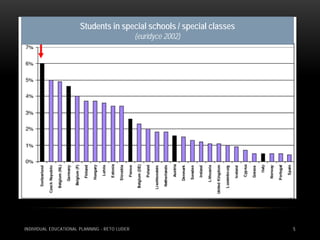
Students in special schools / special classes
                                               (euridyce 2002)


INDIVIDUAL EDUCATIONAL PLANNING - RETO LUDER                           5
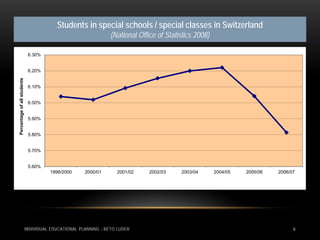
Students in special schools / special classes in Switzerland
                                                                 (National Office of Statistics 2008)

                              6.30%


                              6.20%
Percentage of all students


                              6.10%


                              6.00%


                              5.90%


                              5.80%


                              5.70%


                              5.60%
                                       1999/2000      2000/01      2001/02     2002/03    2003/04       2004/05   2005/06   2006/07


                             INDIVIDUAL EDUCATIONAL PLANNING - RETO LUDER                                                         6
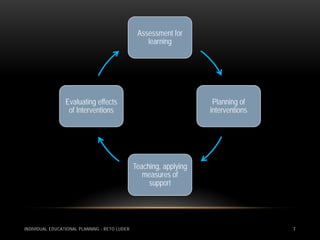
Assessment for
                                                   learning


                 Evaluating effects                                  Planning of
                  of Interventions                                  interventions


                                               Teaching, applying
                                                  measures of
                                                    support


INDIVIDUAL EDUCATIONAL PLANNING - RETO LUDER                                        7
INDIVIDUAL EDUCATIONAL PLANS
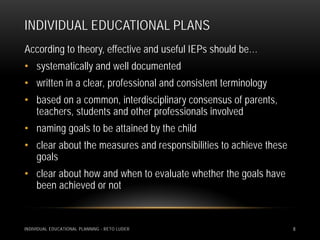
According to theory, effective and useful IEPs should be…
• systematically and well documented
• written in a clear, professional and consistent terminology
• based on a common, interdisciplinary consensus of parents,
  teachers, students and other professionals involved
• naming goals to be attained by the child
• clear about the measures and responsibilities to achieve these
  goals
• clear about how and when to evaluate whether the goals have
  been achieved or not


INDIVIDUAL EDUCATIONAL PLANNING - RETO LUDER                       8
In practice, the situation is far less clear…

Practitioners mostly follow their own, not always
systematic idea of IEP (Luder, Niedermann & Buholzer 2006),
their procedures are often not coordinated and not very
effective (Truscott et al. 2005).
In consequence, the coherence between indications,
goals and interventions in IEPs is often rather poor
(Poppes et al. 2002, Shriner & Destefano 2003).


INDIVIDUAL EDUCATIONAL PLANNING - RETO LUDER                  9
QUALITY OF GOALS
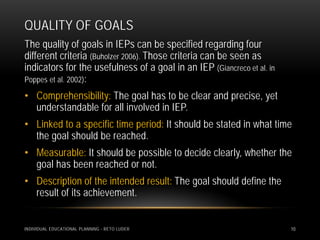
The quality of goals in IEPs can be specified regarding four
different criteria (Buholzer 2006). Those criteria can be seen as
indicators for the usefulness of a goal in an IEP (Giancreco et al. in
Poppes et al. 2002):

• Comprehensibility: The goal has to be clear and precise, yet
  understandable for all involved in IEP.
• Linked to a specific time period: It should be stated in what time
  the goal should be reached.
• Measurable: It should be possible to decide clearly, whether the
  goal has been reached or not.
• Description of the intended result: The goal should define the
  result of its achievement.


INDIVIDUAL EDUCATIONAL PLANNING - RETO LUDER                             10
RESEARCH QUESTIONS

• Why, based on what kind of indication do they get
  individual support in the first place?
• What goals are aimed with the special support?
• What kinds of measures are taken to achieve these
  goals?

A special focus was on the content and the quality of goals and on the
coherence between indications, goals and measures of support in
individual educational plans. As additional factors, school type (regular
classroom vs. special school) and gender where analyzed.


INDIVIDUAL EDUCATIONAL PLANNING - RETO LUDER                           11
METHOD: DESIGN
The data was collected in two studies. In both studies, individual
educational plans of children with special educational needs were
analyzed.
Study one focused on the goals of special education support while
study two focused on the coherence of indications, goals and
interventions in IEPs.
In study two, case managers participated in a survey and were
asked about the indications for the special educational support, the
goals that were set in the educational plans and the measures of
support taken to achieve these goals.


INDIVIDUAL EDUCATIONAL PLANNING - RETO LUDER                         12
METHOD: SAMPLE
In total, IEPs of 488 children with SEN where analyzed.
In study one, IEPs of 439 children with SEN were collected. 298
were male (68%) and 141 female (32%). They had an age between
4 and 12 years (from Kindergarten to 6th grade). One group was
selected from inclusive mainstream classes with additional special
educational support and a second group from special schools.
In study two, IEPs of 49 children with SEN where analyzed. 28
were male (57%) and 21 female (43%). They had an age between
12 and 15 years (7th to 9th grade). All 49 children were attaining
school in inclusive mainstream classes with individual special
educational support.


INDIVIDUAL EDUCATIONAL PLANNING - RETO LUDER                         13
METHOD: DATA ANALYSIS
The data in both studies was analyzed by methods of content
analysis, using the software MaxQDA.
 In a first step, text elements were assigned to one of 10 domains
of activity and participation. The domains are based on the
International Classification of Functioning, Disability and Health
(ICF) and focusing on school-relevant areas of activity and
participation


INDIVIDUAL EDUCATIONAL PLANNING - RETO LUDER                         14
METHOD: DATA ANALYSIS
• Learning and applying knowledge
• Mathematics
• Language
• Reading and writing
• General tasks and demands
• Communication
• Mobility
• Self-care
• Interpersonal interactions and relationships
• Domestic life


INDIVIDUAL EDUCATIONAL PLANNING - RETO LUDER     15
METHOD: DATA ANALYSIS
Further methods of content analysis used (Dieckmann 2010):
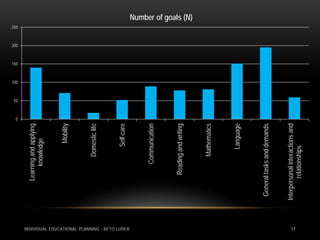
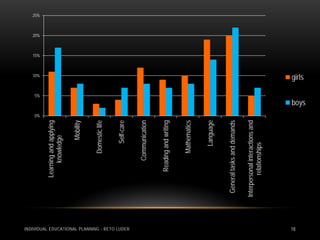
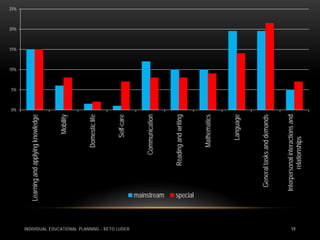
• Frequency analysis: The number of goals in different domains and in
     correlation with the variables gender and school type was counted.
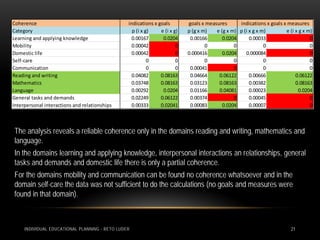
• Analysis of coherence: The probability (p) of a combined appearance of
     indications, goals and interventions of one category (the same domain)
     within the same case is compared to the empirical incidence in the data (e).
     If e > p, the categories have inner consistency within the cases.
• Rating of the quality of goals: Each goal was checked applying the
     quality criteria for goals in IEPs mentioned above. For each criteria fulfilled,
     one of four possible points was assigned to the goal. After that, each goal
     was rated on a scale from zero to four points.


INDIVIDUAL EDUCATIONAL PLANNING - RETO LUDER                                            16
0
                                                                                    50
                                                                                         100
                                                                                               150
                                                                                                     200
                                                                                                           250
                                                      Learning and applying
                                                           knowledge


                                                                     Mobility


                                                               Domestic life


                                                                   Self-care


INDIVIDUAL EDUCATIONAL PLANNING - RETO LUDER
                                                             Communication


                                                        Reading and writing
                                                                                                                 Number of goals (N)


                                                                Mathematics


                                                                  Language


                                                General tasks and demands


                                               Interpersonal interactions and
17


                                                        relationships
0%
                                                                                        5%
                                                                                              10%
                                                                                                     15%
                                                                                                           20%
                                                                                                                 25%


                                                      Learning and applying
                                                           knowledge

                                                                     Mobility


                                                               Domestic life


                                                                   Self-care


INDIVIDUAL EDUCATIONAL PLANNING - RETO LUDER
                                                             Communication


                                                        Reading and writing


                                                                Mathematics


                                                                  Language


                                                General tasks and demands

                                               Interpersonal interactions and
                                                        relationships
18
                                                                                             girls


                                                                                     boys
0%
                                                                                              5%
                                                                                                   10%
                                                                                                         15%
                                                                                                               20%
                                                                                                                     25%


                                               Learning and applying knowledge


                                                                              Mobility


                                                                         Domestic life


                                                                             Self-care


INDIVIDUAL EDUCATIONAL PLANNING - RETO LUDER
                                                                       Communication


                                               mainstream
                                                                   Reading and writing

                                               special
                                                                         Mathematics


                                                                            Language


                                                            General tasks and demands


                                                       Interpersonal interactions and
19


                                                                relationships
mainstream                                                    special
                                                                            1%
              0%


                                                                19%

                                          excellent (4)                                      excellent (4)
35%                         37%
                                          good (3)
                                                                                       38%   good (3)
                                          average (2)                                        average (2)
                                                          16%

                                          poor (1)                                           poor (1)
                                          very poor (0)                                      very poor (0)

      15%           13%                                               26%


INDIVIDUAL EDUCATIONAL PLANNING - RETO LUDER                                                       20
Coherence                                       indications x goals        goals x measures      indications x goals x measures
Category                                          p (i x g)    e (i x g)   p (g x m)   e (g x m) p (i x g x m)        e (i x g x m)
Learning and applying knowledge                  0.00167        0.0204      0.00166       0.0204      0.00033                     0
Mobility                                          0.00042              0           0           0             0                    0
Domestic life                                    0.00042               0   0.000416       0.0204    0.000084                      0
Self-care                                                 0            0           0           0             0                    0
Communication                                             0            0    0.00041            0             0                    0
Reading and writing                              0.04082       0.08163      0.04664     0.06122       0.00666              0.06122
Mathematics                                      0.03748       0.08163      0.03123     0.08163       0.00382              0.08163
Language                                         0.00292        0.0204      0.01166     0.04081       0.00023               0.0204
General tasks and demands                        0.02249       0.06122      0.00374            0      0.00045                     0
Interpersonal interactions and relationships     0.00333       0.02041      0.00083       0.0204      0.00007                     0


The analysis reveals a reliable coherence only in the domains reading and writing, mathematics and
language.
In the domains learning and applying knowledge, interpersonal interactions an relationships, general
tasks and demands and domestic life there is only a partial coherence.
For the domains mobility and communication can be found no coherence whatsoever and in the
domain self-care the data was not sufficient to do the calculations (no goals and measures were
found in that domain).


     INDIVIDUAL EDUCATIONAL PLANNING - RETO LUDER                                                                        21
DISCUSSION

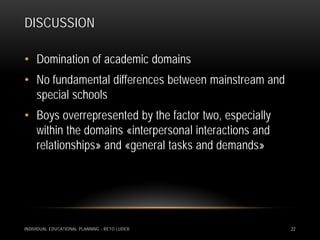
• Domination of academic domains
• No fundamental differences between mainstream and
  special schools
• Boys overrepresented by the factor two, especially
  within the domains «interpersonal interactions and
  relationships» and «general tasks and demands»


INDIVIDUAL EDUCATIONAL PLANNING - RETO LUDER           22
DISCUSSION

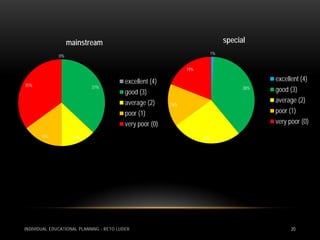
• Quality of goals is alarming, slightly better in special
  than in mainstream schools.
• Inner coherence of IEPs is good in classic academic
  domains like mathematics or reading and writing.
• It is rather poor in other domains.


INDIVIDUAL EDUCATIONAL PLANNING - RETO LUDER                 23
CONCLUSION (1)

IEPs in inclusive mainstream schools, as well as in
special schools focus on mainly the same, mostly
academic domains of competences.
Goals in IEPs very often refer to academic abilities like
reading and writing or mathematics.
Overall, no fundamental differences in IEP could be found
between special schools and inclusive mainstream
schools.


INDIVIDUAL EDUCATIONAL PLANNING - RETO LUDER                24
CONCLUSION (2)

A somewhat disturbing result is the often low quality of
goals formulated in IEPs.
As goals are a crucial element for the quality of IEP in
general, the importance of goals in IEPs has to be
emphasized.
In goal-setting, teachers and school teams, notably in
mainstream schools need specific know-how and support,
especially in non-academic domains of special
educational support.

INDIVIDUAL EDUCATIONAL PLANNING - RETO LUDER               25
CONCLUSION (3)

Coherence of IEPs in mainstream schools is better, the closer
the content is to academic competences with important
meaning for the school curriculum.
Since deficits in academic domains often are caused also by
factors in other, non-academic domains, it would be useful to
extend the view towards a broader focus and to consider also
other aspects of the child than its abilities in academic
domains.
Therefore, to improve the quality and coherence of IEPs, a
goal-based approach with a broad view on various factors in
different domains should be focused.


INDIVIDUAL EDUCATIONAL PLANNING - RETO LUDER                26
Thank you for your attention!

TIME FOR QUESTIONS AND DISCUSSION


INDIVIDUAL EDUCATIONAL PLANNING - RETO LUDER   27
REFERENCES
•    Diekmann, Andreas (2010). Empirische Sozialforschung. Grundlagen, Methoden, Anwendungen: Reinbek: Rowohlt.
•    Hollenweger, Judith &. Luder Reto (2010). Schulische Standortgespräche. Ein Verfahren zur Förderplanung und
     Zuweisung von sonderpädagogischen Massnahmen. In: Sonderpädagogische Förderung heute 55 (3), S. 271–286.
•    Isaksson, J. , Lindqvist, R. & Bergström, E. (2007). School problems or individual shortcomings? A study of
     individual educational plans in Sweden. European Journal of Special Needs Education 22 (1), pp. 75-91.
•    Luder, Reto (2011). Förderplanung als interdisziplinäre und kooperative Aufgabe. In: Reto Luder, Raphael
     Gschwend, André Kunz und Peter Diezi-Duplain (Ed.): Sonderpädagogische Förderung gemeinsam planen.
     Grundlagen, Modelle und Instrumente für die Praxis. 1., neue Ausg. Zürich: Pestalozzianum, S. 11–28.
•    Luder, Reto; Gschwend, Raphael; Kunz, André; Diezi-Duplain, Peter (Ed.) (2011). Sonderpädagogische Förderung
     gemeinsam planen. Grundlagen, Modelle und Instrumente für die Praxis. 1., neue Ausg. Zürich: Pestalozzianum.
•    Luder, Reto; Niedermann, Albin &. Buholzer Alois (2006). Förderdiagnostisches Arbeiten in Theorie und Praxis.
     Ergebnisse einer qualitativ-empirischen Studie. In: Vierteljahresschrift für Heilpädagogik und ihre Nachbargebiete
     75, 4, S. 293–304.
•    Poppes, P.; Vlaskamp, C.; De Greeter, K.; Hakken, H. (2002). Te importance of setting goals: the effect of
     instruction and training on the technical and intrinsic quality of goals. In: Journal of Special Needs Education (17),
     S. 241–250.
•    Shriner, James G.; Destefano, Lizanne (2003): Participation and accommodation in state assessment: The role of
     individualized education programs. In: Exceptional Children 69 (2), S. 147–161.
•    Sopko, K. M. (2003). The IEP: A Synthesis of Current Literature Since 1997. Alexandria (VA): NASDSE.
•    Truscott, Stephen D.; Catanese, Angela M.; Abrams, Laura M. (2005). The Evolving Context of Special Education
     Classification in the United States. In: School Psychology International 26 (2), S. 162–177.
•    UNESCO (2005). Guidelines for inclusion: ensuring access to education for all. Paris: UNESCO.


    INDIVIDUAL EDUCATIONAL PLANNING - RETO LUDER                                                                      28

Prof. Reto Luder

  • 1.
    INCLUSIVE SUPPORT FORCHILDREN WITH SPECIAL EDUCATIONAL NEEDS - WHAT DOES IT MEAN IN PRACTICE? The coherence of indications, goals and measures of support in individual educational plans Zurich University of Teacher Education, Switzerland Reto Luder – Siauliai – May 2012 INDIVIDUAL EDUCATIONAL PLANNING - RETO 1 LUDER
  • 2.
  • 3.
  • 4.
    OVERVIEW • Context: Inclusive education and individual educational planning in Switzerland • Aim of the study and research questions • Method • Results • Discussion INDIVIDUAL EDUCATIONAL PLANNING - RETO LUDER 4
  • 5.
    Students in specialschools / special classes (euridyce 2002) INDIVIDUAL EDUCATIONAL PLANNING - RETO LUDER 5
  • 6.
    Students in specialschools / special classes in Switzerland (National Office of Statistics 2008) 6.30% 6.20% Percentage of all students 6.10% 6.00% 5.90% 5.80% 5.70% 5.60% 1999/2000 2000/01 2001/02 2002/03 2003/04 2004/05 2005/06 2006/07 INDIVIDUAL EDUCATIONAL PLANNING - RETO LUDER 6
  • 7.
    Assessment for learning Evaluating effects Planning of of Interventions interventions Teaching, applying measures of support INDIVIDUAL EDUCATIONAL PLANNING - RETO LUDER 7
  • 8.
    INDIVIDUAL EDUCATIONAL PLANS Accordingto theory, effective and useful IEPs should be… • systematically and well documented • written in a clear, professional and consistent terminology • based on a common, interdisciplinary consensus of parents, teachers, students and other professionals involved • naming goals to be attained by the child • clear about the measures and responsibilities to achieve these goals • clear about how and when to evaluate whether the goals have been achieved or not INDIVIDUAL EDUCATIONAL PLANNING - RETO LUDER 8
  • 9.
    In practice, thesituation is far less clear… Practitioners mostly follow their own, not always systematic idea of IEP (Luder, Niedermann & Buholzer 2006), their procedures are often not coordinated and not very effective (Truscott et al. 2005). In consequence, the coherence between indications, goals and interventions in IEPs is often rather poor (Poppes et al. 2002, Shriner & Destefano 2003). INDIVIDUAL EDUCATIONAL PLANNING - RETO LUDER 9
  • 10.
    QUALITY OF GOALS Thequality of goals in IEPs can be specified regarding four different criteria (Buholzer 2006). Those criteria can be seen as indicators for the usefulness of a goal in an IEP (Giancreco et al. in Poppes et al. 2002): • Comprehensibility: The goal has to be clear and precise, yet understandable for all involved in IEP. • Linked to a specific time period: It should be stated in what time the goal should be reached. • Measurable: It should be possible to decide clearly, whether the goal has been reached or not. • Description of the intended result: The goal should define the result of its achievement. INDIVIDUAL EDUCATIONAL PLANNING - RETO LUDER 10
  • 11.
    RESEARCH QUESTIONS • Why,based on what kind of indication do they get individual support in the first place? • What goals are aimed with the special support? • What kinds of measures are taken to achieve these goals? A special focus was on the content and the quality of goals and on the coherence between indications, goals and measures of support in individual educational plans. As additional factors, school type (regular classroom vs. special school) and gender where analyzed. INDIVIDUAL EDUCATIONAL PLANNING - RETO LUDER 11
  • 12.
    METHOD: DESIGN The datawas collected in two studies. In both studies, individual educational plans of children with special educational needs were analyzed. Study one focused on the goals of special education support while study two focused on the coherence of indications, goals and interventions in IEPs. In study two, case managers participated in a survey and were asked about the indications for the special educational support, the goals that were set in the educational plans and the measures of support taken to achieve these goals. INDIVIDUAL EDUCATIONAL PLANNING - RETO LUDER 12
  • 13.
    METHOD: SAMPLE In total,IEPs of 488 children with SEN where analyzed. In study one, IEPs of 439 children with SEN were collected. 298 were male (68%) and 141 female (32%). They had an age between 4 and 12 years (from Kindergarten to 6th grade). One group was selected from inclusive mainstream classes with additional special educational support and a second group from special schools. In study two, IEPs of 49 children with SEN where analyzed. 28 were male (57%) and 21 female (43%). They had an age between 12 and 15 years (7th to 9th grade). All 49 children were attaining school in inclusive mainstream classes with individual special educational support. INDIVIDUAL EDUCATIONAL PLANNING - RETO LUDER 13
  • 14.
    METHOD: DATA ANALYSIS Thedata in both studies was analyzed by methods of content analysis, using the software MaxQDA. In a first step, text elements were assigned to one of 10 domains of activity and participation. The domains are based on the International Classification of Functioning, Disability and Health (ICF) and focusing on school-relevant areas of activity and participation INDIVIDUAL EDUCATIONAL PLANNING - RETO LUDER 14
  • 15.
    METHOD: DATA ANALYSIS •Learning and applying knowledge • Mathematics • Language • Reading and writing • General tasks and demands • Communication • Mobility • Self-care • Interpersonal interactions and relationships • Domestic life INDIVIDUAL EDUCATIONAL PLANNING - RETO LUDER 15
  • 16.
    METHOD: DATA ANALYSIS Furthermethods of content analysis used (Dieckmann 2010): • Frequency analysis: The number of goals in different domains and in correlation with the variables gender and school type was counted. • Analysis of coherence: The probability (p) of a combined appearance of indications, goals and interventions of one category (the same domain) within the same case is compared to the empirical incidence in the data (e). If e > p, the categories have inner consistency within the cases. • Rating of the quality of goals: Each goal was checked applying the quality criteria for goals in IEPs mentioned above. For each criteria fulfilled, one of four possible points was assigned to the goal. After that, each goal was rated on a scale from zero to four points. INDIVIDUAL EDUCATIONAL PLANNING - RETO LUDER 16
  • 17.
    0 50 100 150 200 250 Learning and applying knowledge Mobility Domestic life Self-care INDIVIDUAL EDUCATIONAL PLANNING - RETO LUDER Communication Reading and writing Number of goals (N) Mathematics Language General tasks and demands Interpersonal interactions and 17 relationships
  • 18.
    0% 5% 10% 15% 20% 25% Learning and applying knowledge Mobility Domestic life Self-care INDIVIDUAL EDUCATIONAL PLANNING - RETO LUDER Communication Reading and writing Mathematics Language General tasks and demands Interpersonal interactions and relationships 18 girls boys
  • 19.
    0% 5% 10% 15% 20% 25% Learning and applying knowledge Mobility Domestic life Self-care INDIVIDUAL EDUCATIONAL PLANNING - RETO LUDER Communication mainstream Reading and writing special Mathematics Language General tasks and demands Interpersonal interactions and 19 relationships
  • 20.
    mainstream special 1% 0% 19% excellent (4) excellent (4) 35% 37% good (3) 38% good (3) average (2) average (2) 16% poor (1) poor (1) very poor (0) very poor (0) 15% 13% 26% INDIVIDUAL EDUCATIONAL PLANNING - RETO LUDER 20
  • 21.
    Coherence indications x goals goals x measures indications x goals x measures Category p (i x g) e (i x g) p (g x m) e (g x m) p (i x g x m) e (i x g x m) Learning and applying knowledge 0.00167 0.0204 0.00166 0.0204 0.00033 0 Mobility 0.00042 0 0 0 0 0 Domestic life 0.00042 0 0.000416 0.0204 0.000084 0 Self-care 0 0 0 0 0 0 Communication 0 0 0.00041 0 0 0 Reading and writing 0.04082 0.08163 0.04664 0.06122 0.00666 0.06122 Mathematics 0.03748 0.08163 0.03123 0.08163 0.00382 0.08163 Language 0.00292 0.0204 0.01166 0.04081 0.00023 0.0204 General tasks and demands 0.02249 0.06122 0.00374 0 0.00045 0 Interpersonal interactions and relationships 0.00333 0.02041 0.00083 0.0204 0.00007 0 The analysis reveals a reliable coherence only in the domains reading and writing, mathematics and language. In the domains learning and applying knowledge, interpersonal interactions an relationships, general tasks and demands and domestic life there is only a partial coherence. For the domains mobility and communication can be found no coherence whatsoever and in the domain self-care the data was not sufficient to do the calculations (no goals and measures were found in that domain). INDIVIDUAL EDUCATIONAL PLANNING - RETO LUDER 21
  • 22.
    DISCUSSION • Domination ofacademic domains • No fundamental differences between mainstream and special schools • Boys overrepresented by the factor two, especially within the domains «interpersonal interactions and relationships» and «general tasks and demands» INDIVIDUAL EDUCATIONAL PLANNING - RETO LUDER 22
  • 23.
    DISCUSSION • Quality ofgoals is alarming, slightly better in special than in mainstream schools. • Inner coherence of IEPs is good in classic academic domains like mathematics or reading and writing. • It is rather poor in other domains. INDIVIDUAL EDUCATIONAL PLANNING - RETO LUDER 23
  • 24.
    CONCLUSION (1) IEPs ininclusive mainstream schools, as well as in special schools focus on mainly the same, mostly academic domains of competences. Goals in IEPs very often refer to academic abilities like reading and writing or mathematics. Overall, no fundamental differences in IEP could be found between special schools and inclusive mainstream schools. INDIVIDUAL EDUCATIONAL PLANNING - RETO LUDER 24
  • 25.
    CONCLUSION (2) A somewhatdisturbing result is the often low quality of goals formulated in IEPs. As goals are a crucial element for the quality of IEP in general, the importance of goals in IEPs has to be emphasized. In goal-setting, teachers and school teams, notably in mainstream schools need specific know-how and support, especially in non-academic domains of special educational support. INDIVIDUAL EDUCATIONAL PLANNING - RETO LUDER 25
  • 26.
    CONCLUSION (3) Coherence ofIEPs in mainstream schools is better, the closer the content is to academic competences with important meaning for the school curriculum. Since deficits in academic domains often are caused also by factors in other, non-academic domains, it would be useful to extend the view towards a broader focus and to consider also other aspects of the child than its abilities in academic domains. Therefore, to improve the quality and coherence of IEPs, a goal-based approach with a broad view on various factors in different domains should be focused. INDIVIDUAL EDUCATIONAL PLANNING - RETO LUDER 26
  • 27.
    Thank you foryour attention! TIME FOR QUESTIONS AND DISCUSSION INDIVIDUAL EDUCATIONAL PLANNING - RETO LUDER 27
  • 28.
    REFERENCES • Diekmann, Andreas (2010). Empirische Sozialforschung. Grundlagen, Methoden, Anwendungen: Reinbek: Rowohlt. • Hollenweger, Judith &. Luder Reto (2010). Schulische Standortgespräche. Ein Verfahren zur Förderplanung und Zuweisung von sonderpädagogischen Massnahmen. In: Sonderpädagogische Förderung heute 55 (3), S. 271–286. • Isaksson, J. , Lindqvist, R. & Bergström, E. (2007). School problems or individual shortcomings? A study of individual educational plans in Sweden. European Journal of Special Needs Education 22 (1), pp. 75-91. • Luder, Reto (2011). Förderplanung als interdisziplinäre und kooperative Aufgabe. In: Reto Luder, Raphael Gschwend, André Kunz und Peter Diezi-Duplain (Ed.): Sonderpädagogische Förderung gemeinsam planen. Grundlagen, Modelle und Instrumente für die Praxis. 1., neue Ausg. Zürich: Pestalozzianum, S. 11–28. • Luder, Reto; Gschwend, Raphael; Kunz, André; Diezi-Duplain, Peter (Ed.) (2011). Sonderpädagogische Förderung gemeinsam planen. Grundlagen, Modelle und Instrumente für die Praxis. 1., neue Ausg. Zürich: Pestalozzianum. • Luder, Reto; Niedermann, Albin &. Buholzer Alois (2006). Förderdiagnostisches Arbeiten in Theorie und Praxis. Ergebnisse einer qualitativ-empirischen Studie. In: Vierteljahresschrift für Heilpädagogik und ihre Nachbargebiete 75, 4, S. 293–304. • Poppes, P.; Vlaskamp, C.; De Greeter, K.; Hakken, H. (2002). Te importance of setting goals: the effect of instruction and training on the technical and intrinsic quality of goals. In: Journal of Special Needs Education (17), S. 241–250. • Shriner, James G.; Destefano, Lizanne (2003): Participation and accommodation in state assessment: The role of individualized education programs. In: Exceptional Children 69 (2), S. 147–161. • Sopko, K. M. (2003). The IEP: A Synthesis of Current Literature Since 1997. Alexandria (VA): NASDSE. • Truscott, Stephen D.; Catanese, Angela M.; Abrams, Laura M. (2005). The Evolving Context of Special Education Classification in the United States. In: School Psychology International 26 (2), S. 162–177. • UNESCO (2005). Guidelines for inclusion: ensuring access to education for all. Paris: UNESCO. INDIVIDUAL EDUCATIONAL PLANNING - RETO LUDER 28