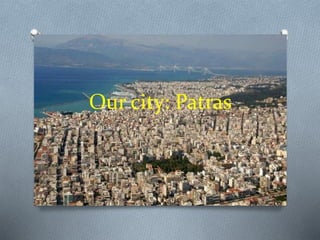
Our city: Patras
The lighthouse of Patras
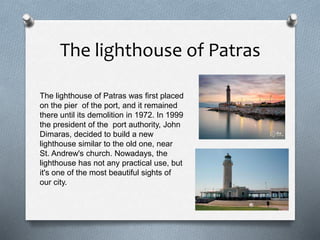
The lighthouse of Patras was first placed
on the pier of the port, and it remained
there until its demolition in 1972. In 1999
the president of the port authority, John
Dimaras, decided to build a new
lighthouse similar to the old one, near
St. Andrew's church. Nowadays, the
lighthouse has not any practical use, but
it's one of the most beautiful sights of
our city.
Saint Andrew Cathedral
Saint Andrew Cathedral is an
orthodox Christian church in
the east side of the city. This
church is dedicated to Apostle
Andrew. It is the biggest church
in Greece and the third biggest
in the Balkans. The cross where
St. Andrew was crucified on and
His Holy scalp are kept in here.
Agiou Nikolaou
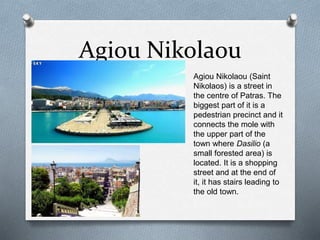
Agiou Nikolaou (Saint
Nikolaos) is a street in
the centre of Patras. The
biggest part of it is a
pedestrian precinct and it
connects the mole with
the upper part of the
town where Dasilio (a
small forested area) is
located. It is a shopping
street and at the end of
it, it has stairs leading to
the old town.
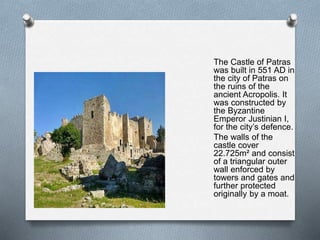
The Castle of Patras
was built in 551 AD in
the city of Patras on
the ruins of the
ancient Acropolis. It
was constructed by
the Byzantine
Emperor Justinian I,
for the city’s defence.
The walls of the
castle cover
22.725m² and consist
of a triangular outer
wall enforced by
towers and gates and
further protected
originally by a moat.
The Roman Odeum
The Roman Odeum of Patras is a
magnificent building of the Roman
ages, which has been restored and it
is currently used for music concerts
and plays. It is located in the old city
center (upper town) next to the
ancient Roman stadium. Every
summer the festival of Patras is held
in the Roman Odeum. It can host
about 2300 spectators and it is one
of the most interesting sights in the
city of Patras!
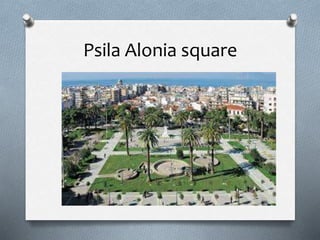
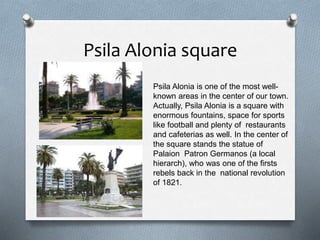
Psila Alonia square
Psila Alonia square
Psila Alonia is one of the most well-
known areas in the center of our town.
Actually, Psila Alonia is a square with
enormous fountains, space for sports
like football and plenty of restaurants
and cafeterias as well. In the center of
the square stands the statue of
Palaion Patron Germanos (a local
hierarch), who was one of the firsts
rebels back in the national revolution
of 1821.
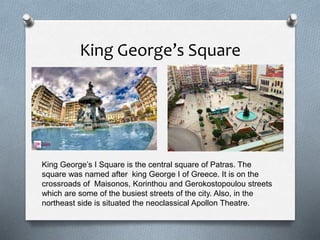
King George’s Square
King George’s I Square is the central square of Patras. The
square was named after king George I of Greece. It is on the
crossroads of Maisonos, Korinthou and Gerokostopoulou streets
which are some of the busiest streets of the city. Also, in the
northeast side is situated the neoclassical Apollon Theatre.
Apollon Theatre
Apollon Theatre is a
historic building designed
by the German architect
Ernesto Chiller and it is
located in the central
square of Patras.
Construction work started
on February 11, 1871 and
was completed on October
10, 1872.
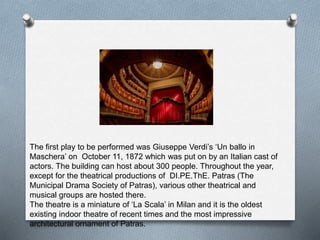
The first play to be performed was Giuseppe Verdi’s ‘Un ballo in
Maschera’ on October 11, 1872 which was put on by an Italian cast of
actors. The building can host about 300 people. Throughout the year,
except for the theatrical productions of DI.PE.ThE. Patras (The
Municipal Drama Society of Patras), various other theatrical and
musical groups are hosted there.
The theatre is a miniature of ‘La Scala’ in Milan and it is the oldest
existing indoor theatre of recent times and the most impressive
architectural ornament of Patras.
The city hall
Patras city hall is a fantastic neoclassical
building which has been home to
Patras town hall. Its central room is
decorated with oil paintings made by
E. Thomopoulos. There, the city council
is holding its meetings and receptions.
In 1993 it suffered damages from the
earthquake and it took many years to
re- open in 2001. It used to be Ioannis
Makrigiannis’ residence.
Patras Carnival
Patras Carnival is the biggest
Carnival in Greece. It isn't an
individual event, but a varied
festival which contains dances,
treasure hunts and other. It
begins on January 17th and it
ends on Shrove Monday.
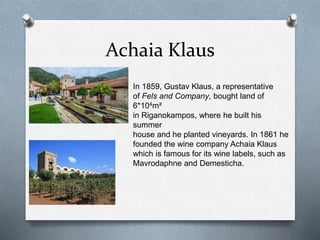
Achaia Klaus
In 1859, Gustav Klaus, a representative
of Fels and Company, bought land of
6*104m²
in Riganokampos, where he built his
summer
house and he planted vineyards. In 1861 he
founded the wine company Achaia Klaus
which is famous for its wine labels, such as
Mavrodaphne and Demesticha.
Pampeloponnisiako Stadium
of PatrasPampeloponnisiako stadium
of Patras is situated in the
southern part of the city , in a
suburb called Koukouli .It was
originally built in 1981 as the
National Stadium of Patras .In
2004 it was reconstructed ,
renamed and it was used to
host football(soccer) matches
for the 2004 Summer
Olympics. It seats 23.558
people and it contains a track
as well as a field with natural
grass .
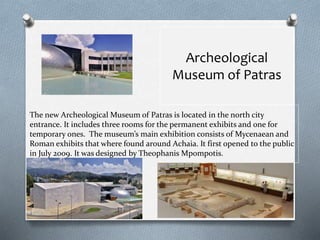
The new Archeological Museum of Patras is located in the north city
entrance. It includes three rooms for the permanent exhibits and one for
temporary ones. The museum’s main exhibition consists of Mycenaean and
Roman exhibits that where found around Achaia. It first opened to the public
in July 2009. It was designed by Theophanis Mpompotis.
Archeological
Museum of Patras
Rio - Antirio Bridge
Rio - Antirio Bridge, or more formally Charilaos Trikoupis Bridge, is a
cable- stayed bridge, which opened in 2004 joining the sea passage
between Rio and Antirio. It
connects the Peloponnese with the western mainland Greece. It
was built by the French manufacture company ''Vinor''.
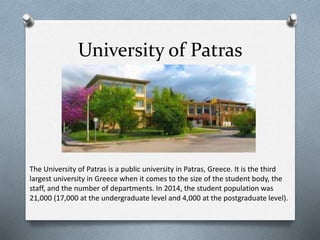
University of Patras
The University of Patras is a public university in Patras, Greece. It is the third
largest university in Greece when it comes to the size of the student body, the
staff, and the number of departments. In 2014, the student population was
21,000 (17,000 at the undergraduate level and 4,000 at the postgraduate level).
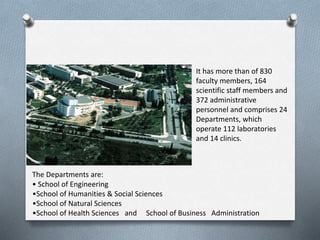
It has more than of 830
faculty members, 164
scientific staff members and
372 administrative
personnel and comprises 24
Departments, which
operate 112 laboratories
and 14 clinics.
The Departments are:
• School of Engineering
•School of Humanities & Social Sciences
•School of Natural Sciences
•School of Health Sciences and School of Business Administration
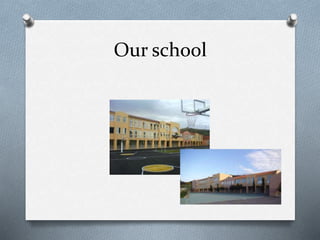
Our school

Our city patras

  • 1.
  • 2.
    The lighthouse ofPatras The lighthouse of Patras was first placed on the pier of the port, and it remained there until its demolition in 1972. In 1999 the president of the port authority, John Dimaras, decided to build a new lighthouse similar to the old one, near St. Andrew's church. Nowadays, the lighthouse has not any practical use, but it's one of the most beautiful sights of our city.
  • 3.
    Saint Andrew Cathedral SaintAndrew Cathedral is an orthodox Christian church in the east side of the city. This church is dedicated to Apostle Andrew. It is the biggest church in Greece and the third biggest in the Balkans. The cross where St. Andrew was crucified on and His Holy scalp are kept in here.
  • 4.
    Agiou Nikolaou Agiou Nikolaou(Saint Nikolaos) is a street in the centre of Patras. The biggest part of it is a pedestrian precinct and it connects the mole with the upper part of the town where Dasilio (a small forested area) is located. It is a shopping street and at the end of it, it has stairs leading to the old town.
  • 5.
  • 6.
    The Castle ofPatras was built in 551 AD in the city of Patras on the ruins of the ancient Acropolis. It was constructed by the Byzantine Emperor Justinian I, for the city’s defence. The walls of the castle cover 22.725m² and consist of a triangular outer wall enforced by towers and gates and further protected originally by a moat.
  • 7.
    The Roman Odeum TheRoman Odeum of Patras is a magnificent building of the Roman ages, which has been restored and it is currently used for music concerts and plays. It is located in the old city center (upper town) next to the ancient Roman stadium. Every summer the festival of Patras is held in the Roman Odeum. It can host about 2300 spectators and it is one of the most interesting sights in the city of Patras!
  • 8.
  • 9.
    Psila Alonia square PsilaAlonia is one of the most well- known areas in the center of our town. Actually, Psila Alonia is a square with enormous fountains, space for sports like football and plenty of restaurants and cafeterias as well. In the center of the square stands the statue of Palaion Patron Germanos (a local hierarch), who was one of the firsts rebels back in the national revolution of 1821.
  • 10.
    King George’s Square KingGeorge’s I Square is the central square of Patras. The square was named after king George I of Greece. It is on the crossroads of Maisonos, Korinthou and Gerokostopoulou streets which are some of the busiest streets of the city. Also, in the northeast side is situated the neoclassical Apollon Theatre.
  • 11.
    Apollon Theatre Apollon Theatreis a historic building designed by the German architect Ernesto Chiller and it is located in the central square of Patras. Construction work started on February 11, 1871 and was completed on October 10, 1872.
  • 12.
    The first playto be performed was Giuseppe Verdi’s ‘Un ballo in Maschera’ on October 11, 1872 which was put on by an Italian cast of actors. The building can host about 300 people. Throughout the year, except for the theatrical productions of DI.PE.ThE. Patras (The Municipal Drama Society of Patras), various other theatrical and musical groups are hosted there. The theatre is a miniature of ‘La Scala’ in Milan and it is the oldest existing indoor theatre of recent times and the most impressive architectural ornament of Patras.
  • 13.
    The city hall Patrascity hall is a fantastic neoclassical building which has been home to Patras town hall. Its central room is decorated with oil paintings made by E. Thomopoulos. There, the city council is holding its meetings and receptions. In 1993 it suffered damages from the earthquake and it took many years to re- open in 2001. It used to be Ioannis Makrigiannis’ residence.
  • 14.
    Patras Carnival Patras Carnivalis the biggest Carnival in Greece. It isn't an individual event, but a varied festival which contains dances, treasure hunts and other. It begins on January 17th and it ends on Shrove Monday.
  • 15.
    Achaia Klaus In 1859,Gustav Klaus, a representative of Fels and Company, bought land of 6*104m² in Riganokampos, where he built his summer house and he planted vineyards. In 1861 he founded the wine company Achaia Klaus which is famous for its wine labels, such as Mavrodaphne and Demesticha.
  • 16.
    Pampeloponnisiako Stadium of PatrasPampeloponnisiakostadium of Patras is situated in the southern part of the city , in a suburb called Koukouli .It was originally built in 1981 as the National Stadium of Patras .In 2004 it was reconstructed , renamed and it was used to host football(soccer) matches for the 2004 Summer Olympics. It seats 23.558 people and it contains a track as well as a field with natural grass .
  • 17.
    The new ArcheologicalMuseum of Patras is located in the north city entrance. It includes three rooms for the permanent exhibits and one for temporary ones. The museum’s main exhibition consists of Mycenaean and Roman exhibits that where found around Achaia. It first opened to the public in July 2009. It was designed by Theophanis Mpompotis. Archeological Museum of Patras
  • 18.
    Rio - AntirioBridge Rio - Antirio Bridge, or more formally Charilaos Trikoupis Bridge, is a cable- stayed bridge, which opened in 2004 joining the sea passage between Rio and Antirio. It connects the Peloponnese with the western mainland Greece. It was built by the French manufacture company ''Vinor''.
  • 19.
    University of Patras TheUniversity of Patras is a public university in Patras, Greece. It is the third largest university in Greece when it comes to the size of the student body, the staff, and the number of departments. In 2014, the student population was 21,000 (17,000 at the undergraduate level and 4,000 at the postgraduate level).
  • 20.
    It has morethan of 830 faculty members, 164 scientific staff members and 372 administrative personnel and comprises 24 Departments, which operate 112 laboratories and 14 clinics. The Departments are: • School of Engineering •School of Humanities & Social Sciences •School of Natural Sciences •School of Health Sciences and School of Business Administration
  • 21.