IMPORTANT ARCHAEOLOGICAL SITES OF GREECE
The Acropolis of Athens is the
main and most famous
archaeological site in Greece. It
is also called the Sacred Rock
and stands on the highest
point of Athens. It is
considered the most important
heritage of the Classical period
and also Europe's most
important ancient monument.
The Parthenon Temple is the
main building on the Acropolis
and constitutes an
architectural splendor of the
ancient times. The most
famous buildings of the
Acropolis are the Parthenon,
the Erechtheion, the Temple of
Athena Nike and the
Propylaea.
THE ACROPOLIS OF ATHENS
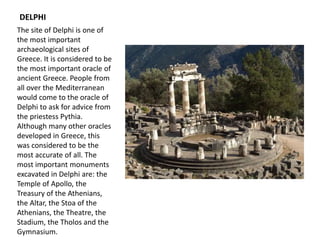
The site of Delphi is one of
the most important
archaeological sites of
Greece. It is considered to be
the most important oracle of
ancient Greece. People from
all over the Mediterranean
would come to the oracle of
Delphi to ask for advice from
the priestess Pythia.
Although many other oracles
developed in Greece, this
was considered to be the
most accurate of all. The
most important monuments
excavated in Delphi are: the
Temple of Apollo, the
Treasury of the Athenians,
the Altar, the Stoa of the
Athenians, the Theatre, the
Stadium, the Tholos and the
Gymnasium.
DELPHI
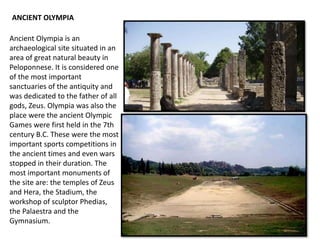
Ancient Olympia is an
archaeological site situated in an
area of great natural beauty in
Peloponnese. It is considered one
of the most important
sanctuaries of the antiquity and
was dedicated to the father of all
gods, Zeus. Olympia was also the
place were the ancient Olympic
Games were first held in the 7th
century B.C. These were the most
important sports competitions in
the ancient times and even wars
stopped in their duration. The
most important monuments of
the site are: the temples of Zeus
and Hera, the Stadium, the
workshop of sculptor Phedias,
the Palaestra and the
Gymnasium.
ANCIENT OLYMPIA
The Sacred Island of Delos
is a small island situated a
few miles away from the
famous island of Mykonos,
in the centre of the
Cyclades. Delos is
considered to be one of
the most important
ancient sites and
sanctuaries of Greece. In
the ancient times, it
worked both as a religious
and trade centre. The most
important monuments of
the site are: the Agora, the
Temple of Apollo, the
Terrace of the Lions and
the ancient theatre.
DELOS
Knossos is the most important
ancient site and best
preserved palace of the
Minoan Civilization. Knossos,
located near modern
Heraklion in Crete island, was
the seat of the legendary King
Minos and it is also a place
connected to many legends
such as the Labyrinth with the
Minotaur and the story of
Daedalus and Icarus. The most
important monuments of the
site are: the palace of
Knossos, the little palace, the
Royal Villa and the house of
the frescoes.
KNOSSOS
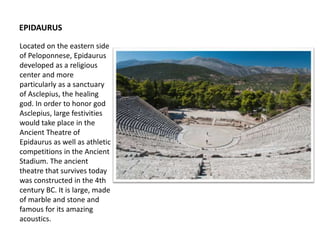
Located on the eastern side
of Peloponnese, Epidaurus
developed as a religious
center and more
particularly as a sanctuary
of Asclepius, the healing
god. In order to honor god
Asclepius, large festivities
would take place in the
Ancient Theatre of
Epidaurus as well as athletic
competitions in the Ancient
Stadium. The ancient
theatre that survives today
was constructed in the 4th
century BC. It is large, made
of marble and stone and
famous for its amazing
acoustics.
EPIDAURUS
The site of Mycenae is
considered one of the oldest
ancient sites in Greece. The
Mycenaean civilization took
its name after the discovery
of the site of Mycenae. The
ancient city of Mycenae was
fortified with what we call
the Massive Cyclopean
walls. The most
characteristic spots of the
site are the Lion Gate and
the big underground tombs.
MYCENAE
Customs and traditions in continental Greece and the Greek
Islands are an important aspect of the Greek culture. There are
either of a religious character or coming from paganism. Most of
the traditions and festivals still celebrated today are religious.
Traditions vary from island to island, from village to village and
from region to region.
CUSTOMS AND TRADITIONS OF GREECE
NAMEDAY CELEBRATION
Most Greeks are named after
a religious saint. A very
important tradition is that
everyone who has a name
coming from a saint
celebrated by the church
celebrates his name on a
given day of the year. On the
"nameday" of someone, his
friends and family visit him
without invitation and offer
wishes and small presents.
The hostess of the house
offers pastries, sweets and
hors d'oeuvres to the guests.
In Greece, namedays are
equally important as
birthdays.
ENGAGEMENT
It is a custom in Greece to get
engaged before getting
married. The man has to ask for
the hand of the woman from
her father and close family,
while the two families give
presents to the bride and the
groom. The couple exchanges
wedding rings that are worn on
the left hand. After the
wedding, these rings will be
worn on the right hand. In
Greece, the engagement period
may last for years and it is like a
commitment to the families.
This custom is still vivid in the
Greek mainland but gradually
tends to disappear.
CARNIVAL
The Carnival in Greece is
called "Apokries". The festival
consists of two weeks of feast,
beginning from the Sunday of
Meat Fare and ends with the
first day of the Lent, called
Clean Monday (Kathari
Deytera). Everyone is
costumed and parties take
place in the streets and bars,
throwing colored confetti to
each other. The most famous
Carnival Parade takes place in
the city of Patras. In many
towns around Greece and in
the islands, local customs
revive. The Carnival is
believed to come from
paganism.
CLEAN MONDAY
Clean Monday or Lent
Monday is the first day of the
Lent (Saracosti) during which
families go for a picnic in the
countryside and fly kites.
EASTER
Easter is the most important celebration for the Greeks. On Good
Thursday or Good Saturday, women dye eggs in red and bake buns.
On Good Friday, the day of mourning, the Epitaphios, the tomb of
Christ with its icon, decorated with flowers, is taken out of the
church and carried around the village followed by a slow procession.
During the night of the Holy Saturday , everybody dresses well and
goes to the church where a ceremony is hold. Just before midnight,
all the lights of the church are turned off, symbolizing the darkness
and silent of the tomb, while the priest lights a candle from the
Eternal Flame, sings the psalm Christos Anesti (meaning Christ has
Resurrected) and offers the flame to light the candles of the people.
Everyone passes the flame to each other. The bells ring continuously
and people throw fireworks. The Good Saturday Dinner takes place
after midnight and consists of mayiritsa, tsoureki (Easter sweet
bread) and red eggs. On Easter Sunday, the family roasts the lamb on
the spit.
CHRISTMAS
In Christmas time, most towns
in Greece are decorated with
bright lights, bells, angels and
other Christmassy objects.
According to Christmas
traditions in Greece, the
patron saint of the holiday is
Saint Nicolas, who is also the
protector of sailors. For this
reason, the Greeks often
decorate boats with many
sparkling lights, rather than
the traditional Christmas
trees. The Christmas season in
Greece begins on December
6th, which is Saint Nicolas
day, and ends on January 6th,
which is the Feast of the
Epiphany (Theophania).
Celebrations really pick-up
from the 20th of December,
as Christmas day gets closer.
THE GREEK
INDEPENDENCE DAY
The Greek Independence Day
celebrates the declaration of
the Independence War
against the Ottomans on
March 25th, 1821. Apart from
a national celebration, this
day is also a religious
celebration dedicated to the
Annunciation of Virgin Mary.
THE “OXI” DAY
On October 28th, the Greeks
celebrate the day when the
Greek dictator Metaxas
refused to let the Italians
invade the country during
World War II. It is the
celebration of the heroic OXI
(NO): most Greeks put a
Greek flag on their windows
and balconies, while a parade
takes place with the
participation of school
students and the army.
SOURCES
• www.greeka.com
• www.wikipedia.com
• www.photosofgreece.com
Thank you for your attention!

Presentation Greece (IV)

  • 1.
  • 2.
    The Acropolis ofAthens is the main and most famous archaeological site in Greece. It is also called the Sacred Rock and stands on the highest point of Athens. It is considered the most important heritage of the Classical period and also Europe's most important ancient monument. The Parthenon Temple is the main building on the Acropolis and constitutes an architectural splendor of the ancient times. The most famous buildings of the Acropolis are the Parthenon, the Erechtheion, the Temple of Athena Nike and the Propylaea. THE ACROPOLIS OF ATHENS
  • 3.
    The site ofDelphi is one of the most important archaeological sites of Greece. It is considered to be the most important oracle of ancient Greece. People from all over the Mediterranean would come to the oracle of Delphi to ask for advice from the priestess Pythia. Although many other oracles developed in Greece, this was considered to be the most accurate of all. The most important monuments excavated in Delphi are: the Temple of Apollo, the Treasury of the Athenians, the Altar, the Stoa of the Athenians, the Theatre, the Stadium, the Tholos and the Gymnasium. DELPHI
  • 4.
    Ancient Olympia isan archaeological site situated in an area of great natural beauty in Peloponnese. It is considered one of the most important sanctuaries of the antiquity and was dedicated to the father of all gods, Zeus. Olympia was also the place were the ancient Olympic Games were first held in the 7th century B.C. These were the most important sports competitions in the ancient times and even wars stopped in their duration. The most important monuments of the site are: the temples of Zeus and Hera, the Stadium, the workshop of sculptor Phedias, the Palaestra and the Gymnasium. ANCIENT OLYMPIA
  • 5.
    The Sacred Islandof Delos is a small island situated a few miles away from the famous island of Mykonos, in the centre of the Cyclades. Delos is considered to be one of the most important ancient sites and sanctuaries of Greece. In the ancient times, it worked both as a religious and trade centre. The most important monuments of the site are: the Agora, the Temple of Apollo, the Terrace of the Lions and the ancient theatre. DELOS
  • 6.
    Knossos is themost important ancient site and best preserved palace of the Minoan Civilization. Knossos, located near modern Heraklion in Crete island, was the seat of the legendary King Minos and it is also a place connected to many legends such as the Labyrinth with the Minotaur and the story of Daedalus and Icarus. The most important monuments of the site are: the palace of Knossos, the little palace, the Royal Villa and the house of the frescoes. KNOSSOS
  • 7.
    Located on theeastern side of Peloponnese, Epidaurus developed as a religious center and more particularly as a sanctuary of Asclepius, the healing god. In order to honor god Asclepius, large festivities would take place in the Ancient Theatre of Epidaurus as well as athletic competitions in the Ancient Stadium. The ancient theatre that survives today was constructed in the 4th century BC. It is large, made of marble and stone and famous for its amazing acoustics. EPIDAURUS
  • 8.
    The site ofMycenae is considered one of the oldest ancient sites in Greece. The Mycenaean civilization took its name after the discovery of the site of Mycenae. The ancient city of Mycenae was fortified with what we call the Massive Cyclopean walls. The most characteristic spots of the site are the Lion Gate and the big underground tombs. MYCENAE
  • 9.
    Customs and traditionsin continental Greece and the Greek Islands are an important aspect of the Greek culture. There are either of a religious character or coming from paganism. Most of the traditions and festivals still celebrated today are religious. Traditions vary from island to island, from village to village and from region to region. CUSTOMS AND TRADITIONS OF GREECE
  • 10.
    NAMEDAY CELEBRATION Most Greeksare named after a religious saint. A very important tradition is that everyone who has a name coming from a saint celebrated by the church celebrates his name on a given day of the year. On the "nameday" of someone, his friends and family visit him without invitation and offer wishes and small presents. The hostess of the house offers pastries, sweets and hors d'oeuvres to the guests. In Greece, namedays are equally important as birthdays.
  • 11.
    ENGAGEMENT It is acustom in Greece to get engaged before getting married. The man has to ask for the hand of the woman from her father and close family, while the two families give presents to the bride and the groom. The couple exchanges wedding rings that are worn on the left hand. After the wedding, these rings will be worn on the right hand. In Greece, the engagement period may last for years and it is like a commitment to the families. This custom is still vivid in the Greek mainland but gradually tends to disappear.
  • 12.
    CARNIVAL The Carnival inGreece is called "Apokries". The festival consists of two weeks of feast, beginning from the Sunday of Meat Fare and ends with the first day of the Lent, called Clean Monday (Kathari Deytera). Everyone is costumed and parties take place in the streets and bars, throwing colored confetti to each other. The most famous Carnival Parade takes place in the city of Patras. In many towns around Greece and in the islands, local customs revive. The Carnival is believed to come from paganism.
  • 13.
    CLEAN MONDAY Clean Mondayor Lent Monday is the first day of the Lent (Saracosti) during which families go for a picnic in the countryside and fly kites.
  • 14.
    EASTER Easter is themost important celebration for the Greeks. On Good Thursday or Good Saturday, women dye eggs in red and bake buns. On Good Friday, the day of mourning, the Epitaphios, the tomb of Christ with its icon, decorated with flowers, is taken out of the church and carried around the village followed by a slow procession. During the night of the Holy Saturday , everybody dresses well and goes to the church where a ceremony is hold. Just before midnight, all the lights of the church are turned off, symbolizing the darkness and silent of the tomb, while the priest lights a candle from the Eternal Flame, sings the psalm Christos Anesti (meaning Christ has Resurrected) and offers the flame to light the candles of the people. Everyone passes the flame to each other. The bells ring continuously and people throw fireworks. The Good Saturday Dinner takes place after midnight and consists of mayiritsa, tsoureki (Easter sweet bread) and red eggs. On Easter Sunday, the family roasts the lamb on the spit.
  • 15.
    CHRISTMAS In Christmas time,most towns in Greece are decorated with bright lights, bells, angels and other Christmassy objects. According to Christmas traditions in Greece, the patron saint of the holiday is Saint Nicolas, who is also the protector of sailors. For this reason, the Greeks often decorate boats with many sparkling lights, rather than the traditional Christmas trees. The Christmas season in Greece begins on December 6th, which is Saint Nicolas day, and ends on January 6th, which is the Feast of the Epiphany (Theophania). Celebrations really pick-up from the 20th of December, as Christmas day gets closer.
  • 16.
    THE GREEK INDEPENDENCE DAY TheGreek Independence Day celebrates the declaration of the Independence War against the Ottomans on March 25th, 1821. Apart from a national celebration, this day is also a religious celebration dedicated to the Annunciation of Virgin Mary.
  • 17.
    THE “OXI” DAY OnOctober 28th, the Greeks celebrate the day when the Greek dictator Metaxas refused to let the Italians invade the country during World War II. It is the celebration of the heroic OXI (NO): most Greeks put a Greek flag on their windows and balconies, while a parade takes place with the participation of school students and the army.
  • 18.
  • 19.
    Thank you foryour attention!