Thessaloniki - Greece
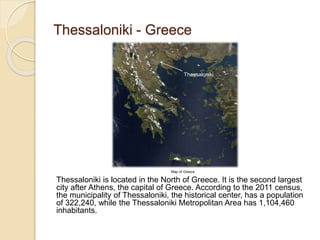
Map of Greece
Thessaloniki is located in the North of Greece. It is the second largest
city after Athens, the capital of Greece. According to the 2011 census,
the municipality of Thessaloniki, the historical center, has a population
of 322,240, while the Thessaloniki Metropolitan Area has 1,104,460
inhabitants.
ThessalonikiThessaloniki
Thessaloniki throughout history
Hellenistic Period
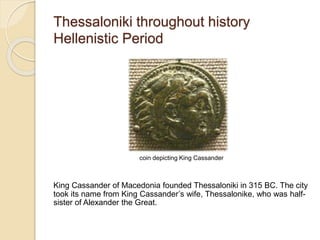
coin depicting King Cassander
King Cassander of Macedonia founded Thessaloniki in 315 BC. The city
took its name from King Cassander’s wife, Thessalonike, who was half-
sister of Alexander the Great.
Roman Period
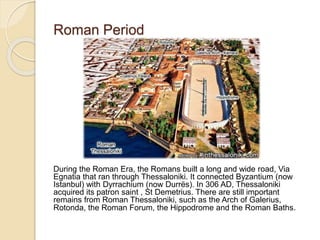
During the Roman Era, the Romans built a long and wide road, Via
Egnatia that ran through Thessaloniki. It connected Byzantium (now
Istanbul) with Dyrrachium (now Durrës). In 306 AD, Thessaloniki
acquired its patron saint , St Demetrius. There are still important
remains from Roman Thessaloniki, such as the Arch of Galerius,
Rotonda, the Roman Forum, the Hippodrome and the Roman Baths.
Byzantine Era
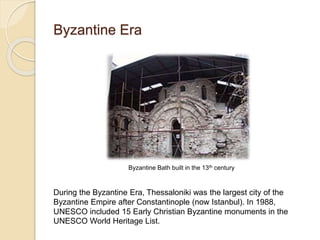
Byzantine Bath built in the 13th century
During the Byzantine Era, Thessaloniki was the largest city of the
Byzantine Empire after Constantinople (now Istanbul). In 1988,
UNESCO included 15 Early Christian Byzantine monuments in the
UNESCO World Heritage List.
Ottoman Era
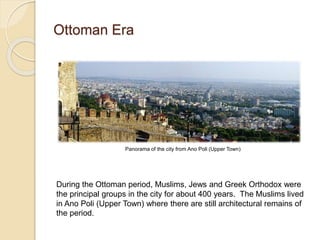
Panorama of the city from Ano Poli (Upper Town)
During the Ottoman period, Muslims, Jews and Greek Orthodox were
the principal groups in the city for about 400 years. The Muslims lived
in Ano Poli (Upper Town) where there are still architectural remains of
the period.
From 20th century on…
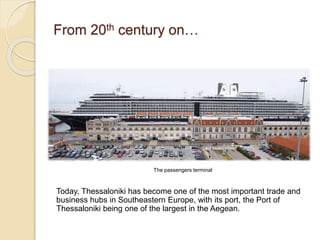
The passengers terminal
Today, Thessaloniki has become one of the most important trade and
business hubs in Southeastern Europe, with its port, the Port of
Thessaloniki being one of the largest in the Aegean.
European City of Culture
In 1997 Thessaloniki became the Cultural Capital of Europe and in
2014 it was the European Youth Capital.
Multicultural monuments of
Thessaloniki
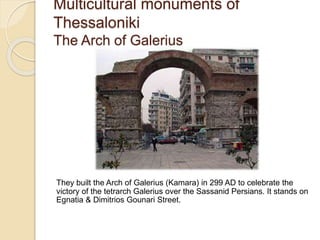
The Arch of Galerius
They built the Arch of Galerius (Kamara) in 299 AD to celebrate the
victory of the tetrarch Galerius over the Sassanid Persians. It stands on
Egnatia & Dimitrios Gounari Street.
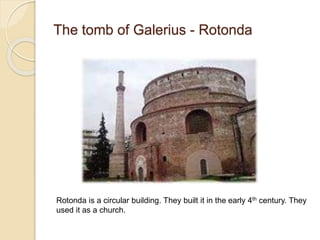
The tomb of Galerius - Rotonda
Rotonda is a circular building. They built it in the early 4th century. They
used it as a church.
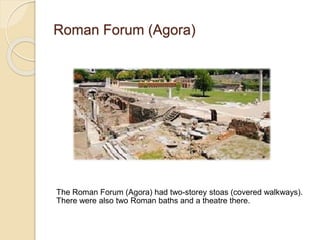
Roman Forum (Agora)
The Roman Forum (Agora) had two-storey stoas (covered walkways).
There were also two Roman baths and a theatre there.
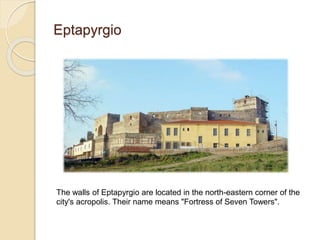
Eptapyrgio
The walls of Eptapyrgio are located in the north-eastern corner of the
city's acropolis. Their name means "Fortress of Seven Towers".
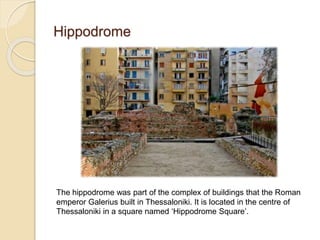
Hippodrome
The hippodrome was part of the complex of buildings that the Roman
emperor Galerius built in Thessaloniki. It is located in the centre of
Thessaloniki in a square named ‘Hippodrome Square’.
Church of Agia Sophia
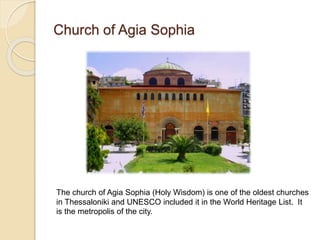
The church of Agia Sophia (Holy Wisdom) is one of the oldest churches
in Thessaloniki and UNESCO included it in the World Heritage List. It
is the metropolis of the city.
Church of Saint Demetrius
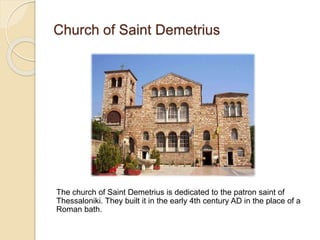
The church of Saint Demetrius is dedicated to the patron saint of
Thessaloniki. They built it in the early 4th century AD in the place of a
Roman bath.
Church of the Acheiropoietos
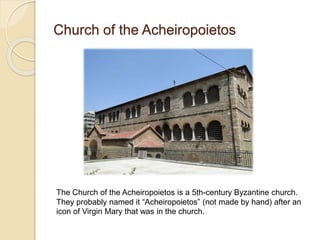
The Church of the Acheiropoietos is a 5th-century Byzantine church.
They probably named it “Acheiropoietos” (not made by hand) after an
icon of Virgin Mary that was in the church.
Church of Hosios David
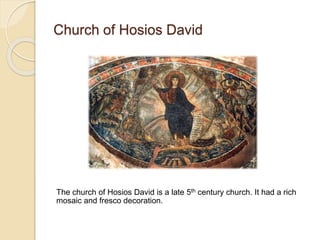
The church of Hosios David is a late 5th century church. It had a rich
mosaic and fresco decoration.
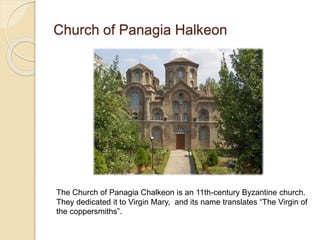
Church of Panagia Halkeon
The Church of Panagia Chalkeon is an 11th-century Byzantine church.
They dedicated it to Virgin Mary, and its name translates “The Virgin of
the coppersmiths”.
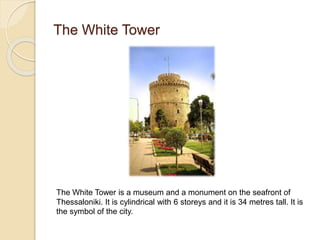
The White Tower
The White Tower is a museum and a monument on the seafront of
Thessaloniki. It is cylindrical with 6 storeys and it is 34 metres tall. It is
the symbol of the city.
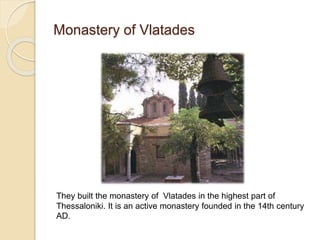
Monastery of Vlatades
They built the monastery of Vlatades in the highest part of
Thessaloniki. It is an active monastery founded in the 14th century
AD.
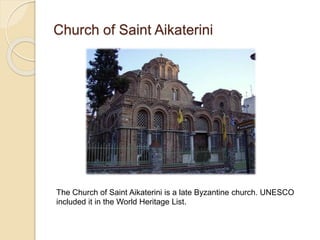
Church of Saint Aikaterini
The Church of Saint Aikaterini is a late Byzantine church. UNESCO
included it in the World Heritage List.
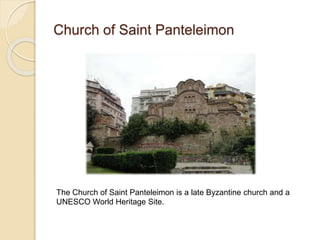
Church of Saint Panteleimon
The Church of Saint Panteleimon is a late Byzantine church and a
UNESCO World Heritage Site.
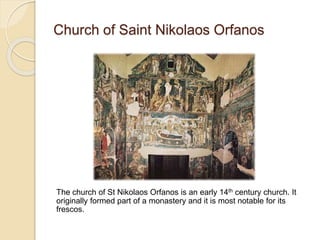
Church of Saint Nikolaos Orfanos
The church of St Nikolaos Orfanos is an early 14th century church. It
originally formed part of a monastery and it is most notable for its
frescos.
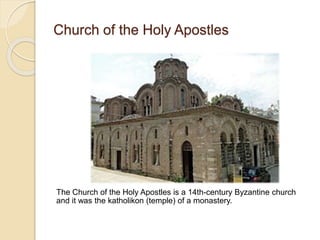
Church of the Holy Apostles
The Church of the Holy Apostles is a 14th-century Byzantine church
and it was the katholikon (temple) of a monastery.
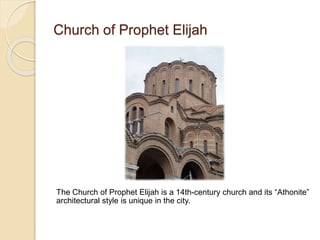
Church of Prophet Elijah
The Church of Prophet Elijah is a 14th-century church and its “Athonite”
architectural style is unique in the city.
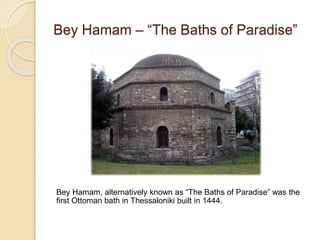
Bey Hamam – “The Baths of Paradise”
Bey Hamam, alternatively known as “The Baths of Paradise” was the
first Ottoman bath in Thessaloniki built in 1444.
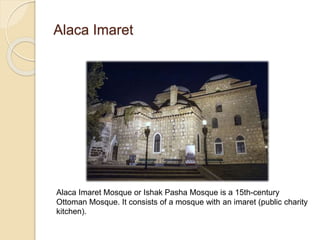
Alaca Imaret
Alaca Imaret Mosque or Ishak Pasha Mosque is a 15th-century
Ottoman Mosque. It consists of a mosque with an imaret (public charity
kitchen).
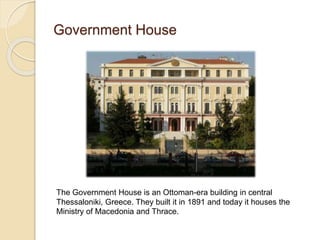
Government House
The Government House is an Ottoman-era building in central
Thessaloniki, Greece. They built it in 1891 and today it houses the
Ministry of Macedonia and Thrace.
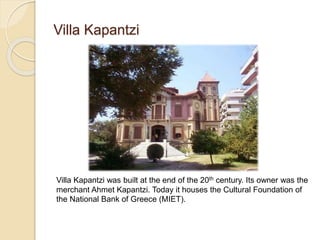
Villa Kapantzi
Villa Kapantzi was built at the end of the 20th century. Its owner was the
merchant Ahmet Kapantzi. Today it houses the Cultural Foundation of
the National Bank of Greece (MIET).
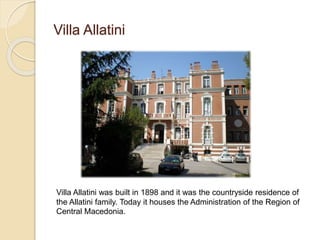
Villa Allatini
Villa Allatini was built in 1898 and it was the countryside residence of
the Allatini family. Today it houses the Administration of the Region of
Central Macedonia.
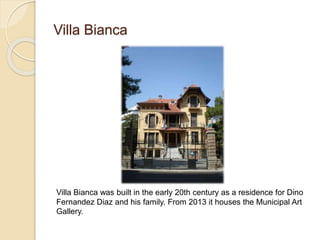
Villa Bianca
Villa Bianca was built in the early 20th century as a residence for Dino
Fernandez Diaz and his family. From 2013 it houses the Municipal Art
Gallery.
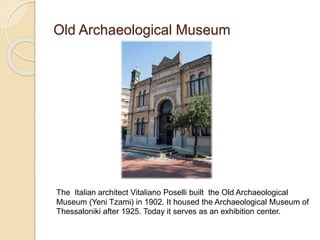
Old Archaeological Museum
The Italian architect Vitaliano Poselli built the Old Archaeological
Museum (Yeni Tzami) in 1902. It housed the Archaeological Museum of
Thessaloniki after 1925. Today it serves as an exhibition center.
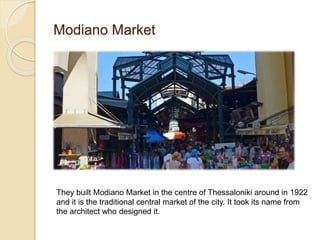
Modiano Market
They built Modiano Market in the centre of Thessaloniki around in 1922
and it is the traditional central market of the city. It took its name from
the architect who designed it.
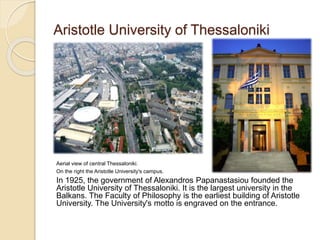
Aristotle University of Thessaloniki
Aerial view of central Thessaloniki.
On the right the Aristotle University's campus.
In 1925, the government of Alexandros Papanastasiou founded the
Aristotle University of Thessaloniki. It is the largest university in the
Balkans. The Faculty of Philosophy is the earliest building of Aristotle
University. The University's motto is engraved on the entrance.
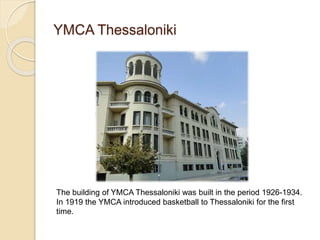
YMCA Thessaloniki
The building of YMCA Thessaloniki was built in the period 1926-1934.
In 1919 the YMCA introduced basketball to Thessaloniki for the first
time.
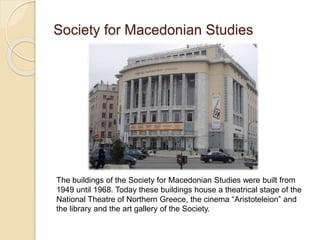
Society for Macedonian Studies
The buildings of the Society for Macedonian Studies were built from
1949 until 1968. Today these buildings house a theatrical stage of the
National Theatre of Northern Greece, the cinema “Aristoteleion” and
the library and the art gallery of the Society.
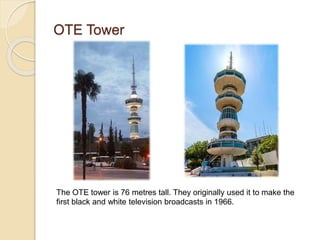
OTE Tower
The OTE tower is 76 metres tall. They originally used it to make the
first black and white television broadcasts in 1966.
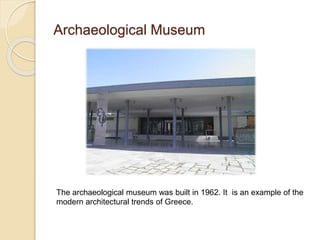
Archaeological Museum
The archaeological museum was built in 1962. It is an example of the
modern architectural trends of Greece.
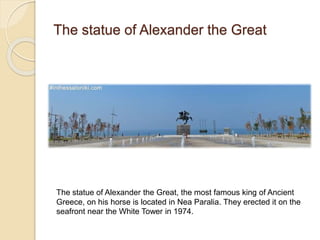
The statue of Alexander the Great
The statue of Alexander the Great, the most famous king of Ancient
Greece, on his horse is located in Nea Paralia. They erected it on the
seafront near the White Tower in 1974.
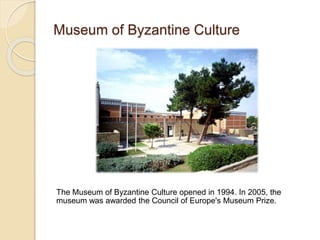
Museum of Byzantine Culture
The Museum of Byzantine Culture opened in 1994. In 2005, the
museum was awarded the Council of Europe's Museum Prize.
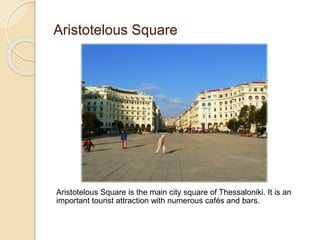
Aristotelous Square
Aristotelous Square is the main city square of Thessaloniki. It is an
important tourist attraction with numerous cafés and bars.
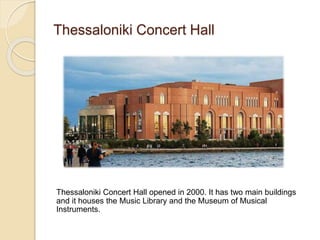
Thessaloniki Concert Hall
Thessaloniki Concert Hall opened in 2000. It has two main buildings
and it houses the Music Library and the Museum of Musical
Instruments.
Thank you for watching this brief
presentation of our city and its main
monuments. We hope that you enjoyed
it and that you will visit it soon…
Primary School of Anatoliko,
Thessaloniki, Greece.
February 2016

Our city and its monuments

  • 1.
    Thessaloniki - Greece Mapof Greece Thessaloniki is located in the North of Greece. It is the second largest city after Athens, the capital of Greece. According to the 2011 census, the municipality of Thessaloniki, the historical center, has a population of 322,240, while the Thessaloniki Metropolitan Area has 1,104,460 inhabitants. ThessalonikiThessaloniki
  • 2.
    Thessaloniki throughout history HellenisticPeriod coin depicting King Cassander King Cassander of Macedonia founded Thessaloniki in 315 BC. The city took its name from King Cassander’s wife, Thessalonike, who was half- sister of Alexander the Great.
  • 3.
    Roman Period During theRoman Era, the Romans built a long and wide road, Via Egnatia that ran through Thessaloniki. It connected Byzantium (now Istanbul) with Dyrrachium (now Durrës). In 306 AD, Thessaloniki acquired its patron saint , St Demetrius. There are still important remains from Roman Thessaloniki, such as the Arch of Galerius, Rotonda, the Roman Forum, the Hippodrome and the Roman Baths.
  • 4.
    Byzantine Era Byzantine Bathbuilt in the 13th century During the Byzantine Era, Thessaloniki was the largest city of the Byzantine Empire after Constantinople (now Istanbul). In 1988, UNESCO included 15 Early Christian Byzantine monuments in the UNESCO World Heritage List.
  • 5.
    Ottoman Era Panorama ofthe city from Ano Poli (Upper Town) During the Ottoman period, Muslims, Jews and Greek Orthodox were the principal groups in the city for about 400 years. The Muslims lived in Ano Poli (Upper Town) where there are still architectural remains of the period.
  • 6.
    From 20th centuryon… The passengers terminal Today, Thessaloniki has become one of the most important trade and business hubs in Southeastern Europe, with its port, the Port of Thessaloniki being one of the largest in the Aegean.
  • 7.
    European City ofCulture In 1997 Thessaloniki became the Cultural Capital of Europe and in 2014 it was the European Youth Capital.
  • 8.
    Multicultural monuments of Thessaloniki TheArch of Galerius They built the Arch of Galerius (Kamara) in 299 AD to celebrate the victory of the tetrarch Galerius over the Sassanid Persians. It stands on Egnatia & Dimitrios Gounari Street.
  • 9.
    The tomb ofGalerius - Rotonda Rotonda is a circular building. They built it in the early 4th century. They used it as a church.
  • 10.
    Roman Forum (Agora) TheRoman Forum (Agora) had two-storey stoas (covered walkways). There were also two Roman baths and a theatre there.
  • 11.
    Eptapyrgio The walls ofEptapyrgio are located in the north-eastern corner of the city's acropolis. Their name means "Fortress of Seven Towers".
  • 12.
    Hippodrome The hippodrome waspart of the complex of buildings that the Roman emperor Galerius built in Thessaloniki. It is located in the centre of Thessaloniki in a square named ‘Hippodrome Square’.
  • 13.
    Church of AgiaSophia The church of Agia Sophia (Holy Wisdom) is one of the oldest churches in Thessaloniki and UNESCO included it in the World Heritage List. It is the metropolis of the city.
  • 14.
    Church of SaintDemetrius The church of Saint Demetrius is dedicated to the patron saint of Thessaloniki. They built it in the early 4th century AD in the place of a Roman bath.
  • 15.
    Church of theAcheiropoietos The Church of the Acheiropoietos is a 5th-century Byzantine church. They probably named it “Acheiropoietos” (not made by hand) after an icon of Virgin Mary that was in the church.
  • 16.
    Church of HosiosDavid The church of Hosios David is a late 5th century church. It had a rich mosaic and fresco decoration.
  • 17.
    Church of PanagiaHalkeon The Church of Panagia Chalkeon is an 11th-century Byzantine church. They dedicated it to Virgin Mary, and its name translates “The Virgin of the coppersmiths”.
  • 18.
    The White Tower TheWhite Tower is a museum and a monument on the seafront of Thessaloniki. It is cylindrical with 6 storeys and it is 34 metres tall. It is the symbol of the city.
  • 19.
    Monastery of Vlatades Theybuilt the monastery of Vlatades in the highest part of Thessaloniki. It is an active monastery founded in the 14th century AD.
  • 20.
    Church of SaintAikaterini The Church of Saint Aikaterini is a late Byzantine church. UNESCO included it in the World Heritage List.
  • 21.
    Church of SaintPanteleimon The Church of Saint Panteleimon is a late Byzantine church and a UNESCO World Heritage Site.
  • 22.
    Church of SaintNikolaos Orfanos The church of St Nikolaos Orfanos is an early 14th century church. It originally formed part of a monastery and it is most notable for its frescos.
  • 23.
    Church of theHoly Apostles The Church of the Holy Apostles is a 14th-century Byzantine church and it was the katholikon (temple) of a monastery.
  • 24.
    Church of ProphetElijah The Church of Prophet Elijah is a 14th-century church and its “Athonite” architectural style is unique in the city.
  • 25.
    Bey Hamam –“The Baths of Paradise” Bey Hamam, alternatively known as “The Baths of Paradise” was the first Ottoman bath in Thessaloniki built in 1444.
  • 26.
    Alaca Imaret Alaca ImaretMosque or Ishak Pasha Mosque is a 15th-century Ottoman Mosque. It consists of a mosque with an imaret (public charity kitchen).
  • 27.
    Government House The GovernmentHouse is an Ottoman-era building in central Thessaloniki, Greece. They built it in 1891 and today it houses the Ministry of Macedonia and Thrace.
  • 28.
    Villa Kapantzi Villa Kapantziwas built at the end of the 20th century. Its owner was the merchant Ahmet Kapantzi. Today it houses the Cultural Foundation of the National Bank of Greece (MIET).
  • 29.
    Villa Allatini Villa Allatiniwas built in 1898 and it was the countryside residence of the Allatini family. Today it houses the Administration of the Region of Central Macedonia.
  • 30.
    Villa Bianca Villa Biancawas built in the early 20th century as a residence for Dino Fernandez Diaz and his family. From 2013 it houses the Municipal Art Gallery.
  • 31.
    Old Archaeological Museum TheItalian architect Vitaliano Poselli built the Old Archaeological Museum (Yeni Tzami) in 1902. It housed the Archaeological Museum of Thessaloniki after 1925. Today it serves as an exhibition center.
  • 32.
    Modiano Market They builtModiano Market in the centre of Thessaloniki around in 1922 and it is the traditional central market of the city. It took its name from the architect who designed it.
  • 33.
    Aristotle University ofThessaloniki Aerial view of central Thessaloniki. On the right the Aristotle University's campus. In 1925, the government of Alexandros Papanastasiou founded the Aristotle University of Thessaloniki. It is the largest university in the Balkans. The Faculty of Philosophy is the earliest building of Aristotle University. The University's motto is engraved on the entrance.
  • 34.
    YMCA Thessaloniki The buildingof YMCA Thessaloniki was built in the period 1926-1934. In 1919 the YMCA introduced basketball to Thessaloniki for the first time.
  • 35.
    Society for MacedonianStudies The buildings of the Society for Macedonian Studies were built from 1949 until 1968. Today these buildings house a theatrical stage of the National Theatre of Northern Greece, the cinema “Aristoteleion” and the library and the art gallery of the Society.
  • 36.
    OTE Tower The OTEtower is 76 metres tall. They originally used it to make the first black and white television broadcasts in 1966.
  • 37.
    Archaeological Museum The archaeologicalmuseum was built in 1962. It is an example of the modern architectural trends of Greece.
  • 38.
    The statue ofAlexander the Great The statue of Alexander the Great, the most famous king of Ancient Greece, on his horse is located in Nea Paralia. They erected it on the seafront near the White Tower in 1974.
  • 39.
    Museum of ByzantineCulture The Museum of Byzantine Culture opened in 1994. In 2005, the museum was awarded the Council of Europe's Museum Prize.
  • 40.
    Aristotelous Square Aristotelous Squareis the main city square of Thessaloniki. It is an important tourist attraction with numerous cafés and bars.
  • 41.
    Thessaloniki Concert Hall ThessalonikiConcert Hall opened in 2000. It has two main buildings and it houses the Music Library and the Museum of Musical Instruments.
  • 42.
    Thank you forwatching this brief presentation of our city and its main monuments. We hope that you enjoyed it and that you will visit it soon… Primary School of Anatoliko, Thessaloniki, Greece. February 2016