Presented by
R . Uthra
K . Nithinila
CONTENTS
 Introduction
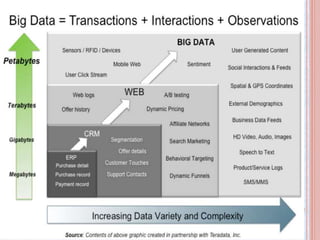
 What is big data ?
 Characteristics & its structure
 Why big data ?
 Types of tools & Concepts used
 Data used & Data transmission
 Applications of big data
 Impacts on IT
 Benefits & Importance
 Future of Big data
 Conclusion
INTRODUCTION
 Big Data may well be the Next Big Thing in the IT
world.
 Big data burst upon the scene in the first decade of
the 21st century.
 The first organizations to embrace it were online and
startup firms. Firms like Google, eBay, LinkedIn, and
Face book were built around big data from the
beginning.
 Like many new information technologies, big data can
bring about dramatic cost reductions, substantial
improvements in the time required to perform a
computing task, or new product and service
offerings.
WHAT IS BIG DATA ?
 ‘Big Data’ is similar to ‘small data’, but bigger in
size
 But having data bigger it requires different
approaches:
i)Techniques ii)Tools iii)Architecture
 An aim to solve new problems or old problems in
a better way
 Big Data generates value from the storage and
processing of very large quantities of digital
information that cannot be analyzed with
traditional computing techniques.
THREE CHARACTERISTICS OF BIG DATA
V3S
Volume
• Data
quantity
Velocity
• Data
Speed
Variety
• Data
Structures
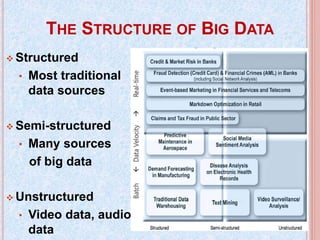
THE STRUCTURE OF BIG DATA
 Structured
• Most traditional
data sources
 Semi-structured
• Many sources
of big data
 Unstructured
• Video data, audio
data
8
WHY BIG DATA ?
 Growth of Big Data is needed
– Increase of storage capacities
– Increase of processing power
– Availability of data(different data types)
– Every day we create 2.5 quintillion bytes of
data; 90% of the data in the world today has
been created in the last two years alone
WHY BIG DATA ?
• FB generates 10TB
daily
•Twitter generates
7TB of data
Daily
•IBM claims 90% of
today’s stored data
was generated
in just the last two
years.
Walmart handles more than 1 million customer
transactions every hour.
TYPES OF TOOLS & CONCEPTS USED
Tools :
 Hosting :
Distributed Servers / Cloud (e.g. Amazon EC2)
 Storage :
Distributed Storage (e.g. Amazon S3)
 Programming Model :
Distributed Processing (e.g. MapReduce)
 Operations Performed :
Analytic / Semantic Processing
Concepts :
→ NoSQL
→ HADOOP
→No ACID (atomicity, consistency, isolation,
durability)
DATA USED & DATA TRANSMISSION
 Google processes 20 PB a day
 Wayback Machine has 3 PB + 100 TB/month
 Facebook has 2.5 PB of user data + 15 TB/day
 eBay has 6.5 PB of user data + 50 TB/day
 CERN’s Large Hydron Collider (LHC) generates 15
PB a year
 Data transmission with high-value-per-bit
 Lower-cost-per bit technologies
 Networking switching to 10-40 Gbps
Application Of Big Data analytics
Homeland
Security
Smarter
Healthcare
Multi-channel
sales
Telecom
Manufacturing
Traffic Control
Trading
Analytics
Search
Quality
APPLICATIONS
http://www.meltinfo.com/ppt/ibm-big-data
BIG DATA’S IMPACTS ON IT
 Big data is a troublesome force presenting
opportunities with challenges to IT
organizations.
 By 2015 4.4 million IT jobs in Big Data ; 1.9
million is in US itself
 India will require a minimum of 1 lakh data
scientists in the next couple of years in addition
to data analysts and data managers to support
the Big Data space.
BENEFITS OF BIG DATA
•Real-time big data isn’t just a process for storing
petabytes or exabytes of data.
•Technologies like Hadoop give you the scale and
flexibility to store data and Technologies such as
MapReduce,Hive and Impala enable you to run queries
•Our newest research finds that organizations are using
big data to target customer-centric outcomes, tap into
internal data and build a better information ecosystem.
•And the Internet boom of the 1990s,and the social media
explosion of today.
REASONS FOR THE IMPORTANCE OF BIG
DATA
 Increase innovation and development of next
generation product
 Improve customer satisfaction
 Sharpen competitive advantages
 Create more narrow segmentation of customers
 Reduce downtime
FUTURE OF BIG DATA
 $15 billion on software firms only specializing in
data management and analytics.
 In February 2012, the open source analyst firm
wikibon released the first market forecast for Big
Data
 The McKinsey Global Institute estimates that data
volume is growing 40% per year, and will grow 44x
between 2009 and 2020.
CONCLUSION
 The concept of big data is too easy and
keeps data safe.
 The maintenance cost is reduced
 Google Translate does a good job at
translating web pages.
 Big data indicates that analytics
initiatives are becoming a reality in all
organizations.
ANY QUERIES ?
Our big data

Our big data

  • 1.
    Presented by R .Uthra K . Nithinila
  • 2.
    CONTENTS  Introduction  Whatis big data ?  Characteristics & its structure  Why big data ?  Types of tools & Concepts used  Data used & Data transmission  Applications of big data  Impacts on IT  Benefits & Importance  Future of Big data  Conclusion
  • 3.
    INTRODUCTION  Big Datamay well be the Next Big Thing in the IT world.  Big data burst upon the scene in the first decade of the 21st century.  The first organizations to embrace it were online and startup firms. Firms like Google, eBay, LinkedIn, and Face book were built around big data from the beginning.  Like many new information technologies, big data can bring about dramatic cost reductions, substantial improvements in the time required to perform a computing task, or new product and service offerings.
  • 4.
    WHAT IS BIGDATA ?  ‘Big Data’ is similar to ‘small data’, but bigger in size  But having data bigger it requires different approaches: i)Techniques ii)Tools iii)Architecture  An aim to solve new problems or old problems in a better way  Big Data generates value from the storage and processing of very large quantities of digital information that cannot be analyzed with traditional computing techniques.
  • 6.
    THREE CHARACTERISTICS OFBIG DATA V3S Volume • Data quantity Velocity • Data Speed Variety • Data Structures
  • 8.
    THE STRUCTURE OFBIG DATA  Structured • Most traditional data sources  Semi-structured • Many sources of big data  Unstructured • Video data, audio data 8
  • 9.
    WHY BIG DATA?  Growth of Big Data is needed – Increase of storage capacities – Increase of processing power – Availability of data(different data types) – Every day we create 2.5 quintillion bytes of data; 90% of the data in the world today has been created in the last two years alone
  • 10.
    WHY BIG DATA? • FB generates 10TB daily •Twitter generates 7TB of data Daily •IBM claims 90% of today’s stored data was generated in just the last two years.
  • 11.
    Walmart handles morethan 1 million customer transactions every hour.
  • 12.
    TYPES OF TOOLS& CONCEPTS USED Tools :  Hosting : Distributed Servers / Cloud (e.g. Amazon EC2)  Storage : Distributed Storage (e.g. Amazon S3)  Programming Model : Distributed Processing (e.g. MapReduce)  Operations Performed : Analytic / Semantic Processing Concepts : → NoSQL → HADOOP →No ACID (atomicity, consistency, isolation, durability)
  • 13.
    DATA USED &DATA TRANSMISSION  Google processes 20 PB a day  Wayback Machine has 3 PB + 100 TB/month  Facebook has 2.5 PB of user data + 15 TB/day  eBay has 6.5 PB of user data + 50 TB/day  CERN’s Large Hydron Collider (LHC) generates 15 PB a year  Data transmission with high-value-per-bit  Lower-cost-per bit technologies  Networking switching to 10-40 Gbps
  • 14.
    Application Of BigData analytics Homeland Security Smarter Healthcare Multi-channel sales Telecom Manufacturing Traffic Control Trading Analytics Search Quality
  • 15.
  • 16.
    BIG DATA’S IMPACTSON IT  Big data is a troublesome force presenting opportunities with challenges to IT organizations.  By 2015 4.4 million IT jobs in Big Data ; 1.9 million is in US itself  India will require a minimum of 1 lakh data scientists in the next couple of years in addition to data analysts and data managers to support the Big Data space.
  • 18.
    BENEFITS OF BIGDATA •Real-time big data isn’t just a process for storing petabytes or exabytes of data. •Technologies like Hadoop give you the scale and flexibility to store data and Technologies such as MapReduce,Hive and Impala enable you to run queries •Our newest research finds that organizations are using big data to target customer-centric outcomes, tap into internal data and build a better information ecosystem. •And the Internet boom of the 1990s,and the social media explosion of today.
  • 19.
    REASONS FOR THEIMPORTANCE OF BIG DATA  Increase innovation and development of next generation product  Improve customer satisfaction  Sharpen competitive advantages  Create more narrow segmentation of customers  Reduce downtime
  • 20.
    FUTURE OF BIGDATA  $15 billion on software firms only specializing in data management and analytics.  In February 2012, the open source analyst firm wikibon released the first market forecast for Big Data  The McKinsey Global Institute estimates that data volume is growing 40% per year, and will grow 44x between 2009 and 2020.
  • 22.
    CONCLUSION  The conceptof big data is too easy and keeps data safe.  The maintenance cost is reduced  Google Translate does a good job at translating web pages.  Big data indicates that analytics initiatives are becoming a reality in all organizations.
  • 23.

Editor's Notes

  • #7 Acco.to IBM
  • #15  Quote practical examples