BENEFITS AND CHALLENGES of big data IN
SMART CITIES
Presented by
R . Uthra,
Final Year (B.C.A.,)
CONTENTS
 INTRODUCTION
WHAT IS BIG DATA
CHARACTERISTICS OF BIG DATA
SMART CITIES
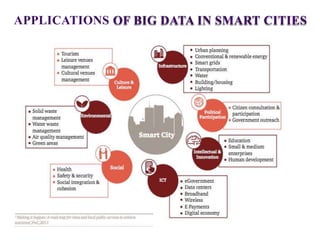
APPLICATIONS OF BIG DATA IN SMART CITIES
BENEFITS OF BIG DATA
CHALLENGES OF BIG DATA
REQUIREMENTS TO IMPLEMENT BIG DATA
CONCLUSION
REFERENCE
INTRODUCTION
Many governments including India are making an
allowance for adopting the smart city concept in their
cities and implementing big data applications that
support smart city components
One of the recent technologies that have a huge
potential to improve smart city services is big data
analytics.
Effective analysis and utilization of big data is a
key factor for success in many business and service
domains, including the smart city domain.
WHAT IS BIG DATA ?
Big data is a relative term describing a situation
where the volume, velocity and variety of data exceed
an organization’s storage or compute capacity for
accurate and timely decision making.
An aim to solve new problems or old problems in a
better way
Big Data generates value from the storage and
processing of very large quantities of digital information
that cannot be analyzed with traditional computing
techniques.
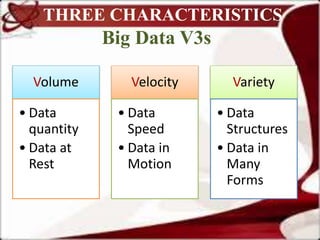
THREE CHARACTERISTICS
Big Data V3s
Volume
• Data
quantity
• Data at
Rest
Velocity
• Data
Speed
• Data in
Motion
Variety
• Data
Structures
• Data in
Many
Forms
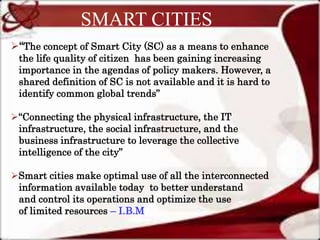
SMART CITIES
“The concept of Smart City (SC) as a means to enhance
the life quality of citizen has been gaining increasing
importance in the agendas of policy makers. However, a
shared definition of SC is not available and it is hard to
identify common global trends”
“Connecting the physical infrastructure, the IT
infrastructure, the social infrastructure, and the
business infrastructure to leverage the collective
intelligence of the city”
Smart cities make optimal use of all the interconnected
information available today to better understand
and control its operations and optimize the use
of limited resources – I.B.M
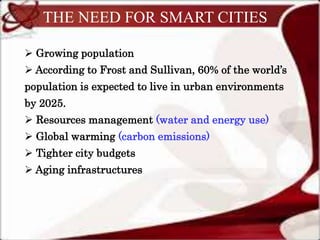
THE NEED FOR SMART CITIES
 Growing population
 According to Frost and Sullivan, 60% of the world’s
population is expected to live in urban environments
by 2025.
 Resources management (water and energy use)
 Global warming (carbon emissions)
 Tighter city budgets
 Aging infrastructures
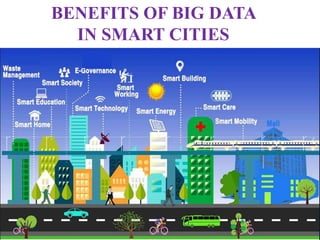
BENEFITS OF BIG DATA
IN SMART CITIES
CHALLENGES OF BIG DATA IN SMART CITIES
Data and information Sharing
Data sources and characteristics
Data Quality
Security and privacy
Cost
Smart City Population
REQUIREMENTS TO IMPLEMENT BIG DATA
Big Data Management
Big Data Processing Platforms
Smart network infrastructure
Advanced Algorithms
Open Standard Technology
Security and Privacy
Citizen Awareness
Government Role
CONCLUSION
There is a huge potential for using big data to
address many of the issues involved in smart cities
using analytics for deeper insights and better
decision making practices.
 Smart city will improve governance,enhance the
economic standing of the city, improve the quality of
life of citizens, and create a environmentally
friendly and sustainable infrastructures.
With all success factors in place and better
understanding of the concepts, making a city
smart will be possible.
REFERENCES
[1] Kitchin R. The real-time city? Big data and smart urbanism.
GeoJournal. 2014; 79(1):1–14.CrossRef
[2] Townsend IS 2013. Smart cities: big data, civic hackers and
the quest for a new utopia. WW Norton & Company.
[3] Batty M. Big data, smart cities and city planning. Dialogues
Hum Geog. 2013; 3(3):274–9.MathSciNetCrossRef
[4] Al-Hader M, Rodzi A. The smart city infrastructure development &
monitoring. Theor Empir Res Urban Manage. 2009; 4(2):87–94.
ANY
?
bigdata in smart cities

bigdata in smart cities

  • 1.
    BENEFITS AND CHALLENGESof big data IN SMART CITIES Presented by R . Uthra, Final Year (B.C.A.,)
  • 2.
    CONTENTS  INTRODUCTION WHAT ISBIG DATA CHARACTERISTICS OF BIG DATA SMART CITIES APPLICATIONS OF BIG DATA IN SMART CITIES BENEFITS OF BIG DATA CHALLENGES OF BIG DATA REQUIREMENTS TO IMPLEMENT BIG DATA CONCLUSION REFERENCE
  • 3.
    INTRODUCTION Many governments includingIndia are making an allowance for adopting the smart city concept in their cities and implementing big data applications that support smart city components One of the recent technologies that have a huge potential to improve smart city services is big data analytics. Effective analysis and utilization of big data is a key factor for success in many business and service domains, including the smart city domain.
  • 4.
    WHAT IS BIGDATA ? Big data is a relative term describing a situation where the volume, velocity and variety of data exceed an organization’s storage or compute capacity for accurate and timely decision making. An aim to solve new problems or old problems in a better way Big Data generates value from the storage and processing of very large quantities of digital information that cannot be analyzed with traditional computing techniques.
  • 5.
    THREE CHARACTERISTICS Big DataV3s Volume • Data quantity • Data at Rest Velocity • Data Speed • Data in Motion Variety • Data Structures • Data in Many Forms
  • 6.
    SMART CITIES “The conceptof Smart City (SC) as a means to enhance the life quality of citizen has been gaining increasing importance in the agendas of policy makers. However, a shared definition of SC is not available and it is hard to identify common global trends” “Connecting the physical infrastructure, the IT infrastructure, the social infrastructure, and the business infrastructure to leverage the collective intelligence of the city” Smart cities make optimal use of all the interconnected information available today to better understand and control its operations and optimize the use of limited resources – I.B.M
  • 7.
    THE NEED FORSMART CITIES  Growing population  According to Frost and Sullivan, 60% of the world’s population is expected to live in urban environments by 2025.  Resources management (water and energy use)  Global warming (carbon emissions)  Tighter city budgets  Aging infrastructures
  • 9.
    BENEFITS OF BIGDATA IN SMART CITIES
  • 10.
    CHALLENGES OF BIGDATA IN SMART CITIES Data and information Sharing Data sources and characteristics Data Quality Security and privacy Cost Smart City Population
  • 11.
    REQUIREMENTS TO IMPLEMENTBIG DATA Big Data Management Big Data Processing Platforms Smart network infrastructure Advanced Algorithms Open Standard Technology Security and Privacy Citizen Awareness Government Role
  • 12.
    CONCLUSION There is ahuge potential for using big data to address many of the issues involved in smart cities using analytics for deeper insights and better decision making practices.  Smart city will improve governance,enhance the economic standing of the city, improve the quality of life of citizens, and create a environmentally friendly and sustainable infrastructures. With all success factors in place and better understanding of the concepts, making a city smart will be possible.
  • 13.
    REFERENCES [1] Kitchin R.The real-time city? Big data and smart urbanism. GeoJournal. 2014; 79(1):1–14.CrossRef [2] Townsend IS 2013. Smart cities: big data, civic hackers and the quest for a new utopia. WW Norton & Company. [3] Batty M. Big data, smart cities and city planning. Dialogues Hum Geog. 2013; 3(3):274–9.MathSciNetCrossRef [4] Al-Hader M, Rodzi A. The smart city infrastructure development & monitoring. Theor Empir Res Urban Manage. 2009; 4(2):87–94.
  • 14.