PRESENTED BY
R.UTHRA
M.SASIKALA
R.A.COLLEGE FOR WOMEN,
TIRUVARUR.
CONTENTS
• INTRODUCTION
• CHARACTERISTICS
• LAYERS AND STRUCTURES
• WHY BIG DATA ?
• TOOLS AND TECHNOLOGIES USED
• HADOOP ARCHITECTURE
• APPLICATIONS OF BIG DATA
• BENEFITS OF BIG DATA
• FUTURE AND IMPORTANCE
• CONCLUSION
INTRODUCTION
• Big Data may well be the next big thing in the IT
world.
• The first organizations to embrace it were Online
and Startup firms like Google, eBay , LinkedIn and
Face book were built around Big Data from the
beginning.
• Early use of term Big Data in magazine article by
fiction author Erik Larson in 1989.
• Big data is the amount of data that is beyond the
storage and processing capabilities of a single
physical machine.
WHAT IS BIG DATAANALYTICS?
• Big data analytics refers to the process of
collecting, organizing and analyzing large sets of
data to find patterns and useful information
• Big data analytics is the application of advanced
analytic techniques to very big data sets.
• Hence, Big data analytics is really about two
things —big data and analytics—plus how the
two have teamed up to create one of the most
profound trends in business intelligence (BI)
today.
.
CHARACTERISTICS OF
BIG DATA
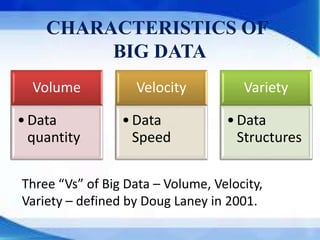
Volume
•Data
quantity
Velocity
•Data
Speed
Variety
•Data
Structures
Three “Vs” of Big Data – Volume, Velocity,
Variety – defined by Doug Laney in 2001.
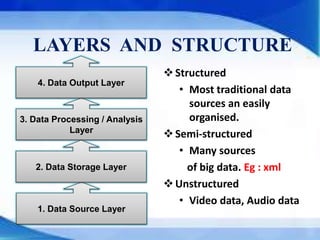
LAYERS AND STRUCTURE
1. Data Source Layer
3. Data Processing / Analysis
Layer
2. Data Storage Layer
4. Data Output Layer
Structured
• Most traditional data
sources an easily
organised.
Semi-structured
• Many sources
of big data. Eg : xml
Unstructured
• Video data, Audio data
WHY BIG DATA ?
Growth of Big Data is needed
– Increase of storage capacities
– Increase of processing power
– Availability of data(different data types)
– Every day we create 2.5 quintillion bytes of
data.
– IBM claims that 90% of the data in the world
today has been created in the last two years
alone
TOOLS & TECHNOLOGIES
USED
• Map Reduce-for distributed processing
• HADOOP
• NoSQL
• No ACID(ATOMICITY, CONSISTENCY, ISOLATION,
DURABILITY)
• Data Mining
• Data Base Analytics
• Amazon EC2 - for distributed Servers
• Amazon S3 – for distributed Storage
HADOOPARCHITECTURE
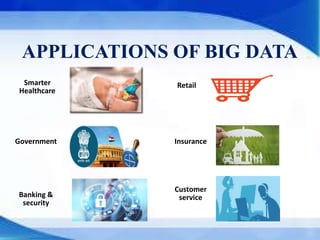
Government
Smarter
Healthcare
Retail
Insurance
Banking &
security
Customer
service
APPLICATIONS OF BIG DATA
BENEFITS OF BIG DATA
• Real time big data isn’t just a process for storing
petabytes or exabytes of data in a data
warehouse.
• Technologies like Hadoop give you the scale and
flexibility to store data.
• Technologies such as Map Reduce , Hive and
Impala enable you to run queries.
• Cost reduction.
• Faster , better decision making.
• Reduce downtime.
FUTURE AND IMPORTANCE
• The McKinsey Global Institute estimates that
data volume is growing 40% per year, and will
grow 44x between 2009 and 2020.
• Increase innovation and development of next
generation product
• Improve customer satisfaction
• Sharpen competitive advantages
• Create more narrow segmentation of
customers
CONCLUSION
• Big data has now become a popular term used to
describe the exponential growth and availability
of data both structured and unstructured.
• An aim is to solve new problems or old problems
in a better way.
• The maintenance cost is reduced.
• Google Translate does a good job at translating
web pages.
• Big data indicates that analytics initiatives are
becoming a reality in all organizations.
BigData
BigData

BigData

  • 1.
  • 2.
    CONTENTS • INTRODUCTION • CHARACTERISTICS •LAYERS AND STRUCTURES • WHY BIG DATA ? • TOOLS AND TECHNOLOGIES USED • HADOOP ARCHITECTURE • APPLICATIONS OF BIG DATA • BENEFITS OF BIG DATA • FUTURE AND IMPORTANCE • CONCLUSION
  • 3.
    INTRODUCTION • Big Datamay well be the next big thing in the IT world. • The first organizations to embrace it were Online and Startup firms like Google, eBay , LinkedIn and Face book were built around Big Data from the beginning. • Early use of term Big Data in magazine article by fiction author Erik Larson in 1989. • Big data is the amount of data that is beyond the storage and processing capabilities of a single physical machine.
  • 4.
    WHAT IS BIGDATAANALYTICS? • Big data analytics refers to the process of collecting, organizing and analyzing large sets of data to find patterns and useful information • Big data analytics is the application of advanced analytic techniques to very big data sets. • Hence, Big data analytics is really about two things —big data and analytics—plus how the two have teamed up to create one of the most profound trends in business intelligence (BI) today. .
  • 5.
    CHARACTERISTICS OF BIG DATA Volume •Data quantity Velocity •Data Speed Variety •Data Structures Three“Vs” of Big Data – Volume, Velocity, Variety – defined by Doug Laney in 2001.
  • 6.
    LAYERS AND STRUCTURE 1.Data Source Layer 3. Data Processing / Analysis Layer 2. Data Storage Layer 4. Data Output Layer Structured • Most traditional data sources an easily organised. Semi-structured • Many sources of big data. Eg : xml Unstructured • Video data, Audio data
  • 7.
    WHY BIG DATA? Growth of Big Data is needed – Increase of storage capacities – Increase of processing power – Availability of data(different data types) – Every day we create 2.5 quintillion bytes of data. – IBM claims that 90% of the data in the world today has been created in the last two years alone
  • 9.
    TOOLS & TECHNOLOGIES USED •Map Reduce-for distributed processing • HADOOP • NoSQL • No ACID(ATOMICITY, CONSISTENCY, ISOLATION, DURABILITY) • Data Mining • Data Base Analytics • Amazon EC2 - for distributed Servers • Amazon S3 – for distributed Storage
  • 10.
  • 11.
  • 12.
    BENEFITS OF BIGDATA • Real time big data isn’t just a process for storing petabytes or exabytes of data in a data warehouse. • Technologies like Hadoop give you the scale and flexibility to store data. • Technologies such as Map Reduce , Hive and Impala enable you to run queries. • Cost reduction. • Faster , better decision making. • Reduce downtime.
  • 13.
    FUTURE AND IMPORTANCE •The McKinsey Global Institute estimates that data volume is growing 40% per year, and will grow 44x between 2009 and 2020. • Increase innovation and development of next generation product • Improve customer satisfaction • Sharpen competitive advantages • Create more narrow segmentation of customers
  • 14.
    CONCLUSION • Big datahas now become a popular term used to describe the exponential growth and availability of data both structured and unstructured. • An aim is to solve new problems or old problems in a better way. • The maintenance cost is reduced. • Google Translate does a good job at translating web pages. • Big data indicates that analytics initiatives are becoming a reality in all organizations.

Editor's Notes

  • #12  Quote practical examples