LDRP INSTITUTE OF TECHNOLOGY AND RESEARCH
GANDHINAGAR
CE-IT Department
Name of Guide Name of HOD
Mr.Ochchhav Patel Shivangi surti
Internal Guide Head of the Department
LDRP ITR LDRP ITR
Small data Big data
• Mostly Structured. Mostly Unstructured.
• Store in MB,GB,TB. Store in PB,EB.
• Increase gradually. Increase exponentiatty.
• Locally present, centeralized. Globally present, distributed.
• SQL server,oracle. Hadoop,spark.
• Single node. Multimode cluster.
Content
1. Introduction
2. What is Big Data
3. Characteristic of Big Data
4. Storing, Selecting and processing of Big Data
5. Why Big Data
6. How it is Different
7. Big Data sources
8. Tools used in Big Data
9. Application of Big Data
10. Risks of Big Data
11. Benefits of Big Data
12. How Big Data Impact on IT
13. Future of Big Data
Introduction
• Big Data may well be the Next Big Thing in the IT world.
• Big data burst upon the scene in the first decade of the 21st century.
• The first organizations to embrace it were online and startup firms. Firms
like Google, eBay, LinkedIn, and Facebook were built around big data
from the beginning.
• Like many new information technologies, big data can bring about
dramatic cost reductions, substantial improvements in the time required to
perform a computing task, or new product and service offerings.
What Is Big Data ?
• ‘Big Data’ is similar to ‘small data’, but bigger in size
• The term "big data" refers to data that is so large, fast or complex that it's
difficult or impossible to process using traditional methods.
• Facebook handles 40 billion photos from its user base.
• Decoding the human genome originally took 10years to process; now it
can be achieved in one week.
• but having data bigger it requires different approaches:
– Techniques, tools and architecture
• There is little doubt that the quantities of data now available are indeed
large, but that's not the most relevant characteristic of this new data
ecosystem.
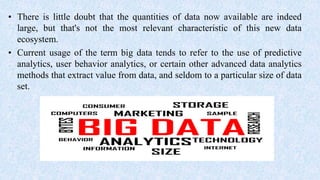
• Current usage of the term big data tends to refer to the use of predictive
analytics, user behavior analytics, or certain other advanced data analytics
methods that extract value from data, and seldom to a particular size of data
set.
Characteristic of Big Data
• There are three types of Characteristic:-
1.Volume:-
-Data qunatity
2.Velocity:-
-Data speed
3.Variety:-
-Data types
Storing big data
Analyzing your data characteristics
• Selecting data sources for analysis
• Eliminating redundant data
• Establishing the role of NoSQL
Overview of Big Data stores
• Data models: key value, graph, document, column-family
• Hadoop Distributed File System
• HBase
• Hive
Selecting Big Data stores
• Choosing the correct data stores based on your data characteristics
• Moving code to data
• Implementing polyglot data store solutions
• Aligning business goals to the appropriate data store
Processing Big Data
Integrating disparate data stores
• Mapping data to the programming framework
• Connecting and extracting data from storage
• Transforming data for processing
• Subdividing data in preparation for Hadoop MapReduce
Employing Hadoop MapReduce
• Creating the components of Hadoop MapReduce jobs
• Distributing data processing across server farms
• Executing Hadoop MapReduce jobs
• Monitoring the progress of job flows
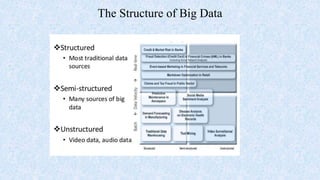
The Structure of Big Data
Why Big Data?
Growth of Big Data is needed
• Increase of storage capacities
• Increase of processing power
• Availability of data(different data types)
• Every day we create 2.5 quintillion bytes of data; 90% of the data in the
world today has been created in the last two years alone.
• FB generates 10TB daily
• Twitter generates 7TB of data Daily
• IBM claims 90% of today’s stored data was generated in just the last two
years.
How Is Big Data Different
1) Automatically generated by a machine
(e.g. Sensor embedded in an engine)
2) Typically an entirely new source of data
(e.g. Use of the internet)
3) Not designed to be friendly
(e.g. Text streams)
4) May not have much values
• Need to focus on the important part
Big Data sources
• 1.User
• 2.Application
• 3.System
• 4.Sensroes
Data generation points Examples
1. Mobile Device
2. Microphones
3. Readers/Scanners
4. Programs/ Software
5. Social Media
6. Cameras
Big Data Analytics
• Examining large amount of data
• Appropriate information
• Identification of hidden patterns, unknown correlations
• Competitive advantage
• Better business decisions: strategic and operational
• Effective marketing, customer satisfaction, increased revenue
Types of tools used in Big-Data
• Where processing is hosted?
– Distributed Servers / Cloud (e.g. Amazon EC2)
• Where data is stored?
– Distributed Storage (e.g. Amazon S3)
• What is the programming model?
– Distributed Processing (e.g. MapReduce)
• How data is stored & indexed?
– High-performance schema-free databases (e.g.MongoDB)
Risks of Big Data
• Will be so overwhelmed
-Need the right people and solve the right problems
• Costs escalate too fast
-Isn’t necessary to capture 100%
• Many sources of big data is privacy
-self-regulation
-Legal regulation
How Big data impacts on IT
• Big data is a troublesome force presenting opportunities with challenges
to IT organizations.
• By 2015 4.4 million IT jobs in Big Data ; 1.9 million is in US itself
• India will require a minimum of 1 lakh data scientists in the next couple
of years in addition to data analysts and data managers to support the Big
Data space.
Benefits of Big Data
• Our newest research finds that organizations are using big data to target
customer-centric outcomes, tap into internal data and build a better
information ecosystem.
• Big Data is already an important part of the $64 billion database and data
analytics market
• It offers commercial opportunities of a comparable scale to enterprise
software in the late 1980s
• And the Internet boom of the 1990s, and the social media explosion of
today.
• Fast forward to the present and technologies like Hadoop give you the
scale and flexibility to store data before you know how you are going to
process it.
Future of Big Data
• $15 billion on software firms only specializing in data management and
analytics.
• This industry on its own is worth more than $100 billion and growing at
almost 10% a year which is roughly twice as fast as the software
business as a whole.
• In February 2012, the open source analyst firm Wikibon released the first
market forecast for Big Data , listing $5.1B revenue in 2012 with growth
to $53.4B in 2017
References
• www.Slideshare.com
• www.wikipedia.com
• www.computereducation.org
• Books-
 Big Data by Viktor Mayer-Schonberger
Thank You.

BigData.pptx

  • 1.
    LDRP INSTITUTE OFTECHNOLOGY AND RESEARCH GANDHINAGAR CE-IT Department Name of Guide Name of HOD Mr.Ochchhav Patel Shivangi surti Internal Guide Head of the Department LDRP ITR LDRP ITR
  • 3.
    Small data Bigdata • Mostly Structured. Mostly Unstructured. • Store in MB,GB,TB. Store in PB,EB. • Increase gradually. Increase exponentiatty. • Locally present, centeralized. Globally present, distributed. • SQL server,oracle. Hadoop,spark. • Single node. Multimode cluster.
  • 4.
    Content 1. Introduction 2. Whatis Big Data 3. Characteristic of Big Data 4. Storing, Selecting and processing of Big Data 5. Why Big Data 6. How it is Different 7. Big Data sources 8. Tools used in Big Data 9. Application of Big Data 10. Risks of Big Data 11. Benefits of Big Data 12. How Big Data Impact on IT 13. Future of Big Data
  • 5.
    Introduction • Big Datamay well be the Next Big Thing in the IT world. • Big data burst upon the scene in the first decade of the 21st century. • The first organizations to embrace it were online and startup firms. Firms like Google, eBay, LinkedIn, and Facebook were built around big data from the beginning. • Like many new information technologies, big data can bring about dramatic cost reductions, substantial improvements in the time required to perform a computing task, or new product and service offerings.
  • 6.
    What Is BigData ? • ‘Big Data’ is similar to ‘small data’, but bigger in size • The term "big data" refers to data that is so large, fast or complex that it's difficult or impossible to process using traditional methods. • Facebook handles 40 billion photos from its user base. • Decoding the human genome originally took 10years to process; now it can be achieved in one week. • but having data bigger it requires different approaches: – Techniques, tools and architecture
  • 7.
    • There islittle doubt that the quantities of data now available are indeed large, but that's not the most relevant characteristic of this new data ecosystem. • Current usage of the term big data tends to refer to the use of predictive analytics, user behavior analytics, or certain other advanced data analytics methods that extract value from data, and seldom to a particular size of data set.
  • 8.
    Characteristic of BigData • There are three types of Characteristic:- 1.Volume:- -Data qunatity 2.Velocity:- -Data speed 3.Variety:- -Data types
  • 9.
    Storing big data Analyzingyour data characteristics • Selecting data sources for analysis • Eliminating redundant data • Establishing the role of NoSQL Overview of Big Data stores • Data models: key value, graph, document, column-family • Hadoop Distributed File System • HBase • Hive
  • 10.
    Selecting Big Datastores • Choosing the correct data stores based on your data characteristics • Moving code to data • Implementing polyglot data store solutions • Aligning business goals to the appropriate data store
  • 11.
    Processing Big Data Integratingdisparate data stores • Mapping data to the programming framework • Connecting and extracting data from storage • Transforming data for processing • Subdividing data in preparation for Hadoop MapReduce Employing Hadoop MapReduce • Creating the components of Hadoop MapReduce jobs • Distributing data processing across server farms • Executing Hadoop MapReduce jobs • Monitoring the progress of job flows
  • 12.
  • 13.
    Why Big Data? Growthof Big Data is needed • Increase of storage capacities • Increase of processing power • Availability of data(different data types) • Every day we create 2.5 quintillion bytes of data; 90% of the data in the world today has been created in the last two years alone. • FB generates 10TB daily • Twitter generates 7TB of data Daily • IBM claims 90% of today’s stored data was generated in just the last two years.
  • 14.
    How Is BigData Different 1) Automatically generated by a machine (e.g. Sensor embedded in an engine) 2) Typically an entirely new source of data (e.g. Use of the internet) 3) Not designed to be friendly (e.g. Text streams) 4) May not have much values • Need to focus on the important part
  • 15.
    Big Data sources •1.User • 2.Application • 3.System • 4.Sensroes
  • 16.
    Data generation pointsExamples 1. Mobile Device 2. Microphones 3. Readers/Scanners 4. Programs/ Software 5. Social Media 6. Cameras
  • 17.
    Big Data Analytics •Examining large amount of data • Appropriate information • Identification of hidden patterns, unknown correlations • Competitive advantage • Better business decisions: strategic and operational • Effective marketing, customer satisfaction, increased revenue
  • 18.
    Types of toolsused in Big-Data • Where processing is hosted? – Distributed Servers / Cloud (e.g. Amazon EC2) • Where data is stored? – Distributed Storage (e.g. Amazon S3) • What is the programming model? – Distributed Processing (e.g. MapReduce) • How data is stored & indexed? – High-performance schema-free databases (e.g.MongoDB)
  • 19.
    Risks of BigData • Will be so overwhelmed -Need the right people and solve the right problems • Costs escalate too fast -Isn’t necessary to capture 100% • Many sources of big data is privacy -self-regulation -Legal regulation
  • 20.
    How Big dataimpacts on IT • Big data is a troublesome force presenting opportunities with challenges to IT organizations. • By 2015 4.4 million IT jobs in Big Data ; 1.9 million is in US itself • India will require a minimum of 1 lakh data scientists in the next couple of years in addition to data analysts and data managers to support the Big Data space.
  • 21.
    Benefits of BigData • Our newest research finds that organizations are using big data to target customer-centric outcomes, tap into internal data and build a better information ecosystem. • Big Data is already an important part of the $64 billion database and data analytics market • It offers commercial opportunities of a comparable scale to enterprise software in the late 1980s • And the Internet boom of the 1990s, and the social media explosion of today. • Fast forward to the present and technologies like Hadoop give you the scale and flexibility to store data before you know how you are going to process it.
  • 22.
    Future of BigData • $15 billion on software firms only specializing in data management and analytics. • This industry on its own is worth more than $100 billion and growing at almost 10% a year which is roughly twice as fast as the software business as a whole. • In February 2012, the open source analyst firm Wikibon released the first market forecast for Big Data , listing $5.1B revenue in 2012 with growth to $53.4B in 2017
  • 23.
    References • www.Slideshare.com • www.wikipedia.com •www.computereducation.org • Books-  Big Data by Viktor Mayer-Schonberger
  • 24.