Community Needs
Assessment
LIS 490CEL
Oct 6, 2009
Jaime Schumacher
What is a Community Needs
Assessment?
 Community
• Common History
• Common Ethnicity/Culture
• Common Geography
• Common Interests
 Needs
• Normative Need
• Comparative Need
• Felt Need
• Expressed Need
 Assessment
• Gauge key issues, opinions, attitudes, assumptions, needs
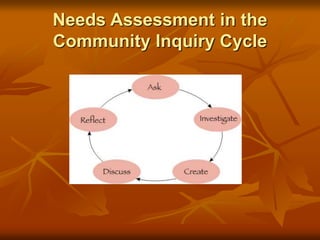
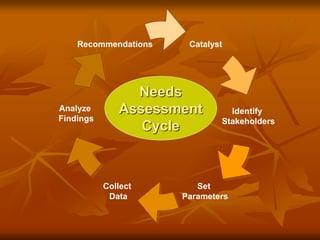
Needs Assessment in the
Community Inquiry Cycle
Why Use a Community
Assessment?
 Gather information from citizens
 Identify gaps
 Set priorities and allocate resources
 Evaluate current programs
 Determine (and even generate) citizen
support for initiatives
Assessment Success
 Community Involvement and Buy-In
• Stakeholder Participatory Model – Equal
involvement of stakeholders and evaluators in
all phases of the assessment…collaboration!
• Convergent Data Analysis & Multi-method
Approach
• Variety of research methods
• Variety of data sources, perspectives
Recommendations Catalyst
Analyze
Findings
Identify
Stakeholders
Set
Parameters
Collect
Data
Needs
Assessment
Cycle
Catalyst
Recommendations Catalyst
Analyze
Findings
Identify
Stakeholders
Set
Parameters
Collect
Data
 Event that highlights a potential need or
necessitates the definition of a need
 Examples
• Expressed need
• Tragedy
• Funding becomes available
• Outdated services
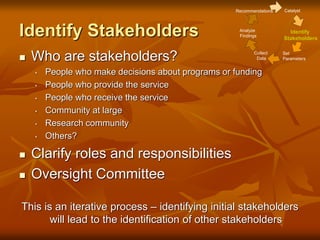
 Who are stakeholders?
• People who make decisions about programs or funding
• People who provide the service
• People who receive the service
• Community at large
• Research community
• Others?
 Clarify roles and responsibilities
 Oversight Committee
This is an iterative process – identifying initial stakeholders
will lead to the identification of other stakeholders
Identify Stakeholders
Recommendations Catalyst
Analyze
Findings
Identify
Stakeholders
Set
Parameters
Collect
Data
Set Parameters
Recommendations Catalyst
Analyze
Findings
Identify
Stakeholders
Set
Parameters
Collect
Data
 Define Objective of Needs
Assessment
• Explicit
• Agreement between all stakeholders and
evaluators…No hidden agendas!
 Determine Content
• What information should be sought?
• What is the scope?
 Discuss Potential Issues
 Data Sources
 Data Collection Methods
 Data Collection Tools
• Qualitative Measures
• Quantitative Measures
 Monitoring
Collect Data
Recommendations Catalyst
Analyze
Findings
Identify
Stakeholders
Set
Parameters
Collect
Data
Qualitative Measures
Recommendations Catalyst
Analyze
Findings
Identify
Stakeholders
Set
Parameters
Collect
Data
 Small Groups
• Focus Groups
• Delphi Technique
• Nominal Group Technique
 Key Informant Interviews
 Public Hearings/Community Forums
Quantitative Measures
Recommendations Catalyst
Analyze
Findings
Identify
Stakeholders
Set
Parameters
Collect
Data
 Survey
• Telephone Surveys
• Mailed Surveys
• Distributed Surveys
• Face to Face Surveys
 Secondary Data
• Census
• Similar assessments performed in similar communities
• State and county level reports
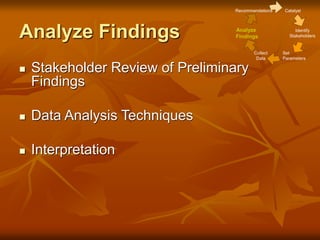
 Stakeholder Review of Preliminary
Findings
 Data Analysis Techniques
 Interpretation
Analyze Findings
Recommendations Catalyst
Analyze
Findings
Identify
Stakeholders
Set
Parameters
Collect
Data
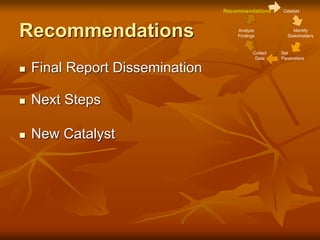
Recommendations
Recommendations Catalyst
Analyze
Findings
Identify
Stakeholders
Set
Parameters
Collect
Data
 Final Report Dissemination
 Next Steps
 New Catalyst
Case Study
Community-wide service needs assessment
of elderly residents in Lorain County, Ohio.
1996
Shantha Balaswamy
Holly Dabelko
 A migration of elderly into the county
 Initiated by a major provider of elderly
services in the county
 Agency’s director enlisted director of the
department of nursing of a local
community college
Catalyst
Recommendations Catalyst
Analyze
Findings
Identify
Stakeholders
Set
Parameters
Collect
Data
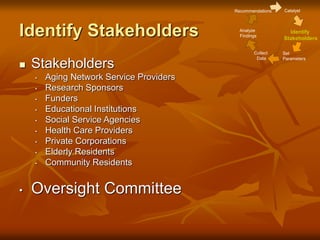
Identify Stakeholders
 Stakeholders
• Aging Network Service Providers
• Research Sponsors
• Funders
• Educational Institutions
• Social Service Agencies
• Health Care Providers
• Private Corporations
• Elderly Residents
• Community Residents
• Oversight Committee
Recommendations Catalyst
Analyze
Findings
Identify
Stakeholders
Set
Parameters
Collect
Data
Set Parameters
 Objective:
• “Develop a comprehensive assessment of service needs for the
elderly residents and explore availability of resources.”
• Support a tax levy for senior services
• Generate additional funding
 Content
• Service utilization, service needs, service gaps for older people
• Empirical data
• Level of frailty and functional impairment
Recommendations Catalyst
Analyze
Findings
Identify
Stakeholders
Set
Parameters
Collect
Data
Collect Data
Recommendations Catalyst
Analyze
Findings
Identify
Stakeholders
Set
Parameters
Collect
Data
 Survey of 400 community
residents over age 60
 Focus groups with elderly
participants in senior centers
 Key informant interviews with
community leaders
 Survey of service providers
Analyze Findings
Recommendations Catalyst
Analyze
Findings
Identify
Stakeholders
Set
Parameters
Collect
Data
 Community’s elderly are in good
health
 Most needed services are currently
available
 Over half of respondents reported
having symptoms of depression
 One in ten reported feeling lonely,
unhappy, and lacked necessary
psychotropic medications
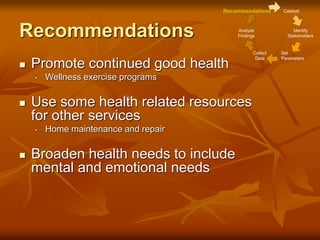
Recommendations
Recommendations Catalyst
Analyze
Findings
Identify
Stakeholders
Set
Parameters
Collect
Data
 Promote continued good health
• Wellness exercise programs
 Use some health related resources
for other services
• Home maintenance and repair
 Broaden health needs to include
mental and emotional needs
Group Discussion
Community Needs Assessments are often
initiated to provide information in order to
take some action. In what other ways can
the results of a Community Needs
Assessment be used?
What experiences have you had with Needs
Assessments in your own communities?

community-needs-assessment-presentation.ppt