Performing a Community Assessment:  Curriculum Overview
Step 1: Develop a Community  Partnership   Identify stakeholders Form a Community Partnership Assess Partnership’s individual and organizational capacity Identify benefits and risks Step 1 Planning Worksheet  – Community Partnership Organizational Chart
Step 2: Determine Your Focus Identify and prioritize community  public health needs Define the problem Create realistic and  achievable goals and objectives Step 2 Planning Worksheet  – Issues, Problems, Goals and Objectives
Step 3: Identify the Information (Data) You Need   Articulate the primary questions you would like to answer Identify what type of data you will need Identify data sources Step 3 Planning Worksheet  – Questions, Data Types and Data Sources
Step 4: Determine How to Get the Information (Collect Data)   Identify what new data  will need to be collected Select the appropriate  data collection method(s) Revisit steps 1-3 to make sure you’re on track Step 4 Planning Worksheet  – Data Collection Plan
Step 5: Determine How to Understand the Information (Analyze Data)   Check the data Go back to the primary assessment questions Reduce the amount of data Analyze the data Verify findings Interpret findings and draw conclusions Step 5 Planning Worksheet  – Data Analysis Plan
Step 6: Determine How to Use and Communicate Results   Identify assessment products Identify target audiences Present your findings Determine next steps Celebrate and acknowledge your work! Step 6 Planning Worksheet  – Ways to Report the Results to Target Audiences
Appendices   Data Collection Methods:  Asset Mapping Focus Groups Surveys Key Informant Interviews Rapid Appraisal Community Forums Computer Software to Compile and Analyze Data Materials for Step 5 Data Analysis Exercises Ethical Considerations in Human Subjects Research Resources
Introduction
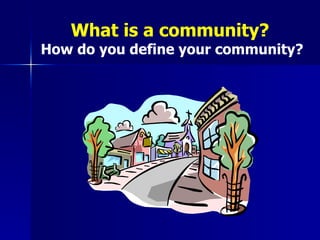
What is a community?   How do you define your community?
Introduction: What is a Community Assessment? Process of collecting, analyzing and reporting information about the needs, strengths and assets of a community Purpose: to identify unmet needs and plan/prioritize ways to meet them Should be driven by community leaders Should actively involve community members Also called a “Community Needs Assessment”
Introduction: Why Do a Community Assessment? To identify new community public  health issues To better understand known community  public health issues To learn more about the priorities, assets, and concerns of community member To offer solutions for addressing unmet health needs To gain community member support for health improvement solutions
Introduction: Why Do a Community Assessment? To collaborate with essential community  health leaders and partner organizations To convince funders to provide you with  needed resources To convince policymakers and other decision-makers to provide your community with needed programs or services Your community asked you to do it You have already received funds to conduct a community assessment
Introduction: What Resources Will I Need? Will depend on your  size  and  focus   Will depend on the collective resources of your planning group This curriculum emphasizes a collaborative approach to maximize the collective resources available A grant may assist you if you need to do a larger assessment than you have resources If applying for a grant is out of the question, then settle on a smaller assessment
Introduction: How Do I Use This Curriculum? Complete each of the six step worksheets to create an assessment workplan Complete the six steps in the order most appropriate for your group and context Think of this as a dynamic process where the completion of each step informs each of the previous and subsequent steps If not planning an assessment right away, use this curriculum as a reference for any future assessment or research activities
Introduction: Training Goal To help participants plan and conduct a community assessment
Introduction: Training Objectives Upon completion of this workshop, participants will be able to: Develop a Community Partnership to plan and conduct a community assessment Develop goals and objectives to focus the community assessment Identify good sources of secondary (existing) data and determine need to collect primary (new) data Identify appropriate methods for collecting primary data Identify appropriate methods for analyzing data Identify appropriate ways to report results and identify target audiences   Complete a community assessment plan
Step 1: Develop a Community Partnership
Step 1.1: Identify Stakeholders   Stakeholders:  Persons or organizations with a  stake  in the community assessment
Step 1.1: Identify Stakeholders Examples: Community leaders or community members Policy makers or decision-makers Health agencies Other community-based organizations, non-profits Neighborhood or civic associations Voluntary groups Religious organizations Many others…
Step 1.1: Discussion Questions for Identifying Stakeholders   What defines your community? What social institutions exist in your community?  Which impact health?  Which have an interest in health issues? What clubs, associations, organizations, voluntary groups, support groups and faith-based organizations exist in your community?
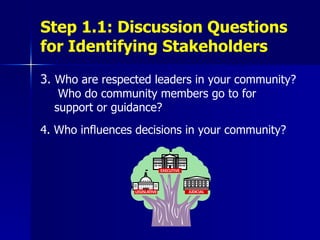
Step 1.1: Discussion Questions for Identifying Stakeholders 3.  Who are respected leaders in your community?  Who do community members go to for support or guidance? 4. Who influences decisions in your community?
Step 1.1: Discussion Questions for Identifying Stakeholders   Who of the above would have the most expertise to conduct a community assessment? Who of the above  must  be involved to conduct a community assessment? Who of the above would most use the results of a community assessment? 9. Who has a positive image and respected  reputation in the community?
Step 1.1: Discussion Questions for Identifying Stakeholders Look at the individuals and organizations mentioned in questions 6-9.  These are your community assessment stakeholders.
Step 1.2: Form a Community Partnership   Community Partnership:  A collaboration of people and/or organizations that work together while still keeping their separate identities.  Also called a “Collaborative” or “Collaboration”.
Step 1.2: Form a Community Partnership Community Partner:  One member of the Partnership Benefits of engaging stakeholders into a Community Partnership: Pool resources and skills Expand the reach and acceptability of the assessment Assures the assessment reflects diverse community beliefs and meets diverse community needs Make sure results and reports are widely distributed
Step 1.2: Form a  Community Partnership   Invite all stakeholders to participate Determine what level of participation each wants to contribute Assess collective resources and skills Seek out additional community stakeholders if additional resources or skills would help to plan and conduct the community assessment
Benefits of keeping an open invitation to identified stakeholders Controversial relationships and issues can be addressed openly and early The perspectives and values of everyone are considered  Stakeholders make contribution to and have ownership of the plan You probably will need all the major players in your community to conduct a needs assessment Opposing views are understood and addressed more easily
Characteristics of a Successful Collaboration Shared goals and interests Inclusive governance Shared responsibility and input Shared ownership and commitment Trust Balance of power and influence On-going management and support Clear roles and responsibilities Set ground rules for maintaining a safe atmosphere Active participation Good leadership Good consensus building and conflict resolution
Step 1.3: Assess Partnership’s Capacity   Important to determine the amount of resources, time and capacity each can  actually provide  to this effort Important to assess even if your Community Partnership has already been formed or even worked together before Will identify Partnership strengths and assets Will identify Partnership limitations Will help to overcome limitations or invite more Partners Will help Partnership to see where everyone is coming from Will help to see the potential reach of the assessment results
Step 1.3: Assess Partnership’s Capacity   Mission –   What is their organizational mission?  Clientele -   What community or population(s) do they serve?  Funding -   Does their current funding situation allow for them to be involved and at what level?  Can they dedicate any funding or other resources to this effort?  Are there any conflicts of interest?
Step 1.3: Assess Partnership’s Capacity Staffing -   Do they have staff who can dedicate some of their time to the assessment?  If so, what skills do they possess that could be useful to the assessment?  Organizational Support -   What role can their current work play in the assessment process?  What kind of organizational support can they dedicate to the assessment?  Can they dedicate office space? Research -   Do they have any data research capacities?  (data collection, data management, data analysis, report writing, other)
Step 1.3: Assess Partnership’s Capacity   Technology -   Do they have any computer or other technology that could be useful to the assessment?  Can they dedicate any of this technology or the use of it?  Media -   Can they offer access to the media for assessment efforts?  These could mean contacts within radio, television or newspaper media outlets, or any other ability to get press coverage.
Step 1.3: Assess Partnership’s Capacity Allies -   Do they have a community advisory board or highly involved clientele?  Can those allies lend any support or strength to the Partnership or assessment process?  Interests -   What is their particular interest in the community assessment?  What would they like to see happen as a result of participating in this process? Involvement -   How would they like to be involved in this effort?  What level and type of involvement can they commit?
Step 1.4: Identify Benefits and Risks Working well in a Community Partnership is about maximizing benefits and minimizing risks
Step 1.4: Identify Benefits and Risks Think through ahead of time the potential benefits and risks for: Community partners Community residents Community leaders and advocates Public health professionals and agencies Health service providers Elected and appointed officials
Step 1.4: Identify Benefits and Risks Examples of benefits: Greater understanding of health assets and needs Community advocates will have the data they need to advocate Public health agencies will have the data they need to plan Examples of risks: Providers may not share valuable data Elected officials may feel findings reflect badly on them Community members may feel hostile toward Partnership if not included or findings not used to their benefit
Group Exercise: Complete Step 1 Worksheet Consider your small group to be the start of your Community Partnership Complete worksheet for your Partnership using questions on pages 4-7 and 4-8 Identify additional stakeholders if your Partnership lacks necessary resources, staffing or capacities. Answer questions on pages 4-3 and 4-4 to identify new Community Assessment stakeholders.
Step 2: Determine Your Focus
Step 2.1: Identify and Prioritize Community Public Health Needs The public health issue(s) your Community Partnership prioritizes will become your community assessment focus Broad focus:  general information about disease rates, available services, or community members’ perspectives on health or health care Specific focus:  focus on a particular health topic that your Community Partnership agrees is a priority area If resources are limited, assess one topic well and conduct another assessment later
Step 2.1: Identify and Prioritize Community Public Health Needs Discuss the community health issues your Partners are most concerned with Create a list Discuss which of these issues were raised the most or are the most pressing in your community Prioritize health issues to focus your assessment If you cannot agree on one or two health topics, then agree to conduct a broad assessment to determine the most pressing health issues in the community
Step 2.2: Define the Problem Frame the assessment focus in terms of a public health problem: Unmet needs Gaps in health care services or programs Lack of community-wide resources or funding This will help you: Further focus the assessment and data collection Plan for community improvements  Provide a rationale for community improvements Provide an argument to external audiences when you seek funding or policy change
What makes good goals and objectives?
A Goal Is a broad statement Provides the overall vision, focus and direction Can be more lofty than objectives
Objectives Are steps to achieve goal(s) Are always active Are clear Are SMART: Specific Measurable Achievable  given available time, staffing, and resources Relevant  to the goals, needs, and interests of the community and Community Partnership Contain a  Time Frame  for when it will be accomplished
Step 2.3: Create Realistic and Achievable Goals and Objectives Assessment goals and objectives are different from program goals and objectives They should be specific to your  community assessment They should not promise to: create or implement programs, change policy, change health behaviors, educate the community, provide services, etc. They could instead promise to: collect/gather/ understand information, examine issues, analyze data, make recommendations, engage Community Partners, etc.
Example Goal and Objectives Goal:  To understand community members’ access to health care Gather secondary data from at least 10 local health care service providers in spring 2008 to better understand which services are most utilized by the community, and which are not. Perform asset mapping in 4 low-income neighborhoods in summer 2008 to determine what services are accessible by what neighborhoods in the community. Survey 20% of residents in summer 2008 about their use of local health care services to better understand community health assets and needs.
Example Goal and Objectives for a More Narrowly Focused Assessment Goal:  To understand the dietary behaviors of community teens Gather sales data from 2 high school food service directors in 2007. Conduct surveys with 50% of high school students regarding their at-home and in-school dietary behaviors before  June 2007 . Map the locations of fast food and convenient store outlets before  January 2008  near 2 high school campuses and students’ walking routes.
Group Exercise: Complete Step 2 Worksheet Discuss the public health issues that concern your group members Prioritize one issue to focus your community assessment Frame that selected issue as a problem Discuss and agree on your assessment goal and objectives
Step 3: Identify the Information (Data) You Need
Step 3.1: Articulate the Primary Questions You Would Like to Answer Clear questions will further focus your assessment and drive data collection Develop  answerable  questions  Number of questions depend on Partnership interests and assessment scope and focus Good rule of thumb: 3-6 questions Discuss questions with Partners and prioritize list of clear questions you can realistically answer with available resources
Examples of Primary Questions Where do community residents go for health services?  What local health services do residents use the most?  Which do they use the least?  Are those services accessible to most people?  (Are the location and hours of operation convenient?  Is there public transportation to the site?)  Which diseases or conditions affect  the community the most?
Examples of Primary Questions How does our community compare to other communities around health issues? What do high school students know about eating a healthy diet? What foods are available for high school students, both on campus and nearby?
What is data? What types of data  are there?
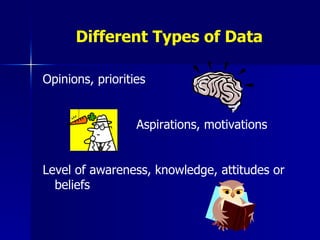
Different Types of Data Opinions, priorities Aspirations, motivations Level of awareness, knowledge, attitudes or beliefs
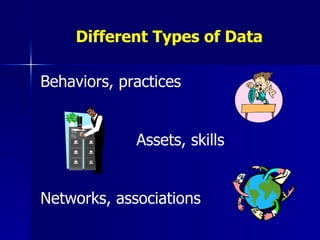
Different Types of Data Behaviors, practices Assets, skills Networks, associations
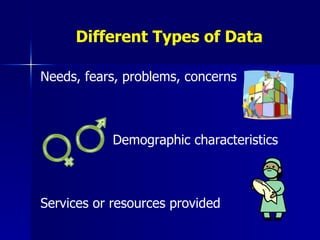
Different Types of Data Needs, fears, problems, concerns   Demographic characteristics Services or resources provided
Different Types of Data Resident utilization of services  or resources provided Numbers or rates of disease,  illness, disability, injuries Sales transactions, purchases
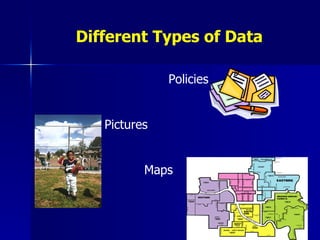
Different Types of Data   Policies Pictures   Maps
Step 3.2: Identify What Type of Data You Will Need Many different types of data can answer your assessment question It would be good to collect it all, but you need to consider the following when identifying what type of data you need: Assessment time frame Available resources Dedicated staff time and skills Assessment goals and objectives Problem statement Prioritized questions
Which Types of Data Will Best Answer These Primary Questions? Where do community residents go for health services?  What local health services do residents use the most?  Which do they use the least?  Are those services accessible to most people?  (Are the location and hours of operation convenient?  Is there public transportation to the site?)  Which diseases or conditions affect the community the most?  How does our community compare to other communities around health issues? What do high school students know about eating a healthy diet? What foods are available for high school students, both on campus and nearby?
Step 3.3: Identify Data Sources Start first with data that already exists Secondary Data:  Data that has been collected for another purpose and can be made available to you for your data needs Ask around your community and ask your Partners to see what data is out there and what you can use
Step 3.3: Identify Data Sources Some local sources of data may include: County Health Department Vital statistics (birth and death certificates) City or County Government Schools
Step 3.3: Identify Data Sources Hospitals or clinics Health agencies or advocacy groups Universities or community colleges Other local surveys or research efforts? Other free online sources of data are listed on pages 4-23 to 4-25
Pros and Cons of Using Secondary Data Pros: It’s cheaper   It’s quicker You can use your resources for data analysis and report writing It may have collected data from a large sample
Pros and Cons of Using Secondary Data Cons: The data may be outdated It most likely won’t be exactly what you want There may be some sharing/privacy issues Often not collected on the local level Can’t control the quality of the data
Evaluating Secondary Data Make sure any secondary data: Comes from a credible source Captures what you want to measure Is applicable to your community Appears to be reliable and bias-free Is timely No data will be perfect.  Balance the pros and cons of each source and determine which aspects are most important for your assessment data needs.
Where Can You Find the Data to Answer These Primary Questions? Where do community residents go for health services?  What local health services do residents use the most?  Which do they use the least?  Are those services accessible to most people?  (Are the location and hours of operation convenient?  Is there public transportation to the site?)  Which diseases or conditions affect the community the most?  How does our community compare to other communities around health issues? What do high school students know about eating a healthy diet? What foods are available for high school students, both on campus and nearby?
Group Exercise:  Complete Step 3 Worksheet Create the primary assessment question(s) your group would like to answer Brainstorm what types of data you would like to collect to answer those questions Brainstorm where you could find or collect that data
Step 4: Determine How to Get the Information (Collect Data)
Step 4.1: Identify What New Data Will Need to be Collected Look at your Step 3 Worksheet – which data types  cannot  be gathered from secondary data sources? These are the data you will need to collect New data you collect is also called  primary data Before selecting data collection method(s), be sure you  need  this data to answer your questions
What is  quantitative data? -------------------------------- What is  qualitative data?
Quantitative vs. Qualitative Data Quantitative: Collected in the form of numbers or percentages Closed-ended questions Answers who?, what?, when? and where? Can “represent” a population by collecting data from a “sample” to approximate the experience of the entire community  Cannot collect new ideas or responses, only those considered ahead of time Qualitative: Collected in the form of words, concepts, themes, or categories Open-ended questions Answers how?, why? Can provide richer, more in-depth data Can provide data in a respondent’s own words Can explore new ideas in a dynamic and unstructured way
Step 4.2: Select the Appropriate Data Collection Method(s) Appendix A contains information on how to perform these data collection methods: Asset Mapping Focus Groups Key Informant Interviews Surveys Community Forums Rapid Appraisal Techniques
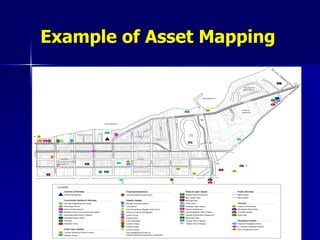
Data Collection Methods:  Asset Mapping An inventory of community health assets (resources, services, facilities, organizations, associations, etc.) Usually represented by geographically mapped data Builds on existing community resources Data can be used to develop, improve or advocate for additional resources or funding Needs community buy-in and participation May require a lot of time to survey community and to verify current addresses
Example of Asset Mapping
Data Collection Methods:   Focus Groups A series of discussions involving 8-12 people, selected to share their perceptions of a defined topic Stimulates participants to share their opinions openly in a group discussion Captures rich data in participants’ own words Flexible to capture new ideas and issues Can be difficult to summarize and interpret results across groups  Need to be creative when recruiting busy people
Example of Focus Groups
Data Collection Methods:  Key Informant Interview A survey conducted over the phone or in person during an interview Short answer or open-ended questions Allows respondents to share their opinions without the pressure of the group dynamic Allows interviewer to clarify questions and draw out thoughtful responses Selecting the “right” key informants may be difficult so they represent diverse backgrounds and viewpoints Takes a while to administer; difficult to keep respondents on track
Data Collection Methods:  Quantitative Survey A survey conducted over the phone, in person, or via mail Closed-ended questions (multiple choice, true/false or yes/no, brief numbered responses) Easy to administer Large amounts of data can be gathered from many respondents, and so can collect a larger sample and be representative of the broader population Must be constructed to avoid “leading” or “loaded” questions May require additional skills or funding to analyze data
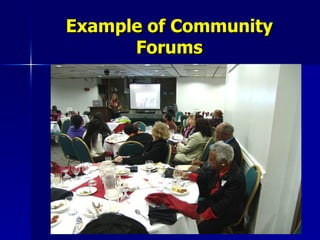
Data Collection Methods:  Community Forums A series of public meetings focused on a defined topic Moderated to ensure that important topics are covered and time is used well Relatively inexpensive and easy to conduct Educational Allows for community and stakeholder participation in issue Allows for the gathering of many perspectives at once Participants may not be representative of the larger population, as those who attend may not reflect the entire community or target audiences
Example of Community Forums
Data Collection Methods:  Rapid Appraisal Methods Observations and photography that can help to describe or visually depict community conditions Relatively easy and inexpensive   Data can be gathered quickly Provide descriptions and visual imagery that give meaning to quantitative data Can be difficult to represent the entire community experience Can be difficult to interpret and summarize photographs and observation notes
Things to Consider as You Select Your Methods What data collection method or methods would best collect the type of data you need, from the source you indicated Partnership resources:  Time Staffing Skills Funding Computer technology Prior experience Potential benefits Potential challenges
Some Helpful Tips About Collecting Primary Data Be flexible – modify your  plan as you gain new insight Don’t reinvent the wheel – borrow what you can from similar efforts or get online Don’t bite off more than you can chew – collect fewer data well, rather than many data poorly Be humble – ask for input and help
Step 4.3: Revisit Steps 1-3 to Make Sure You’re on Track Before you spend any time or resources collecting data, be sure your community assessment plan so far is: Feasible  –  Is the assessment doable? Useful  –  Will the data you collect be useful?  Will it address the community public health issues you identified? Accurate  –  Will the assessment methodologies collect information that accurately reflects reality? Fair  –  Will the assessment be conducted with awareness of the rights of the people involved? Responsive  –  Is the assessment guided by the previous decisions made by your Partnership throughout the planning process so far?
Completing a Data  Collection Plan Some important issues to consider : What types of data (identified in step 3) will be collected with each data collection method? How would you define the source of data for each data collection method more specifically?  In other words,  define your target respondents .  Which of your assessment questions will each method answer?  This will ensure that the data you collect through each method are strategic to answering these questions. What specific activities will need to be accomplished in order to best plan and perform these proposed data collection methods? Some activities may include data collection tool development, data collector training, respondent recruitment, etc.
Group Exercise: Complete Step 4 Worksheet Discuss the questions on pages 4-30 and 4-31 Consider the pros and cons of qualitative and quantitative data Consider the advantages and disadvantages of the different methods Decide which method or methods would be most appropriate for your community assessment Complete the rest of the Step 4 worksheet for each data collection method selected
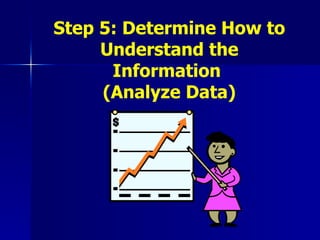
Step 5: Determine How to Understand the Information  (Analyze Data)
Why It’s a Good Idea to Plan Ahead for Data Analyses To determine if the data you collect are practical for analyses To review the appropriateness of your chosen data collection method(s) To inform the data collection instrument(s) you develop  To decide if you will need help with analyses
Step 5.1: Check the Data Make sure it’s all there Make sure it makes sense Catch any mistakes that happened while filling out the survey or entering the data Perform data quality checks throughout your data collection process Common mistakes: A missing or incomplete response An impossible response A response unrelated to the question A response that contradicts an earlier response
Step 5.2: Go Back to the Primary Assessment Questions Be sure to analyze only the data that will help you answer your primary question(s) Don’t get side-tracked into analyzing other pieces of data with your limited time and resources It is normal to collect more data than you will need for your community assessment You can return to any other interesting data after completing your Community Assessment Plan
Step 5.3: Reduce the Amount of Data Save your data in its original form so that you can return to it if you need to Look at it in small chunks at a time Eliminate any irrelevant data from your analysis
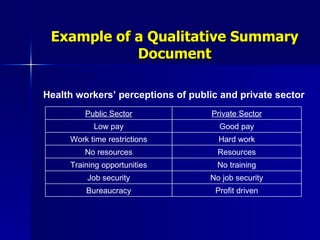
Step 5.3: Reduce the Amount of Data Create summary documents to help you “eyeball” the data more easily to look for patterns or themes: Numeric spreadsheet Qualitative summary document See also Appendix B: Computer Software to Compile and Analyze Data
Example of a Numeric Spreadsheet
Example of a Qualitative Summary Document Health workers’ perceptions of public and private sector Profit driven Bureaucracy No job security Job security No training Training opportunities Resources No resources Hard work Work time restrictions Good pay Low pay Private Sector Public Sector
What is the difference between discrete and continuous data?
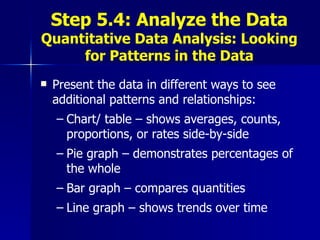
Step 5.4: Analyze the Data Quantitative Data Analysis: Looking for Patterns in the Data Calculate averages  Used with “continuous” data: infinite number of values Add numbered responses Divide by number of responses 2 + 4 + 6 + 10 = 22  22/4 = 5.5 Count frequencies Used with “discrete” data: set number of response categories Count number of responses Number “yes”, number “no” Number of choice “A”, Number of choice “B”, etc.
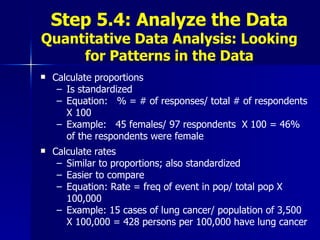
Step 5.4: Analyze the Data Quantitative Data Analysis: Looking for Patterns in the Data Calculate proportions  Is standardized  Equation:  % = # of responses/ total # of respondents X 100 Example:  45 females/ 97 respondents  X 100 = 46% of the respondents were female Calculate rates Similar to proportions; also standardized  Easier to compare Equation: Rate = freq of event in pop/ total pop X 100,000 Example: 15 cases of lung cancer/ population of 3,500 X 100,000 = 428 persons per 100,000 have lung cancer
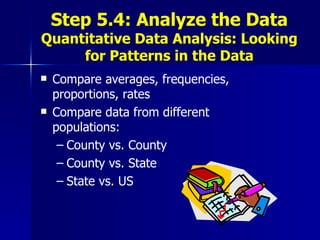
Step 5.4: Analyze the Data Quantitative Data Analysis: Looking for Patterns in the Data Compare averages, frequencies, proportions, rates  Compare data from different populations:  County vs. County County vs. State State vs. US
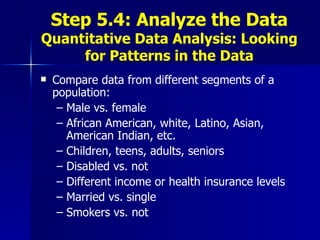
Step 5.4: Analyze the Data Quantitative Data Analysis: Looking for Patterns in the Data Compare data from different segments of a population: Male vs. female African American, white, Latino, Asian, American Indian, etc. Children, teens, adults, seniors Disabled vs. not Different income or health insurance levels Married vs. single  Smokers vs. not
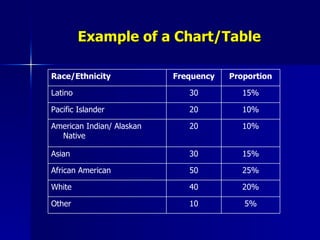
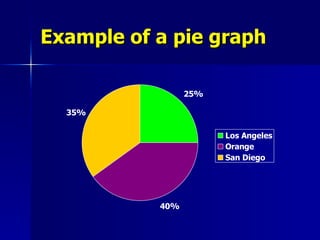
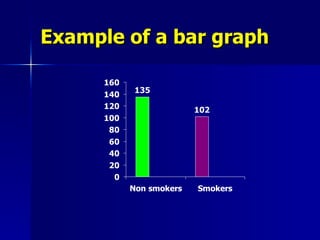
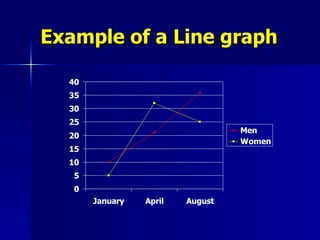
Step 5.4: Analyze the Data Quantitative Data Analysis: Looking for Patterns in the Data Present the data in different ways to see additional patterns and relationships: Chart/ table – shows averages, counts, proportions, or rates side-by-side Pie graph – demonstrates percentages of the whole Bar graph – compares quantities Line graph – shows trends over time
Example of a Chart/Table 5% 10 Other 20% 40 White 25% 50 African American 15% 30 Asian 10% 20 American Indian/ Alaskan Native 10% 20 Pacific Islander 15% 30 Latino Proportion Frequency Race/Ethnicity
Example of a pie graph
Example of a bar graph
Example of a Line graph
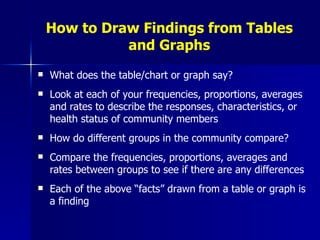
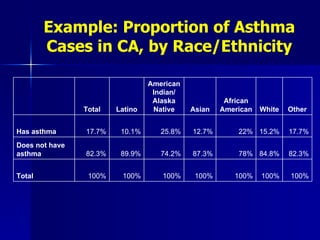
How to Draw Findings from Tables and Graphs What does the table/chart or graph say?  Look at each of your frequencies, proportions, averages and rates to describe the responses, characteristics, or health status of community members How do different groups in the community compare? Compare the frequencies, proportions, averages and rates between groups to see if there are any differences Each of the above “facts” drawn from a table or graph is a finding
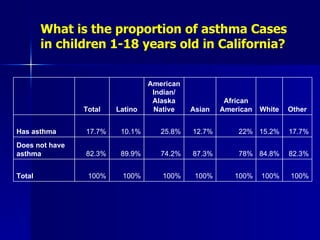
Example: Proportion of Asthma Cases in CA, by Race/Ethnicity 100% 82.3% 17.7% Total 100% 100% 100% 100% 100% 100% Total 82.3% 84.8% 78% 87.3% 74.2% 89.9% Does not have asthma 17.7% 15.2% 22% 12.7% 25.8% 10.1% Has asthma Other White African American Asian American Indian/ Alaska Native Latino
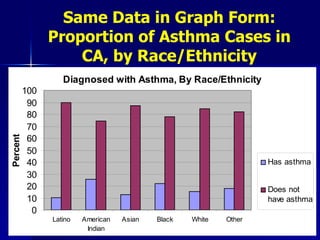
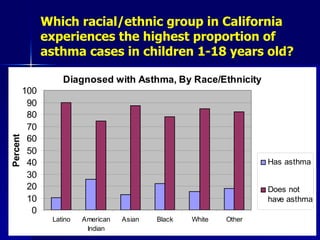
Same Data in Graph Form: Proportion of Asthma Cases in CA, by Race/Ethnicity
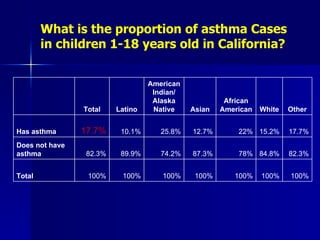
What is the proportion of asthma Cases in children 1-18 years old in California? 100% 82.3% 17.7% Total 100% 100% 100% 100% 100% 100% Total 82.3% 84.8% 78% 87.3% 74.2% 89.9% Does not have asthma 17.7% 15.2% 22% 12.7% 25.8% 10.1% Has asthma Other White African American Asian American Indian/ Alaska Native Latino
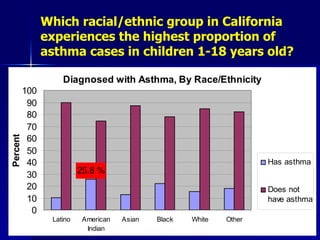
Which racial/ethnic group in California experiences the highest proportion of asthma cases in children 1-18 years old?
Exercise 5.4A Look at sample survey and sample spreadsheet in Appendix C Answer questions on page 4-51 and 4-52 Discuss any difficulties or questions
Step 5.4: Analyze the Data Qualitative Data Analysis: Looking for Themes in the Data Qualitative data analysis can be deceptively trickier Qualitative data is by nature “bigger” Analysis requires more analytical thinking and interpretation Qualitative data is more open to “bias” Numbers don’t lie Analysts bring their values, assumptions and opinions Analysts may think they “know” how people feel Include at least 2, preferably 3 people in each stage of data analysis to avoid bias Create as structured of a process as possible to avoid bias
Step 5.4: Analyze the Data Qualitative Data Analysis: Looking for Themes in the Data Read through all of the data at least twice Stay “close” or “grounded” in the data Create categories Focus group or interview questions Or specific assessment health issues  List themes that emerge from discussion Sub-categories Ideas Rank order according to frequency of appearance Summarize discussion around each theme Determine your findings
How to Draw Findings from Qualitative Data What are the most frequently occurring themes that arose across all of your focus group/open-ended survey questions?  How do the different themes intersect and relate to each other?  Compare the themes discussed by each type of focus group/survey participant to see if there are any differences Each of the above “facts” drawn from the qualitative data is a finding
Exercise 5.4B Look at sample focus group discussion transcript in Appendix C Answer questions on page 4-56 Discuss any difficulties or questions
Step 5.5: Verify Findings You now have: Some patterns and relationships you found in your quantitative data Some themes and categories you found in your qualitative data Based on the results you tallied and summarized, pull out the main findings of each method you used Verify these findings by re-tallying and re-summarizing the data to make sure you get the same results; correct any mistakes You can also verify your findings by comparing the results reached by 2 or more analysts independently; correct any mistakes
Step 5.6: Interpret Findings and Draw Conclusions What possible interpretations, or explanations, could explain each finding? Invite different perspectives in this process, to make sure one person’s viewpoint does not dominate or bias the conclusions  Some things to consider as you draw meaning from your data findings: Is this finding similar to what you expected?  How/why is it different? What do you think could explain this finding? What are all the different alternative interpretations/ explanations you may have not considered? Is there evidence to support any of the interpretation or interpretations you have considered? Do you feel comfortable sharing this interpretation with the general public as a conclusion of your assessment?
Why is Data Interpretation so Important in Community Assessments? Interpretation is the effort of figuring out what the findings mean and is part of the overall effort to make sense of the evidence gathered Uncovering facts regarding a community’s needs is not sufficient to draw conclusions – those facts must be interpreted before conclusions can be drawn Data must be interpreted to appreciate the practical significance of what has been learned Interpretations (or explanations) can be strengthened through active discussion and community participation
Exercise 5.6 Look at the secondary data tables in Appendix C Answer questions on page 4-59 Discuss any difficulties or questions
Completing a Data Analysis Plan Some important issues to consider : What is the nature of the data collected with each method –  quantitative, qualitative, or both ? What  specific activities  will need to be accomplished in order to best plan and perform the proposed data analysis? Determine who in your community partnership has the experience, interest and time to accomplish each activity. Select a due date or timeline for each activity so that this planning worksheet can become an achievable Data Analysis Plan.
Group Exercise: Complete Step 5 Worksheet List each data source and data collection method you selected in steps 3 and 4 Determine whether the data collected with each method will be qualitative or quantitative (or both) Decide which data analysis activities will be necessary for each method, as described in step 5 Decide who in your group has the skills, interest and time to achieve each data analysis activity
Step 6: Determine How to Use and Communicate Results
6.1: Identify Assessment Products Before you begin your assessment, it is important to plan what types of products you would like to use to communicate your findings to external audiences These may take the form of: Written reports Report summaries Presentations Recommendations Fact sheets/ briefs Newspaper articles Others
Effective Assessment Products Are… Concise  -  Make it short and to the point.  Make it easy to find information.   Interesting  -  Present and discuss the findings that are new and compelling.   Responsive  -  Consider your target audiences and keep them in mind while writing the report.   Useful  -  Write clear conclusions and recommendations.  They will be more usable.   Attractive  -  Spend a small portion of your budget to bind your reports or print products in color to distribute to your important target audiences.
Tips on Developing Products Get community input on findings and conclusions Make modifications before finalizing Pull out key points Decide carefully how to present data to back up your findings and conclusions Graphs and tables Table summarizing main qualitative themes and descriptions Story boxes highlighting quotes Maps and Photographs
Putting a Report Together… Cover page Executive Summary Table of Contents Introduction Methodology Main findings Discussion
Design Tips for Easy Reading Use clear, readable, and large font Times/Times New Roman Palatino Garamond Arial Tahoma Avoid  script,   condensed,   or   narrow   fonts Use clear, uniform heading formats in bold or bold italic Leave plenty of “white space” Include page numbers
6.2: Identify Target Audiences Identify strategic “internal” and “external” audiences to share your results with Think about: Who will want to hear the findings? Who  needs  to hear the findings? What do you think each target audience will most want to hear? Can you tailor your assessment products to be responsive to the needs/interests of each target audience?
Example Target Audiences Community Partnership members Community members and patients Hospitals, clinics, or other  health centers Local businesses and employers
Example Target Audiences Health insurance plans Other local, regional or statewide advocacy groups Legislators and policymakers Elected officials Funders or private foundations
Present Your Findings Plan your messages for each target audience Formulate your argument and anticipate opposing arguments (Exercise 6.3 on page 4-68) Focus your message around common health care values: Cost Quality Access Equity Rights
6.4: Determine Next Steps Identifying your “next steps” for after the assessment will help your Partnership be more strategic throughout the assessment These might include….
6.4: Determine Next Steps Identify additional stakeholders, allies, or partners Seek funding Identify program or service needs  Identify necessary policy changes Engage in policy change or advocacy efforts Mobilize leaders and residents around an issue Identify needed research or evaluation activities Develop an on-going collaboration with your Partnership Develop a longer-term work plan with your Partnership
6.5: Celebrate and acknowledge your work!
Group Exercise: Complete Step 6 Worksheet Identify some strategic assessment products Identify target audiences for each Identify what type of findings or data you will highlight for each target audience Determine product development activities and assign timelines and responsibilities

Performing a Community Health Assessment

  • 1.
    Performing a CommunityAssessment: Curriculum Overview
  • 2.
    Step 1: Developa Community Partnership Identify stakeholders Form a Community Partnership Assess Partnership’s individual and organizational capacity Identify benefits and risks Step 1 Planning Worksheet – Community Partnership Organizational Chart
  • 3.
    Step 2: DetermineYour Focus Identify and prioritize community public health needs Define the problem Create realistic and achievable goals and objectives Step 2 Planning Worksheet – Issues, Problems, Goals and Objectives
  • 4.
    Step 3: Identifythe Information (Data) You Need Articulate the primary questions you would like to answer Identify what type of data you will need Identify data sources Step 3 Planning Worksheet – Questions, Data Types and Data Sources
  • 5.
    Step 4: DetermineHow to Get the Information (Collect Data) Identify what new data will need to be collected Select the appropriate data collection method(s) Revisit steps 1-3 to make sure you’re on track Step 4 Planning Worksheet – Data Collection Plan
  • 6.
    Step 5: DetermineHow to Understand the Information (Analyze Data) Check the data Go back to the primary assessment questions Reduce the amount of data Analyze the data Verify findings Interpret findings and draw conclusions Step 5 Planning Worksheet – Data Analysis Plan
  • 7.
    Step 6: DetermineHow to Use and Communicate Results Identify assessment products Identify target audiences Present your findings Determine next steps Celebrate and acknowledge your work! Step 6 Planning Worksheet – Ways to Report the Results to Target Audiences
  • 8.
    Appendices Data Collection Methods: Asset Mapping Focus Groups Surveys Key Informant Interviews Rapid Appraisal Community Forums Computer Software to Compile and Analyze Data Materials for Step 5 Data Analysis Exercises Ethical Considerations in Human Subjects Research Resources
  • 9.
  • 10.
    What is acommunity? How do you define your community?
  • 11.
    Introduction: What isa Community Assessment? Process of collecting, analyzing and reporting information about the needs, strengths and assets of a community Purpose: to identify unmet needs and plan/prioritize ways to meet them Should be driven by community leaders Should actively involve community members Also called a “Community Needs Assessment”
  • 12.
    Introduction: Why Doa Community Assessment? To identify new community public health issues To better understand known community public health issues To learn more about the priorities, assets, and concerns of community member To offer solutions for addressing unmet health needs To gain community member support for health improvement solutions
  • 13.
    Introduction: Why Doa Community Assessment? To collaborate with essential community health leaders and partner organizations To convince funders to provide you with needed resources To convince policymakers and other decision-makers to provide your community with needed programs or services Your community asked you to do it You have already received funds to conduct a community assessment
  • 14.
    Introduction: What ResourcesWill I Need? Will depend on your size and focus Will depend on the collective resources of your planning group This curriculum emphasizes a collaborative approach to maximize the collective resources available A grant may assist you if you need to do a larger assessment than you have resources If applying for a grant is out of the question, then settle on a smaller assessment
  • 15.
    Introduction: How DoI Use This Curriculum? Complete each of the six step worksheets to create an assessment workplan Complete the six steps in the order most appropriate for your group and context Think of this as a dynamic process where the completion of each step informs each of the previous and subsequent steps If not planning an assessment right away, use this curriculum as a reference for any future assessment or research activities
  • 16.
    Introduction: Training GoalTo help participants plan and conduct a community assessment
  • 17.
    Introduction: Training ObjectivesUpon completion of this workshop, participants will be able to: Develop a Community Partnership to plan and conduct a community assessment Develop goals and objectives to focus the community assessment Identify good sources of secondary (existing) data and determine need to collect primary (new) data Identify appropriate methods for collecting primary data Identify appropriate methods for analyzing data Identify appropriate ways to report results and identify target audiences Complete a community assessment plan
  • 18.
    Step 1: Developa Community Partnership
  • 19.
    Step 1.1: IdentifyStakeholders Stakeholders: Persons or organizations with a stake in the community assessment
  • 20.
    Step 1.1: IdentifyStakeholders Examples: Community leaders or community members Policy makers or decision-makers Health agencies Other community-based organizations, non-profits Neighborhood or civic associations Voluntary groups Religious organizations Many others…
  • 21.
    Step 1.1: DiscussionQuestions for Identifying Stakeholders What defines your community? What social institutions exist in your community? Which impact health? Which have an interest in health issues? What clubs, associations, organizations, voluntary groups, support groups and faith-based organizations exist in your community?
  • 22.
    Step 1.1: DiscussionQuestions for Identifying Stakeholders 3. Who are respected leaders in your community? Who do community members go to for support or guidance? 4. Who influences decisions in your community?
  • 23.
    Step 1.1: DiscussionQuestions for Identifying Stakeholders Who of the above would have the most expertise to conduct a community assessment? Who of the above must be involved to conduct a community assessment? Who of the above would most use the results of a community assessment? 9. Who has a positive image and respected reputation in the community?
  • 24.
    Step 1.1: DiscussionQuestions for Identifying Stakeholders Look at the individuals and organizations mentioned in questions 6-9. These are your community assessment stakeholders.
  • 25.
    Step 1.2: Forma Community Partnership Community Partnership: A collaboration of people and/or organizations that work together while still keeping their separate identities. Also called a “Collaborative” or “Collaboration”.
  • 26.
    Step 1.2: Forma Community Partnership Community Partner: One member of the Partnership Benefits of engaging stakeholders into a Community Partnership: Pool resources and skills Expand the reach and acceptability of the assessment Assures the assessment reflects diverse community beliefs and meets diverse community needs Make sure results and reports are widely distributed
  • 27.
    Step 1.2: Forma Community Partnership Invite all stakeholders to participate Determine what level of participation each wants to contribute Assess collective resources and skills Seek out additional community stakeholders if additional resources or skills would help to plan and conduct the community assessment
  • 28.
    Benefits of keepingan open invitation to identified stakeholders Controversial relationships and issues can be addressed openly and early The perspectives and values of everyone are considered Stakeholders make contribution to and have ownership of the plan You probably will need all the major players in your community to conduct a needs assessment Opposing views are understood and addressed more easily
  • 29.
    Characteristics of aSuccessful Collaboration Shared goals and interests Inclusive governance Shared responsibility and input Shared ownership and commitment Trust Balance of power and influence On-going management and support Clear roles and responsibilities Set ground rules for maintaining a safe atmosphere Active participation Good leadership Good consensus building and conflict resolution
  • 30.
    Step 1.3: AssessPartnership’s Capacity Important to determine the amount of resources, time and capacity each can actually provide to this effort Important to assess even if your Community Partnership has already been formed or even worked together before Will identify Partnership strengths and assets Will identify Partnership limitations Will help to overcome limitations or invite more Partners Will help Partnership to see where everyone is coming from Will help to see the potential reach of the assessment results
  • 31.
    Step 1.3: AssessPartnership’s Capacity Mission – What is their organizational mission? Clientele - What community or population(s) do they serve? Funding - Does their current funding situation allow for them to be involved and at what level? Can they dedicate any funding or other resources to this effort? Are there any conflicts of interest?
  • 32.
    Step 1.3: AssessPartnership’s Capacity Staffing - Do they have staff who can dedicate some of their time to the assessment? If so, what skills do they possess that could be useful to the assessment? Organizational Support - What role can their current work play in the assessment process? What kind of organizational support can they dedicate to the assessment? Can they dedicate office space? Research - Do they have any data research capacities? (data collection, data management, data analysis, report writing, other)
  • 33.
    Step 1.3: AssessPartnership’s Capacity Technology - Do they have any computer or other technology that could be useful to the assessment? Can they dedicate any of this technology or the use of it? Media - Can they offer access to the media for assessment efforts? These could mean contacts within radio, television or newspaper media outlets, or any other ability to get press coverage.
  • 34.
    Step 1.3: AssessPartnership’s Capacity Allies - Do they have a community advisory board or highly involved clientele? Can those allies lend any support or strength to the Partnership or assessment process? Interests - What is their particular interest in the community assessment? What would they like to see happen as a result of participating in this process? Involvement - How would they like to be involved in this effort? What level and type of involvement can they commit?
  • 35.
    Step 1.4: IdentifyBenefits and Risks Working well in a Community Partnership is about maximizing benefits and minimizing risks
  • 36.
    Step 1.4: IdentifyBenefits and Risks Think through ahead of time the potential benefits and risks for: Community partners Community residents Community leaders and advocates Public health professionals and agencies Health service providers Elected and appointed officials
  • 37.
    Step 1.4: IdentifyBenefits and Risks Examples of benefits: Greater understanding of health assets and needs Community advocates will have the data they need to advocate Public health agencies will have the data they need to plan Examples of risks: Providers may not share valuable data Elected officials may feel findings reflect badly on them Community members may feel hostile toward Partnership if not included or findings not used to their benefit
  • 38.
    Group Exercise: CompleteStep 1 Worksheet Consider your small group to be the start of your Community Partnership Complete worksheet for your Partnership using questions on pages 4-7 and 4-8 Identify additional stakeholders if your Partnership lacks necessary resources, staffing or capacities. Answer questions on pages 4-3 and 4-4 to identify new Community Assessment stakeholders.
  • 39.
  • 40.
    Step 2.1: Identifyand Prioritize Community Public Health Needs The public health issue(s) your Community Partnership prioritizes will become your community assessment focus Broad focus: general information about disease rates, available services, or community members’ perspectives on health or health care Specific focus: focus on a particular health topic that your Community Partnership agrees is a priority area If resources are limited, assess one topic well and conduct another assessment later
  • 41.
    Step 2.1: Identifyand Prioritize Community Public Health Needs Discuss the community health issues your Partners are most concerned with Create a list Discuss which of these issues were raised the most or are the most pressing in your community Prioritize health issues to focus your assessment If you cannot agree on one or two health topics, then agree to conduct a broad assessment to determine the most pressing health issues in the community
  • 42.
    Step 2.2: Definethe Problem Frame the assessment focus in terms of a public health problem: Unmet needs Gaps in health care services or programs Lack of community-wide resources or funding This will help you: Further focus the assessment and data collection Plan for community improvements Provide a rationale for community improvements Provide an argument to external audiences when you seek funding or policy change
  • 43.
    What makes goodgoals and objectives?
  • 44.
    A Goal Isa broad statement Provides the overall vision, focus and direction Can be more lofty than objectives
  • 45.
    Objectives Are stepsto achieve goal(s) Are always active Are clear Are SMART: Specific Measurable Achievable given available time, staffing, and resources Relevant to the goals, needs, and interests of the community and Community Partnership Contain a Time Frame for when it will be accomplished
  • 46.
    Step 2.3: CreateRealistic and Achievable Goals and Objectives Assessment goals and objectives are different from program goals and objectives They should be specific to your community assessment They should not promise to: create or implement programs, change policy, change health behaviors, educate the community, provide services, etc. They could instead promise to: collect/gather/ understand information, examine issues, analyze data, make recommendations, engage Community Partners, etc.
  • 47.
    Example Goal andObjectives Goal: To understand community members’ access to health care Gather secondary data from at least 10 local health care service providers in spring 2008 to better understand which services are most utilized by the community, and which are not. Perform asset mapping in 4 low-income neighborhoods in summer 2008 to determine what services are accessible by what neighborhoods in the community. Survey 20% of residents in summer 2008 about their use of local health care services to better understand community health assets and needs.
  • 48.
    Example Goal andObjectives for a More Narrowly Focused Assessment Goal: To understand the dietary behaviors of community teens Gather sales data from 2 high school food service directors in 2007. Conduct surveys with 50% of high school students regarding their at-home and in-school dietary behaviors before June 2007 . Map the locations of fast food and convenient store outlets before January 2008 near 2 high school campuses and students’ walking routes.
  • 49.
    Group Exercise: CompleteStep 2 Worksheet Discuss the public health issues that concern your group members Prioritize one issue to focus your community assessment Frame that selected issue as a problem Discuss and agree on your assessment goal and objectives
  • 50.
    Step 3: Identifythe Information (Data) You Need
  • 51.
    Step 3.1: Articulatethe Primary Questions You Would Like to Answer Clear questions will further focus your assessment and drive data collection Develop answerable questions Number of questions depend on Partnership interests and assessment scope and focus Good rule of thumb: 3-6 questions Discuss questions with Partners and prioritize list of clear questions you can realistically answer with available resources
  • 52.
    Examples of PrimaryQuestions Where do community residents go for health services? What local health services do residents use the most? Which do they use the least? Are those services accessible to most people? (Are the location and hours of operation convenient? Is there public transportation to the site?) Which diseases or conditions affect the community the most?
  • 53.
    Examples of PrimaryQuestions How does our community compare to other communities around health issues? What do high school students know about eating a healthy diet? What foods are available for high school students, both on campus and nearby?
  • 54.
    What is data?What types of data are there?
  • 55.
    Different Types ofData Opinions, priorities Aspirations, motivations Level of awareness, knowledge, attitudes or beliefs
  • 56.
    Different Types ofData Behaviors, practices Assets, skills Networks, associations
  • 57.
    Different Types ofData Needs, fears, problems, concerns Demographic characteristics Services or resources provided
  • 58.
    Different Types ofData Resident utilization of services or resources provided Numbers or rates of disease, illness, disability, injuries Sales transactions, purchases
  • 59.
    Different Types ofData Policies Pictures Maps
  • 60.
    Step 3.2: IdentifyWhat Type of Data You Will Need Many different types of data can answer your assessment question It would be good to collect it all, but you need to consider the following when identifying what type of data you need: Assessment time frame Available resources Dedicated staff time and skills Assessment goals and objectives Problem statement Prioritized questions
  • 61.
    Which Types ofData Will Best Answer These Primary Questions? Where do community residents go for health services? What local health services do residents use the most? Which do they use the least? Are those services accessible to most people? (Are the location and hours of operation convenient? Is there public transportation to the site?) Which diseases or conditions affect the community the most? How does our community compare to other communities around health issues? What do high school students know about eating a healthy diet? What foods are available for high school students, both on campus and nearby?
  • 62.
    Step 3.3: IdentifyData Sources Start first with data that already exists Secondary Data: Data that has been collected for another purpose and can be made available to you for your data needs Ask around your community and ask your Partners to see what data is out there and what you can use
  • 63.
    Step 3.3: IdentifyData Sources Some local sources of data may include: County Health Department Vital statistics (birth and death certificates) City or County Government Schools
  • 64.
    Step 3.3: IdentifyData Sources Hospitals or clinics Health agencies or advocacy groups Universities or community colleges Other local surveys or research efforts? Other free online sources of data are listed on pages 4-23 to 4-25
  • 65.
    Pros and Consof Using Secondary Data Pros: It’s cheaper It’s quicker You can use your resources for data analysis and report writing It may have collected data from a large sample
  • 66.
    Pros and Consof Using Secondary Data Cons: The data may be outdated It most likely won’t be exactly what you want There may be some sharing/privacy issues Often not collected on the local level Can’t control the quality of the data
  • 67.
    Evaluating Secondary DataMake sure any secondary data: Comes from a credible source Captures what you want to measure Is applicable to your community Appears to be reliable and bias-free Is timely No data will be perfect. Balance the pros and cons of each source and determine which aspects are most important for your assessment data needs.
  • 68.
    Where Can YouFind the Data to Answer These Primary Questions? Where do community residents go for health services? What local health services do residents use the most? Which do they use the least? Are those services accessible to most people? (Are the location and hours of operation convenient? Is there public transportation to the site?) Which diseases or conditions affect the community the most? How does our community compare to other communities around health issues? What do high school students know about eating a healthy diet? What foods are available for high school students, both on campus and nearby?
  • 69.
    Group Exercise: Complete Step 3 Worksheet Create the primary assessment question(s) your group would like to answer Brainstorm what types of data you would like to collect to answer those questions Brainstorm where you could find or collect that data
  • 70.
    Step 4: DetermineHow to Get the Information (Collect Data)
  • 71.
    Step 4.1: IdentifyWhat New Data Will Need to be Collected Look at your Step 3 Worksheet – which data types cannot be gathered from secondary data sources? These are the data you will need to collect New data you collect is also called primary data Before selecting data collection method(s), be sure you need this data to answer your questions
  • 72.
    What is quantitative data? -------------------------------- What is qualitative data?
  • 73.
    Quantitative vs. QualitativeData Quantitative: Collected in the form of numbers or percentages Closed-ended questions Answers who?, what?, when? and where? Can “represent” a population by collecting data from a “sample” to approximate the experience of the entire community Cannot collect new ideas or responses, only those considered ahead of time Qualitative: Collected in the form of words, concepts, themes, or categories Open-ended questions Answers how?, why? Can provide richer, more in-depth data Can provide data in a respondent’s own words Can explore new ideas in a dynamic and unstructured way
  • 74.
    Step 4.2: Selectthe Appropriate Data Collection Method(s) Appendix A contains information on how to perform these data collection methods: Asset Mapping Focus Groups Key Informant Interviews Surveys Community Forums Rapid Appraisal Techniques
  • 75.
    Data Collection Methods: Asset Mapping An inventory of community health assets (resources, services, facilities, organizations, associations, etc.) Usually represented by geographically mapped data Builds on existing community resources Data can be used to develop, improve or advocate for additional resources or funding Needs community buy-in and participation May require a lot of time to survey community and to verify current addresses
  • 76.
  • 77.
    Data Collection Methods: Focus Groups A series of discussions involving 8-12 people, selected to share their perceptions of a defined topic Stimulates participants to share their opinions openly in a group discussion Captures rich data in participants’ own words Flexible to capture new ideas and issues Can be difficult to summarize and interpret results across groups Need to be creative when recruiting busy people
  • 78.
  • 79.
    Data Collection Methods: Key Informant Interview A survey conducted over the phone or in person during an interview Short answer or open-ended questions Allows respondents to share their opinions without the pressure of the group dynamic Allows interviewer to clarify questions and draw out thoughtful responses Selecting the “right” key informants may be difficult so they represent diverse backgrounds and viewpoints Takes a while to administer; difficult to keep respondents on track
  • 80.
    Data Collection Methods: Quantitative Survey A survey conducted over the phone, in person, or via mail Closed-ended questions (multiple choice, true/false or yes/no, brief numbered responses) Easy to administer Large amounts of data can be gathered from many respondents, and so can collect a larger sample and be representative of the broader population Must be constructed to avoid “leading” or “loaded” questions May require additional skills or funding to analyze data
  • 81.
    Data Collection Methods: Community Forums A series of public meetings focused on a defined topic Moderated to ensure that important topics are covered and time is used well Relatively inexpensive and easy to conduct Educational Allows for community and stakeholder participation in issue Allows for the gathering of many perspectives at once Participants may not be representative of the larger population, as those who attend may not reflect the entire community or target audiences
  • 82.
  • 83.
    Data Collection Methods: Rapid Appraisal Methods Observations and photography that can help to describe or visually depict community conditions Relatively easy and inexpensive Data can be gathered quickly Provide descriptions and visual imagery that give meaning to quantitative data Can be difficult to represent the entire community experience Can be difficult to interpret and summarize photographs and observation notes
  • 84.
    Things to Consideras You Select Your Methods What data collection method or methods would best collect the type of data you need, from the source you indicated Partnership resources: Time Staffing Skills Funding Computer technology Prior experience Potential benefits Potential challenges
  • 85.
    Some Helpful TipsAbout Collecting Primary Data Be flexible – modify your plan as you gain new insight Don’t reinvent the wheel – borrow what you can from similar efforts or get online Don’t bite off more than you can chew – collect fewer data well, rather than many data poorly Be humble – ask for input and help
  • 86.
    Step 4.3: RevisitSteps 1-3 to Make Sure You’re on Track Before you spend any time or resources collecting data, be sure your community assessment plan so far is: Feasible – Is the assessment doable? Useful – Will the data you collect be useful? Will it address the community public health issues you identified? Accurate – Will the assessment methodologies collect information that accurately reflects reality? Fair – Will the assessment be conducted with awareness of the rights of the people involved? Responsive – Is the assessment guided by the previous decisions made by your Partnership throughout the planning process so far?
  • 87.
    Completing a Data Collection Plan Some important issues to consider : What types of data (identified in step 3) will be collected with each data collection method? How would you define the source of data for each data collection method more specifically? In other words, define your target respondents . Which of your assessment questions will each method answer? This will ensure that the data you collect through each method are strategic to answering these questions. What specific activities will need to be accomplished in order to best plan and perform these proposed data collection methods? Some activities may include data collection tool development, data collector training, respondent recruitment, etc.
  • 88.
    Group Exercise: CompleteStep 4 Worksheet Discuss the questions on pages 4-30 and 4-31 Consider the pros and cons of qualitative and quantitative data Consider the advantages and disadvantages of the different methods Decide which method or methods would be most appropriate for your community assessment Complete the rest of the Step 4 worksheet for each data collection method selected
  • 89.
    Step 5: DetermineHow to Understand the Information (Analyze Data)
  • 90.
    Why It’s aGood Idea to Plan Ahead for Data Analyses To determine if the data you collect are practical for analyses To review the appropriateness of your chosen data collection method(s) To inform the data collection instrument(s) you develop To decide if you will need help with analyses
  • 91.
    Step 5.1: Checkthe Data Make sure it’s all there Make sure it makes sense Catch any mistakes that happened while filling out the survey or entering the data Perform data quality checks throughout your data collection process Common mistakes: A missing or incomplete response An impossible response A response unrelated to the question A response that contradicts an earlier response
  • 92.
    Step 5.2: GoBack to the Primary Assessment Questions Be sure to analyze only the data that will help you answer your primary question(s) Don’t get side-tracked into analyzing other pieces of data with your limited time and resources It is normal to collect more data than you will need for your community assessment You can return to any other interesting data after completing your Community Assessment Plan
  • 93.
    Step 5.3: Reducethe Amount of Data Save your data in its original form so that you can return to it if you need to Look at it in small chunks at a time Eliminate any irrelevant data from your analysis
  • 94.
    Step 5.3: Reducethe Amount of Data Create summary documents to help you “eyeball” the data more easily to look for patterns or themes: Numeric spreadsheet Qualitative summary document See also Appendix B: Computer Software to Compile and Analyze Data
  • 95.
    Example of aNumeric Spreadsheet
  • 96.
    Example of aQualitative Summary Document Health workers’ perceptions of public and private sector Profit driven Bureaucracy No job security Job security No training Training opportunities Resources No resources Hard work Work time restrictions Good pay Low pay Private Sector Public Sector
  • 97.
    What is thedifference between discrete and continuous data?
  • 98.
    Step 5.4: Analyzethe Data Quantitative Data Analysis: Looking for Patterns in the Data Calculate averages Used with “continuous” data: infinite number of values Add numbered responses Divide by number of responses 2 + 4 + 6 + 10 = 22 22/4 = 5.5 Count frequencies Used with “discrete” data: set number of response categories Count number of responses Number “yes”, number “no” Number of choice “A”, Number of choice “B”, etc.
  • 99.
    Step 5.4: Analyzethe Data Quantitative Data Analysis: Looking for Patterns in the Data Calculate proportions Is standardized Equation: % = # of responses/ total # of respondents X 100 Example: 45 females/ 97 respondents X 100 = 46% of the respondents were female Calculate rates Similar to proportions; also standardized Easier to compare Equation: Rate = freq of event in pop/ total pop X 100,000 Example: 15 cases of lung cancer/ population of 3,500 X 100,000 = 428 persons per 100,000 have lung cancer
  • 100.
    Step 5.4: Analyzethe Data Quantitative Data Analysis: Looking for Patterns in the Data Compare averages, frequencies, proportions, rates Compare data from different populations: County vs. County County vs. State State vs. US
  • 101.
    Step 5.4: Analyzethe Data Quantitative Data Analysis: Looking for Patterns in the Data Compare data from different segments of a population: Male vs. female African American, white, Latino, Asian, American Indian, etc. Children, teens, adults, seniors Disabled vs. not Different income or health insurance levels Married vs. single Smokers vs. not
  • 102.
    Step 5.4: Analyzethe Data Quantitative Data Analysis: Looking for Patterns in the Data Present the data in different ways to see additional patterns and relationships: Chart/ table – shows averages, counts, proportions, or rates side-by-side Pie graph – demonstrates percentages of the whole Bar graph – compares quantities Line graph – shows trends over time
  • 103.
    Example of aChart/Table 5% 10 Other 20% 40 White 25% 50 African American 15% 30 Asian 10% 20 American Indian/ Alaskan Native 10% 20 Pacific Islander 15% 30 Latino Proportion Frequency Race/Ethnicity
  • 104.
    Example of apie graph
  • 105.
    Example of abar graph
  • 106.
    Example of aLine graph
  • 107.
    How to DrawFindings from Tables and Graphs What does the table/chart or graph say? Look at each of your frequencies, proportions, averages and rates to describe the responses, characteristics, or health status of community members How do different groups in the community compare? Compare the frequencies, proportions, averages and rates between groups to see if there are any differences Each of the above “facts” drawn from a table or graph is a finding
  • 108.
    Example: Proportion ofAsthma Cases in CA, by Race/Ethnicity 100% 82.3% 17.7% Total 100% 100% 100% 100% 100% 100% Total 82.3% 84.8% 78% 87.3% 74.2% 89.9% Does not have asthma 17.7% 15.2% 22% 12.7% 25.8% 10.1% Has asthma Other White African American Asian American Indian/ Alaska Native Latino
  • 109.
    Same Data inGraph Form: Proportion of Asthma Cases in CA, by Race/Ethnicity
  • 110.
    What is theproportion of asthma Cases in children 1-18 years old in California? 100% 82.3% 17.7% Total 100% 100% 100% 100% 100% 100% Total 82.3% 84.8% 78% 87.3% 74.2% 89.9% Does not have asthma 17.7% 15.2% 22% 12.7% 25.8% 10.1% Has asthma Other White African American Asian American Indian/ Alaska Native Latino
  • 111.
    What is theproportion of asthma Cases in children 1-18 years old in California? 100% 82.3% 17.7% Total 100% 100% 100% 100% 100% 100% Total 82.3% 84.8% 78% 87.3% 74.2% 89.9% Does not have asthma 17.7% 15.2% 22% 12.7% 25.8% 10.1% Has asthma Other White African American Asian American Indian/ Alaska Native Latino
  • 112.
    Which racial/ethnic groupin California experiences the highest proportion of asthma cases in children 1-18 years old?
  • 113.
    Which racial/ethnic groupin California experiences the highest proportion of asthma cases in children 1-18 years old?
  • 114.
    Exercise 5.4A Lookat sample survey and sample spreadsheet in Appendix C Answer questions on page 4-51 and 4-52 Discuss any difficulties or questions
  • 115.
    Step 5.4: Analyzethe Data Qualitative Data Analysis: Looking for Themes in the Data Qualitative data analysis can be deceptively trickier Qualitative data is by nature “bigger” Analysis requires more analytical thinking and interpretation Qualitative data is more open to “bias” Numbers don’t lie Analysts bring their values, assumptions and opinions Analysts may think they “know” how people feel Include at least 2, preferably 3 people in each stage of data analysis to avoid bias Create as structured of a process as possible to avoid bias
  • 116.
    Step 5.4: Analyzethe Data Qualitative Data Analysis: Looking for Themes in the Data Read through all of the data at least twice Stay “close” or “grounded” in the data Create categories Focus group or interview questions Or specific assessment health issues List themes that emerge from discussion Sub-categories Ideas Rank order according to frequency of appearance Summarize discussion around each theme Determine your findings
  • 117.
    How to DrawFindings from Qualitative Data What are the most frequently occurring themes that arose across all of your focus group/open-ended survey questions? How do the different themes intersect and relate to each other? Compare the themes discussed by each type of focus group/survey participant to see if there are any differences Each of the above “facts” drawn from the qualitative data is a finding
  • 118.
    Exercise 5.4B Lookat sample focus group discussion transcript in Appendix C Answer questions on page 4-56 Discuss any difficulties or questions
  • 119.
    Step 5.5: VerifyFindings You now have: Some patterns and relationships you found in your quantitative data Some themes and categories you found in your qualitative data Based on the results you tallied and summarized, pull out the main findings of each method you used Verify these findings by re-tallying and re-summarizing the data to make sure you get the same results; correct any mistakes You can also verify your findings by comparing the results reached by 2 or more analysts independently; correct any mistakes
  • 120.
    Step 5.6: InterpretFindings and Draw Conclusions What possible interpretations, or explanations, could explain each finding? Invite different perspectives in this process, to make sure one person’s viewpoint does not dominate or bias the conclusions Some things to consider as you draw meaning from your data findings: Is this finding similar to what you expected? How/why is it different? What do you think could explain this finding? What are all the different alternative interpretations/ explanations you may have not considered? Is there evidence to support any of the interpretation or interpretations you have considered? Do you feel comfortable sharing this interpretation with the general public as a conclusion of your assessment?
  • 121.
    Why is DataInterpretation so Important in Community Assessments? Interpretation is the effort of figuring out what the findings mean and is part of the overall effort to make sense of the evidence gathered Uncovering facts regarding a community’s needs is not sufficient to draw conclusions – those facts must be interpreted before conclusions can be drawn Data must be interpreted to appreciate the practical significance of what has been learned Interpretations (or explanations) can be strengthened through active discussion and community participation
  • 122.
    Exercise 5.6 Lookat the secondary data tables in Appendix C Answer questions on page 4-59 Discuss any difficulties or questions
  • 123.
    Completing a DataAnalysis Plan Some important issues to consider : What is the nature of the data collected with each method – quantitative, qualitative, or both ? What specific activities will need to be accomplished in order to best plan and perform the proposed data analysis? Determine who in your community partnership has the experience, interest and time to accomplish each activity. Select a due date or timeline for each activity so that this planning worksheet can become an achievable Data Analysis Plan.
  • 124.
    Group Exercise: CompleteStep 5 Worksheet List each data source and data collection method you selected in steps 3 and 4 Determine whether the data collected with each method will be qualitative or quantitative (or both) Decide which data analysis activities will be necessary for each method, as described in step 5 Decide who in your group has the skills, interest and time to achieve each data analysis activity
  • 125.
    Step 6: DetermineHow to Use and Communicate Results
  • 126.
    6.1: Identify AssessmentProducts Before you begin your assessment, it is important to plan what types of products you would like to use to communicate your findings to external audiences These may take the form of: Written reports Report summaries Presentations Recommendations Fact sheets/ briefs Newspaper articles Others
  • 127.
    Effective Assessment ProductsAre… Concise - Make it short and to the point. Make it easy to find information. Interesting - Present and discuss the findings that are new and compelling. Responsive - Consider your target audiences and keep them in mind while writing the report. Useful - Write clear conclusions and recommendations. They will be more usable. Attractive - Spend a small portion of your budget to bind your reports or print products in color to distribute to your important target audiences.
  • 128.
    Tips on DevelopingProducts Get community input on findings and conclusions Make modifications before finalizing Pull out key points Decide carefully how to present data to back up your findings and conclusions Graphs and tables Table summarizing main qualitative themes and descriptions Story boxes highlighting quotes Maps and Photographs
  • 129.
    Putting a ReportTogether… Cover page Executive Summary Table of Contents Introduction Methodology Main findings Discussion
  • 130.
    Design Tips forEasy Reading Use clear, readable, and large font Times/Times New Roman Palatino Garamond Arial Tahoma Avoid script, condensed, or narrow fonts Use clear, uniform heading formats in bold or bold italic Leave plenty of “white space” Include page numbers
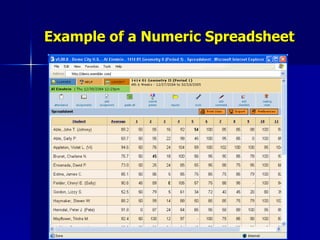
  • 131.
    6.2: Identify TargetAudiences Identify strategic “internal” and “external” audiences to share your results with Think about: Who will want to hear the findings? Who needs to hear the findings? What do you think each target audience will most want to hear? Can you tailor your assessment products to be responsive to the needs/interests of each target audience?
  • 132.
    Example Target AudiencesCommunity Partnership members Community members and patients Hospitals, clinics, or other health centers Local businesses and employers
  • 133.
    Example Target AudiencesHealth insurance plans Other local, regional or statewide advocacy groups Legislators and policymakers Elected officials Funders or private foundations
  • 134.
    Present Your FindingsPlan your messages for each target audience Formulate your argument and anticipate opposing arguments (Exercise 6.3 on page 4-68) Focus your message around common health care values: Cost Quality Access Equity Rights
  • 135.
    6.4: Determine NextSteps Identifying your “next steps” for after the assessment will help your Partnership be more strategic throughout the assessment These might include….
  • 136.
    6.4: Determine NextSteps Identify additional stakeholders, allies, or partners Seek funding Identify program or service needs Identify necessary policy changes Engage in policy change or advocacy efforts Mobilize leaders and residents around an issue Identify needed research or evaluation activities Develop an on-going collaboration with your Partnership Develop a longer-term work plan with your Partnership
  • 137.
    6.5: Celebrate andacknowledge your work!
  • 138.
    Group Exercise: CompleteStep 6 Worksheet Identify some strategic assessment products Identify target audiences for each Identify what type of findings or data you will highlight for each target audience Determine product development activities and assign timelines and responsibilities