OSTEORADIONECROSIS
Dr Maroti
FHNO Fellow
Contents
➔ Introduction
➔ Other terminologies
➔ Definition
➔ Epidemiology
➔ Risk Factors
➔ Pathophysiology
➔ Clinical features
➔ Staging
➔ Radiological findings
➔ Prevention
➔ Non surgical management
➔ Surgical management
complication of radiotherapy in head and neck cancer.
first described by Regaud in 1922
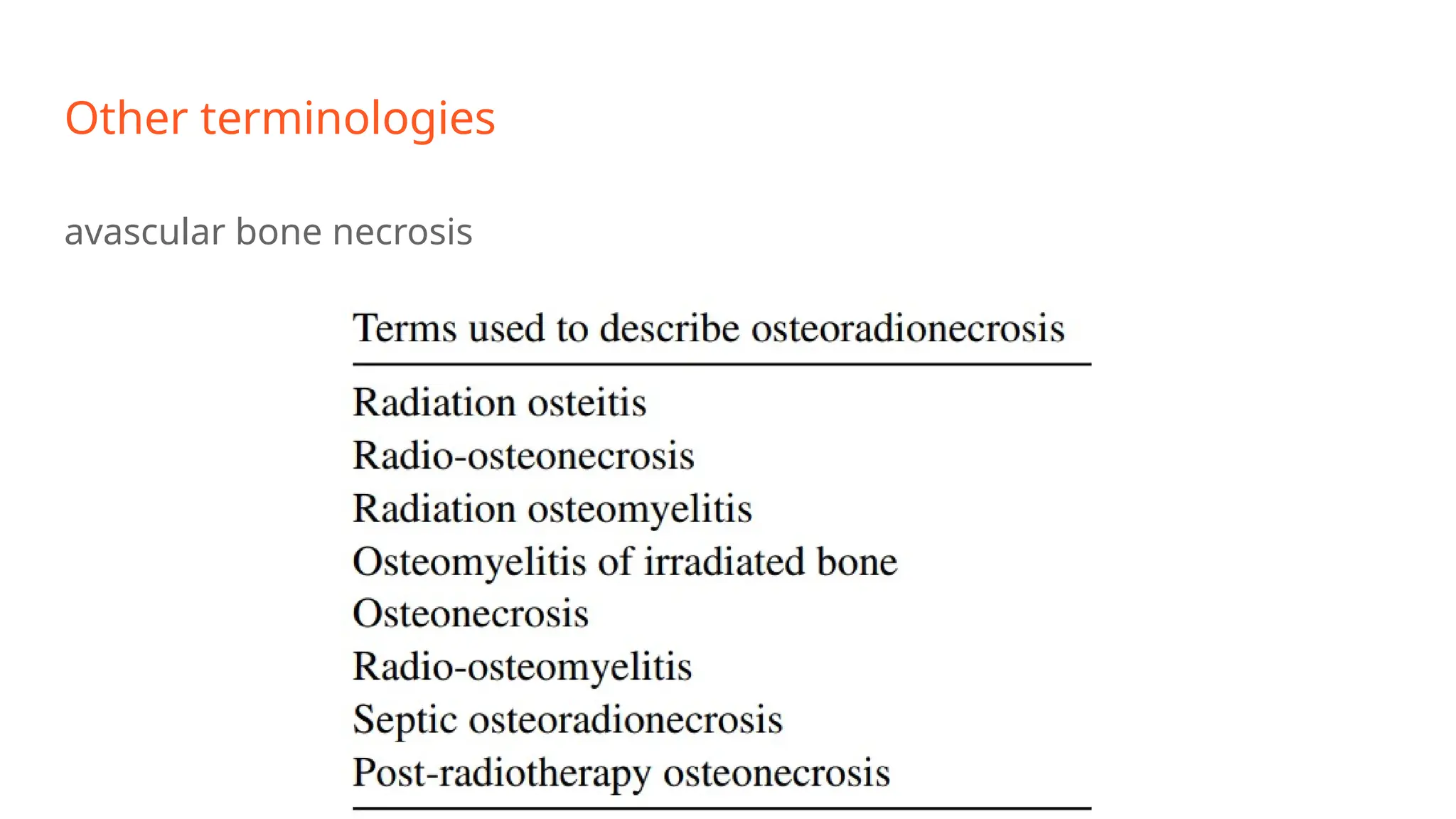
Other terminologies
avascular bone necrosis
Definations
1983, Marx defined ORN as ‘an area >1 cm of exposed bone in a field of irradiation that failed to
show any evidence of healing for at least 6 months’.
In 1987, Marx and Johnson3 suggested the definition of ORN as: ‘The exposure of nonviable bone
which fails to heal without intervention’.
Epstein et al. defined ORN as ‘an ulceration or necrosis of the mucous membrane, with exposure of
necrotic bone for more than 3 months’.
Widmark et al. described ORN as ‘a non-healing mucosal or cutaneous ulcer with denuded bone,
lasting for more than 3 months’
In 1997, Wong et al. defined ORN as ‘a slow-healing radiation-induced ischemic necrosis of variable
extent occurring in the absence of local primary tumor necrosis, recurrence or metastatic disease’.
ORN of the jaws is defined as exposed irradiated bone that fails to heal over
a period of 3 months without evidence of persisting or recurrent tumour
Epidemiology
0.4% to 56%
usually affects patients over 55 years of age
Mandible>>>Maxilla
mandible vascular supply is only
one-sixth that of the maxilla
Risk factors
the documented incidence of ORN after extractions is about 5%
three times higher in dentate than in edentulous patients
>50 Gy (ASCO guidelines)
Pathophysiology
❖ animals were divided into three groups of 4,500, 5,500, and 7,500 r for
the first irradiation.
❖ The severity and extent of the necrosis were also in direct relationship to
the time of onset, which was related to the irradiation dose.
1963
classic triad of osteoradionecrosis as radiation, trauma, and infection.
trauma to be a portal of entry for oral bacterial flora into the underlying bone
He did not, however, demonstrate through cultures or tissue sections such a
spread of osteomyelitis and microorganisms throughout the bone;
Radiation
Trauma
Infection
1970
Osteoradionecrosis is not a primary infection of irradiated bone. It is a
complex metabolic and tissue homeostatic deficiency created by radiation-
induced cellular injury.
Micro-organism plays minor role in ORN
Direct role of trauma is que
Spontaneous orn is valid thing
three H” principle of irradiated tissue- hypovascular, hypocellular, and hypoxic
tissue
1983
osteoradionecrosis of the mandible is an ischemic necrosis caused by radiation-induced obliteration of
the inferior alveolar artery and branches of this artery, whereas revascularization from branches of the
facial artery is disturbed by radiation-induced vascular disease and periosteal damage.
1990
a radiation-induced fibroatrophic mechanism, including free radical
formation, endothelial dysfunction, inflammation, microvascular thrombosis,
fibrosis and remodeling, and finally bone and tissue necrosis.
late fibroatrophic phase
03
● an attempt to remodel the tissue with
formation of fragile healed tissues
that are at an increased risk of
reactivated inflammation when the
tissue sustains local injury, which
could possibly lead to tissue necrosis
organized phase
02 ● abnormal fibroblastic activity, and the
extracellular matrix loses organization
initial prefibrotic phase
01
● endothelial cells are mainly observed,
with an accompanying acute
inflammatory response
2004
bacteria, particularly anaerobes, may play a more fundamental role in the
pathophysiology of osteoradionecrosis
teeth present in the field of irradiation might represent the port of entry for
microorganisms.
Porphyromonas gingivalis was the most predominant organism, followed by
Fusobacterium nucleatum
2005
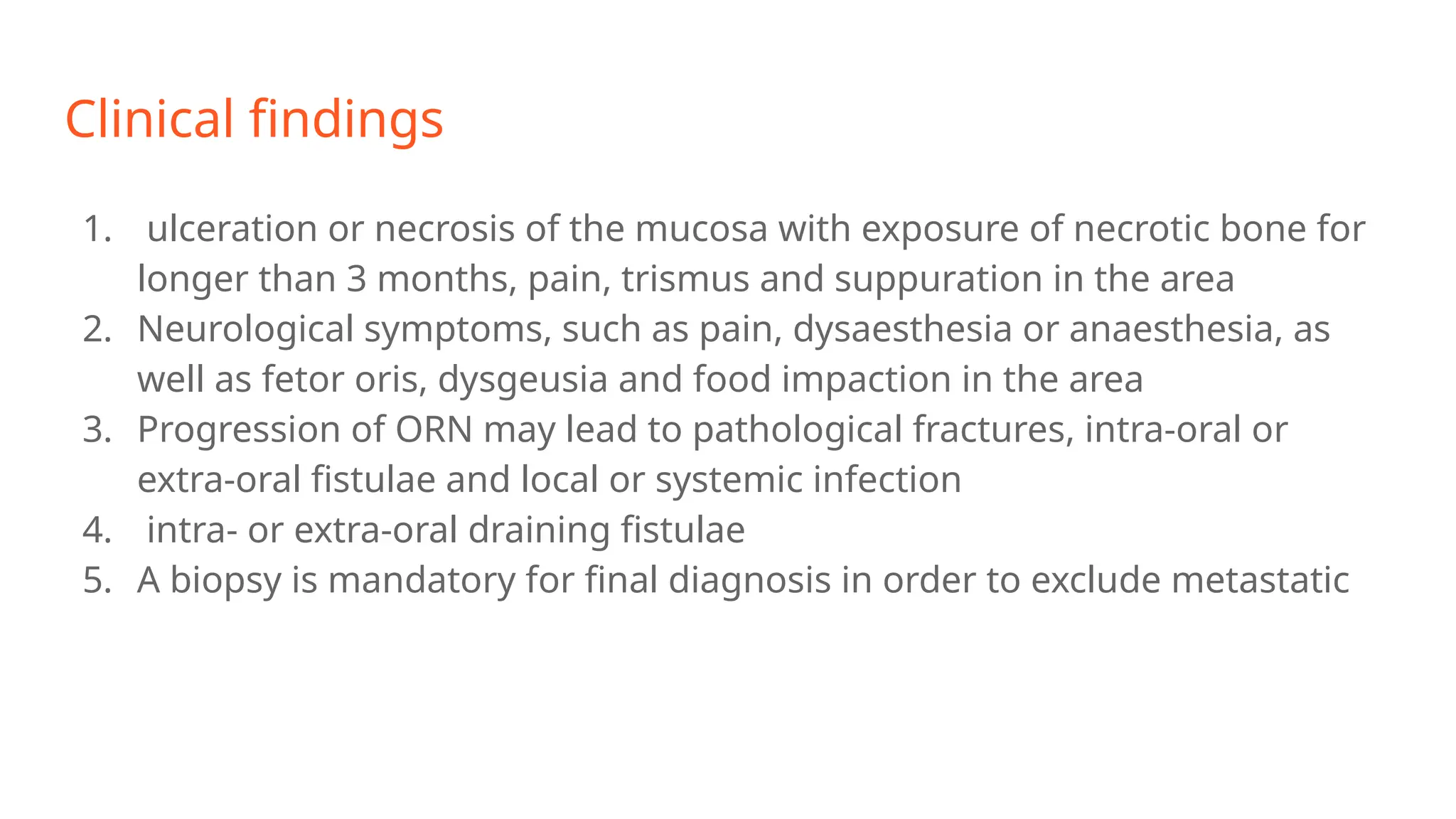
Clinical findings
1. ulceration or necrosis of the mucosa with exposure of necrotic bone for
longer than 3 months, pain, trismus and suppuration in the area
2. Neurological symptoms, such as pain, dysaesthesia or anaesthesia, as
well as fetor oris, dysgeusia and food impaction in the area
3. Progression of ORN may lead to pathological fractures, intra-oral or
extra-oral fistulae and local or systemic infection
4. intra- or extra-oral draining fistulae
5. A biopsy is mandatory for final diagnosis in order to exclude metastatic
ORN of the jaw should be operationally characterized
as:
radiographic lytic or mixed sclerotic lesion of bone
and/or
visibly exposed bone
and/or
bone probed through a periodontal pocket or fistula
Clinical diagnostic criteria
Staging
based on
1. response to hyperbaric oxygen (HBO) therapy,
2. degree of bone damage,
3. clinical–radiological findings,
4. duration of bone exposure and
5. treatment required
Which staging system should be used?
Radiological findings
Orthopantomography (OPT), cone-beam computed tomography (CBCT), and
computed tomography (CT) are the frequently used
recommended additional imaging techniques include bone scintigraphy,
single-photon emission computed tomography (SPECT), and positron
emission tomography (PET)
Orthopantomogram
most frequently used
CT
cortical destruction that is ill-defined resulting in a mixed sclerotic-lucent
pattern sequestration, especially of the buccal bone an absence of soft tissue
mass is an important feature to differentiate it from neoplastic recurrence
but the presence of soft tissue does not exclude osteoradionecrosis
. Any abnormal growth in the surrounding soft tissue should be considered a
second primary cancer or a tumor recurrence to rule out the possibility
Magnetic Resonance Imaging (MRI)
MRI can demonstrate altered bone marrow in the ORNJ region with aberrant,
homogeneous, low marrow signal intensity on T1-weighted images and
elevated signal intensity on T2-weighted images
Bone Scintigraphy, Single Photon Emission Computed Tomography (Spect), and Positron Emission Tomography (PET)
sensitivity of up to 100% in the diagnosis of ORNJ
Prevention
PRE-RT
❏ prophylactic oral care prior to, during, and after the completion of radiation
therapy.
❏ recommends a 2- week period of healing, if oncologically safe, should be
provided between date of dental extraction and start of RT. situations where
a patient does not have one to 2 weeks of healing available and presents
with hopeless teeth within the planned radiation field, the Panel
recommends removal.
❏ Radiation Dosimetry- radiation dose to the jaw of 50 Gy is at higher risk of
developing ORN
POST RT
❏ Dental extractions and implant placement in areas that received 50 Gy
≥
should be avoided
❏ noninvasive alternatives to dental extraction for problematic teeth in
areas at high risk for ORN
❏ Patients requiring dental extraction in a high-risk region due to recurrent
infection that cannot be alleviated without extraction should be
monitored closely for healing with frequent irrigation of the surgical site
❏ limited benefit of perioperative HBO for prevention of ORN
patients who required multiple dental extractions
NONSURGICAL MANAGEMENT OF ORN
1. Pentoxifylline and PENTOCLO
Evidence remains limited for pentoxifylline and PENTOCLO. With respect to mild to moderate
grades of ORN, PENTOCLO may be a useful tool in managing ORN without surgery.
Pentoxifylline- a methylxanthine derivative that exerts an anti-TNF_ effect, increases
erythrocyte flexibility, dilates blood vessels, inhibits inflammatory reactions in vivo, inhibits
proliferation of human dermal fibroblasts and the production of extracellular matrix and
increases collagenase activity in vitro
Vit-E- tocopherol (vitamin E), which scavenges the reactive oxygen species that were generated
during oxidative stress by protecting cell membranes against peroxidation of lipids, partial
inhibition of TGF-_1, and expression of procollagen genes, so reducing fibrosis.
2. HBO
revascularize irradiated tissues and to improve the fibroblastic cellular
density
current literature is inconclusive regarding the effect of HBO, combined with
surgery or alone.
Wilfred-Hall Protocol
Surgical Management
➔ Sequestrectomy
➔ Resection
Treatment of Mandibular Osteoradionecrosis by Cancellous Bone Grafting
Distraction Osteogenesis
Conclusion
● ORN is still a serious complication resulting from radiotherapy
● overall incidence of 11.8 % before 1968 and 5.4 % thereafter.
● clinical management of ORN is difficult and normally comprises medical
care, the avoidance of toxic habits, improvement of dental hygiene, the
control of infections with antibiotics and antiseptics and removal of the
necrotic tissue with more aggressive surgery once complications have
appeared (pathological fractures)
● Effective management of any disease process initially requires diagnosis
before treatment.
OSTEORADIONECROSIS (MANDIBLE) -Post radiation toxicity.pptx

OSTEORADIONECROSIS (MANDIBLE) -Post radiation toxicity.pptx

  • 1.
  • 2.
    Contents ➔ Introduction ➔ Otherterminologies ➔ Definition ➔ Epidemiology ➔ Risk Factors ➔ Pathophysiology ➔ Clinical features ➔ Staging ➔ Radiological findings ➔ Prevention ➔ Non surgical management ➔ Surgical management
  • 3.
    complication of radiotherapyin head and neck cancer. first described by Regaud in 1922
  • 4.
  • 5.
    Definations 1983, Marx definedORN as ‘an area >1 cm of exposed bone in a field of irradiation that failed to show any evidence of healing for at least 6 months’. In 1987, Marx and Johnson3 suggested the definition of ORN as: ‘The exposure of nonviable bone which fails to heal without intervention’. Epstein et al. defined ORN as ‘an ulceration or necrosis of the mucous membrane, with exposure of necrotic bone for more than 3 months’. Widmark et al. described ORN as ‘a non-healing mucosal or cutaneous ulcer with denuded bone, lasting for more than 3 months’ In 1997, Wong et al. defined ORN as ‘a slow-healing radiation-induced ischemic necrosis of variable extent occurring in the absence of local primary tumor necrosis, recurrence or metastatic disease’.
  • 6.
    ORN of thejaws is defined as exposed irradiated bone that fails to heal over a period of 3 months without evidence of persisting or recurrent tumour
  • 7.
    Epidemiology 0.4% to 56% usuallyaffects patients over 55 years of age Mandible>>>Maxilla mandible vascular supply is only one-sixth that of the maxilla
  • 8.
    Risk factors the documentedincidence of ORN after extractions is about 5% three times higher in dentate than in edentulous patients >50 Gy (ASCO guidelines)
  • 9.
  • 10.
    ❖ animals weredivided into three groups of 4,500, 5,500, and 7,500 r for the first irradiation. ❖ The severity and extent of the necrosis were also in direct relationship to the time of onset, which was related to the irradiation dose. 1963
  • 11.
    classic triad ofosteoradionecrosis as radiation, trauma, and infection. trauma to be a portal of entry for oral bacterial flora into the underlying bone He did not, however, demonstrate through cultures or tissue sections such a spread of osteomyelitis and microorganisms throughout the bone; Radiation Trauma Infection 1970
  • 12.
    Osteoradionecrosis is nota primary infection of irradiated bone. It is a complex metabolic and tissue homeostatic deficiency created by radiation- induced cellular injury. Micro-organism plays minor role in ORN Direct role of trauma is que Spontaneous orn is valid thing three H” principle of irradiated tissue- hypovascular, hypocellular, and hypoxic tissue 1983
  • 14.
    osteoradionecrosis of themandible is an ischemic necrosis caused by radiation-induced obliteration of the inferior alveolar artery and branches of this artery, whereas revascularization from branches of the facial artery is disturbed by radiation-induced vascular disease and periosteal damage. 1990
  • 15.
    a radiation-induced fibroatrophicmechanism, including free radical formation, endothelial dysfunction, inflammation, microvascular thrombosis, fibrosis and remodeling, and finally bone and tissue necrosis. late fibroatrophic phase 03 ● an attempt to remodel the tissue with formation of fragile healed tissues that are at an increased risk of reactivated inflammation when the tissue sustains local injury, which could possibly lead to tissue necrosis organized phase 02 ● abnormal fibroblastic activity, and the extracellular matrix loses organization initial prefibrotic phase 01 ● endothelial cells are mainly observed, with an accompanying acute inflammatory response 2004
  • 17.
    bacteria, particularly anaerobes,may play a more fundamental role in the pathophysiology of osteoradionecrosis teeth present in the field of irradiation might represent the port of entry for microorganisms. Porphyromonas gingivalis was the most predominant organism, followed by Fusobacterium nucleatum 2005
  • 18.
    Clinical findings 1. ulcerationor necrosis of the mucosa with exposure of necrotic bone for longer than 3 months, pain, trismus and suppuration in the area 2. Neurological symptoms, such as pain, dysaesthesia or anaesthesia, as well as fetor oris, dysgeusia and food impaction in the area 3. Progression of ORN may lead to pathological fractures, intra-oral or extra-oral fistulae and local or systemic infection 4. intra- or extra-oral draining fistulae 5. A biopsy is mandatory for final diagnosis in order to exclude metastatic
  • 19.
    ORN of thejaw should be operationally characterized as: radiographic lytic or mixed sclerotic lesion of bone and/or visibly exposed bone and/or bone probed through a periodontal pocket or fistula
  • 22.
  • 24.
    Staging based on 1. responseto hyperbaric oxygen (HBO) therapy, 2. degree of bone damage, 3. clinical–radiological findings, 4. duration of bone exposure and 5. treatment required
  • 28.
    Which staging systemshould be used?
  • 29.
    Radiological findings Orthopantomography (OPT),cone-beam computed tomography (CBCT), and computed tomography (CT) are the frequently used recommended additional imaging techniques include bone scintigraphy, single-photon emission computed tomography (SPECT), and positron emission tomography (PET)
  • 30.
  • 31.
    CT cortical destruction thatis ill-defined resulting in a mixed sclerotic-lucent pattern sequestration, especially of the buccal bone an absence of soft tissue mass is an important feature to differentiate it from neoplastic recurrence but the presence of soft tissue does not exclude osteoradionecrosis . Any abnormal growth in the surrounding soft tissue should be considered a second primary cancer or a tumor recurrence to rule out the possibility
  • 32.
    Magnetic Resonance Imaging(MRI) MRI can demonstrate altered bone marrow in the ORNJ region with aberrant, homogeneous, low marrow signal intensity on T1-weighted images and elevated signal intensity on T2-weighted images
  • 33.
    Bone Scintigraphy, SinglePhoton Emission Computed Tomography (Spect), and Positron Emission Tomography (PET) sensitivity of up to 100% in the diagnosis of ORNJ
  • 34.
    Prevention PRE-RT ❏ prophylactic oralcare prior to, during, and after the completion of radiation therapy. ❏ recommends a 2- week period of healing, if oncologically safe, should be provided between date of dental extraction and start of RT. situations where a patient does not have one to 2 weeks of healing available and presents with hopeless teeth within the planned radiation field, the Panel recommends removal. ❏ Radiation Dosimetry- radiation dose to the jaw of 50 Gy is at higher risk of developing ORN
  • 35.
    POST RT ❏ Dentalextractions and implant placement in areas that received 50 Gy ≥ should be avoided ❏ noninvasive alternatives to dental extraction for problematic teeth in areas at high risk for ORN ❏ Patients requiring dental extraction in a high-risk region due to recurrent infection that cannot be alleviated without extraction should be monitored closely for healing with frequent irrigation of the surgical site ❏ limited benefit of perioperative HBO for prevention of ORN
  • 36.
    patients who requiredmultiple dental extractions
  • 37.
    NONSURGICAL MANAGEMENT OFORN 1. Pentoxifylline and PENTOCLO Evidence remains limited for pentoxifylline and PENTOCLO. With respect to mild to moderate grades of ORN, PENTOCLO may be a useful tool in managing ORN without surgery. Pentoxifylline- a methylxanthine derivative that exerts an anti-TNF_ effect, increases erythrocyte flexibility, dilates blood vessels, inhibits inflammatory reactions in vivo, inhibits proliferation of human dermal fibroblasts and the production of extracellular matrix and increases collagenase activity in vitro Vit-E- tocopherol (vitamin E), which scavenges the reactive oxygen species that were generated during oxidative stress by protecting cell membranes against peroxidation of lipids, partial inhibition of TGF-_1, and expression of procollagen genes, so reducing fibrosis.
  • 38.
    2. HBO revascularize irradiatedtissues and to improve the fibroblastic cellular density current literature is inconclusive regarding the effect of HBO, combined with surgery or alone.
  • 39.
  • 40.
  • 43.
    Treatment of MandibularOsteoradionecrosis by Cancellous Bone Grafting Distraction Osteogenesis
  • 44.
    Conclusion ● ORN isstill a serious complication resulting from radiotherapy ● overall incidence of 11.8 % before 1968 and 5.4 % thereafter. ● clinical management of ORN is difficult and normally comprises medical care, the avoidance of toxic habits, improvement of dental hygiene, the control of infections with antibiotics and antiseptics and removal of the necrotic tissue with more aggressive surgery once complications have appeared (pathological fractures) ● Effective management of any disease process initially requires diagnosis before treatment.