Management of
Jacob’s Ulcer
DR Maroti W
Fellow, MCC Thalassery
Jacob’s Ulcer=Rodent
Ulcer=Basal cell
carcinoma
Management of Basal
cell carcinoma
FHNO
Fellow
Dr Maroti
Malabar Cancer
Centre
Introduction
➔ Basal cell carcinoma (BCC) is an
exceedingly common cutaneous
malignancy- constitutes approximately
75% of nonmelanoma skin cancers
➔ Cutaneous SCC- 2nd most common
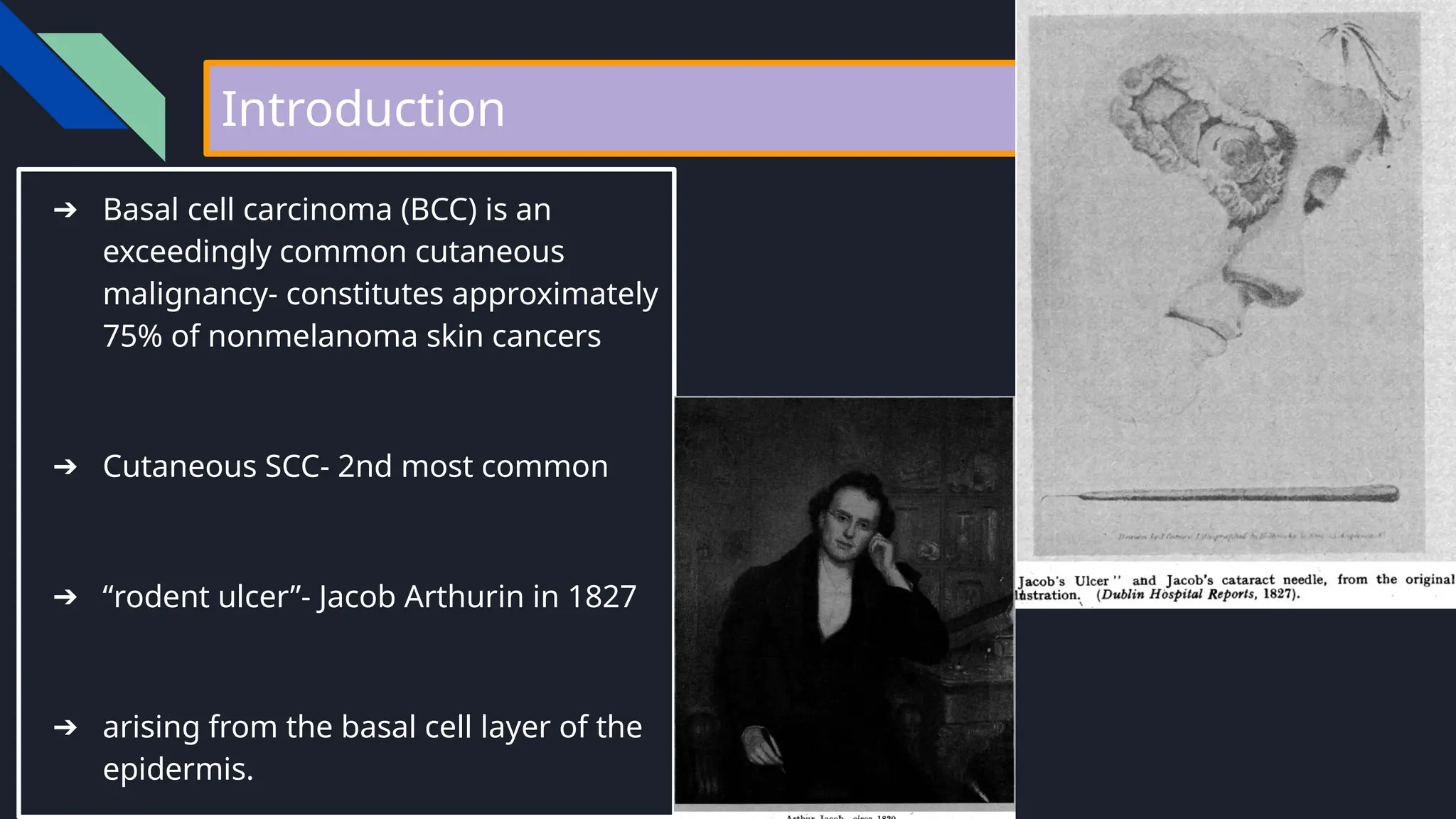
➔ “rodent ulcer”- Jacob Arthurin in 1827
➔ arising from the basal cell layer of the
epidermis.
➔ BCC is nowadays thought to arise from stem cells of the hair follicle
➔ BCC is one of the most highly mutated human tumours (i.e. tumour
mutational burden [TMB] is 65 mutations/megabases, compared with
14 mutations/ megabases for melanoma)
Definition
a locally invasive,
slowly spreading tumor which
rarely metastasize,
arising in the epidermis or hair follicles and in which, in particular, the
peripheral cells usually simulate the basal cells of the epidermis
EPIDEMIOLOGY
❏ incidence of BCC has increased since the mid-2000, 16 to 20 per
100,000
❏ Regional variations- highest incidence has been reported in Australia,
followed by the US and Europe
❏ markedly after the age of 40, frequently occurs in elderly white-skinned
people in the seventh to eighth decades
❏ more aggressive in the age group below 35 years.
❏ generally affects men (1.5–2:1)
❏ typically recognized in white people (skin type 1 or type 2)
Aetiology
1. ultraviolet light (UV)
type, quantity, and timing of sun exposure
associated with an increased risk
Type- Short-wavelength UVB radiation (290-320
nm, sunburn rays) is believed to play a greater
role in BCC formation than long-wavelength UVA
radiation (320-400 nm, tanning rays).
Timing – Childhood sun exposure appears to be
more important than exposure during adult life
Frequency and amount – Solar exposure in
intermittent, intense increments increases the
risk of BCC more than a similar dose delivered
more continuously over the same period of time
Is there any latency period after DNA damage?
A latency period of 20-50 years is typical
between the time of UV damage and the
clinical onset of BCC. Therefore, in most cases
BCC develops on chronically sun-exposed skin
in elderly people
Risk factors
01 02 03
Environmental risk
factors
I. UVB is more
carcinogenic than
UVA at
wavelengths of
290–320 nm
II. arsenic, alkylating
agents, polycyclic
aromatic
hydrocarbons;
Genetic
predisposition and
genodermatosis
I. loss of inhibition of
hedgehog
signalling
II. Syndromes-
Xeroderma
pigmentosum,
Gorlin's syndrome,
Bazex’s syndrome
Patient (or
individual) risk
factors
I. male sex,
II. older age,
III. Fitzpatrick type I or
II skin
IV. Immunosuppressi
on
V. chronic wounds,
VI. burns, sinus tracts
and ulcers
Overexpression in BCC (upregulation og SHH pathway
Hh ligands bind to PTCH1, the pathway is activated, thereby,
releasing PTCH-mediated SMO
SMO is in turn inducing the release of the GLI proteins, which are
sequestered in the cytoplasm by several proteins, such as the
suppressor of fused (SUFU)
GLI transcription factors enter the nucleus, activate the transcription
of context-specific genes, and regulate self-renewal, cell fate,
survival, and angiogenesis.
Any level of genetic mutations in the Hh signaling pathway, such
as PTCH1, SMO, and SUFU, will develop an increased expression
of GLI1
Histological subtypes
Morpheaform Infiltrative Micronodular
Nodular
Superficial
1. Nodular BCC
➢ most common histological subtype- accounting for 50 to 79 percent
➢ small, dome-shaped nodule with telangiectasia and a raised rolled edge.
➢ often referred to as ‘rodent’ ulcers
2. Superficial BCC
➢ Relatively common and is the least aggressive
➢ scaly and dry, erythematous plaques.
3. Basosquamous variants
most aggressive histological subtype
1. Pigmented BCC- seen in those with darker skin (Fitzpatrick type III or IV)
2. Morphoeic BCCs- appear as indurated plaques with indeterminate borders.
Locally aggressive
Clinical assessment and staging
1. a thorough head and neck examination with adequate lighting and dermoscopy
2. Cranial nerve examination- For perineural invasion
3. Examination of regional lymph node basins
4. diagnostic (incisional or punch) and mapping biopsies
Challenging sites (both from a resection and reconstructive perspective) include:
periophthalmic region, preauricular region (facial nerve), nose and lip
AJCC 8th Staging
Imaging
not routinely indicated for early-stage disease in the clinically node-negative
patient
useful to perform to delineate the overall extent of the tumour when perineural
invasion (magnetic resonance imaging [MRI]) or bony invasion (computed
tomography [CT]) is suspected
When to plan imaging?
A. clinically node-positive patient
B. recurrent tumours
C. For advanced tumours
D. Patients with clinically perineural invasion or aggressive histological type
Management of BCC
goal of treatment of BCC is to completely remove the tumor and
maximally preserve function and cosmesis
Choice of treatment depends-
1. risk of lesion recurrence
2. presence or absence of aggressive clinical and histopathologic features
3. location of the lesion
4. Patient preference
Treatment strategies
1. Early stage
➔ Surgical excision-
complete excision rates of 85% have previously been reported with a 3 mm
peripheral excision margin and 95% with 4–5 mm peripheral excision margin.
The deep margin should include a cuff of subcutaneous fat routinely, but deeper
excision may be required based on clinical assessment of the tumour
SURGICAL
EXCISION
Mohs micrographic surgery
(MMS)-
staged, systematic resection in
combination with thorough histological
assessment of the surgical excision
margin
Treatment modality of choice in high-
risk BCC
MOHS
MICROGRAPHIC
SURGERY
For primary BCC, the 5-year recurrence rate has been reported to be 1.4 percent,
while for recurrent tumors it has been estimated at 4 percent
3370) patients
98% HN site
At 5.6 percent, MMCS results in the lowest 5-year recurrence rate out of all treatment
modalities. In contrast, surgical excision, ED&C, and radiation therapy show
recurrence rates of 17.4 percent, 40 percent, and 9.8 percent, respectively.
➔ Destructive techniques- not indicated in recurrence of high-risk
1. Curettage and cautery- may be undertaken for small (<4 mm), well-defined BCCs
with 5-year cure rates approximately 97%.
does not allow for histological margin examination
2. Cryosurgery- low-risk BCC
3. photodynamic therapy (PDT) - low-risk, superficial subtype, lower success
rates
4. lasers (pulsed dye and CO2)- low-risk, superficial or thin nodular BCCs
DESTRUCTIVE
TECQ
➔ Topical therapies
5-fluorouracil (5-FU) cream- superficial BCC
Imiquimod 5% cream- superficial BCC, induces a tumour-directed cellular immune
response through agonism of toll-like receptors (TLRs) 7 and 8. induces interferon
and other cytokines and is thought to promote T-cell-mediated apoptosis of tumor
cells
topical imiquimod 5% cream once daily, five times per week for 6 weeks resulted in a
histologic clearance rate of 82 percent 12 weeks after treatment
TOPICAL
THERAPIES
2. Radiotherapy
alternative to surgical excision in the following clinical situations
❏ Elderly patients, or frailty, with poor performance status
❏ Anatomical regions where RT is likely to result in better aesthetic or functional
outcome compared to surgery
❏ Surgery is not feasible or is contraindicated
❏ Patient preference
Low-energy (KV) X-rays- Electrons are preferable to photons as they avoid damage to
deeper structures due to their ability to distribute energy in a more superficial plane.
High-energy (MV) X-rays- if the tumour is fixed to underlying tissues or has deep invasion
RADIOTHERAPY
Radiation therapy has been reported to result in low recurrence rates for both
primary BCC (7.4 percent) and recurrent BCC (9.5 percent)
2. Advanced stage or metastatic
Metastasis of BCC is extremely rare, occurring in approximately 0.003 percent to 0.1
percent of cases
Surgical excision- en-bloc resection of the tumour is required. This will include
excision of invaded structures such as fat, muscle, bone and orbit
consideration of adjuvant radiotherapy postoperatively,
Definitive radiotherapy as the primary treatment modality (with or without concurrent
chemotherapy) should be considered where surgical resection is not feasible
ADVANCED/
METASTATIC
Standard surgical excision
be recommended in
subjects with non-
recurrent, operable BCC
over any other t/t
modality
Management of Neck
Radiation therapy (RT) to the neck is not recommended as a primary modality of
treatment.
better outcomes in terms of both survival and recurrence when nodal disease is
addressed with surgery and adjuvant RT than either surgery or RT alone.
The indication for chemoradiotherapy for ENE positive nodes is extrapolated from
mucosal head and neck squamous cell carcinomas (HNSCC), as there are no
comparative trials available for cSCC.
NCCN recommends selective neck dissection (SND) when single node is involved
and comprehensive neck dissection when more than one nodes are involved.
Superficial parotidectomy is advocated when parotid nodes are involved
Adjuvant RT
1. involved (microscopic or macroscopic) surgical margins where
further surgery is not deemed appropriate.
2. If perineural invasion PNI) is present with a close or involved
surgical margin
Targeted and Immunotherapies
in cases of unresectable or metastatic disease
vismodegib and sonidegib, directed against the
hedgehog pathway
Low risk and High risk
high (H-zone), medium (M-zone), and low risk (L-
zone).
(H-zone: central face, eyebrows, nose, lips, chin,
ear, temple,
(M-zone: cheeks, forehead, scalp, neck, jawline,
the trunk and extremities (L-zone).
Low risk
High risk
Advansed
Guidelines
Question 1: Should sunscreen creams with solar protection factor 30 be
≥
recommended in subjects who are exposed to solar ultraviolet radiation (UVR) to
reduce the incidence of BCC?
may be considered
Surgery v/s Non-sx options
overall non-surgical treatments are less effective than surgery in low-risk BCC,
however recurrence rates are acceptable and cosmetic outcomes are probably
superior.
52 RCTs (26 new) involving 6690 participants
Margins
Should a surgical excision with 3
≥
mm clinical margins be
recommended in subjects with
operable BCC compared with
surgical excision with <3 mm
clinical margins?
Strong in favor.
Surgery v/s RT
Should standard surgical excision be recommended in subjects with non-recurrent,
operable BCC compared with radiotherapy?
Strong in favor.
Hedgehog inhibitors v/s F/U or BSC
Should treatment with Hedgehog pathway inhibitors be recommended in subjects
with laBCC and mBCC compared with follow-up/best supportive care?
Strong in favor
Management of Basal_cell_carcinoma of Head and neck.pptx

Management of Basal_cell_carcinoma of Head and neck.pptx

  • 1.
    Management of Jacob’s Ulcer DRMaroti W Fellow, MCC Thalassery
  • 2.
  • 3.
    Management of Basal cellcarcinoma FHNO Fellow Dr Maroti Malabar Cancer Centre
  • 5.
    Introduction ➔ Basal cellcarcinoma (BCC) is an exceedingly common cutaneous malignancy- constitutes approximately 75% of nonmelanoma skin cancers ➔ Cutaneous SCC- 2nd most common ➔ “rodent ulcer”- Jacob Arthurin in 1827 ➔ arising from the basal cell layer of the epidermis.
  • 6.
    ➔ BCC isnowadays thought to arise from stem cells of the hair follicle ➔ BCC is one of the most highly mutated human tumours (i.e. tumour mutational burden [TMB] is 65 mutations/megabases, compared with 14 mutations/ megabases for melanoma)
  • 7.
    Definition a locally invasive, slowlyspreading tumor which rarely metastasize, arising in the epidermis or hair follicles and in which, in particular, the peripheral cells usually simulate the basal cells of the epidermis
  • 8.
    EPIDEMIOLOGY ❏ incidence ofBCC has increased since the mid-2000, 16 to 20 per 100,000 ❏ Regional variations- highest incidence has been reported in Australia, followed by the US and Europe ❏ markedly after the age of 40, frequently occurs in elderly white-skinned people in the seventh to eighth decades ❏ more aggressive in the age group below 35 years. ❏ generally affects men (1.5–2:1) ❏ typically recognized in white people (skin type 1 or type 2)
  • 9.
    Aetiology 1. ultraviolet light(UV) type, quantity, and timing of sun exposure associated with an increased risk Type- Short-wavelength UVB radiation (290-320 nm, sunburn rays) is believed to play a greater role in BCC formation than long-wavelength UVA radiation (320-400 nm, tanning rays). Timing – Childhood sun exposure appears to be more important than exposure during adult life Frequency and amount – Solar exposure in intermittent, intense increments increases the risk of BCC more than a similar dose delivered more continuously over the same period of time
  • 10.
    Is there anylatency period after DNA damage? A latency period of 20-50 years is typical between the time of UV damage and the clinical onset of BCC. Therefore, in most cases BCC develops on chronically sun-exposed skin in elderly people
  • 11.
    Risk factors 01 0203 Environmental risk factors I. UVB is more carcinogenic than UVA at wavelengths of 290–320 nm II. arsenic, alkylating agents, polycyclic aromatic hydrocarbons; Genetic predisposition and genodermatosis I. loss of inhibition of hedgehog signalling II. Syndromes- Xeroderma pigmentosum, Gorlin's syndrome, Bazex’s syndrome Patient (or individual) risk factors I. male sex, II. older age, III. Fitzpatrick type I or II skin IV. Immunosuppressi on V. chronic wounds, VI. burns, sinus tracts and ulcers
  • 12.
    Overexpression in BCC(upregulation og SHH pathway Hh ligands bind to PTCH1, the pathway is activated, thereby, releasing PTCH-mediated SMO SMO is in turn inducing the release of the GLI proteins, which are sequestered in the cytoplasm by several proteins, such as the suppressor of fused (SUFU) GLI transcription factors enter the nucleus, activate the transcription of context-specific genes, and regulate self-renewal, cell fate, survival, and angiogenesis. Any level of genetic mutations in the Hh signaling pathway, such as PTCH1, SMO, and SUFU, will develop an increased expression of GLI1
  • 14.
    Histological subtypes Morpheaform InfiltrativeMicronodular Nodular Superficial
  • 15.
    1. Nodular BCC ➢most common histological subtype- accounting for 50 to 79 percent ➢ small, dome-shaped nodule with telangiectasia and a raised rolled edge. ➢ often referred to as ‘rodent’ ulcers
  • 16.
    2. Superficial BCC ➢Relatively common and is the least aggressive ➢ scaly and dry, erythematous plaques.
  • 17.
    3. Basosquamous variants mostaggressive histological subtype 1. Pigmented BCC- seen in those with darker skin (Fitzpatrick type III or IV) 2. Morphoeic BCCs- appear as indurated plaques with indeterminate borders. Locally aggressive
  • 19.
    Clinical assessment andstaging 1. a thorough head and neck examination with adequate lighting and dermoscopy 2. Cranial nerve examination- For perineural invasion 3. Examination of regional lymph node basins 4. diagnostic (incisional or punch) and mapping biopsies Challenging sites (both from a resection and reconstructive perspective) include: periophthalmic region, preauricular region (facial nerve), nose and lip
  • 20.
  • 23.
    Imaging not routinely indicatedfor early-stage disease in the clinically node-negative patient useful to perform to delineate the overall extent of the tumour when perineural invasion (magnetic resonance imaging [MRI]) or bony invasion (computed tomography [CT]) is suspected When to plan imaging? A. clinically node-positive patient B. recurrent tumours C. For advanced tumours D. Patients with clinically perineural invasion or aggressive histological type
  • 24.
    Management of BCC goalof treatment of BCC is to completely remove the tumor and maximally preserve function and cosmesis Choice of treatment depends- 1. risk of lesion recurrence 2. presence or absence of aggressive clinical and histopathologic features 3. location of the lesion 4. Patient preference
  • 25.
  • 26.
    1. Early stage ➔Surgical excision- complete excision rates of 85% have previously been reported with a 3 mm peripheral excision margin and 95% with 4–5 mm peripheral excision margin. The deep margin should include a cuff of subcutaneous fat routinely, but deeper excision may be required based on clinical assessment of the tumour SURGICAL EXCISION
  • 27.
    Mohs micrographic surgery (MMS)- staged,systematic resection in combination with thorough histological assessment of the surgical excision margin Treatment modality of choice in high- risk BCC MOHS MICROGRAPHIC SURGERY
  • 28.
    For primary BCC,the 5-year recurrence rate has been reported to be 1.4 percent, while for recurrent tumors it has been estimated at 4 percent 3370) patients 98% HN site
  • 29.
    At 5.6 percent,MMCS results in the lowest 5-year recurrence rate out of all treatment modalities. In contrast, surgical excision, ED&C, and radiation therapy show recurrence rates of 17.4 percent, 40 percent, and 9.8 percent, respectively.
  • 30.
    ➔ Destructive techniques-not indicated in recurrence of high-risk 1. Curettage and cautery- may be undertaken for small (<4 mm), well-defined BCCs with 5-year cure rates approximately 97%. does not allow for histological margin examination 2. Cryosurgery- low-risk BCC 3. photodynamic therapy (PDT) - low-risk, superficial subtype, lower success rates 4. lasers (pulsed dye and CO2)- low-risk, superficial or thin nodular BCCs DESTRUCTIVE TECQ
  • 31.
    ➔ Topical therapies 5-fluorouracil(5-FU) cream- superficial BCC Imiquimod 5% cream- superficial BCC, induces a tumour-directed cellular immune response through agonism of toll-like receptors (TLRs) 7 and 8. induces interferon and other cytokines and is thought to promote T-cell-mediated apoptosis of tumor cells topical imiquimod 5% cream once daily, five times per week for 6 weeks resulted in a histologic clearance rate of 82 percent 12 weeks after treatment TOPICAL THERAPIES
  • 33.
    2. Radiotherapy alternative tosurgical excision in the following clinical situations ❏ Elderly patients, or frailty, with poor performance status ❏ Anatomical regions where RT is likely to result in better aesthetic or functional outcome compared to surgery ❏ Surgery is not feasible or is contraindicated ❏ Patient preference Low-energy (KV) X-rays- Electrons are preferable to photons as they avoid damage to deeper structures due to their ability to distribute energy in a more superficial plane. High-energy (MV) X-rays- if the tumour is fixed to underlying tissues or has deep invasion RADIOTHERAPY
  • 34.
    Radiation therapy hasbeen reported to result in low recurrence rates for both primary BCC (7.4 percent) and recurrent BCC (9.5 percent)
  • 36.
    2. Advanced stageor metastatic Metastasis of BCC is extremely rare, occurring in approximately 0.003 percent to 0.1 percent of cases Surgical excision- en-bloc resection of the tumour is required. This will include excision of invaded structures such as fat, muscle, bone and orbit consideration of adjuvant radiotherapy postoperatively, Definitive radiotherapy as the primary treatment modality (with or without concurrent chemotherapy) should be considered where surgical resection is not feasible ADVANCED/ METASTATIC
  • 37.
    Standard surgical excision berecommended in subjects with non- recurrent, operable BCC over any other t/t modality
  • 38.
    Management of Neck Radiationtherapy (RT) to the neck is not recommended as a primary modality of treatment. better outcomes in terms of both survival and recurrence when nodal disease is addressed with surgery and adjuvant RT than either surgery or RT alone. The indication for chemoradiotherapy for ENE positive nodes is extrapolated from mucosal head and neck squamous cell carcinomas (HNSCC), as there are no comparative trials available for cSCC.
  • 39.
    NCCN recommends selectiveneck dissection (SND) when single node is involved and comprehensive neck dissection when more than one nodes are involved. Superficial parotidectomy is advocated when parotid nodes are involved
  • 43.
    Adjuvant RT 1. involved(microscopic or macroscopic) surgical margins where further surgery is not deemed appropriate. 2. If perineural invasion PNI) is present with a close or involved surgical margin
  • 44.
    Targeted and Immunotherapies incases of unresectable or metastatic disease vismodegib and sonidegib, directed against the hedgehog pathway
  • 47.
    Low risk andHigh risk
  • 48.
    high (H-zone), medium(M-zone), and low risk (L- zone). (H-zone: central face, eyebrows, nose, lips, chin, ear, temple, (M-zone: cheeks, forehead, scalp, neck, jawline, the trunk and extremities (L-zone).
  • 49.
  • 50.
  • 51.
  • 52.
    Guidelines Question 1: Shouldsunscreen creams with solar protection factor 30 be ≥ recommended in subjects who are exposed to solar ultraviolet radiation (UVR) to reduce the incidence of BCC? may be considered
  • 53.
    Surgery v/s Non-sxoptions overall non-surgical treatments are less effective than surgery in low-risk BCC, however recurrence rates are acceptable and cosmetic outcomes are probably superior. 52 RCTs (26 new) involving 6690 participants
  • 54.
    Margins Should a surgicalexcision with 3 ≥ mm clinical margins be recommended in subjects with operable BCC compared with surgical excision with <3 mm clinical margins? Strong in favor.
  • 55.
    Surgery v/s RT Shouldstandard surgical excision be recommended in subjects with non-recurrent, operable BCC compared with radiotherapy? Strong in favor.
  • 56.
    Hedgehog inhibitors v/sF/U or BSC Should treatment with Hedgehog pathway inhibitors be recommended in subjects with laBCC and mBCC compared with follow-up/best supportive care? Strong in favor