Drug Therapy Issues
Michael C. Joseph, MD, MPH
December 7, 2016
(Peer Learning)
Outline
Drug Development
Prescription Drugs
Generic Drugs
Over-the-Counter Drugs
Dietary Supplements
Drug Safety Issues in Seniors
RESOURCES
Drug Development
 Only 1 in 10,000 drugs studied makes it to
market
 It takes more than 10 years of clinical studies
to bring a new drug to market
 Each clinical study costs upwards of $15,000
per patient
 Total drug development costs average $2.5B
 Patents protect drugs from copycat versions
for 20 years after the drug is invented. This
includes the time spent in clinical studies to
accumulate enough data to get a drug
approved by the U.S. Food and Drug
Administration.
Prescription Drug Price Increases
 U.S. prescription spending rose 12.2% in 2014, accelerating from a 2.4% rise in
2013.
 From 2010-2015 there were price increases of 100% (insulin), 1,000% (skin
treatments), and 1,000% for heart medicines; all these drugs were > 10 years old.
 The top 50 Branded drug price increases ranged from 63% to 391% (Edecrin®,
etacrynic acid, a diuretic) from December 2012 to July 2015.
Turing Pharmaceuticals bought and increased the price of an old anti-parasitic drug,
Daraprim®, from $ 3.50 per pill to $ 750.00 (5,000%). The Turing CEO, Martin
Shkreli, invoked the Fifth Amendment in a Congressional Hearing on Drug Prices,
then after being excused and leaving the room he promptly called the lawmakers
“imbeciles” on Twitter.
Mylan Pharmaceuticals raised the price of a two-pack of Epipen® (injectable
epinephrine) from $100 in 2009 to $608 in 2016. The two-pack costs around $60
to produce. [Mylan agreed to a recent $ 465 million settlement with the federal
government on allegations that it overcharged Medicaid for Epipen. (Wall Street
Journal, 28 October 2016] [Epipen costs $21 USD and is free to seniors in the U.K.
(Letter to the Editor, Wall Street Journal)]
TV Drug Advertising
 Drugmakers spent $ 2.4 billion on TV ads for prescription
drugs in 2015, up 23 % from 2014.
 TV audiences have grown accustomed to ads for treatment
for high cholesterol, erectile dysfunction, overactive
bladder, and a host of other “lifestyle” conditions.
 Newer ads cover serious, life-threatening conditions or
those with relatively small populations – often expensive
medicines prescribed by specialist doctors, such as:
−Optivo® which costs about $12,500 per month (for lung
cancer)
−Hetlioz®, which costs $ 148,000 per year (for a sleeping
disorder that affects only about 80,000 blind people)
−Plus drugs for Multiple Sclerosis and Plaque Psoriasis.
The Cost-benefit Argument
 In many European countries, the price of a new drug is a
condition of marketing approval
 In the U.S., the price of a new drug is a marketing decision (what
the market will bear and competitors’ pricing) by the drug
company sponsor
 In addition to recouping the cost of drug development, examples
of cost-benefit arguments by sponsors include:
− Treatment of Hepatitis C will save millions in 20-30 years by reduced
complications (liver cancer, cirrhosis) and costs (liver transplants). Solvadi®
costs $7,000 per week for 12 weeks ($ 84,000), but a 12-week regimen costs
only $136 to manufacture.
− The cost per lung cancer patient over the 5.7 month treatment period will be
more than $65,000 for Portrazza®, after studies showed survival for 11.5 months
vs. 9.9 months in patients treated with standard chemotherapy. Portrazza costs
$11,430/month, but the monthly cost should be only $1,875, according to
a cost-benefit analysis.
Generics Regulations
 Generic Drugs must:
−contain the same active ingredients as the innovator (brand
name) drug (inactive ingredients may vary)
−be identical in strength, dosage form, and route of
administration
−have the same use indications
−be bioequivalent (match 80-125% of the blood level of the
brand name drug)
−meet the same batch requirements for identity, strength,
purity, and quality
−be manufactured under the same strict standards of FDA's
Good Manufacturing Practice regulations required for innovator
products.
(FDA 2009)
Generic Drugs Marketing
 The first approved Generic is granted six
months’ marketing exclusivity.
 In 2015, Generics accounted for 88% of new
prescriptions, but only 28% of total drug
spending.
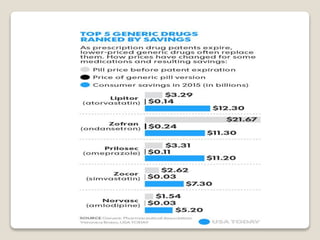
 They can cost up to 60-90% less than the
price of the brand-name drug, but they may
not be covered by insurers and may have
higher out-of-pocket costs.
Generics Drug Pricing
 A federal probe has been underway since 2014 into Generics price-
fixing.
 The top 50 generic drug price increases ranged from 474%
(ethacrynic acid – an old diuretic) to over 18,000% (tetracycline – an
old antibiotic) from December 2012 to July 2015.
 More than 300 of 1,441 Generics reviewed had at least one 100%
price increase between 2010 and 2015.
 Large purchasers have sued Mylan and Endo after price increases of
884% (digoxin) and 8,281% (doxycycline – an old antibiotic for
multiply-resistant infections), between 2012 and 2014.
(Wall Street Journal, 04 November 2016)
Generics Marketing Delays
 Drug companies can delay Generics by:
−extending the branded drug’s patent life;
−suing the Generics companies for patent
infringement (especially in biologics, where
unique production techniques are employed);
−paying a fee to the Generics companies to
delay their marketing;
−marketing “Authorized Generics”:
 Either by licensing a Generics company; or
 By safety and efficacy testing of old drugs, [e.g.
Colcrys® (colchicine)] and obtaining 3-year
exclusivity.
Anticompetitive Drug Pricing
 Drug companies can stifle competition
by:
−buying both Patent-holding and Generics
companies;
−decreasing their tax burden by shifting
income abroad, through mergers or
purchases of foreign companies;
−extending their patent by 5 years through
a new dosage form or route of delivery,
changes to the active molecule (such as
isolating the L-form of Lexapro®), or
combining old Generics.
Generic Drug Combination Pricing
Narrow Therapeutic Index (NTI)
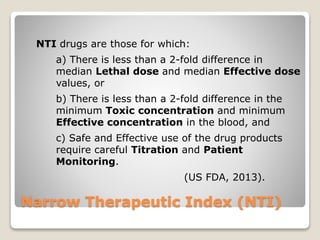
NTI drugs are those for which:
a) There is less than a 2-fold difference in
median Lethal dose and median Effective dose
values, or
b) There is less than a 2-fold difference in the
minimum Toxic concentration and minimum
Effective concentration in the blood, and
c) Safe and Effective use of the drug products
require careful Titration and Patient
Monitoring.
(US FDA, 2013).
Safety Problems with NTI Generics
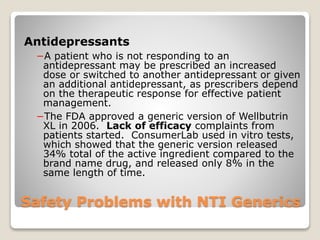
Antidepressants
−A patient who is not responding to an
antidepressant may be prescribed an increased
dose or switched to another antidepressant or given
an additional antidepressant, as prescribers depend
on the therapeutic response for effective patient
management.
−The FDA approved a generic version of Wellbutrin
XL in 2006. Lack of efficacy complaints from
patients started. ConsumerLab used in vitro tests,
which showed that the generic version released
34% total of the active ingredient compared to the
brand name drug, and released only 8% in the
same length of time.
Safety Problems with NTI Generics
Antihypertensives
Decreased blood levels can cause hypertensive crisis
and stroke; increased blood levels can cause low
blood pressure, dizziness, fainting spells, and falls.
Of 35 Generics compared to Dilatrend®
(carvedilol), 3 had “incorrect mean carvedilol
content,” 1 had “excess impurities”, while 11 had
“incorrect hardness”, 9 “inadequate dissolution”, and
7 “failed two tests - generally hardness and
dissolution”.
Safety Problems with NTI Generics
Antiepileptics
Patients with uncontrolled epilepsy can have real social
and economic harm. They can be seriously injured during
a seizure, they can lose their right to drive, or even lose
their job.
−An Epilepsy Society of America survey of patients
who were switched to a Generic found:
 59% reported a worsening of seizures
 49% reported worsened side effects
Review of an Rx database showed:
◦ Patients who had an epileptic event requiring ER care,
and had not required care for at least 6 months - had
81% greater odds of having had a switch to a Generic.
Safety Problems with NTI Generics
 Anticoagulants
−Anticoagulant drugs, such as warfarin, must
be dosed for each individual patient, and lab
tests must be monitored on a regular basis to
avoid serious adverse events of hemorrhage
with overdose, and clotting with underdose.
−This table shows Higher Risks from 37,756
switches between Coumadin® and warfarin.
Drug Thrombotic Events Hemorrhage Risk
Coumadin to warfarin 1.81x 1.51x
warfarin to Coumadin 1.76x 1.74x
warfarin to another
warfarin
1.89x 1.74x
Over-the-Counter (OTC) Drugs
 Over-the-counter medicines (OTCs) or
nonprescription medicines refers to medicines that
you can buy without a prescription. They are safe and
effective when you follow the directions on the
label and as directed by your health care
professional.
 They are marketed for self-limited conditions such as
pain, diarrhea, skin care, and cough and cold
symptoms. Their prices are generally low.
 The treated illnesses should be acute, unlikely to
cause complications, and easy to diagnose (e.g.
vaginal yeast infections but not genital herpes).
 Labeled directions recommend seeking medical care if
the patient is worried about worsening, new
symptoms, or the condition does not resolve within a
reasonable period.
Supplements - Background
 It is not legal to market a supplement as a
preventive treatment, or cure, or to alleviate
the symptoms of a disease.
 But, they are commonly used in illnesses
such as mood disorders, fatigue, pain,
insomnia, sexual dysfunction, and symptoms
of menopause.
 They are used by 68% of adults, and more
than one-half of patients with cancer and
chronic illnesses – but 70% of users do not
inform their physicians.
Supplements - Regulation
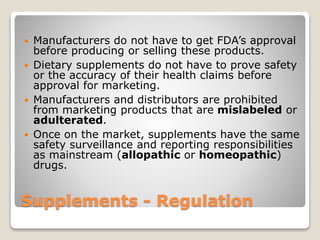
 Manufacturers do not have to get FDA’s approval
before producing or selling these products.
 Dietary supplements do not have to prove safety
or the accuracy of their health claims before
approval for marketing.
 Manufacturers and distributors are prohibited
from marketing products that are mislabeled or
adulterated.
 Once on the market, supplements have the same
safety surveillance and reporting responsibilities
as mainstream (allopathic or homeopathic)
drugs.
Supplements - Labeling
 Claims such as “Supports heart health” or
“Will help maintain your normal energy”
must be accompanied by this Disclaimer “This
statement has not been evaluated by the
Food and Drug Administration. This product
is not intended to diagnose, treat, cure, or
prevent any disease”.
 Studies have shown that more than 90% of
supplement health claims are incorrect; 1/3 did
not contain the active ingredients claimed; and
1/3 contained unlisted substances – including
steroids, psychoactive substances, and toxic
substances such as arsenic, cadmium, lead, or
mercury.
Supplements – Safety Studies
 Only 0.3% of the 55,000 dietary supplements on
the U.S. market have been studied regarding
their common side effects.
 Randomized clinical studies of some antioxidants
and vitamins have found increased mortality
rates (iron in older women; beta-carotene in
patients with some cancers).
 Supplements have been recalled because of:
−Microbiological, pesticide, or heavy metal contamination;
−Absence of a substance claimed to be in the product;
−The presence of more or less than the amount of the
main dietary ingredient listed on the label.
Supplements – Safety Risks
Supplements change the activity of
mainstream drugs by:
−Interference with binding to blood carrier proteins or target
tissues
−Competition for metabolic enzyme pathways, especially in
the liver;
−Increasing or decreasing clearance from the body
−Increasing or decreasing blood drug levels
These potential complications are especially critical for NTI
drugs or those with an inherent risk of toxicity – such as
cancer drugs, drugs for diabetes, and heart medications.
Senior Drug Safety Issues
 Studies show that 40% of patients in their 60s
take more than five medications
(polypharmacy)
 Medication use can increase from middle age for
patients being treated for chronic diseases such
as diabetes or cardiovascular disorders.
 Patients may see multiple doctors who do not
coordinate their medications
 Most drugs depend on intact liver and/or kidney
functions, which may be impaired, for proper
metabolism and clearance
 Frailty, neurological changes, and nutritional
deficiencies may increase the risks and severity
of common side effects, such as dizziness
AGS Beers Criteria
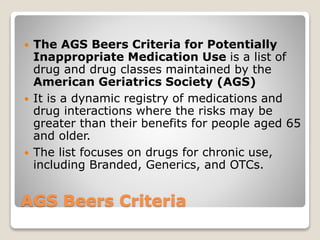
 The AGS Beers Criteria for Potentially
Inappropriate Medication Use is a list of
drug and drug classes maintained by the
American Geriatrics Society (AGS)
 It is a dynamic registry of medications and
drug interactions where the risks may be
greater than their benefits for people aged 65
and older.
 The list focuses on drugs for chronic use,
including Branded, Generics, and OTCs.
Beers Criteria - Examples
NSAIDs (to reduce pain and
inflammation)
◦ Can increase the risk of bleeding stomach ulcers. Can
also increase blood pressure, damage your kidneys, and
worsen heart failure.
MUSCLE RELAXANTS
◦ Can make you groggy and confused, increase your risk
of falls, and cause dry mouth, constipation, and
problems urinating.
ANTIHISTAMINES
◦ Can cause confusion, blurred vision, dry mouth,
constipation, and problems urinating.
Drug Safety Personal Guidelines
 Maintain a list of all medications and dosages
you take, including OTCs and Supplements.
Take this list (and any questionable drug
allergies) with you to every healthcare
encounter.
 Be vigilant about side effects, and report any
unusual signs or symptoms with new
medications promptly.
 Check your medicine cabinet periodically, and
discard unused and expired medications
appropriately.
Drug Therapy Issues

Drug Therapy Issues

  • 1.
    Drug Therapy Issues MichaelC. Joseph, MD, MPH December 7, 2016 (Peer Learning)
  • 2.
    Outline Drug Development Prescription Drugs GenericDrugs Over-the-Counter Drugs Dietary Supplements Drug Safety Issues in Seniors RESOURCES
  • 3.
    Drug Development  Only1 in 10,000 drugs studied makes it to market  It takes more than 10 years of clinical studies to bring a new drug to market  Each clinical study costs upwards of $15,000 per patient  Total drug development costs average $2.5B  Patents protect drugs from copycat versions for 20 years after the drug is invented. This includes the time spent in clinical studies to accumulate enough data to get a drug approved by the U.S. Food and Drug Administration.
  • 4.
    Prescription Drug PriceIncreases  U.S. prescription spending rose 12.2% in 2014, accelerating from a 2.4% rise in 2013.  From 2010-2015 there were price increases of 100% (insulin), 1,000% (skin treatments), and 1,000% for heart medicines; all these drugs were > 10 years old.  The top 50 Branded drug price increases ranged from 63% to 391% (Edecrin®, etacrynic acid, a diuretic) from December 2012 to July 2015. Turing Pharmaceuticals bought and increased the price of an old anti-parasitic drug, Daraprim®, from $ 3.50 per pill to $ 750.00 (5,000%). The Turing CEO, Martin Shkreli, invoked the Fifth Amendment in a Congressional Hearing on Drug Prices, then after being excused and leaving the room he promptly called the lawmakers “imbeciles” on Twitter. Mylan Pharmaceuticals raised the price of a two-pack of Epipen® (injectable epinephrine) from $100 in 2009 to $608 in 2016. The two-pack costs around $60 to produce. [Mylan agreed to a recent $ 465 million settlement with the federal government on allegations that it overcharged Medicaid for Epipen. (Wall Street Journal, 28 October 2016] [Epipen costs $21 USD and is free to seniors in the U.K. (Letter to the Editor, Wall Street Journal)]
  • 5.
    TV Drug Advertising Drugmakers spent $ 2.4 billion on TV ads for prescription drugs in 2015, up 23 % from 2014.  TV audiences have grown accustomed to ads for treatment for high cholesterol, erectile dysfunction, overactive bladder, and a host of other “lifestyle” conditions.  Newer ads cover serious, life-threatening conditions or those with relatively small populations – often expensive medicines prescribed by specialist doctors, such as: −Optivo® which costs about $12,500 per month (for lung cancer) −Hetlioz®, which costs $ 148,000 per year (for a sleeping disorder that affects only about 80,000 blind people) −Plus drugs for Multiple Sclerosis and Plaque Psoriasis.
  • 6.
    The Cost-benefit Argument In many European countries, the price of a new drug is a condition of marketing approval  In the U.S., the price of a new drug is a marketing decision (what the market will bear and competitors’ pricing) by the drug company sponsor  In addition to recouping the cost of drug development, examples of cost-benefit arguments by sponsors include: − Treatment of Hepatitis C will save millions in 20-30 years by reduced complications (liver cancer, cirrhosis) and costs (liver transplants). Solvadi® costs $7,000 per week for 12 weeks ($ 84,000), but a 12-week regimen costs only $136 to manufacture. − The cost per lung cancer patient over the 5.7 month treatment period will be more than $65,000 for Portrazza®, after studies showed survival for 11.5 months vs. 9.9 months in patients treated with standard chemotherapy. Portrazza costs $11,430/month, but the monthly cost should be only $1,875, according to a cost-benefit analysis.
  • 7.
    Generics Regulations  GenericDrugs must: −contain the same active ingredients as the innovator (brand name) drug (inactive ingredients may vary) −be identical in strength, dosage form, and route of administration −have the same use indications −be bioequivalent (match 80-125% of the blood level of the brand name drug) −meet the same batch requirements for identity, strength, purity, and quality −be manufactured under the same strict standards of FDA's Good Manufacturing Practice regulations required for innovator products. (FDA 2009)
  • 8.
    Generic Drugs Marketing The first approved Generic is granted six months’ marketing exclusivity.  In 2015, Generics accounted for 88% of new prescriptions, but only 28% of total drug spending.  They can cost up to 60-90% less than the price of the brand-name drug, but they may not be covered by insurers and may have higher out-of-pocket costs.
  • 10.
    Generics Drug Pricing A federal probe has been underway since 2014 into Generics price- fixing.  The top 50 generic drug price increases ranged from 474% (ethacrynic acid – an old diuretic) to over 18,000% (tetracycline – an old antibiotic) from December 2012 to July 2015.  More than 300 of 1,441 Generics reviewed had at least one 100% price increase between 2010 and 2015.  Large purchasers have sued Mylan and Endo after price increases of 884% (digoxin) and 8,281% (doxycycline – an old antibiotic for multiply-resistant infections), between 2012 and 2014. (Wall Street Journal, 04 November 2016)
  • 11.
    Generics Marketing Delays Drug companies can delay Generics by: −extending the branded drug’s patent life; −suing the Generics companies for patent infringement (especially in biologics, where unique production techniques are employed); −paying a fee to the Generics companies to delay their marketing; −marketing “Authorized Generics”:  Either by licensing a Generics company; or  By safety and efficacy testing of old drugs, [e.g. Colcrys® (colchicine)] and obtaining 3-year exclusivity.
  • 12.
    Anticompetitive Drug Pricing Drug companies can stifle competition by: −buying both Patent-holding and Generics companies; −decreasing their tax burden by shifting income abroad, through mergers or purchases of foreign companies; −extending their patent by 5 years through a new dosage form or route of delivery, changes to the active molecule (such as isolating the L-form of Lexapro®), or combining old Generics.
  • 13.
  • 14.
    Narrow Therapeutic Index(NTI) NTI drugs are those for which: a) There is less than a 2-fold difference in median Lethal dose and median Effective dose values, or b) There is less than a 2-fold difference in the minimum Toxic concentration and minimum Effective concentration in the blood, and c) Safe and Effective use of the drug products require careful Titration and Patient Monitoring. (US FDA, 2013).
  • 15.
    Safety Problems withNTI Generics Antidepressants −A patient who is not responding to an antidepressant may be prescribed an increased dose or switched to another antidepressant or given an additional antidepressant, as prescribers depend on the therapeutic response for effective patient management. −The FDA approved a generic version of Wellbutrin XL in 2006. Lack of efficacy complaints from patients started. ConsumerLab used in vitro tests, which showed that the generic version released 34% total of the active ingredient compared to the brand name drug, and released only 8% in the same length of time.
  • 16.
    Safety Problems withNTI Generics Antihypertensives Decreased blood levels can cause hypertensive crisis and stroke; increased blood levels can cause low blood pressure, dizziness, fainting spells, and falls. Of 35 Generics compared to Dilatrend® (carvedilol), 3 had “incorrect mean carvedilol content,” 1 had “excess impurities”, while 11 had “incorrect hardness”, 9 “inadequate dissolution”, and 7 “failed two tests - generally hardness and dissolution”.
  • 17.
    Safety Problems withNTI Generics Antiepileptics Patients with uncontrolled epilepsy can have real social and economic harm. They can be seriously injured during a seizure, they can lose their right to drive, or even lose their job. −An Epilepsy Society of America survey of patients who were switched to a Generic found:  59% reported a worsening of seizures  49% reported worsened side effects Review of an Rx database showed: ◦ Patients who had an epileptic event requiring ER care, and had not required care for at least 6 months - had 81% greater odds of having had a switch to a Generic.
  • 18.
    Safety Problems withNTI Generics  Anticoagulants −Anticoagulant drugs, such as warfarin, must be dosed for each individual patient, and lab tests must be monitored on a regular basis to avoid serious adverse events of hemorrhage with overdose, and clotting with underdose. −This table shows Higher Risks from 37,756 switches between Coumadin® and warfarin. Drug Thrombotic Events Hemorrhage Risk Coumadin to warfarin 1.81x 1.51x warfarin to Coumadin 1.76x 1.74x warfarin to another warfarin 1.89x 1.74x
  • 19.
    Over-the-Counter (OTC) Drugs Over-the-counter medicines (OTCs) or nonprescription medicines refers to medicines that you can buy without a prescription. They are safe and effective when you follow the directions on the label and as directed by your health care professional.  They are marketed for self-limited conditions such as pain, diarrhea, skin care, and cough and cold symptoms. Their prices are generally low.  The treated illnesses should be acute, unlikely to cause complications, and easy to diagnose (e.g. vaginal yeast infections but not genital herpes).  Labeled directions recommend seeking medical care if the patient is worried about worsening, new symptoms, or the condition does not resolve within a reasonable period.
  • 20.
    Supplements - Background It is not legal to market a supplement as a preventive treatment, or cure, or to alleviate the symptoms of a disease.  But, they are commonly used in illnesses such as mood disorders, fatigue, pain, insomnia, sexual dysfunction, and symptoms of menopause.  They are used by 68% of adults, and more than one-half of patients with cancer and chronic illnesses – but 70% of users do not inform their physicians.
  • 21.
    Supplements - Regulation Manufacturers do not have to get FDA’s approval before producing or selling these products.  Dietary supplements do not have to prove safety or the accuracy of their health claims before approval for marketing.  Manufacturers and distributors are prohibited from marketing products that are mislabeled or adulterated.  Once on the market, supplements have the same safety surveillance and reporting responsibilities as mainstream (allopathic or homeopathic) drugs.
  • 22.
    Supplements - Labeling Claims such as “Supports heart health” or “Will help maintain your normal energy” must be accompanied by this Disclaimer “This statement has not been evaluated by the Food and Drug Administration. This product is not intended to diagnose, treat, cure, or prevent any disease”.  Studies have shown that more than 90% of supplement health claims are incorrect; 1/3 did not contain the active ingredients claimed; and 1/3 contained unlisted substances – including steroids, psychoactive substances, and toxic substances such as arsenic, cadmium, lead, or mercury.
  • 23.
    Supplements – SafetyStudies  Only 0.3% of the 55,000 dietary supplements on the U.S. market have been studied regarding their common side effects.  Randomized clinical studies of some antioxidants and vitamins have found increased mortality rates (iron in older women; beta-carotene in patients with some cancers).  Supplements have been recalled because of: −Microbiological, pesticide, or heavy metal contamination; −Absence of a substance claimed to be in the product; −The presence of more or less than the amount of the main dietary ingredient listed on the label.
  • 24.
    Supplements – SafetyRisks Supplements change the activity of mainstream drugs by: −Interference with binding to blood carrier proteins or target tissues −Competition for metabolic enzyme pathways, especially in the liver; −Increasing or decreasing clearance from the body −Increasing or decreasing blood drug levels These potential complications are especially critical for NTI drugs or those with an inherent risk of toxicity – such as cancer drugs, drugs for diabetes, and heart medications.
  • 25.
    Senior Drug SafetyIssues  Studies show that 40% of patients in their 60s take more than five medications (polypharmacy)  Medication use can increase from middle age for patients being treated for chronic diseases such as diabetes or cardiovascular disorders.  Patients may see multiple doctors who do not coordinate their medications  Most drugs depend on intact liver and/or kidney functions, which may be impaired, for proper metabolism and clearance  Frailty, neurological changes, and nutritional deficiencies may increase the risks and severity of common side effects, such as dizziness
  • 26.
    AGS Beers Criteria The AGS Beers Criteria for Potentially Inappropriate Medication Use is a list of drug and drug classes maintained by the American Geriatrics Society (AGS)  It is a dynamic registry of medications and drug interactions where the risks may be greater than their benefits for people aged 65 and older.  The list focuses on drugs for chronic use, including Branded, Generics, and OTCs.
  • 27.
    Beers Criteria -Examples NSAIDs (to reduce pain and inflammation) ◦ Can increase the risk of bleeding stomach ulcers. Can also increase blood pressure, damage your kidneys, and worsen heart failure. MUSCLE RELAXANTS ◦ Can make you groggy and confused, increase your risk of falls, and cause dry mouth, constipation, and problems urinating. ANTIHISTAMINES ◦ Can cause confusion, blurred vision, dry mouth, constipation, and problems urinating.
  • 28.
    Drug Safety PersonalGuidelines  Maintain a list of all medications and dosages you take, including OTCs and Supplements. Take this list (and any questionable drug allergies) with you to every healthcare encounter.  Be vigilant about side effects, and report any unusual signs or symptoms with new medications promptly.  Check your medicine cabinet periodically, and discard unused and expired medications appropriately.