OSTEOCHONDROMA
 Osteochondroma or osteocartilaginous
exostoses is the most common benign
tumor of the bones.
 The tumor forms cartilage-capped bony
outgrowth on the surface of bones
(exostoses)
 It mostly occurs where cartilage forms bone.
Commonly affects long bones in the leg,
pelvis, or scapula
 Target- METAPHYSIS
 Development take place during skeletal
growth between the ages of 13 and 15 and
ceases when the growth plate fuses at
puberty.
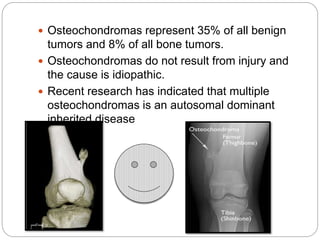
 Osteochondromas represent 35% of all benign
tumors and 8% of all bone tumors.
 Osteochondromas do not result from injury and
the cause is idiopathic.
 Recent research has indicated that multiple
osteochondromas is an autosomal dominant
inherited disease
Transmission
Non
hereditary
85%
Hereditary
15%
Number
Solitary
Multiple
Size
Sessile
Pedunculated
 The majority of osteochondromas are
symptomless and are found incidentally.
 Hard immobile painless palpable mass,
 Nerve & vascular compression(numbness,
weakness, loss of pulse)
 Muscle soreness
 Bursitis
 If the tumor is found under a tendon, it can cause
pain during movement causing restriction of joint
motion.
• NO
TREATMENT
• (only follow up)
Solitary and
asymptomatic
• COMPLETE
SURGICAL
EXCISION
Symptomatic
Signs of malignancy
Pain at
the site
Growth
after
puberty
Cartilage
cap
>2cm
Osteochondroma
Osteochondroma

Osteochondroma

  • 1.
  • 2.
     Osteochondroma orosteocartilaginous exostoses is the most common benign tumor of the bones.  The tumor forms cartilage-capped bony outgrowth on the surface of bones (exostoses)  It mostly occurs where cartilage forms bone. Commonly affects long bones in the leg, pelvis, or scapula  Target- METAPHYSIS  Development take place during skeletal growth between the ages of 13 and 15 and ceases when the growth plate fuses at puberty.
  • 3.
     Osteochondromas represent35% of all benign tumors and 8% of all bone tumors.  Osteochondromas do not result from injury and the cause is idiopathic.  Recent research has indicated that multiple osteochondromas is an autosomal dominant inherited disease
  • 4.
  • 5.
     The majorityof osteochondromas are symptomless and are found incidentally.  Hard immobile painless palpable mass,  Nerve & vascular compression(numbness, weakness, loss of pulse)  Muscle soreness  Bursitis  If the tumor is found under a tendon, it can cause pain during movement causing restriction of joint motion.
  • 7.
    • NO TREATMENT • (onlyfollow up) Solitary and asymptomatic • COMPLETE SURGICAL EXCISION Symptomatic
  • 8.
    Signs of malignancy Painat the site Growth after puberty Cartilage cap >2cm