Hacking the
LINUX KERNEL
Introduction
Kurusa Levente
<levex@linux.com>
Free Software Conference Szeged, Szent-Györgyi Albert Agóra, 2013. november 29. 15:00
A little bit of history...
● Development began in 1991 on behalf of Linus
Torvalds
● UNIX clone
● Originally not meant to be portable
What is a kernel and what is it for?
● The core of the operating system
● Responsibilities:
● Initialize the system for usage
● Minimal protection of data
● Help development of software by abstractions.
What type of a kernel is Linux?
● Monolithic
● Modular
● Free software!
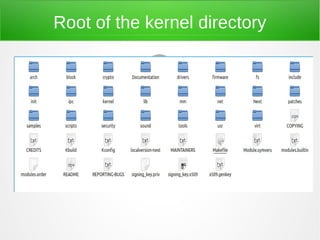
Root of the kernel directory
Development statistics
● Since 2005, more than 10000 developers from 1000
companies
● Every 70 days a new release, this number was 80 days
in 2012.
● Approx. 10000 modifications each release
● Every hour 7.14 modifications, this was 6.9 in 2012
Code statistics
● Approx. 44000 files
● Approx 18M lines of code
● Languages:
– 96.08% ANSI-C
– 3.63 % Assembly
– 0.10 % Perl
Where is Linux mostly used?
● Android devices (1.3M each day)
● Smart TVs (700.000 daily)
● Financial transactions (80%)
● Supercomputers (98%)
És:
● The cloud (Google, Facebook, Amazon)
● Defence system
● Nuclear submarines
● Trains, airports, and more!
Contribution
● This is the biggest collab project!
● The hackers have already found the easy but
useful way.
● 'scripts/checkpatch.pl'
● With this script you can find common
codestyle issues in the code
Staging drivers
● Drivers of small startups (mostly)
● Full of codestyle errors
● Checkpatch.pl finds these and identifies them
● The volunteering developer corrects them!
(patching)
● And they have contributed to the success of
Linux! :-)
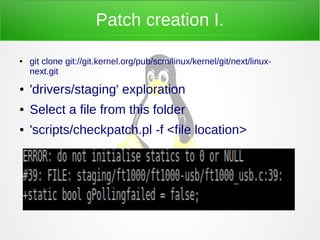
Patch creation I.
● git clone git://git.kernel.org/pub/scm/linux/kernel/git/next/linux-
next.git
● 'drivers/staging' exploration
● Select a file from this folder
● 'scripts/checkpatch.pl -f <file location>
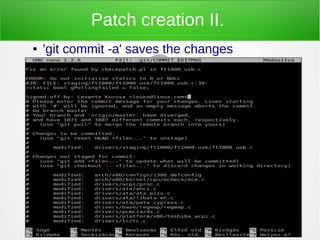
Patch creation II.
● 'git commit -a' saves the changes
Patch creation III.
● 'git format-patch -1 ' creates a patch file, name
is shown on stdout.
● Next step is to send the patch.
Sending the patch
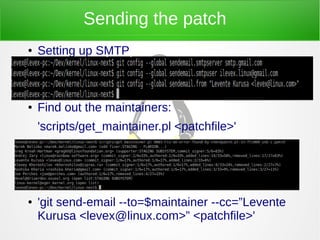
● Setting up SMTP
●
●
● Find out the maintainers:
'scripts/get_maintainer.pl <patchfile>'
●
●
● 'git send-email --to=$maintainer --cc=”Levente
Kurusa <levex@linux.com>” <patchfile>'
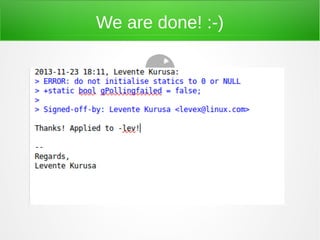
We are done! :-)
Postscript
● Hopefully when you go home, you create a
patch like this! :-)
● After that, welcome to the group of Kernel
Hackers!
Thank you for your attention!
● Kernel panic – not syncing: Reached end of
presentation.

Hacking the Linux Kernel - An Introduction

  • 1.
    Hacking the LINUX KERNEL Introduction KurusaLevente <levex@linux.com> Free Software Conference Szeged, Szent-Györgyi Albert Agóra, 2013. november 29. 15:00
  • 2.
    A little bitof history... ● Development began in 1991 on behalf of Linus Torvalds ● UNIX clone ● Originally not meant to be portable
  • 3.
    What is akernel and what is it for? ● The core of the operating system ● Responsibilities: ● Initialize the system for usage ● Minimal protection of data ● Help development of software by abstractions.
  • 4.
    What type ofa kernel is Linux? ● Monolithic ● Modular ● Free software!
  • 5.
    Root of thekernel directory
  • 6.
    Development statistics ● Since2005, more than 10000 developers from 1000 companies ● Every 70 days a new release, this number was 80 days in 2012. ● Approx. 10000 modifications each release ● Every hour 7.14 modifications, this was 6.9 in 2012
  • 7.
    Code statistics ● Approx.44000 files ● Approx 18M lines of code ● Languages: – 96.08% ANSI-C – 3.63 % Assembly – 0.10 % Perl
  • 8.
    Where is Linuxmostly used? ● Android devices (1.3M each day) ● Smart TVs (700.000 daily) ● Financial transactions (80%) ● Supercomputers (98%) És: ● The cloud (Google, Facebook, Amazon) ● Defence system ● Nuclear submarines ● Trains, airports, and more!
  • 9.
    Contribution ● This isthe biggest collab project! ● The hackers have already found the easy but useful way. ● 'scripts/checkpatch.pl' ● With this script you can find common codestyle issues in the code
  • 10.
    Staging drivers ● Driversof small startups (mostly) ● Full of codestyle errors ● Checkpatch.pl finds these and identifies them ● The volunteering developer corrects them! (patching) ● And they have contributed to the success of Linux! :-)
  • 11.
    Patch creation I. ●git clone git://git.kernel.org/pub/scm/linux/kernel/git/next/linux- next.git ● 'drivers/staging' exploration ● Select a file from this folder ● 'scripts/checkpatch.pl -f <file location>
  • 12.
    Patch creation II. ●'git commit -a' saves the changes
  • 13.
    Patch creation III. ●'git format-patch -1 ' creates a patch file, name is shown on stdout. ● Next step is to send the patch.
  • 14.
    Sending the patch ●Setting up SMTP ● ● ● Find out the maintainers: 'scripts/get_maintainer.pl <patchfile>' ● ● ● 'git send-email --to=$maintainer --cc=”Levente Kurusa <levex@linux.com>” <patchfile>'
  • 15.
  • 16.
    Postscript ● Hopefully whenyou go home, you create a patch like this! :-) ● After that, welcome to the group of Kernel Hackers!
  • 17.
    Thank you foryour attention! ● Kernel panic – not syncing: Reached end of presentation.