Ossification of Posterior
Longitudinal Ligament(OPLL)
Arjun Das
Resident of
Department of Orthopedics and Traumatology
Anatomy :PLL
 Runs along the posterior aspect of the vertebral body inside
the vertebral canal from the body of the axis to the sacrum.
At the level of C2 , spreads out and becomes the tectorial membrane
that inserts into the base of skull.
Composed of longitudinal fibers.
Arises from sup. Margin of 1 vertebra and attach to inferior margin of
vertebra
Forms the anterior wall of vertebral canal
Fibers wider at IVD and more adherent than vertebral body
PLL much thinner than ALL ,significant for pathophysiology of disc
herniations occurring posterolateral .
In cervical and thoracic regions has uniform width over bodies and
discs
In lumbar region widest at disc
Firmly anchored to Annulus fibrosus ,cartilage of vertebral endplates
and margins of vertebra
Cranial counterpart is Tectorial membrane
Comprise superficial and deep connective tissue layers
Tightens with cervical flexion
Superficial layer
More posterior
Continuation of Tectorial membrane at body of Axis
Consists of central band of fibers 8 to 10 mm wide
Described as “fan –like “giving denticulate appearance
More on thoracic and lumbar regions
Span upto 4 vertebral levels
Fibers more vertical orientation
Deep layer
Adherent to sup. Layer in midline
Continuation of Cruciform ligament of Atlas
Uniform diameter
2-3 mm wide at narrowest part
Also has denticulate appearance
Intersegmental
Fiber orientation can’t be established
Function
Proctective role than supportive role .
Sup . Layer : limit forward flexion
Deep layer :limit lateral flexion and rotation
Increased rotational and lateral flexion forces : creates more
denticulate appearance in lower thoracic and lumbar region
Elastin in PLL :role in dynamic motion of spine
Embryology
 At 6 WOG :vertebral column appears as hypocellular light zone
forming vertebral body
Hpercellular dark zone forming IVD
At 7 WOG : light zone ad dark zone distinct but ligament unclear
At 8 WOG : longitudinal arrangement of cells and collagen fibers
appears at the adult ALL but not at PLL
At 10 WOG : Dark zone decreases in width and origin of PLL appears
( unclear at vertebral body but clear at disc )
Nerve supply
Primary source : meningeal branch from spinal nerve
Gives ascending and descending branches which fuses and forms
Transverse branches
Transverse branches from opposite side forms network of nerve
fibers superficially
Innervates the PLL in vertebral segments
Physiological variants
PLL Is narrower and weaker .
Fibers of annulus fibrosus and edge of vertebral body m/c site of
attachment
Sometimes to posterior aspect of vertebra
PLL most developed at L3 and L4 (1.4mm thickness )
Ligament in mid portion of each vertebral body covers vascular
foramina
From L2 upwards ligament thins markedly
Ossification of Posterior Longitudinal
Ligament (OPLL)
Chronically ,progressive disease .
Ectopic enchondral and membranous ossification
Unkown etiology
Multifactorial condition : genetic and environmental factors
Original reported from japan
Epidemiology
Incidence
In Japanese > 30 yrs upto 3%
In the United States and Europe , upto 1.7%
Gender
Cervical : M>F (2:1)
Dorsal :F>M
Race
More in Japanese
Age
Started in 40s and become symptomatic in 50s
Risk factors
Gentic locus close to HLA ,on chr. 6
DM
Obesity
Acromegaly
Hypoparathyroidism
Bone forming conditions : DISH and Fluorosis
PATHOGENESIS
Ligament cells from pts with OPLL have osteoblast –like
characteristics
Factors that initiate these cells to form calcification and ossification
are :
Genetic factors :COL6A1, COL11A2 and NPPS
Hormonal factors :non –insulin dependent D.M, hypoparathyroidism
Environmental factors : mechanical stress in ligaments of spine
Life style
a/w DISH and Fluorosis
Pathogenesis of Neural injury in OPLL
A) Mechanical
 Static compression
Occupying ratio greater than 60 % indicates high risk of development of myelopathy
SAC < 6 mm
Dynamic compression
Degenerative spondylolisthesis
SAC 6-13 mm
Threshold of SAC
Normal : 13 mm
B) Vascular
Pathology
Site
Cervical (C2-C4) : 70 %
Dorsal (T1-T4) :15%
Lumbar (L1-L3 ) : 15 %
High frequency with cervical OPLL a/w thracolumbar OPLL
Character
Early : PLL hypertrophy
Then : Punctate calcification within PLL
Then : Actual ossification
Types of OPLL
Types of OPLL
Microscopic features
Early OPLL
Hypertrophy PLL d/to fibroblastic hyperplasia and increased collagen
deposition with punctate calcification
Immature form
Woven bone with fibrocartilaginous cell proliferation
Mature form
Lamellar bone with well developed haversian systems
Mostly endochondral ossification and sometime membranous
Pathological changes in cord
Demyelination and loss of axon
Always in posterior and posterolateral part of cord
Natural History Of OPLL
OPLL ↑in thickness 0.4mm/yr
Longitudinal expansion 0.67mm/yr
More with continuous or mixed type
Rapid progression in 4th decade and then decreases
Also occurs post –operatively
In 60-70 % after posterior decompression
In 36-64 % after anterior decompression and fusion
Matsunga et al . Demonstrated that 38 % pts presenting with myelopathy had
progressive worsening of symptoms if not operated .
Causes of late deterioration
Post operative progression of OPLL
Progressive deformity and instability
Thoracic myelopathy secondary to OPLL or OLF or both
Degenerative lumbar stenosis
Diagnostic criteria
Radiological
OPLL visible on lateral view X-ray
CT scan may be used for better assessment
Clinical
Cervical myelopathic symptoms
Radicular symptoms
Abnormality of cervical range of movement
Clinical picture
Accidental discovery
Onset
Usually graudual progressive but may be acute (after trauma )
Pain
Axial neck and upper limb pain
Motor abnormalities
Weakness
Incoordination
Clumsiness
Muscle wasting
Bladder –bowel dysfunction
Sensory symptoms
Neurological deficits
Myelopathy or myeloradiculopathy rather than radiculopathy alone
Associated co-existing conditions
DM
Hypoparathyrodism
Mytonic muscular dystrophy
Acromegaly
Obesity
Radiological features
X- ray
• Normal AP diameter of
cervical canal :17mm from C3-C7
• Absolute stenosis : 10 mm or less
• Relative stenosis : 10 – 13 mm
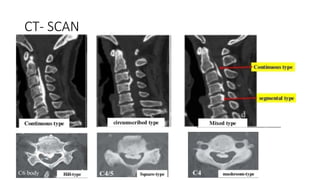
CT- SCAN
Dural calcification
CT signs of Dural Penetrance (Single –layer
and Double –layer Signs )
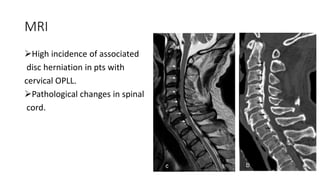
MRI
High incidence of associated
disc herniation in pts with
cervical OPLL.
Pathological changes in spinal
cord.
Treatment
Conservative management
Surgical management
Conservative management
Indications
Axial pain without or with subclinical myelopathy
Main insult is dynamic compression (less than 60 % stenosis or 6-13mm SAC)
Severe co morbidity
Measures
Collar
Traction
Careful life style
Analgesics and anti –inflammatory drugs
Anti depressants and anticonvulsants
Opiods
Surgery : Indications
Is there a rule for prophylactic surgery ?
Myelopathy or radiculo-myelopathy with predominant myelopathy
Role of prophylactic surgery in asymptomatic patient
Severe canal compromise :
•SAC <6mm or
•Occupational ratio >60 %
Presence of cord signal in MRI
SSEP is affected
Young age (< 65yrs )
Surgical procedures
Anterior surgery :single/ multilevel (upto 4)
Corpectomy with removal of calcified mass
Corpectomy without removal of calcified mass (ant .floating method )
Open Window Corpectomy/Skip cervical corpectomy ( removal of post ½ of body
leaving ant one )
Oblique Cervical Corpectomy
With fusion and Halo Vest or with fusion and fixation
Surgical procedures
Posterior surgery
Laminectomy
Laminectomy + fixation and fusion
Laminoplasty (open door or double door laminoplasty )
Combined anterior and posterior surgery
Choice of approach
Factors in favor of ant .approach
Presence of facilities and expertise
Occupying ratio more than 60 %
Hill- shaped calcification
Kyphotic deformity or degenerative instability
Limited corpectomy levels (upto 4 )
Fessler et al. found pts with anterior approach t/t have improvement of
1.24 Nurick grades than laminectomy pts by 0.07.
Factors allowing posterior approach
Comorbidity prevent more lengthy procedures
Occupying ratio less than 60 %
Plateau – shaped calcification
Preserved lordotic spine or maximum straightening
Radiological signs help in choosing approach
Gwinn et al. proposed simple straight line method to effective spinal canal
lordosis
Anterior surgery :better achieve decompression in lost effective lordosis
In 2008 ,Fusiyoshi et al . Proposed a new concept called K-line .
Fusiyoshi et al . Proposed in K line(-) ventral approach have a better
chance of neurological outcome .
K line (-) pts have kyphosis that prohibits a dorsal approach as spinal
cord has less potential to shift following decompression .
Anterior corpectomy and fusion
Advantages
Improved myelopathy scores
Direct removal of pathology
Disadvantages
Increased complications
Anterior approach related (dysphagia ,hoarseness ,prolonged intubation )
Graft expulsion
Pseudoarthrosis
C5 root palsy
Laminoplasty
Advantages
Decreased approach related complications
Better tolerated in pts >65 years
Improved stability
Disadvantages
Increased neck pain
Less improvement in myelopathy scores
Persistent ossified bar/ligament
C5 root palsy
Prognosis
Patient’s factors :
Old age
Preoperative neurological status and duration of symptoms
H/O trauma causing acute presentations
Disease’s factors
Occupying ratio of OPLL or SAC
Saggital shape of ossification (hill –shaped ) esp. with post. Decompression
Management’s factors
Progression more with posterior decompression
• Thank you

OPLL - SPINE

  • 1.
    Ossification of Posterior LongitudinalLigament(OPLL) Arjun Das Resident of Department of Orthopedics and Traumatology
  • 2.
    Anatomy :PLL  Runsalong the posterior aspect of the vertebral body inside the vertebral canal from the body of the axis to the sacrum. At the level of C2 , spreads out and becomes the tectorial membrane that inserts into the base of skull. Composed of longitudinal fibers. Arises from sup. Margin of 1 vertebra and attach to inferior margin of vertebra Forms the anterior wall of vertebral canal
  • 4.
    Fibers wider atIVD and more adherent than vertebral body PLL much thinner than ALL ,significant for pathophysiology of disc herniations occurring posterolateral . In cervical and thoracic regions has uniform width over bodies and discs In lumbar region widest at disc Firmly anchored to Annulus fibrosus ,cartilage of vertebral endplates and margins of vertebra Cranial counterpart is Tectorial membrane
  • 5.
    Comprise superficial anddeep connective tissue layers Tightens with cervical flexion Superficial layer More posterior Continuation of Tectorial membrane at body of Axis Consists of central band of fibers 8 to 10 mm wide Described as “fan –like “giving denticulate appearance More on thoracic and lumbar regions Span upto 4 vertebral levels Fibers more vertical orientation
  • 6.
    Deep layer Adherent tosup. Layer in midline Continuation of Cruciform ligament of Atlas Uniform diameter 2-3 mm wide at narrowest part Also has denticulate appearance Intersegmental Fiber orientation can’t be established
  • 7.
    Function Proctective role thansupportive role . Sup . Layer : limit forward flexion Deep layer :limit lateral flexion and rotation Increased rotational and lateral flexion forces : creates more denticulate appearance in lower thoracic and lumbar region Elastin in PLL :role in dynamic motion of spine
  • 8.
    Embryology  At 6WOG :vertebral column appears as hypocellular light zone forming vertebral body Hpercellular dark zone forming IVD At 7 WOG : light zone ad dark zone distinct but ligament unclear At 8 WOG : longitudinal arrangement of cells and collagen fibers appears at the adult ALL but not at PLL At 10 WOG : Dark zone decreases in width and origin of PLL appears ( unclear at vertebral body but clear at disc )
  • 9.
    Nerve supply Primary source: meningeal branch from spinal nerve Gives ascending and descending branches which fuses and forms Transverse branches Transverse branches from opposite side forms network of nerve fibers superficially Innervates the PLL in vertebral segments
  • 10.
    Physiological variants PLL Isnarrower and weaker . Fibers of annulus fibrosus and edge of vertebral body m/c site of attachment Sometimes to posterior aspect of vertebra PLL most developed at L3 and L4 (1.4mm thickness ) Ligament in mid portion of each vertebral body covers vascular foramina From L2 upwards ligament thins markedly
  • 11.
    Ossification of PosteriorLongitudinal Ligament (OPLL) Chronically ,progressive disease . Ectopic enchondral and membranous ossification Unkown etiology Multifactorial condition : genetic and environmental factors Original reported from japan
  • 12.
    Epidemiology Incidence In Japanese >30 yrs upto 3% In the United States and Europe , upto 1.7% Gender Cervical : M>F (2:1) Dorsal :F>M Race More in Japanese Age Started in 40s and become symptomatic in 50s
  • 13.
    Risk factors Gentic locusclose to HLA ,on chr. 6 DM Obesity Acromegaly Hypoparathyroidism Bone forming conditions : DISH and Fluorosis
  • 14.
    PATHOGENESIS Ligament cells frompts with OPLL have osteoblast –like characteristics Factors that initiate these cells to form calcification and ossification are : Genetic factors :COL6A1, COL11A2 and NPPS Hormonal factors :non –insulin dependent D.M, hypoparathyroidism Environmental factors : mechanical stress in ligaments of spine Life style a/w DISH and Fluorosis
  • 15.
    Pathogenesis of Neuralinjury in OPLL A) Mechanical  Static compression Occupying ratio greater than 60 % indicates high risk of development of myelopathy SAC < 6 mm Dynamic compression Degenerative spondylolisthesis SAC 6-13 mm Threshold of SAC Normal : 13 mm B) Vascular
  • 16.
    Pathology Site Cervical (C2-C4) :70 % Dorsal (T1-T4) :15% Lumbar (L1-L3 ) : 15 % High frequency with cervical OPLL a/w thracolumbar OPLL
  • 17.
    Character Early : PLLhypertrophy Then : Punctate calcification within PLL Then : Actual ossification
  • 18.
  • 19.
  • 20.
    Microscopic features Early OPLL HypertrophyPLL d/to fibroblastic hyperplasia and increased collagen deposition with punctate calcification Immature form Woven bone with fibrocartilaginous cell proliferation Mature form Lamellar bone with well developed haversian systems Mostly endochondral ossification and sometime membranous
  • 21.
    Pathological changes incord Demyelination and loss of axon Always in posterior and posterolateral part of cord
  • 22.
    Natural History OfOPLL OPLL ↑in thickness 0.4mm/yr Longitudinal expansion 0.67mm/yr More with continuous or mixed type Rapid progression in 4th decade and then decreases Also occurs post –operatively In 60-70 % after posterior decompression In 36-64 % after anterior decompression and fusion Matsunga et al . Demonstrated that 38 % pts presenting with myelopathy had progressive worsening of symptoms if not operated .
  • 23.
    Causes of latedeterioration Post operative progression of OPLL Progressive deformity and instability Thoracic myelopathy secondary to OPLL or OLF or both Degenerative lumbar stenosis
  • 24.
    Diagnostic criteria Radiological OPLL visibleon lateral view X-ray CT scan may be used for better assessment Clinical Cervical myelopathic symptoms Radicular symptoms Abnormality of cervical range of movement
  • 25.
    Clinical picture Accidental discovery Onset Usuallygraudual progressive but may be acute (after trauma ) Pain Axial neck and upper limb pain Motor abnormalities Weakness Incoordination Clumsiness Muscle wasting Bladder –bowel dysfunction Sensory symptoms
  • 26.
    Neurological deficits Myelopathy ormyeloradiculopathy rather than radiculopathy alone Associated co-existing conditions DM Hypoparathyrodism Mytonic muscular dystrophy Acromegaly Obesity
  • 27.
  • 28.
    X- ray • NormalAP diameter of cervical canal :17mm from C3-C7 • Absolute stenosis : 10 mm or less • Relative stenosis : 10 – 13 mm
  • 29.
  • 31.
  • 32.
    CT signs ofDural Penetrance (Single –layer and Double –layer Signs )
  • 33.
    MRI High incidence ofassociated disc herniation in pts with cervical OPLL. Pathological changes in spinal cord.
  • 34.
  • 35.
    Conservative management Indications Axial painwithout or with subclinical myelopathy Main insult is dynamic compression (less than 60 % stenosis or 6-13mm SAC) Severe co morbidity Measures Collar Traction Careful life style Analgesics and anti –inflammatory drugs Anti depressants and anticonvulsants Opiods
  • 36.
    Surgery : Indications Isthere a rule for prophylactic surgery ? Myelopathy or radiculo-myelopathy with predominant myelopathy Role of prophylactic surgery in asymptomatic patient Severe canal compromise : •SAC <6mm or •Occupational ratio >60 % Presence of cord signal in MRI SSEP is affected Young age (< 65yrs )
  • 37.
    Surgical procedures Anterior surgery:single/ multilevel (upto 4) Corpectomy with removal of calcified mass Corpectomy without removal of calcified mass (ant .floating method ) Open Window Corpectomy/Skip cervical corpectomy ( removal of post ½ of body leaving ant one ) Oblique Cervical Corpectomy With fusion and Halo Vest or with fusion and fixation
  • 38.
    Surgical procedures Posterior surgery Laminectomy Laminectomy+ fixation and fusion Laminoplasty (open door or double door laminoplasty ) Combined anterior and posterior surgery
  • 39.
    Choice of approach Factorsin favor of ant .approach Presence of facilities and expertise Occupying ratio more than 60 % Hill- shaped calcification Kyphotic deformity or degenerative instability Limited corpectomy levels (upto 4 ) Fessler et al. found pts with anterior approach t/t have improvement of 1.24 Nurick grades than laminectomy pts by 0.07.
  • 40.
    Factors allowing posteriorapproach Comorbidity prevent more lengthy procedures Occupying ratio less than 60 % Plateau – shaped calcification Preserved lordotic spine or maximum straightening
  • 41.
    Radiological signs helpin choosing approach Gwinn et al. proposed simple straight line method to effective spinal canal lordosis Anterior surgery :better achieve decompression in lost effective lordosis
  • 42.
    In 2008 ,Fusiyoshiet al . Proposed a new concept called K-line .
  • 43.
    Fusiyoshi et al. Proposed in K line(-) ventral approach have a better chance of neurological outcome . K line (-) pts have kyphosis that prohibits a dorsal approach as spinal cord has less potential to shift following decompression .
  • 45.
    Anterior corpectomy andfusion Advantages Improved myelopathy scores Direct removal of pathology Disadvantages Increased complications Anterior approach related (dysphagia ,hoarseness ,prolonged intubation ) Graft expulsion Pseudoarthrosis C5 root palsy
  • 46.
    Laminoplasty Advantages Decreased approach relatedcomplications Better tolerated in pts >65 years Improved stability Disadvantages Increased neck pain Less improvement in myelopathy scores Persistent ossified bar/ligament C5 root palsy
  • 48.
    Prognosis Patient’s factors : Oldage Preoperative neurological status and duration of symptoms H/O trauma causing acute presentations Disease’s factors Occupying ratio of OPLL or SAC Saggital shape of ossification (hill –shaped ) esp. with post. Decompression Management’s factors Progression more with posterior decompression
  • 49.

Editor's Notes

  • #13 Once in japan major cause of myelopathy hence Japanese disease
  • #15 PERK (membrane protein kinase ) upregulated in cells
  • #17 M/C AT c5
  • #19 S 39 % M 29 Con 27 Circ 5 Investigation committee on OPLL of Japanese ministry of pubic health and welfare
  • #20 Circumscribed : lesion located post to disc space Segmental : post to vertebral body Continous : several vertebral bodies
  • #22 So posterior decompression may insult the cord which is already insulted posteriorly
  • #23 Do these mean prophylactic surgery indicated ??
  • #32 May show double layer sign on axial ant ligamental and post dural rims of hyperdense ossification This double layer sign to diagnose dural ossification
  • #34 Hypointensity in T1 and hyperintensity on T2 image
  • #43 K line positive ventral to this line K line negative dorsal to this line