





Gap Analysis &
Improvement Tactics for
your EH&S program
Onsite Support Service:
What do you need help with to stay in
compliance?
Meet Your Moderator:
Sasha Laferte
1. All lines are muted, use the chat panel for tech
issues.
2. Unanswered questions will be answered on
Twitter after the webinar.
3. Webinar recording and slides will be emailed to
you tomorrow morning.
Share With the Audience
Meet Your Presenter
Mike Albert
Onsite Support Services
Manager, New England
malbert@triumvirate.com
www.linkedin.com/in/michaelalbert1
• Triumvirate for 6 ½ years
• Completed multiple gap analysis for
different size sites
• Manage multiple onsite teams at large
and small Institutions
• Insight through EH&S programs
• Program growth through knowledge in
EPA and state agencies
• Leader and Inovative services manager
for Triumvirate’s Onsite Support
Programs
Triumvirate’s helpful hints to
knowing your program better.
Gap Analysis and Improvement
Tactics. Understand compliance; save
time and money.
Our Key Message
It is great to know your
strengths, but it is better to
know your weakness…
and then fix them!
What Will You Learn?
What can this analysis
offer for my company?
I think I am doing great!
Why do I need this?
Top Talent = Top Results
If there is something I
am missing, is it hard to
fix?
How many times do you run into a
roadblock and need external
sources to help you out?
1) Never – I can do it myself
2) 1-2 times a month
3) 1-2 times a week
4) Daily
5) All the time
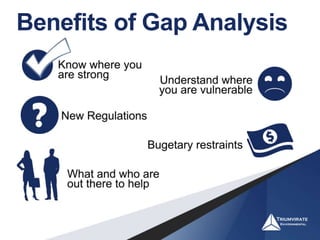
Benefits of Gap Analysis
Overview
Find the Gaps
The Budget
Immediate Tactics
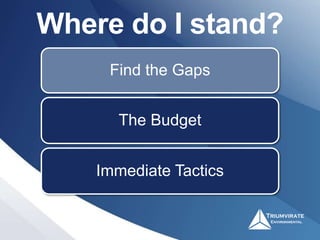
Where do I stand?
Find the Gaps
The Budget
Immediate Tactics
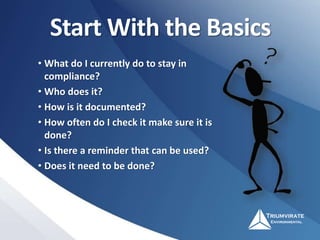
Start With the Basics
• What do I currently do to stay in
compliance?
• Who does it?
• How is it documented?
• How often do I check it make sure it is
done?
• Is there a reminder that can be used?
• Does it need to be done?
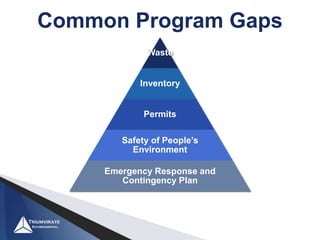
Common Program Gaps
Waste
Inventory
Permits
Safety of People’s
Environment
Emergency Response and
Contingency Plan
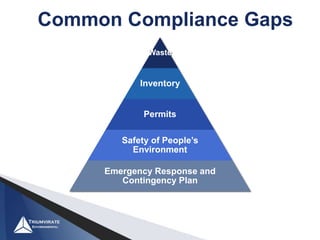
Common Compliance Gaps
Waste
Inventory
Permits
Safety of People’s
Environment
Emergency Response and
Contingency Plan
Helpful Tip
Actually look at all
documents that you need,
don’t assume they exist
because you think or were
told…
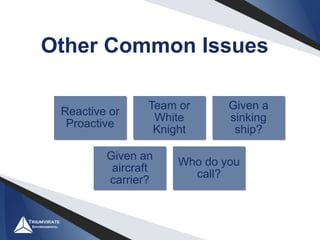
Other Common Issues
Reactive or
Proactive
Team or
White
Knight
Given a
sinking
ship?
Given an
aircraft
carrier?
Who do you
call?
The Budget
Find the Gaps
The Budget
Immediate Tactics
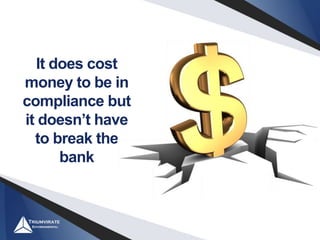
It does cost
money to be in
compliance but
it doesn’t have
to break the
bank
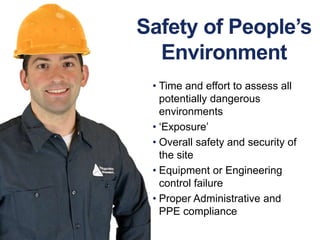
Safety of People’s
Environment
• Time and effort to assess all
potentially dangerous
environments
• ‘Exposure’
• Overall safety and security of
the site
• Equipment or Engineering
control failure
• Proper Administrative and
PPE compliance
Costs of Plans and
Permits
• Time, effort = $ or $$$
• Knowledge and
Experience
• Costs for submittals,
renewals
• Full understanding of
site
Helpful tip – proving by
experience or knowledge from a
fellow experience will help get
‘smaller’ numbers passed
through the budget
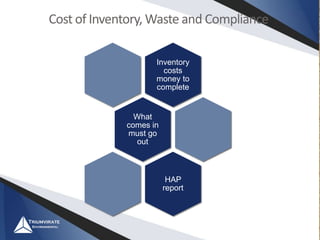
Cost of Inventory, Waste and Compliance
Inventory
costs
money to
complete
What
comes in
must go
out
HAP
report
Other Cost Factors
• Size of your institution or
site
• What is in place already
• What you need to know
more about
• How often you scratch your
head and wonder, what if…
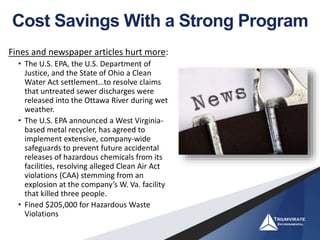
Cost Savings With a Strong Program
Fines and newspaper articles hurt more:
• The U.S. EPA, the U.S. Department of
Justice, and the State of Ohio a Clean
Water Act settlement…to resolve claims
that untreated sewer discharges were
released into the Ottawa River during wet
weather.
• The U.S. EPA announced a West Virginia-
based metal recycler, has agreed to
implement extensive, company-wide
safeguards to prevent future accidental
releases of hazardous chemicals from its
facilities, resolving alleged Clean Air Act
violations (CAA) stemming from an
explosion at the company’s W. Va. facility
that killed three people.
• Fined $205,000 for Hazardous Waste
Violations
Immediate Tactics to Help Solve Problems
Find the Gaps
The Budget
Immediate Tactics
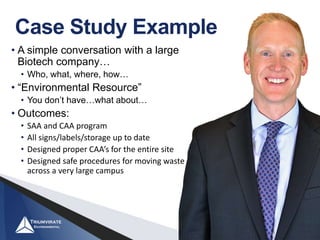
Case Study Example
• A simple conversation with a large
Biotech company…
• Who, what, where, how…
• “Environmental Resource”
• You don’t have…what about…
• Outcomes:
• SAA and CAA program
• All signs/labels/storage up to date
• Designed proper CAA’s for the entire site
• Designed safe procedures for moving waste
across a very large campus
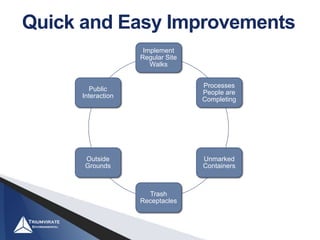
Quick and Easy Improvements
Implement
Regular Site
Walks
Processes
People are
Completing
Unmarked
Containers
Trash
Receptacles
Outside
Grounds
Public
Interaction
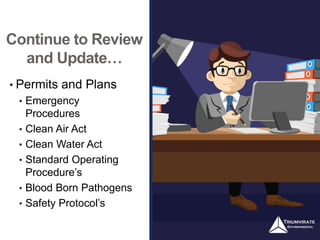
Continue to Review
and Update…
• Permits and Plans
• Emergency
Procedures
• Clean Air Act
• Clean Water Act
• Standard Operating
Procedure’s
• Blood Born Pathogens
• Safety Protocol’s
Agencies and Regulations
to Consider
Case Study
• You get an unexpected
call from your…
• Local State Agency
• Coming in to inspect
tomorrow and want to
review the previous
inspection
• Let’s check
• Main Accumulation
Storage Area’s
• Satellite Accumulation
Area’s
• Paperwork for disposal
• Sewer discharge permit
• Air permits (generators)
Case Study
• Outcomes from a smaller
community based
company
• Chance to follow up with
over generating of waste
from a 3 month period
(refile, make clear, report
when project was
completed)
• Updated and documented
some SAA issues (very
common)
• Buttoned up and cleaned
up Universal Waste area
• Scheduled work and follow
up with missing discharge
sampling reports
Case Study 3: Onsite Program
1) When an onsite program is in place
1) Up to date with your program
2) Feel confident about inspection (Still initial
shock)
3) Focus on what needs to be done
2) Passed inspection!
3) 180 degree change from years prior
1) Minor issues found
2) Everything documented and fixed before
follow up
3) Learned for the future
Case Study 3: Outcomes
Outcomes
Passed inspection!
Know your local state agency representative
A chance to impress this person
Follow up items included
• Fixing some SAA’s
• Adjusting CAA storage arrangement to
better communicate hazards
• Posting extra signs in the CAA
• Making a plan to fix a generator and
emissions issue
Helpful Tip
Be honest with
yourself!
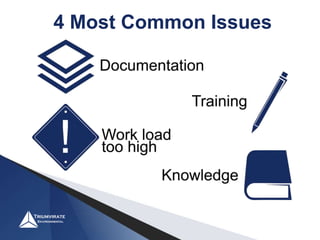
4 Most Common Issues
Summary
Find the Gaps
The Budget
Immediate Tactics
Action Plan
Observe and make changes to
some immediate issues that
improves your program
Take the survey
Reach out for more resources when
you hit a roadblock
Do you need some sort of
customized Onsite Support
Program?
Fully Integrated Onsite Support Program
1) Why is Triumvirate efficient, effective
and innovative?
2) What makes our people unique and
top notch?
3) Why we make the biggest
difference as a partner in your
compliance world.
Want to dig deeper into Triumvirate’s Fully
Integrated Onsite Program Opportunities?
Question
and
Answer?
Thank You For Attending!
• You will receive an email
tomorrow with a copy of
this presentation
• Please complete our
short survey
• Register for future
webinars at
http://www.triumvirate.co
m/training/events
• Expect a transcribed copy
of the Q&A as well as a
special offer.

Gap Analysis & Improvement Tactics for Your EH&S Program

  • 1.
    Gap Analysis & ImprovementTactics for your EH&S program Onsite Support Service: What do you need help with to stay in compliance?
  • 2.
  • 3.
    1. All linesare muted, use the chat panel for tech issues. 2. Unanswered questions will be answered on Twitter after the webinar. 3. Webinar recording and slides will be emailed to you tomorrow morning. Share With the Audience
  • 4.
    Meet Your Presenter MikeAlbert Onsite Support Services Manager, New England malbert@triumvirate.com www.linkedin.com/in/michaelalbert1 • Triumvirate for 6 ½ years • Completed multiple gap analysis for different size sites • Manage multiple onsite teams at large and small Institutions • Insight through EH&S programs • Program growth through knowledge in EPA and state agencies • Leader and Inovative services manager for Triumvirate’s Onsite Support Programs
  • 5.
    Triumvirate’s helpful hintsto knowing your program better. Gap Analysis and Improvement Tactics. Understand compliance; save time and money.
  • 6.
    Our Key Message Itis great to know your strengths, but it is better to know your weakness… and then fix them!
  • 7.
    What Will YouLearn? What can this analysis offer for my company? I think I am doing great! Why do I need this? Top Talent = Top Results If there is something I am missing, is it hard to fix?
  • 8.
    How many timesdo you run into a roadblock and need external sources to help you out? 1) Never – I can do it myself 2) 1-2 times a month 3) 1-2 times a week 4) Daily 5) All the time
  • 9.
  • 10.
    Overview Find the Gaps TheBudget Immediate Tactics
  • 11.
    Where do Istand? Find the Gaps The Budget Immediate Tactics
  • 12.
    Start With theBasics • What do I currently do to stay in compliance? • Who does it? • How is it documented? • How often do I check it make sure it is done? • Is there a reminder that can be used? • Does it need to be done?
  • 13.
    Common Program Gaps Waste Inventory Permits Safetyof People’s Environment Emergency Response and Contingency Plan
  • 14.
    Common Compliance Gaps Waste Inventory Permits Safetyof People’s Environment Emergency Response and Contingency Plan
  • 15.
    Helpful Tip Actually lookat all documents that you need, don’t assume they exist because you think or were told…
  • 16.
    Other Common Issues Reactiveor Proactive Team or White Knight Given a sinking ship? Given an aircraft carrier? Who do you call?
  • 17.
    The Budget Find theGaps The Budget Immediate Tactics
  • 18.
    It does cost moneyto be in compliance but it doesn’t have to break the bank
  • 19.
    Safety of People’s Environment •Time and effort to assess all potentially dangerous environments • ‘Exposure’ • Overall safety and security of the site • Equipment or Engineering control failure • Proper Administrative and PPE compliance
  • 20.
    Costs of Plansand Permits • Time, effort = $ or $$$ • Knowledge and Experience • Costs for submittals, renewals • Full understanding of site Helpful tip – proving by experience or knowledge from a fellow experience will help get ‘smaller’ numbers passed through the budget
  • 21.
    Cost of Inventory,Waste and Compliance Inventory costs money to complete What comes in must go out HAP report
  • 22.
    Other Cost Factors •Size of your institution or site • What is in place already • What you need to know more about • How often you scratch your head and wonder, what if…
  • 23.
    Cost Savings Witha Strong Program Fines and newspaper articles hurt more: • The U.S. EPA, the U.S. Department of Justice, and the State of Ohio a Clean Water Act settlement…to resolve claims that untreated sewer discharges were released into the Ottawa River during wet weather. • The U.S. EPA announced a West Virginia- based metal recycler, has agreed to implement extensive, company-wide safeguards to prevent future accidental releases of hazardous chemicals from its facilities, resolving alleged Clean Air Act violations (CAA) stemming from an explosion at the company’s W. Va. facility that killed three people. • Fined $205,000 for Hazardous Waste Violations
  • 24.
    Immediate Tactics toHelp Solve Problems Find the Gaps The Budget Immediate Tactics
  • 25.
    Case Study Example •A simple conversation with a large Biotech company… • Who, what, where, how… • “Environmental Resource” • You don’t have…what about… • Outcomes: • SAA and CAA program • All signs/labels/storage up to date • Designed proper CAA’s for the entire site • Designed safe procedures for moving waste across a very large campus
  • 26.
    Quick and EasyImprovements Implement Regular Site Walks Processes People are Completing Unmarked Containers Trash Receptacles Outside Grounds Public Interaction
  • 27.
    Continue to Review andUpdate… • Permits and Plans • Emergency Procedures • Clean Air Act • Clean Water Act • Standard Operating Procedure’s • Blood Born Pathogens • Safety Protocol’s
  • 28.
  • 29.
    Case Study • Youget an unexpected call from your… • Local State Agency • Coming in to inspect tomorrow and want to review the previous inspection • Let’s check • Main Accumulation Storage Area’s • Satellite Accumulation Area’s • Paperwork for disposal • Sewer discharge permit • Air permits (generators)
  • 30.
    Case Study • Outcomesfrom a smaller community based company • Chance to follow up with over generating of waste from a 3 month period (refile, make clear, report when project was completed) • Updated and documented some SAA issues (very common) • Buttoned up and cleaned up Universal Waste area • Scheduled work and follow up with missing discharge sampling reports
  • 31.
    Case Study 3:Onsite Program 1) When an onsite program is in place 1) Up to date with your program 2) Feel confident about inspection (Still initial shock) 3) Focus on what needs to be done 2) Passed inspection! 3) 180 degree change from years prior 1) Minor issues found 2) Everything documented and fixed before follow up 3) Learned for the future
  • 32.
    Case Study 3:Outcomes Outcomes Passed inspection! Know your local state agency representative A chance to impress this person Follow up items included • Fixing some SAA’s • Adjusting CAA storage arrangement to better communicate hazards • Posting extra signs in the CAA • Making a plan to fix a generator and emissions issue
  • 33.
    Helpful Tip Be honestwith yourself!
  • 34.
  • 35.
    Summary Find the Gaps TheBudget Immediate Tactics
  • 36.
    Action Plan Observe andmake changes to some immediate issues that improves your program Take the survey Reach out for more resources when you hit a roadblock Do you need some sort of customized Onsite Support Program?
  • 37.
    Fully Integrated OnsiteSupport Program 1) Why is Triumvirate efficient, effective and innovative? 2) What makes our people unique and top notch? 3) Why we make the biggest difference as a partner in your compliance world. Want to dig deeper into Triumvirate’s Fully Integrated Onsite Program Opportunities?
  • 38.
  • 39.
    Thank You ForAttending! • You will receive an email tomorrow with a copy of this presentation • Please complete our short survey • Register for future webinars at http://www.triumvirate.co m/training/events • Expect a transcribed copy of the Q&A as well as a special offer.

Editor's Notes

  • #4 Lisa All lines are muted, use the chat panel for tech issues. Q&A at the end, tweet questions using #EventsRule Unanswered questions will be answered on Twitter after the webinar. Webinar recording and slides will be emailed to you tomorrow morning.
  • #6 Programs are good and bad Some ‘perfect’ programs do have small gaps Some good case studies Good take home advise Couple quick examples of what you can do now to analyze what is out there on your site. Stress this is an overview Light assessment of some common errors found – not all encompassing information
  • #8 Start-Up EH&S Programs New to the Environmental business? Have some concerns or don’t know where to start? Need resources to get you off the ground? Small EH&S Programs Need some extra help? Don’t have to much money to spend on the service? Large EH&S Programs Need extra help? Need to consolidate resources and potentially outsource? Need a specific expertise? What you need to do & When you need to do it!
  • #9 Via – consultant, friend, groups outside your organization Are you lucky enough to have all the resources at your finger tips Do other constraints come into play when you need more information and updated resources?
  • #11 How to complete a basis Gap Analysis to identify issues. Where does the budget stand to do this type of work? What can I do right now to change the program & can I bring in some resources to fix them
  • #13 What are the normal actions I do to stay in compliance? Completing permits, collecting waste, handling virgin stock material, assessing different research, clinical, or general lab space. Am I doing the work? Is a team doing the work? Do I have any way to complete it? Documentation is 90% of the game to prove something is done and how it is done. Do you have a calendar in place? Is it an excel spreadsheet, word document, in my super massive brain capacity? What prompts me to do the tasks? Reminder through e-mail, the feel of the weather, changing of the clocks or is it unfortunately inspection by inspection (reactionary and not pro-active) Am I doing enough? Am I doing too much? (Who does too much?) are my resources where they need to be?
  • #14 Original slide: Emergency Response and Contingency Plan Trained personnel Updated plan Safety of People’s Environment Documentation of incidents or SOP’s for prevention Permits - up to date? Accurate? Need revising? Air, Water, etc. Inventory - per OSHA and the Hazard Compliance Standard. Active? Inactive? Do you have an inventory of all chemicals onsite per OSHA (HCS) Waste -municipal trash, recyclables, chemicals, biologicals, etc. Shipping off-site, drain disposal, etc.
  • #15 Eyewash, safety shower, fume hoods, fire extinguishers Original Slide 2) What is out of compliance? Emergency Response and Contingency Plan Training and correct equipment Plan accurate? Safety of People’s Environment Can I prevent something before it happens Always reactive? Permits Renew schedule? Process change? Inventory Exist? Written on 1987 excel? Paper copy? Waste Know all waste areas? Process change? Paperwork
  • #16 Kid – immunization records accurate? Pull the records! IRS – make sure you are accurate, have the documents with you! Permits – up to date? Accurate? Need revising? Inventory – per OSHA and the Hazard Compliance Standard. Active? Inactive? Waste – municipal trash, recyclables, chemicals, biologicals, etc.
  • #17 Contantly reacting to problem? You ‘the Man or Woman’ onsite determining all these outcomes? Walk in to a situation that is completely out of control To diverse, to many hands in the pot? The person before you didn’t do much? Person before you thought they were doing the right thing? Walked into a great program and wondering what else can be done? Not Ghostbusters! But the EnvironmentalBusters!
  • #19 Many people could say you need a team of 2, 5, 10 to run programs. Assessment is first tool success. Don’t over-hire-over commit right of the back Don’t go out and get all the latest and greatest yet (know that it is the DOT regulating the Shipping industry that until now, 2015, have they not really dug into e-manifesting? How much paperwork is signed to get rid of waste off the site?) Make educated decisions behind the work and get outside help when needed BIGGEST – regulations change and get updated – remember to stay up to date!
  • #20 Correct equipment, asking the right questions, making sure all grounds are covered What was the exposure? What? How Long? Preventable? Or something new identified through new process or accident that needs to be re-evaluated? Employee safety…public safety…security camera’s, officers, follow through with plans cost money Engineering control failures will happen – how are you prepared to help? Are all of your fume hoods up-to-date with testing?
  • #21 1) 2) Knowledge is key so you know what to do and how to do it. Do you need to be an expert? No, but you need to have the basics to understand what needs to be done. 3) All permits come at a cost to receive, renew and ‘own’ over time – industry actions require specific permits ex: fume hoods – need to be in compliance with the CAA 4) Knowing your areas are key – cannot stay in the office all day, part of the job is walking the land and surveying, interacting with others.
  • #22  Fire department will give you a big smile and check mark – larger departments are better when your on their good side (fyi) BIDMC – ETO spill. Bad reaction to problem, over-reaction to problem, but lead to good follow up discussion and improvements later on Recent webinar done on inventory by Schuyler Stuart – highlights ways to do inventory Save money – less multiples of chemicals on your site, sharing, safety of flammables and more high hazard chemicals, overall decrease in needs for volumes Does the volume you ship out the only waste you produce? What about the drains? Fume hoods? HVAC systems? Others? More than one option and way for it to get out Original slide: Inventory costs money to complete Accurate inventory key for success Also can save you money What comes in must go out Accuracy of volumes Options for disposal…correct options for disposal HAP report? (Hazardous Air Pollutant) Who needs to submit and why? http://www.epa.gov/oaqps001/permits/obtain.html Definition help: http://www.epa.gov/region9/air/permit/defn.html
  • #23 Unlabeled inventory, drum, container Black smoke omitting from a stack somewhere – or weird smell?
  • #26 Who are you? What are you researching? Where are you located? How big is your industry?...can I get your phone number, slip them ours… What does this mean? Do you know about chemicals? Do you know about water discharge? We ask: Do you know about CAA and recent fines leveed within the biotech/research field you are in? Found this particular site did not have any SAA’s or MAA’s per regulation. Storage area’s yes, collecting waste yet, but up to compliance…eh not really
  • #27 Making sure you take periodic walks to know the site Pay attention to the details – design specific days around specific areas to focus on, don’t do it all at once Ask questions and inquire – don’t promise the world but have good follow up and follow through Original Slide Walk around and access your site Look, head up, smile: Unmarked containers Processes that people are doing Trash receptacles Public interaction Outside grounds Walking person…observing an area
  • #28 Making sure you take periodic walks to know the site Pay attention to the details – design specific days around specific areas to focus on, don’t do it all at once Ask questions and inquire – don’t promise the world but have good follow up and follow through
  • #30 Do you even know if you had a previous inspection? By whom and when? Did we pass? Obviously we do OK…but not great because they want to review! You would be so lucky to know this was happening. Occasionally it does (heads up) Most of the time they just show up Do you know where everything is? Could you call it up within a reasonable time-frame? This is a case where they did call the day before and inquired about a 3 month window where the waste being generated and shipped was too high (SQG) Didn’t I file a report? I thought I did…let me check…as a SQG do you know you need to file an exemption report if and when you go over your generator status? Couldn’t find anything but had enough resources to reach out immediately, figure out why it was over (project based) building gut and removal (PCB’s, lead, Asbestos) Made correct documentation, everything else looked real good and overall they found little findings elsewhere. Overall = good report What if no-phone call comes in Talk BIDMC study where a phone call came to me as a team member…more immediate, react quickly. Leads to onsite program
  • #31 Do you even know if you had a previous inspection? By whom and when? Did we pass? Obviously we do OK…but not great because they want to review! You would be so lucky to know this was happening. Occasionally it does (heads up) Most of the time they just show up Do you know where everything is? Could you call it up within a reasonable time-frame? This is a case where they did call the day before and inquired about a 3 month window where the waste being generated and shipped was too high (SQG) Didn’t I file a report? I thought I did…let me check…as a SQG do you know you need to file an exemption report if and when you go over your generator status? Couldn’t find anything but had enough resources to reach out immediately, figure out why it was over (project based) building gut and removal (PCB’s, lead, Asbestos) Made correct documentation, everything else looked real good and overall they found little findings elsewhere. Overall = good report What if no-phone call comes in Talk BIDMC study where a phone call came to me as a team member…more immediate, react quickly. Leads to onsite program
  • #32 Not only stay in compliance but regularly service Always have shock (Reference EPA call actually DEP) Understand what can and will happen during an inspection Move quickly to check out what needs to done, where will they go first – tidy up or help out with something immediate In this case we had people on 5 days a week for 40 hours…lots of resources – call to me, call to my office, call to others to help… More resources the better – onsite program constantly keeps people in the loop and up to date Some time or a lot of time? How often? More of a support vs. onsite time? What level of experience to do you want/need? Customized and unique program
  • #33 Not only stay in compliance but regularly service Always have shock (Reference EPA call actually DEP) Understand what can and will happen during an inspection Move quickly to check out what needs to done, where will they go first – tidy up or help out with something immediate In this case we had people on 5 days a week for 40 hours…lots of resources – call to me, call to my office, call to others to help… More resources the better – onsite program constantly keeps people in the loop and up to date Some time or a lot of time? How often? More of a support vs. onsite time? What level of experience to do you want/need? Customized and unique program
  • #35 Permits, manifests, SOP’s Training of you and others around you Too much work? We all have it but does it hinder your chances to stay in compliance Background knowledge of 20 years? Just out of school? Need more training and resources? Know where to start?
  • #38 Not one type of program will fit all your needs. Fine tune what resources you need and when you need them Larger places may need people on site every day Smaller places may need a person who shows up 1xmonth Do you need help with permits, sampling, program writing, OSHA work? Waste pick-ups, inspections, BBP’s