Four Key Elements To
Strengthen Your Hazardous
Waste Management Program
Make Your Organization More Sustainable!
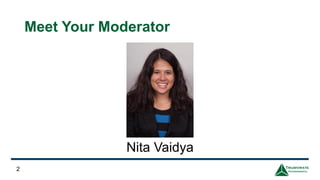
Meet Your Moderator
2
Nita Vaidya
3
During this Webinar
✓ All lines will be muted.
✓ Communicate via the questions tab in your webinar panel.
✓ Unanswered questions will be responded to personally after
the webinar.
✓ Webinar recording and slides will be emailed to you
tomorrow.
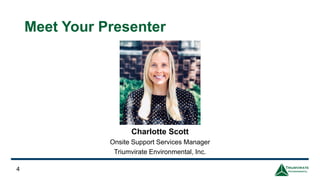
Charlotte Scott
Onsite Support Services Manager
Triumvirate Environmental, Inc.
4
Meet Your Presenter
1. Lifecycle of Hazardous Materials
2. Compliance – Keep The Doors Open!
3. Safety & Security Procedures
4. Sustainability & Proactivity
Summary / Q&A
5
Agenda
6
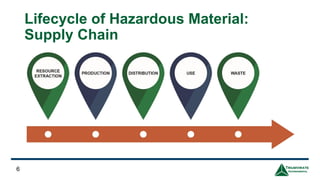
Lifecycle of Hazardous Material:
Supply Chain
7
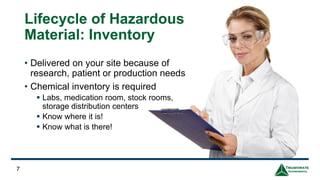
Lifecycle of Hazardous
Material: Inventory
• Delivered on your site because of
research, patient or production needs
• Chemical inventory is required
▪ Labs, medication room, stock rooms,
storage distribution centers
▪ Know where it is!
▪ Know what is there!
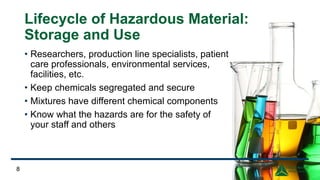
Lifecycle of Hazardous Material:
Storage and Use
• Researchers, production line specialists, patient
care professionals, environmental services,
facilities, etc.
• Keep chemicals segregated and secure
• Mixtures have different chemical components
• Know what the hazards are for the safety of
your staff and others
88
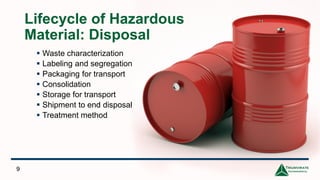
Lifecycle of Hazardous
Material: Disposal
▪ Waste characterization
▪ Labeling and segregation
▪ Packaging for transport
▪ Consolidation
▪ Storage for transport
▪ Shipment to end disposal
▪ Treatment method
99
Poll Question
Do you feel confident you
have control over what
hazardous materials enter
your site on a day-to-day
basis?
10
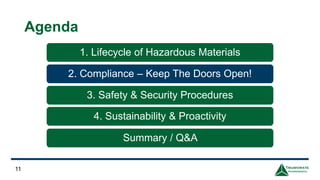
1. Lifecycle of Hazardous Materials
2. Compliance – Keep The Doors Open!
3. Safety & Security Procedures
4. Sustainability & Proactivity
Summary / Q&A
11
Agenda
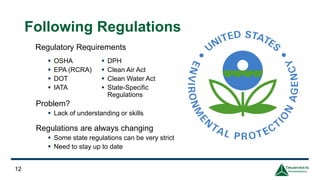
Regulatory Requirements
12
Regulations are always changing
▪ Some state regulations can be very strict
▪ Need to stay up to date
▪ DPH
▪ Clean Air Act
▪ Clean Water Act
▪ State-Specific
Regulations
▪ OSHA
▪ EPA (RCRA)
▪ DOT
▪ IATA
Problem?
▪ Lack of understanding or skills
Following Regulations
13
Compliance Inspections/
Assessments
• Types of inspections dependent
on hazardous materials
▪ Main Accumulation Areas
▪ Satellite Accumulation Areas (state-
specific)
▪ Other Wastes
- Universal
- Biological
- Radiological
▪ Chemical storage
▪ Lab Audits
▪ Contingency Plan Requirements
▪ Mechanical spaces
14
Compliance Completion
• How do you tackle this work?
▪ Internal vs external
• Many elite programs have help!
▪ Specialized labor
▪ Struggle to keep organization due to
outside costs
▪ This is usually not your only job!
15
Elite Compliance
• What is an Elite Compliance Program?
▪ Full understanding of environmental impacts
of an industry
▪ Complex knowledge of chemical inventories
• Number 1 Priority for an Elite Program
▪ Understand what makes a complete
program
- Regulations and responsibilities
- Document control
• Continued Costs
▪ Updated trainings
▪ Consistent monitoring
▪ Ongoing maintenance
Do you feel confident that
you would be able to pass a
hazardous waste regulatory
inspection?
16
Poll Question
1. Lifecycle of Hazardous Materials
2. Compliance – Keep The Doors Open!
3. Safety & Security Procedures
4. Sustainability & Proactivity
Summary / Q&A
17
Agenda
18
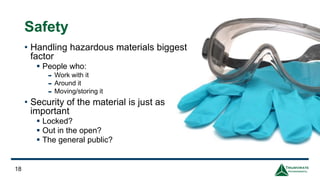
Safety
• Handling hazardous materials biggest
factor
▪ People who:
- Work with it
- Around it
- Moving/storing it
• Security of the material is just as
important
▪ Locked?
▪ Out in the open?
▪ The general public?
19
Emergency Response
• Are you ready?
• Who do you call?
• Who is trained onsite?
• What can you do to make sure this
system is set up?
• Response needed
▪ Safe
▪ Efficient
▪ Accurate
▪ Consistent
20
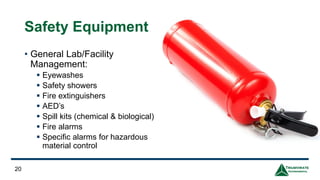
Safety Equipment
• General Lab/Facility
Management:
▪ Eyewashes
▪ Safety showers
▪ Fire extinguishers
▪ AED’s
▪ Spill kits (chemical & biological)
▪ Fire alarms
▪ Specific alarms for hazardous
material control
1. Lifecycle of Hazardous Materials
2. Compliance – Keep The Doors Open!
3. Safety & Security Procedures
4. Sustainability & Proactivity
Summary / Q&A
21
Agenda
22
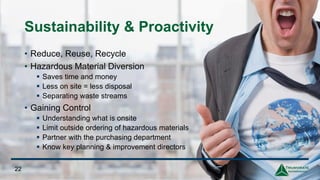
Sustainability & Proactivity
• Reduce, Reuse, Recycle
• Hazardous Material Diversion
▪ Saves time and money
▪ Less on site = less disposal
▪ Separating waste streams
• Gaining Control
▪ Understanding what is onsite
▪ Limit outside ordering of hazardous materials
▪ Partner with the purchasing department
▪ Know key planning & improvement directors
23
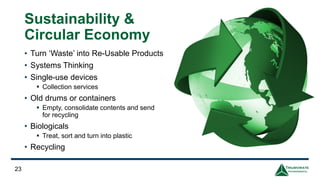
Sustainability &
Circular Economy
• Turn ‘Waste’ into Re-Usable Products
• Systems Thinking
• Single-use devices
▪ Collection services
• Old drums or containers
▪ Empty, consolidate contents and send
for recycling
• Biologicals
▪ Treat, sort and turn into plastic
• Recycling
24
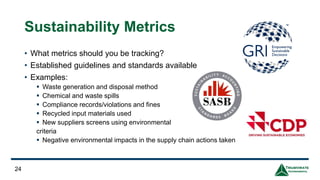
Sustainability Metrics
• What metrics should you be tracking?
• Established guidelines and standards available
• Examples:
▪ Waste generation and disposal method
▪ Chemical and waste spills
▪ Compliance records/violations and fines
▪ Recycled input materials used
▪ New suppliers screens using environmental
criteria
▪ Negative environmental impacts in the supply chain actions taken
1. Lifecycle of Hazardous Materials
2. Compliance – Keep The Doors Open!
3. Safety & Security Procedures
4. Sustainability & Proactivity
Summary / Q&A
25
Agenda
26
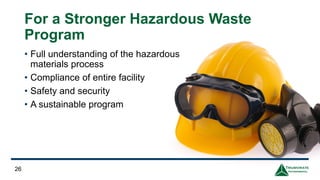
For a Stronger Hazardous Waste
Program
• Full understanding of the hazardous
materials process
• Compliance of entire facility
• Safety and security
• A sustainable program
27
Elite Programs are Necessary
for Success
• Workload too high?
• Too much training to worry about keeping staff
up-to-date?
• Documentation too complex for a small staff?
• Not your main focus?
• Consider external support for added value
success
▪ Add expertise
▪ Add time to your work day
▪ Rely on experts
THANK YOU!
Request a Free Onsite
Services Strategy Session:
http://info.triumvirate.com/free-onsite-services-strategy-session
Charlotte Scott: cscott@triumvirate.com

Four Elements to Strengthen Your Hazardous Waste Management Program

  • 1.
    Four Key ElementsTo Strengthen Your Hazardous Waste Management Program Make Your Organization More Sustainable!
  • 2.
  • 3.
    3 During this Webinar ✓All lines will be muted. ✓ Communicate via the questions tab in your webinar panel. ✓ Unanswered questions will be responded to personally after the webinar. ✓ Webinar recording and slides will be emailed to you tomorrow.
  • 4.
    Charlotte Scott Onsite SupportServices Manager Triumvirate Environmental, Inc. 4 Meet Your Presenter
  • 5.
    1. Lifecycle ofHazardous Materials 2. Compliance – Keep The Doors Open! 3. Safety & Security Procedures 4. Sustainability & Proactivity Summary / Q&A 5 Agenda
  • 6.
    6 Lifecycle of HazardousMaterial: Supply Chain
  • 7.
    7 Lifecycle of Hazardous Material:Inventory • Delivered on your site because of research, patient or production needs • Chemical inventory is required ▪ Labs, medication room, stock rooms, storage distribution centers ▪ Know where it is! ▪ Know what is there!
  • 8.
    Lifecycle of HazardousMaterial: Storage and Use • Researchers, production line specialists, patient care professionals, environmental services, facilities, etc. • Keep chemicals segregated and secure • Mixtures have different chemical components • Know what the hazards are for the safety of your staff and others 88
  • 9.
    Lifecycle of Hazardous Material:Disposal ▪ Waste characterization ▪ Labeling and segregation ▪ Packaging for transport ▪ Consolidation ▪ Storage for transport ▪ Shipment to end disposal ▪ Treatment method 99
  • 10.
    Poll Question Do youfeel confident you have control over what hazardous materials enter your site on a day-to-day basis? 10
  • 11.
    1. Lifecycle ofHazardous Materials 2. Compliance – Keep The Doors Open! 3. Safety & Security Procedures 4. Sustainability & Proactivity Summary / Q&A 11 Agenda
  • 12.
    Regulatory Requirements 12 Regulations arealways changing ▪ Some state regulations can be very strict ▪ Need to stay up to date ▪ DPH ▪ Clean Air Act ▪ Clean Water Act ▪ State-Specific Regulations ▪ OSHA ▪ EPA (RCRA) ▪ DOT ▪ IATA Problem? ▪ Lack of understanding or skills Following Regulations
  • 13.
    13 Compliance Inspections/ Assessments • Typesof inspections dependent on hazardous materials ▪ Main Accumulation Areas ▪ Satellite Accumulation Areas (state- specific) ▪ Other Wastes - Universal - Biological - Radiological ▪ Chemical storage ▪ Lab Audits ▪ Contingency Plan Requirements ▪ Mechanical spaces
  • 14.
    14 Compliance Completion • Howdo you tackle this work? ▪ Internal vs external • Many elite programs have help! ▪ Specialized labor ▪ Struggle to keep organization due to outside costs ▪ This is usually not your only job!
  • 15.
    15 Elite Compliance • Whatis an Elite Compliance Program? ▪ Full understanding of environmental impacts of an industry ▪ Complex knowledge of chemical inventories • Number 1 Priority for an Elite Program ▪ Understand what makes a complete program - Regulations and responsibilities - Document control • Continued Costs ▪ Updated trainings ▪ Consistent monitoring ▪ Ongoing maintenance
  • 16.
    Do you feelconfident that you would be able to pass a hazardous waste regulatory inspection? 16 Poll Question
  • 17.
    1. Lifecycle ofHazardous Materials 2. Compliance – Keep The Doors Open! 3. Safety & Security Procedures 4. Sustainability & Proactivity Summary / Q&A 17 Agenda
  • 18.
    18 Safety • Handling hazardousmaterials biggest factor ▪ People who: - Work with it - Around it - Moving/storing it • Security of the material is just as important ▪ Locked? ▪ Out in the open? ▪ The general public?
  • 19.
    19 Emergency Response • Areyou ready? • Who do you call? • Who is trained onsite? • What can you do to make sure this system is set up? • Response needed ▪ Safe ▪ Efficient ▪ Accurate ▪ Consistent
  • 20.
    20 Safety Equipment • GeneralLab/Facility Management: ▪ Eyewashes ▪ Safety showers ▪ Fire extinguishers ▪ AED’s ▪ Spill kits (chemical & biological) ▪ Fire alarms ▪ Specific alarms for hazardous material control
  • 21.
    1. Lifecycle ofHazardous Materials 2. Compliance – Keep The Doors Open! 3. Safety & Security Procedures 4. Sustainability & Proactivity Summary / Q&A 21 Agenda
  • 22.
    22 Sustainability & Proactivity •Reduce, Reuse, Recycle • Hazardous Material Diversion ▪ Saves time and money ▪ Less on site = less disposal ▪ Separating waste streams • Gaining Control ▪ Understanding what is onsite ▪ Limit outside ordering of hazardous materials ▪ Partner with the purchasing department ▪ Know key planning & improvement directors
  • 23.
    23 Sustainability & Circular Economy •Turn ‘Waste’ into Re-Usable Products • Systems Thinking • Single-use devices ▪ Collection services • Old drums or containers ▪ Empty, consolidate contents and send for recycling • Biologicals ▪ Treat, sort and turn into plastic • Recycling
  • 24.
    24 Sustainability Metrics • Whatmetrics should you be tracking? • Established guidelines and standards available • Examples: ▪ Waste generation and disposal method ▪ Chemical and waste spills ▪ Compliance records/violations and fines ▪ Recycled input materials used ▪ New suppliers screens using environmental criteria ▪ Negative environmental impacts in the supply chain actions taken
  • 25.
    1. Lifecycle ofHazardous Materials 2. Compliance – Keep The Doors Open! 3. Safety & Security Procedures 4. Sustainability & Proactivity Summary / Q&A 25 Agenda
  • 26.
    26 For a StrongerHazardous Waste Program • Full understanding of the hazardous materials process • Compliance of entire facility • Safety and security • A sustainable program
  • 27.
    27 Elite Programs areNecessary for Success • Workload too high? • Too much training to worry about keeping staff up-to-date? • Documentation too complex for a small staff? • Not your main focus? • Consider external support for added value success ▪ Add expertise ▪ Add time to your work day ▪ Rely on experts
  • 28.
    THANK YOU! Request aFree Onsite Services Strategy Session: http://info.triumvirate.com/free-onsite-services-strategy-session Charlotte Scott: cscott@triumvirate.com